

Targeting of M2-like tumor-associated macrophages with a melittin-based pro-apoptotic peptide
Open accessThe DOI matches its Crossref record; 51 of the 52 references it cites were found in a registry or an index.
Abstract
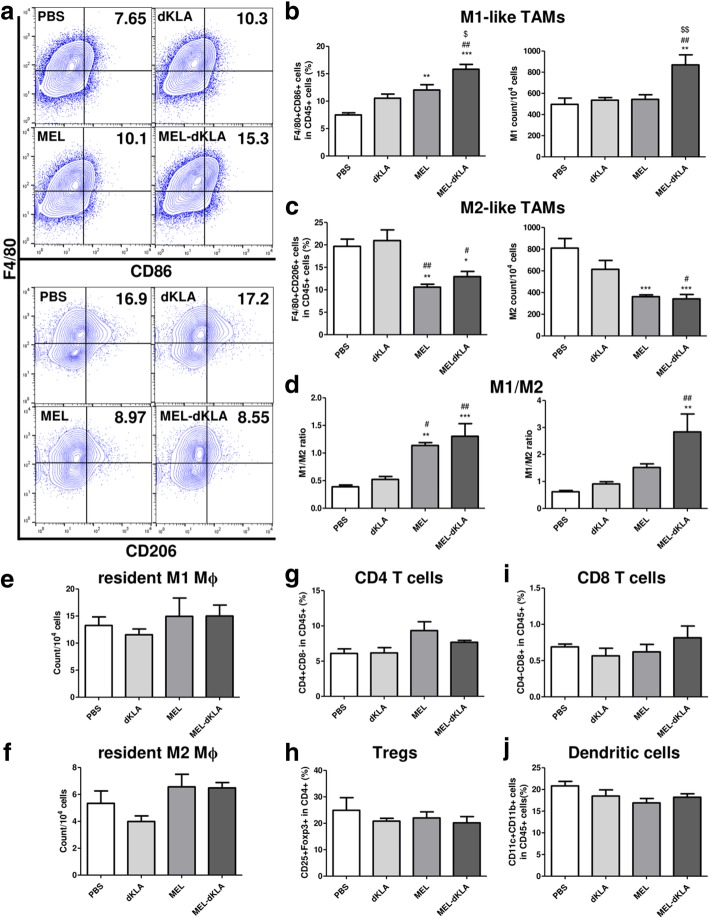
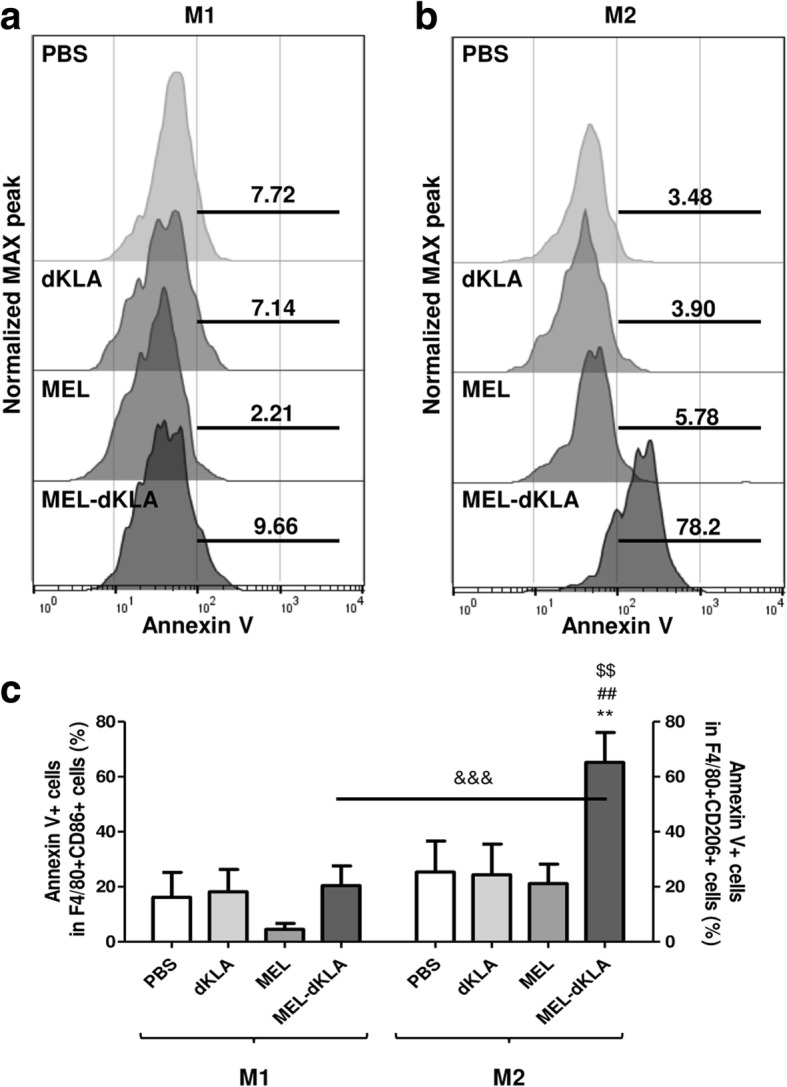
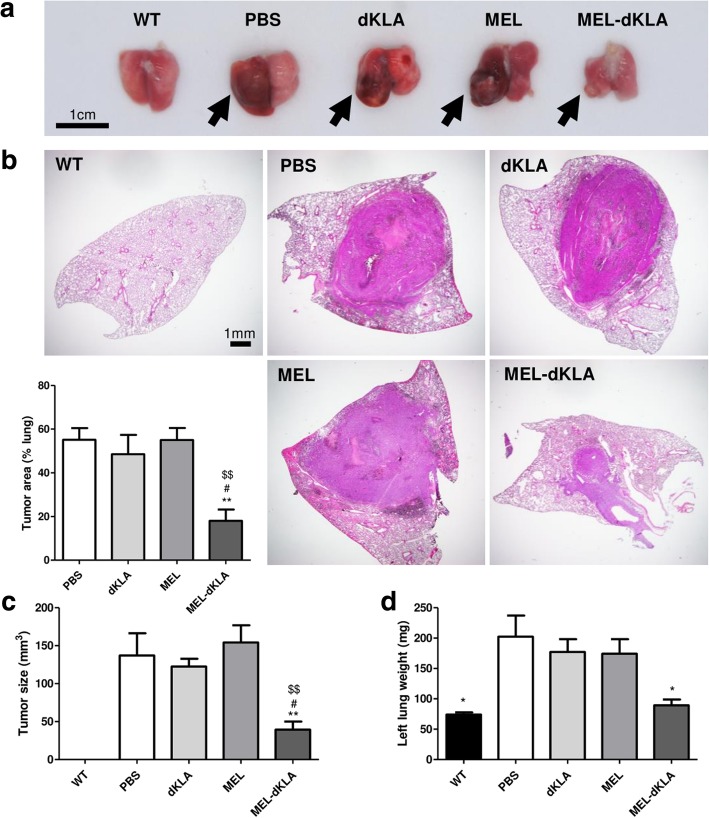
Background Tumor-associated macrophages (TAMs) are the major component of tumor-infiltrating immune cells. Macrophages are broadly categorized as M1 or M2 types, and TAMs have been shown to express an M2-like phenotype. TAMs promote tumor progression and contribute to resistance to chemotherapies. Therefore, M2-like TAMs are potential targets for the cancer immunotherapy. In this study, we targeted M2-like TAMs using a hybrid peptide, MEL-dKLA, composed of melittin (MEL), which binds preferentially to M2-like TAMs, and the pro-apoptotic peptide d (KLAKLAK)2 (dKLA), which induces mitochondrial death after cell membrane penetration. Methods The M1 or M2-differentiated RAW264.7 cells were used for mitochondrial colocalization and apoptosis test in vitro. For in vivo study, the murine Lewis lung carcinoma cells were inoculated subcutaneously in the right flank of mouse. The dKLA, MEL and MEL-dKLA peptides were intraperitoneally injected at 175 nmol/kg every 3 days. Flow cytometry analysis of tumor-associated macrophages and immunofluorescence staining were performed to investigate the immunotherapeutic effects of MEL-dKLA. Results We showed that MEL-dKLA induced selective cell death of M2 macrophages in vitro, whereas MEL did not disrupt the mitochondrial membrane. We also showed that MEL-dKLA selectively targeted M2-like TAMs without affecting other leukocytes, such as T cells and dendritic cells, in vivo. These features resulted in lower tumor growth rates, tumor weights, and angiogenesis in vivo. Importantly, although both MEL and MEL-dKLA reduced numbers of CD206+ M2-like TAMs in tumors, only MEL-dKLA induced apoptosis in CD206+ M2-like TAMs, and MEL did not induce cell death. Conclusion Taken together, our study demonstrated that MEL-dKLA could be used to target M2-like TAMs as a promising cancer therapeutic agent.
Overview
The claims and statistics of this paper haven’t been checked yet.
Free: it reads the open-access text and checks the first 5 claims that cite a source we can check. Create a free account to check every claim.
Integrity signals
Registry
Cites
Statistics
Figures
Verification
Claims the paper makes
The claims and statistics of this paper haven’t been checked yet.
Free: it reads the open-access text and checks the first 5 claims that cite a source we can check. Create a free account to check every claim.
Claims other papers make about this one
Each is checked against this paper’s own text: does it say what the citing paper says it does?
The source backs part of the claim, not all of it — or backs it for a different population, condition or comparison.
In the citing paper
“In turn, TAMs promote angiogenesis [by releasing vascular endothelial growth factor (VEGF) and interleukin (IL)-8] and ECM remodeling (via MMP production) [49].”
From 3D In Vitro Model (R)evolution: Unveiling Tumor–Stroma Interactions (2021) · cites this paper as [49]
Experimental — accuracy not yet measuredThe source backs part of the claim, not all of it — or backs it for a different population, condition or comparison.
In the citing paper
“In turn, TAMs promote angiogenesis [by releasing vascular endothelial growth factor (VEGF) and interleukin (IL)-8] and ECM remodeling (via MMP production) [49].”
From 3D In Vitro Model (R)evolution: Unveiling Tumor–Stroma Interactions (2021) · cites this paper as [49]
Experimental — accuracy not yet measured
Self-check
Percentages, sums and reported differences re-computed from the paper’s own numbers.
The self-check needs the paper’s full text.
Citations
Cites
Exploring the full spectrum of macrophage activation
Mosser, D. M., & Edwards, J. P. (2008) · Nature Reviews Immunology · doi:10.1038/nri2448 · Cited by 9,144
Alternative activation of macrophages
Gordon, S. (2003) · Nature Reviews Immunology · doi:10.1038/nri978 · Cited by 6,189
MANTOVANI, A., SOZZANI, S., LOCATI, M., ALLAVENA, P., & SICA, A. (2002) · Trends in Immunology · doi:10.1016/s1471-4906(02)02302-5 · Cited by 5,528
Monocyte and macrophage heterogeneity
Gordon, S., & Taylor, P. R. (2005) · Nature Reviews Immunology · doi:10.1038/nri1733 · Cited by 5,190
Macrophage Diversity Enhances Tumor Progression and Metastasis
Qian, B.-Z., & Pollard, J. W. (2010) · Cell · doi:10.1016/j.cell.2010.03.014 · Cited by 5,188
Fate Mapping Reveals Origins and Dynamics of Monocytes and Tissue Macrophages under Homeostasis
Yona, S., Kim, K.-W., Wolf, Y., Mildner, A., Varol, D., Breker, M., Strauss-Ayali, D., Viukov, S., Guilliams, M., Misharin, A., et al. (2013) · Immunity · doi:10.1016/j.immuni.2012.12.001 · Cited by 3,245
Immune-related adverse events with immune checkpoint blockade: a comprehensive review
Michot, J. M., Bigenwald, C., Champiat, S., Collins, M., Carbonnel, F., Postel-Vinay, S., Berdelou, A., Varga, A., Bahleda, R., Hollebecque, A., et al. (2016) · European Journal of Cancer · doi:10.1016/j.ejca.2015.11.016 · Cited by 2,127
Understanding the Mysterious M2 Macrophage through Activation Markers and Effector Mechanisms
Rőszer, T. (2015) · Mediators of Inflammation · doi:10.1155/2015/816460 · Cited by 1,762
DeNardo, D. G., Brennan, D. J., Rexhepaj, E., Ruffell, B., Shiao, S. L., Madden, S. F., Gallagher, W. M., Wadhwani, N., Keil, S. D., Junaid, S. A., et al. (2011) · Cancer Discovery · doi:10.1158/2159-8274.cd-10-0028 · Cited by 1,715
Macrophages, innate immunity and cancer: balance, tolerance, and diversity
Mantovani, A., & Sica, A. (2010) · Current Opinion in Immunology · doi:10.1016/j.coi.2010.01.009 · Cited by 1,484
Sica, A., Schioppa, T., Mantovani, A., & Allavena, P. (2006) · European Journal of Cancer · doi:10.1016/j.ejca.2006.01.003 · Cited by 1,451
Zhu, Y., Knolhoff, B. L., Meyer, M. A., Nywening, T. M., West, B. L., Luo, J., Wang-Gillam, A., Goedegebuure, S. P., Linehan, D. C., & DeNardo, D. G. (2014) · Cancer Research · doi:10.1158/0008-5472.can-13-3723 · Cited by 1,324
Wyckoff, J., Wang, W., Lin, E. Y., Wang, Y., Pixley, F., Stanley, E. R., Graf, T., Pollard, J. W., Segall, J., & Condeelis, J. (2004) · Cancer Research · doi:10.1158/0008-5472.can-04-1449 · Cited by 1,188
Anti-cancer activity of targeted pro-apoptotic peptides
Ellerby, H. M., Arap, W., Ellerby, L. M., Kain, R., Andrusiak, R., Rio, G. D., Krajewski, S., Lombardo, C. R., Rao, R., Ruoslahti, E., et al. (1999) · Nature Medicine · doi:10.1038/12469 · Cited by 936
Role of tumor-associated macrophages in tumor progression and invasion
Mantovani, A., Schioppa, T., Porta, C., Allavena, P., & Sica, A. (2006) · Cancer and Metastasis Reviews · doi:10.1007/s10555-006-9001-7 · Cited by 888 · cited 1×
“phages that are differentiated by the tumor microenvironment [9, 10].”
BackgroundMacrophage activation and its role in repair and pathology after spinal cord injury
Gensel, J. C., & Zhang, B. (2015) · Brain Research · doi:10.1016/j.brainres.2014.12.045 · Cited by 771
Arlauckas, S. P., Garris, C. S., Kohler, R. H., Kitaoka, M., Cuccarese, M. F., Yang, K. S., Miller, M. A., Carlson, J. C., Freeman, G. J., Anthony, R. M., et al. (2017) · Science Translational Medicine · doi:10.1126/scitranslmed.aal3604 · Cited by 669
Georgoudaki, A.-M., Prokopec, K. E., Boura, V. F., Hellqvist, E., Sohn, S., Östling, J., Dahan, R., Harris, R. A., Rantalainen, M., Klevebring, D., et al. (2016) · Cell Reports · doi:10.1016/j.celrep.2016.04.084 · Cited by 609
De Novo Antimicrobial Peptides with Low Mammalian Cell Toxicity
Javadpour, M. M., Juban, M. M., Lo, W.-C. J., Bishop, S. M., Alberty, J. B., Cowell, S. M., Becker, C. L., & McLaughlin, M. L. (1996) · Journal of Medicinal Chemistry · doi:10.1021/jm9509410 · Cited by 597
Clinical significance of macrophage heterogeneity in human malignant tumors
Komohara, Y., Jinushi, M., & Takeya, M. (2014) · Cancer Science · doi:10.1111/cas.12314 · Cited by 551
Perivascular M2 Macrophages Stimulate Tumor Relapse after Chemotherapy
Hughes, R., Qian, B.-Z., Rowan, C., Muthana, M., Keklikoglou, I., Olson, O. C., Tazzyman, S., Danson, S., Addison, C., Clemons, M., et al. (2015) · Cancer Research · doi:10.1158/0008-5472.can-14-3587 · Cited by 518
Nakasone, E. S., Askautrud, H. A., Kees, T., Park, J.-H., Plaks, V., Ewald, A. J., Fein, M., Rasch, M. G., Tan, Y.-X., Qiu, J., et al. (2012) · Cancer Cell · doi:10.1016/j.ccr.2012.02.017 · Cited by 478
Steggerda, S. M., Bennett, M. K., Chen, J., Emberley, E., Huang, T., Janes, J. R., Li, W., MacKinnon, A. L., Makkouk, A., Marguier, G., et al. (2017) · Journal for ImmunoTherapy of Cancer · doi:10.1186/s40425-017-0308-4 · Cited by 476
Differential expression of FIZZ1 and Ym1 in alternatively versus classically activated macrophages
Raes, G., De Baetselier, P., Noël, W., Beschin, A., Brombacher, F., & Hassanzadeh Gh., G. (2002) · Journal of Leukocyte Biology · doi:10.1189/jlb.71.4.597 · Cited by 443 · cited 1×
“M2-like TAMs [46, 47], human and mouse macrophages often share a lot of phenotypic characteristics.”
BackgroundAssessing bioenergetic function in response to oxidative stress by metabolic profiling
Dranka, B. P., Benavides, G. A., Diers, A. R., Giordano, S., Zelickson, B. R., Reily, C., Zou, L., Chatham, J. C., Hill, B. G., Zhang, J., et al. (2011) · Free Radical Biology and Medicine · doi:10.1016/j.freeradbiomed.2011.08.005 · Cited by 436
Identification and manipulation of tumor associated macrophages in human cancers
Heusinkveld, M., & van der Burg, S. H. (2011) · Journal of Translational Medicine · doi:10.1186/1479-5876-9-216 · Cited by 435
Macrophages orchestrate breast cancer early dissemination and metastasis
Linde, N., Casanova-Acebes, M., Sosa, M. S., Mortha, A., Rahman, A., Farias, E., Harper, K., Tardio, E., Reyes Torres, I., Jones, J., et al. (2018) · Nature Communications · doi:10.1038/s41467-017-02481-5 · Cited by 413
Zhang, W., Zhu, X.-D., Sun, H.-C., Xiong, Y.-Q., Zhuang, P.-Y., Xu, H.-X., Kong, L.-Q., Wang, L., Wu, W.-Z., & Tang, Z.-Y. (2010) · Clinical Cancer Research · doi:10.1158/1078-0432.ccr-09-2904 · Cited by 374
Arginase-1 and Ym1 are markers for murine, but not human, alternatively activated myeloid cells
Raes, G., Van den Bergh, R., De Baetselier, P., & Ghassabeh, G. H. (2005) · The Journal of Immunology · doi:10.4049/jimmunol.174.11.6561 · Cited by 302
All‐D‐magainin: chirality, antimicrobial activity and proteolytic resistance
(1990) · FEBS Letters · doi:10.1016/0014-5793(90)81351-n · Cited by 294 · cited 1×
“The all-D enantiomer form of amino acids was used for the KLA sequence to avoid degradation by proteases in vivo [26].”
MethodMovahedi, K., Schoonooghe, S., Laoui, D., Houbracken, I., Waelput, W., Breckpot, K., Bouwens, L., Lahoutte, T., De Baetselier, P., Raes, G., et al. (2012) · Cancer Research · doi:10.1158/0008-5472.can-11-2994 · Cited by 291
Castells, M., Thibault, B., Delord, J.-P., & Couderc, B. (2012) · International Journal of Molecular Sciences · doi:10.3390/ijms13089545 · Cited by 285
The interaction of bee melittin with lipid bilayer membranes
Dawson, C. R., Drake, A. F., Helliwell, J., & Hider, R. C. (1978) · Biochimica et Biophysica Acta (BBA) - Biomembranes · doi:10.1016/0005-2736(78)90131-1 · Cited by 254
Cailhier, J. F., Partolina, M., Vuthoori, S., Wu, S., Ko, K., Watson, S., Savill, J., Hughes, J., & Lang, R. A. (2005) · The Journal of Immunology · doi:10.4049/jimmunol.174.4.2336 · Cited by 247
A proapoptotic peptide for the treatment of solid tumors.
Mai, J., Mi, Z., Kim, S.-H., Ng, B., & Robbins, P. D. (2001) · PubMed · Cited by 247
Labeling Mitochondria with MitoTracker Dyes
Chazotte, B. (2011) · Cold Spring Harbor Protocols · doi:10.1101/pdb.prot5648 · Cited by 212
Zhang, B., Yao, G., Zhang, Y., Gao, J., Yang, B., Rao, Z., & Gao, J. (2011) · Clinics · doi:10.1590/s1807-59322011001100006 · Cited by 188
Precision Targeting of Tumor Macrophages with a CD206 Binding Peptide
Scodeller, P., Simón-Gracia, L., Kopanchuk, S., Tobi, A., Kilk, K., Säälik, P., Kurm, K., Squadrito, M. L., Kotamraju, V. R., Rinken, A., et al. (2017) · Scientific Reports · doi:10.1038/s41598-017-14709-x · Cited by 179
Allavena, P., Chieppa, M., Bianchi, G., Solinas, G., Fabbri, M., Laskarin, G., & Mantovani, A. (2010) · Journal of Immunology Research · doi:10.1155/2010/547179 · Cited by 170
Differential Macrophage Activation Alters the Expression Profile of NTPDase and Ecto-5′-Nucleotidase
Zanin, R. F., Braganhol, E., Bergamin, L. S., Campesato, L. F. I., Filho, A. Z., Moreira, J. C. F., Morrone, F. B., Sévigny, J., Schetinger, M. R. C., de Souza Wyse, A. T., et al. (2012) · PLoS ONE · doi:10.1371/journal.pone.0031205 · Cited by 157
Colpaert, C., Vermeulen, P., Fox, S. B., Harris, A. L., Dirix, L. Y., & Marck, E. A. V. (2003) · Breast Cancer Research and Treatment · doi:10.1023/a:1025702330207 · Cited by 137
Tumor-associated macrophages: a molecular perspective
Sica, A., Saccani, A., & Mantovani, A. (2002) · International Immunopharmacology · doi:10.1016/s1567-5769(02)00064-4 · Cited by 134
A mitochondrial targeted fusion peptide exhibits remarkable cytotoxicity
Law, B., Quinti, L., Choi, Y., Weissleder, R., & Tung, C.-H. (2006) · Molecular Cancer Therapeutics · doi:10.1158/1535-7163.mct-05-0509 · Cited by 127
Miyasato, Y., Shiota, T., Ohnishi, K., Pan, C., Yano, H., Horlad, H., Yamamoto, Y., Yamamoto‐Ibusuki, M., Iwase, H., Takeya, M., et al. (2017) · Cancer Science · doi:10.1111/cas.13287 · Cited by 118
Lee, C., Bae, S.-J. S., Joo, H., & Bae, H. (2017) · Oncotarget · doi:10.18632/oncotarget.18627 · Cited by 79 · cited 3×
“We previously reported that melittin (MEL) binds preferentially to CD206 M2-like macrophages [18].”
BackgroundMethodInfluentialSelf-citationKim, H. Y., Kim, S., Youn, H., Chung, J.-K., Shin, D. H., & Lee, K. (2011) · Biomaterials · doi:10.1016/j.biomaterials.2011.03.074 · Cited by 73
Self-citationLearning from PD-1 Resistance: New Combination Strategies
Bu, X., Mahoney, K. M., & Freeman, G. J. (2016) · Trends in Molecular Medicine · doi:10.1016/j.molmed.2016.04.008 · Cited by 71
Synthesis and Biological Characterisation of Targeted Pro‐Apoptotic Peptide
Foillard, S., Jin, Z.-H., Garanger, É., Boturyn, D., Favrot, M., Coll, J., & Dumy, P. (2008) · ChemBioChem · doi:10.1002/cbic.200800327 · Cited by 54
Melittin and the 8–26 fragment. Differences in ionophoric properties as measured by monolayer method
Gevod, V. S., & Birdi, K. S. (1984) · Biophysical Journal · doi:10.1016/s0006-3495(84)84255-1 · Cited by 52
Kwon, M.-K., Nam, J.-O., Park, R., Lee, B.-H., Park, J., Byun, Y., Kim, S., Kwon, I. C., & Kim, I.-S. (2008) · Molecular Cancer Therapeutics · doi:10.1158/1535-7163.mct-07-2009 · Cited by 33
Enhanced intracellular delivery of macromolecules by melittin derivatives mediated cellular uptake
Kyung, H., Kim, H., Lee, H., & Lee, S. J. (2017) · Journal of Industrial and Engineering Chemistry · doi:10.1016/j.jiec.2017.09.039 · Cited by 11
Self-citation
Cited by
3D In Vitro Model (R)evolution: Unveiling Tumor–Stroma Interactions
Rodrigues, J., Heinrich, M. A., Teixeira, L. M., & Prakash, J. (2021) · Trends in Cancer · doi:10.1016/j.trecan.2020.10.009 · Cited by 405
“In turn, TAMs promote angiogenesis [by releasing vascular endothelial growth factor (VEGF) and interleukin (IL)-8] and ECM remodeling (via MMP production) [49].”
BackgroundTumor-Associated Macrophage Subsets: Shaping Polarization and Targeting
Zhang, Q., & Sioud, M. (2023) · International Journal of Molecular Sciences · doi:10.3390/ijms24087493 · Cited by 300
He, W., Kapate, N., Shields, C. W., & Mitragotri, S. (2020) · Advanced Drug Delivery Reviews · doi:10.1016/j.addr.2019.12.001 · Cited by 236
Ge, Z., & Ding, S. (2020) · Frontiers in Oncology · doi:10.3389/fonc.2020.590941 · Cited by 222
Galectin-3 as a Next-Generation Biomarker for Detecting Early Stage of Various Diseases
Hara, A., Niwa, M., Noguchi, K., Kanayama, T., Niwa, A., Matsuo, M., Hatano, Y., & Tomita, H. (2020) · Biomolecules · doi:10.3390/biom10030389 · Cited by 214
Metadata
- Authors
- Lee, C., Jeong, H., Bae, Y., Shin, K., Kang, S., Kim, H., Oh, J., & Bae, H.
- Affiliations
- Kyung Hee University (KR)
- Corresponding author
- Bae, Hyunsu
- Venue
- Journal for ImmunoTherapy of Cancer
- Publisher
- BMJ
- Published
- 2019-06-07
- Volume
- 7
- Issue
- 1
- Pages
- 147-147
- ISSN
- 2051-1426 (ISSN-L)
- PMC
- PMC6555931
- OpenAlex
- W2948475148
- Cited by
- 211
- References
- 52
- Citations by year
- 2026: 3 · 2025: 18 · 2024: 34 · 2023: 32 · 2022: 35 · 2021: 38 · 2020: 48 · 2019: 3
- FWCI
- 12.36
- Type
- journal article
- Language
- en
- Open access
- gold
- doi.org
- Licence
- cc-by
- creativecommons.org/licenses/by/4.0/ (tdm)
- Locations
- Journal for ImmunoTherapy of Cancer (publishedVersion, cc-by)
- PubMed Central (publishedVersion, cc-by)
- PubMed (publishedVersion)
- DOAJ (DOAJ: Directory of Open Access Journals) (submittedVersion, cc-by-sa)
- Funders
- National Research Foundation of Korea (2017R1A2B3009574, 2017M3A9E4057926)
- Topics
- Life Sciences › Immunology and Microbiology › Immunology › Immune cells in cancer
- Health Sciences › Medicine › Pharmacology (medical) › Healthcare and Venom Research
- Life Sciences › Biochemistry, Genetics and Molecular Biology › Biotechnology › Bacterial Cancer Therapy
- Keywords
- tumor-associated macrophages, M2 macrophages, melittin, proapoptotic peptide, hybrid peptides, CD206, mitochondrial apoptosis, Lewis lung carcinoma, cancer immunotherapy, tumor growth inhibition, angiogenesis, RAW 264.7 macrophages
- MeSH terms
- Animals, Flow Cytometry, Humans, Immunotherapy, Macrophages, Melitten, Peptides, Apoptosis, Carcinoma, Lewis Lung, Mice
About these checks
Registry, retraction, Cites and statistics results are computed, not judged, with one exception: a printed reference that no index lists is read once by a model before it counts as a citation error. Claims are extracted by a model and kept only when their quote appears verbatim in the text; each cited source is then checked, with a model’s help, for whether it says what the claim relies on. Those verdicts can be wrong — read the claim’s quote and the cited source before relying on one.
Statistics and arithmetic are recomputed, not judged.
Confidence bands are shown only for fields calibrated on our annotated test set. None is calibrated yet, so no band is shown.
What counts as a claim ›How we measure confidence ›How we check this ›
Are you an author, or do you see a problem with this page? Request a review
Data sources
Bibliographic data: Semantic Scholar, OpenAlex, Crossref.
Contains information from the Semantic Scholar Academic Graph Datasets, made available under the ODC Attribution License (ODC-BY 1.0).
Semantic Scholar’s data is described in: Kinney, R., et al. (2023). The Semantic Scholar Open Data Platform. arXiv:2301.10140.
