

Clusterin protects neurons against intracellular proteotoxicity
The DOI matches its Crossref record; 63 of the 63 references it cites were found in a registry or an index.
Abstract
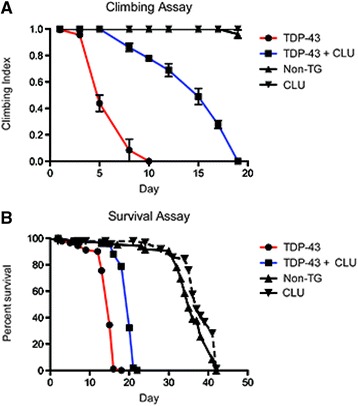
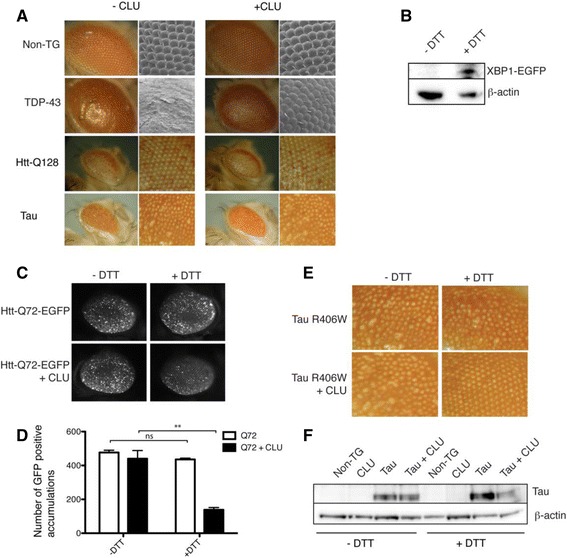
It is now widely accepted in the field that the normally secreted chaperone clusterin is redirected to the cytosol during endoplasmic reticulum (ER) stress, although the physiological function(s) of this physical relocation remain unknown. We have examined in this study whether or not increased expression of clusterin is able to protect neuronal cells against intracellular protein aggregation and cytotoxicity, characteristics that are strongly implicated in a range of neurodegenerative diseases. We used the amyotrophic lateral sclerosis-associated protein TDP-43 as a primary model to investigate the effects of clusterin on protein aggregation and neurotoxicity in complementary in vitro, neuronal cell and Drosophila systems. We have shown that clusterin directly interacts with TDP-43 in vitro and potently inhibits its aggregation, and observed that in ER stressed neuronal cells, clusterin co-localized with TDP-43 and specifically reduced the numbers of cytoplasmic inclusions. We further showed that the expression of TDP-43 in transgenic Drosophila neurons induced ER stress and that co-expression of clusterin resulted in a dramatic clearance of mislocalized TDP-43 from motor neuron axons, partially rescued locomotor activity and significantly extended lifespan. We also showed that in Drosophila photoreceptor cells, clusterin co-expression gave ER stress-dependent protection against proteotoxicity arising from both Huntingtin-Q128 and mutant (R406W) human tau. We therefore conclude that increased expression of clusterin can provide an important defense against intracellular proteotoxicity under conditions that mimic specific features of neurodegenerative disease.
Overview
The claims and statistics of this paper haven’t been checked yet.
Free: it reads the open-access text and checks the first 5 claims that cite a source we can check. Create a free account to check every claim.
Integrity signals
Registry
Cites
Statistics
Figures
Verification
Claims the paper makes
The claims and statistics of this paper haven’t been checked yet.
Free: it reads the open-access text and checks the first 5 claims that cite a source we can check. Create a free account to check every claim.
Claims other papers make about this one
Each is checked against this paper’s own text: does it say what the citing paper says it does?
In the citing paper
“The putative interaction of CLU with tau is further supported by prior reports showing that CLU binds tau and protects against tau mediated degeneration (Gregory et al., 2017; Zhou et al., 2014).”
From Interaction of tau with HNRNPA2B1 and N6-methyladenosine RNA mediates the progression of tauopathy (2021) · cites this paper as Gregory et al., 2017
Self-check
Percentages, sums and reported differences re-computed from the paper’s own numbers.
The self-check needs the paper’s full text.
Citations
Cites
Targeted gene expression as a means of altering cell fates and generating dominant phenotypes
Brand, A. H., & Perrimon, N. (1993) · Development · doi:10.1242/dev.118.2.401 · Cited by 9,612
The unfolded protein response: controlling cell fate decisions under ER stress and beyond
Hetz, C. (2012) · Nature Reviews Molecular Cell Biology · doi:10.1038/nrm3270 · Cited by 4,093
Harold, D., Abraham, R., Hollingworth, P., Sims, R., Gerrish, A., Hamshere, M. L., Pahwa, J. S., Moskvina, V., Dowzell, K., Williams, A., et al. (2009) · Nature Genetics · doi:10.1038/ng.440 · Cited by 3,326
An optimized transgenesis system for Drosophila using germ-line-specific φC31 integrases
Bischof, J., Maeda, R. K., Hediger, M., Karch, F., & Basler, K. (2007) · Proceedings of the National Academy of Sciences · doi:10.1073/pnas.0611511104 · Cited by 1,866
Mackenzie, I. R. A., Bigio, E. H., Ince, P. G., Geser, F., Neumann, M., Cairns, N. J., Kwong, L. K., Forman, M. S., Ravits, J., Stewart, H., et al. (2007) · Annals of Neurology · doi:10.1002/ana.21147 · Cited by 992 · cited 1×
“It is seen, with the exception of cases resulting from SOD1 mutations [50], in most post-mortem cases of FTD and ALS [51], and correlates well with synaptic pathology and cognitive deficits [52].”
BackgroundTauopathy in Drosophila : Neurodegeneration Without Neurofibrillary Tangles
Wittmann, C. W., Wszolek, M. F., Shulman, J. M., Salvaterra, P. M., Lewis, J., Hutton, M., & Feany, M. B. (2001) · Science · doi:10.1126/science.1062382 · Cited by 939 · cited 1×
“For comparison, we also examined the effects of expression both of exon 1 of the Htt gene, containing a 128 glutamine residue expansion (Htt-Q128; [40]), and also of mutant (R406W) human tau, which is associated with frontotemporal dementia with parkinsonism-17 (FTDP-17) [41].”
BackgroundAberrant cleavage of TDP-43 enhances aggregation and cellular toxicity
Zhang, Y.-J., Xu, Y.-F., Cook, C., Gendron, T. F., Roettges, P., Link, C. D., Lin, W.-L., Tong, J., Castanedes-Casey, M., Ash, P., et al. (2009) · Proceedings of the National Academy of Sciences · doi:10.1073/pnas.0900688106 · Cited by 604
Clusterin Has Chaperone-like Activity Similar to That of Small Heat Shock Proteins
Humphreys, D. T., Carver, J. A., Easterbrook-Smith, S. B., & Wilson, M. R. (1999) · Journal of Biological Chemistry · doi:10.1074/jbc.274.11.6875 · Cited by 455
Self-citationClusterin inhibits apoptosis by interacting with activated Bax
Zhang, H., Kim, J. K., Edwards, C. A., Xu, Z., Taichman, R., & Wang, C.-Y. (2005) · Nature Cell Biology · doi:10.1038/ncb1291 · Cited by 453 · cited 1×
“It has also been reported that in response to chemotherapeutic drug treatment, CLU relocates to mitochondria and interacts with Bax to inhibit apoptosis [47].”
BackgroundInteractions of pathological proteins in neurodegenerative diseases
Spires-Jones, T. L., Attems, J., & Thal, D. R. (2017) · Acta Neuropathologica · doi:10.1007/s00401-017-1709-7 · Cited by 429
Research works printed but not linked: 1
- Zhang F Kumano M Beraldi E Fazli L Du C Moore S Clusterin facilitates stress-induced lipidation of LC3 and autophagosome biogenesis to enhance cancer cell survival Nat Commun 2014 5 6775 PMC4275590 25503391
Cited by
Clusterin in Alzheimer’s Disease: Mechanisms, Genetics, and Lessons From Other Pathologies
Foster, E. M., Dangla-Valls, A., Lovestone, S., Ribe, E. M., & Buckley, N. J. (2019) · Frontiers in Neuroscience · doi:10.3389/fnins.2019.00164 · Cited by 381
Serum neuronal exosomes predict and differentiate Parkinson’s disease from atypical parkinsonism
Jiang, C., Hopfner, F., Katsikoudi, A., Hein, R., Catli, C., Evetts, S., Huang, Y., Wang, H., Ryder, J. W., Kuhlenbaeumer, G., et al. (2020) · Journal of Neurology, Neurosurgery & Psychiatry · doi:10.1136/jnnp-2019-322588 · Cited by 275
Interaction of tau with HNRNPA2B1 and N6-methyladenosine RNA mediates the progression of tauopathy
Jiang, L., Lin, W., Zhang, C., Ash, P. E. A., Verma, M., Kwan, J., van Vliet, E., Yang, Z., Cruz, A. L., Boudeau, S., et al. (2021) · Molecular Cell · doi:10.1016/j.molcel.2021.07.038 · Cited by 177
“The putative interaction of CLU with tau is further supported by prior studies showing that CLU binds tau and protects against tau-mediated degeneration (Gregory et al., 2017; Zhou et al., 2014).”
Balcar, V. J., Zeman, T., Janout, V., Janoutová, J., Lochman, J., & Šerý, O. (2021) · Neurochemical Research · doi:10.1007/s11064-020-03176-y · Cited by 17
Metadata
- Authors
- Gregory, J. M., Whiten, D. R., Brown, R. A., Barros, T. P., Kumita, J. R., Yerbury, J. J., Satapathy, S., McDade, K., Smith, C., Luheshi, L. M., Dobson, C. M., & Wilson, M. R.
- Venue
- Acta Neuropathologica Communications
- Published
- 2017-11-07
- Volume
- 5
- Issue
- 1
- ISSN
- 2051-5960
- PMC
- PMC5678579
- Cited by
- 69
- References
- 63
- Language
- en
About these checks
Registry, retraction, Cites and statistics results are computed, not judged, with one exception: a printed reference that no index lists is read once by a model before it counts as a citation error. Claims are extracted by a model and kept only when their quote appears verbatim in the text; each cited source is then checked, with a model’s help, for whether it says what the claim relies on. Those verdicts can be wrong — read the claim’s quote and the cited source before relying on one.
Statistics and arithmetic are recomputed, not judged.
Confidence bands are shown only for fields calibrated on our annotated test set. None is calibrated yet, so no band is shown.
What counts as a claim ›How we measure confidence ›How we check this ›
Are you an author, or do you see a problem with this page? Request a review
Data sources
Bibliographic data: Semantic Scholar, OpenAlex, Crossref.
Contains information from the Semantic Scholar Academic Graph Datasets, made available under the ODC Attribution License (ODC-BY 1.0).
Semantic Scholar’s data is described in: Kinney, R., et al. (2023). The Semantic Scholar Open Data Platform. arXiv:2301.10140.
