

The DOI matches its Crossref record; 60 of the 61 references it cites were found in a registry or an index.
Cerebrovascular pathology in Down syndrome and Alzheimer disease
Open accessAbstract
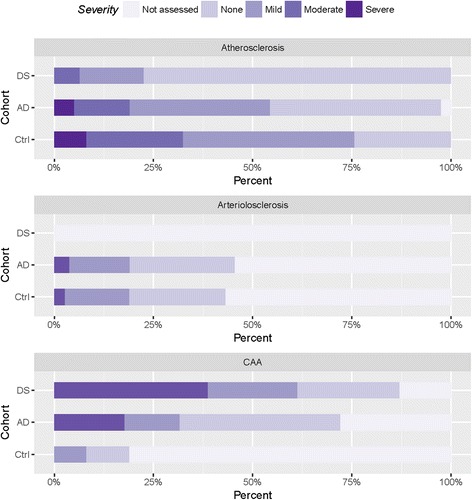
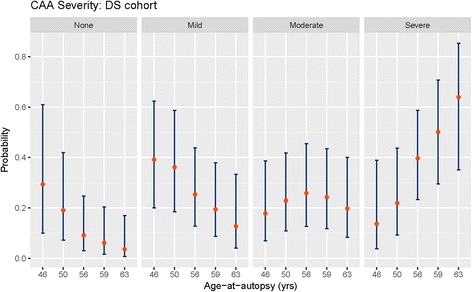
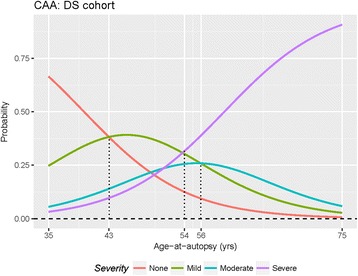
People with Down syndrome (DS) are at high risk for developing Alzheimer disease (AD) with age. Typically, by age 40 years, most people with DS have sufficient neuropathology for an AD diagnosis. Interestingly, atherosclerosis and hypertension are atypical in DS with age, suggesting the lack of these vascular risk factors may be associated with reduced cerebrovascular pathology. However, because the extra copy of APP leads to increased beta-amyloid peptide (Aβ) accumulation in DS, we hypothesized that there would be more extensive and widespread cerebral amyloid angiopathy (CAA) with age in DS relative to sporadic AD. To test this hypothesis CAA, atherosclerosis and arteriolosclerosis were used as measures of cerebrovascular pathology and compared in post mortem tissue from individuals with DS (n = 32), sporadic AD (n = 80) and controls (n = 37). CAA was observed with significantly higher frequencies in brains of individuals with DS compared to sporadic AD and controls. Atherosclerosis and arteriolosclerosis were rare in the cases with DS. CAA in DS may be a target for future interventional clinical trials.
Overview
The claims and statistics of this paper haven’t been checked yet.
Run the check — free, no account needed. It reads the open-access text and checks the sources it cites.
Integrity signals
Registry
Cites
Statistics
Figures
Verification
Claims the paper makes
The claims and statistics of this paper haven’t been checked yet.
Run the check — free, no account needed. It reads the open-access text and checks the sources it cites.
Claims other papers make about this one
Each is checked against this paper’s own text: does it say what the citing paper says it does?
The cited source says what the claim attributes to it.
In the citing paper
“People with DSAD have a significant burden of cerebral amyloid angiopathy (CAA), with more severe CAA found than in sporadic AD [25, 40].”
From Apolipoprotein E abundance is elevated in the brains of individuals with Down syndrome–Alzheimer’s disease (2025) · cites this paper as [25]
Self-check
Percentages, sums and reported differences re-computed from the paper’s own numbers.
The self-check needs the paper’s full text.
Citations
Cites
Neuropathological stageing of Alzheimer-related changes.
Braak, H., & Braak, E. (1991) · Acta Neuropathologica · doi:10.1007/bf00308809 · Cited by 16,123
Agresti, A. (2002) · Wiley Series in Probability and Statistics · doi:10.1002/0471249688 · Cited by 6,746
Hyman, B. T., Phelps, C. H., Beach, T. G., Bigio, E. H., Cairns, N. J., Carrillo, M. C., Dickson, D. W., Duyckaerts, C., Frosch, M. P., Masliah, E., et al. (2012) · Alzheimer's & Dementia · doi:10.1016/j.jalz.2011.10.007 · Cited by 3,092
(2001) · The Lancet · doi:10.1016/s0140-6736(00)03589-3 · Cited by 1,338
Cerebral amyloid angiopathy. A critical review.
Vinters, H. V. (1987) · Stroke · doi:10.1161/01.str.18.2.311 · Cited by 1,070
Cerebral amyloid angiopathy in the elderly
Viswanathan, A., & Greenberg, S. M. (2011) · Annals of Neurology · doi:10.1002/ana.22516 · Cited by 643
Charidimou, A., Gang, Q., & Werring, D. J. (2012) · Journal of Neurology, Neurosurgery & Psychiatry · doi:10.1136/jnnp-2011-301308 · Cited by 611
Ellis, R. J., Olichney, J. M., Thal, L. J., Mirra, S. S., Morris, J. C., Beekly, D., & Heyman, A. (1996) · Neurology · doi:10.1212/wnl.46.6.1592 · Cited by 561
A Prospective Study of Alzheimer Disease in Down Syndrome
Lai, F., & Williams, R. S. (1989) · Archives of Neurology · doi:10.1001/archneur.1989.00520440031017 · Cited by 561
Alzheimer neuropathologic alterations in aged cognitively normal subjects
Davis, D. G., Schmitt, F. A., Wekstein, D. R., & Markesbery, W. R. (1999) · Journal of Neuropathology and Experimental Neurology · doi:10.1097/00005072-199904000-00008 · Cited by 516 · cited 1×
“9 years at autopsy) has been reported as high as 62% [17].”
BackgroundSelf-citation
Research works printed but not linked: 1
- R_Core_Team (2016) A language and environment for statistical computing. R Foundation for Statistical Computing, Vienna
Cited by
Sorted by citations
Dementia in Down syndrome: unique insights for Alzheimer disease research
Lott, I. T., & Head, E. (2019) · Nature Reviews Neurology · doi:10.1038/s41582-018-0132-6 · Cited by 383
Self-citationAlzheimer's disease associated with Down syndrome: a genetic form of dementia
Fortea, J., Zaman, S. H., Hartley, S., Rafii, M. S., Head, E., & Carmona-Iragui, M. (2021) · The Lancet Neurology · doi:10.1016/s1474-4422(21)00245-3 · Cited by 357
Self-citationChen, X., & Mobley, W. C. (2019) · Frontiers in Neuroscience · doi:10.3389/fnins.2019.00659 · Cited by 302
Davidson, Y. S., Robinson, A., Prasher, V. P., & Mann, D. M. A. (2018) · Acta Neuropathologica Communications · doi:10.1186/s40478-018-0559-4 · Cited by 146
Evolution of neuroinflammation across the lifespan of individuals with Down syndrome
Flores-Aguilar, L., Iulita, M. F., Kovecses, O., Torres, M. D., Levi, S. M., Zhang, Y., Askenazi, M., Wisniewski, T., Busciglio, J., & Cuello, A. C. (2020) · Brain · doi:10.1093/brain/awaa326 · Cited by 138
Metadata
- Authors
- Head, E., Phelan, M. J., Doran, E., Kim, R. C., Poon, W. W., Schmitt, F. A., & Lott, I. T.
- Affiliations
- University of Kentucky (US)
- University of California, Irvine (US)
- Corresponding author
- Head, Elizabeth
- Venue
- Acta Neuropathologica Communications
- Published
- 2017-12
- Volume
- 5
- Issue
- 1
- Pages
- 93-93
- ISSN
- 2051-5960 (ISSN-L)
- PMC
- PMC5709935
- OpenAlex
- W2771929031
- Cited by
- 105
- References
- 61
- Citations by year
- 2026: 9 · 2025: 22 · 2024: 18 · 2023: 9 · 2022: 12 · 2021: 15 · 2020: 8 · 2019: 8 · 2018: 4
- FWCI
- 5.14
- Type
- journal article
- Language
- en
- Open access
- gold
- doi.org
- Locations
- Acta Neuropathologica Communications (publishedVersion, cc-by)
- Europe PMC (PubMed Central) (publishedVersion, cc-by)
- PubMed Central (publishedVersion, cc-by)
- PubMed (publishedVersion)
- eScholarship (California Digital Library) (submittedVersion, cc-by)
- UKnowledge (University of Kentucky) (submittedVersion, cc-by)
- DOAJ (DOAJ: Directory of Open Access Journals) (submittedVersion, cc-by-sa)
- eScholarship (California Digital Library) (submittedVersion)
- Funders
- National Institute on Aging (P50AG16573, R01AG21912)
- National Institute of Child Health and Human Development (R01HD065160, R01HD064993)
- Topics
- Health Sciences › Medicine › Public Health, Environmental and Occupational Health › Down syndrome and intellectual disability research
- Life Sciences › Neuroscience › Cellular and Molecular Neuroscience › Alzheimer's disease research and treatments
- Health Sciences › Medicine › Psychiatry and Mental health › Dementia and Cognitive Impairment Research
- Keywords
- Down syndrome, Alzheimer's disease, cerebral amyloid angiopathy, cerebrovascular pathology, atherosclerosis, arteriolosclerosis, amyloid-beta deposition, vascular risk factors, postmortem brain
- MeSH terms
- Age Factors, Aged, Aged, 80 and over, Alzheimer Disease, Down Syndrome, Female, Humans, Male, Middle Aged, Probability, Cohort Studies, Cerebral Amyloid Angiopathy, Atherosclerosis, Arteriolosclerosis
About these checks
Registry, retraction, Cites and statistics results are computed, not judged, with one exception: a printed reference that no index lists is read once by a model before it counts as a citation error. Claims are extracted by a model and kept only when their quote appears verbatim in the text; each cited source is then checked, with a model’s help, for whether it says what the claim relies on. Those verdicts can be wrong — read the claim’s quote and the cited source before relying on one.
Statistics and arithmetic are recomputed, not judged.
Confidence bands are shown only for fields calibrated on our annotated test set. None is calibrated yet, so no band is shown.
What counts as a claim ›How we measure confidence ›How we check this ›
Are you an author, or do you see a problem with this page? Request a review
