

It’s the thought that counts: belief in suicide as an escape moderates the relationship between emotion dysregulation and suicidal ideation cross-sectionally and longitudinally
Open accessThe DOI matches its Crossref record; 38 of the 38 references it cites were found in a registry or an index.
Abstract
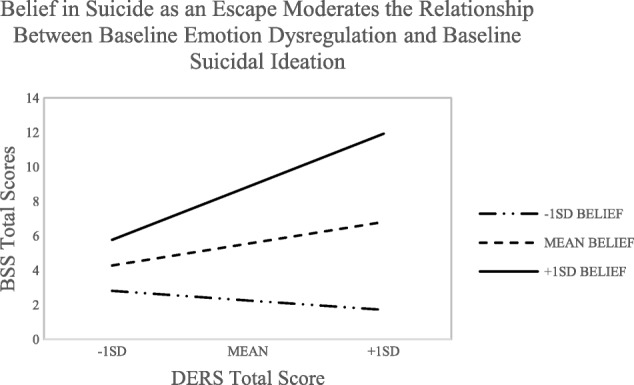
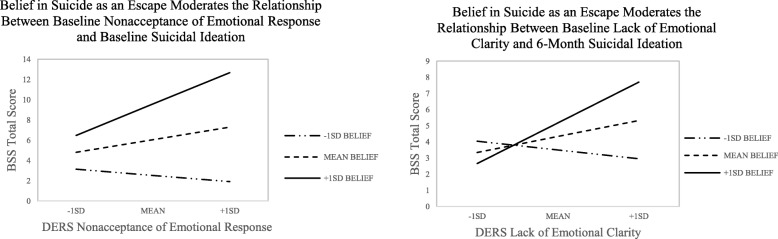
Background: Previous research has illustrated a relationship between emotion dysregulation and suicidal ideation, both cross-sectionally and longitudinally. However, it is not yet understood how this relationship manifests. The aim of this study was to explore if two beliefs about suicide, (1) suicide as a way to escape from emotional pain and (2) suicide as a solution to a problem, moderate the relationship between emotion dysregulation and suicidal ideation. Methods: One hundred one community participants completed questionnaires examining emotion dysregulation, suicidal ideation, and beliefs in the functions of suicide. Inclusion criteria were used to over-sample individuals within the community experiencing higher levels of suicidal ideation and emotion dysregulation. Hierarchical linear regressions with interaction terms were used to assess moderation effects. The moderating role of beliefs in the function of suicide was examined both cross-sectionally and longitudinally. Results: Suicide as an escape significantly moderated the relationship between global emotion dysregulation and suicidal ideation cross-sectionally, while it moderated the relationship between a facet of emotion dysregulation and suicidal ideation longitudinally. Greater endorsement of this belief resulted in a stronger relationship between emotion dysregulation and suicidal ideation. The function of suicide as a solution to a problem did not moderate the emotion dysregulation-suicidal ideation relationship. Conclusions: These findings underscore the importance of not only addressing emotion dysregulation but also addressing the underlying belief that suicide is an escape in individuals who experience both emotion dysregulation and suicidal ideation. Intervention efforts to address belief in suicide as an escape along with emotion dysregulation are delineated.
Overview
The claims and statistics of this paper haven’t been checked yet.
Free: it reads the open-access text and checks the first 5 claims that cite a source we can check. Create a free account to check every claim.
Integrity signals
Registry
Cites
Statistics
Figures
Verification
Claims the paper makes
The claims and statistics of this paper haven’t been checked yet.
Free: it reads the open-access text and checks the first 5 claims that cite a source we can check. Create a free account to check every claim.
Self-check
Percentages, sums and reported differences re-computed from the paper’s own numbers.
The self-check needs the paper’s full text.
Citations
Cites
Multiple regression: testing and interpreting interactions
(1992) · Choice Reviews Online · doi:10.5860/choice.29-3352 · Cited by 36,654
Cicchetti, D. V. (1994) · Psychological Assessment · doi:10.1037/1040-3590.6.4.284 · Cited by 9,349
Gratz, K. L., & Roemer, L. (2004) · Journal of Psychopathology and Behavioral Assessment · doi:10.1023/b:joba.0000007455.08539.94 · Cited by 8,942
(1991) · Cited by 7,187
Assessment of suicidal intention: The Scale for Suicide Ideation.
Beck, A. T., Kovacs, M., & Weissman, A. (1979) · Journal of Consulting and Clinical Psychology · doi:10.1037//0022-006x.47.2.343 · Cited by 3,419
Cross-national prevalence and risk factors for suicidal ideation, plans and attempts
Nock, M. K., Borges, G., Bromet, E. J., Alonso, J., Angermeyer, M., Beautrais, A., Bruffaerts, R., Chiu, W. T., de Girolamo, G., Gluzman, S., et al. (2008) · British Journal of Psychiatry · doi:10.1192/bjp.bp.107.040113 · Cited by 2,654
Misunderstanding analysis of covariance.
Miller, G. A., & Chapman, J. P. (2001) · Journal of Abnormal Psychology · doi:10.1037/0021-843x.110.1.40 · Cited by 2,136
Baumeister, R. F. (1990) · Psychological Review · doi:10.1037/0033-295x.97.1.90 · Cited by 1,919
A single-item measure of social identification: reliability, validity, and utility
Postmes, T., Haslam, S. A., & Jans, L. (2013) · British Journal of Social Psychology · doi:10.1111/bjso.12006 · Cited by 1,021
Beyond the tower of Babel: A nomenclature for suicidology
O'Carroll, P. W., Berman, A. L., Maris, R. W., Moscicki, E. K., Tanney, B. L., & Silverman, M. M. (1996) · Suicide and Life-Threatening Behavior · doi:10.1111/j.1943-278x.1996.tb00609.x · Cited by 982
Commentary: Suicide as Psychache
SHNEIDMAN, E. S. (1993) · The Journal of Nervous and Mental Disease · doi:10.1097/00005053-199303000-00001 · Cited by 775
Single-Item Versus Multiple-Item Measurement Scales: An Empirical Comparison
Gardner, D. G., Cummings, L. L., Dunham, R. B., & Pierce, J. L. (1998) · Educational and Psychological Measurement · doi:10.1177/0013164498058006003 · Cited by 730
Problem-solving skills in suicidal psychiatric patients.
Schotte, D. E., & Clum, G. A. (1987) · Journal of Consulting and Clinical Psychology · doi:10.1037/0022-006x.55.1.49 · Cited by 485
Jakupcak, M., Cook, J., Imel, Z., Fontana, A., Rosenheck, R., & McFall, M. (2009) · Journal of Traumatic Stress · doi:10.1002/jts.20423 · Cited by 367
Suicide ideation in a college population: A test of a model.
Schotte, D. E., & Clum, G. A. (1982) · Journal of Consulting and Clinical Psychology · doi:10.1037//0022-006x.50.5.690 · Cited by 356
A caveat on using single‐item versus multiple‐item scales
Loo, R. (2002) · Journal of Managerial Psychology · doi:10.1108/02683940210415933 · Cited by 347
Ang, R. P., & Huan, V. S. (2006) · Child Psychiatry and Human Development · doi:10.1007/s10578-006-0023-8 · Cited by 343
Borges, G., Angst, J., Nock, M. K., Ruscio, A. M., & Kessler, R. C. (2008) · Journal of Affective Disorders · doi:10.1016/j.jad.2007.01.036 · Cited by 334
Reliability and Validity of 2 Single-Item Measures of Psychosocial Stress
Littman, A. J., White, E., Satia, J. A., Bowen, D. J., & Kristal, A. R. (2006) · Epidemiology · doi:10.1097/01.ede.0000219721.89552.51 · Cited by 266
Emotion dysregulation and vulnerability to suicidal ideation and attempts
Rajappa, K., Gallagher, M., & Miranda, R. (2012) · Cognitive Therapy and Research · doi:10.1007/s10608-011-9419-2 · Cited by 251
ENNS, M. W., COX, B. J., AFIFI, T. O., DE GRAAF, R., TEN HAVE, M., & SAREEN, J. (2006) · Psychological Medicine · doi:10.1017/s0033291706008646 · Cited by 206
Affective, Behavioral, and Cognitive Functioning in Adolescents with Multiple Suicide Attempts
Esposito, C., Spirito, A., Boergers, J., & Donaldson, D. (2003) · Suicide and Life-Threatening Behavior · doi:10.1521/suli.33.4.389.25231 · Cited by 198
Pisani, A. R., Wyman, P. A., Petrova, M., Schmeelk-Cone, K., Goldston, D. B., Xia, Y., & Gould, M. S. (2013) · Journal of Youth and Adolescence · doi:10.1007/s10964-012-9884-2 · Cited by 183
Suicidal behavior and problems with emotion regulation
Neacsiu, A. D., Fang, C. M., Rodriguez, M., & Rosenthal, M. Z. (2018) · Suicide and Life-Threatening Behavior · doi:10.1111/sltb.12335 · Cited by 139
Osborne, T. L., Michonski, J. D., Sayrs, J. H. R., Welch, S. S., & Anderson, L. K. (2017) · Journal of Psychopathology and Behavioral Assessment · doi:10.1007/s10862-017-9586-x · Cited by 122
Empirically based comprehensive treatment program for parasuicide.
Clum, G. A., Patsiokas, A. T., & Luscomb, R. L. (1979) · Journal of Consulting and Clinical Psychology · doi:10.1037//0022-006x.47.5.937 · Cited by 113
Miranda, R., Tsypes, A., Gallagher, M., & Rajappa, K. (2013) · Cognitive Therapy and Research · doi:10.1007/s10608-013-9524-5 · Cited by 113
Trajectories of suicidal ideation among adolescents following psychiatric hospitalization.
Wolff, J. C., Davis, S., Liu, R. T., Cha, C. B., Cheek, S. M., Nestor, B. A., Frazier, E. A., Schaffer, M. M., & Spirito, A. (2018) · Journal of Abnormal Child Psychology · doi:10.1007/s10802-017-0293-6 · Cited by 95
Priester, M. J., & Clum, G. A. (1993) · Journal of Psychopathology and Behavioral Assessment · doi:10.1007/bf01371381 · Cited by 66
Predicting Repetition of Suicide Attempt: A Prospective Study of 50Suicide Attempters
Dieserud, G., Røysamb, E., Braverman, M. T., Dalgard, O. S., & Ekeberg, Ø. (2003) · Archives of Suicide Research · doi:10.1080/13811110301571 · Cited by 61
Ellis, T. E., & Rufino, K. A. (2016) · Archives of Suicide Research · doi:10.1080/13811118.2015.1093983 · Cited by 61
Zinbarg, R. E., Suzuki, S., Uliaszek, A. A., & Lewis, A. R. (2010) · Journal of Abnormal Psychology · doi:10.1037/a0017552 · Cited by 45
Self-citationCheatle, M. D. (2014) · Pain Physician · doi:10.36076/ppj.2014/17/e359 · Cited by 45
Zvolensky, M. J., Bakhshaie, J., Garza, M., Valdivieso, J., Ortiz, M., Bogiaizian, D., Robles, Z., Schmidt, N. B., & Vujanovic, A. (2015) · Cognitive Therapy and Research · doi:10.1007/s10608-015-9696-2 · Cited by 36
Cognitive predictors of suicide risk among hospitalized psychiatric patients: A prospective study
Hughes, S. L., & Neimeyer, R. A. (1993) · Death Studies · doi:10.1080/07481189308252609 · Cited by 35
Skinner, K. D., Rojas, S. M., & Veilleux, J. C. (2016) · Suicide and Life-Threatening Behavior · doi:10.1111/sltb.12249 · Cited by 29
Suicidal Behaviors QuestionnairePreprint
Wilson, L. (2018) · OSF Preprints (OSF Preprints) · Cited by 15
Scale for Suicide Ideation: Psychometric properties of a self-report version
Beck, A. T., Steer, R. A., & Ranieri, W. F. (1988) · Journal of Clinical Psychology · doi:10.1002/1097-4679(198807)44:4<499::aid-jclp2270440404>3.0.co;2-6
Research works printed but not linked: 3
- First MB Gibbon M Spitzer RL Williams JBW Benjamin LS Structured clinical interview for DSM IV axis I and II disorders 1997 Washington APA
- IBM IBM SPSS Advanced Statistics 24. Ibm 2016 184
- Hayes AF Process: a versatile computational tool for observed variable mediation, moderation, and conditional process modeling 2012 1 39
Cited by
Emotion dysregulation acts in the relationship between vulnerable narcissism and suicidal ideation
Ponzoni, S., Beomonte Zobel, S., Rogier, G., & Velotti, P. (2021) · Scandinavian Journal of Psychology · doi:10.1111/sjop.12730 · Cited by 44
Rogante, E., Cifrodelli, M., Sarubbi, S., Costanza, A., Erbuto, D., Berardelli, I., & Pompili, M. (2024) · Healthcare · doi:10.3390/healthcare12020169 · Cited by 39
Self‐harm as the first presentation of attention deficit hyperactivity disorder in adolescents
Ward, J. H., & Curran, S. R. (2021) · Child and Adolescent Mental Health · doi:10.1111/camh.12471 · Cited by 38
Non-Suicidal Self-Injury: An Observational Study in a Sample of Adolescents and Young Adults
Matera, E., Margari, M., Serra, M. C. D. V. F., Petruzzelli, M. G., Gabellone, A., Piarulli, F. M., Pugliese, A., Tassiello, A. R., Croce, F., Renna, C., et al. (2021) · Brain Sciences · doi:10.3390/brainsci11080974 · Cited by 22
Yin, Q., Hughes, C. D., & Rizvi, S. L. (2023) · Behaviour Research and Therapy · doi:10.1016/j.brat.2023.104427 · Cited by 17
Metadata
- Authors
- Al-Dajani, N., Uliaszek, A. A., & Hamdullahpur, K.
- Affiliations
- University of Toronto (CA)
- ORCID
- Uliaszek, Amanda A.
- Venue
- Borderline Personality Disorder and Emotion Dysregulation
- Published
- 2019-11-05
- Volume
- 6
- Issue
- 1
- Pages
- 16-16
- ISSN
- 2051-6673 (ISSN-L)
- PMC
- PMC6833273
- OpenAlex
- W2988427575
- Cited by
- 18
- References
- 38
- Citations by year
- 2025: 1 · 2024: 6 · 2023: 3 · 2022: 3 · 2021: 4 · 2020: 1
- FWCI
- 2.34
- Type
- journal article
- Language
- en
- Open access
- gold
- doi.org
- Licence
- cc-by
- creativecommons.org/licenses/by/4.0/ (tdm)
- creativecommons.org/licenses/by/4.0/ (vor)
- Locations
- Borderline Personality Disorder and Emotion Dysregulation (publishedVersion, cc-by)
- PubMed Central (publishedVersion, cc-by)
- PubMed (publishedVersion)
- TSpace (University of Toronto) (submittedVersion, cc-by)
- DOAJ (DOAJ: Directory of Open Access Journals) (submittedVersion, cc-by-sa)
- Funders
- University of Toronto
- University of Toronto Scarborough
- Topics
- Social Sciences › Psychology › Clinical Psychology › Suicide and Self-Harm Studies
- Social Sciences › Psychology › Clinical Psychology › Personality Disorders and Psychopathology
- Social Sciences › Psychology › Experimental and Cognitive Psychology › Anxiety, Depression, Psychometrics, Treatment, Cognitive Processes
- Keywords
- emotional dysregulation, suicidal ideation, moderating effect, community sample
About these checks
Registry, retraction, Cites and statistics results are computed, not judged, with one exception: a printed reference that no index lists is read once by a model before it counts as a citation error. Claims are extracted by a model and kept only when their quote appears verbatim in the text; each cited source is then checked, with a model’s help, for whether it says what the claim relies on. Those verdicts can be wrong — read the claim’s quote and the cited source before relying on one.
Statistics and arithmetic are recomputed, not judged.
Confidence bands are shown only for fields calibrated on our annotated test set. None is calibrated yet, so no band is shown.
What counts as a claim ›How we measure confidence ›How we check this ›
Are you an author, or do you see a problem with this page? Request a review
Data sources
Bibliographic data: Semantic Scholar, OpenAlex, Crossref.
Contains information from the Semantic Scholar Academic Graph Datasets, made available under the ODC Attribution License (ODC-BY 1.0).
Semantic Scholar’s data is described in: Kinney, R., et al. (2023). The Semantic Scholar Open Data Platform. arXiv:2301.10140.
