

Deep Learning applications for COVID-19
Open accessThe DOI matches its Crossref record; 188 of the 189 references it cites were found in a registry or an index.
Abstract
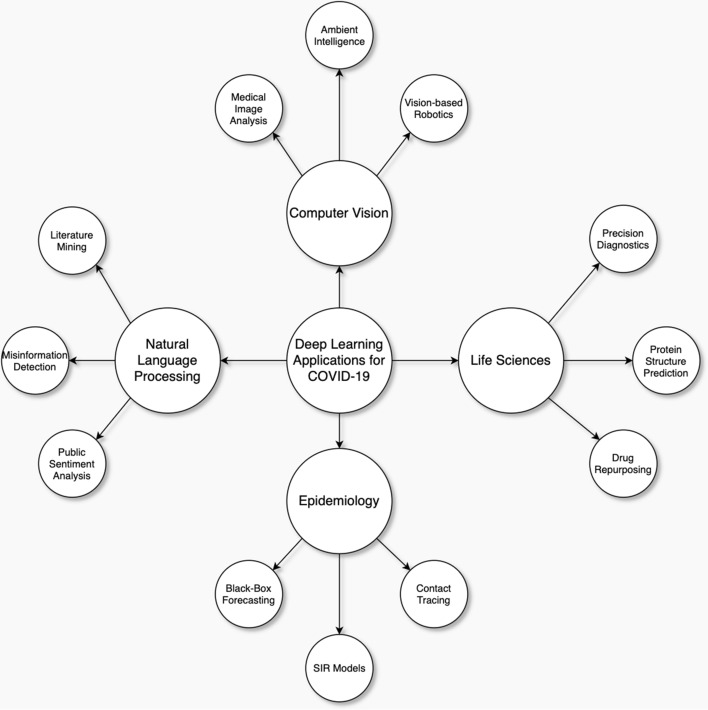
This survey explores how Deep Learning has battled the COVID-19 pandemic and provides directions for future research on COVID-19. We cover Deep Learning applications in Natural Language Processing, Computer Vision, Life Sciences, and Epidemiology. We describe how each of these applications vary with the availability of big data and how learning tasks are constructed. We begin by evaluating the current state of Deep Learning and conclude with key limitations of Deep Learning for COVID-19 applications. These limitations include Interpretability, Generalization Metrics, Learning from Limited Labeled Data, and Data Privacy. Natural Language Processing applications include mining COVID-19 research for Information Retrieval and Question Answering, as well as Misinformation Detection, and Public Sentiment Analysis. Computer Vision applications cover Medical Image Analysis, Ambient Intelligence, and Vision-based Robotics. Within Life Sciences, our survey looks at how Deep Learning can be applied to Precision Diagnostics, Protein Structure Prediction, and Drug Repurposing. Deep Learning has additionally been utilized in Spread Forecasting for Epidemiology. Our literature review has found many examples of Deep Learning systems to fight COVID-19. We hope that this survey will help accelerate the use of Deep Learning for COVID-19 research.
Overview
The claims and statistics of this paper haven’t been checked yet.
Free: it reads the open-access text and checks the first 5 claims that cite a source we can check. Create a free account to check every claim.
Integrity signals
Registry
Cites
Statistics
Figures
Verification
Claims the paper makes
The claims and statistics of this paper haven’t been checked yet.
Free: it reads the open-access text and checks the first 5 claims that cite a source we can check. Create a free account to check every claim.
Claims other papers make about this one
Each is checked against this paper’s own text: does it say what the citing paper says it does?
The source backs part of the claim, not all of it — or backs it for a different population, condition or comparison.
In the citing paper
“In 2020, DL is playing an increasingly vital role in early diagnosis of the novel coronavirus (COVID-19) [29, 46–48].”
From Review of deep learning: concepts, CNN architectures, challenges, applications, future directions (2021) · cites this paper as [29]
Experimental — accuracy not yet measured
Self-check
Percentages, sums and reported differences re-computed from the paper’s own numbers.
The self-check needs the paper’s full text.
Citations
Cites
Deep Residual Learning for Image Recognition
He, K., Zhang, X., Ren, S., & Sun, J. (2016) · 2016 IEEE Conference on Computer Vision and Pattern Recognition (CVPR) · doi:10.1109/cvpr.2016.90 · Cited by 235,474 · cited 6×
“This results in a 3% accuracy improvement over a more standard ResNet-50 architecture.”
MethodInfluentialVaswani, A., Shazeer, N., Parmar, N., Uszkoreit, J., Jones, L., Gomez, A. N., Kaiser, L., & Polosukhin, I. (2017) · arXiv · doi:10.48550/arxiv.1706.03762 · Cited by 120,404 · cited 2×
“NLP has seen a boom of interest due to the invention of the Transformer Neural Network architecture [21].”
BackgroundMethodImageNet classification with deep convolutional neural networks
Krizhevsky, A., Sutskever, I., & Hinton, G. E. (2017) · Communications of the ACM · doi:10.1145/3065386 · Cited by 112,155 · cited 8×
“AlexNet inspired further interest in Deep Neural Networks for Computer Vision.”
BackgroundInfluentialBERT: Pre-training of Deep Bidirectional Transformers for Language Understanding
Devlin, J., Chang, M.-W., Lee, K., & Toutanova, K. (2019) · Proceedings of the 2019 Conference of the North American Chapter of the Association for Computational Linguistics: Human Language Technologies, Volume 1 (Long and Short Papers) · doi:10.18653/v1/n19-1423 · Cited by 54,325
Densely Connected Convolutional Networks
Huang, G., Liu, Z., Van Der Maaten, L., & Weinberger, K. Q. (2017) · 2017 IEEE Conference on Computer Vision and Pattern Recognition (CVPR) · doi:10.1109/cvpr.2017.243 · Cited by 48,566
ImageNet Large Scale Visual Recognition Challenge
Russakovsky, O., Deng, J., Su, H., Krause, J., Satheesh, S., Ma, S., Huang, Z., Karpathy, A., Khosla, A., Bernstein, M., et al. (2015) · International Journal of Computer Vision · doi:10.1007/s11263-015-0816-y · Cited by 39,380 · cited 1×
“The success of Deep Computer Vision is largely attributed to the ImageNet dataset [82].”
Background(2008) · Journal of Machine Learning Research · Cited by 33,051
Exploring the Limits of Transfer Learning with a Unified Text-to-Text Transformer
Raffel, C., Shazeer, N., Roberts, A., Lee, K., Narang, S., Matena, M., Zhou, Y., Li, W., & Liu, P. J. (2019) · arXiv · doi:10.48550/arxiv.1910.10683 · Cited by 31,859 · cited 1×
“Some approaches to QA surveyed generate the answer directly [35], rather than classifying its presence in a context.”
BackgroundPyTorch: An Imperative Style, High-Performance Deep Learning Library
Paszke, A., Gross, S., Massa, F., Lerer, A., Bradbury, J., Chanan, G., Killeen, T., Lin, Z., Gimelshein, N., Antiga, L., et al. (2019) · arXiv · doi:10.48550/arxiv.1912.01703 · Cited by 31,473
Distributed Representations of Words and Phrases and their Compositionality
Mikolov, T., Sutskever, I., Chen, K., Corrado, G., & Dean, J. (2013) · arXiv · doi:10.48550/arxiv.1310.4546 · Cited by 24,533 · cited 1×
“A promising approach to this is the emphasis on evidence retrieval such as Retrieval-Augmented Generation [151].”
Background
Research works printed but not linked: 1
- Kingma D, Ba J. Adam: A method for stochastic optimization. In: International conference on learning representations; 2014.
Cited by
Items 101–200 of 350
A tree-based explainable AI model for early detection of Covid-19 using physiological data
Talib, M. W. A., Afadar, Y., Nasir, Q., Nassif, A. B., Hijazi, H., & Hasasneh, A. (2024) · BMC Medical Informatics and Decision Making · doi:10.1186/s12911-024-02576-2 · Cited by 14
Villar-Rodríguez, G., Souto-Rico, M., & Martín, A. G. (2022) · Communication & Society · doi:10.15581/003.35.2.239-256 · Cited by 16
“, 2021) and to the importance of NLP to address COVID-19 misinformation under these circumstances (Shorten et al., 2021).”
BackgroundNew approach of KNN Algorithm in quantum computing based on new design of quantum circuits
Hai, V. T., Chuong, P. H., & Bao, P. T. (2022) · Informatica · doi:10.31449/inf.v46i5.3608 · Cited by 14
The Treasury Chest of Text Mining: Piling Available Resources for Powerful Biomedical Text Mining
Rosário‐Ferreira, N., Marques-Pereira, C., Pires, M., Ramalhão, D., Pereira, N. N., Guimarães, V., Costa, V. S., & Moreira, I. S. (2021) · BioChem · doi:10.3390/biochem1020007 · Cited by 17
“An NLP model should understand the language, semantics, and vocabulary to predict token features correctly [8].”
BackgroundE-GCS: Detection of COVID-19 through classification by attention bottleneck residual network
Ahila, T., & Subhajini, A. C. (2022) · Engineering Applications of Artificial Intelligence · doi:10.1016/j.engappai.2022.105398 · Cited by 12
Chen, Y., & Zhang, Z. (2022) · Information Processing & Management · doi:10.1016/j.ipm.2022.103073 · Cited by 12
COVID-19 advising application development for Apple devices (iOS)
Alshahrani, S. M., & Khan, N. A. (2023) · PeerJ Computer Science · doi:10.7717/peerj-cs.1274 · Cited by 20
Prediction of mine water quality by the Seq2Seq model based on attention mechanism
Wang, X., & Li, Y. (2024) · Heliyon · doi:10.1016/j.heliyon.2024.e37916 · Cited by 15
Application Peculiarities of Deep Learning Methods in the Problem of Big Datasets Classification
Rusyn, B., Lutsyk, O., Kosarevych, R., & Obukh, Y. (2021) · Lecture notes in electrical engineering · doi:10.1007/978-3-030-92435-5_28 · Cited by 10
Individual Factors Associated With COVID-19 Infection: A Machine Learning Study
Ramírez-delReal, T. A., Martínez-García, M., Márquez, M. F., López-Trejo, L., Gutiérrez-Esparza, G. O., & Lemus, E. H. (2022) · Frontiers in Public Health · doi:10.3389/fpubh.2022.912099 · Cited by 13
“In this study, we applied four machine learning models: random forest, CART, C4.5, XGBoost, as well as deep neural networks, based on their high performance to diagnose COVID-19 (11, 55–57).”
MethodAn Experimental Approach to Diagnose Covid-19 Using Optimized CNN
Singha, A. K., Pathak, N., Sharma, N., Gandhar, A., Urooj, S., Zubair, S., Sultana, J., & Nagalaxmi, G. (2022) · Intelligent Automation & Soft Computing · doi:10.32604/iasc.2022.024172 · Cited by 10
Hansun, S., Charles, V., & Gherman, T. (2023) · Heliyon · doi:10.1016/j.heliyon.2023.e14397 · Cited by 13
“Various Deep Learning methods, such as Generative Adversarial Networks (GANs), Extreme Learning Machine (ELM), and LSTM, have been employed in COVID-19 research [17] and in spread forecasting for epidemiology [18].”
Human behavior in the time of COVID-19: Learning from big data
Lyu, H., Imtiaz, A., Zhao, Y., & Luo, J. (2023) · Frontiers in Big Data · doi:10.3389/fdata.2023.1099182 · Cited by 12
“While computer vision techniques have been primarily adapted in healthcare, methods, especially object detection, have been applied to measuring human behavior (Ulhaq et al., 2020; Shorten et al., 2021).”
MethodPeddinti, B., Shaikh, A., Bhavya, K. R., & Kumar, K. C. N. (2021) · Biomedical Signal Processing and Control · doi:10.1016/j.bspc.2021.102605 · Cited by 10
Sahoo, P., Saha, S., Mondal, S., & Sharma, N. (2022) · Proceedings - International Conference on Pattern Recognition/Proceedings/International Conference on Pattern Recognition · doi:10.1109/icpr56361.2022.9956499 · Cited by 11
“Problems like the cost of X-ray and CT equipment, higher radiation risk for the patients, portability, require extensive cleaning after each scan may limit the relevance of AI-based investigation for COVID-19 screening [7], [8].”
BackgroundExplainability of Automated Fact Verification Systems: A Comprehensive Review
Vallayil, M., Nand, P., Yan, W., & Allende‐Cid, H. (2023) · Applied Sciences · doi:10.3390/app132312608 · Cited by 22
Use of Generative AI Tools to Facilitate Personalized Learning in the Flipped Classroom
Zhen, H., & Yahaya, W. A. J. W. (2024) · Advances in educational technologies and instructional design book series · doi:10.4018/979-8-3693-1351-0.ch016 · Cited by 11
Applications of Artificial Intelligence in COVID-19 Pandemic
Al-Shoqran, M., & Shorman, S. M. (2021) · Lecture notes in networks and systems · doi:10.1007/978-3-030-77246-8_30 · Cited by 9
Enabling microservices management for Deep Learning applications across the Edge-Cloud Continuum
Houmani, Z., Balouek‐Thomert, D., Caron, E., & Parashar, M. (2021) · International Symposium on Computer Architecture and High Performance Computing (SBAC-PAD) · doi:10.1109/sbac-pad53543.2021.00025 · Cited by 13
“Deep Learning (DL) applications present a growing potential to extract knowledge from the analysis of streaming data, with applications in numerous domains including computer vision [1], speech recognition [2], and COVID-19 research [3].”
BackgroundWang, J., Chavda, V. P., Prajapati, R., Bedse, A. P., Patel, J., Popat, S., Jogi, G., Nalla, L. V., Jetha, K. L., Shen, B., et al. (2023) · Current Research in Biotechnology · doi:10.1016/j.crbiot.2023.100159 · Cited by 10
KerasBERT: Modeling the Keras Language
Shorten, C., & Khoshgoftaar, T. M. (2021) · International Conference on Machine Learning and Applications · doi:10.1109/icmla52953.2021.00041 · Cited by 9
Self-citationA multilevel approach for screening natural compounds as an antiviral agent for COVID-19
Vasighi, M., Romanova, J., & Nedyalkova, M. (2022) · Computational Biology and Chemistry · doi:10.1016/j.compbiolchem.2022.107694 · Cited by 9
“A broad overview for the use of deep learning in the battle with the COVID-19 pandemic as a survey (Shorten et al., 2021) gives an overview of the capability of the prediction power of Deep Learning and the problems that we can solve by using such tools.”
Application of Deep Learning to IVC Filter Detection from CT Scans
Gomes, R., Kamrowski, C., Mohan, P. D., Senor, C., Langlois, J., & Wildenberg, J. C. (2022) · Diagnostics · doi:10.3390/diagnostics12102475 · Cited by 9
Using Artificial Intelligence for COVID-19 Detection in Blood Exams: A Comparative Analysis
Loddo, A., Meloni, G., & Pes, B. (2022) · IEEE Access · doi:10.1109/access.2022.3221750 · Cited by 10
“Another example is the work of Shorten et al. [22].”
ResultCOVID-19: Worldwide Profiles during the First 250 Days
António, N., Rita, P., & Saraiva, P. M. (2021) · Applied Sciences · doi:10.3390/app11083400 · Cited by 9
Lee, K., Takahashi, F., Kawasaki, Y., Yoshinaga, N., & Sakai, H. M. (2023) · Japan Journal of Nursing Science · doi:10.1111/jjns.12529 · Cited by 9
Triplet-constrained deep hashing for chest X-ray image retrieval in COVID-19 assessment
Wang, L., Wang, Q., Wang, X., Ma, Y., Zhang, L., & Liu, M. (2024) · Neural Networks · doi:10.1016/j.neunet.2024.106182 · Cited by 9
Jony, S. S. R., Haque, U., Webb, N. J., Spence, E. E., Rahman, M. S., Aghamohammadi, N., Lie, Y., Ángulo-Molina, A., Ananth, S., Ren, X., et al. (2021) · Behavioral Sciences · doi:10.3390/bs11080106 · Cited by 8
Convoluational Transformer With Adaptive Position Embedding For Covid-19 Detection From Cough Sounds
Yan, T., Meng, H., Liu, S., Parada‐Cabaleiro, E., Ren, Z. X., & Schuller, B. W. (2022) · IEEE International Conference on Acoustics Speech and Signal Processing · doi:10.1109/icassp43922.2022.9747513 · Cited by 10
“CNNs have also been commonly used for diagnosing Covid-19, not only trough X-ray image recognition [ 13 ], but also through the identification in audio signals [ 14 , 15 ].”
IRIS: Interference and Resource Aware Predictive Orchestration for ML Inference Serving
Ferikoglou, A., Chrysomeris, P., Tzenetopoulos, A., Katsaragakis, M., Masouros, D., & Soudris, D. (2023) · IEEE ... International Conference on Cloud Computing · doi:10.1109/cloud60044.2023.00021 · Cited by 15
Laffafchi, S., Ebrahimi, A., & Kafan, S. (2024) · Health Information Science and Systems · doi:10.1007/s13755-024-00276-9 · Cited by 8
“Different ML methods were applied to heal health-care problems like neural network and deep learning, natural language processing, rule-based expert systems, and image processing [6, 18, 30].”
Islam, M. S., Hasan, K. F., Shajeeb, H. H., Rana, H. K., Rahman, M. S., Hasan, M. M., Azad, A., Abdullah, I., & Moni, M. A. (2025) · AI Open · doi:10.1016/j.aiopen.2025.01.003 · Cited by 10
Li, W., Chen, X., Liu, S., Zhang, C., & Liu, G. (2025) · PLoS Computational Biology · doi:10.1371/journal.pcbi.1012778 · Cited by 7
AI-Powered Solutions for Sustainable Water Conservation
Farooq, M. U., Murtaza, G., Mahmood, M. H., Rai, S. I., Tanveer, H., Haq, E. U., Muhammad, H., & Sabir, R. M. (2025) · Advances in computational intelligence and robotics book series · doi:10.4018/979-8-3373-0680-3.ch016 · Cited by 8
A Decade of Deepfake Research in the Generative AI Era, 2014–2024: A Bibliometric Analysis
Acim, B., Boukhlif, M., Ouhnni, H., Kharmoum, N., & Ziti, S. (2025) · Publications · doi:10.3390/publications13040050 · Cited by 17
Li, Y., & Ma, K. (2022) · International Journal of Environmental Research and Public Health · doi:10.3390/ijerph191912528 · Cited by 7
“[26] examined how DL could be used to combat the COVID-19 pandemic and makes suggestions for future studies.”
BackgroundDeep learning based masked face recognition in the era of the COVID-19 pandemic
Abdulmunem, A. A., Al-Shakarchy, N. D., & Safoq, M. S. (2022) · International Journal of Power Electronics and Drive Systems/International Journal of Electrical and Computer Engineering · doi:10.11591/ijece.v13i2.pp1550-1559 · Cited by 7
Utku, A., & Akcayol, M. A. (2024) · Neural Computing and Applications · doi:10.1007/s00521-024-09597-y · Cited by 7
“Some studies have been conducted to obtain the virus’s genetic structure [6].”
The Impact of AI on Business, Economics and Innovation
Echeberría, A. L. (2022) · Springer eBooks · doi:10.1007/978-3-030-88241-9_3 · Cited by 8
Chicaiza, J. A., Villota, S. D., Naranjo, P. G. V., & Rumipamba-Zambrano, R. (2022) · IEEE Access · doi:10.1109/access.2022.3159025 · Cited by 8
“Regarding computer science contributions, and specifically, regarding AI techniques application to COVID-19 mitigation, there have been comprehensive research studies [15], [38], [39] focused on different COVID-19 aspects such as prediction, diagnosis, image recognition, among others.”
MethodAI bot to detect fake COVID‐19 vaccine certificate
Arif, M., Shamsudheen, S., Ajesh, F., Wang, G., & Chen, J. (2022) · IET Information Security · doi:10.1049/ise2.12063 · Cited by 7
“[36] the number of transformations utilised to define the pattern uniform was fixed as two.”
MethodLi, H., & Deng, J. (2022) · PLoS ONE · doi:10.1371/journal.pone.0270308 · Cited by 7
“If these technologies are to be applied to translation, they need continuous improvement and optimization [8].”
BackgroundRetractedDeep-Learning-Based COVID-19 Detection: Challenges and Future Directions
Arshad, Q., Khan, W. Z., Azam, F., & Khan, M. K. (2022) · IEEE Transactions on Artificial Intelligence · doi:10.1109/tai.2022.3224097 · Cited by 20
“injected into AI, this may limit the generalization ability [181].”
BackgroundResearch on Deep Learning-based Cross-disciplinary Applications
Li, Z., & Meng, L. (2022) · International Conference on Advanced Mechatronic Systems · doi:10.1109/icamechs57222.2022.10003391 · Cited by 7
“With the wide spread of the COVID-19 outbreak, proper mask-wearing is effective in preventing the spread of the outbreak [8].”
BackgroundLarge-Scale Knowledge Synthesis and Complex Information Retrieval from Biomedical Documents
Saxena, S., Sangani, R., Prasad, S., Kumar, S., Athale, M., Awhad, R., & Vaddina, V. (2022) · IEEE International Conference on Big Data (BigData) · doi:10.1109/bigdata55660.2022.10020725 · Cited by 12
“Due to the pandemic, information extraction around COVID-19 data has emerged as an active research area [10], predominantly using knowledge graphs [11] [12].”
Gupta, V., & Jaiswal, A. (2022) · Lecture notes on data engineering and communications technologies · doi:10.1007/978-981-19-2347-0_31 · Cited by 6
Denoising Letter Images from Scanned Invoices Using Stacked Autoencoders
Ibrahim, M. M., Hanif, M. I., Ahmad, S., Jamil, F., Sehar, T., Lee, Y., & Kim, D. (2021) · Computers, materials & continua/Computers, materials & continua (Print) · doi:10.32604/cmc.2022.022458 · Cited by 8
Covid-19 detection on x-ray images using a deep learning architecture
Akgül, İ., Kaya, V., Ünver, E., Karavaş, E., Baran, A., & Tuncer, S. (2022) · Journal of Engineering Research · doi:10.36909/jer.13901 · Cited by 7
Aslan, M. F., Hasikin, K. B., Yusefi, A., Durdu, A., Sabancı, K., & Azizan, M. M. (2022) · Frontiers in Public Health · doi:10.3389/fpubh.2022.855994 · Cited by 7
An Overview of Augmenting AI Application in Healthcare
Chellasamy, A., & Nagarathinam, A. (2022) · Lecture notes on data engineering and communications technologies · doi:10.1007/978-981-19-0898-9_31 · Cited by 8
DStore: A Lightweight Scalable Learning Model Repository with Fine-Grain Tensor-Level Access
Madhyastha, M., Underwood, R., Burns, R. C., & Nicolae, B. (2023) · International Conference on Supercomputing · doi:10.1145/3577193.3593730 · Cited by 9
Wozniak, M. K., & Giabbanelli, P. J. (2021) · ACM/IEEE/SCS Workshop on Principles of Advanced and Distributed Simulation (PADS) · doi:10.1145/3437959.3459256 · Cited by 9
“This article has been cited almost 70,000 times and ResNet-based solutions have demonstrated their performance among application domains, such as the first place at the premier competition for protein structure prediction [69].”
BackgroundBorcoman, M., & Sorea, D. (2022) · Sustainability · doi:10.3390/su14031194 · Cited by 6
Challenges and opportunities of the spatiotemporal responses to the global pandemic of COVID-19
Yang, C. P., Bao, S.-M., Guan, W., Howell, K., Hu, T., Lan, H., Li, Y., Liu, Q., Smith, J., Srirenganathan, A., et al. (2022) · Ann. GIS · doi:10.1080/19475683.2022.2141396 · Cited by 4
Role of AI and ML in Epidemics and Pandemics
Bezbaruah, R., Ghosh, M., Kumari, S., Nongrang, L., Ali, S. R., Lahiri, M., Waris, H., & Kakoti, B. B. (2023) · Wiley eBooks · doi:10.1002/9781119865728.ch15 · Cited by 12
Hill, C., Irshaidat, F., Johnson, M., & Fresneda, J. E. (2025) · Decision Analytics Journal · doi:10.1016/j.dajour.2025.100644 · Cited by 11
Shi, X., Tao, Y., & Lin, S.-C. (2024) · International Signal Processing, Communications and Engineering Management Conference (ISPCEM) · doi:10.1109/ispcem64498.2024.00050 · Cited by 39
“…Khoshgoftaar, and Furht reviewed various deep learning applications for COVID-19, highlighting the role of convolutional neural networks (CNNs) and other architectures in analyzing medical images and sequence data, which has been crucial for timely diagnostic support in clinical settings [4].”
Transmission line fault detection using deep learning technique
Hlalele, T. S. (2024) · International Conference on Advances in Artificial Intelligence (ICAAI) · doi:10.1145/3704137.3704170 · Cited by 7
“Certain constraints of deep learning are also addressed in [10].”
Densely Populated Regions Face Masks Localization and Classification Using Deep Learning Models
Pham-Hoang-Nam, A., Le-Thi-Tuong, V., Phung-Khanh, L., & Ly-Tu, N. (2022) · Annals of Computer Science and Information Systems · doi:10.15439/2021r13 · Cited by 5
A Lightweight CNN and Class Weight Balancing on Chest X-ray Images for COVID-19 Detection
Alduaiji, N., Algarni, A. D., Hamza, S. H. A., Abdel-Azim, G., & Hamam, H. (2022) · Electronics · doi:10.3390/electronics11234008 · Cited by 6
Contemporary Study for Detection of COVID-19 Using Machine Learning with Explainable AI
Akbar, S., Azam, H., Almutairi, S. S., Alqahtani, O., Shah, H., & Aleryani, A. (2024) · Computers, materials & continua/Computers, materials & continua (Print) · doi:10.32604/cmc.2024.050913 · Cited by 8
Kertati, I. (2021) · WSEAS TRANSACTIONS ON ENVIRONMENT AND DEVELOPMENT · doi:10.37394/232015.2021.17.76 · Cited by 8
UAV based 5G indoor localization for emergency services
Kolawole, O. Y., & Hunukumbure, M. (2022) · ACM MobiCom Workshop on Drone Assisted Wireless Communications for 5G and Beyond (DroneCom) · doi:10.1145/3555661.3560862 · Cited by 5
Robust Object Recognition with Deep Learning on a Variety of Datasets
(2023) · International journal of intelligent engineering and systems · doi:10.22266/ijies2023.0831.35 · Cited by 5
Improving Named Entity Recognition in Bahasa Indonesia with Transformer-Word2Vec-CNN-Attention Model
(2023) · International journal of intelligent engineering and systems · doi:10.22266/ijies2023.0831.53 · Cited by 9
Williams, A. H., & Zhan, C. (2023) · BioDrugs · doi:10.1007/s40259-023-00611-8 · Cited by 5
Gatto, A., Aloisi, V., Accarino, G., Immorlano, F., Chiarelli, M., & Aloisio, G. (2022) · AI · doi:10.3390/ai3010009 · Cited by 6
Meta-research on COVID-19: An overview of the early trendsPreprint
Colavizza, G. (2021) · arXiv (Cornell University) · doi:10.48550/arxiv.2106.02961 · Cited by 9
“The importance of machine learning and data science in fighting COVID-19 has been recognized and surveyed early on [20, 120, 110].”
Reddy, M. V. K., Raju, L. R., Prasad, K. S., Kumari, D. A., Veerabhadram, V., & Yamsani, N. (2025) · Scientific Reports · doi:10.1038/s41598-025-98719-0 · Cited by 13
A comprehensive performance evaluation of TEEs for confidential DNA alignment
Brescia, L., Colonnelli, I., Birke, R., Schiavoni, V., Felber, P. A., & Aldinucci, M. (2025) · Future Generation Computer Systems · doi:10.1016/j.future.2025.108031 · Cited by 5
Survey of COVID-19 Prediction Models and Their Limitations
Ennab, M., & Mcheick, H. (2022) · International Journal of Intelligent Information Systems · doi:10.11648/j.ijiis.20221102.11 · Cited by 8
Saif, A., Muneer, G., Abdulrahman, Y., Abdulbaqi, H., Abdullah, A., Ali, A., & Derhim, A. (2022) · Technology audit and production reserves · doi:10.15587/2706-5448.2022.269861 · Cited by 10
“It is considered as the backbone and the basic field for dealing with variety of tasks of machine learning [25, 26].”
BackgroundWang, Z., Liu, Y., & Zhan, P. (2024) · Journal of Educational and Behavioral Statistics · doi:10.3102/10769986241268907 · Cited by 5
“…previously time-consuming deep learning methods has been greatly reduced, making it widely applied in fields such as psychology, biomedical, financial risk management, network security, autonomous driving, and intelligent translation (Kuutti et al., 2019; Lago et al., 2021; Shorten et al., 2021).”
Tuning parameters of deep neural network training algorithms pays off: a computational study
Coppola, C., Papa, L., Boresta, M., Amerini, I., & Palagi, L. (2024) · Top · doi:10.1007/s11750-024-00683-x · Cited by 12
“…image recognition and classification (Hijazi et al. 2015), monocular depth estimation (Papa et al. 2022), semantic segmentation (Guo et al. 2018), video recognition (Ding and Tao 2017), and vision, speech, and image processing tasks (Abbaschian et al. 2021; Kuutti et al. 2021; Shorten et al. 2021).”
Advancements in Machine Learning and Deep Learning for Breast Cancer Detection: A Systematic Review
Khan, Z., Botlagunta, M. D., Kumari, G. L. A., Malviya, P., & Botlagunta, M. (2024) · Artificial intelligence · doi:10.5772/intechopen.1008207 · Cited by 4
Coughing-Based Recognition of Covid-19 with Spatial Attentive ConvLSTM Recurrent Neural Networks
Yan, T., Meng, H., Parada‐Cabaleiro, E., Liu, S., Song, M., & Schuller, B. W. (2021) · Interspeech (USB) · doi:10.21437/interspeech.2021-630 · Cited by 5
“Indeed, this advance has already shown successful results for NLP-based COVID-19 applications [11].”
BackgroundInvestigating the Generalization of Image Classifiers with Augmented Test Sets
Shorten, C., & Khoshgoftaar, T. M. (2021) · IEEE International Conference on Tools with Artificial Intelligence (ICTAI) · doi:10.1109/ictai52525.2021.00010 · Cited by 4
Self-citationCOVID-19 Detection from X-Ray Images using Convoluted Neural Networks: A Literature Review
Alrusaini, O. A. (2022) · International Journal of Advanced Computer Science and Applications · doi:10.14569/ijacsa.2022.0130313 · Cited by 5
“For these reasons (and many more), deep learning enthusiasts have been challenging themselves to map X-ray images from persons tested using the conventional approaches and mapping them to their results [16].”
BackgroundPinto, L., Gopalan, S., & Balasubramaniam, P. (2022) · Information Sciences · doi:10.1016/j.ins.2022.06.065 · Cited by 4
Deep Learning-Assisted Efficient Staging of SARS-CoV-2 Lesions Using Lung CT Slices
Sukanya, S. A., & Krishnamurthy, K. (2022) · Mathematical Problems in Engineering · doi:10.1155/2022/9613902 · Cited by 4
“An essential step in the ght against COVID-19 is the eective screening of infected patients so that they can receive immediate treatment and care, as well as isolate and mitigate the virus’s spread [12, 13].”
BackgroundLanguage Models for Deep Learning Programming: A Case Study with Keras
Shorten, C., & Khoshgoftaar, T. M. (2022) · Advances in intelligent systems and computing · doi:10.1007/978-981-19-6153-3_6 · Cited by 7
Self-citationAn Artificial Intelligence Enabled Model to Minimize Corona Virus Variant Infection Spreading
Dash, D., Panigrahi, I., & Pattnaik, P. K. (2023) · Lecture notes in networks and systems · doi:10.1007/978-981-99-3932-9_8 · Cited by 4
Perkgöz, C. (2024) · PeerJ Computer Science · doi:10.7717/peerj-cs.1885 · Cited by 4
Auto informing COVID-19 detection result from x-ray/CT images based on deep learning
Mahmood, A. F., & Mahmood, S. W. (2021) · Review of Scientific Instruments · doi:10.1063/5.0059829 · Cited by 4
Predicting the Severity of COVID-19 Respiratory Illness with Deep Learning
Shorten, C., Khoshgoftaar, T. M., Hashemi, J., Dalmida, S. G., Newman, D. M., Datta, D., Martinez, L. A., Sareli, C., & Eckard, P. (2022) · Proceedings of the ... International Florida Artificial Intelligence Research Society Conference · doi:10.32473/flairs.v35i.130670 · Cited by 6
“We are working on developing Precision Medicine systems in collaboration with the Memorial Healthcare System with Deep Learning techniques (Shorten et al. 2021).”
MethodSelf-citationA Survey on Big Data Research in Fighting COVID-19: Contributions and TechniquesPreprint
Riswantini, D., Nugraheni, E., Munandar, D., Arisal, A., & Suwarningsih, W. (2021) · Research Square · doi:10.21203/rs.3.rs-504124/v1 · Cited by 4
“It is a basic statistical tool for analyzing infectious disease outbreaks with more specificity in modeling population subsets for accurate forecasting [109].”
MethodPravallika, N., & Rekha, D. K. S. (2021) · Alınteri Zirai Bilimler Dergisi · doi:10.47059/alinteri/v36i1/ajas21072 · Cited by 3
Review on Healthcare Quality Using Machine Learning Methods
Pokkuluri, K. S., & N., S. S. S. N. U. D. (2023) · Advances in medical technologies and clinical practice book series · doi:10.4018/979-8-3693-0876-9.ch024 · Cited by 3
Research on the Recognition Algorithm for the Presence of Occlusion in Face Images based On DDPM
Dai, C. (2024) · International Conference on Software, Systems and Information Technology (SSITCON) · doi:10.1109/ssitcon62437.2024.10796124 · Cited by 3
“Since the AE structure can make the model concise, Kroner et al [15] proposed combining the AE structure with GAN, although this combination can reconstruct complex image structures and textures and generate more realistic images, it has a large limitation on the resolution of the image, which may…”
Researching public health datasets in the era of deep learning: a systematic literature review
Obeidat, R., Alsmadi, I. M., Baker, Q. B., Al-Njadat, A., Srinivasan, S., Ashong, G., & Osigwe, I. (2025) · Health Informatics Journal · doi:10.1177/14604582241307839 · Cited by 6
“139,140 By utilizing deep learning techniques, researchers can develop predictive models for health monitoring offering a nuanced understanding of health dynamics.”
Prabahar, A., & Palanisamy, A. (2022) · Methods in molecular biology · doi:10.1007/978-1-0716-2305-3_11 · Cited by 3
A Survey on Digital Epidemiology: Networks and Models
Pastor-Escuredo, D., & Olmos, L. E. (2022) · Medical Research Archives · doi:10.18103/mra.v10i10.3175 · Cited by 5
Nonlinear input feature reduction for data-based physical modeling
Beneddine, S. (2022) · Journal of Computational Physics · doi:10.1016/j.jcp.2022.111832 · Cited by 3
“Needless to say that this scientific trend goes well beyond the sole topic of fluid mechanics or even physics and concerns virtually all open modeling problems (for instance, in biotechnology [7], solid mechanics [8], molecular dynamics [9], epidemiology [10], etc.”
BackgroundAlpha Fusion Adversarial Attack Analysis Using Deep Learning
Khan, M., Ullah, A., Naz, I., Haider, S., Jhanji, N., Shorfuzzaman, M., & Masud, M. (2023) · Computer Systems Science and Engineering · doi:10.32604/csse.2023.029642 · Cited by 3
La farmacia en la nueva era de la inteligencia artificial
Urbano, M. (2023) · TECHNO REVIEW International Technology Science and Society Review /Revista Internacional de Tecnología Ciencia y Sociedad · doi:10.37467/revtechno.v13.4804 · Cited by 3
Beyond the Model: Data Pre-processing Attack to Deep Learning Models in Android Apps
Sang, Y., Huang, Y., Huang, S., & Cui, H. (2023) · doi:10.1145/3591197.3591308 · Cited by 7
“We first summarize the general pre-processing rules of DL apps from large-scale DL apps collected by previous works [12, 18, 33, 42, 49].”
MethodInfluentialBiswas, B., Das, K., Saikia, D., & Chouhan, P. (2023) · Sankhya A · doi:10.1007/s13171-023-00312-y · Cited by 3
“Note that, applications neural network has been widely reported to predict as well as analyse the COVID-19 outbreak using different neural network schemes (Zrieq et al., 2022; Shorten et al., 2021; Mukhi et al., 2023; Kumar et al., 2021).”
Ten Key Problems of Pre-trained Models: An Outlook of Representation Learning
Ding, N., Chen, W., Zhang, Z., Hu, S., Cui, G., Yao, Y., Qin, Y., Zeng, Z., Han, X., Liu, Z., et al. (2023) · Springer eBooks · doi:10.1007/978-981-99-1600-9_14 · Cited by 3
Covid-19 Early Diagnosis Based on Transfer Learning and Modified CNN Architecture
Indra, Z., Elfizar, Bahri, Z., & Alfirman (2023) · International Conference on Vocational Education and Electrical Engineering (ICVEE) · doi:10.1109/icvee59738.2023.10348185 · Cited by 3
“However, since being declared as an international pandemic disease, COVID-19 has become one of the biggest health problems in this century [5], [6].”
Background
Metadata
- Authors
- Shorten, C., Khoshgoftaar, T. M., & Furht, B.
- Affiliations
- Florida Atlantic University (US)
- Corresponding author
- Shorten, Connor
- Venue
- Journal of Big Data
- Published
- 2021-01-11
- Volume
- 8
- Issue
- 1
- Pages
- 18-18
- ISSN
- 2196-1115 (ISSN-L)
- PMC
- PMC7797891
- OpenAlex
- W3121263745
- Cited by
- 350
- References
- 175
- Citations by year
- 2026: 10 · 2025: 42 · 2024: 54 · 2023: 92 · 2022: 100 · 2021: 52
- FWCI
- 39.32
- Type
- journal article
- Language
- en
- Open access
- gold
- doi.org
- Licence
- cc-by
- creativecommons.org/licenses/by/4.0 (tdm)
- creativecommons.org/licenses/by/4.0 (vor)
- Locations
- Journal Of Big Data (publishedVersion, cc-by)
- PubMed Central (publishedVersion, cc-by)
- PubMed (publishedVersion)
- DOAJ (DOAJ: Directory of Open Access Journals) (submittedVersion, cc-by-sa)
- Funders
- National Science Foundation (IIS-2027890)
- Topics
- Health Sciences › Medicine › Radiology, Nuclear Medicine and Imaging › COVID-19 diagnosis using AI
- Health Sciences › Medicine › Health Informatics › Artificial Intelligence in Healthcare and Education
- Physical Sciences › Computer Science › Information Systems › Healthcare during COVID-19 Pandemic
- Keywords
- COVID-19 pandemic, deep learning applications, natural language processing, computer vision, information retrieval, question answering, misinformation detection, sentiment analysis, medical image analysis, ambient intelligence, vision-based robotics, precision diagnostics, protein structure prediction, drug repurposing, interpretability, limited labeled data, data privacy
About these checks
Registry, retraction, Cites and statistics results are computed, not judged, with one exception: a printed reference that no index lists is read once by a model before it counts as a citation error. Claims are extracted by a model and kept only when their quote appears verbatim in the text; each cited source is then checked, with a model’s help, for whether it says what the claim relies on. Those verdicts can be wrong — read the claim’s quote and the cited source before relying on one.
Statistics and arithmetic are recomputed, not judged.
Confidence bands are shown only for fields calibrated on our annotated test set. None is calibrated yet, so no band is shown.
What counts as a claim ›How we measure confidence ›How we check this ›
Are you an author, or do you see a problem with this page? Request a review
Data sources
Bibliographic data: Semantic Scholar, OpenAlex, Crossref.
Contains information from the Semantic Scholar Academic Graph Datasets, made available under the ODC Attribution License (ODC-BY 1.0).
Semantic Scholar’s data is described in: Kinney, R., et al. (2023). The Semantic Scholar Open Data Platform. arXiv:2301.10140.
