

Deep Learning applications for COVID-19
Open accessThe DOI matches its Crossref record; 188 of the 189 references it cites were found in a registry or an index.
Abstract
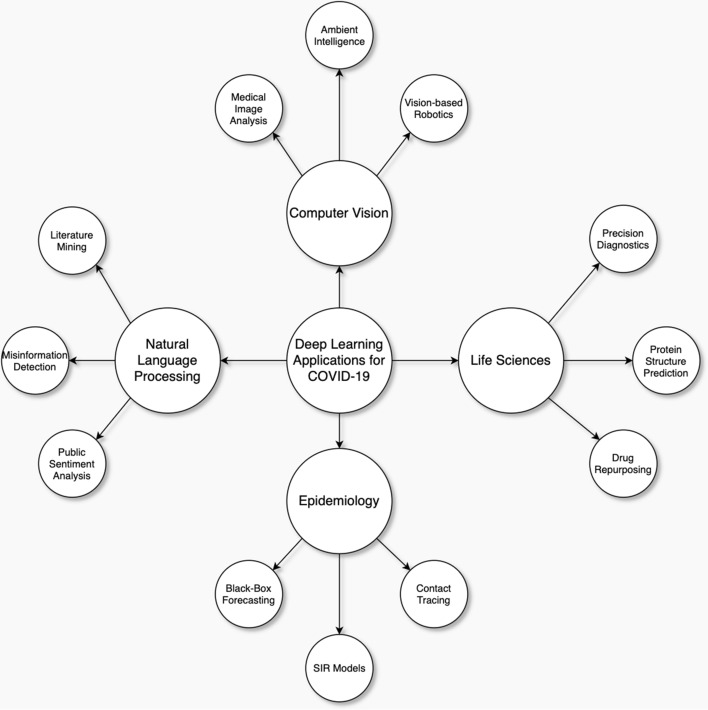
This survey explores how Deep Learning has battled the COVID-19 pandemic and provides directions for future research on COVID-19. We cover Deep Learning applications in Natural Language Processing, Computer Vision, Life Sciences, and Epidemiology. We describe how each of these applications vary with the availability of big data and how learning tasks are constructed. We begin by evaluating the current state of Deep Learning and conclude with key limitations of Deep Learning for COVID-19 applications. These limitations include Interpretability, Generalization Metrics, Learning from Limited Labeled Data, and Data Privacy. Natural Language Processing applications include mining COVID-19 research for Information Retrieval and Question Answering, as well as Misinformation Detection, and Public Sentiment Analysis. Computer Vision applications cover Medical Image Analysis, Ambient Intelligence, and Vision-based Robotics. Within Life Sciences, our survey looks at how Deep Learning can be applied to Precision Diagnostics, Protein Structure Prediction, and Drug Repurposing. Deep Learning has additionally been utilized in Spread Forecasting for Epidemiology. Our literature review has found many examples of Deep Learning systems to fight COVID-19. We hope that this survey will help accelerate the use of Deep Learning for COVID-19 research.
Overview
The claims and statistics of this paper haven’t been checked yet.
Free: it reads the open-access text and checks the first 5 claims that cite a source we can check. Create a free account to check every claim.
Integrity signals
Registry
Cites
Statistics
Figures
Verification
Claims the paper makes
The claims and statistics of this paper haven’t been checked yet.
Free: it reads the open-access text and checks the first 5 claims that cite a source we can check. Create a free account to check every claim.
Claims other papers make about this one
Each is checked against this paper’s own text: does it say what the citing paper says it does?
The source backs part of the claim, not all of it — or backs it for a different population, condition or comparison.
In the citing paper
“In 2020, DL is playing an increasingly vital role in early diagnosis of the novel coronavirus (COVID-19) [29, 46–48].”
From Review of deep learning: concepts, CNN architectures, challenges, applications, future directions (2021) · cites this paper as [29]
Experimental — accuracy not yet measured
Self-check
Percentages, sums and reported differences re-computed from the paper’s own numbers.
The self-check needs the paper’s full text.
Citations
Cites
Deep Residual Learning for Image Recognition
He, K., Zhang, X., Ren, S., & Sun, J. (2016) · 2016 IEEE Conference on Computer Vision and Pattern Recognition (CVPR) · doi:10.1109/cvpr.2016.90 · Cited by 235,474 · cited 6×
“This results in a 3% accuracy improvement over a more standard ResNet-50 architecture.”
MethodInfluentialVaswani, A., Shazeer, N., Parmar, N., Uszkoreit, J., Jones, L., Gomez, A. N., Kaiser, L., & Polosukhin, I. (2017) · arXiv · doi:10.48550/arxiv.1706.03762 · Cited by 120,404 · cited 2×
“NLP has seen a boom of interest due to the invention of the Transformer Neural Network architecture [21].”
BackgroundMethodImageNet classification with deep convolutional neural networks
Krizhevsky, A., Sutskever, I., & Hinton, G. E. (2017) · Communications of the ACM · doi:10.1145/3065386 · Cited by 112,155 · cited 8×
“AlexNet inspired further interest in Deep Neural Networks for Computer Vision.”
BackgroundInfluentialBERT: Pre-training of Deep Bidirectional Transformers for Language Understanding
Devlin, J., Chang, M.-W., Lee, K., & Toutanova, K. (2019) · Proceedings of the 2019 Conference of the North American Chapter of the Association for Computational Linguistics: Human Language Technologies, Volume 1 (Long and Short Papers) · doi:10.18653/v1/n19-1423 · Cited by 54,325
Densely Connected Convolutional Networks
Huang, G., Liu, Z., Van Der Maaten, L., & Weinberger, K. Q. (2017) · 2017 IEEE Conference on Computer Vision and Pattern Recognition (CVPR) · doi:10.1109/cvpr.2017.243 · Cited by 48,566
ImageNet Large Scale Visual Recognition Challenge
Russakovsky, O., Deng, J., Su, H., Krause, J., Satheesh, S., Ma, S., Huang, Z., Karpathy, A., Khosla, A., Bernstein, M., et al. (2015) · International Journal of Computer Vision · doi:10.1007/s11263-015-0816-y · Cited by 39,380 · cited 1×
“The success of Deep Computer Vision is largely attributed to the ImageNet dataset [82].”
Background(2008) · Journal of Machine Learning Research · Cited by 33,051
Exploring the Limits of Transfer Learning with a Unified Text-to-Text Transformer
Raffel, C., Shazeer, N., Roberts, A., Lee, K., Narang, S., Matena, M., Zhou, Y., Li, W., & Liu, P. J. (2019) · arXiv · doi:10.48550/arxiv.1910.10683 · Cited by 31,859 · cited 1×
“Some approaches to QA surveyed generate the answer directly [35], rather than classifying its presence in a context.”
BackgroundPyTorch: An Imperative Style, High-Performance Deep Learning Library
Paszke, A., Gross, S., Massa, F., Lerer, A., Bradbury, J., Chanan, G., Killeen, T., Lin, Z., Gimelshein, N., Antiga, L., et al. (2019) · arXiv · doi:10.48550/arxiv.1912.01703 · Cited by 31,473
Distributed Representations of Words and Phrases and their Compositionality
Mikolov, T., Sutskever, I., Chen, K., Corrado, G., & Dean, J. (2013) · arXiv · doi:10.48550/arxiv.1310.4546 · Cited by 24,533 · cited 1×
“A promising approach to this is the emphasis on evidence retrieval such as Retrieval-Augmented Generation [151].”
Background
Research works printed but not linked: 1
- Kingma D, Ba J. Adam: A method for stochastic optimization. In: International conference on learning representations; 2014.
Cited by
Items 301–350 of 350
Zhao, W., & Wang, W. (2023) · Research Square · doi:10.21203/rs.3.rs-3118475/v1
Cedeño-Moreno, D., Vargas-Lombardo, M., & Navarro, N. D. C. (2023) · Communications in computer and information science · doi:10.1007/978-3-031-45682-4_10
Methods for Analyzing Unknown Health Risk Based on Nature Language Process (NLP)
Liu, J., & Jiang, T. (2023) · Studies in health technology and informatics · doi:10.3233/shti230894
Interactive art design with deep learning and information fusion technology
Zhu, M. (2023) · International Workshop on Signal Processing and Machine Learning (WSPML) · doi:10.1117/12.3014595
“Shorten C believed that deep learning is suitable for various tasks such as natural language processing, computer vision, and life sciences [8].”
BackgroundDetecting Facial Expressions and Recognition in a Mask Wear Person
Gupta, R., Sharma, S., & Anand, M. (2023) · International Conference on Recent Advances in Information Technology for Sustainable Development (ICRAIS) · doi:10.1109/icrais59684.2023.10367079
“Their capacity to discern intricate patterns and hierarchical representations from vast datasets has been a key factor in these advancements [4].”
BackgroundMotion Posture Detection Based on Image Recognition through Deep Learning Algorithm
Hou, W., Wang, P., Lv, X., Yang, J., Man, W., & Zhao, X. (2023) · International Conference on Evolutionary Algorithms and Soft Computing Techniques (EASCT) · doi:10.1109/easct59475.2023.10392598
“However, such methods are very sensitive to human pose and motion, and fail if the pose changes or the motion changes [7].”
BackgroundLogistics Distribution Route Planning and Resource Allocation Based on Deep Learning Algorithm
Song, S. (2023) · International Conference on Evolutionary Algorithms and Soft Computing Techniques (EASCT) · doi:10.1109/easct59475.2023.10392906
“…of Input Level, Output Level and Concealed Level, which are mostly applied to Image Identification [9], Recurrent Neural Networks (RNN) are Supervised Learning Methods, which are designed for Natural Language Processing (NLP) and LSTM (NLP), which is a non-supervised Learning Method [10].”
MethodApplication of Deep Learning in Scalable Computer Network Design Software System
Shi, J., Yanxia, Z., Donggang, H., & Hongjun, Q. (2023) · IEEE International Conference on Data Science and Computer Application (ICDSCA) · doi:10.1109/icdsca59871.2023.10392926
“With the continuous deepening of research, the application scope of this technology in the field of computer network design continues to expand, becoming one of the most promising machine learning technologies currently [6].”
BackgroundInvestigation on Energy Data Prediction and Optimization Methods Based on Deep Learning
Anqing, C., Ruoxue, W., Xu, Z., Dalin, W., & Hualong, L. (2023) · IEEE International Conference on Artificial Intelligence and Computer Applications (ICAICA) · doi:10.1109/icaica58456.2023.10405611 · Cited by 2
“Therefore, they are widely used in energy data prediction and have achieved significant prediction accuracy and performance improvement [12-13].”
BackgroundKazi, A. K., Siddiqui, M. A., Ahmed, S. S., Asif, R., & Nabeel (2024) · Pakistan Journal of Engineering Technology & Science · doi:10.22555/pjets.v11i1.1029
“A survey was conducted in [8] which explores the several deep learning applications in natural language processing for COVID-19.”
BackgroundGRANULOMATOSIS WITH POLYANGIITIS: LITERATURE REVIEW
Sh.A., B., Khaitmurodov, D. E., & Kurbonov, Y. K. (2024) · International Journal of Medical Sciences And Clinical Research · doi:10.37547/ijmscr/volume04issue02-03
Deep Learning-Based Approaches for Early Diagnosis and Tracking of COVID-19Preprint
Lhiadi, R., Amaanaoui, T., Kaaouachi, A., & Jaddar, A. (2024) · Research Square · doi:10.21203/rs.3.rs-4110808/v1
Cross-dataset application for fair evaluation of COVID-19 X-ray models
Pedroso, G. D. S. G., Ventura, T. M., & de Oliveira, A. G. (2023) · doi:10.5753/eri-mt.2023.236474
“…da COVID-19 e seu avanc¸o pelo mundo, diversos trabalhos com Inte-ligˆencia Artificial (IA), em espec´ıfico, as Redes Neurais Convolucionais ( Convolutional Neural Networks - CNN ), comec¸aram a ser realizados para auxiliar no combate da doenc¸a [Shorten et al. 2021, Altan and Karasu 2020].”
BackgroundAnalysis and Prediction of Covid19 Patient Details using Machine Learning
Kumar, A., Singh, K. U., Singh, T., Kumar, G., Pandey, S. K., & Dwivedi, P. D. (2023) · International Conference on Artificial Intelligence for Innovations in Healthcare Industries (ICAIIHI) · doi:10.1109/icaiihi57871.2023.10489308
“…technique which is available for CVD by using both ANN and BNS by applying this algorithm to this application for classification purpose result generates 99.51% and 97.92% the accuracy is calculated which help medical field in the form of earlier detection and also in accuracy aspect wise [6].”
MethodInfluential(2024) · International Research Journal of Modernization in Engineering Technology and Science · doi:10.56726/irjmets49071
An Efficient Deep Learning Approach for Detection of COVID-19 from Chest CT Scan Images
Patil, P. B. (2024) · Journal of Electrical Systems · doi:10.52783/jes.2992
“…may not always diagnose positive cases of COVID-19 using CT images, which can delay treatment and even promote further transmission of the virus because infected patients are not immediately isolated, even though rapid detection of the infection using CT images is critical [10] [11] [12].”
BackgroundSustainable Artificial Intelligence: Assessing Performance in Detecting Fake Images
Alrusaini, O. A. (2024) · International Journal of Advanced Computer Science and Applications · doi:10.14569/ijacsa.2024.0150493
“It is a collection of techniques involving statistical and pixel-level image analysis to identify inconsistencies [15, 16].”
MethodHerzog, D. J., & Herzog, N. J. (2024) · Metaverse · doi:10.54517/m.v5i1.2690 · Cited by 2
Application of Big Data Technology in Data Prediction Models Based on Deep Learning Algorithms
He, Y. J., & Ma, L. (2024) · International Conference on Distributed Computing and Electrical Circuits and Electronics (ICDCECE) · doi:10.1109/icdcece60827.2024.10548254
“In big data processing and analysis, a distributed computing framework is used for large-scale data processing and analysis tasks, and Apache Flink, a real-time streaming processing framework, is used to provide instant feedback [16-17].”
Gao, C., Zhan, S., Lin, Y., Zhu, E., Liu, Y., Zheng, X., & Hong, S. (2024) · IEEE International Conference on Image Processing and Computer Applications (ICIPCA) · doi:10.1109/icipca61593.2024.10709044
“Each time step represents an electricity consumption data point, and the inputs for each time step include factors such as electricity consumption, time characteristics, etc. [12-13].”
BackgroundYang, J., Liu, H., Liu, F., Yang, H., Chen, Q., & Han, D. (2024) · IEEE International Conference on Image Processing and Computer Applications (ICIPCA) · doi:10.1109/icipca61593.2024.10709245
“For reservoirs, seismic data or core images can be used as inputs to extract spatial features through convolutional and pooling layers, and then attribute prediction can be performed through fully connected layers [17-18].”
BackgroundKushnareva, M. (2024) · Journal of Social Science and Humanities · doi:10.53469/jssh.2024.6(12).20
Fault Diagnosis and Prediction of Secondary Power Equipment Based on Deep Learning
Li, Z., Wang, Y., Zhi, Z., & Zhao, G. (2025) · Lecture notes in electrical engineering · doi:10.1007/978-981-96-4675-3_31
Asraf, S. S., Nagaraj, P., & Muneeswaran, V. (2025) · Elsevier eBooks · doi:10.1016/b978-0-443-26765-9.00001-9
Using Natural Language Processing (NLP) to Identify Fraudulent Healthcare Claims
Cheekaramelli, M. J. R. (2025) · International Journal of Computing and Engineering · doi:10.47941/ijce.2738 · Cited by 3
“Most importantly, these clusters significantly speed up deep learning (Shorten et al., 2021) and their processing times for complex models.”
Research on Occluded Face Restoration Based on Denoising Diffusion Modeling
Wang, Y. (2025) · IEEE International Conference on Electronic Technology, Communication and Information (ICETCI) · doi:10.1109/icetci64844.2025.11084040
“Kroner et al [10] proposed that combining AE structure with GAN can enable complex image texture reconstruction to some extent, thus restoring more realistic images, but the resolution of the restored images is not high.”
Kavitha, N. S., Rajasekar, L., Muniyandy, E., & Balaji, S. R. (2025) · SSRN Electronic Journal · doi:10.2139/ssrn.5351404
More than Words: The Value of Alignment, Narrative, and Persuasion in Managerial Strategic ResponsesPreprint
Babu, X., & Zhang, J. (2025) · SSRN Electronic Journal · doi:10.2139/ssrn.5382813
Real-Time Body Modeling and Clothing Adaptation Based on Generative Adversarial Network
Xiang, Y., & Ma, C. (2025) · IEEE International Conference on Image Processing and Computer Applications (ICIPCA) · doi:10.1109/icipca65645.2025.11139003
“The specific implementation and performance of different deep learning models in these applications were analyzed [2].”
Construction of Digital Video Monitoring Platform for Smart Grid Based on DL Algorithm
Liu, Y., Miao, C., Mei, L., Jiang, G., & Lv, J. (2024) · International Conference on Internet of Things, Robotics and Distributed Computing (ICIRDC) · doi:10.1109/icirdc65564.2024.00067
“Shorten C conducted in-depth research on the application of deep learning in the COVID-19 pandemic [6].”
Izuchukwu, C., Wimmer, H., Schwind, J. S., & Tome, J. (2025) · The Open Public Health Journal · doi:10.2174/0118749445406703250824134524
Medical Image Information Segmentation Algorithm based on Deep Learning
Zhou, W. (2025) · International Conference on Intelligent Computing and Knowledge Extraction (ICICKE) · doi:10.1109/icicke65317.2025.11136622
“Ultimately, it is injected into the corresponding stage of the decoder through a skip connection to achieve lesion edge refinement and multi-scale context perception [12] .”
Lv, J., Zhang, B., Cao, C., Jiang, G., Zhang, T., & Li, J. (2025) · Lecture notes in networks and systems · doi:10.1007/978-981-96-6124-4_47
Applications of Artificial Intelligence in Instructional Design and Educational Strategies
Ruiz-Jaimes, M. Á., Navarro, Y. T., Castillo, Á. I. D., Morales, T. H. V., Cortés, A. L. B., & Ruíz-Vanoye, J. A. (2025) · Advances in computational intelligence and robotics book series · doi:10.4018/979-8-3373-0598-1.ch008 · Cited by 1
Additional file 1 of The forecast of COVID-19 spread risk at the county level
Hssayeni, M. D., Chala, A., Dev, R., Xu, L., Shaw, J., Furht, B., & Ghoraani, B. (2021) · Figshare · doi:10.6084/m9.figshare.14927032
Self-citationWelding Deformation Prediction Model of Pump Truck Arm Based on Deep Learning
Liu, Z., Liu, H., & Zeng, R. (2025) · Lecture notes in electrical engineering · doi:10.1007/978-981-96-5906-7_19
Building Information Modeling and Analysis Based on Big Data and Deep Learning
Li, R. (2025) · IEEE International Conference on Control, Electronics and Computer Technology (ICCECT) · doi:10.1109/iccect64621.2025.11339697
Mut, N. A. I. C., Ali, O., & Zain, N. M. (2025) · International Journal of Education Psychology and Counseling · doi:10.35631/ijepc.1061001
Bag, A., Chowdhury, A., Das, C., Ray, S. S., & Ghosh, K. (2026) · International Conference on Image Processing and Capsule Networks (ICIPCN) · doi:10.1109/icipcn67432.2026.11438547
“With the availability of large-scale and high-resolution datasets, researchers increasingly adopted machine learning and deep learning approaches that includes LSTM and other neural network models [19], [20] to capture nonlinear temporal patterns and improve forecasting accuracy.”
Chen, H., Liu, C., Chen, J., Luo, G., Chen, L., Chen, X., & Li, M. (2025) · International Conference on Electronic Communication, Computer Science and Technology (ECCST) · doi:10.1109/eccst68196.2025.11441178
“To thoroughly evaluate performance, we benchmark our method against YOLOv5s [9] , MobileNet [3] , and ShuffleNet [4] due to their suitability for edge devices.”
Data-driven Management Solution for Microservice-based Deep Learning Applications
Houmani, Z. (2021) · theses.fr (ABES) · doi:10.70675/8a393657zad8cz4129za1d0z77b80e884d8b · Cited by 1
Zhang, Y., & Wan, X. (2025) · International Conference Communication, Networks & Computing · doi:10.1109/cnc68716.2025.11484946
“Through the above steps, the model can accurately capture and understand the environmental change patterns in the urbanization process [14-15] .”
FAMIT-P: Fairness-Aware Mobility-Modulated Transformer for Future Pandemic Forecasting
Ansari, N. W., Ahmed, T., Hasan, M., Rafi, M. A. H., Rahat, M. M. A., Trina, N. A., & Tanfe, S. A. (2025) · IEEE International Conference on Biomedical Engineering, Computer and Information Technology for Health (BECITHCON) · doi:10.1109/becithcon69222.2025.11504302
“Models must be both equitable and interpretable to avoid biases and build trust, thereby supporting effective decision-making [7].”
Gokul, A. G., Kumaratharan, N., Rani, P. L., & Devi, N. (2026) · Measurement Science Review · doi:10.2478/msr-2026-0018
“This approach can be applied to diversified diseases, such as cancer, cardiovascular diseases, diabetes, and infectious diseases [7].”
From Fear to Forecast: Machine Learning Solutions for Mass Psychosis in Crisis Scenarios
Sheikh, R., Sharma, L., Singh, D., Rout, P. P., Das, S., & Yadav, T. (2026) · Cureus Journal of Computer Science. · doi:10.7759/s44389-026-00085-z
“MPI was first documented in the 15th century when mass motor outbreaks were often misattributed to demonic possessions, i.e., the Salem Witch Trials being the classic example of this [6,7,8].”
Application of artificial intelligence chatbots for primary diagnosis at home
Hirosawa, T. (2026) · Elsevier eBooks · doi:10.1016/b978-0-443-43934-6.00006-7
Mažonienė, E., & Šešok, D. (2026) · Symmetry · doi:10.3390/sym18081294
Development of Non-contact Mental Health Monitoring Method and System Based on Computer Vision
Hou, S., & Wang, Y. (2026) · Lecture notes on data engineering and communications technologies · doi:10.1007/978-981-95-7622-7_39
Kandati, D. R., Anusha, S., Ashalatha, N., & Ahmed, M. A. (2026) · International Journal of Clinical Microbiology and Biochemical Technology · doi:10.29328/journal.ijcmbt.1001042
Shen, T., Lei, X., Lok, H. K., Li, H., 潘中泽, Wang, X., & Fu, X. (2026) · Frontiers in Materials · doi:10.3389/fmats.2026.1966940
Metadata
- Authors
- Shorten, C., Khoshgoftaar, T. M., & Furht, B.
- Affiliations
- Florida Atlantic University (US)
- Corresponding author
- Shorten, Connor
- Venue
- Journal of Big Data
- Published
- 2021-01-11
- Volume
- 8
- Issue
- 1
- Pages
- 18-18
- ISSN
- 2196-1115 (ISSN-L)
- PMC
- PMC7797891
- OpenAlex
- W3121263745
- Cited by
- 350
- References
- 175
- Citations by year
- 2026: 10 · 2025: 42 · 2024: 54 · 2023: 92 · 2022: 100 · 2021: 52
- FWCI
- 39.32
- Type
- journal article
- Language
- en
- Open access
- gold
- doi.org
- Licence
- cc-by
- creativecommons.org/licenses/by/4.0 (tdm)
- creativecommons.org/licenses/by/4.0 (vor)
- Locations
- Journal Of Big Data (publishedVersion, cc-by)
- PubMed Central (publishedVersion, cc-by)
- PubMed (publishedVersion)
- DOAJ (DOAJ: Directory of Open Access Journals) (submittedVersion, cc-by-sa)
- Funders
- National Science Foundation (IIS-2027890)
- Topics
- Health Sciences › Medicine › Radiology, Nuclear Medicine and Imaging › COVID-19 diagnosis using AI
- Health Sciences › Medicine › Health Informatics › Artificial Intelligence in Healthcare and Education
- Physical Sciences › Computer Science › Information Systems › Healthcare during COVID-19 Pandemic
- Keywords
- COVID-19 pandemic, deep learning applications, natural language processing, computer vision, information retrieval, question answering, misinformation detection, sentiment analysis, medical image analysis, ambient intelligence, vision-based robotics, precision diagnostics, protein structure prediction, drug repurposing, interpretability, limited labeled data, data privacy
About these checks
Registry, retraction, Cites and statistics results are computed, not judged, with one exception: a printed reference that no index lists is read once by a model before it counts as a citation error. Claims are extracted by a model and kept only when their quote appears verbatim in the text; each cited source is then checked, with a model’s help, for whether it says what the claim relies on. Those verdicts can be wrong — read the claim’s quote and the cited source before relying on one.
Statistics and arithmetic are recomputed, not judged.
Confidence bands are shown only for fields calibrated on our annotated test set. None is calibrated yet, so no band is shown.
What counts as a claim ›How we measure confidence ›How we check this ›
Are you an author, or do you see a problem with this page? Request a review
Data sources
Bibliographic data: Semantic Scholar, OpenAlex, Crossref.
Contains information from the Semantic Scholar Academic Graph Datasets, made available under the ODC Attribution License (ODC-BY 1.0).
Semantic Scholar’s data is described in: Kinney, R., et al. (2023). The Semantic Scholar Open Data Platform. arXiv:2301.10140.
