

Race and gender differences in how sense of belonging influences decisions to major in STEM
Open accessThe DOI matches its Crossref record; 28 of the 30 references it cites were found in a registry or an index; none of the 25 sources its claims cite is checked for support yet.
Abstract
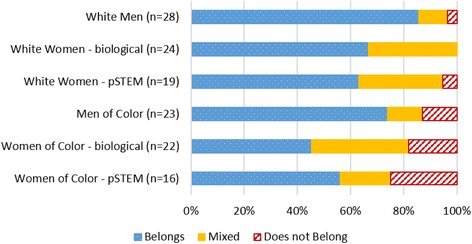
BACKGROUND: Women and students of color are widely underrepresented in most STEM fields. In order to investigate this underrepresentation, we interviewed 201 college seniors, primarily women and people of color, who either majored in STEM or started but dropped a STEM major. Here we discuss one section of the longer interview that focused on students' sense of belonging, which has been found to be related to retention. In our analysis, we examine the intersections of race and gender with students' sense of belonging, a topic largely absent from the current literature. RESULTS: We found that white men were most likely to report a sense of belonging whereas women of color were the least likely. Further, we found that representation within one's STEM sub-discipline, namely biology versus the physical sciences, impacts sense of belonging for women. Four key factors were found to contribute to sense of belonging for all students interviewed: interpersonal relationships, perceived competence, personal interest, and science identity. CONCLUSIONS: Our findings indicate that students who remain in STEM majors report a greater sense of belonging than those who leave STEM. Additionally, we found that students from underrepresented groups are less likely to feel they belong. These findings highlight structural and cultural features of universities, as well as STEM curricula and pedagogy, that continue to privilege white males.
Overview
CoChat Summary
TL;DR
This interview study of 201 college seniors examines how sense of belonging in STEM varies by race, gender, and their intersections, comparing STEM majors and leavers. It finds white men most likely and women of color least likely to report belonging, with belonging linked to interpersonal relationships, competence, interest, and science identity.
Key findings
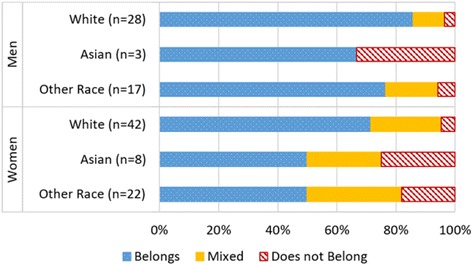
- White men were the most likely to report a sense of belonging compared with all other students (Z = 2.37, p ≤ 0.01), while women of color were the least likely (Z = 3.62, p ≤ 0.01).
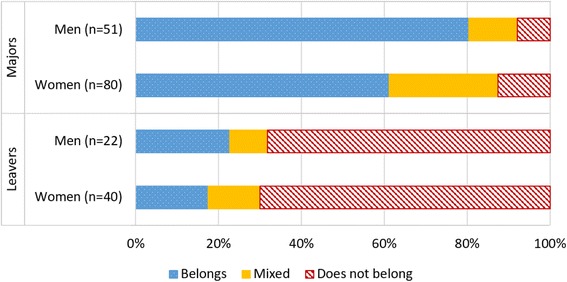
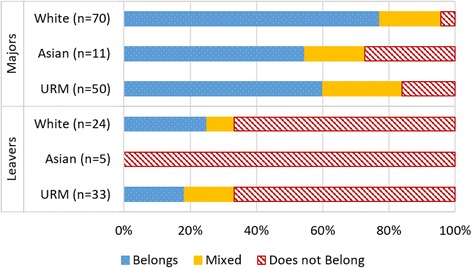
- Female STEM majors were significantly less likely than male majors to report belonging (Z = 2.41, p ≤ 0.01), and students of color who majored in STEM were significantly less likely than white majors to report belonging (Z = 2.23, p ≤ 0.01); leavers across demographic groups were more likely to report not belonging.
- Representation in a STEM subfield mattered: women of color in physical sciences (pSTEM), where they are highly underrepresented, reported belonging significantly less frequently than white men (Z = 2.17, p ≤ 0.05).
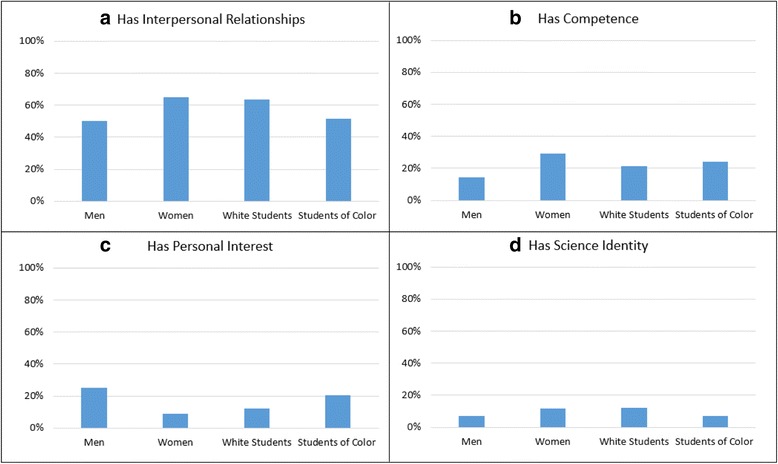
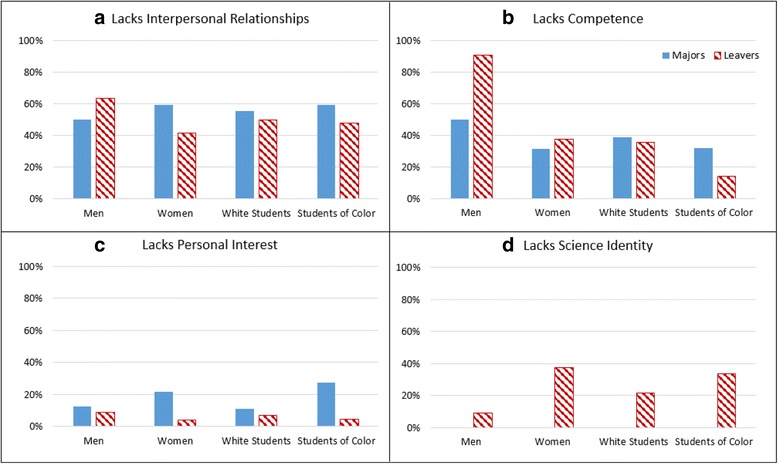
- Four themes explained belonging or lack of belonging: interpersonal relationships, perceived competence, personal interest, and science identity. Interpersonal relationships were the largest factor cited for each demographic group; competence was second. No majors cited a lack of science identity as a reason for not belonging, whereas approximately one quarter of leavers did.
Methods
- Qualitative interview study using a subset of 201 interviews from the larger Roots of STEM Success Project, which conducted more than 300 interviews with college seniors in 2013. Participants attended 1 of the 16 public University of North Carolina campuses, had attended North Carolina public school, were younger than 30, and were either STEM majors or STEM leavers.
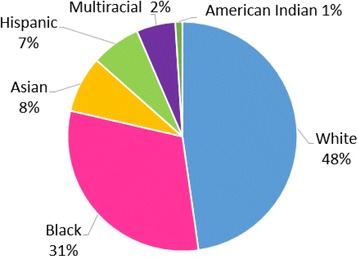
- The purposive sample oversampled students underrepresented in STEM: 66% women and 34% men; 48% white and 52% students of color. Students were recruited via email survey and interviewed for 30–60 min by Skype, phone, or in person.
- Analysis used a partial grounded theory approach: two researchers independently coded interviews, compared codes, and resolved discrepancies through discussion. Belonging explanations were coded into interpersonal relationships, science identity, personal interest, and competence; comparisons used tests of proportions and Z-scores.
Limitations
- The paper states the sample is self-selected and purposive, limited to college seniors in North Carolina who graduated from a North Carolina high school and attended one of the 16 UNC campuses, so findings are not generalizable beyond the sample. It also states only two axes of identity—race and gender—could be investigated.
- The paper acknowledges small subsample sizes, cautioning that some comparisons should be made with caution, and notes debate about using quantitative tests on qualitative data.
- Evident from the text: Asian students were collapsed with other students of color because of low numbers; competence was based on students’ self-perception, not actual grades or course performance; and the data are correlational, so causal direction cannot be determined.
Model-written summary. Check it against the paper before relying on it.
Integrity signals
Registry
Cites
Statistics
Figures
Verification
Claims the paper makes
0 Valid · 0 Not valid · 14 Not checked · 107 Own results and interpretations
A result the paper reports from its own data — it cites no other source for it, so there is none to check. The quote shows it is in the paper.
In the paper
“We find that women of color in pSTEM, where they are highly underrepresented, report belonging significantly less frequently than white men (Z = 2.17, p ≤ 0.05).”
§ Race and gender differences in how sense of belonging influences decisions to major in STEM > Results > The intersection of race and gender in students’ sense of belonging
plainstates an association- Asserted: passes — The authors put it forward as true.
- Checkable: passes — It can be checked against evidence.
- Load-bearing: passes — The paper’s conclusions depend on it.
- Based: passes — The paper gives a reason why it holds.
A result the paper reports from its own data — it cites no other source for it, so there is none to check. The quote shows it is in the paper.
In the paper
“We found that female majors were significantly less likely than male majors to report they felt they belonged in STEM (Z = 2.41, p ≤ 0.01)”
§ Race and gender differences in how sense of belonging influences decisions to major in STEM > Results > The intersection of race and gender in students’ sense of belonging
plainstates an associationn = 51 ·- Asserted: passes — The authors put it forward as true.
- Checkable: passes — It can be checked against evidence.
- Load-bearing: passes — The paper’s conclusions depend on it.
- Based: passes — The paper gives a reason why it holds.
A result the paper reports from its own data — it cites no other source for it, so there is none to check. The quote shows it is in the paper.
In the paper
“we found that students of color who major in STEM are significantly less likely to report a sense of belonging than white majors (Z = 2.23, p ≤ 0.01)”
§ Race and gender differences in how sense of belonging influences decisions to major in STEM > Results > The intersection of race and gender in students’ sense of belonging
plainstates an association- Asserted: passes — The authors put it forward as true.
- Checkable: passes — It can be checked against evidence.
- Load-bearing: passes — The paper’s conclusions depend on it.
- Based: passes — The paper gives a reason why it holds.
A result the paper reports from its own data — it cites no other source for it, so there is none to check. The quote shows it is in the paper.
In the paper
“white men were the most likely to report a sense of belonging when compared to all other students (Z = 2.37, p ≤ 0.01)”
- Also stated in: § Results · plain
“white men were most likely to report a sense of belonging”
§ Race and gender differences in how sense of belonging influences decisions to major in STEM > Results > The intersection of race and gender in students’ sense of belonging
plainstates an association- Asserted: passes — The authors put it forward as true.
- Checkable: passes — It can be checked against evidence.
- Load-bearing: passes — The paper’s conclusions depend on it.
- Based: passes — The paper gives a reason why it holds.
- Also stated in: § Results · plain
A result the paper reports from its own data — it cites no other source for it, so there is none to check. The quote shows it is in the paper.
In the paper
“the patterns for Asian students match those of URMs’ more closely than those of white students”
§ Race and gender differences in how sense of belonging influences decisions to major in STEM > Results > The intersection of race and gender in students’ sense of belonging
plainstates an association- Asserted: passes — The authors put it forward as true.
- Checkable: passes — It can be checked against evidence.
- Load-bearing: passes — The paper’s conclusions depend on it.
- Based: passes — The paper gives a reason why it holds.
87 more claims
Create a free account to see all 121 claims and to verify the 25 references still open.
- The quote only partly states this claim. 2
- It may state two separate claims as one. 18
- Probably not a substantial claim. 14
Claims other papers make about this one
Each is checked against this paper’s own text: does it say what the citing paper says it does?
The source backs part of the claim, not all of it — or backs it for a different population, condition or comparison.
In the citing paper
“In a qualitative study contrasting students that persisted with those who left STEM, Rainey etal. (2018) found that while all students expressed the importance of sense of belonging, those that left their STEM major were lacking science identity.”
From "It Just Makes It Feel Like You're Not Alone": A Qualitative Study of a Social Support Group for High-Achieving, Low-Income STEM Majors (2024) · cites this paper as Rainey et al., 2018
Experimental — accuracy not yet measuredThe source backs part of the claim, not all of it — or backs it for a different population, condition or comparison.
In the citing paper
“More recent research focused specifically on STEM students suggests that institutional practices that promote STEM students' interpersonal relationships, perceived competence, personal interest, and science identity contribute to feelings of belonging (Rainey et al., 2018).”
From The Importance of STEM Sense of Belonging and Academic Hope in Enhancing Persistence for Low-Income, Underrepresented STEM Students (2024) · cites this paper as Rainey et al., 2018
Experimental — accuracy not yet measuredThe source backs part of the claim, not all of it — or backs it for a different population, condition or comparison.
In the citing paper
“Understanding representation matters and youth need to see people that look like them in leadership roles in science in order for them to visualize themselves in these fields (Indian University 2019; Rainey et al. 2018).”
From Creating Community and Engaging Community: The Foundations of the Estate Little Princess Archaeology Project in St. Croix, United States Virgin Islands (2022) · cites this paper as Rainey et al. 2018
Experimental — accuracy not yet measuredThe cited source says what the claim attributes to it.
In the citing paper
“Additionally, in their qualitative investigation, Rainey et al. found that STEM students' perceptions of sense of belonging affected their decisions to persist or withdraw from their STEM major.”
From The Importance of STEM Sense of Belonging and Academic Hope in Enhancing Persistence for Low-Income, Underrepresented STEM Students (2024) · cites this paper as Rainey et al., 2018
Self-check
Percentages, sums and reported differences re-computed from the paper’s own numbers.
Each contradiction between two passages listed here was confirmed by an independent check.
Rated minor: it would not touch a result — a value no result rests on, a p-value that stays on the same side of the significance level, or a conflict that is clerical, resolved elsewhere in the paper, or outside its own findings.
In the paper
§ Race and gender differences in how sense of belonging influences decisions to major in STEM > Results > The intersection of race and gender in students’ sense of belonging
“We have responses from 22 men and 40 women who were leavers.”
§ Race and gender differences in how sense of belonging influences decisions to major in STEM > Results > The intersection of race and gender in students’ sense of belonging
“We have responses from 24 white students, 5 Asian students, and 35 URMs who were leavers.”
Citations
Cites
Mapping the Margins: Intersectionality, Identity Politics, and Violence against Women of Color
Crenshaw, K. (1991) · Stanford Law Review · doi:10.2307/1229039 · Cited by 32,792 · cited 5×
“Intersectionality refers to the idea that aspects of one’s identity (e.g., race, gender, class, sexual orientation) are not unitary and mutually exclusive, but instead interact to construct one’s identity (Crenshaw 1991; Collins 2015).”
InfluentialThe Journal of College Science Teaching
(1971) · Journal of Chemical Education · doi:10.1021/ed048p284 · Cited by 3,332
Women, Minorities, and Persons with Disabilities in Science and Engineering: 2013: (558442013-001)
(2013) · PsycEXTRA Dataset · doi:10.1037/e558442013-001 · Cited by 2,471
Carlone, H. B., & Johnson, A. (2007) · Journal of Research in Science Teaching · doi:10.1002/tea.20237 · Cited by 2,433 · cited 5×
“There exist other intersectional works that investigate women of color’s experiences (e.g., Carlone and Johnson 2007; Crenshaw 1991), but we had difficulty finding literature that focused on women of color’s sense of belonging.”
InfluentialIntersectionality's Definitional Dilemmas
Collins, P. H. (2015) · Annual Review of Sociology · doi:10.1146/annurev-soc-073014-112142 · Cited by 2,419
Mattley, C., Strauss, A., & Corbin, J. (1999) · Contemporary Sociology · doi:10.2307/2655359 · Cited by 2,408 · cited 1×
“Using a partial grounded theory approach to qualitative data analysis (Strauss and Corbin 1997), two researchers independently read the responses and coded under broad categories, some of which were determined a priori and others that emerged from the data.”
A question of belonging: Race, social fit, and achievement.
Walton, G. M., & Cohen, G. L. (2007) · Journal of Personality and Social Psychology · doi:10.1037/0022-3514.92.1.82 · Cited by 2,163
Bowleg, L. (2008) · Sex Roles · doi:10.1007/s11199-008-9400-z · Cited by 2,004 · cited 1×
“For example, considering race and gender as single axes of identity without analysis of the intersections of those groups can lead to the erasure of some identities, such as for women of color (Bowleg 2008; Crenshaw 1991).”
A Brief Social-Belonging Intervention Improves Academic and Health Outcomes of Minority Students
Walton, G. M., & Cohen, G. L. (2011) · Science · doi:10.1126/science.1198364 · Cited by 1,992
Classroom Belonging among Early Adolescent Students: Relationships to Motivation and Achievement
Goodenow, C. (1993) · The Journal of Early Adolescence · doi:10.1177/0272431693013001002 · Cited by 1,614 · cited 1×
“Sense of belonging refers to “students’ sense of being accepted, valued, included, and encouraged by others (teachers and peers) in the academic classroom setting and of feeling oneself to be an important part of the life and activity of the class” (Goodenow 1993, p. 80).”
Why do women opt out? Sense of belonging and women's representation in mathematics.
Good, C., Rattan, A., & Dweck, C. S. (2012) · Journal of Personality and Social Psychology · doi:10.1037/a0026659 · Cited by 1,113 · cited 2×
“Within STEM, both women and students of color have consistently reported less sense of belonging than men and white students (Good et al. 2012; Johnson 2012; Smith et al. 2013).”
Signaling Threat: How Situational Cues Affect Women in Math, Science, and Engineering Settings
Murphy, M. C., Steele, C. M., & Gross, J. J. (2007) · Psychological Science · doi:10.1111/j.1467-9280.2007.01995.x · Cited by 1,048 · cited 2×
“can influence sense of belonging, particularly for women in male-dominated fields, such as most STEM disciplines (Murphy et al. 2007).”
Using Numbers in Qualitative Research
Maxwell, J. A. (2010) · Qualitative Inquiry · doi:10.1177/1077800410364740 · Cited by 985
College Students' Sense of Belonging
Strayhorn, T. L. (2012) · doi:10.4324/9780203118924 · Cited by 690 · cited 2×
“Interpersonal relationships were the largest factor cited for each demographic group, aligning with the literature (Strayhorn 2012).”
College Students' Sense of Belonging: A Key to Educational Success for All Students
Strayhorn, T. L. (2012) · Cited by 662
Strauss, A. L. (1997) · Cited by 650
Ong, M., Smith, J. M., & Ko, L. T. (2018) · Journal of Research in Science Teaching · doi:10.1002/tea.21417 · Cited by 613 · cited 1×
“Though it is beyond the scope of this work, there exists literature (e.g., Ong et al. 2017) that investigates women of color’s persistence and resilience in STEM.”
Espinosa, L. (2011) · Harvard Educational Review · doi:10.17763/haer.81.2.92315ww157656k3u · Cited by 585 · cited 5×
“Our definition overlaps in part with Carlone and Johnson’s definition of research scientist identity, which relates to excitement for uncovering the natural world and scientific knowledge (Carlone and Johnson 2007; Espinosa 2011).”
InfluentialBianchini, J. A. (2013) · Science Education · doi:10.1002/sce.21032 · Cited by 560 · cited 3×
“Research that examines only race or only gender differences in outcomes may mask the ways intersections of race and gender shape experiences of students.”
Higher Education: Handbook of Theory and Research
(1998) · Higher Education: Handbook of Theory and Research · doi:10.1007/978-94-011-3971-7 · Cited by 479
Johnson, D. R. (2012) · Journal of College Student Development · doi:10.1353/csd.2012.0028 · Cited by 319
Smith, J. L., Lewis, K. L., Hawthorne, L., & Hodges, S. D. (2013) · Personality and Social Psychology Bulletin · doi:10.1177/0146167212468332 · Cited by 256 · cited 5×
“Recent studies have continued to confirm these findings (Smith et al. 2013; Thoman et al. 2014; Walton and Cohen 2011).”
InfluentialThe effects of an academic environment intervention on science identification among women in STEM
Ramsey, L. R., Betz, D. E., & Sekaquaptewa, D. (2013) · Social Psychology of Education · doi:10.1007/s11218-013-9218-6 · Cited by 152 · cited 1×
“For example, multiple academic and environmental interventions have been shown to improve women’s and minorities’ sense of belonging (Ramsey et al. 2013; Smith et al. 2013; Walton and Cohen 2011).”
Thoman, D. B., Arizaga, J. A., Smith, J. L., Story, T. S., & Soncuya, G. (2014) · Psychology of Women Quarterly · doi:10.1177/0361684313499899 · Cited by 102 · cited 3×
“Such feelings may cause those students, especially women, to experience competing belonging from non-STEM fields, pulling them out of STEM (Thoman et al. 2014).”
Hazari, Z., Sadler, P. M., & Sonnert, G. (2013) · The journal of college science teaching · Cited by 64
To recruit and advance: women students and faculty in science and engineering
(2007) · Choice Reviews Online · doi:10.5860/choice.44-5018 · Cited by 64 · cited 3×
“Research that examines only race or only gender differences in outcomes may mask the ways intersections of race and gender shape experiences of students.”
Möller, S., Banerjee, N., Bottía, M. C., Stearns, E., Mickelson, R. A., Dancy, M., Wright, E., & Valentino, L. (2014) · Journal of Hispanic Higher Education · doi:10.1177/1538192714540533 · Cited by 34 · cited 1×
“Other analyses using the same dataset may be found in Mickelson et al. (2015) and Moller et al. (2015).”
Self-citationStatistical Trends in Women’s Participation in Science: Commentary on Valla and Ceci (2011)
Kessel, C., & Nelson, D. J. (2011) · Perspectives on Psychological Science · doi:10.1177/1745691611400206 · Cited by 10 · cited 1×
“Women and people of color have been largely underrepresented in, and historically excluded from, most STEM fields, though trends are showing improvement (Kessel and Nelson, 2011; National Science Foundation and National Center for Science and Engineering Statistics, 2017).”
Research works printed but not linked: 6
- Meiners, E., Fuller, L., McCullough, L., Newell, D., Bartsch, I., & Daly, C. (2004). Special Issue: Women in Science Vol. 5,# 4, May 2004 Editor, Heidi Fencl, University of Wisconsin Green Bay, Department of Physics. Journal of International Women’s Studies, 5, 1.
- Mickelson RA Parker A Stearns E Moller S Dancy M Ruiz-Smith Lawson Clark S Family matters: familial support and African American female success Contemporary African American families: achievements, challenges, and empowerment strategies in the 21st century 2015 New York Routledge-Taylor & Francis
- National Research Council (2013). Seeking solutions: maximizing American talent by advancing women of color in academia: summary of a conference. Washington: National Academies Press.
- National Science Foundation National Center for Science and Engineering Statistics Women, minorities, and persons with disabilities in science and engineering: 2017 2017 Arlington Special Report NSF 17–310
- Shain, C. H. (2002). Revisiting the problem of engineering school persistence in African-American women students. Doctoral dissertation. Retrieved from ProQuest Dissertations and Theses database. (Publication No. 304798888).
- Valenzuela, Y. (2006). Mi fuerza/my strength. The academic and personal experiences of Chicana/Latina transfer students in math and science. Doctoral dissertation. Retrieved from Pro-Quest Dissertation and Theses database. (Publication No. 304916976).
Cited by
Allen, K.-A., Kern, M. L., Rozek, C. S., McInerney, D. M., & Slavich, G. M. (2021) · Australian Journal of Psychology · doi:10.1080/00049530.2021.1883409 · Cited by 935
“…sexually or gender diverse, or individuals with behaviours, attributes, or abilities that depart from the social norm, such as those that stem from mental health issues or disability (Gardner et al., 2019; Harrist & Bradley, 2002; Rainey et al., 2018; Spencer et al., 2016; Steger & Kashdan, 2009).”
BackgroundKricorian, K., Seu, M., Lopez, D., Ureta, E., & Equils, O. (2020) · International Journal of STEM Education · doi:10.1186/s40594-020-00219-2 · Cited by 298
Chan, R. C. H. (2022) · International Journal of STEM Education · doi:10.1186/s40594-022-00352-0 · Cited by 188
“Women also experience less positivity, a lack of belonging, and unequal treatment in STEM work environments, which further lead to lower aspirations toward STEM-related careers (Rainey et al., 2018).”
BackgroundHostile climates are barriers to diversifying the geosciences
Marín-Spiotta, E., Barnes, R. T., Berhe, A. A., Hastings, M. G., Mattheis, A., Schneider, B., & Williams, B. M. (2020) · Advances in Geosciences · doi:10.5194/adgeo-53-117-2020 · Cited by 226
Harris, R. B., Mack, M. R., Bryant, J., Theobald, E. J., & Freeman, S. (2020) · Science Advances · doi:10.1126/sciadv.aaz5687 · Cited by 183
Metadata
- Authors
- Rainey, K., Dancy, M., Mickelson, R., Stearns, E., & Moller, S.
- Affiliations
- University of Colorado Boulder (US)
- University of North Carolina at Charlotte (US)
- Corresponding author
- Rainey, Katherine
- Venue
- International Journal of STEM Education
- Published
- 2018-04-10
- Volume
- 5
- Issue
- 1
- Pages
- 10-10
- ISSN
- 2196-7822 (ISSN-L)
- PMC
- PMC6310405
- OpenAlex
- W2806119487
- Cited by
- 681
- References
- 30
- Citations by year
- 2026: 75 · 2025: 118 · 2024: 141 · 2023: 109 · 2022: 84 · 2021: 74 · 2020: 61 · 2019: 16 · 2018: 2
- FWCI
- 76.00
- Type
- journal article
- Language
- en
- Open access
- gold
- doi.org
- Licence
- cc-by
- creativecommons.org/licenses/by/4.0 (tdm)
- creativecommons.org/licenses/by/4.0 (vor)
- Locations
- International Journal of STEM Education (publishedVersion, cc-by)
- Europe PMC (PubMed Central) (publishedVersion, cc-by)
- PubMed Central (publishedVersion, cc-by)
- PubMed (publishedVersion)
- DOAJ (DOAJ: Directory of Open Access Journals) (submittedVersion, cc-by-sa)
- Funders
- National Science Foundation (0969286)
- Topics
- Social Sciences › Psychology › Applied Psychology › Career Development and Diversity
- Social Sciences › Education › Higher Education Research Studies
- Social Sciences › Sociology and Political Science › Critical Race Theory in Education
- Keywords
- sense of belonging, STEM major choice, underrepresentation in STEM, women in STEM, students of color, gender and race intersection, STEM retention, science identity, perceived competence, interpersonal relationships, college seniors
About these checks
Registry, retraction, Cites and statistics results are computed, not judged, with one exception: a printed reference that no index lists is read once by a model before it counts as a citation error. Claims are extracted by a model and kept only when their quote appears verbatim in the text; each cited source is then checked, with a model’s help, for whether it says what the claim relies on. Those verdicts can be wrong — read the claim’s quote and the cited source before relying on one.
A language model drew the claims from the paper on 2026-10-05, under version 3 of the claim definition (model deepseek-v4.1-flash, prompt extract-v3).
A second model labelled each claim on 2026-10-05 (model jev-1.13-20260917, definition revision gold-guideline-v0.2).
Statistics and arithmetic are recomputed, not judged.
Confidence bands are shown only for fields calibrated on our annotated test set. None is calibrated yet, so no band is shown.
What counts as a claim ›How we measure confidence ›How we check this ›
Are you an author, or do you see a problem with this page? Request a review
Data sources
Bibliographic data: Semantic Scholar, OpenAlex, Crossref.
Contains information from the Semantic Scholar Academic Graph Datasets, made available under the ODC Attribution License (ODC-BY 1.0).
Semantic Scholar’s data is described in: Kinney, R., et al. (2023). The Semantic Scholar Open Data Platform. arXiv:2301.10140.
