

The DOI matches its Crossref record; 208 of the 210 references it cites were found in a registry or an index.
Conserved genes and pathways in primary human fibroblast strains undergoing replicative and radiation induced senescence
Open accessAbstract
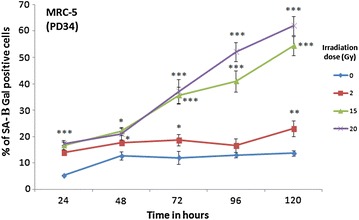
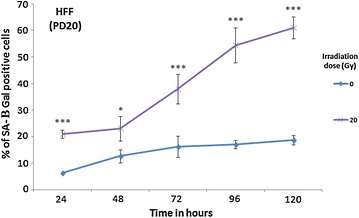
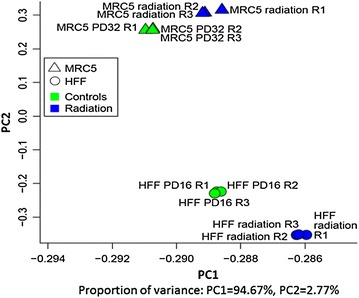
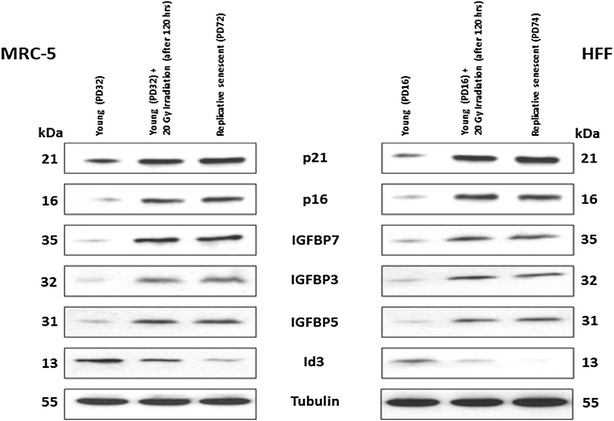
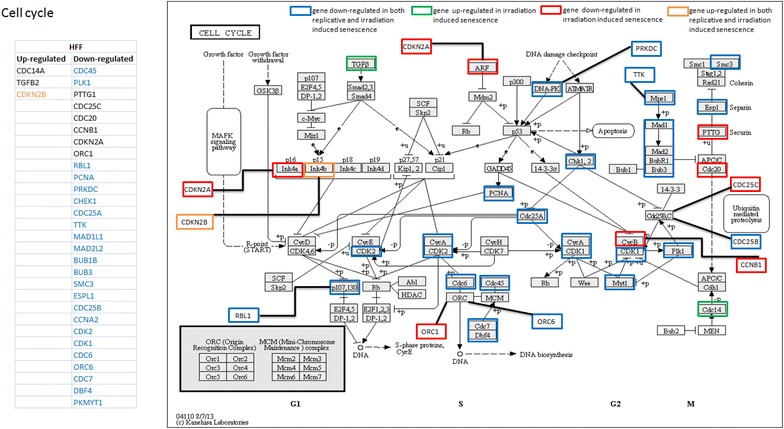
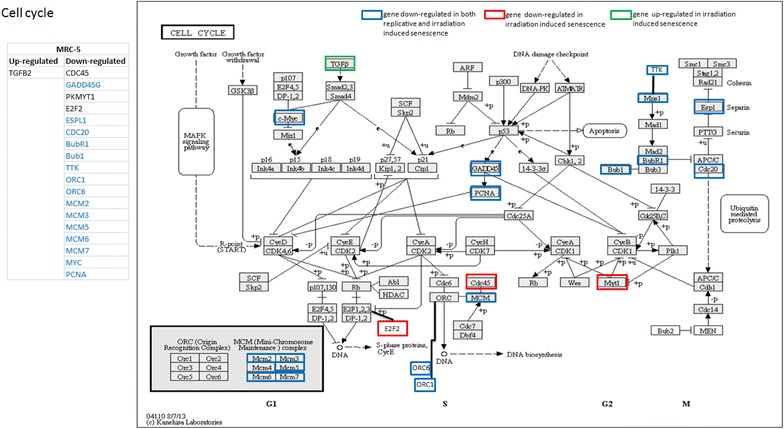
BACKGROUND: Cellular senescence is induced either internally, for example by replication exhaustion and cell division, or externally, for example by irradiation. In both cases, cellular damages accumulate which, if not successfully repaired, can result in senescence induction. Recently, we determined the transcriptional changes combined with the transition into replicative senescence in primary human fibroblast strains. Here, by γ-irradiation we induced premature cellular senescence in the fibroblast cell strains (HFF and MRC-5) and determined the corresponding transcriptional changes by high-throughput RNA sequencing. RESULTS: Comparing the transcriptomes, we found a high degree of similarity in differential gene expression in replicative as well as in irradiation induced senescence for both cell strains suggesting, in each cell strain, a common cellular response to error accumulation. On the functional pathway level, "Cell cycle" was the only pathway commonly down-regulated in replicative and irradiation-induced senescence in both fibroblast strains, confirming the tight link between DNA repair and cell cycle regulation. However, "DNA repair" and "replication" pathways were down-regulated more strongly in fibroblasts undergoing replicative exhaustion. We also retrieved genes and pathways in each of the cell strains specific for irradiation induced senescence. CONCLUSION: We found the pathways associated with "DNA repair" and "replication" less stringently regulated in irradiation induced compared to replicative senescence. The strong regulation of these pathways in replicative senescence highlights the importance of replication errors for its induction.
Overview
The claims and statistics of this paper haven’t been checked yet.
Run the check — free, no account needed. It reads the open-access text and checks the sources it cites.
Integrity signals
Registry
Cites
Statistics
Figures
Verification
Claims the paper makes
The claims and statistics of this paper haven’t been checked yet.
Run the check — free, no account needed. It reads the open-access text and checks the sources it cites.
Claims other papers make about this one
Each is checked against this paper’s own text: does it say what the citing paper says it does?
In the citing paper
“These processes are commonly damaged in primary human fibroblast strains undergoing a cellular aging process as a consequence of finite proliferative capacity or oxidative stress [67]”
Self-check
Percentages, sums and reported differences re-computed from the paper’s own numbers.
The self-check needs the paper’s full text.
Citations
Cites
1 retracted
Oncogenic activity of Cdc6 through repression of the INK4/ARF locus
González, S., Klatt, P., Delgado, S., Conde, E., López‐Ríos, F., Sánchez‐Céspedes, M., Méndez, J., Antequera, F., & Serrano, M. (2006) · Nature · doi:10.1038/nature04585 · Cited by 186
RetractedControlling the False Discovery Rate: A Practical and Powerful Approach to Multiple Testing
Benjamini, Y., & Hochberg, Y. (1995) · Journal of the Royal Statistical Society Series B: Statistical Methodology · doi:10.1111/j.2517-6161.1995.tb02031.x · Cited by 109,482
Moderated estimation of fold change and dispersion for RNA-seq data with DESeq2
Love, M. I., Huber, W., & Anders, S. (2014) · Genome Biology · doi:10.1186/s13059-014-0550-8 · Cited by 95,106
Robinson, M. D., McCarthy, D. J., & Smyth, G. K. (2010) · Bioinformatics · doi:10.1093/bioinformatics/btp616 · Cited by 41,364
Differential expression analysis for sequence count data
Anders, S., & Huber, W. (2010) · Genome Biology · doi:10.1186/gb-2010-11-10-r106 · Cited by 15,581
TopHat: discovering splice junctions with RNA-Seq
Trapnell, C., Pachter, L. S., & Salzberg, S. L. (2009) · Bioinformatics · doi:10.1093/bioinformatics/btp120 · Cited by 11,682
A biomarker that identifies senescent human cells in culture and in aging skin in vivo.
Dimri, G. P., Lee, X., Basile, G., Acosta, M., Scott, G., Roskelley, C., Medrano, E. E., Linskens, M., Rubelj, I., & Pereira-Smith, O. (1995) · Proceedings of the National Academy of Sciences · doi:10.1073/pnas.92.20.9363 · Cited by 7,477
The limited in vitro lifetime of human diploid cell strains
Hayflick, L. (1965) · Experimental Cell Research · doi:10.1016/0014-4827(65)90211-9 · Cited by 5,876
Oncogenic ras provokes premature cell senescence associated with accumulation of p53 and p16INK4a
Serrano, M., Lin, A. W., McCurrach, M. E., Beach, D., & Lowe, S. W. (1997) · Cell · doi:10.1016/s0092-8674(00)81902-9 · Cited by 5,218 · cited 1×
“it, the accumulation of errors can overwhelm the cell [2–11] and lead to mutations and potentially to cancer.”
BackgroundCellular senescence: when bad things happen to good cells
Campisi, J., & d'Adda di Fagagna, F. (2007) · Nature Reviews Molecular Cell Biology · doi:10.1038/nrm2233 · Cited by 4,441
Cited by
Sorted by citations
Skin Aging, Cellular Senescence and Natural Polyphenols
Csekes, E., & Račková, L. (2021) · International Journal of Molecular Sciences · doi:10.3390/ijms222312641 · Cited by 352
Gene expression hallmarks of cellular ageing
Frenk, S., & Houseley, J. (2018) · Biogerontology · doi:10.1007/s10522-018-9750-z · Cited by 181
DePianto, D. J., Heiden, J. A. V., Morshead, K. B., Sun, K.-H., Modrusan, Z. D., Teng, G., Wolters, P. J., & Arron, J. R. (2021) · JCI Insight · doi:10.1172/jci.insight.143626 · Cited by 95
Short-term gain, long-term pain: the senescence life cycle and cancer
Chan, A. S. L., & Narita, M. (2019) · Genes & Development · doi:10.1101/gad.320937.118 · Cited by 80
Nagane, M., Kanai, E., Shibata, Y., Shimizu, T., Yoshioka, C., Maruo, T., & Yamashita, T. (2018) · PLoS ONE · doi:10.1371/journal.pone.0195151 · Cited by 86
Metadata
- Authors
- Marthandan, S., Menzel, U., Priebe, S., Groth, M., Guthke, R., Platzer, M., Hemmerich, P., Kaether, C., & Diekmann, S.
- Affiliations
- Leibniz Institute on Aging - Fritz Lipmann Institute (FLI) (DE)
- Leibniz-Institut für Naturstoff-Forschung und Infektionsbiologie e. V. - Hans-Knöll-Institut (HKI) (DE)
- Corresponding author
- Marthandan, Shiva
- Venue
- Biological Research
- Published
- 2016-07-28
- Volume
- 49
- Issue
- 1
- Pages
- 34-34
- ISSN
- 0716-9760 (ISSN-L)
- 0717-6287
- PMC
- PMC4963952
- OpenAlex
- W2491783232
- Cited by
- 39
- References
- 210
- Citations by year
- 2026: 1 · 2025: 2 · 2024: 6 · 2023: 3 · 2022: 7 · 2021: 5 · 2020: 2 · 2019: 6 · 2018: 5 · 2017: 2
- FWCI
- 3.49
- Type
- journal article
- Language
- en
- Open access
- gold
- doi.org
- Licence
- cc-by
- Locations
- Biological Research (publishedVersion, cc-by)
- Europe PMC (PubMed Central) (publishedVersion, cc-by)
- PubMed Central (publishedVersion, cc-by)
- PubMed (publishedVersion)
- LA Referencia (Red Federada de Repositorios Institucionales de Publicaciones Científicas) (publishedVersion, other-oa)
- Americanae (AECID Library) (submittedVersion, cc-by)
- DOAJ (DOAJ: Directory of Open Access Journals) (submittedVersion, cc-by-sa)
- Informationszentrum Lebenswissenschaften (ZB MED) (submittedVersion, cc-by)
- Funders
- Bundesministerium für Bildung und Forschung– BMBF (0315581)
- Topics
- Life Sciences › Biochemistry, Genetics and Molecular Biology › Cell Biology › Telomeres, Telomerase, and Senescence
- Life Sciences › Biochemistry, Genetics and Molecular Biology › Aging › Genetics, Aging, and Longevity in Model Organisms
- Health Sciences › Medicine › Dermatology › Skin Protection and Aging
- Keywords
- cellular senescence, replicative senescence, radiation-induced senescence, gamma irradiation, primary human fibroblasts, DNA repair, DNA replication, cell cycle regulation, transcriptome, differential gene expression, DNA damage accumulation, MRC-5 cells
- MeSH terms
- Analysis of Variance, beta-Galactosidase, Cells, Cultured, DNA Damage, DNA Repair, DNA Replication, Fibroblasts, Gamma Rays, Humans, Lung, Male, Time Factors, Immunoblotting, Down-Regulation, Up-Regulation, Cellular Senescence, Sequence Analysis, RNA, Gene Expression Profiling, Aborted Fetus
About these checks
Registry, retraction, Cites and statistics results are computed, not judged, with one exception: a printed reference that no index lists is read once by a model before it counts as a citation error. Claims are extracted by a model and kept only when their quote appears verbatim in the text; each cited source is then checked, with a model’s help, for whether it says what the claim relies on. Those verdicts can be wrong — read the claim’s quote and the cited source before relying on one.
Statistics and arithmetic are recomputed, not judged.
Confidence bands are shown only for fields calibrated on our annotated test set. None is calibrated yet, so no band is shown.
What counts as a claim ›How we measure confidence ›How we check this ›
Are you an author, or do you see a problem with this page? Request a review
