

Negative consequences of positive feedbacks in US wildfire management
Open accessThe DOI matches its Crossref record; 77 of the 80 references it cites were found in a registry or an index; 14 of the 104 sources its claims cite were checked for support.
Abstract
Over the last two decades wildfire activity, damage, and management cost within the US have increased substantially. These increases have been associated with a number of factors including climate change and fuel accumulation due to a century of active fire suppression. The increased fire activity has occurred during a time of significant ex-urban development of the Wildland Urban Interface (WUI) along with increased demand on water resources originating on forested landscapes. These increased demands have put substantial pressure on federal agencies charged with wildfire management to continue and expand the century old policy of aggressive wildfire suppression. However, aggressive wildfire suppression is one of the major factors that drive the increased extent, intensity, and damage associated with the small number of large wildfires that are unable to be suppressed. In this paper we discuss the positive feedback loops that lead to demands for increasing suppression response while simultaneously increasing wildfire risk in the future. Despite a wealth of scientific research that demonstrates the limitations of the current management paradigm pressure to maintain the existing system are well entrenched and driven by the existing social systems that have evolved under our current management practice. Interestingly, US federal wildland fire policy provides considerable discretion for managers to pursue a range of management objectives; however, societal expectations and existing management incentive structures result in policy implementation that is straining the resilience of fire adapted ecosystems and the communities that reside in and adjacent to them.
Overview
CoChat Summary
TL;DR
The paper argues that US wildfire management is caught in positive feedback loops: aggressive suppression reduces fire in the short term but accumulates fuels and encourages WUI development, increasing future wildfire risk and suppression demand. It concludes that transforming the suppression-centric paradigm will require altered incentives, risk sharing, fuel treatments, improved decision support, and long-term visioning.
Key findings
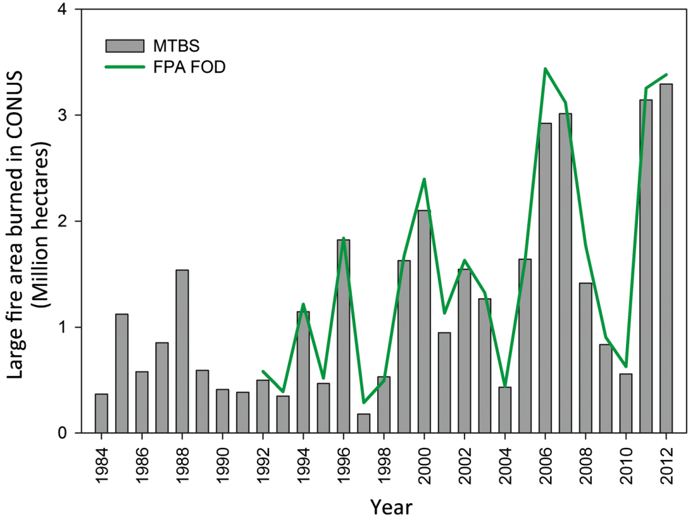
- Initial attack is reported as averaging 97–99% successful (Calkin et al. 2005), yet area burned by large fires has increased over recent decades, prompting more suppression effort.
- Large wildfire suppression by US federal agencies cost nearly $24 billion between 2000 and 2013 (2013 US$); the USDA Forest Service represents about 70% of federal wildfire management expenditures, and wildfire-related expenses rose from 17% of USFS appropriated funds in 1995 to 51% in 2014, alongside reductions in vegetation/watershed management (22%), facilities (67%), roads (46%), and deferred maintenance (95%).
- Wildfire-related insured losses in the US from 2002 to 2011 totaled $7.9 billion, a $6.2 billion increase over the previous decade; home destruction is primarily determined by the home ignition zone within 30–60 m of the home, and Colorado examples include Fourmile Canyon (169 homes destroyed), High Park (259 homes, one fatality), Waldo Canyon (346 homes), Black Forest (486 homes, two fatalities), and Lower North Fork (23 homes, three fatalities from an escaped prescribed fire).
- The paper identifies a self-reinforcing cycle in which suppression without commensurate fuel treatment is a policy error; it cites the Southeastern US, where Region 8 is 10% of the Forest Service land base but from 2007–2012 accounted for almost 70% of the Agency’s prescribed burned area while only 6% of large fire suppression costs.
Methods
- This is a review/conceptual synthesis of US wildfire management, not a new empirical study; it examines organizational structure, agency and public incentives, historical context, modern context, landscape hazard, and value susceptibility.
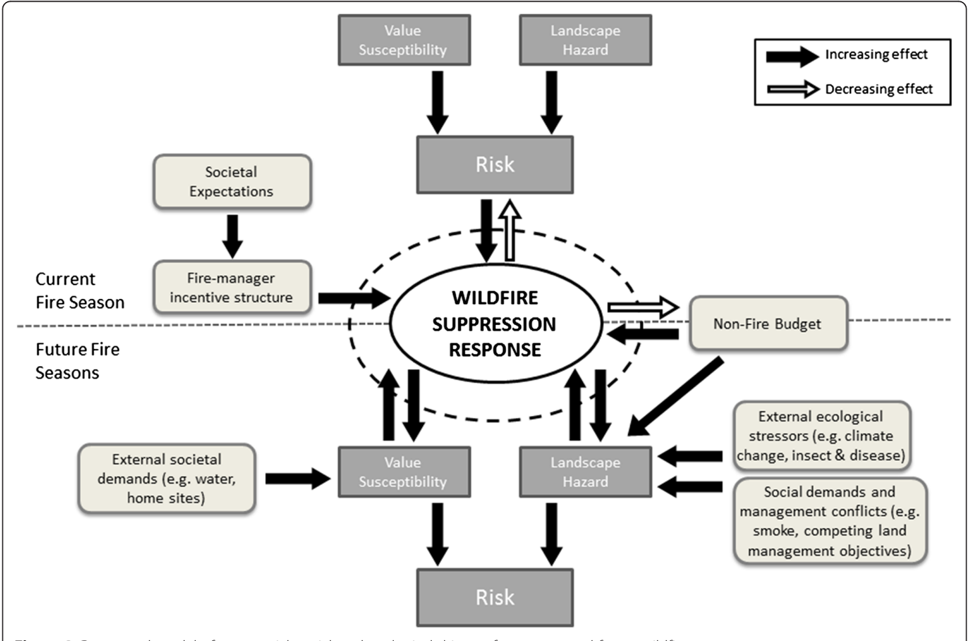
- It evaluates incentives and consequences within an actuarial risk assessment framework and presents a conceptual model (Figure 2) of managerial, social, and ecological drivers of near-term and future wildfire management response.
- The analysis is qualitative, drawing on cited literature, historical reports (e.g., Sudworth 1900; Show and Kotok 1924), and case examples to argue that modern wildfire problems derive from a self-reinforcing cycle of countereffective actions.
Limitations
- The paper does not state a formal limitations section (stated).
- Evident from the text: it is a conceptual/review article without new quantitative data or formal hypothesis testing, relying on cited studies, selected historical accounts, and case examples.
- Evident from the text: the focus is primarily on the US, especially the western US, with some Australian and southeastern US comparisons; generalizability beyond those contexts is not established.
Model-written summary. Check it against the paper before relying on it.
Integrity signals
Registry
Cites
Statistics
Figures
Verification
Claims the paper makes
11 Valid · 2 Not valid · 67 Not checked · 42 Own results and interpretations
At least one cited source doesn’t support this claim or points to a different paper, and none confirmed it — see the verdicts below.
In the paper
“Nowadays, forest scientists and ecologists find these historical reports convincing evidence that attempted”
§ Negative consequences of positive feedbacks in US wildfire management > Historical context
What the sources say
- Disputedcites Show and Kotok 1924 matched to “The role of fire in the California pine forests” (1924) sourceExperimental — accuracy not yet measured
The Summary says fire exclusion increases undergrowth and fire hazard, but explicitly argues that this does not undermine protection. It instead identifies fire as a destroyer and advocates the highest practicable degree of protection, contrary to the claim that attempted protection caused forest destruction. (LLM, conf=0.90)
Checked by a reasoning model — may be wrong.
boostedstates a cause- Asserted: passes — The authors put it forward as true.
- Checkable: passes — It can be checked against evidence.
- Load-bearing: passes — The paper’s conclusions depend on it.
- Based: passes — The paper gives a reason why it holds.
- Disputed
Every source the paper cites for this claim was checked and supports it.
In the paper
“Socio-political influence from politicians, landowners and the affected public on fire managers increases the level and cost of suppression response (Canton-Thompson et al. 2008).”
§ Negative consequences of positive feedbacks in US wildfire management > Drivers of wildfire response
What the sources say
- Supportedcites Canton-Thompson et al. 2008 matched to “External Human Factors in Incident Management Team Decisionmaking and Their Effect on Large Fire Suppression Expenditures” (2008) source
The Social-Political Pressure section reports that residents’ expectations and political pressure for full suppression lead to higher costs. It also describes a landowner seeking a change in suppression tactics and a political figure directing full suppression instead of limited suppression, with substantial cost increases. (LLM, conf=0.92)
plainstates a cause- Asserted: passes — The authors put it forward as true.
- Checkable: passes — It can be checked against evidence.
- Load-bearing: passes — The paper’s conclusions depend on it.
- Based: passes — The paper gives a reason why it holds.
- Supported
The sources with a verdict support this claim; the rest weren’t checked yet, have no full text we could read, or their verdicts aren’t rated yet.
In the paper
“Increasing wildfire activity, damage, and associated management cost within the US (Williams 2013) is driven by a complex web of social and ecological factors (Spies et al. 2014).”
§ Negative consequences of positive feedbacks in US wildfire management > Modern context
What the sources say
- Not checked — no full text of the sourcecites Williams 2013 matched to “Exploring the onset of high-impact mega-fires through a forest land management prism” (2013) source
- Supportedcites Spies et al. 2014 matched to “Examining fire-prone forest landscapes as coupled human and natural systems” (2014) source
The Spies et al. citation is attached to the explanation involving social and ecological factors; the preceding statement about increasing activity, damage, and costs is cited to Williams. In “External drivers,” the paper describes interactions among socioeconomic and ecological conditions, climate, development, and fire policy. “Heterogeneity and system complexity” also describes how human activities and ecological conditions jointly affect fire-prone landscapes. Page numbers were not available in our copy. (LLM, conf=0.90)
plainstates a cause- Asserted: passes — The authors put it forward as true.
- Checkable: passes — It can be checked against evidence.
- Load-bearing: unclear — It is unclear whether the paper’s conclusions depend on it.
- Based: passes — The paper gives a reason why it holds.
The cited sources support only part of this claim — read each source’s verdict below.
In the paper
“Severe wildfires can result in significant and costly impacts to municipal watersheds, ranging from increased sedimentation to increased likelihood of debris flows to damage of water delivery infrastructure and interruption of service, prompting additional interest in risk mitigation options (Warziniack and Thompson 2013;Tillery et al. 2014).”
§ Negative consequences of positive feedbacks in US wildfire management > Landscape hazard & value susceptibility
What the sources say
- Supportedcites Warziniack and Thompson 2013 matched to “Wildfire risk and optimal investments in watershed protection” (2013) source
The Introduction (page not supplied) says high-severity fires can increase debris flows and reservoir sedimentation, damage critical infrastructure, and raise drinking-water treatment costs. It also describes a utility shutting down river intakes after a fire, supporting the interruption-of-service point. (LLM, conf=0.93)
- Partly supportedcites Tillery et al. 2014 matched to “Potential postwildfire debris-flow hazards: a prewildfire evaluation for the Sandia and Manzano Mountains and surrounding areas, central New Mexico” (2014) sourceExperimental — accuracy not yet measured
The Introduction states that wildfire can drastically increase debris-flow probability and threaten water conveyances critical to municipal supplies. It does not establish the claimed increased sedimentation, costs, or interruption of water service; the Limitations of Hazard Assessment discusses mitigation planning, not those impacts. (LLM, conf=0.85)
plainstates a cause- Asserted: passes — The authors put it forward as true.
- Checkable: passes — It can be checked against evidence.
- Load-bearing: passes — The paper’s conclusions depend on it.
- Based: passes — The paper gives a reason why it holds.
- Supported
The cited sources support only part of this claim — read each source’s verdict below.
In the paper
“Prescribed fire has been well recognized within the scientific literature (Hann and Bunnell 2001;Graham et al. 2004;Martinson and Omi 2013) as a fuel modification and restoration technique that is highly effective at mitigating wildfire behavior.”
§ Negative consequences of positive feedbacks in US wildfire management > Landscape hazard & value susceptibility
What the sources say
- Not checked — no full text of the sourcecites Hann and Bunnell 2001 matched to “Fire and land management planning and implementation across multiple scales” (2001) source
- Supportedcites Graham et al. 2004 matched to “Science basis for changing forest structure to modify wildfire behavior and severity” (2004) source
The Prescribed Fire section (page not provided) says its beneficial effects on fuel structure and wildfire behavior have long been observed and that it can effectively alter potential fire behavior. The Thinning and Prescribed Fire Combined section also describes prescribed fire as part of fuel treatments and of maintaining restored dry-forest conditions. (LLM, conf=0.88)
- Partly supportedcites Martinson and Omi 2013 matched to “Fuel treatments and fire severity: A meta-analysis” (2013) sourceExperimental — accuracy not yet measured
The Management Implications section says treatments that reduce surface fuels, particularly through prescribed burning, are well supported for moderating potential wildfire behavior in long-needle pine and mixed conifer forests. The claim omits those ecosystem limits and describes prescribed fire as a restoration technique, a role not established by the cited passage. (LLM, conf=0.85)
boostedstates a cause- Asserted: passes — The authors put it forward as true.
- Checkable: passes — It can be checked against evidence.
- Load-bearing: unclear — It is unclear whether the paper’s conclusions depend on it.
- Based: passes — The paper gives a reason why it holds.
59 more claims · 3 with their cited sources checked
Create a free account to see all 122 claims and to verify the 9 references still open.
- It may state two separate claims as one. 37
- Probably not a substantial claim. 28
Citations
Cites
Adaptation, adaptive capacity and vulnerability
Smit, B., & Wandel, J. (2006) · Global Environmental Change · doi:10.1016/j.gloenvcha.2006.03.008 · Cited by 5,282
A Project for Monitoring Trends in Burn Severity
Eidenshink, J., Schwind, B., Brewer, K., Zhu, Z.-L., Quayle, B., & Howard, S. (2007) · Fire Ecology · doi:10.4996/fireecology.0301003 · Cited by 1,423
Walker, B., Gunderson, L., Kinzig, A., Folke, C., Carpenter, S., & Schultz, L. (2006) · Ecology and Society · doi:10.5751/es-01530-110113 · Cited by 1,374 · cited 2×
“Managing towards resilience can be characterized as actions that maintain a desirable state or transform existing structure to achieve a more desirable state (Walker et al. 2006).”
BackgroundHerrman, H., Stewart, D. E., Diaz-Granados, N., Berger, E. L., Jackson, B., & Yuen, T. (2011) · The Canadian Journal of Psychiatry · doi:10.1177/070674371105600504 · Cited by 1,338
Learning to coexist with wildfire
Moritz, M. A., Batllori, E., Bradstock, R. A., Gill, A. M., Handmer, J., Hessburg, P. F., Leonard, J., McCaffrey, S., Odion, D. C., Schoennagel, T., et al. (2014) · Nature · doi:10.1038/nature13946 · Cited by 1,169 · cited 3×
“Recognition that fire exclusion is neither desirable nor possible in many regions of the country is an essential (Moritz et al. 2014) and will be a critical component of any effort to transform wildfire management.”
BackgroundECOLOGICAL RESTORATION OF SOUTHWESTERN PONDEROSA PINE ECOSYSTEMS: A BROAD PERSPECTIVE
Allen, C. D., Savage, M., Falk, D. A., Suckling, K. F., Swetnam, T. W., Schulke, T., Stacey, P. B., Morgan, P., Hoffman, M., & Klingel, J. T. (2002) · Ecological Applications · doi:10.1890/1051-0761(2002)012[1418:erospp]2.0.co;2 · Cited by 945 · cited 1×
“There is general scientific agreement that fuel loading and stand density have reduced the resilience of these forests by making them more susceptible to wildfire and insect and disease outbreaks (Allen et al. 2002; Hessburg et al. 2005; Noss et al. 2006).”
BackgroundFire in America: A Cultural History of Wildland and Rural Fire
Steen, H. K., & Pyne, S. J. (1984) · The Western Historical Quarterly · doi:10.2307/968568 · Cited by 782
Driving forces of global wildfires over the past millennium and the forthcoming century
Pechony, O., & Shindell, D. T. (2010) · Proceedings of the National Academy of Sciences · doi:10.1073/pnas.1003669107 · Cited by 717
FEDERAL FOREST‐FIRE POLICY IN THE UNITED STATES
Stephens, S. L., & Ruth, L. W. (2005) · Ecological Applications · doi:10.1890/04-0545 · Cited by 584 · cited 2×
“accumulated (Arno and Brown 1991; Stephens and Ruth 2005) and impacts to natural and developed resources are”
BackgroundCheatgrass (Bromus tectorum L) dominance in the Great Basin Desert
Knapp, P. A. (1996) · Global Environmental Change · doi:10.1016/0959-3780(95)00112-3 · Cited by 560
Research works printed but not linked: 8
- 2. Arno SF, Brown JK (1991) Overcoming the paradox in managing wildland fire in western wildlands. University of Montana, Montana Forest and Conservation Experiment Station, Missoula, MT, pp 40-46
- 11. Cleetus R, Mulik K (2014) Playing with fire: how climate change and development patterns are contributing to the soaring costs of western wildfires., Available at: http://www.ucsusa.org/assets/documents/global_warming/playing-with- fire-report.pdf. Accessed September 9, 2014
- 15. Collins R, de Neufville R, Claro J, Oliveira T, Pacheco A (2013) Forest fire management to avoid unintended consequences: a case study of Portugal using system dynamics. J Environm Manage 130:1-9 Colorado Department of Fire Prevention and Control (2014) Special report: Colorado Firefighting Air Corps., Available at: http://dfs.state.co.us/. Accessed October 30, 2014
- 24. Fowler C, Konopik E (2007) The history of fire in the southern United States. Human Ecol Rev 14(2):165-176
- 35. Interagency Working Group (2001) Review and update of the 1995 federal wildland fire management policy. National Interagency Fire Center, Boise, ID
- 45. Moritz MA, Batllori E, Bradstock RA, Gill MA, Handmer J, Hessburg PF, Leonard J, McCaffrey S, Odion DC, Schoennagel T, Syphard AD (2014) Learning to coexist with wildfire. Nature 515(7525):58-66 National Interagency Fire Center (2014) Available at: https://www.nifc.gov/ fireInfo/fireInfo_documents/SuppCosts.pdf. Accessed February 23, 2015
- 52. Pyne S (2011) The wallow fire: a ruinous burn. Wildfire Magazine 2011:14-17
- USDA Forest Service (2014) The rising cost of fire operations: effects on the forest service’s non-fire work., Available at: http://www.fs.fed.us/sites/default/files/media/2014/34/nr-firecostimpact-082014.pdf . Accessed October 30, 2014
Cited by
Items 101–200 of 325
Dye, A. W., Houtman, R. M., Gao, P., Anderegg, W. R. L., Fettig, C. J., Hicke, J. A., Kim, J. B., Still, C. J., Young, K. A., & Riley, K. L. (2024) · Carbon Balance and Management · doi:10.1186/s13021-024-00282-0 · Cited by 83
Colavito, M. M. (2021) · Forests · doi:10.3390/f12040483 · Cited by 41
Assessing Transboundary Wildfire Exposure in the Southwestern United States
Ager, A. A., Palaiologou, P., Evers, C., Day, M. A., & Barros, A. M. G. (2018) · Risk Analysis · doi:10.1111/risa.12999 · Cited by 43
Marjani, M., Mahdianpari, M., Ahmadi, S. A., Hemmati, E., Mohammadimanesh, F., & Mesgari, M. S. (2024) · IEEE Geoscience and Remote Sensing Letters · doi:10.1109/lgrs.2024.3417624 · Cited by 46
The wildland fire system and challenges for engineering
Finney, M. A. (2020) · Fire Safety Journal · doi:10.1016/j.firesaf.2020.103085 · Cited by 41
Self-citationNilsson, S., & Enander, A. (2019) · Journal of Contingencies and Crisis Management · doi:10.1111/1468-5973.12284 · Cited by 49
Ager, A. A., Barros, A. M. G., Preisler, H. K., Day, M. A., Spies, T. A., Bailey, J. D., & Bolte, J. P. (2017) · Ecology and Society · doi:10.5751/es-09680-220412 · Cited by 39
Spatiotemporal changes in conterminous US wildfire exposure from 1940 to 2010
Strader, S. M. (2018) · Natural Hazards · doi:10.1007/s11069-018-3217-z · Cited by 36
Cognition of complexity and trade-offs in a wildfire-prone social-ecological system
Hamilton, M., Salerno, J., & Fischer, A. P. (2019) · Environmental Research Letters · doi:10.1088/1748-9326/ab59c1 · Cited by 40
Tedim, F. M. S., McCaffrey, S., Leone, V., Varela, C. V., Depietri, Y., Buergelt, P. T., & Lovreglio, R. (2021) · Forest Policy and Economics · doi:10.1016/j.forpol.2021.102565 · Cited by 44
Managed Wildfire: A Strategy Facilitated by Civil Society Partnerships and Interagency Cooperation
Davis, E. J., Huber‐Stearns, H., Caggiano, M. D., McAvoy, D. J., Cheng, A. S., Deak, A. L., & Evans, A. M. (2022) · Society & Natural Resources · doi:10.1080/08941920.2022.2092803 · Cited by 37
Turner, B. L. (2021) · Soil Systems · doi:10.3390/soilsystems5030039 · Cited by 38
Greiner, S. M., Schultz, C. A., & Kooistra, C. M. (2020) · International Journal of Wildland Fire · doi:10.1071/wf20124 · Cited by 37
Pawlikowski, N. C., Coppoletta, M., Knapp, E. E., & Taylor, A. H. (2018) · Forest Ecology and Management · doi:10.1016/j.foreco.2018.12.016 · Cited by 33
Wildfire Trend Analysis over the Contiguous United States Using Remote Sensing Observations
Salguero, J., Li, J., Farahmand, A., & Reager, J. T. (2020) · Remote Sensing · doi:10.3390/rs12162565 · Cited by 37
Multitemporal LiDAR improves estimates of fire severity in forested landscapes
Hoe, M. S., Dunn, C. J., & Temesgen, H. (2018) · International Journal of Wildland Fire · doi:10.1071/wf17141 · Cited by 31
Strategic application of wildland fire suppression in the southwestern United States
Young, J. D., Thode, A. E., Huang, C.-H., Ager, A. A., & Fulé, P. Z. (2019) · Journal of Environmental Management · doi:10.1016/j.jenvman.2019.01.003 · Cited by 32
Near-term probabilistic forecast of significant wildfire events for the Western United States
Preisler, H. K., Riley, K. L., Stonesifer, C. S., Calkin, D. E., & Jolly, W. M. (2016) · International Journal of Wildland Fire · doi:10.1071/wf16038 · Cited by 28
Self-citationExpanding Our Understanding of Forest Structural Restoration Needs in the Pacific Northwest
DeMeo, T., Haugo, R. D., Ringo, C. D., Kertis, J., Acker, S. A., Simpson, M., & Stern, M. A. (2018) · Northwest Science · doi:10.3955/046.092.0104 · Cited by 31
Schweizer, D. W., Preisler, H. K., & Cisneros, R. (2018) · Air Quality Atmosphere & Health · doi:10.1007/s11869-018-0633-x · Cited by 36
Schultz, C. A., Miller, L. F., Greiner, S. M., & Kooistra, C. M. (2021) · Forests · doi:10.3390/f12030344 · Cited by 34
Intensifying Fire Season Aridity Portends Ongoing Expansion of Severe Wildfire in Western US Forests
Parks, S. A., Coop, J. D., & Davis, K. T. (2025) · Global Change Biology · doi:10.1111/gcb.70429 · Cited by 48
Martinuzzi, S., Allstadt, A. J., Pidgeon, A. M., Flather, C. H., Jolly, W. M., & Radeloff, V. C. (2019) · Ecological Applications · doi:10.1002/eap.1904 · Cited by 33
Barrett, K. J., Cannon, J. B., Schuetter, A. M., & Cheng, A. S. (2021) · Forest Ecology and Management · doi:10.1016/j.foreco.2021.119018 · Cited by 33
Fillmore, S. D., McCaffrey, S., & Smith, A. M. S. (2021) · Fire · doi:10.3390/fire4030062 · Cited by 33
Koplitz, S. N., Nolte, C. G., Sabo, R. D., Clark, C. M., Horn, K. J., Thomas, R. Q., & Newcomer-Johnson, T. (2021) · Environmental Research Letters · doi:10.1088/1748-9326/abd26e · Cited by 36
Aligning Smoke Management with Ecological and Public Health Goals
Long, J. W., Tarnay, L., & North, M. P. (2017) · Journal of Forestry · doi:10.5849/jof.16-042 · Cited by 38
Insect Community Response Following Wildfire in an Eastern North American Pine Barrens
Thompson, H. M., Lesser, M. R., Myers, L., & Mihuc, T. B. (2022) · Forests · doi:10.3390/f13010066 · Cited by 28
Miller, B. A., Yung, L., Wyborn, C. A., Essen, M., Gray, B., & Williams, D. R. (2022) · Fire · doi:10.3390/fire5020049 · Cited by 44
Climate and wildfire adaptation of inland Northwest US forests
Hessburg, P. F., Charnley, S., Gray, A. N., Spies, T. A., Peterson, D. W., Flitcroft, R. L., Wendel, K. L., Halofsky, J. E., White, E. M., & Marshall, J. E. A. (2021) · Frontiers in Ecology and the Environment · doi:10.1002/fee.2408 · Cited by 28
Glenn, E., Yung, L., Wyborn, C. A., & Williams, D. R. (2022) · International Journal of Wildland Fire · doi:10.1071/wf21079 · Cited by 25
Cognitive Maps Reveal Diverse Perceptions of How Prescribed Fire Affects Forests and Communities
Hamilton, M., & Salerno, J. (2020) · Frontiers in Forests and Global Change · doi:10.3389/ffgc.2020.00075 · Cited by 31
Shrestha, A., Grala, R. K., Grado, S. C., Roberts, S. D., Gordon, J. S., & Adhikari, R. K. (2021) · Forest Policy and Economics · doi:10.1016/j.forpol.2021.102451 · Cited by 24
Using Risk Analysis to Reveal Opportunities for the Management of Unplanned Ignitions in Wilderness
Barnett, K., Miller, C., & Venn, T. J. (2016) · Journal of Forestry · doi:10.5849/jof.15-111 · Cited by 23
Stonesifer, C. S., Calkin, D. E., Thompson, M. P., & Belval, E. J. (2021) · Forests · doi:10.3390/f12081078 · Cited by 27
Self-citationAdapting wildland fire governance to climate change in Alaska
Rutherford, T. K., & Schultz, C. A. (2019) · Ecology and Society · doi:10.5751/es-10810-240127 · Cited by 28
The suppression model fragilities
Xanthopoulos, G., Leone, V., & Delogu, G. M. (2019) · Elsevier eBooks · doi:10.1016/b978-0-12-815721-3.00007-2 · Cited by 31
Abrams, J., Greiner, S. M., Schultz, C. A., Evans, A. M., & Huber‐Stearns, H. (2021) · Environmental Management · doi:10.1007/s00267-021-01451-4 · Cited by 25
Wildfire policies contribution to foster extreme wildfires
Fernandes, P. M., Delogu, G. M., Leone, V., & Ascoli, D. (2019) · Elsevier eBooks · doi:10.1016/b978-0-12-815721-3.00010-2 · Cited by 42
Salis, M., Arca, B., Alcasena, F., Massaiu, A., Bacciu, V., Bosseur, F., Caramelle, P., Dettori, S., de Oliveira, A. F., Molina, D., et al. (2019) · European Journal of Forest Research · doi:10.1007/s10342-019-01179-1 · Cited by 23
Merschel, A. G., Beedlow, P. A., Shaw, D. C., Woodruff, D. R., Lee, E. H., Cline, S. P., Comeleo, R. L., Hagmann, R. K., & Reilly, M. J. (2021) · Trees Forests and People · doi:10.1016/j.tfp.2021.100074 · Cited by 29
Untrammeling the wilderness: restoring natural conditions through the return of human-ignited fire
Boerigter, C. E., Parks, S. A., Long, J. W., Coop, J. D., Armstrong, M., & Hankins, D. L. (2024) · Fire Ecology · doi:10.1186/s42408-024-00297-5 · Cited by 24
Conceptualizing a probabilistic risk and loss assessment framework for wildfires
Khorasani, N. E., Ebrahimian, H., Buja, L. E., Cutter, S. L., Kosović, B., Lareau, N. P., Meacham, B. J., Rowell, E. M., Taciroğlu, E., Thompson, M. P., et al. (2022) · Natural Hazards · doi:10.1007/s11069-022-05472-y · Cited by 30
Self-citationGarden design can reduce wildfire risk and drive more sustainable co-existence with wildfire
Ondei, S., Price, O. F., & Bowman, D. M. J. S. (2024) · npj natural hazards. · doi:10.1038/s44304-024-00012-z · Cited by 27
Xue, Z., Gupta, P., & Christopher, S. A. (2021) · Atmospheric chemistry and physics · doi:10.5194/acp-21-11243-2021 · Cited by 29
Rapp, C. E., Wilson, R. S., Toman, E., & Jolly, W. M. (2021) · Fire Ecology · doi:10.1186/s42408-021-00119-y · Cited by 25
Nichols, J., Joseph, E., Kaphle, A., Tunby, P., Rodríguez, L., Khandelwal, A. S., Reale, J. K., Regier, P., Horn, D. J., & González‐Pinzón, R. (2024) · Nature Communications · doi:10.1038/s41467-024-51306-9 · Cited by 27
Jacobson, M., Smith, H. M., Huber‐Stearns, H., Davis, E. J., Cheng, A. S., & Deak, A. L. (2021) · Journal of Risk Research · doi:10.1080/13669877.2021.1962954 · Cited by 28
Cheng, A. S., & Dale, L. (2020) · Review of Policy Research · doi:10.1111/ropr.12379 · Cited by 30
A Geospatial Framework to Assess Fireline Effectiveness for Large Wildfires in the Western USA
Gannon, B. M., Thompson, M. P., Deming, K. Z., Bayham, J., Wei, Y., & O’Connor, C. D. (2020) · Fire · doi:10.3390/fire3030043 · Cited by 20
Self-citationAn Uncertainty Analysis of Wildfire Modeling
Riley, K. L., & Thompson, M. P. (2016) · Geophysical monograph · doi:10.1002/9781119028116.ch13 · Cited by 25
Self-citationÚbeda, X., Pereira, P. A. D. S., & Villas, D. B. (2018) · The Science of The Total Environment · doi:10.1016/j.scitotenv.2018.04.272 · Cited by 23
Fernandes, P. M., Guiomar, N., Mateus, P., & Oliveira, T. (2016) · Land Use Policy · doi:10.1016/j.landusepol.2016.10.008 · Cited by 25
Co-management during crisis: insights from jurisdictionally complex wildfires
Nowell, B. L., Steelman, T. A., Velez, A. K., & Albrecht, K. (2022) · International Journal of Wildland Fire · doi:10.1071/wf21139 · Cited by 23
Green, D. S., Martin, M. E., Powell, R. A., McGregor, E. L., Gabriel, M. W., Pilgrim, K. L., Schwartz, M. K., & Matthews, S. M. (2022) · Ecosphere · doi:10.1002/ecs2.3877 · Cited by 23
Mitigating wildfire smoke inside homes: Evidence from Oregon, September 2020
Castillo, C., Dittrich, R., Shandas, V., Gall, E. T., & Starry, O. (2023) · Risk Analysis · doi:10.1111/risa.14252 · Cited by 21
Does conserving roadless wildland increase wildfire activity in western US national forests?
Johnston, J. D., Kilbride, J. B., Meigs, G. W., Dunn, C. J., & Kennedy, R. E. (2021) · Environmental Research Letters · doi:10.1088/1748-9326/ac13ee · Cited by 21
Probabilistic Wildfire Segmentation Using Supervised Deep Generative Model from Satellite Imagery
Asanjan, A. A., Memarzadeh, M., Lott, P. A., Rieffel, E. G., & Grabbe, S. R. (2023) · Remote Sensing · doi:10.3390/rs15112718 · Cited by 21
Probabilistic Wildfire Risk Assessment Methodology and Evaluation of a Supply Chain Network
Ma, F., Lee, J. Y., Camenzind, D., & Wolcott, M. P. (2022) · International Journal of Disaster Risk Reduction · doi:10.1016/j.ijdrr.2022.103340 · Cited by 24
Cullen, A. C., Prichard, S. J., Abatzoglou, J. T., Dolk, A., Kessenich, L., Bloem, S., Bukovsky, M., Humphrey, R., McGinnis, S., Skinner, H. K., et al. (2023) · Risk Analysis · doi:10.1111/risa.14113 · Cited by 23
Adaptive Governance in Fire-Prone Landscapes
Platt, E. K., Charnley, S., Bailey, J. D., & Cramer, L. A. (2022) · Society & Natural Resources · doi:10.1080/08941920.2022.2035872 · Cited by 20
Wheatley, M. J., Wotton, B. M., Woolford, D. G., Martell, D. L., & Johnston, J. M. (2022) · International Journal of Wildland Fire · doi:10.1071/wf22006 · Cited by 20
Rego, F. C., Morgan, P., Fernandes, P. M., & Hoffman, C. M. (2021) · Springer textbooks in earth sciences, geography and environment · doi:10.1007/978-3-030-69815-7_13 · Cited by 22
A monthly gridded burned area database of national wildland fire data
Gincheva, A., Pausas, J. G., Edwards, A., Provenzale, A., Cerdà, A., Hanes, C. C., Royé, D., Chuvieco, E., Mouillot, F., Vissio, G., et al. (2024) · Scientific Data · doi:10.1038/s41597-024-03141-2 · Cited by 30
The Role of Previous Fires in the Management and Expenditures of Subsequent Large Wildfires
Belval, E. J., O’Connor, C. D., Thompson, M. P., & Hand, M. S. (2019) · Fire · doi:10.3390/fire2040057 · Cited by 14
Self-citationCoastal tree-ring records for paleoclimate and paleoenvironmental applications in North America
Tucker, C. S., & Pearl, J. K. (2021) · Quaternary Science Reviews · doi:10.1016/j.quascirev.2021.107044 · Cited by 16
Consequential lightning-caused wildfires and the “let burn” narrative
Pietruszka, B. M., Young, J. D., Short, K. C., Denis, L. A. S., Thompson, M. P., & Calkin, D. E. (2023) · Fire Ecology · doi:10.1186/s42408-023-00208-0 · Cited by 18
Self-citationCoexistence Praxis: The Role of Resource Managers in Wolf-Livestock Interactions on Federal Lands
Martin, J. V., Epstein, K., Anderson, R. M., & Charnley, S. (2021) · Frontiers in Conservation Science · doi:10.3389/fcosc.2021.707068 · Cited by 19
Spatial analysis of wildfire incidence in the USA: the role of climatic spillovers
Agovino, M., Cerciello, M., Ferraro, A., & Garofalo, A. (2020) · Environment Development and Sustainability · doi:10.1007/s10668-020-00863-2 · Cited by 12
Rapp, C. E., & Wilson, R. S. (2022) · International Journal of Disaster Risk Reduction · doi:10.1016/j.ijdrr.2022.102877 · Cited by 18
Climate Change, Forest Fires, and Health in California
Cisneros, R., Schweizer, D. W., Tarnay, L., Navarro, K. M., Veloz, D., & Procter, C. T. (2017) · Springer climate · doi:10.1007/978-3-319-61346-8_8 · Cited by 22
Iniguez, J. M., Evans, A. M., Dadashi, S., Young, J. D., Meyer, M. D., Thode, A. E., Hedwall, S. J., McCaffrey, S., Fillmore, S. D., & Bean, R. (2022) · Forests · doi:10.3390/f13050793 · Cited by 14
Wildland fires ignited by avian electrocutions
Barnes, T. A., Dwyer, J. F., Mojica, E. K., Petersen, P. A., & Harness, R. E. (2022) · Wildlife Society Bulletin · doi:10.1002/wsb.1302 · Cited by 15
Schweizer, D. W., Nichols, T., Cisneros, R., Navarro, K. M., & Procter, T. (2019) · Springer eBooks · doi:10.1007/978-3-030-23773-8_4 · Cited by 21
From rigidity traps towards reparative disaster governance and management
Eriksen, C., Kirschner, J., Simon, G. L., O’Grady, N., Uyttewaal, K., Lüthi, S., Prior, T., Zeffiri, F., Emmenegger, R., Ay, D., et al. (2025) · International Journal of Disaster Risk Reduction · doi:10.1016/j.ijdrr.2025.105603 · Cited by 18
Wasserman, T. N., Meador, A. J. S., & Waltz, A. E. M. (2019) · Forests · doi:10.3390/f10060465 · Cited by 10
Interaction of a buoyant plume with a turbulent canopy mixing layer
Chung, H., & Koseff, J. R. (2023) · Physical Review Fluids · doi:10.1103/physrevfluids.8.064501 · Cited by 14
A history of wilderness fire management in the Northern Rockies
Berkey, J. K., Miller, C., & Larson, A. J. (2021) · doi:10.2737/rmrs-gtr-428 · Cited by 10
Early wildfire detection using different machine learning algorithms
Moradi, S., Hafezi, M., & Sheikhi, A. (2024) · Remote Sensing Applications Society and Environment · doi:10.1016/j.rsase.2024.101346 · Cited by 14
Ma, F., & Lee, J. Y. (2024) · Fire Technology · doi:10.1007/s10694-024-01683-w · Cited by 15
How Does Fire Suppression Alter the Wildfire Regime? A Systematic Review
Hai, J., Ling, Z., Gao, C., Wang, H., & Wu, J. (2023) · Fire · doi:10.3390/fire6110424 · Cited by 25
Cognition of feedback loops in a fire-prone social-ecological system
Hamilton, M., Salerno, J., & Fischer, A. P. (2022) · Global Environmental Change · doi:10.1016/j.gloenvcha.2022.102519 · Cited by 16
Smoke complaints caused by wildland fire in the southern Sierra Nevada region, California
Cisneros, R., Alcala, E., Schweizer, D. W., & Burke, N. J. (2018) · International Journal of Wildland Fire · doi:10.1071/wf18060 · Cited by 11
An optimization model to prioritize fuel treatments within a landscape fuel break network
Nguyen, D. T., Wei, Y., Belval, E. J., Thompson, M. P., Gannon, B. M., Young, J. D., O’Connor, C. D., & Calkin, D. E. (2024) · PLoS ONE · doi:10.1371/journal.pone.0313591 · Cited by 14
Self-citationAlvis, J. M., Mendoza, G. L. O., & Sossa, J. W. Z. (2025) · Sustainability · doi:10.3390/su17104505 · Cited by 20
Evaluation of Litter Flammability from Dominated Artificial Forests in Southwestern China
Li, S., Zhang, Z., Zheng, J., Hou, G., Liu, H., & Cui, X. (2023) · Forests · doi:10.3390/f14061229 · Cited by 9
The space–time cube as an approach to quantifying future wildfires in California
Moanga, D. A., Biging, G. S., Radke, J., & Butsic, V. (2020) · International Journal of Wildland Fire · doi:10.1071/wf19062 · Cited by 8
Stranded land constrains public land management and contributes to larger fires
Leonard, B., Plantinga, A. J., & Wibbenmeyer, M. J. (2021) · Environmental Research Letters · doi:10.1088/1748-9326/ac2e39 · Cited by 11
Systems Thinking and Wildland Fire Management
Thompson, M. P., Dunn, C. J., & Calkin, D. E. (2017) · Cited by 9
Self-citationMagerl, A., Gingrich, S., Matej, S., Cunfer, G., Forrest, M., Lauk, C., Schlaffer, S., Weidinger, F., Yuskiw, C., & Erb, K. (2023) · Global Biogeochemical Cycles · doi:10.1029/2023gb007813 · Cited by 10
Furniss, T. J., Povak, N. A., Hessburg, P. F., Salter, R. B., Duan, Z., & Wigmosta, M. S. (2023) · Frontiers in Forests and Global Change · doi:10.3389/ffgc.2023.1269081 · Cited by 15
Indigenous stewardship rights and opportunities to recenter Indigenous fire
Hankins, D. L., Bisbing, S. M., Christianson, A. C., Clark, S., Desautel, C., Eriksen, C., Fulé, P. Z., Hessburg, P. F., Magee, C., Stephens, S. L., et al. (2025) · Fire Ecology · doi:10.1186/s42408-025-00393-0 · Cited by 12
Roberts, R. M., Jones, K. W., Duke, E., Shinbrot, X. A., Harper, E. E., Fons, E., Cheng, A. S., & Wolk, B. H. (2019) · Journal of Environmental Management · doi:10.1016/j.jenvman.2019.109286 · Cited by 16
Socially vulnerable US Pacific Northwest communities are more likely to experience wildfires
Reilley, C., Dunn, C. J., Crandall, M. S., & Kline, J. D. (2024) · Environmental Research Letters · doi:10.1088/1748-9326/ad6cec · Cited by 9
Sweeney, K. E., Dittrich, R., Moffat, S., Power, C., & Kline, J. D. (2023) · Fire Ecology · doi:10.1186/s42408-023-00206-2 · Cited by 9
The US Forest Service Life First safety initiative: exploring unnecessary exposure to risk
Flores, D., & Haire, E. R. (2022) · International Journal of Wildland Fire · doi:10.1071/wf21099 · Cited by 10
Exposure to wildfires and health outcomes of vulnerable people: Evidence from US data
Zheng, J. (2023) · Economics & Human Biology · doi:10.1016/j.ehb.2023.101311 · Cited by 11
Franz, S. T., Colavito, M. M., & Edgeley, C. M. (2024) · International Journal of Wildland Fire · doi:10.1071/wf24031 · Cited by 9
Metadata
- Authors
- Calkin, D. E., Thompson, M. P., & Finney, M. A.
- Affiliations
- US Forest Service (US)
- Corresponding author
- Calkin, David E
- Venue
- Forest Ecosystems
- Publisher
- Elsevier BV
- Published
- 2015-04-14
- Volume
- 2
- Issue
- 1
- ISSN
- 2095-6355 (ISSN-L)
- 2197-5620
- OpenAlex
- W2121495297
- Cited by
- 323
- References
- 80
- Citations by year
- 2026: 34 · 2025: 32 · 2024: 35 · 2023: 29 · 2022: 32 · 2021: 38 · 2020: 21 · 2019: 30 · 2018: 24 · 2017: 19 · 2016: 23 · 2015: 5
- FWCI
- 19.39
- Type
- journal article
- Language
- en
- Open access
- gold
- doi.org
- Locations
- Forest Ecosystems (publishedVersion, cc-by)
- DOAJ (DOAJ: Directory of Open Access Journals) (submittedVersion)
- Topics
- Physical Sciences › Environmental Science › Global and Planetary Change › Fire effects on ecosystems
- Life Sciences › Agricultural and Biological Sciences › Forestry › Forest Management and Policy
- Social Sciences › Sociology and Political Science › Disaster Management and Resilience
- Keywords
- wildfire management, wildfire suppression, positive feedback loop, wildland-urban interface, fire policy, fuel accumulation, climate change, wildfire risk, fire-adapted ecosystems, ecosystem resilience
About these checks
Registry, retraction, Cites and statistics results are computed, not judged, with one exception: a printed reference that no index lists is read once by a model before it counts as a citation error. Claims are extracted by a model and kept only when their quote appears verbatim in the text; each cited source is then checked, with a model’s help, for whether it says what the claim relies on. Those verdicts can be wrong — read the claim’s quote and the cited source before relying on one.
The claim verdicts this report counts are experimental: their accuracy is not yet measured.
A language model drew the claims from the paper on 2026-10-10, under version 3 of the claim definition (model deepseek-v4.1-flash, prompt extract-v3).
A second model labelled each claim on 2026-10-10 (model jev-1.13-20260917, definition revision gold-guideline-v0.2).
Cited sources are checked with a language model’s help (gpt-6-sol).
Statistics and arithmetic are recomputed, not judged.
Confidence bands are shown only for fields calibrated on our annotated test set. None is calibrated yet, so no band is shown.
What counts as a claim ›How we measure confidence ›How we check this ›
Are you an author, or do you see a problem with this page? Request a review
Data sources
Bibliographic data: Semantic Scholar, OpenAlex, Crossref.
Contains information from the Semantic Scholar Academic Graph Datasets, made available under the ODC Attribution License (ODC-BY 1.0).
Semantic Scholar’s data is described in: Kinney, R., et al. (2023). The Semantic Scholar Open Data Platform. arXiv:2301.10140.
