

Negative consequences of positive feedbacks in US wildfire management
Open accessThe DOI matches its Crossref record; 77 of the 80 references it cites were found in a registry or an index; 14 of the 104 sources its claims cite were checked for support.
Abstract
Over the last two decades wildfire activity, damage, and management cost within the US have increased substantially. These increases have been associated with a number of factors including climate change and fuel accumulation due to a century of active fire suppression. The increased fire activity has occurred during a time of significant ex-urban development of the Wildland Urban Interface (WUI) along with increased demand on water resources originating on forested landscapes. These increased demands have put substantial pressure on federal agencies charged with wildfire management to continue and expand the century old policy of aggressive wildfire suppression. However, aggressive wildfire suppression is one of the major factors that drive the increased extent, intensity, and damage associated with the small number of large wildfires that are unable to be suppressed. In this paper we discuss the positive feedback loops that lead to demands for increasing suppression response while simultaneously increasing wildfire risk in the future. Despite a wealth of scientific research that demonstrates the limitations of the current management paradigm pressure to maintain the existing system are well entrenched and driven by the existing social systems that have evolved under our current management practice. Interestingly, US federal wildland fire policy provides considerable discretion for managers to pursue a range of management objectives; however, societal expectations and existing management incentive structures result in policy implementation that is straining the resilience of fire adapted ecosystems and the communities that reside in and adjacent to them.
Overview
CoChat Summary
TL;DR
The paper argues that US wildfire management is caught in positive feedback loops: aggressive suppression reduces fire in the short term but accumulates fuels and encourages WUI development, increasing future wildfire risk and suppression demand. It concludes that transforming the suppression-centric paradigm will require altered incentives, risk sharing, fuel treatments, improved decision support, and long-term visioning.
Key findings
- Initial attack is reported as averaging 97–99% successful (Calkin et al. 2005), yet area burned by large fires has increased over recent decades, prompting more suppression effort.
- Large wildfire suppression by US federal agencies cost nearly $24 billion between 2000 and 2013 (2013 US$); the USDA Forest Service represents about 70% of federal wildfire management expenditures, and wildfire-related expenses rose from 17% of USFS appropriated funds in 1995 to 51% in 2014, alongside reductions in vegetation/watershed management (22%), facilities (67%), roads (46%), and deferred maintenance (95%).
- Wildfire-related insured losses in the US from 2002 to 2011 totaled $7.9 billion, a $6.2 billion increase over the previous decade; home destruction is primarily determined by the home ignition zone within 30–60 m of the home, and Colorado examples include Fourmile Canyon (169 homes destroyed), High Park (259 homes, one fatality), Waldo Canyon (346 homes), Black Forest (486 homes, two fatalities), and Lower North Fork (23 homes, three fatalities from an escaped prescribed fire).
- The paper identifies a self-reinforcing cycle in which suppression without commensurate fuel treatment is a policy error; it cites the Southeastern US, where Region 8 is 10% of the Forest Service land base but from 2007–2012 accounted for almost 70% of the Agency’s prescribed burned area while only 6% of large fire suppression costs.
Methods
- This is a review/conceptual synthesis of US wildfire management, not a new empirical study; it examines organizational structure, agency and public incentives, historical context, modern context, landscape hazard, and value susceptibility.
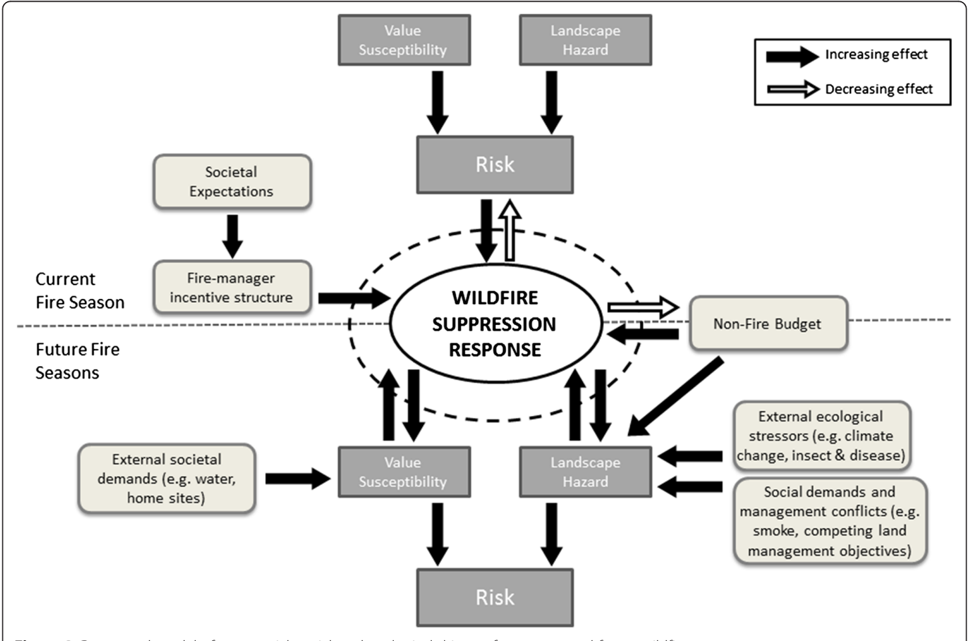
- It evaluates incentives and consequences within an actuarial risk assessment framework and presents a conceptual model (Figure 2) of managerial, social, and ecological drivers of near-term and future wildfire management response.
- The analysis is qualitative, drawing on cited literature, historical reports (e.g., Sudworth 1900; Show and Kotok 1924), and case examples to argue that modern wildfire problems derive from a self-reinforcing cycle of countereffective actions.
Limitations
- The paper does not state a formal limitations section (stated).
- Evident from the text: it is a conceptual/review article without new quantitative data or formal hypothesis testing, relying on cited studies, selected historical accounts, and case examples.
- Evident from the text: the focus is primarily on the US, especially the western US, with some Australian and southeastern US comparisons; generalizability beyond those contexts is not established.
Model-written summary. Check it against the paper before relying on it.
Integrity signals
Registry
Cites
Statistics
Figures
Verification
Claims the paper makes
11 Valid · 2 Not valid · 67 Not checked · 42 Own results and interpretations
At least one cited source doesn’t support this claim or points to a different paper, and none confirmed it — see the verdicts below.
In the paper
“Nowadays, forest scientists and ecologists find these historical reports convincing evidence that attempted”
§ Negative consequences of positive feedbacks in US wildfire management > Historical context
What the sources say
- Disputedcites Show and Kotok 1924 matched to “The role of fire in the California pine forests” (1924) sourceExperimental — accuracy not yet measured
The Summary says fire exclusion increases undergrowth and fire hazard, but explicitly argues that this does not undermine protection. It instead identifies fire as a destroyer and advocates the highest practicable degree of protection, contrary to the claim that attempted protection caused forest destruction. (LLM, conf=0.90)
Checked by a reasoning model — may be wrong.
boostedstates a cause- Asserted: passes — The authors put it forward as true.
- Checkable: passes — It can be checked against evidence.
- Load-bearing: passes — The paper’s conclusions depend on it.
- Based: passes — The paper gives a reason why it holds.
- Disputed
Every source the paper cites for this claim was checked and supports it.
In the paper
“Socio-political influence from politicians, landowners and the affected public on fire managers increases the level and cost of suppression response (Canton-Thompson et al. 2008).”
§ Negative consequences of positive feedbacks in US wildfire management > Drivers of wildfire response
What the sources say
- Supportedcites Canton-Thompson et al. 2008 matched to “External Human Factors in Incident Management Team Decisionmaking and Their Effect on Large Fire Suppression Expenditures” (2008) source
The Social-Political Pressure section reports that residents’ expectations and political pressure for full suppression lead to higher costs. It also describes a landowner seeking a change in suppression tactics and a political figure directing full suppression instead of limited suppression, with substantial cost increases. (LLM, conf=0.92)
plainstates a cause- Asserted: passes — The authors put it forward as true.
- Checkable: passes — It can be checked against evidence.
- Load-bearing: passes — The paper’s conclusions depend on it.
- Based: passes — The paper gives a reason why it holds.
- Supported
The sources with a verdict support this claim; the rest weren’t checked yet, have no full text we could read, or their verdicts aren’t rated yet.
In the paper
“Increasing wildfire activity, damage, and associated management cost within the US (Williams 2013) is driven by a complex web of social and ecological factors (Spies et al. 2014).”
§ Negative consequences of positive feedbacks in US wildfire management > Modern context
What the sources say
- Not checked — no full text of the sourcecites Williams 2013 matched to “Exploring the onset of high-impact mega-fires through a forest land management prism” (2013) source
- Supportedcites Spies et al. 2014 matched to “Examining fire-prone forest landscapes as coupled human and natural systems” (2014) source
The Spies et al. citation is attached to the explanation involving social and ecological factors; the preceding statement about increasing activity, damage, and costs is cited to Williams. In “External drivers,” the paper describes interactions among socioeconomic and ecological conditions, climate, development, and fire policy. “Heterogeneity and system complexity” also describes how human activities and ecological conditions jointly affect fire-prone landscapes. Page numbers were not available in our copy. (LLM, conf=0.90)
plainstates a cause- Asserted: passes — The authors put it forward as true.
- Checkable: passes — It can be checked against evidence.
- Load-bearing: unclear — It is unclear whether the paper’s conclusions depend on it.
- Based: passes — The paper gives a reason why it holds.
The cited sources support only part of this claim — read each source’s verdict below.
In the paper
“Severe wildfires can result in significant and costly impacts to municipal watersheds, ranging from increased sedimentation to increased likelihood of debris flows to damage of water delivery infrastructure and interruption of service, prompting additional interest in risk mitigation options (Warziniack and Thompson 2013;Tillery et al. 2014).”
§ Negative consequences of positive feedbacks in US wildfire management > Landscape hazard & value susceptibility
What the sources say
- Supportedcites Warziniack and Thompson 2013 matched to “Wildfire risk and optimal investments in watershed protection” (2013) source
The Introduction (page not supplied) says high-severity fires can increase debris flows and reservoir sedimentation, damage critical infrastructure, and raise drinking-water treatment costs. It also describes a utility shutting down river intakes after a fire, supporting the interruption-of-service point. (LLM, conf=0.93)
- Partly supportedcites Tillery et al. 2014 matched to “Potential postwildfire debris-flow hazards: a prewildfire evaluation for the Sandia and Manzano Mountains and surrounding areas, central New Mexico” (2014) sourceExperimental — accuracy not yet measured
The Introduction states that wildfire can drastically increase debris-flow probability and threaten water conveyances critical to municipal supplies. It does not establish the claimed increased sedimentation, costs, or interruption of water service; the Limitations of Hazard Assessment discusses mitigation planning, not those impacts. (LLM, conf=0.85)
plainstates a cause- Asserted: passes — The authors put it forward as true.
- Checkable: passes — It can be checked against evidence.
- Load-bearing: passes — The paper’s conclusions depend on it.
- Based: passes — The paper gives a reason why it holds.
- Supported
The cited sources support only part of this claim — read each source’s verdict below.
In the paper
“Prescribed fire has been well recognized within the scientific literature (Hann and Bunnell 2001;Graham et al. 2004;Martinson and Omi 2013) as a fuel modification and restoration technique that is highly effective at mitigating wildfire behavior.”
§ Negative consequences of positive feedbacks in US wildfire management > Landscape hazard & value susceptibility
What the sources say
- Not checked — no full text of the sourcecites Hann and Bunnell 2001 matched to “Fire and land management planning and implementation across multiple scales” (2001) source
- Supportedcites Graham et al. 2004 matched to “Science basis for changing forest structure to modify wildfire behavior and severity” (2004) source
The Prescribed Fire section (page not provided) says its beneficial effects on fuel structure and wildfire behavior have long been observed and that it can effectively alter potential fire behavior. The Thinning and Prescribed Fire Combined section also describes prescribed fire as part of fuel treatments and of maintaining restored dry-forest conditions. (LLM, conf=0.88)
- Partly supportedcites Martinson and Omi 2013 matched to “Fuel treatments and fire severity: A meta-analysis” (2013) sourceExperimental — accuracy not yet measured
The Management Implications section says treatments that reduce surface fuels, particularly through prescribed burning, are well supported for moderating potential wildfire behavior in long-needle pine and mixed conifer forests. The claim omits those ecosystem limits and describes prescribed fire as a restoration technique, a role not established by the cited passage. (LLM, conf=0.85)
boostedstates a cause- Asserted: passes — The authors put it forward as true.
- Checkable: passes — It can be checked against evidence.
- Load-bearing: unclear — It is unclear whether the paper’s conclusions depend on it.
- Based: passes — The paper gives a reason why it holds.
59 more claims · 3 with their cited sources checked
Create a free account to see all 122 claims and to verify the 9 references still open.
- It may state two separate claims as one. 37
- Probably not a substantial claim. 28
Citations
Cites
Adaptation, adaptive capacity and vulnerability
Smit, B., & Wandel, J. (2006) · Global Environmental Change · doi:10.1016/j.gloenvcha.2006.03.008 · Cited by 5,282
A Project for Monitoring Trends in Burn Severity
Eidenshink, J., Schwind, B., Brewer, K., Zhu, Z.-L., Quayle, B., & Howard, S. (2007) · Fire Ecology · doi:10.4996/fireecology.0301003 · Cited by 1,423
Walker, B., Gunderson, L., Kinzig, A., Folke, C., Carpenter, S., & Schultz, L. (2006) · Ecology and Society · doi:10.5751/es-01530-110113 · Cited by 1,374 · cited 2×
“Managing towards resilience can be characterized as actions that maintain a desirable state or transform existing structure to achieve a more desirable state (Walker et al. 2006).”
BackgroundHerrman, H., Stewart, D. E., Diaz-Granados, N., Berger, E. L., Jackson, B., & Yuen, T. (2011) · The Canadian Journal of Psychiatry · doi:10.1177/070674371105600504 · Cited by 1,338
Learning to coexist with wildfire
Moritz, M. A., Batllori, E., Bradstock, R. A., Gill, A. M., Handmer, J., Hessburg, P. F., Leonard, J., McCaffrey, S., Odion, D. C., Schoennagel, T., et al. (2014) · Nature · doi:10.1038/nature13946 · Cited by 1,169 · cited 3×
“Recognition that fire exclusion is neither desirable nor possible in many regions of the country is an essential (Moritz et al. 2014) and will be a critical component of any effort to transform wildfire management.”
BackgroundECOLOGICAL RESTORATION OF SOUTHWESTERN PONDEROSA PINE ECOSYSTEMS: A BROAD PERSPECTIVE
Allen, C. D., Savage, M., Falk, D. A., Suckling, K. F., Swetnam, T. W., Schulke, T., Stacey, P. B., Morgan, P., Hoffman, M., & Klingel, J. T. (2002) · Ecological Applications · doi:10.1890/1051-0761(2002)012[1418:erospp]2.0.co;2 · Cited by 945 · cited 1×
“There is general scientific agreement that fuel loading and stand density have reduced the resilience of these forests by making them more susceptible to wildfire and insect and disease outbreaks (Allen et al. 2002; Hessburg et al. 2005; Noss et al. 2006).”
BackgroundFire in America: A Cultural History of Wildland and Rural Fire
Steen, H. K., & Pyne, S. J. (1984) · The Western Historical Quarterly · doi:10.2307/968568 · Cited by 782
Driving forces of global wildfires over the past millennium and the forthcoming century
Pechony, O., & Shindell, D. T. (2010) · Proceedings of the National Academy of Sciences · doi:10.1073/pnas.1003669107 · Cited by 717
FEDERAL FOREST‐FIRE POLICY IN THE UNITED STATES
Stephens, S. L., & Ruth, L. W. (2005) · Ecological Applications · doi:10.1890/04-0545 · Cited by 584 · cited 2×
“accumulated (Arno and Brown 1991; Stephens and Ruth 2005) and impacts to natural and developed resources are”
BackgroundCheatgrass (Bromus tectorum L) dominance in the Great Basin Desert
Knapp, P. A. (1996) · Global Environmental Change · doi:10.1016/0959-3780(95)00112-3 · Cited by 560
(1982) · Medical Entomology and Zoology · Cited by 558
How risk management can prevent future wildfire disasters in the wildland-urban interface
Calkin, D. E., Cohen, J. D., Finney, M. A., & Thompson, M. P. (2014) · Proceedings of the National Academy of Sciences · doi:10.1073/pnas.1315088111 · Cited by 529 · cited 2×
“Highly damaging wildfires such as the Waldo Canyon, Fourmile, and Black Forest Fires occur during the 2 percent of events where suppression is not effective (Calkin et al. 2014).”
BackgroundSelf-citationHessburg, P. F., Agee, J. K., & Franklin, J. F. (2005) · Forest Ecology and Management · doi:10.1016/j.foreco.2005.02.016 · Cited by 488 · cited 5×
“Consequences of fire exclusion can be generalized from detailed ecological research that shows low and mid-elevation forests with relatively frequent fires have become denser and spatially continuous and support large crown fires (Hessburg et al. 2005).”
BackgroundInfluentialExpansion of the US wildland–urban interface
Theobald, D. M., & Romme, W. H. (2007) · Landscape and Urban Planning · doi:10.1016/j.landurbplan.2007.06.002 · Cited by 487
Preventing Disaster: Home Ignitability in the Wildland-Urban Interface
Cohen, J. D. (2000) · Journal of Forestry · doi:10.1093/jof/98.3.15 · Cited by 459
The challenge of quantitative risk analysis for wildland fire
Finney, M. A. (2005) · Forest Ecology and Management · doi:10.1016/j.foreco.2005.02.010 · Cited by 451
Self-citationScience basis for changing forest structure to modify wildfire behavior and severity
Graham, R. T., McCaffrey, S., & Jain, T. B. (2004) · doi:10.2737/rmrs-gtr-120 · Cited by 366
Reinhardt, E. D., Keane, R. E., Calkin, D. E., & Cohen, J. D. (2008) · Forest Ecology and Management · doi:10.1016/j.foreco.2008.09.016 · Cited by 349 · cited 1×
“Recognizing this reality, Reinhardt et al. (2008) identified the importance of fuel treatment in creating landscapes where fire can occur without devastating consequences; recognizing that we cannot, nor should not expect fuel treatment programs to replace naturally occurring wildfire.”
BackgroundSelf-citationUncertainty and risk in wildland fire management: A review
Thompson, M. P., & Calkin, D. E. (2011) · Journal of Environmental Management · doi:10.1016/j.jenvman.2011.03.015 · Cited by 343 · cited 2×
“…understanding of the socioeconomic and ecological consequences of fire engender further uncertainty when evaluating alternative courses of action (Thompson and Calkin 2011; Venn and Calkin 2011; Hyde et al. 2013) which may lead to managers pursuing aggressive suppression strategies under…”
BackgroundSelf-citationFire Ecology: United States and Southern Canada.
Gimingham, C. H., Wright, H. A., & Bailey, A. W. (1983) · The Journal of Applied Ecology · doi:10.2307/2403557 · Cited by 326
Using Fire to Increase the Scale, Benefits, and Future Maintenance of Fuels Treatments
North, M., Collins, B. M., & Stephens, S. (2012) · Journal of Forestry · doi:10.5849/jof.12-021 · Cited by 317
McCaffrey, S., Toman, E., Stidham, M., & Shindler, B. (2013) · International Journal of Wildland Fire · doi:10.1071/wf11115 · Cited by 297
Forest Service Large Fire Area Burned and Suppression Expenditure Trends, 1970–2002
Calkin, D. E., Gebert, K. M., Jones, J. G., & Neilson, R. P. (2005) · Journal of Forestry · doi:10.1093/jof/103.4.179 · Cited by 251
Self-citationCheatgrass (Bromus tectorum L.)
Klemmedson, J. O., & Smith, J. G. (1964) · The Botanical Review · doi:10.1007/bf02858603 · Cited by 229
A wildfire risk assessment framework for land and resource management
Scott, J. H., Thompson, M. P., & Calkin, D. E. (2013) · doi:10.2737/rmrs-gtr-315 · Cited by 223
Self-citationBest practices in risk and crisis communication: Implications for natural hazards management
Steelman, T. A., & McCaffrey, S. (2013) · Natural Hazards · doi:10.1007/s11069-012-0386-z · Cited by 213 · cited 1×
“Wildfire management response that promotes increased application of wildfire may be hindered by societal expectations of the suppression only orientation of past management practices (Steelman and McCaffrey 2013).”
BackgroundExploring the onset of high-impact mega-fires through a forest land management prism
Williams, J. (2013) · Forest Ecology and Management · doi:10.1016/j.foreco.2012.06.030 · Cited by 212
Parks, S. A., Miller, C., Nelson, C. R., & Holden, Z. A. (2014) · Ecosystems · doi:10.1007/s10021-013-9704-x · Cited by 212
DOMBECK, M. P., WILLIAMS, J. E., & WOOD, C. A. (2004) · Conservation Biology · doi:10.1111/j.1523-1739.2004.00491.x · Cited by 205
Cascading effects of fire exclusion in the Rocky Mountain ecosystems: a literature review
Keane, R. E., Ryan, K. C., Veblen, T. T., Allen, C. D., Logan, J., & Hawkes, B. (2002) · doi:10.2737/rmrs-gtr-91 · Cited by 205 · cited 4×
“The same trends are documented in low- and mid-elevation forests throughout the west (Keane et al. 2002; Hessburg et al. 2005; Pechony and Shindall 2010) but more slowly where productivity is lower (e.”
BackgroundInfluentialFire in America: A Cultural History of Wildland and Rural Fire
Worster, D., & Pyne, S. J. (1983) · The Journal of American History · doi:10.2307/1890525 · Cited by 192
Examining fire-prone forest landscapes as coupled human and natural systems
Spies, T. A., White, E. M., Kline, J. D., Fischer, A. P., Ager, A., Bailey, J., Bolte, J., Koch, J., Platt, E., Olsen, C. S., et al. (2014) · Ecology and Society · doi:10.5751/es-06584-190309 · Cited by 186
Collins, R. D., de Neufville, R., Claro, J., Oliveira, T., & Pacheco, A. P. (2013) · Journal of Environmental Management · doi:10.1016/j.jenvman.2013.08.033 · Cited by 184 · cited 3×
“The selfreinforcing nature of aggressive suppression response is not unique to wildfire management in the US and has been demonstrated using a system dynamics modelling approach to wildfire management in Portugal (Collins et al. 2013).”
BackgroundA spatial database of wildfires in the United States, 1992-2011
Short, K. C. (2014) · Earth System Science Data · doi:10.5194/essd-6-1-2014 · Cited by 180 · cited 2×
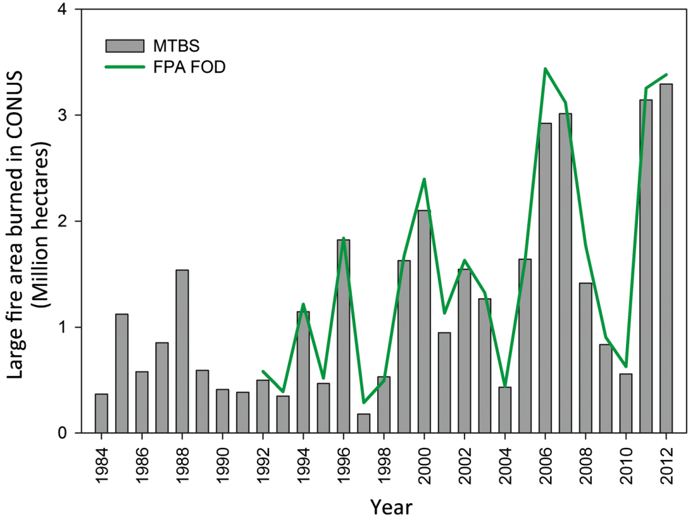
“A large wildfire is defined here as –2012 (bars) are based on large perimeters mapped as part of the An additional set of estimates for 1992–2012 (line) is based on records Database (Short 2014). implications to the implementation of wildfire policy and associated consequences.”
BackgroundBrockway, D. G., Gatewood, R. G., & Paris, R. B. (2002) · Journal of Environmental Management · doi:10.1006/jema.2002.0540 · Cited by 175 · cited 1×
“Grassland and shrubland ecosystems have also experienced changes in fire regime in the past century, with some losing diversity without fire (Brockway et al. 2002) and some because of increased fire frequency after invasion by exotic annual grasses that increase continuity and flammability under a…”
BackgroundForgotten Fires: Native Americans and the Transient Wilderness
Pinkoski, M., Stewart, O. C., Lewis, H. T., & Anderson, M. K. (2003) · Anthropologica · doi:10.2307/25606129 · Cited by 168
Graham, R. T. (2003) · doi:10.2737/rmrs-gtr-114 · Cited by 165
Lydersen, J. M., North, M. P., & Collins, B. M. (2014) · Forest Ecology and Management · doi:10.1016/j.foreco.2014.06.005 · Cited by 161
Wildfire Management in the United States: The Evolution of a Policy Failure
Busenberg, G. (2004) · Review of Policy Research · doi:10.1111/j.1541-1338.2004.00066.x · Cited by 159
Estimating Suppression Expenditures for Individual Large Wildland Fires
Gebert, K. M., Calkin, D. E., & Yoder, J. (2007) · Western Journal of Applied Forestry · doi:10.1093/wjaf/22.3.188 · Cited by 143
Self-citationEstimation of wildfire size and risk changes due to fuels treatments
Cochrane, M. A., Moran, C. J., Wimberly, M. C., Baer, A. D., Finney, M. A., Beckendorf, K. L., Eidenshink, J., & Zhu, Z. (2012) · International Journal of Wildland Fire · doi:10.1071/wf11079 · Cited by 136 · cited 1×
“Despite the critical role past fire scars have played in the suppression of large fires (Graham 2003; Cochrane et al. 2012), extensive application of the use of naturally ignited wildfires has not yet been well demonstrated outside large wilderness areas.”
BackgroundSelf-citationForgotten Fires: Native Americans and the Transient Wilderness
Fisher, C., Stewart, O. C., Lewis, H. T., & Anderson, M. K. (2004) · The Western Historical Quarterly · doi:10.2307/25442993 · Cited by 136
Sustainability in forest management and a new role for resilience thinking
Rist, L., & Moen, J. (2013) · Forest Ecology and Management · doi:10.1016/j.foreco.2013.08.033 · Cited by 121
Spatial Distribution of Water Supply in the Coterminous United States1
Brown, T. C., Hobbins, M. T., & Ramirez, J. A. (2008) · JAWRA Journal of the American Water Resources Association · doi:10.1111/j.1752-1688.2008.00252.x · Cited by 121
Responding to bushfire risk: the need for transformative adaptation
O’Neill, S. J., & Handmer, J. (2012) · Environmental Research Letters · doi:10.1088/1748-9326/7/1/014018 · Cited by 118
Fire and land management planning and implementation across multiple scales
Hann, W. J., & Bunnell, D. L. (2001) · International Journal of Wildland Fire · doi:10.1071/wf01037 · Cited by 115 · cited 2×
“Prescribed fire has been well recognized within the scientific literature (Hann and Bunnell 2001; Graham et al. 2004; Martinson and Omi 2013) as a fuel modification and restoration technique that is highly effective at mitigating wildfire behavior.”
BackgroundNoss, R. F., Beier, P., Wallace Covington, W., Edward Grumbine, R., Lindenmayer, D. B., Prather, J. W., Schmiegelow, F., Sisk, T. D., & Vosick, D. J. (2006) · Restoration Ecology · doi:10.1111/j.1526-100x.2006.00099.x · Cited by 108 · cited 4×
“Under certain conditions wildland fire can promote significant ecological benefits and reduce the risk that high intensity fires will spread to areas of high value into the future (Noss et al. 2006).”
BackgroundInfluentialCalkin, D. C., Finney, M. A., Ager, A. A., Thompson, M. P., & Gebert, K. M. (2011) · Forest Policy and Economics · doi:10.1016/j.forpol.2011.02.007 · Cited by 107 · cited 2×
“…management plans have not sufficiently considered the role of existing beneficial use on future fire management opportunities (Doan et al. 2006; Calkin et al. 2011) and managers are subject to a status quo bias that makes them reluctant to select beneficial use strategies when full suppression…”
BackgroundSelf-citationThe role of fire in the California pine forests
Show, S. B., & Kotok, E. I. (1924) · doi:10.5962/bhl.title.107935 · Cited by 104 · cited 3×
“Several decades later, Show and Kotok (1924) recorded effects of pursuing total fire exclusion: “The establishment of the national forests in California, beginning as early as 1891, thus found forest burning an established practice.”
BackgroundInfluentialEcological foundations for fire management in North American forest and shrubland ecosystems
Keeley, J. E., Aplet, G. H., Christensen, N. L., Conard, S. G., Johnson, E. A., Omi, P. N., Peterson, D. L., & Swetnam, T. W. (2009) · doi:10.2737/pnw-gtr-779 · Cited by 101 · cited 1×
“The range of ecosystem conditions, fire regimes and land uses suggests a one size fits all approach to wildfire and fuels management is neither desirable nor feasible (Keeley et al. 2009).”
BackgroundCan behavioral decision theory explain risk-averse fire management decisions?
Maguire, L. A., & Albright, E. A. (2005) · Forest Ecology and Management · doi:10.1016/j.foreco.2005.01.027 · Cited by 98 · cited 2×
“Fire managers can also exhibit systematic errors in estimating and interpreting probabilistic information (such as underestimating likely outcomes while overestimating rare events), which can lead to poor risk management (Donovan and Noordijk 2005; Maguire and Albright 2005; Wibbenmeyer et al. 2013).”
BackgroundFactors influencing large wildland fire suppression expenditures
Liang, J., Calkin, D. E., Gebert, K. M., Venn, T. J., & Silverstein, R. P. (2008) · International Journal of Wildland Fire · doi:10.1071/wf07010 · Cited by 97 · cited 1×
“Despite the vigorous fire suppression near human communities (Gebert et al. 2007; Liang et al. 2008; Gude et al. 2013) the number of homes destroyed by wildfire continues on an upward trend.”
BackgroundSelf-citationFuel treatments and fire severity: A meta-analysis
Martinson, E. J., & Omi, P. N. (2013) · doi:10.2737/rmrs-rp-103 · Cited by 91
Managing Wildfire Events: Risk‐Based Decision Making Among a Group of Federal Fire Managers
Wilson, R. S., Winter, P. L., Maguire, L. A., & Ascher, T. (2011) · Risk Analysis · doi:10.1111/j.1539-6924.2010.01534.x · Cited by 89 · cited 4×
“When selecting strategies, fire managers have displayed the discounting bias (overemphasizing short-term risk reduction over longer-term considerations), the status quo bias (reverting to suppressing all fires relative to allowing fires to burn for ecological considerations), and the loss aversion bias (preferring saf…”
BackgroundInfluentialCommunity wildfire protection planning: is the Healthy Forests Restoration Act’s vagueness genius?
Jakes, P. J., Nelson, K. C., Enzler, S. A., Burns, S., Cheng, A. S., Sturtevant, V., Williams, D. R., Bujak, A., Brummel, R. F., Grayzeck-Souter, S., et al. (2011) · International Journal of Wildland Fire · doi:10.1071/wf10038 · Cited by 85 · cited 1×
“Keywords: Wildfire suppression; Wildfire paradox; Wildland urban interface; Resilience”
BackgroundVenn, T. J., & Calkin, D. E. (2011) · International Journal of Wildland Fire · doi:10.1071/wf09095 · Cited by 79 · cited 2×
“…and ecological consequences of fire engender further uncertainty when evaluating alternative courses of action (Thompson and Calkin 2011; Venn and Calkin 2011; Hyde et al. 2013) which may lead to managers pursuing aggressive suppression strategies under conditions with low levels of…”
BackgroundSelf-citationThe Effect of Newspaper Coverage and Political Pressure on Wildfire Suppression Costs
Donovan, G. H., Prestemon, J. P., & Gebert, K. (2011) · Society & Natural Resources · doi:10.1080/08941921003649482 · Cited by 70 · cited 2×
“For example Donovan et al. (2011) demonstrated that per area cost of managing a wildfire was positively associated with the seniority of the congressional representative of the district in which the fire occurred and the amount of media coverage.”
BackgroundEvidence for the effect of homes on wildfire suppression costs
Gude, P. H., Jones, K., Rasker, R., & Greenwood, M. C. (2013) · International Journal of Wildland Fire · doi:10.1071/wf11095 · Cited by 69 · cited 1×
“Despite the vigorous fire suppression near human communities (Gebert et al. 2007; Liang et al. 2008; Gude et al. 2013) the number of homes destroyed by wildfire continues on an upward trend.”
BackgroundCalkin, D. E., Venn, T., Wibbenmeyer, M., & Thompson, M. P. (2013) · International Journal of Wildland Fire · doi:10.1071/wf11075 · Cited by 67 · cited 2×
“In a choice survey of federal wildfire managers Calkin et al. (2013) demonstrated that, all else equal, mangers were more likely to select wildfire suppression strategies with higher suppression costs after accounting for potential risk to homes, ecological values, and firefighter exposure.”
BackgroundSelf-citationWibbenmeyer, M. J., Hand, M. S., Calkin, D. E., Venn, T. J., & Thompson, M. P. (2013) · Risk Analysis · doi:10.1111/j.1539-6924.2012.01894.x · Cited by 66
Self-citationCanton-Thompson, J., Gebert, K. M., Thompson, B., Jones, G., Calkin, D., & Donovan, G. (2008) · Journal of Forestry · doi:10.1093/jof/106.8.416 · Cited by 65
Self-citation(2010) · Cited by 64
An Alternative Incentive Structure for Wildfire Management on National Forest Land
Donovan, G. H., & Brown, T. C. (2005) · Forest Science · doi:10.1093/forestscience/51.5.387 · Cited by 64 · cited 2×
“…on the level of suppression response, the existing incentive structure and budget process provides only weak feedback in terms of internalizing the impact of wildfire suppression spending on decision makers charged with managing wildland fires (Donovan and Brown 2005; Thompson et al. 2013).”
BackgroundSocial, Institutional, and Psychological Factors Affecting Wildfire Incident Decision Making
Thompson, M. P. (2014) · Society & Natural Resources · doi:10.1080/08941920.2014.901460 · Cited by 62 · cited 3×
“Further, federal fire managers exhibit decision biases and heuristics that are common to environments characterized by significant complexity and uncertainty, which can lead to suboptimal decisions and outcomes (Thompson 2014).”
BackgroundSelf-citationCharacterizing Fire-on-Fire Interactions in Three Large Wilderness Areas
Teske, C. C., Seielstad, C. A., & Queen, L. P. (2012) · Fire Ecology · doi:10.4996/fireecology.0802082 · Cited by 56 · cited 2×
“…and Bob Marshall Wilderness Areas in Montana, and the Gila Wilderness in New Mexico, once reduced fuel loading and barriers to fire spread associated with past fire scars have been achieved, wildfire can play a role in maintaining these landscapes (Teske et al. 2012; Parks et al. 2014).”
BackgroundHyde, K., Dickinson, M. B., Bohrer, G., Calkin, D., Evers, L., Gilbertson-Day, J., Nicolet, T., Ryan, K., & Tague, C. (2013) · International Journal of Wildland Fire · doi:10.1071/wf11143 · Cited by 51 · cited 1×
“…consequences of fire engender further uncertainty when evaluating alternative courses of action (Thompson and Calkin 2011; Venn and Calkin 2011; Hyde et al. 2013) which may lead to managers pursuing aggressive suppression strategies under conditions with low levels of risk to valued assets…”
BackgroundSelf-citationA Risk-Based Approach to Wildland Fire Budgetary Planning
Thompson, M. P., Calkin, D. E., Finney, M. A., Gebert, K. M., & Hand, M. S. (2013) · Forest Science · doi:10.5849/forsci.09-124 · Cited by 46 · cited 2×
“…on the level of suppression response, the existing incentive structure and budget process provides only weak feedback in terms of internalizing the impact of wildfire suppression spending on decision makers charged with managing wildland fires (Donovan and Brown 2005; Thompson et al. 2013).”
BackgroundSelf-citationMeldrum, J. R., Champ, P. A., Warziniack, T., Brenkert–Smith, H., Barth, C. M., & Falk, L. C. (2014) · International Journal of Wildland Fire · doi:10.1071/wf13130 · Cited by 44
Barriers to Wildland Fire Use A Preliminary Problem Analysis
Doane, D., Morgan, P., & Miller, C. (2006) · Cited by 33
Wildfire Risk Assessment Framework for Land and Resource Management
Scott, J. H., Thompson, M. P., & Calkin, D. E. (2013) · Lincoln (University of Nebraska) · Cited by 31
Self-citationTillery, A. C., Haas, J. R., Miller, L. W., Scott, J. H., & Thompson, M. P. (2014) · Scientific Investigations Report · doi:10.3133/sir20145161 · Cited by 30
Self-citationFranklin, J. F., Hagmann, R. K., & Urgenson, L. S. (2014) · Landscape Ecology · doi:10.1007/s10980-014-0077-0 · Cited by 23 · cited 4×
“…societal factors such as inadequate funding, conflicts among objectives and priority of resource values as well as limited public understanding have created significant delay in the implementation of these programs to restore forest resilience to fire (Franklin et al. 2014; Rideout et al. 2014).”
BackgroundInfluentialWildfire risk and optimal investments in watershed protection
Warziniack, T., Thompson, M., Warziniack, T., & Thompson, M. (2013) · Unknown · doi:10.22004/ag.econ.176677 · Cited by 22
Self-citationRideout, D. B., Ziesler, P. S., & Kernohan, N. J. (2014) · Journal of Environmental Management · doi:10.1016/j.jenvman.2014.03.023 · Cited by 15
Donovan, G. H., & Noordijk, P. (2005) · Journal of Forestry · doi:10.1093/jof/103.1.10 · Cited by 15
Scott, J. H., Helmbrecht, D., & Thompson, M. P. (2014) · doi:10.2737/rmrs-rn-71 · Cited by 13
Self-citation
Research works printed but not linked: 8
- 2. Arno SF, Brown JK (1991) Overcoming the paradox in managing wildland fire in western wildlands. University of Montana, Montana Forest and Conservation Experiment Station, Missoula, MT, pp 40-46
- 11. Cleetus R, Mulik K (2014) Playing with fire: how climate change and development patterns are contributing to the soaring costs of western wildfires., Available at: http://www.ucsusa.org/assets/documents/global_warming/playing-with- fire-report.pdf. Accessed September 9, 2014
- 15. Collins R, de Neufville R, Claro J, Oliveira T, Pacheco A (2013) Forest fire management to avoid unintended consequences: a case study of Portugal using system dynamics. J Environm Manage 130:1-9 Colorado Department of Fire Prevention and Control (2014) Special report: Colorado Firefighting Air Corps., Available at: http://dfs.state.co.us/. Accessed October 30, 2014
- 24. Fowler C, Konopik E (2007) The history of fire in the southern United States. Human Ecol Rev 14(2):165-176
- 35. Interagency Working Group (2001) Review and update of the 1995 federal wildland fire management policy. National Interagency Fire Center, Boise, ID
- 45. Moritz MA, Batllori E, Bradstock RA, Gill MA, Handmer J, Hessburg PF, Leonard J, McCaffrey S, Odion DC, Schoennagel T, Syphard AD (2014) Learning to coexist with wildfire. Nature 515(7525):58-66 National Interagency Fire Center (2014) Available at: https://www.nifc.gov/ fireInfo/fireInfo_documents/SuppCosts.pdf. Accessed February 23, 2015
- 52. Pyne S (2011) The wallow fire: a ruinous burn. Wildfire Magazine 2011:14-17
- USDA Forest Service (2014) The rising cost of fire operations: effects on the forest service’s non-fire work., Available at: http://www.fs.fed.us/sites/default/files/media/2014/34/nr-firecostimpact-082014.pdf . Accessed October 30, 2014
Cited by
Adapt to more wildfire in western North American forests as climate changes
Schoennagel, T., Balch, J. K., Brenkert-Smith, H., Dennison, P. E., Harvey, B. J., Krawchuk, M. A., Mietkiewicz, N., Morgan, P., Moritz, M. A., Rasker, R., et al. (2017) · Proceedings of the National Academy of Sciences · doi:10.1073/pnas.1617464114 · Cited by 774
Wildfire management in Mediterranean-type regions: paradigm change needed
Moreira, F., Ascoli, D., Safford, H., Adams, M. A., Moreno, J. M., Pereira, J. M. C., Catry, F. X., Armesto, J., Bond, W., González, M. E., et al. (2020) · Environmental Research Letters · doi:10.1088/1748-9326/ab541e · Cited by 561
North, M. P., Stephens, S. L., Collins, B. M., Agee, J. K., Aplet, G., Franklin, J. F., & Fulé, P. Z. (2015) · Science · doi:10.1126/science.aab2356 · Cited by 484
Adapting western North American forests to climate change and wildfires: 10 common questions
Prichard, S. J., Hessburg, P. F., Hagmann, R. K., Povak, N. A., Dobrowski, S. Z., Hurteau, M. D., Kane, V. R., Keane, R. E., Kobziar, L. N., Kolden, C. A., et al. (2021) · Ecological Applications · doi:10.1002/eap.2433 · Cited by 336
High-severity fire: evaluating its key drivers and mapping its probability across western US forests
Parks, S. A., Holsinger, L. M., Panunto, M. H., Jolly, W. M., Dobrowski, S. Z., & Dillon, G. K. (2018) · Environmental Research Letters · doi:10.1088/1748-9326/aab791 · Cited by 241
Metadata
- Authors
- Calkin, D. E., Thompson, M. P., & Finney, M. A.
- Affiliations
- US Forest Service (US)
- Corresponding author
- Calkin, David E
- Venue
- Forest Ecosystems
- Publisher
- Elsevier BV
- Published
- 2015-04-14
- Volume
- 2
- Issue
- 1
- ISSN
- 2095-6355 (ISSN-L)
- 2197-5620
- OpenAlex
- W2121495297
- Cited by
- 323
- References
- 80
- Citations by year
- 2026: 34 · 2025: 32 · 2024: 35 · 2023: 29 · 2022: 32 · 2021: 38 · 2020: 21 · 2019: 30 · 2018: 24 · 2017: 19 · 2016: 23 · 2015: 5
- FWCI
- 19.39
- Type
- journal article
- Language
- en
- Open access
- gold
- doi.org
- Locations
- Forest Ecosystems (publishedVersion, cc-by)
- DOAJ (DOAJ: Directory of Open Access Journals) (submittedVersion)
- Topics
- Physical Sciences › Environmental Science › Global and Planetary Change › Fire effects on ecosystems
- Life Sciences › Agricultural and Biological Sciences › Forestry › Forest Management and Policy
- Social Sciences › Sociology and Political Science › Disaster Management and Resilience
- Keywords
- wildfire management, wildfire suppression, positive feedback loop, wildland-urban interface, fire policy, fuel accumulation, climate change, wildfire risk, fire-adapted ecosystems, ecosystem resilience
About these checks
Registry, retraction, Cites and statistics results are computed, not judged, with one exception: a printed reference that no index lists is read once by a model before it counts as a citation error. Claims are extracted by a model and kept only when their quote appears verbatim in the text; each cited source is then checked, with a model’s help, for whether it says what the claim relies on. Those verdicts can be wrong — read the claim’s quote and the cited source before relying on one.
The claim verdicts this report counts are experimental: their accuracy is not yet measured.
A language model drew the claims from the paper on 2026-10-10, under version 3 of the claim definition (model deepseek-v4.1-flash, prompt extract-v3).
A second model labelled each claim on 2026-10-10 (model jev-1.13-20260917, definition revision gold-guideline-v0.2).
Cited sources are checked with a language model’s help (gpt-6-sol).
Statistics and arithmetic are recomputed, not judged.
Confidence bands are shown only for fields calibrated on our annotated test set. None is calibrated yet, so no band is shown.
What counts as a claim ›How we measure confidence ›How we check this ›
Are you an author, or do you see a problem with this page? Request a review
Data sources
Bibliographic data: Semantic Scholar, OpenAlex, Crossref.
Contains information from the Semantic Scholar Academic Graph Datasets, made available under the ODC Attribution License (ODC-BY 1.0).
Semantic Scholar’s data is described in: Kinney, R., et al. (2023). The Semantic Scholar Open Data Platform. arXiv:2301.10140.
