

Factors influencing consumers’ purchase intention of green sportswear
Open accessThe DOI matches its Crossref record; 54 of the 57 references it cites were found in a registry or an index, and 1 are not checked yet.
Abstract
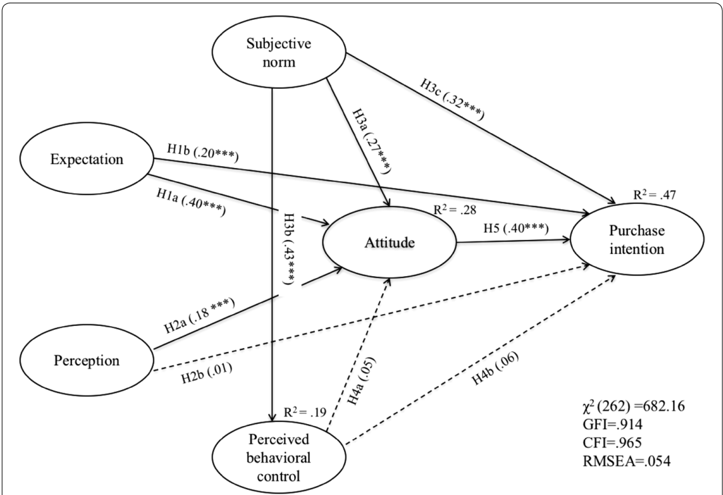
The purpose of this study was to examine consumers’ purchase intention for green sportswear by investigating the effects of their expectation, perception, subjective norm, perceived behavior control, and attitude on purchasing green sportswear. The study further investigated differential influences towards purchase intention for green sportswear between non-green and green product users. A within-subjects research design was used to empirically test our conceptual model, which was expanded from the theory of planned behavior by adding two additional predictors (expectation and perception). An online survey was conducted with a nationwide convenience sample of U.S. consumers whose ages ranged from 18 to 74 years, and a total of 542 usable responses were obtained. The results of the overall model testing confirmed the significant effects of expectation, perception, subjective norm, and attitude on consumers’ purchase intention for green sportswear. The findings from the comparative model testing indicated significant differences between non-green and green product users in terms of the effects of expectation and perceived behavior control on participants’ green sportswear purchase intention. The outcomes of this study offer useful insights for developing effective strategies for consumers to generate more positive perception, expectation, and attitude towards purchasing green sportswear. This study also suggests potential ways for apparel retailers to develop effective marketing strategies for this sportswear segment to satisfy the values of potential customers.
Overview
The claims and statistics of this paper haven’t been checked yet.
Free: it reads the open-access text and checks the first 5 claims that cite a source we can check. Create a free account to check every claim.
Integrity signals
Registry
Cites
Statistics
Figures
Verification
Claims the paper makes
The claims and statistics of this paper haven’t been checked yet.
Free: it reads the open-access text and checks the first 5 claims that cite a source we can check. Create a free account to check every claim.
Claims other papers make about this one
Each is checked against this paper’s own text: does it say what the citing paper says it does?
The source backs part of the claim, not all of it — or backs it for a different population, condition or comparison.
In the citing paper
“Green products are often more costly than traditional products”
From The Influencing Factors of Consumers’ Purchase Intention toward Green Products: A Case of Consumers in Saudi Arabia (2022) · cites this paper as Nam et al., 2017
Experimental — accuracy not yet measuredThe cited source says what the claim attributes to it.
In the citing paper
“This is especially true for consumers with low concern for the environment who are not willing to pay extra money for acquiring green products”
From The Influencing Factors of Consumers’ Purchase Intention toward Green Products: A Case of Consumers in Saudi Arabia (2022) · cites this paper as Nam et al., 2017
The cited source says what the claim attributes to it.
In the citing paper
“In the context of the affecting factors that are specifically related to the TPB constructs-perceived behavioral control, subjective norms, and attitude (Nam et al., 2017)-findings have endorsed the significant influences of attitude and subjective norms on consumers' intentions to purchase green sportswear.”
From The Influencing Factors of Consumers’ Purchase Intention toward Green Products: A Case of Consumers in Saudi Arabia (2022) · cites this paper as Nam et al., 2017
The cited source says what the claim attributes to it.
In the citing paper
“the product's price plays an important role when a consumer makes a purchasing decision”
From The Influencing Factors of Consumers’ Purchase Intention toward Green Products: A Case of Consumers in Saudi Arabia (2022) · cites this paper as Nam et al., 2017
The cited source says what the claim attributes to it.
In the citing paper
“This result corresponds with the outcomes of Nam et al. (2017) and Choi and Johnson (2019), which demonstrated no considerable impact of perceived behavioral control on attitude.”
From The Influencing Factors of Consumers’ Purchase Intention toward Green Products: A Case of Consumers in Saudi Arabia (2022) · cites this paper as Nam et al. (2017)
1 more claim about this paper
Create a free account to see every claim other papers make about this one.
Self-check
Percentages, sums and reported differences re-computed from the paper’s own numbers.
The self-check needs the paper’s full text.
Citations
Cites
The theory of planned behavior
Ajzen, I. (1991) · Organizational Behavior and Human Decision Processes · doi:10.1016/0749-5978(91)90020-t · Cited by 134,657
Herne, H., Cooley, W. W., & Lohnes, P. R. (1973) · Journal of the Royal Statistical Society. Series A (General) · doi:10.2307/2344428 · Cited by 35,697
(1980) · Medical Entomology and Zoology · Cited by 25,810
A conceptual model of service quality and its implications for future research
Parasuraman, A., Zeithaml, V. A., & Berry, L. L. (1985) · Journal of Marketing · doi:10.1177/002224298504900403 · Cited by 21,645
(2008) · Environmental Chemometrics · doi:10.1201/9781420067972-10 · Cited by 8,170
Perceived Behavioral Control, Self‐Efficacy, Locus of Control, and the Theory of Planned Behavior 1
Ajzen, I. (2002) · Journal of Applied Social Psychology · doi:10.1111/j.1559-1816.2002.tb00236.x · Cited by 7,629 · cited 2×
“The findings are contradicted by Ajzen (2002) and previous studies, where PBC positively influences consumers’ attitude and purchase intention (Gopi and Ramayah 2007; Kang et al.”
BackgroundResultPrediction of goal-directed behavior: Attitudes, intentions, and perceived behavioral control
Ajzen, I., & Madden, T. J. (1986) · Journal of Experimental Social Psychology · doi:10.1016/0022-1031(86)90045-4 · Cited by 5,718 · cited 1×
“PBC is not only a powerful factor influencing to attitude and behavior change, but also is related to salient beliefs that have been regarded as important resources for decision-making (Armitage and Talibudeen 2010; Ajzen and Madden 1986).”
BackgroundA Dynamic Process Model of Service Quality: From Expectations to Behavioral Intentions
Boulding, W., Kalra, A., Staelin, R., & Zeithaml, V. A. (1993) · Journal of Marketing Research · doi:10.1177/002224379303000102 · Cited by 3,416 · cited 1×
“Perceived product quality associated with consumers’ expectation and perception has a direct positive influence on consumers’ purchase intention (Boulding et al. 1993; Tsiotsou 2006).”
BackgroundTargeting consumers who are willing to pay more for environmentally friendly products
Laroche, M., Bergeron, J., & Barbaro‐Forleo, G. (2001) · Journal of Consumer Marketing · doi:10.1108/eum0000000006155 · Cited by 2,974
Predicting green product consumption using theory of planned behavior and reasoned action
Paul, J., Modi, A., & Patel, J. (2016) · Journal of Retailing and Consumer Services · doi:10.1016/j.jretconser.2015.11.006 · Cited by 2,399
Research works printed but not linked: 4
- Ko, S. B. (2012). Predictors of purchase intention toward green apparel products in the US and China (Unpublished doctoral dissertation). Stillwater: Oklahoma State University.
- Kotler, P., & Keller, K. L. (2006). Marketing management (12th ed.). Upper Saddle River: Pearson Prentice Hall Inc.
- Mandese, J. (1991). New study finds green confusion. Advertising Age, 62(45), 1-56.
- Oliver, R. L. (1981). Measurement and evaluation of satisfaction processes in retail settings. Journal of Retailing, 57(3), 25-48.
Cited by
On the factors influencing green purchase intention: a meta-analysis approach
Zhuang, W., Luo, X., & Riaz, M. U. (2021) · Frontiers in Psychology · doi:10.3389/fpsyg.2021.644020 · Cited by 440
“In the literature on environmental knowledge, researchers usually use different environmental knowledge concepts to predict individual green behavior: general or specific environmental knowledge, and subjective or objective environmental knowledge (Lee, 2017).”
BackgroundSustainable fashion: current and future research directions
Mukendi, A., Davies, I., Glozer, S., & McDonagh, P. (2020) · European Journal of Marketing · doi:10.1108/ejm-02-2019-0132 · Cited by 325
Witek, L., & Kuźniar, W. (2020) · Sustainability · doi:10.3390/su13010209 · Cited by 213
Green innovation and environmental awareness driven green purchase intentions
Zameer, H., & Yasmeen, H. (2022) · Marketing Intelligence & Planning · doi:10.1108/mip-12-2021-0457 · Cited by 200
Consumer Perceptions of Sustainable Products: A Systematic Literature Review
Camilleri, M. A., Cricelli, L., Mauriello, R., & Strazzullo, S. (2023) · Sustainability · doi:10.3390/su15118923 · Cited by 188
“Thus, many studies try to explain consumer choices by analysing the interplay between these two factors’ categories [16,17].”
Background
Metadata
- Authors
- Nam, C., Dong, H., & Lee, Y.-A.
- Affiliations
- Iowa State University (US)
- Corresponding author
- Nam, Changhyun
- Venue
- Fashion and Textiles
- Published
- 2017-01-17
- Volume
- 4
- Issue
- 1
- ISSN
- 2198-0802 (ISSN-L)
- OpenAlex
- W2570501474
- Semantic Scholar
- b95ed3c5ffd554fbb023e2b70388fa187c3c7266
- Cited by
- 197
- References
- 57
- Citations by year
- 2026: 12 · 2025: 32 · 2024: 36 · 2023: 29 · 2022: 20 · 2021: 28 · 2020: 22 · 2019: 10 · 2018: 5 · 2017: 3
- FWCI
- 19.79
- Type
- journal article
- Language
- en
- Open access
- gold
- doi.org
- Licence
- cc-by
- creativecommons.org/licenses/by/4.0 (tdm)
- creativecommons.org/licenses/by/4.0 (vor)
- Locations
- Fashion and Textiles (publishedVersion, cc-by)
- Topics
- Social Sciences › Business, Management and Accounting › Marketing › Environmental Sustainability in Business
- Social Sciences › Business, Management and Accounting › Marketing › Consumer Perception and Purchasing Behavior
- Social Sciences › Business, Management and Accounting › Marketing › Consumer Retail Behavior Studies
- Keywords
- purchase intention, theory of planned behavior, consumer perception, subjective norms, perceived behavioral control, consumer attitudes, apparel marketing, sustainable fashion
About these checks
Registry, retraction, Cites and statistics results are computed, not judged, with one exception: a printed reference that no index lists is read once by a model before it counts as a citation error. Claims are extracted by a model and kept only when their quote appears verbatim in the text; each cited source is then checked, with a model’s help, for whether it says what the claim relies on. Those verdicts can be wrong — read the claim’s quote and the cited source before relying on one.
Statistics and arithmetic are recomputed, not judged.
Confidence bands are shown only for fields calibrated on our annotated test set. None is calibrated yet, so no band is shown.
What counts as a claim ›How we measure confidence ›How we check this ›
Are you an author, or do you see a problem with this page? Request a review
Data sources
Bibliographic data: Semantic Scholar, OpenAlex, Crossref.
Contains information from the Semantic Scholar Academic Graph Datasets, made available under the ODC Attribution License (ODC-BY 1.0).
Semantic Scholar’s data is described in: Kinney, R., et al. (2023). The Semantic Scholar Open Data Platform. arXiv:2301.10140.
