

Factors influencing consumers’ purchase intention of green sportswear
Open accessThe DOI matches its Crossref record; 54 of the 57 references it cites were found in a registry or an index, and 1 are not checked yet.
Abstract
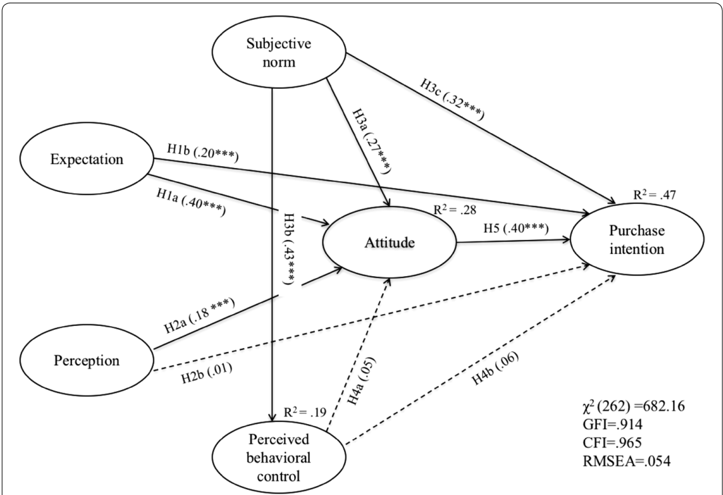
The purpose of this study was to examine consumers’ purchase intention for green sportswear by investigating the effects of their expectation, perception, subjective norm, perceived behavior control, and attitude on purchasing green sportswear. The study further investigated differential influences towards purchase intention for green sportswear between non-green and green product users. A within-subjects research design was used to empirically test our conceptual model, which was expanded from the theory of planned behavior by adding two additional predictors (expectation and perception). An online survey was conducted with a nationwide convenience sample of U.S. consumers whose ages ranged from 18 to 74 years, and a total of 542 usable responses were obtained. The results of the overall model testing confirmed the significant effects of expectation, perception, subjective norm, and attitude on consumers’ purchase intention for green sportswear. The findings from the comparative model testing indicated significant differences between non-green and green product users in terms of the effects of expectation and perceived behavior control on participants’ green sportswear purchase intention. The outcomes of this study offer useful insights for developing effective strategies for consumers to generate more positive perception, expectation, and attitude towards purchasing green sportswear. This study also suggests potential ways for apparel retailers to develop effective marketing strategies for this sportswear segment to satisfy the values of potential customers.
Overview
The claims and statistics of this paper haven’t been checked yet.
Free: it reads the open-access text and checks the first 5 claims that cite a source we can check. Create a free account to check every claim.
Integrity signals
Registry
Cites
Statistics
Figures
Verification
Claims the paper makes
The claims and statistics of this paper haven’t been checked yet.
Free: it reads the open-access text and checks the first 5 claims that cite a source we can check. Create a free account to check every claim.
Claims other papers make about this one
Each is checked against this paper’s own text: does it say what the citing paper says it does?
The source backs part of the claim, not all of it — or backs it for a different population, condition or comparison.
In the citing paper
“Green products are often more costly than traditional products”
From The Influencing Factors of Consumers’ Purchase Intention toward Green Products: A Case of Consumers in Saudi Arabia (2022) · cites this paper as Nam et al., 2017
Experimental — accuracy not yet measuredThe cited source says what the claim attributes to it.
In the citing paper
“This is especially true for consumers with low concern for the environment who are not willing to pay extra money for acquiring green products”
From The Influencing Factors of Consumers’ Purchase Intention toward Green Products: A Case of Consumers in Saudi Arabia (2022) · cites this paper as Nam et al., 2017
The cited source says what the claim attributes to it.
In the citing paper
“In the context of the affecting factors that are specifically related to the TPB constructs-perceived behavioral control, subjective norms, and attitude (Nam et al., 2017)-findings have endorsed the significant influences of attitude and subjective norms on consumers' intentions to purchase green sportswear.”
From The Influencing Factors of Consumers’ Purchase Intention toward Green Products: A Case of Consumers in Saudi Arabia (2022) · cites this paper as Nam et al., 2017
The cited source says what the claim attributes to it.
In the citing paper
“the product's price plays an important role when a consumer makes a purchasing decision”
From The Influencing Factors of Consumers’ Purchase Intention toward Green Products: A Case of Consumers in Saudi Arabia (2022) · cites this paper as Nam et al., 2017
The cited source says what the claim attributes to it.
In the citing paper
“This result corresponds with the outcomes of Nam et al. (2017) and Choi and Johnson (2019), which demonstrated no considerable impact of perceived behavioral control on attitude.”
From The Influencing Factors of Consumers’ Purchase Intention toward Green Products: A Case of Consumers in Saudi Arabia (2022) · cites this paper as Nam et al. (2017)
1 more claim about this paper
Create a free account to see every claim other papers make about this one.
Self-check
Percentages, sums and reported differences re-computed from the paper’s own numbers.
The self-check needs the paper’s full text.
Citations
Cites
The theory of planned behavior
Ajzen, I. (1991) · Organizational Behavior and Human Decision Processes · doi:10.1016/0749-5978(91)90020-t · Cited by 134,657
Herne, H., Cooley, W. W., & Lohnes, P. R. (1973) · Journal of the Royal Statistical Society. Series A (General) · doi:10.2307/2344428 · Cited by 35,697
(1980) · Medical Entomology and Zoology · Cited by 25,810
A conceptual model of service quality and its implications for future research
Parasuraman, A., Zeithaml, V. A., & Berry, L. L. (1985) · Journal of Marketing · doi:10.1177/002224298504900403 · Cited by 21,645
(2008) · Environmental Chemometrics · doi:10.1201/9781420067972-10 · Cited by 8,170
Perceived Behavioral Control, Self‐Efficacy, Locus of Control, and the Theory of Planned Behavior 1
Ajzen, I. (2002) · Journal of Applied Social Psychology · doi:10.1111/j.1559-1816.2002.tb00236.x · Cited by 7,629 · cited 2×
“The findings are contradicted by Ajzen (2002) and previous studies, where PBC positively influences consumers’ attitude and purchase intention (Gopi and Ramayah 2007; Kang et al.”
BackgroundResultPrediction of goal-directed behavior: Attitudes, intentions, and perceived behavioral control
Ajzen, I., & Madden, T. J. (1986) · Journal of Experimental Social Psychology · doi:10.1016/0022-1031(86)90045-4 · Cited by 5,718 · cited 1×
“PBC is not only a powerful factor influencing to attitude and behavior change, but also is related to salient beliefs that have been regarded as important resources for decision-making (Armitage and Talibudeen 2010; Ajzen and Madden 1986).”
BackgroundA Dynamic Process Model of Service Quality: From Expectations to Behavioral Intentions
Boulding, W., Kalra, A., Staelin, R., & Zeithaml, V. A. (1993) · Journal of Marketing Research · doi:10.1177/002224379303000102 · Cited by 3,416 · cited 1×
“Perceived product quality associated with consumers’ expectation and perception has a direct positive influence on consumers’ purchase intention (Boulding et al. 1993; Tsiotsou 2006).”
BackgroundTargeting consumers who are willing to pay more for environmentally friendly products
Laroche, M., Bergeron, J., & Barbaro‐Forleo, G. (2001) · Journal of Consumer Marketing · doi:10.1108/eum0000000006155 · Cited by 2,974
Predicting green product consumption using theory of planned behavior and reasoned action
Paul, J., Modi, A., & Patel, J. (2016) · Journal of Retailing and Consumer Services · doi:10.1016/j.jretconser.2015.11.006 · Cited by 2,399
Research works printed but not linked: 4
- Ko, S. B. (2012). Predictors of purchase intention toward green apparel products in the US and China (Unpublished doctoral dissertation). Stillwater: Oklahoma State University.
- Kotler, P., & Keller, K. L. (2006). Marketing management (12th ed.). Upper Saddle River: Pearson Prentice Hall Inc.
- Mandese, J. (1991). New study finds green confusion. Advertising Age, 62(45), 1-56.
- Oliver, R. L. (1981). Measurement and evaluation of satisfaction processes in retail settings. Journal of Retailing, 57(3), 25-48.
Cited by
On the factors influencing green purchase intention: a meta-analysis approach
Zhuang, W., Luo, X., & Riaz, M. U. (2021) · Frontiers in Psychology · doi:10.3389/fpsyg.2021.644020 · Cited by 440
“In the literature on environmental knowledge, researchers usually use different environmental knowledge concepts to predict individual green behavior: general or specific environmental knowledge, and subjective or objective environmental knowledge (Lee, 2017).”
BackgroundSustainable fashion: current and future research directions
Mukendi, A., Davies, I., Glozer, S., & McDonagh, P. (2020) · European Journal of Marketing · doi:10.1108/ejm-02-2019-0132 · Cited by 325
Witek, L., & Kuźniar, W. (2020) · Sustainability · doi:10.3390/su13010209 · Cited by 213
Green innovation and environmental awareness driven green purchase intentions
Zameer, H., & Yasmeen, H. (2022) · Marketing Intelligence & Planning · doi:10.1108/mip-12-2021-0457 · Cited by 200
Consumer Perceptions of Sustainable Products: A Systematic Literature Review
Camilleri, M. A., Cricelli, L., Mauriello, R., & Strazzullo, S. (2023) · Sustainability · doi:10.3390/su15118923 · Cited by 188
“Thus, many studies try to explain consumer choices by analysing the interplay between these two factors’ categories [16,17].”
BackgroundInfluencing factors for the purchase intention of consumers choosing bioplastic products in Germany
Klein, F., Emberger‐Klein, A., Menrad, K., Möhring, W., & Blesin, J.-M. (2019) · Sustainable Production and Consumption · doi:10.1016/j.spc.2019.01.004 · Cited by 171
Consumer Attitudes Towards New Circular Models in the Fashion Industry
Musová, Z., Musa, H., Drugdova, J., Lăzăroiu, G., & Alayasa, J. (2021) · Journal of Competitiveness · doi:10.7441/joc.2021.03.07 · Cited by 168
“Using natural fabrics and materials (e. g., organic cotton) joc2021-3-v2.indd 120 27.9.2021 8:28:06 121 as well as recycled materials can reduce the overall negative environmental impact (Nam et al., 2017).”
BackgroundInfluentialFast fashion consumption and its environmental impact: a literature review
Aponte, N. O., Gómez, J. A. H., Argüelles, V. T., & Smith, E. (2024) · Sustainability Science Practice and Policy · doi:10.1080/15487733.2024.2381871 · Cited by 138
The Drivers of Sustainable Apparel and Sportswear Consumption: A Segmented Kano Perspective
Baier, D., Rausch, T. M., & Wagner, T. F. (2020) · Sustainability · doi:10.3390/su12072788 · Cited by 131
Ali, S., Danish, M., Khuwaja, F. M., Sajjad, M. S., & Zahid, H. (2019) · Environments · doi:10.3390/environments6050053 · Cited by 121
“In the past, numerous researchers have studied green buying behavior among different product categories, such as green food [19], green sportswear [20], green wine packing [21], green apparel [22], green vehicle [23], and green skin care products [24].”
BackgroundAn Integrated Model for Examining Tourists’ Revisit Intention to Beach Tourism Destinations
Hasan, K., Abdullah, S. K., Islam, F., & Neela, N. M. (2020) · Journal of Quality Assurance in Hospitality & Tourism · doi:10.1080/1528008x.2020.1740134 · Cited by 118
Sobuj, M., Khan, A. M., Habib, M. A., & Islam, M. M. (2021) · Research Journal of Textile and Apparel · doi:10.1108/rjta-10-2019-0052 · Cited by 120
Factors influencing customers’ green purchasing intention: evidence from developing country
Chanda, R. C., Isa, S. M., & Ahmed, T. (2023) · Journal of Science and Technology Policy Management · doi:10.1108/jstpm-03-2022-0044 · Cited by 123
Hong, Y., Mamun, A. A., Masukujjaman, M., & Yang, Q. Y. (2023) · Asia Pacific Management Review · doi:10.1016/j.apmrv.2023.10.002 · Cited by 110
Cayaban, C. J. G., Prasetyo, Y. T., Persada, S. F., Borres, R. D., Gumasing, M. J. J., & Nadlifatin, R. (2023) · Sustainability · doi:10.3390/su15118502 · Cited by 109
Hao, Y., Wang, Y., Wu, Q., Sun, S., Wang, W., & Cui, M. (2020) · Sustainable Development · doi:10.1002/sd.2074 · Cited by 103
Drivers of green apparel consumption: Digging a little deeper into green apparel buying intentions
Tandon, A., Sithipolvanichgul, J., Asmi, F., Anwar, M., & Dhir, A. (2023) · Business Strategy and the Environment · doi:10.1002/bse.3350 · Cited by 103
García‐Vázquez, E., & García‐Ael, C. (2021) · Sustainable Production and Consumption · doi:10.1016/j.spc.2021.07.032 · Cited by 104
Lau, O., & Ki, C.-W. (2021) · Fashion and Textiles · doi:10.1186/s40691-021-00270-9 · Cited by 72
Chi, T., Gerard, J., Yu, Y., & Wang, Y. (2021) · International Journal of Fashion Design Technology and Education · doi:10.1080/17543266.2021.1872714 · Cited by 98
Factors influencing the green purchase behaviour of millennials: An emerging country perspective
Dilotsotlhe, N. (2021) · Cogent Business & Management · doi:10.1080/23311975.2021.1908745 · Cited by 93
Determinants of green behavior (Revisited): A comparative study
Ogiemwonyi, O. (2024) · Resources Conservation & Recycling Advances · doi:10.1016/j.rcradv.2024.200214 · Cited by 96
The impact of user perceptions of AR on purchase intention of location-based AR navigation systems
Jung, T. H., Bae, S., Moorhouse, N., & Kwon, O. (2021) · Journal of Retailing and Consumer Services · doi:10.1016/j.jretconser.2021.102575 · Cited by 91
Ebrahimi, P., Khajeheian, D., & Fekete‐Farkas, M. (2021) · International Journal of Environmental Research and Public Health · doi:10.3390/ijerph182413276 · Cited by 81
Khan, S. J., Badghish, S., Kaur, P., Sharma, R. K., & Dhir, A. (2023) · Business Strategy and the Environment · doi:10.1002/bse.3360 · Cited by 77
Celebrity Endorsement, Brand Equity, and Green Cosmetics Purchase Intention Among Chinese Youth
Lili, Z., Al Mamun, A., Hayat, N., Salamah, A. A., Yang, Q., & Ali, M. H. (2022) · Frontiers in Psychology · doi:10.3389/fpsyg.2022.860177 · Cited by 72
Yusuf, D. M., & Zulfitri, Z. (2021) · European Journal of Business Management and Research · doi:10.24018/ejbmr.2021.6.6.1135 · Cited by 73
“The findings in this study are supported by previous research that Subjective Norm has a significant effect on Attitude (Nam et al., 2017), (Matikiti, 2015).”
ResultThe Impact of Environmental Concern on Intention to Reduce Consumption of Single-Use Bottled Water
Borusiak, B., Szymkowiak, A., Pierański, B., & Szalonka, K. (2021) · Energies · doi:10.3390/en14071985 · Cited by 69
“Similar results are found in the research concerning intention to buy hybrid cars [60] and green sportswear [61], whereas de Leeuw et al.”
ResultBakış, S., & Kitapçı, H. (2023) · Journal of Fashion Marketing and Management · doi:10.1108/jfmm-02-2022-0032 · Cited by 68
Why U.S. Consumers Buy Sustainable Cotton Made Collegiate Apparel? A Study of the Key Determinants
Chi, T., Gerard, J., Dephillips, A., Liu, H., & Sun, J. (2019) · Sustainability · doi:10.3390/su11113126 · Cited by 64
“The measures and scales for attitude, subjective norms, PBC, PCE, environmental knowledge and WTB were adapted from prior relevant studies (Barbarossa & De Pelsmacker, 2016; Gam et al., 2010; Nam et al., 2017; Nilsson, 2008; Zhang & Chi, 2015).”
MethodSustainable consumption practices among Chinese youth
Hong, Y., Mamun, A. A., Masukujjaman, M., & Yang, Q. Y. (2024) · Humanities and Social Sciences Communications · doi:10.1057/s41599-024-03582-5 · Cited by 58
“Numerous companies are now producing environmentally friendly goods, and consumers are increasingly inclined to opt for eco-friendly products (Nam et al., 2017).”
Su, S., & Li, Y. (2024) · Sustainability · doi:10.3390/su162410934 · Cited by 62
The Impacts of E-Payment System and Impulsive Buying to Purchase Intention in E-commerce
Halim, E., Januardin, R., & Hebrard, M. (2020) · International Conference on Information Management and Technology (ICIMTech) · doi:10.1109/icimtech50083.2020.9211154 · Cited by 57
“[19], [20], [24], [25], [26], [31], [32], [33] PIC 1 The idea to purchase on the Online Store/E-Commerce is lovely.”
BackgroundResultNgo, Q., Nguyen, T.-D., & Phan, N.-B. (2025) · PLoS ONE · doi:10.1371/journal.pone.0323879 · Cited by 59
“However, the existing literature reveals substantial inconsistencies in the relationships among these key TPB antecedents when predicting green purchasing intentions and green purchasing behaviours [11–19].”
Klein, F., Emberger‐Klein, A., & Menrad, K. (2020) · Sustainability · doi:10.3390/su12020675 · Cited by 56
“[29] show that prior purchases of green apparel is an indicator for future purchases.”
BackgroundResultShih, I.-T., Silalahi, A. D. K., Khishigtogtokh, B., & Jargalsaikhan, S. (2024) · Cogent Business & Management · doi:10.1080/23311975.2024.2431647 · Cited by 54
“…consumer trust but also loyalty, proving crucial for businesses aiming to meet the expectations of modern consumers (Bangsa & schlegelmilch, 2020; nam et al., 2017). several studies have linked consumers’ perceptions of sustainability to positive outcomes like loy-alty and engagement (chang &…”
Ali, S., Javed, H. M. U., & Danish, M. (2021) · Environmental Science and Pollution Research · doi:10.1007/s11356-020-12163-3 · Cited by 54
“…of eco-friendly behavior has been a research agenda of hundreds of scholars who have produced dozens of researches on green consumption behavior (Carlucci et al. 2018; Hameed et al. 2019; Moser 2016; Nam et al. 2017; Pham et al. 2019; Testa et al. 2019; Xu et al. 2019; Yadav and Pathak 2016).”
BackgroundAli, S., Javed, H. M. U., Ali, W., & Zahid, H. (2022) · Journal of Environmental Planning and Management · doi:10.1080/09640568.2022.2081137 · Cited by 54
Cheah, W. K. A., & Aigbogun, O. (2022) · Cleaner and Responsible Consumption · doi:10.1016/j.clrc.2022.100077 · Cited by 54
Antecedents of Thai student teacher sustainable consumption behavior
Pimdee, P. (2020) · Heliyon · doi:10.1016/j.heliyon.2020.e04676 · Cited by 54
“, 2016), environmentally friendly consumption, and green consumption (Haraty and Bitar, 2019; Nam et al., 2017), and environmental sustainability have become areas of concern for many global citizens and educators.”
BackgroundHasan, M. K., Ray, R., & Neela, N. M. (2021) · Tourism Planning & Development · doi:10.1080/21568316.2021.2001035 · Cited by 51
Zubaidi, N. A. (2020) · Journal of Sustainable Marketing · doi:10.51300/josm-2020-23 · Cited by 47
“…individual knowledge about the brand and its green positioning (Suki, 2016), consumer expectations and perception about a company (Nam et al., 2017), consumers environmental concerns (Chaudhary, 2018), self-image congruence with green product consumers (Nguyen & Nguyen, 2020),…”
BackgroundSpindler, V., Schunk, H., & Könecke, T. (2023) · Sustainable Production and Consumption · doi:10.1016/j.spc.2023.05.003 · Cited by 30
Han, T. (2018) · Sustainability · doi:10.3390/su10062025 · Cited by 44
Maziriri, E. T., Nyagadza, B., Chuchu, T., & Mazuruse, G. (2023) · PSU Research Review · doi:10.1108/prr-03-2022-0033 · Cited by 42
Stahl, F. F., Emberger‐Klein, A., & Menrad, K. (2021) · Frontiers in Sustainability · doi:10.3389/frsus.2021.624913 · Cited by 37
Borriello, A., Massey, G. R., & Rose, J. M. (2022) · Marine Pollution Bulletin · doi:10.1016/j.marpolbul.2022.113689 · Cited by 37
What Triggers You to Buy Green Products? Explaining Through an Extended TPB Model
Niloy, A. C., Sultana, J., bin Alam, J., Ghosh, A., & Farhan, K. M. (2023) · Asia-Pacific Journal of Management Research and Innovation · doi:10.1177/2319510x231171195 · Cited by 34
“Attitude is crucial to decision-making (Nam et al., 2017).”
Sustainable knowledge from consumer perspective addressing microfibre pollution
Yan, S., Henninger, C. E., Jones, C., & McCormick, H. (2020) · Journal of Fashion Marketing and Management · doi:10.1108/jfmm-08-2019-0181 · Cited by 32
The impact of communication on consumer knowledge of environmentally sustainable apparel
Li, J., & Leonas, K. K. (2021) · Journal of Fashion Marketing and Management · doi:10.1108/jfmm-02-2021-0034 · Cited by 30
Slow fashion purchase intention drivers: an Indonesian study
Aprianingsih, A., Fachira, I., Setiawan, M., Debby, T., Desiana, N., & Lathifan, S. A. N. (2022) · Journal of Fashion Marketing and Management · doi:10.1108/jfmm-07-2021-0176 · Cited by 29
Sustainable apparel: a perspective from Bangladesh’s young consumers
Su, J., Iqbal, M. A., Haque, F., & Akter, M. M. K. (2023) · Social Responsibility Journal · doi:10.1108/srj-01-2022-0035 · Cited by 29
Lin, C. A., Wang, X., & Dam, L. (2023) · Emerging Media · doi:10.1177/27523543231188279 · Cited by 28
“For instance, Nam et al. ’ s (2017) work found that perceived behavioral control had a direct effect on green sportswear purchase intentions among green product users but not non-green product users.”
BackgroundOn the way to reduce marine microplastics pollution. Research landscape of psychosocial drivers
García‐Vázquez, E., García‐Ael, C., & Topa, G. (2021) · The Science of The Total Environment · doi:10.1016/j.scitotenv.2021.149384 · Cited by 28
Airline Passengers’ Perceived Sacrifice and Green Practices Adoption Behaviours
Wong, L. J., Sia, J. K.-M., & Ling, T. H. Y. (2020) · Asian Journal of Business Research · doi:10.14707/ajbr.200092 · Cited by 27
Brice, J., & Thorpe, H. (2021) · Frontiers in Sports and Active Living · doi:10.3389/fspor.2021.660935 · Cited by 27
Consumer Patterns of Sustainable Clothing Based on Theory of Reasoned Action: Evidence from Ecuador
Leclercq-Machado, L., Álvarez-Risco, A., Ibarra, V. J. G., Esquerre-Botton, S., Morales-Ríos, F., Anderson-Seminario, M. D. L. M., Del-Aguila-Arcentales, S., Davies, N. M., & Yáñez, J. A. (2022) · Sustainability · doi:10.3390/su142214737 · Cited by 27
How are sports management, renewable energy, and green finance related? A survey evidence
Zhu, J., Liang, Z., Zhang, C., & Wei, X. (2023) · Renewable Energy · doi:10.1016/j.renene.2023.02.040 · Cited by 26
Sustainable post-purchase behaviour of consumers of fashion textile products
Kemi, A. P., & Zilahy, G. (2025) · Discover Sustainability · doi:10.1007/s43621-025-00888-5 · Cited by 27
“The construct of perceived behavioural control was adopted from Sreen et al. [82] and Nam et al. [85], who explored factors influencing consumers’ purchase intention of green sportswear.”
An empirical study on electric vehicle adoption in India: A step towards a greener environment
Jain, M., & Singh, A. (2024) · Transport Policy · doi:10.1016/j.tranpol.2024.07.018 · Cited by 28
Aydın, G. (2024) · Journal of Fashion Marketing and Management · doi:10.1108/jfmm-02-2024-0061 · Cited by 25
Wu, Z., Zhou, L., Ding, X., Wu, X., & Wang, L. (2022) · Fashion and Textiles · doi:10.1186/s40691-022-00308-6 · Cited by 22
Consumers' Attitude Towards Eco Friendly Textile Products
Zver, M. M., & Vukasović, T. (2021) · Tekstilec · doi:10.14502/tekstilec2021.64.159-171 · Cited by 23
“According to researches [9, 21], certificates are an influencing factor in willingness to pay more for environment-friendly textile products.”
BackgroundEnhancing Environmental Standards in Textiles: The Role of OEKO-TEX® Standard 100
Popescu, A. (2024) · Bulletin of the Transilvania University of Brasov Series V Economic Sciences · doi:10.31926/but.es.2024.17.66.1.6 · Cited by 21
“Furthermore, research (Nassivera et al., 2017; Ellis et al., 2012; Nam et al., 2017; Zver and Vukasović, 2021) has revealed a substantial market segment that is willing to pay more for sustainable and eco-friendly products, including textiles certified by reputable standards like OEKO-TEX®.”
BackgroundAn exploration of issues affecting consumer purchase decisions towards eco-friendly brands
Olasiuk, H. (2019) · Marketing and Management of Innovations · doi:10.21272/mmi.2019.2-15 · Cited by 20
“Purchase intention of «green» sportswear buyers are found to be significantly affected by expectations, perception, subjective norms and attitude toward eco-products (Changhyun et al., 2017).”
BackgroundGen Z college students’ fashion consumption paradox: sustainable vs. fast fashion
Kang, J. H., & Badal, C. (2025) · Fashion and Textiles · doi:10.1186/s40691-025-00442-x · Cited by 19
Consumer Demand for Environmental Friendliness as a New Round of Modern Marketing Development
Khachatryan, A., Sakhbieva, A. I., Kirpicheva, M. A., Dolgova, M. V., & Chernov, S. B. (2023) · Polish Journal of Environmental Studies · doi:10.15244/pjoes/166350 · Cited by 19
“At the same time, the motives for purchasing green products are represented by consumers’ expectations, perceptions, and subjective norms [6, 25].”
BackgroundLi, Y., & An, N. (2025) · World · doi:10.3390/world6010020 · Cited by 19
“This multidimensional perception of benefits motivates sports enthusiasts to view purchasing sustainable sports products as aligned with their personal values and social responsibility, thereby fostering positive attitudes and driving their purchase intentions [21].”
Wahyudi, W., Mukhsin, M., & Nupus, H. (2021) · Jurnal Riset Bisnis dan Manajemen Tirtayasa · doi:10.48181/jrbmt.v5i1.11545 · Cited by 19
Young Indonesian Muslim women consumer behavior toward modest sportswear
Sekolah Tinggi Manajemen IPMI, J., Leonnard, L., Sjahrifa, C., Sekolah Tinggi Manajemen IPMI, J., Fathia, C. A., Sekolah Tinggi Manajemen IPMI, J., Daniya, D., & Sekolah Tinggi Manajemen IPMI, J. (2019) · Journal of Business & Retail Management Research · doi:10.24052/jbrmr/v13is04/art-26 · Cited by 18
Pardeshi, V. H., Pardeshi, H., & Khanna, V. T. (2024) · NMIMS Management Review · doi:10.1177/09711023241292475 · Cited by 17
“The measurement items were adapted from various sources: EK (Kim & Damhorst, 1998), social influence (Lee et al., 2009), past experience with sustainable products (Pickett-Baker & Ozaki, 2008), price consciousness, and intentions to purchase sustainable apparel (Nam et al., 2017).”
Dahhan, A., & Arenkov, I. (2025) · Multidisciplinary Science Journal · doi:10.31893/multiscience.2025427 · Cited by 16
“Generally speaking, these norms reveal the extent to which a person feels ethically responsible for others by buying green products and how important a positive social image is to consumers (Nam et al., 2017).”
Digital Marketing Dan Brand Image Terhadap Intensi Pembelian Produk Susu Murni
Santoso, R., Fianto, A. Y. A., & Erstiawan, M. S. (2023) · JURNAL NUSANTARA APLIKASI MANAJEMEN BISNIS · doi:10.29407/nusamba.v8i1.18163 · Cited by 16
Living in the Plastic Age: Perspectives from Humanities, Social Sciences and Environmental Sciences
Kramm, J., Völker, C., & Verlag, C. (2023) · Campus Verlag eBooks · doi:10.12907/978-3-593-44902-9 · Cited by 16
FACTORS INFLUENCING YOUNG FEMALE PURCHASE INTENTION TOWARDS LOCAL COSMETICS PRODUCT IN MALAYSIA
Mud, N. N. N., Hairani, N., Zakaria, A. N. I., Kamaruddin, M., & Hasan, H. (2020) · International Journal of Modern Trends in Social Sciences · doi:10.35631/ijmtss.311001 · Cited by 16
Ismail, A., Dora, Y. M., & Hidajat, T. (2024) · Preprints.org · doi:10.20944/preprints202402.1188.v1 · Cited by 15
Green Buying Behaviour: An Integrated Model
Duque Oliva, E. J., Sánchez-Torres, J. A., Arroyo-Cañada, F.-J., Argila-Irurita, A., Fuente, J. G.-L., Palacio-López, S.-M., & Arrubla-Zapata, J.-P. (2024) · Sustainability · doi:10.3390/su16114441 · Cited by 14
“The theory of planned behaviour is the most popular theory for the central model of analysis [2,18–25].”
BackgroundInfluentialMohamed, T. Z. F. (2024) · Transportation Journal · doi:10.1002/tjo3.12001 · Cited by 14
Thresholds of Sustainability: Necessary and Sufficient Conditions for Green Buying Behavior
Aydın, G. (2025) · Sustainability · doi:10.3390/su17114965 · Cited by 14
GREEN PURCHASE INTENTION AND BEHAVIOR AMONG MILLENNIAL COFFEE SHOP CUSTOMERS
Djaelani, D. D., Negari, V. P., & Cuaca, D. (2020) · Dinasti International Journal of Digital Business Management · doi:10.31933/dijdbm.v1i3.244 · Cited by 14
Kim, J. A., & Kang, E. (2022) · Sustainability · doi:10.3390/su14021005 · Cited by 15
Utilising 3D fashion design software to enable remanufacturing in sportswear
Wetherell, S. V., Nicholson, T. R., & James, A. M. (2023) · International Journal of Fashion Design Technology and Education · doi:10.1080/17543266.2023.2277254 · Cited by 15
“…the growth of consumption more generally in clothing but also accounts for the emergence of athleisure, a category of casual, everyday sportswear (Nam, Dong, & Lee, 2017), with extended periods of lockdown during the global pandemic acting as a catalyst for the sectors popularity amongst…”
BackgroundAnggriani, A., Daryanto, A., & Asikin, Z. (2024) · Indonesian Journal of Business and Entrepreneurship · doi:10.17358/ijbe.10.1.223 · Cited by 14
“It significantly affects consumer buying behavior, as shown in research by Nam et al. (2017) and Paul et al. (2016) in the United States, where attitude positively impacts purchasing sustainable clothing products.”
BackgroundFuchs, M., Bodet, G., & Hovemann, G. (2024) · International Journal of Sports Marketing and Sponsorship · doi:10.1108/ijsms-06-2023-0116 · Cited by 8
Chi, T., Frattali, A., Liu, H., & Chen, Y. (2023) · Sustainability · doi:10.3390/su15065404 · Cited by 13
Green consumerism among students: a survey in campus
Azrai, E. P., Sigit, D. V., Heryanti, E., Ichsan, I. Z., Jajomi, Y. P., & Fadrikal, R. (2019) · Journal of Physics Conference Series · doi:10.1088/1742-6596/1317/1/012200 · Cited by 13
Purchase intention toward sustainable masks after COVID-19: the moderating role of health concern
Lee, S. E., Kim, S. J., Oh, K. W., & Lee, K. (2022) · Fashion and Textiles · doi:10.1186/s40691-022-00317-5 · Cited by 14
Zhang, J., Waldron, S., Dong, X., & Dai, X. (2024) · Foods · doi:10.3390/foods13193099 · Cited by 12
Beuria, R. K., Kondasani, R. K. R., & Mahato, J. (2024) · Research Journal of Textile and Apparel · doi:10.1108/rjta-05-2024-0073 · Cited by 12
Furan-based self-healing breathable elastomer coating on polylactide fabric
Ryu, Y. S., Oh, K. W., & Kim, S. H. (2018) · Textile Research Journal · doi:10.1177/0040517518755791 · Cited by 12
“Following the increased awareness of health and widespread growth in the leisure culture, the sports industry has seen rapid developments, especially with steady growth in the high-functional sportswear market.(1) The outdoor brands are now shifting gear to focus on eco-friendly functional materials, including breatha…”
BackgroundIsnanda, S. A., & Nurmala, I. (2022) · The Indonesian Journal of Public Health · doi:10.20473/ijph.v17i1.2022.119-131 · Cited by 12
“Meanwhile, according to Nam et al.'s research, when respondents feel that they are under pressure from people who are important to themselves to use environmentally friendly goods, they will be increasingly encouraged to use environmentally friendly goods (Nam et al., 2017).”
BackgroundFactors that Influence Green Purchase Behavior by Green Purchase Intention on Green Apparel
Lim, I., & Lady, L. (2023) · International Journal of Indonesian Business Review · doi:10.54099/ijibr.v2i1.390 · Cited by 12
Zheng, C., Ling, S., Huang, Y., & Li, X. (2025) · Behavioral Sciences · doi:10.3390/bs15081140 · Cited by 11
“…encompassing expectations of core product attributes, including technical parameters and quality standards (Antonides & Hovestadt, 2021; Curutchet et al., 2019; Nam et al., 2017), as well as expectations of additional values, such as service level and adaptability to specific usage scenarios.”
Sang, V. M., Tran, N. M., Duyen, H. M., Vi, L. T., Bao, N. G., & Thảo, P. T. P. (2023) · KnE Social Sciences · doi:10.18502/kss.v8i20.14625 · Cited by 11
Jaya, F. A., Arief, M., & Suwitho, S. (2024) · International Journal of Research in Business and Social Science (2147-4478) · doi:10.20525/ijrbs.v13i1.3183 · Cited by 13
“Expectation influences purchase intention and perceived behaviour control (Nam et al., 2017), providing insights to create efficient strategies for favourable consumer perceptions, expectations, and attitudes towards buying.”
BackgroundResultA study of the improvement of foam material sealing technology for wetsuits
Oh, H.-K., Oh, K. W., & Park, S. (2019) · Fashion and Textiles · doi:10.1186/s40691-019-0181-5 · Cited by 11
Qalati, S. A., Siddiqui, F., & Kong, Y. (2024) · Journal of Contemporary Marketing Science · doi:10.1108/jcmars-10-2023-0041 · Cited by 11
Customers’ Online Purchase Intention: Applying Extended Theory of Planned Behaviour (TPB) Model
Rameez, M., & Kulathunga, D. (2019) · doi:10.7176/ikm/9-10-04 · Cited by 11
“There can be other factors influencing PBC towards purchase intention (Nam et al., 2017).”
BackgroundResultGarnelo‐Gomez, I., Saraeva, A., & Hurwood, L. (2025) · Journal of Sustainable Marketing · doi:10.51300/10.51300/jsm-2025-142 · Cited by 10
The Effects of Lifestyles on Pursuing Benefits and Purchase Intention of Athleisure wear
Kim, S. N., Jung, H. J., & Oh, K. W. (2017) · Fashion & Textile Research Journal · doi:10.5805/sfti.2017.19.6.723 · Cited by 10
“Nam et al.(2017)의 연구에 따르 면 운동할 때뿐 아니라 일상생활을 하면서도 스포츠 웨어를 입 는 소비자가 증가하면서 스포츠 웨어가 패션에서 큰 부분을 차 지하고 있다고 밝혔다.”
Metadata
- Authors
- Nam, C., Dong, H., & Lee, Y.-A.
- Affiliations
- Iowa State University (US)
- Corresponding author
- Nam, Changhyun
- Venue
- Fashion and Textiles
- Published
- 2017-01-17
- Volume
- 4
- Issue
- 1
- ISSN
- 2198-0802 (ISSN-L)
- OpenAlex
- W2570501474
- Semantic Scholar
- b95ed3c5ffd554fbb023e2b70388fa187c3c7266
- Cited by
- 197
- References
- 57
- Citations by year
- 2026: 12 · 2025: 32 · 2024: 36 · 2023: 29 · 2022: 20 · 2021: 28 · 2020: 22 · 2019: 10 · 2018: 5 · 2017: 3
- FWCI
- 19.79
- Type
- journal article
- Language
- en
- Open access
- gold
- doi.org
- Licence
- cc-by
- creativecommons.org/licenses/by/4.0 (tdm)
- creativecommons.org/licenses/by/4.0 (vor)
- Locations
- Fashion and Textiles (publishedVersion, cc-by)
- Topics
- Social Sciences › Business, Management and Accounting › Marketing › Environmental Sustainability in Business
- Social Sciences › Business, Management and Accounting › Marketing › Consumer Perception and Purchasing Behavior
- Social Sciences › Business, Management and Accounting › Marketing › Consumer Retail Behavior Studies
- Keywords
- purchase intention, theory of planned behavior, consumer perception, subjective norms, perceived behavioral control, consumer attitudes, apparel marketing, sustainable fashion
About these checks
Registry, retraction, Cites and statistics results are computed, not judged, with one exception: a printed reference that no index lists is read once by a model before it counts as a citation error. Claims are extracted by a model and kept only when their quote appears verbatim in the text; each cited source is then checked, with a model’s help, for whether it says what the claim relies on. Those verdicts can be wrong — read the claim’s quote and the cited source before relying on one.
Statistics and arithmetic are recomputed, not judged.
Confidence bands are shown only for fields calibrated on our annotated test set. None is calibrated yet, so no band is shown.
What counts as a claim ›How we measure confidence ›How we check this ›
Are you an author, or do you see a problem with this page? Request a review
Data sources
Bibliographic data: Semantic Scholar, OpenAlex, Crossref.
Contains information from the Semantic Scholar Academic Graph Datasets, made available under the ODC Attribution License (ODC-BY 1.0).
Semantic Scholar’s data is described in: Kinney, R., et al. (2023). The Semantic Scholar Open Data Platform. arXiv:2301.10140.
