

Factors influencing consumers’ purchase intention of green sportswear
Open accessThe DOI matches its Crossref record; 54 of the 57 references it cites were found in a registry or an index, and 1 are not checked yet.
Abstract
The purpose of this study was to examine consumers’ purchase intention for green sportswear by investigating the effects of their expectation, perception, subjective norm, perceived behavior control, and attitude on purchasing green sportswear. The study further investigated differential influences towards purchase intention for green sportswear between non-green and green product users. A within-subjects research design was used to empirically test our conceptual model, which was expanded from the theory of planned behavior by adding two additional predictors (expectation and perception). An online survey was conducted with a nationwide convenience sample of U.S. consumers whose ages ranged from 18 to 74 years, and a total of 542 usable responses were obtained. The results of the overall model testing confirmed the significant effects of expectation, perception, subjective norm, and attitude on consumers’ purchase intention for green sportswear. The findings from the comparative model testing indicated significant differences between non-green and green product users in terms of the effects of expectation and perceived behavior control on participants’ green sportswear purchase intention. The outcomes of this study offer useful insights for developing effective strategies for consumers to generate more positive perception, expectation, and attitude towards purchasing green sportswear. This study also suggests potential ways for apparel retailers to develop effective marketing strategies for this sportswear segment to satisfy the values of potential customers.
Overview
The claims and statistics of this paper haven’t been checked yet.
Free: it reads the open-access text and checks the first 5 claims that cite a source we can check. Create a free account to check every claim.
Integrity signals
Registry
Cites
Statistics
Figures
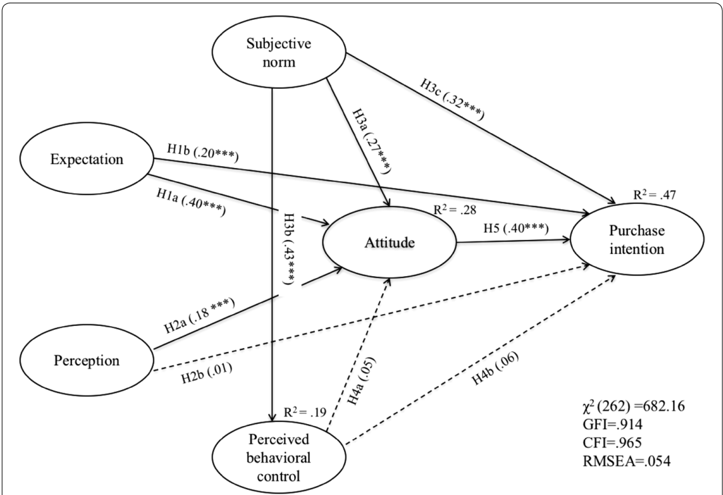
Verification
Claims the paper makes
The claims and statistics of this paper haven’t been checked yet.
Free: it reads the open-access text and checks the first 5 claims that cite a source we can check. Create a free account to check every claim.
Claims other papers make about this one
Each is checked against this paper’s own text: does it say what the citing paper says it does?
The source backs part of the claim, not all of it — or backs it for a different population, condition or comparison.
In the citing paper
“Green products are often more costly than traditional products”
From The Influencing Factors of Consumers’ Purchase Intention toward Green Products: A Case of Consumers in Saudi Arabia (2022) · cites this paper as Nam et al., 2017
Experimental — accuracy not yet measuredThe cited source says what the claim attributes to it.
In the citing paper
“This is especially true for consumers with low concern for the environment who are not willing to pay extra money for acquiring green products”
From The Influencing Factors of Consumers’ Purchase Intention toward Green Products: A Case of Consumers in Saudi Arabia (2022) · cites this paper as Nam et al., 2017
The cited source says what the claim attributes to it.
In the citing paper
“In the context of the affecting factors that are specifically related to the TPB constructs-perceived behavioral control, subjective norms, and attitude (Nam et al., 2017)-findings have endorsed the significant influences of attitude and subjective norms on consumers' intentions to purchase green sportswear.”
From The Influencing Factors of Consumers’ Purchase Intention toward Green Products: A Case of Consumers in Saudi Arabia (2022) · cites this paper as Nam et al., 2017
The cited source says what the claim attributes to it.
In the citing paper
“the product's price plays an important role when a consumer makes a purchasing decision”
From The Influencing Factors of Consumers’ Purchase Intention toward Green Products: A Case of Consumers in Saudi Arabia (2022) · cites this paper as Nam et al., 2017
The cited source says what the claim attributes to it.
In the citing paper
“This result corresponds with the outcomes of Nam et al. (2017) and Choi and Johnson (2019), which demonstrated no considerable impact of perceived behavioral control on attitude.”
From The Influencing Factors of Consumers’ Purchase Intention toward Green Products: A Case of Consumers in Saudi Arabia (2022) · cites this paper as Nam et al. (2017)
1 more claim about this paper
Create a free account to see every claim other papers make about this one.
Self-check
Percentages, sums and reported differences re-computed from the paper’s own numbers.
The self-check needs the paper’s full text.
Citations
Cites
The theory of planned behavior
Ajzen, I. (1991) · Organizational Behavior and Human Decision Processes · doi:10.1016/0749-5978(91)90020-t · Cited by 134,657
Herne, H., Cooley, W. W., & Lohnes, P. R. (1973) · Journal of the Royal Statistical Society. Series A (General) · doi:10.2307/2344428 · Cited by 35,697
(1980) · Medical Entomology and Zoology · Cited by 25,810
A conceptual model of service quality and its implications for future research
Parasuraman, A., Zeithaml, V. A., & Berry, L. L. (1985) · Journal of Marketing · doi:10.1177/002224298504900403 · Cited by 21,645
(2008) · Environmental Chemometrics · doi:10.1201/9781420067972-10 · Cited by 8,170
Perceived Behavioral Control, Self‐Efficacy, Locus of Control, and the Theory of Planned Behavior 1
Ajzen, I. (2002) · Journal of Applied Social Psychology · doi:10.1111/j.1559-1816.2002.tb00236.x · Cited by 7,629 · cited 2×
“The findings are contradicted by Ajzen (2002) and previous studies, where PBC positively influences consumers’ attitude and purchase intention (Gopi and Ramayah 2007; Kang et al.”
BackgroundResultPrediction of goal-directed behavior: Attitudes, intentions, and perceived behavioral control
Ajzen, I., & Madden, T. J. (1986) · Journal of Experimental Social Psychology · doi:10.1016/0022-1031(86)90045-4 · Cited by 5,718 · cited 1×
“PBC is not only a powerful factor influencing to attitude and behavior change, but also is related to salient beliefs that have been regarded as important resources for decision-making (Armitage and Talibudeen 2010; Ajzen and Madden 1986).”
BackgroundA Dynamic Process Model of Service Quality: From Expectations to Behavioral Intentions
Boulding, W., Kalra, A., Staelin, R., & Zeithaml, V. A. (1993) · Journal of Marketing Research · doi:10.1177/002224379303000102 · Cited by 3,416 · cited 1×
“Perceived product quality associated with consumers’ expectation and perception has a direct positive influence on consumers’ purchase intention (Boulding et al. 1993; Tsiotsou 2006).”
BackgroundTargeting consumers who are willing to pay more for environmentally friendly products
Laroche, M., Bergeron, J., & Barbaro‐Forleo, G. (2001) · Journal of Consumer Marketing · doi:10.1108/eum0000000006155 · Cited by 2,974
Predicting green product consumption using theory of planned behavior and reasoned action
Paul, J., Modi, A., & Patel, J. (2016) · Journal of Retailing and Consumer Services · doi:10.1016/j.jretconser.2015.11.006 · Cited by 2,399
Data collection in a flat world: the strengths and weaknesses of Mechanical Turk samples
Goodman, J. K., Cryder, C. E., & Cheema, A. (2013) · Journal of Behavioral Decision Making · doi:10.1002/bdm.1753 · Cited by 2,242 · cited 1×
“studies have indicated that MTurk data are as reliable as the traditionally collected data (Goodman et al. 2013).”
MethodA Comparison of the Theory of Planned Behavior and the Theory of Reasoned Action
Madden, T. J., Ellen, P. S., & Ajzen, I. (1992) · Personality and Social Psychology Bulletin · doi:10.1177/0146167292181001 · Cited by 2,195
Negative Word-of-Mouth by Dissatisfied Consumers: A Pilot Study
Richins, M. L. (1983) · Journal of Marketing · doi:10.1177/002224298304700107 · Cited by 1,807
Green consumers in the 1990s: Profile and implications for advertising
Roberts, J. A. (1996) · Journal of Business Research · doi:10.1016/0148-2963(95)00150-6 · Cited by 1,603 · cited 1×
“Roberts (1996) also argues that PBC can positively influence consumers’ attitude and purchase intention.”
BackgroundTaylor, S., & Todd, P. (1995) · International Journal of Research in Marketing · doi:10.1016/0167-8116(94)00019-k · Cited by 1,567
A Dynamic Process Model of Service Quality: From Expectations to Behavioral Intentions
Boulding, W., Kalra, A., Staelin, R., & Zeithaml, V. A. (1993) · Journal of Marketing Research · doi:10.2307/3172510 · Cited by 1,518
Some New Results on Indirect Effects and Their Standard Errors in Covariance Structure Models
Sobel, M. E. (1986) · Sociological Methodology · doi:10.2307/270922 · Cited by 1,006 · cited 1×
“Sobel, M. E. (1986).”
Tonglet, M., Phillips, P. S., & Read, A. D. (2004) · Resources, Conservation and Recycling · doi:10.1016/j.resconrec.2003.11.001 · Cited by 1,001
Chang, M. K. (1998) · Journal of Business Ethics · doi:10.1023/a:1005721401993 · Cited by 852 · cited 3×
“Other measurement items were modified from 3-items of subjective norm (Fitzmaurice 2005), 3-items of perceived behavioral control (Chang 1998), 7-items of attitude (Chang 1998; Fitzmaurice 2005; Madden et al. 1992), and 3-items of purchase intention (Madden et al.”
MethodHow materialism affects environmental beliefs, concern, and environmentally responsible behavior
Kilbourne, W., & Pickett, G. (2008) · Journal of Business Research · doi:10.1016/j.jbusres.2007.09.016 · Cited by 835 · cited 2×
“As consumers become more aware of consumption-related environmental problems, they simultaneously grow more cautions when purchasing products and eventually seek to purchase eco-friendly products for the betterment of current and future generations (Kilbourne and Pickett 2008; Laroche et al. 2001).”
BackgroundConsumer purchase intention for organic personal care products
Yeon Kim, H., & Chung, J. (2011) · Journal of Consumer Marketing · doi:10.1108/07363761111101930 · Cited by 834 · cited 4×
“Consumers’ PBC towards purchasing organic products positively influences their purchase intention (Kim and Chung 2011).”
BackgroundResultInfluentialNegative Word-of-Mouth by Dissatisfied Consumers: A Pilot Study
Richins, M. L. (1983) · Journal of Marketing · doi:10.2307/3203428 · Cited by 727
Attitude towards the Environment and Green Products:Consumers’ Perspective
Tan, B. C., & Lau, T. C. (2010) · doi:10.3968/j.mse.1913035x20100402.002 · Cited by 715 · cited 4×
“…presents the significant role of consumers’ attitude as a mediator in consumer purchase intention for green sportswear, which is consistent with previous findings stating the significant correlation between attitude and green product purchase intention (Rahbar and Wahid 2011; Chen and Chai 2010).”
BackgroundResultInfluentialThinking green, buying green? Drivers of pro-environmental purchasing behavior
Moser, A. K. (2015) · Journal of Consumer Marketing · doi:10.1108/jcm-10-2014-1179 · Cited by 657
Investigation of green marketing tools' effect on consumers' purchase behavior
Rahbar, E., & Abdul Wahid, N. (2011) · Business Strategy Series · doi:10.1108/17515631111114877 · Cited by 600
Attitude-Behavior Consistency: The Impact of Product Trial versus Advertising
Smith, R. E., & Swinyard, W. R. (1983) · Journal of Marketing Research · doi:10.1177/002224378302000304 · Cited by 563 · cited 1×
“When purchasing products, consumers’ positive or negative experiences toward the products could be accumulated (Sproles 1979), which may lead to change their purchasing behavior (Smith and Swinyard 1983).”
BackgroundFoundations of the American Customer Satisfaction Index
Anderson, E. W., & Fornell, C. (2000) · Total Quality Management · doi:10.1080/09544120050135425 · Cited by 553 · cited 1×
“Consumers may acquire their expectation through word-of-mouth, experience, and social media (Anderson and Fornell 2000).”
BackgroundEthical fashion: myth or future trend?
Joergens, C. (2006) · Journal of Fashion Marketing and Management: An International Journal · doi:10.1108/13612020610679321 · Cited by 532 · cited 2×
“If consumers consider the price for eco-friendly apparel is too high, they tend to purchase other traditional apparel instead of this sustainable apparel (Joergens 2006).”
BackgroundResultThe role of perceived product quality and overall satisfaction on purchase intentions
Tsiotsou, R. (2006) · International Journal of Consumer Studies · doi:10.1111/j.1470-6431.2005.00477.x · Cited by 499
What drives college-age Generation Y consumers?
Noble, S. M., Haytko, D. L., & Phillips, J. (2009) · Journal of Business Research · doi:10.1016/j.jbusres.2008.01.020 · Cited by 492 · cited 1×
“close relationships, such as whether their referents think he or she should purchase a product and his or her motivations to conform to the referents (Noble et al. 2009).”
BackgroundLiobikienė, G., Mandravickaitė, J., & Bernatonienė, J. (2016) · Ecological Economics · doi:10.1016/j.ecolecon.2016.02.008 · Cited by 471
Kang, J., Liu, C., & Kim, S. (2013) · International Journal of Consumer Studies · doi:10.1111/ijcs.12013 · Cited by 459 · cited 1×
“The findings are contradicted by Ajzen (2002) and previous studies, where PBC positively influences consumers’ attitude and purchase intention (Gopi and Ramayah 2007; Kang et al. 2013; Kim and Chung 2011).”
ResultGopi, M., & Ramayah, T. (2007) · International Journal of Emerging Markets · doi:10.1108/17468800710824509 · Cited by 315 · cited 2×
“The findings are contradicted by Ajzen (2002) and previous studies, where PBC positively influences consumers’ attitude and purchase intention (Gopi and Ramayah 2007; Kang et al.”
ResultTseng, S.-C., & Hung, S.-W. (2013) · Journal of Cleaner Production · doi:10.1016/j.jclepro.2013.06.050 · Cited by 302
Fashion: Consumer behavior toward dress
Sproles, G. B. (1979) · Medical Entomology and Zoology · Cited by 243
Consumer Attitudes Toward Fashion Counterfeits: Application of the Theory of Planned Behavior
Kim, H., & Karpova, E. (2010) · Clothing and Textiles Research Journal · doi:10.1177/0887302x09332513 · Cited by 232 · cited 3×
“When a consumer considers that significant others may not agree to purchase a product, he or she may experience psychological obstacles to performing this behavior, negatively affecting to one’s PBC (Kim and Karpova 2010).”
BackgroundPurchasing green to become greener: Factors influence consumers’ green purchasing behavior
Vazifehdoust, H., Taleghani, M., Esmaeilpour, F., Nazari, K., & Khadang, M. (2013) · Management Science Letters · doi:10.5267/j.msl.2013.08.013 · Cited by 227
Green purchase behavior of undergraduate students in Hong Kong
Lai, C. K. M., & Cheng, E. W. L. (2016) · The Social Science Journal · doi:10.1016/j.soscij.2015.11.003 · Cited by 220 · cited 1×
“Consumers’ perception has also been shown to directly influence their purchase intention for organic or green products, because of perceiving the products to be more environmentally friendly, safe, and good for their health (Lai and Cheng 2016).”
BackgroundXu, Y., Chen, Y., Burman, R., & Zhao, H. (2014) · International Journal of Consumer Studies · doi:10.1111/ijcs.12139 · Cited by 209
Incorporating consumers' motivations into the theory of reasoned action
Fitzmaurice, J. (2005) · Psychology and Marketing · doi:10.1002/mar.20090 · Cited by 189 · cited 3×
“Other measurement items were modified from 3-items of subjective norm (Fitzmaurice 2005), 3-items of perceived behavioral control (Chang 1998), 7-items of attitude (Chang 1998; Fitzmaurice 2005; Madden et al. 1992), and 3-items of purchase intention (Madden et al.”
MethodJohe, M. H., & Bhullar, N. (2016) · Ecological Economics · doi:10.1016/j.ecolecon.2016.02.019 · Cited by 178 · cited 2×
“Johe and Bhullar (2016) also found that consumers’ attitude indirectly mediated the effect of organic identity on consumers’ purchase intention.”
BackgroundLee, N., Choi, Y. J., Youn, C., & Lee, Y. (2012) · Clothing and Textiles Research Journal · doi:10.1177/0887302x12446065 · Cited by 163
Self-citationZheng, Y., & Chi, T. (2014) · International Journal of Fashion Design Technology and Education · doi:10.1080/17543266.2014.990059 · Cited by 151 · cited 2×
“Subjective norms are also important predictors for environmental-related behaviors (Ko 2012; Zheng and Chi 2015), second-hand clothing consumption (Xu et al.”
BackgroundGreen spirit: consumer empathies for green apparel
Cowan, K., & Kinley, T. (2014) · International Journal of Consumer Studies · doi:10.1111/ijcs.12125 · Cited by 148 · cited 6×
“The findings of this study supported the findings from previous studies, confirming the strong relationships of attitude with future intention in terms of eco-friendly apparel consumption (Cowan and Kinley 2014).”
BackgroundResultInfluentialBarber, N., Bishop, M., & Gruen, T. W. (2014) · Journal of Environmental Psychology · doi:10.1016/j.jenvp.2014.06.010 · Cited by 137 · cited 1×
“This norm reveals the extent to which an individual feels morally responsible for others by buying green products and how important positive social image is to consumers (Barber et al. 2014).”
BackgroundTradeoffs Between Price and Quality: How a Value Index Affects
Creyer, E. H., & Ross, W. T. (1997) · Journal of Consumer Affairs · doi:10.1111/j.1745-6606.1997.tb00392.x · Cited by 127
Coleman, L. J., Bahnan, N., Kelkar, M., & Curry, N. (2011) · Journal of Applied Business Research (JABR) · doi:10.19030/jabr.v27i3.4217 · Cited by 109 · cited 1×
“One of the motivations for consumers’ green consumption was to comply with other referents, and younger people are more easily affected by what others think about an issue than older populations (Coleman et al. 2011).”
BackgroundKorean Consumers’ Motivations and Perceived Risks Toward the Purchase of Organic Cotton Apparel
Han, T.-I., & Chung, J.-E. (2014) · Clothing and Textiles Research Journal · doi:10.1177/0887302x14538116 · Cited by 77 · cited 6×
“Subjective norms not only play an important role in an individual’s purchasing decision, but also are positively associated with a consumer’s attitude towards certain types of behavior (Han and Chung 2014; Paul et al. 2016).”
BackgroundResultInfluentialArmitage, C. J., & Talibudeen, L. (2010) · British Journal of Psychology · doi:10.1348/000712609x431728 · Cited by 74 · cited 1×
“PBC is not only a powerful factor influencing to attitude and behavior change, but also is related to salient beliefs that have been regarded as important resources for decision-making (Armitage and Talibudeen 2010; Ajzen and Madden 1986).”
BackgroundDiddi, S., & Niehm, L. S. (2016) · Journal of Marketing Channels · doi:10.1080/1046669x.2016.1147892 · Cited by 66 · cited 1×
“Some studies also examined the relationships among consumers’ perception, expectation, and purchasing behaviors for green products (Cowan and Kinley 2014; Diddi and Niehm 2016; Han and Chung 2014; Tseng and Hung 2013).”
BackgroundReview of green electricity products in the United Kingdom, Germany and Finland
Hast, A., Syri, S. M., Jokiniemi, J. K., Huuskonen, M., & Cross, S. (2014) · Renewable and Sustainable Energy Reviews · doi:10.1016/j.rser.2014.10.104 · Cited by 62
Hur, W., Yoo, J., & Hur, J. (2014) · Human Factors and Ergonomics in Manufacturing & Service Industries · doi:10.1002/hfm.20556 · Cited by 23
Umberson, K. (2008) · University of North Texas Digital Library (University of North Texas) · doi:10.12794/metadc9728 · Cited by 18 · cited 1×
“Consumers who have more environmentally conscious attitude are more likely to purchase eco-friendly apparel (Umberson 2008).”
BackgroundLee, C.-K., Lee, Y.-C., Chuang, Y., & Wu, W.-L. (2014) · Studies in computational intelligence · doi:10.1007/978-3-319-05503-9_7 · Cited by 6
Self-citation(1994)
Research works printed but not linked: 4
- Ko, S. B. (2012). Predictors of purchase intention toward green apparel products in the US and China (Unpublished doctoral dissertation). Stillwater: Oklahoma State University.
- Kotler, P., & Keller, K. L. (2006). Marketing management (12th ed.). Upper Saddle River: Pearson Prentice Hall Inc.
- Mandese, J. (1991). New study finds green confusion. Advertising Age, 62(45), 1-56.
- Oliver, R. L. (1981). Measurement and evaluation of satisfaction processes in retail settings. Journal of Retailing, 57(3), 25-48.
Cited by
On the factors influencing green purchase intention: a meta-analysis approach
Zhuang, W., Luo, X., & Riaz, M. U. (2021) · Frontiers in Psychology · doi:10.3389/fpsyg.2021.644020 · Cited by 440
“In the literature on environmental knowledge, researchers usually use different environmental knowledge concepts to predict individual green behavior: general or specific environmental knowledge, and subjective or objective environmental knowledge (Lee, 2017).”
BackgroundSustainable fashion: current and future research directions
Mukendi, A., Davies, I., Glozer, S., & McDonagh, P. (2020) · European Journal of Marketing · doi:10.1108/ejm-02-2019-0132 · Cited by 325
Witek, L., & Kuźniar, W. (2020) · Sustainability · doi:10.3390/su13010209 · Cited by 213
Green innovation and environmental awareness driven green purchase intentions
Zameer, H., & Yasmeen, H. (2022) · Marketing Intelligence & Planning · doi:10.1108/mip-12-2021-0457 · Cited by 200
Consumer Perceptions of Sustainable Products: A Systematic Literature Review
Camilleri, M. A., Cricelli, L., Mauriello, R., & Strazzullo, S. (2023) · Sustainability · doi:10.3390/su15118923 · Cited by 188
“Thus, many studies try to explain consumer choices by analysing the interplay between these two factors’ categories [16,17].”
Background
Metadata
- Authors
- Nam, C., Dong, H., & Lee, Y.-A.
- Affiliations
- Iowa State University (US)
- Corresponding author
- Nam, Changhyun
- Venue
- Fashion and Textiles
- Published
- 2017-01-17
- Volume
- 4
- Issue
- 1
- ISSN
- 2198-0802 (ISSN-L)
- OpenAlex
- W2570501474
- Semantic Scholar
- b95ed3c5ffd554fbb023e2b70388fa187c3c7266
- Cited by
- 197
- References
- 57
- Citations by year
- 2026: 12 · 2025: 32 · 2024: 36 · 2023: 29 · 2022: 20 · 2021: 28 · 2020: 22 · 2019: 10 · 2018: 5 · 2017: 3
- FWCI
- 19.79
- Type
- journal article
- Language
- en
- Open access
- gold
- doi.org
- Licence
- cc-by
- creativecommons.org/licenses/by/4.0 (tdm)
- creativecommons.org/licenses/by/4.0 (vor)
- Locations
- Fashion and Textiles (publishedVersion, cc-by)
- Topics
- Social Sciences › Business, Management and Accounting › Marketing › Environmental Sustainability in Business
- Social Sciences › Business, Management and Accounting › Marketing › Consumer Perception and Purchasing Behavior
- Social Sciences › Business, Management and Accounting › Marketing › Consumer Retail Behavior Studies
- Keywords
- purchase intention, theory of planned behavior, consumer perception, subjective norms, perceived behavioral control, consumer attitudes, apparel marketing, sustainable fashion
About these checks
Registry, retraction, Cites and statistics results are computed, not judged, with one exception: a printed reference that no index lists is read once by a model before it counts as a citation error. Claims are extracted by a model and kept only when their quote appears verbatim in the text; each cited source is then checked, with a model’s help, for whether it says what the claim relies on. Those verdicts can be wrong — read the claim’s quote and the cited source before relying on one.
Statistics and arithmetic are recomputed, not judged.
Confidence bands are shown only for fields calibrated on our annotated test set. None is calibrated yet, so no band is shown.
What counts as a claim ›How we measure confidence ›How we check this ›
Are you an author, or do you see a problem with this page? Request a review
Data sources
Bibliographic data: Semantic Scholar, OpenAlex, Crossref.
Contains information from the Semantic Scholar Academic Graph Datasets, made available under the ODC Attribution License (ODC-BY 1.0).
Semantic Scholar’s data is described in: Kinney, R., et al. (2023). The Semantic Scholar Open Data Platform. arXiv:2301.10140.
