

Face morphing attacks: Investigating detection with humans and computers
Open accessThe DOI matches its Crossref record; 40 of the 42 references it cites were found in a registry or an index.
Abstract
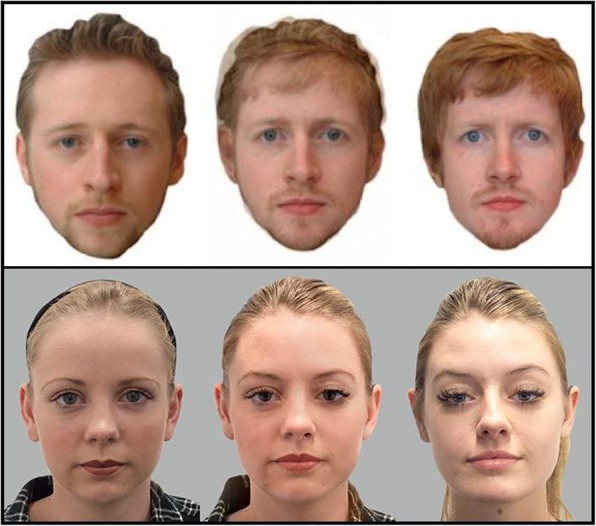
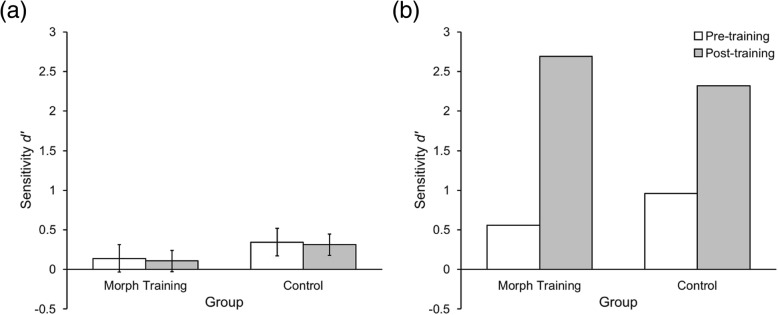
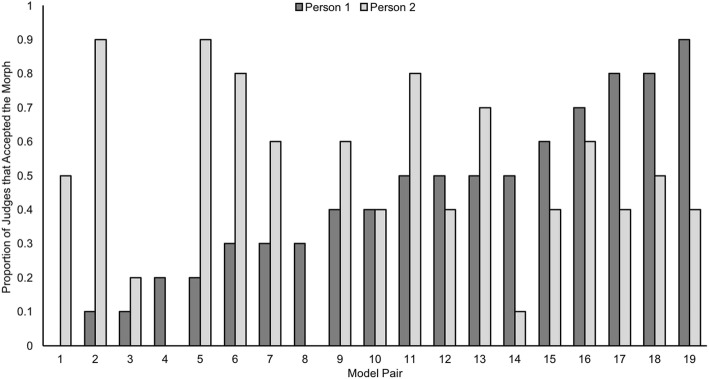
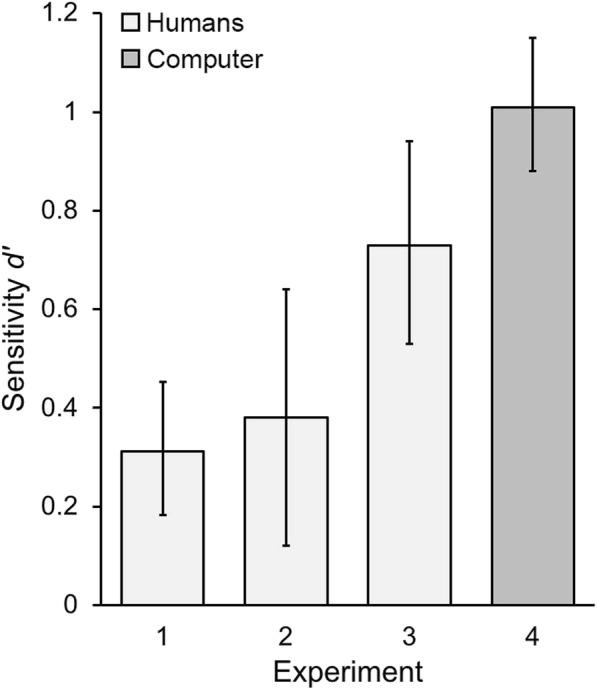
BACKGROUND: In recent years, fraudsters have begun to use readily accessible digital manipulation techniques in order to carry out face morphing attacks. By submitting a morph image (a 50/50 average of two people's faces) for inclusion in an official document such as a passport, it might be possible that both people sufficiently resemble the morph that they are each able to use the resulting genuine ID document. Limited research with low-quality morphs has shown that human detection rates were poor but that training methods can improve performance. Here, we investigate human and computer performance with high-quality morphs, comparable with those expected to be used by criminals. RESULTS: Over four experiments, we found that people were highly error-prone when detecting morphs and that training did not produce improvements. In a live matching task, morphs were accepted at levels suggesting they represent a significant concern for security agencies and detection was again error-prone. Finally, we found that a simple computer model outperformed our human participants. CONCLUSIONS: Taken together, these results reinforce the idea that advanced computational techniques could prove more reliable than training people when fighting these types of morphing attacks. Our findings have important implications for security authorities worldwide.
Overview
The claims and statistics of this paper haven’t been checked yet.
Free: it reads the open-access text and checks the first 5 claims that cite a source we can check. Create a free account to check every claim.
Integrity signals
Registry
Cites
Statistics
Figures
Verification
Claims the paper makes
The claims and statistics of this paper haven’t been checked yet.
Free: it reads the open-access text and checks the first 5 claims that cite a source we can check. Create a free account to check every claim.
Claims other papers make about this one
Each is checked against this paper’s own text: does it say what the citing paper says it does?
The source backs part of the claim, not all of it — or backs it for a different population, condition or comparison.
In the citing paper
“In Kramer et al. ' s [6] study of facial morphs, the automated detection model performed better than the best-performing human (68.4% vs. 64%, respectively), revealing a signi fi cant advantage for the automated detection model.”
From Human Performance in Deepfake Detection: A Systematic Review (2025) · cites this paper as [6]
Experimental — accuracy not yet measuredThe source backs part of the claim, not all of it — or backs it for a different population, condition or comparison.
In the citing paper
“Providing this kind of basic detection guidance yielded no improvement on detection accuracy [4, 6].”
From Human Performance in Deepfake Detection: A Systematic Review (2025) · cites this paper as [6]
Experimental — accuracy not yet measuredThe cited source says what the claim attributes to it.
In the citing paper
“However, none of the experimental studies had any followup, and only two studies had pre -post measurements of the outcome [6, 18].”
From Human Performance in Deepfake Detection: A Systematic Review (2025) · cites this paper as [6]
The cited source says what the claim attributes to it.
In the citing paper
“Almost all video/image stimuli used face swapping or lip-sync technique, except for three studies that used morphing techniques [6, 7, 18].”
From Human Performance in Deepfake Detection: A Systematic Review (2025) · cites this paper as [6]
The cited source says what the claim attributes to it.
In the citing paper
“Furthermore, explicitly teaching detection skills by providing written detection tips does not appear to improve detection compared to control [4, 6].”
From Human Performance in Deepfake Detection: A Systematic Review (2025) · cites this paper as [6]
Self-check
Percentages, sums and reported differences re-computed from the paper’s own numbers.
The self-check needs the paper’s full text.
Citations
Cites
Variability in photos of the same face
Jenkins, R., White, D., Van Montfort, X., & Mike Burton, A. (2011) · Cognition · doi:10.1016/j.cognition.2011.08.001 · Cited by 612
The Glasgow Face Matching Test
Burton, A. M., White, D., & McNeill, A. (2010) · Behavior Research Methods · doi:10.3758/brm.42.1.286 · Cited by 472
Categorical effects in the perception of faces
Beale, J. M., & Keil, F. C. (1995) · Cognition · doi:10.1016/0010-0277(95)00669-x · Cited by 338
Ferrara, M., Franco, A., & Maltoni, D. (2014) · IEEE International Joint Conference on Biometrics · doi:10.1109/btas.2014.6996240 · Cited by 278
Identity From Variation: Representations of Faces Derived From Multiple Instances
Burton, A. M., Kramer, R. S. S., Ritchie, K. L., & Jenkins, R. (2016) · Cognitive Science · doi:10.1111/cogs.12231 · Cited by 247
Self-citationPassport officers’ errors in face matching
White, D., Kemp, R. I., Jenkins, R., Matheson, M., & Burton, A. M. (2014) · PLoS ONE · doi:10.1371/journal.pone.0103510 · Cited by 241
IEEE International Joint Conference on Biometrics
(2014) · doi:10.1109/ijcb32250.2014 · Cited by 239
Young, A. W., & Burton, A. M. (2018) · Trends in Cognitive Sciences · doi:10.1016/j.tics.2017.11.007 · Cited by 235
Matching identities of familiar and unfamiliar faces caught on CCTV images
Bruce, V., Henderson, Z., Newman, C., & Burton, A. M. (2001) · Journal of Experimental Psychology: Applied · doi:10.1037/1076-898x.7.3.207 · Cited by 233
Cited by
Face Morphing Attack Generation and Detection: A Comprehensive Survey
Venkatesh, S. K., Ramachandra, R., Raja, K. B., & Busch, C. (2021) · IEEE Transactions on Technology and Society · doi:10.1109/tts.2021.3066254 · Cited by 204
Deepfakes as a threat to a speaker and facial recognition: An overview of tools and attack vectors
Firc, A., Malinka, K., & Hanáček, P. (2023) · Heliyon · doi:10.1016/j.heliyon.2023.e15090 · Cited by 81
Face Recognition Vendor Test (FRVT) part 4: MORPH - performance of automated face morph detection
Ngan, M. L., Grother, P. J., Hanaoka, K., & Kuo, J. (2020) · doi:10.6028/nist.ir.8292 · Cited by 76
Venkatesh, S. K., Ramachandra, R., Raja, K. B., Spreeuwers, L., Veldhuis, R. N. J., & Busch, C. (2020) · IEEE Winter Conference on Applications of Computer Vision · doi:10.1109/wacv45572.2020.9093488 · Cited by 68
Differential Morph Face Detection using Discriminative Wavelet Sub-bands
Chaudhary, B., Aghdaie, P., Soleymani, S., Dawson, J. M., & Nasrabadi, N. M. (2021) · IEEE/CVF Conference on Computer Vision and Pattern Recognition Workshops (CVPRW) · doi:10.1109/cvprw53098.2021.00158 · Cited by 47
Analyzing Human Observer Ability in Morphing Attack Detection—Where Do We Stand?
Godage, S. R., Løvåsdal, F., Venkatesh, S. K., Raja, K. B., Ramachandra, R., & Busch, C. (2022) · IEEE Transactions on Technology and Society · doi:10.1109/tts.2022.3231450 · Cited by 43
Low Visual Distortion and Robust Morphing Attacks Based on Partial Face Image Manipulation
Qin, L., Peng, F., Venkatesh, S. K., Ramachandra, R., Long, M., & Busch, C. (2020) · IEEE Transactions on Biometrics Behavior and Identity Science · doi:10.1109/tbiom.2020.3022007 · Cited by 36
Face Recognition for Automatic Border Control: A Systematic Literature Review
Hidayat, F., Elviani, U., Situmorang, G. B. G., Ramadhan, M. Z., Alunjati, F. A., & Sucipto, R. F. (2024) · IEEE Access · doi:10.1109/access.2024.3373264 · Cited by 32
Searching for faces in crowd chokepoint videos
Kramer, R. S. S., Hardy, S. C., & Ritchie, K. L. (2019) · Applied Cognitive Psychology · doi:10.1002/acp.3620 · Cited by 26
Self-citationOrthoMAD: Morphing Attack Detection Through Orthogonal Identity Disentanglement
Neto, P. C., Gonçalves, T., Huber, M., Damer, N., Sequeira, A. F., & Cardoso, J. S. (2022) · International Conference of the Biometrics Special Interest Group (BIOSIG) · doi:10.1109/biosig55365.2022.9897057 · Cited by 25
Vulnerability of Face Recognition to Deep MorphingPreprint
Korshunov, P., & Marcel, S. (2019) · arXiv (Cornell University) · doi:10.48550/arxiv.1910.01933 · Cited by 23
Perceptual and computational detection of face morphing
Nightingale, S. J., Agarwal, S., & Farid, H. (2021) · Journal of Vision · doi:10.1167/jov.21.3.4 · Cited by 22
Face Morphing, a Modern Threat to Border Security: Recent Advances and Open Challenges
Pikoulis, E., Ioannou, Z.-M., Paschou, M., & Sakkopoulos, E. (2021) · Applied Sciences · doi:10.3390/app11073207 · Cited by 22
Identifying and minimising the impact of fake visual media: Current and future directions
Nightingale, S. J., & Wade, K. A. (2022) · Memory Mind & Media · doi:10.1017/mem.2022.8 · Cited by 20
Human Performance in Deepfake Detection: A Systematic Review
Somoray, K., Miller, D. J., & Holmes, M. (2025) · Human Behavior and Emerging Technologies · doi:10.1155/hbe2/1833228 · Cited by 19
Algorithmic Fairness in Face Morphing Attack Detection
Ramachandra, R., Raja, K. B., & Busch, C. (2022) · IEEE/CVF Winter Conference on Applications of Computer Vision Workshops (WACVW) · doi:10.1109/wacvw54805.2022.00047 · Cited by 19
Psychophysical Evaluation of Human Performance in Detecting Digital Face Image Manipulations
Nichols, R., Rathgeb, C., Drozdowski, P., & Busch, C. (2022) · IEEE Access · doi:10.1109/access.2022.3160596 · Cited by 16
Makrushin, A., Siegel, D., & Dittmann, J. (2020) · ACM Workshop on Information Hiding and Multimedia Security (IH&MMSec) · doi:10.1145/3369412.3395073 · Cited by 13
Risks of the Malicious Use of Artificial Intelligence and the Possibility of Minimizing Them
Mikhailov, M., & Kokodey, T. (2023) · Russian Journal of Criminology · doi:10.17150/2500-4255.2023.17(5).452-461 · Cited by 11
Venkatesh, S. K., Ramachandra, R., Raja, K. B., Spreeuwers, L., Veldhuis, R. N. J., & Christoph, B. (2020) · doi:10.36227/techrxiv.11630571 · Cited by 12
Morphed Face Detection With Wavelet-Based Co-Occurrence Matrices
Avcıbaş, İ. (2024) · IEEE Signal Processing Letters · doi:10.1109/lsp.2024.3397726 · Cited by 11
Training human super-recognizers’ detection and discrimination of AI-generated faces
Gray, K. L. H., Davis, J. P., Bunce, C., Noyes, E., & Ritchie, K. L. (2025) · Royal Society Open Science · doi:10.1098/rsos.250921 · Cited by 11
Self-citationTechniques and Challenges for Generation and Detection Face Morphing Attacks: A Survey
Saleem, I., & Shukr, B. K. (2023) · Iraqi Journal of Science · doi:10.24996/ijs.2023.64.1.36 · Cited by 11
Singh, J. M., Venkatesh, S. K., & Ramachandra, R. (2023) · International Conference on Information Fusion (FUSION) · doi:10.23919/fusion52260.2023.10224168 · Cited by 11
A Systematic Literature Review on Face Morphing Attack Detection (MAD)
Kenneth, M. O., Bashir, S. A., Abdulhamid, S. M., & Ochei, L. C. (2022) · Lecture notes on data engineering and communications technologies · doi:10.1007/978-3-030-93453-8_7 · Cited by 11
Crowd-Powered Face Manipulation Detection: Fusing Human Examiner Decisions
Rathgeb, C., Nichols, R., Ibsen, M., Drozdowski, P., & Busch, C. (2022) · Proceedings - International Conference on Image Processing · doi:10.1109/icip46576.2022.9897841 · Cited by 10
Kraetzer, C., Makrushin, A., Dittmann, J., & Hildebrandt, M. (2021) · EURASIP Journal on Information Security · doi:10.1186/s13635-021-00123-4 · Cited by 10
Mallat, K., & Dugelay, J. (2021) · IEEE/CVF Conference on Computer Vision and Pattern Recognition Workshops (CVPRW) · doi:10.1109/cvprw53098.2021.00159 · Cited by 9
The super‐recogniser advantage extends to the detection of hyper‐realistic face masks
Robertson, D. J., Davis, J. P., Sanders, J. G., & Towler, A. (2024) · Applied Cognitive Psychology · doi:10.1002/acp.4222 · Cited by 7
Kenneth, M. O., Bashir, S. A., Abisoye, O. A., & Mohammed, A. D. (2021) · Communications in computer and information science · doi:10.1007/978-3-030-69143-1_27 · Cited by 7
Face Morphing Attacks Detection Approaches: A Review
Nomis, E. M., Jasim, K. S., & Al-Janabi, S. (2024) · Mesopotamian Journal of Big Data · doi:10.58496/mjbd/2024/007 · Cited by 7
Preventing face morphing attacks by using legacy face images
Batskos, I., de Wit, F., Spreeuwers, L., & Veldhuis, R. N. J. (2021) · IET Biometrics · doi:10.1049/bme2.12047 · Cited by 7
The Super‐Recogniser Advantage Extends to the Detection of Digitally Manipulated Faces
Davis, J. P., Robertson, D. J., Jenkins, R. E., Ibsen, M., Nichols, R., Babbs, M., Rathgeb, C., Løvåsdal, F., Raja, K. B., & Busch, C. (2025) · Applied Cognitive Psychology · doi:10.1002/acp.70053 · Cited by 6
Davis, J. P., & Robertson, D. J. (2020) · Greenwich Academic Literature Archive (University of Greenwich) · Cited by 6
Geise, S., Luther, A., Reich, S., & Linke, M. (2025) · Studies in Communication and Media · doi:10.5771/2192-4007-2025-4-485 · Cited by 4
Feature Interaction-Based Face De-Morphing Factor Prediction for Restoring Accomplice’s Facial Image
Cai, J., Duan, Q., Long, M., Zhang, L., & Ding, X. (2024) · Sensors · doi:10.3390/s24175504 · Cited by 4
On the Human Ability in Detecting Digitally Manipulated Face Images
Franco, A., Løvåsdal, F., & Maltoni, D. (2023) · IEEE International Conference on Metrology for eXtended Reality, Artificial Intelligence and Neural Engineering (MetroXRAINE) · doi:10.1109/metroxraine58569.2023.10405682 · Cited by 4
Improving face morph detection with the pairs training effect
Flack, T. R., Ritchie, K. L., Cartledge, C., Fuller, E. A., & Kramer, R. S. S. (2023) · Applied Cognitive Psychology · doi:10.1002/acp.4110 · Cited by 3
Self-citationTrans-FD: Transformer-Based Representation Interaction for Face De-Morphing
Long, M., Duan, Q., Zhang, L., Peng, F., & Zhang, D. (2024) · IEEE Transactions on Biometrics Behavior and Identity Science · doi:10.1109/tbiom.2024.3390056 · Cited by 3
Enhancing Aadhar Card Image Security with Machine Learning-Based Face Morphing Detection
Makandar, A., & Javeriya, S. B. (2024) · International Conference on Communications and Computer Science (InCCCS) · doi:10.1109/incccs60947.2024.10593474 · Cited by 3
The super-recogniser advantage extends to the detection of digitally manipulated facesPreprint
Davis, J. P., Robertson, D. J., Jenkins, R. E., Ibsen, M., Nichols, R., Babbs, M., Rathgeb, C., Løvåsdal, F., Raja, K. B., & Busch, C. (2024) · PsyArXiv (OSF Preprints) · doi:10.31234/osf.io/ye7ph · Cited by 3
Kenneth, M. O., & Bashir, S. A. (2022) · Lecture notes on data engineering and communications technologies · doi:10.1007/978-3-030-93453-8_8 · Cited by 2
MASK-MORPH: Does Morphing of Custom 3D Face Masks Threatens the Face Recognition Systems?
Ramachandra, R., & Marcel, S. (2022) · IEEE International Conference on Advanced Video and Signal Based Surveillance (AVSS) · doi:10.1109/avss56176.2022.9959348 · Cited by 2
Venkatesh, S. K., Ramachandra, R., Raja, K. B., Spreeuwers, L., Veldhuis, R. N. J., & Christoph, B. (2020) · doi:10.36227/techrxiv.11630571.v1 · Cited by 2
Singh, J. M. (2023) · arXiv (Cornell University) · doi:10.48550/arxiv.2305.03264 · Cited by 2
If I Change Your Eyes, Are You Still You? Identity Thresholds in Deepfake Perception
Kang, C., Lee, Y., Kwak, H., An, J., & Han, J. (2026) · CHI Conference Extended Abstracts on Human Factors in Computing Systems (CHI EA) · doi:10.1145/3772363.3798341 · Cited by 1
Generalizability of CNN Architectures for Face Morph Presentation AttackPreprint
HmaSalah, S. R., & Asaad, A. (2023) · arXiv (Cornell University) · doi:10.48550/arxiv.2310.11105 · Cited by 1
ОСОБЕННОСТИ СОЗДАНИЯ ВИЗУАЛЬНЫХ ЭФФЕКТОВ ДЛЯ ЦИФРОВОГО КИНО
Филиппова, Н., & Фараон, И. (2018) · Научный взгляд в будущее · doi:10.30888/2415-7538.2021-21-01-029
Single and Differential Morph Attack Detection
Chaudhary, B. (2021) · The Research Repository @ WVU (West Virginia University) · doi:10.33915/etd.10290
Schwarz, F., Schwarz, K., & Creutzburg, R. M. (2022) · Electronic Imaging · doi:10.2352/ei.2022.34.3.mobmu-361
CALP-FD: Cross Attention-Based Facial Landmarks Prompt for Face De-Morphing
Long, M., Wang, Q., Zhang, L., & Zhou, J. (2023) · International Conference on Systems and Informatics (ICSAI) · doi:10.1109/icsai61474.2023.10423337
The super-recogniser advantage extends to the detection of digitally manipulated facesPreprint
Davis, J. P., Robertson, D. J., Jenkins, R. E., Ibsen, M., Nichols, R., Babbs, M., Rathgeb, C., Løvåsdal, F., Raja, K. B., & Busch, C. (2025) · PsyArXiv (OSF Preprints) · doi:10.31234/osf.io/ye7ph_v2
The super-recogniser advantage extends to the detection of hyper-realistic face masksPreprint
Robertson, D. J., Davis, J. P., Sanders, J. G., & Towler, A. (2025) · PsyArXiv (OSF Preprints) · doi:10.31234/osf.io/u2kja_v2
Training super-recognisers’ detection and discrimination of computer-generated facesPreprint
Gray, K. L. H., Davis, J. P., Bunce, C., Noyes, E., & Ritchie, K. L. (2025) · PsyArXiv (OSF Preprints) · doi:10.31234/osf.io/5jqh8_v2
Self-citationLearning Generalisation to Morph Faces: Connections to Memory Theory
Loo, A. (2025) · Open Access Victoria University of Wellington | Te Herenga Waka (Figshare) · doi:10.26686/wgtn.29091056
صميدة, د. أ. ر. (2025) · Journal of Law and Emerging Technologies · doi:10.54873/jolets.v5i1.228
BIOSIG 2022 Fachtagung vom 14.-16. September 2022, international conference
Darmstadt, G. F. I. 2., Brömme, A., Damer, N., Barrero, M. G., Raja, K., Rathgeb, C., Sequeira, A. F., Todisco, M., Uhl, A., & Informatik, G. F. (2022)
Neural and Cognitive Mechanisms Underlying Ensemble Face Perception
Sama, M. A. (2024) · TSpace (University of Toronto)
Hunt, L. (2026) · Kent Academic Repository (University of Kent) · doi:10.22024/unikent/01.02.113519
MADs in Hand: Analysis of Score-Level Fusion Rules for Single-Image Morphing Attack Detection
Panzino, A., Cava, S. M. L., Micheletto, M., Orrù, G., Casula, R., Lama, F., & Marcialis, G. L. (2026) · International Workshop on Biometrics and Forensics (IWBF) · doi:10.1109/iwbf68042.2026.11558184
MorphUNet: Alpha-Controlled Biometric Transport for Diffusion-Based Face Morphing AttacksPreprint
Rizwan, T., Atito, S., Feng, Z., Awais, M., & Kittler, J. (2026) · arXiv (Cornell University) · doi:10.48550/arxiv.2607.25092
Face Morph Detection in Aadhaar Card Images Using Deep Learning Approaches
(2026) · International Research Journal of Modernization in Engineering Technology and Science · doi:10.56726/irjmets101530
Metadata
- Authors
- Kramer, R. S. S., Mireku, M. O., Flack, T. R., & Ritchie, K. L.
- Affiliations
- University of Lincoln (GB)
- Corresponding author
- Kramer, Robin S. S.
- Venue
- Cognitive Research: Principles and Implications
- Published
- 2019-07-29
- Volume
- 4
- Issue
- 1
- Pages
- 28-28
- ISSN
- 2365-7464 (ISSN-L)
- PMC
- PMC6663958
- OpenAlex
- W2965283758
- Cited by
- 48
- References
- 42
- Citations by year
- 2026: 2 · 2025: 5 · 2024: 6 · 2023: 7 · 2022: 10 · 2021: 9 · 2020: 6 · 2019: 2
- FWCI
- 3.92
- Type
- journal article
- Language
- en
- Open access
- gold
- doi.org
- Licence
- cc-by
- creativecommons.org/licenses/by/4.0 (tdm)
- creativecommons.org/licenses/by/4.0 (vor)
- Locations
- Cognitive Research Principles and Implications (publishedVersion, cc-by)
- Europe PMC (PubMed Central) (publishedVersion, cc-by)
- PubMed Central (publishedVersion, cc-by)
- PubMed (publishedVersion)
- Lincoln Repository (University of Lincoln) (acceptedVersion)
- DOAJ (DOAJ: Directory of Open Access Journals) (submittedVersion, cc-by-sa)
- Figshare (submittedVersion, cc-by)
- Topics
- Life Sciences › Neuroscience › Cognitive Neuroscience › Face Recognition and Perception
- Physical Sciences › Computer Science › Computer Vision and Pattern Recognition › Digital Media Forensic Detection
- Physical Sciences › Computer Science › Signal Processing › Biometric Identification and Security
- Keywords
- face morphing attacks, identity fraud, document forgery, passport fraud, face recognition
About these checks
Registry, retraction, Cites and statistics results are computed, not judged, with one exception: a printed reference that no index lists is read once by a model before it counts as a citation error. Claims are extracted by a model and kept only when their quote appears verbatim in the text; each cited source is then checked, with a model’s help, for whether it says what the claim relies on. Those verdicts can be wrong — read the claim’s quote and the cited source before relying on one.
Statistics and arithmetic are recomputed, not judged.
Confidence bands are shown only for fields calibrated on our annotated test set. None is calibrated yet, so no band is shown.
What counts as a claim ›How we measure confidence ›How we check this ›
Are you an author, or do you see a problem with this page? Request a review
Data sources
Bibliographic data: Semantic Scholar, OpenAlex, Crossref.
Contains information from the Semantic Scholar Academic Graph Datasets, made available under the ODC Attribution License (ODC-BY 1.0).
Semantic Scholar’s data is described in: Kinney, R., et al. (2023). The Semantic Scholar Open Data Platform. arXiv:2301.10140.
