

Face morphing attacks: Investigating detection with humans and computers
Open accessThe DOI matches its Crossref record; 40 of the 42 references it cites were found in a registry or an index.
Abstract
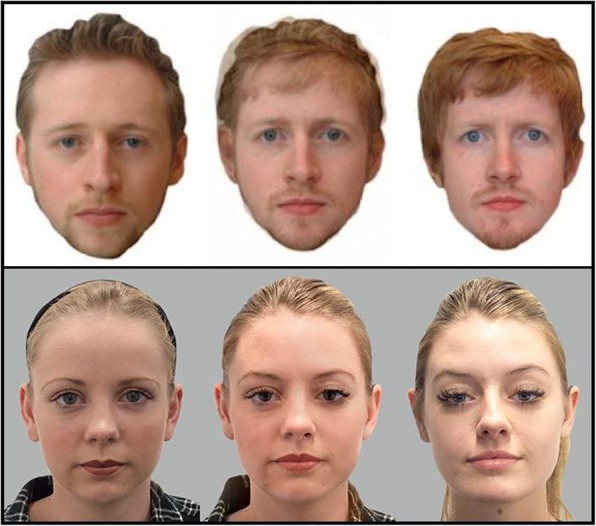
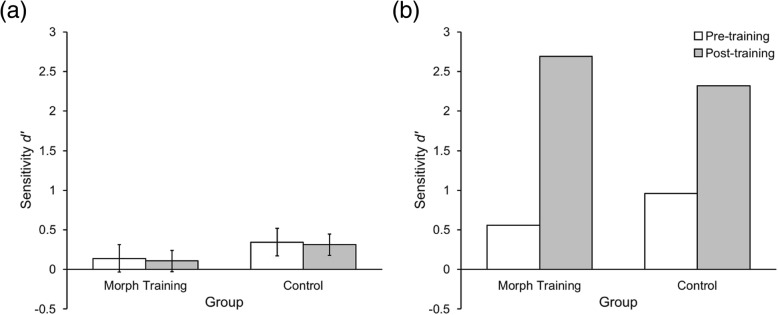
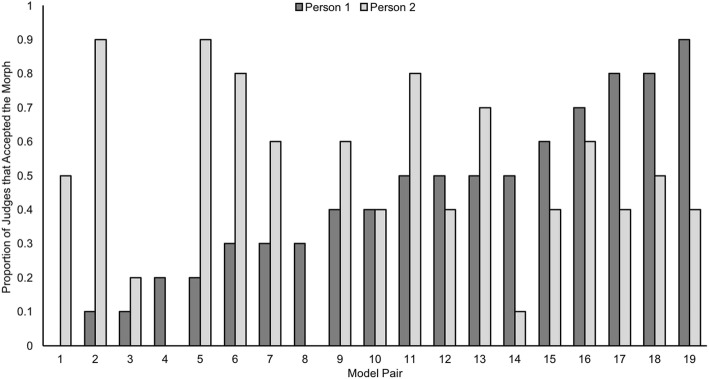
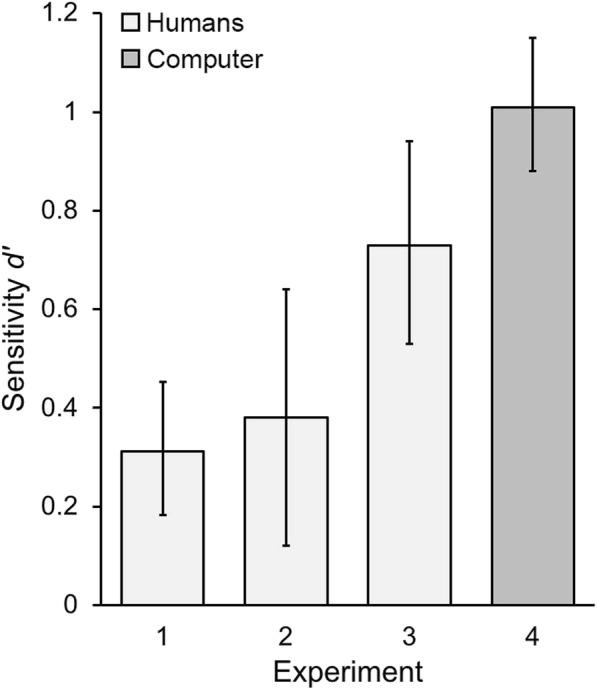
BACKGROUND: In recent years, fraudsters have begun to use readily accessible digital manipulation techniques in order to carry out face morphing attacks. By submitting a morph image (a 50/50 average of two people's faces) for inclusion in an official document such as a passport, it might be possible that both people sufficiently resemble the morph that they are each able to use the resulting genuine ID document. Limited research with low-quality morphs has shown that human detection rates were poor but that training methods can improve performance. Here, we investigate human and computer performance with high-quality morphs, comparable with those expected to be used by criminals. RESULTS: Over four experiments, we found that people were highly error-prone when detecting morphs and that training did not produce improvements. In a live matching task, morphs were accepted at levels suggesting they represent a significant concern for security agencies and detection was again error-prone. Finally, we found that a simple computer model outperformed our human participants. CONCLUSIONS: Taken together, these results reinforce the idea that advanced computational techniques could prove more reliable than training people when fighting these types of morphing attacks. Our findings have important implications for security authorities worldwide.
Overview
The claims and statistics of this paper haven’t been checked yet.
Free: it reads the open-access text and checks the first 5 claims that cite a source we can check. Create a free account to check every claim.
Integrity signals
Registry
Cites
Statistics
Figures
Verification
Claims the paper makes
The claims and statistics of this paper haven’t been checked yet.
Free: it reads the open-access text and checks the first 5 claims that cite a source we can check. Create a free account to check every claim.
Claims other papers make about this one
Each is checked against this paper’s own text: does it say what the citing paper says it does?
The source backs part of the claim, not all of it — or backs it for a different population, condition or comparison.
In the citing paper
“In Kramer et al. ' s [6] study of facial morphs, the automated detection model performed better than the best-performing human (68.4% vs. 64%, respectively), revealing a signi fi cant advantage for the automated detection model.”
From Human Performance in Deepfake Detection: A Systematic Review (2025) · cites this paper as [6]
Experimental — accuracy not yet measuredThe source backs part of the claim, not all of it — or backs it for a different population, condition or comparison.
In the citing paper
“Providing this kind of basic detection guidance yielded no improvement on detection accuracy [4, 6].”
From Human Performance in Deepfake Detection: A Systematic Review (2025) · cites this paper as [6]
Experimental — accuracy not yet measuredThe cited source says what the claim attributes to it.
In the citing paper
“However, none of the experimental studies had any followup, and only two studies had pre -post measurements of the outcome [6, 18].”
From Human Performance in Deepfake Detection: A Systematic Review (2025) · cites this paper as [6]
The cited source says what the claim attributes to it.
In the citing paper
“Almost all video/image stimuli used face swapping or lip-sync technique, except for three studies that used morphing techniques [6, 7, 18].”
From Human Performance in Deepfake Detection: A Systematic Review (2025) · cites this paper as [6]
The cited source says what the claim attributes to it.
In the citing paper
“Furthermore, explicitly teaching detection skills by providing written detection tips does not appear to improve detection compared to control [4, 6].”
From Human Performance in Deepfake Detection: A Systematic Review (2025) · cites this paper as [6]
Self-check
Percentages, sums and reported differences re-computed from the paper’s own numbers.
The self-check needs the paper’s full text.
Citations
Cites
Variability in photos of the same face
Jenkins, R., White, D., Van Montfort, X., & Mike Burton, A. (2011) · Cognition · doi:10.1016/j.cognition.2011.08.001 · Cited by 612
The Glasgow Face Matching Test
Burton, A. M., White, D., & McNeill, A. (2010) · Behavior Research Methods · doi:10.3758/brm.42.1.286 · Cited by 472
Categorical effects in the perception of faces
Beale, J. M., & Keil, F. C. (1995) · Cognition · doi:10.1016/0010-0277(95)00669-x · Cited by 338
Ferrara, M., Franco, A., & Maltoni, D. (2014) · IEEE International Joint Conference on Biometrics · doi:10.1109/btas.2014.6996240 · Cited by 278
Identity From Variation: Representations of Faces Derived From Multiple Instances
Burton, A. M., Kramer, R. S. S., Ritchie, K. L., & Jenkins, R. (2016) · Cognitive Science · doi:10.1111/cogs.12231 · Cited by 247
Self-citationPassport officers’ errors in face matching
White, D., Kemp, R. I., Jenkins, R., Matheson, M., & Burton, A. M. (2014) · PLoS ONE · doi:10.1371/journal.pone.0103510 · Cited by 241
IEEE International Joint Conference on Biometrics
(2014) · doi:10.1109/ijcb32250.2014 · Cited by 239
Young, A. W., & Burton, A. M. (2018) · Trends in Cognitive Sciences · doi:10.1016/j.tics.2017.11.007 · Cited by 235
Matching identities of familiar and unfamiliar faces caught on CCTV images
Bruce, V., Henderson, Z., Newman, C., & Burton, A. M. (2001) · Journal of Experimental Psychology: Applied · doi:10.1037/1076-898x.7.3.207 · Cited by 233
Cited by
Face Morphing Attack Generation and Detection: A Comprehensive Survey
Venkatesh, S. K., Ramachandra, R., Raja, K. B., & Busch, C. (2021) · IEEE Transactions on Technology and Society · doi:10.1109/tts.2021.3066254 · Cited by 204
Deepfakes as a threat to a speaker and facial recognition: An overview of tools and attack vectors
Firc, A., Malinka, K., & Hanáček, P. (2023) · Heliyon · doi:10.1016/j.heliyon.2023.e15090 · Cited by 81
Face Recognition Vendor Test (FRVT) part 4: MORPH - performance of automated face morph detection
Ngan, M. L., Grother, P. J., Hanaoka, K., & Kuo, J. (2020) · doi:10.6028/nist.ir.8292 · Cited by 76
Venkatesh, S. K., Ramachandra, R., Raja, K. B., Spreeuwers, L., Veldhuis, R. N. J., & Busch, C. (2020) · IEEE Winter Conference on Applications of Computer Vision · doi:10.1109/wacv45572.2020.9093488 · Cited by 68
Differential Morph Face Detection using Discriminative Wavelet Sub-bands
Chaudhary, B., Aghdaie, P., Soleymani, S., Dawson, J. M., & Nasrabadi, N. M. (2021) · IEEE/CVF Conference on Computer Vision and Pattern Recognition Workshops (CVPRW) · doi:10.1109/cvprw53098.2021.00158 · Cited by 47
Metadata
- Authors
- Kramer, R. S. S., Mireku, M. O., Flack, T. R., & Ritchie, K. L.
- Affiliations
- University of Lincoln (GB)
- Corresponding author
- Kramer, Robin S. S.
- Venue
- Cognitive Research: Principles and Implications
- Published
- 2019-07-29
- Volume
- 4
- Issue
- 1
- Pages
- 28-28
- ISSN
- 2365-7464 (ISSN-L)
- PMC
- PMC6663958
- OpenAlex
- W2965283758
- Cited by
- 48
- References
- 42
- Citations by year
- 2026: 2 · 2025: 5 · 2024: 6 · 2023: 7 · 2022: 10 · 2021: 9 · 2020: 6 · 2019: 2
- FWCI
- 3.92
- Type
- journal article
- Language
- en
- Open access
- gold
- doi.org
- Licence
- cc-by
- creativecommons.org/licenses/by/4.0 (tdm)
- creativecommons.org/licenses/by/4.0 (vor)
- Locations
- Cognitive Research Principles and Implications (publishedVersion, cc-by)
- Europe PMC (PubMed Central) (publishedVersion, cc-by)
- PubMed Central (publishedVersion, cc-by)
- PubMed (publishedVersion)
- Lincoln Repository (University of Lincoln) (acceptedVersion)
- DOAJ (DOAJ: Directory of Open Access Journals) (submittedVersion, cc-by-sa)
- Figshare (submittedVersion, cc-by)
- Topics
- Life Sciences › Neuroscience › Cognitive Neuroscience › Face Recognition and Perception
- Physical Sciences › Computer Science › Computer Vision and Pattern Recognition › Digital Media Forensic Detection
- Physical Sciences › Computer Science › Signal Processing › Biometric Identification and Security
- Keywords
- face morphing attacks, identity fraud, document forgery, passport fraud, face recognition
About these checks
Registry, retraction, Cites and statistics results are computed, not judged, with one exception: a printed reference that no index lists is read once by a model before it counts as a citation error. Claims are extracted by a model and kept only when their quote appears verbatim in the text; each cited source is then checked, with a model’s help, for whether it says what the claim relies on. Those verdicts can be wrong — read the claim’s quote and the cited source before relying on one.
Statistics and arithmetic are recomputed, not judged.
Confidence bands are shown only for fields calibrated on our annotated test set. None is calibrated yet, so no band is shown.
What counts as a claim ›How we measure confidence ›How we check this ›
Are you an author, or do you see a problem with this page? Request a review
Data sources
Bibliographic data: Semantic Scholar, OpenAlex, Crossref.
Contains information from the Semantic Scholar Academic Graph Datasets, made available under the ODC Attribution License (ODC-BY 1.0).
Semantic Scholar’s data is described in: Kinney, R., et al. (2023). The Semantic Scholar Open Data Platform. arXiv:2301.10140.
