

When there is noise on Sherlock Holmes: mind wandering increases with perceptual processing difficulty during reading and listening
Open accessThe DOI matches its Crossref record; 43 of the 46 references it cites were found in a registry or an index, and 1 are not checked yet; 1 of the 47 sources its claims cite were checked for support.
Abstract
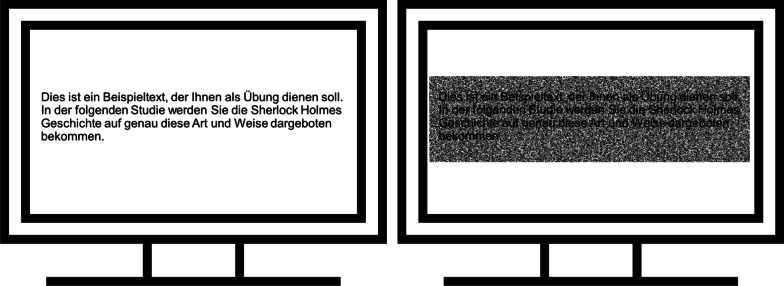
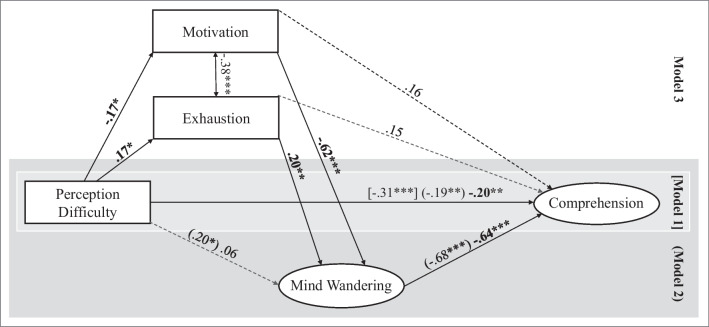
We investigated whether increased perceptual processing difficulty during reading or listening to a Sherlock Holmes novella impacts mind wandering as well as text comprehension. We presented 175 participants with a novella in either a visual or an auditory presentation format and probed their thoughts and motivational states from time to time during reading/listening. For half of the participants in each presentation-format condition (visual or auditory), the story was superimposed by Gaussian noise. For both presentation formats, the participants who were exposed to noise while processing the story mind-wandered more and performed worse in a later comprehension test than the participants who processed the story without added noise. These negative effects of increased perceptual processing difficulty on task focus and comprehension were partly driven by motivational factors: reading/listening motivation mediated the relationship between perceptual processing difficulty and mind wandering.
Verified 2026-11-25 · 1 reference not checked yet
Overview
CoChat Summary
TL;DR
Across visual and auditory presentation, adding Gaussian noise to a Sherlock Holmes novella increased mind wandering and impaired comprehension relative to no-noise conditions. Motivational decline partly mediated the noise–mind-wandering link.
Key findings
- Noise increased mind wandering: descriptive means were 15.82% vs. 21.53% in visual no-noise vs. noise, and 18.65% vs. 27.92% in auditory no-noise vs. noise; multilevel model: perception-difficulty level predicted mind wandering, b = 0.48, SE = 0.21, p = 0.024.
- Noise impaired comprehension: fact-based scores were 9.98 vs. 8.65 (visual) and 9.07 vs. 7.74 (auditory); inference-based scores were 1.52 vs. 1.25 (visual) and 1.36 vs. 1.13 (auditory). Multilevel models: perception difficulty predicted fact-based comprehension, b = −0.68, p = 0.001, and inference-based comprehension, b = −0.71, p = 0.015.
- Mind wandering negatively predicted comprehension and mediated the noise effect: fact-based b = −0.88, p = 0.001; inference-based b = −0.14, p = 0.002; indirect effect of perception difficulty on comprehension via mind wandering b = −0.13, p = 0.022.
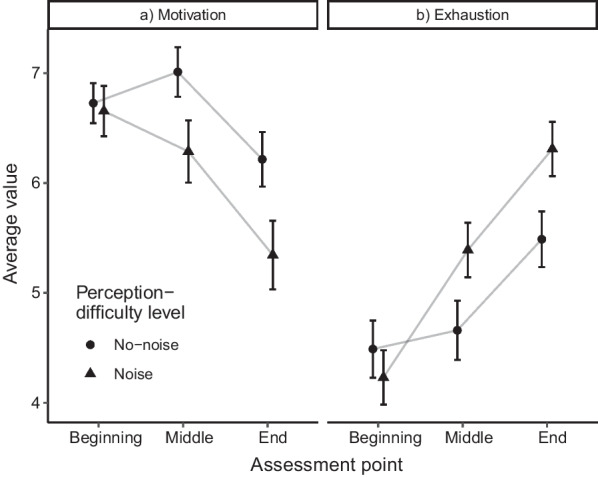
- Motivation mediated the noise–mind-wandering relationship: indirect effect via motivation b = 0.11, p = 0.028; indirect effect via exhaustion was not significant, b = 0.03, p = 0.073. Visual presentation improved fact-based comprehension over auditory, b = 0.46, p = 0.009; presentation format did not significantly predict mind wandering, p = 0.094.
Methods
- 2 (no-noise vs. noise) × 2 (visual vs. auditory) between-participants online Qualtrics experiment; final N = 175 after exclusions (Mage = 24.14, SD = 6.36; 139 female, 33 male, 3 without gender disclosure; 159 German native speakers; 169 with secondary school education or higher). Group sizes: visual no-noise n = 46, visual noise n = 48, auditory no-noise n = 42, auditory noise n = 39.
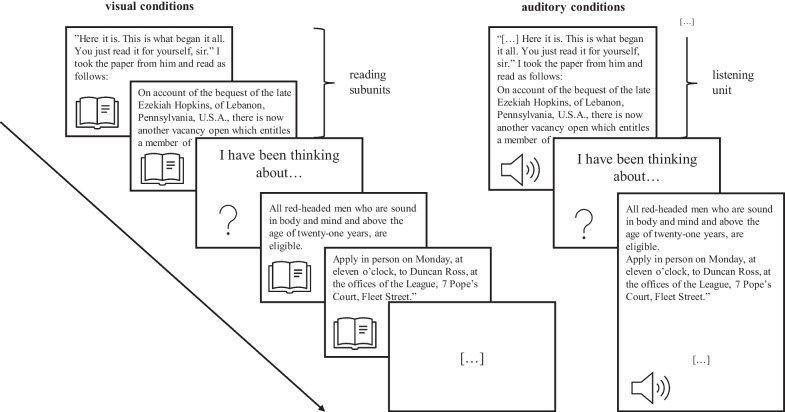
- Materials: German version of *The Red-Headed League* (~5,500 words), presented as text or as a 33-min audio recording in 19 units; 18 thought probes; motivation and exhaustion assessed at beginning, middle, and end; comprehension assessed with 14 multiple-choice questions (12 fact-based, 2 inference-based).
- Analysis: multilevel logistic regressions with random intercepts for mind wandering and fact-based comprehension; ordered logistic regression for inference-based comprehension; Bayesian ANOVAs for manipulation checks and motivational time courses; structural path model with latent mind wandering and comprehension and manifest motivation/exhaustion.
Limitations
- Stated: inference-based comprehension comprised only two questions; the study did not distinguish internal from external distraction, so the noise itself may have attracted attention; reading vs. listening comprehension differences may stem from fixed reading presentation times adjusted to audio, possibly creating an unnaturally slow reading experience; only one kind of perception difficulty (Gaussian noise) was tested.
- Evident: the sample was predominantly female, German-native, educated, and collected online, limiting generalizability.
- Evident: mediation analyses were not preregistered/exploratory, and the paper notes the motivation–mind wandering relationship may be bidirectional; 45 of 220 participants were excluded for technical difficulties, disturbances, dishonesty, long completion, or prior story familiarity.
Model-written summary. Check it against the paper before relying on it.
Integrity signals
Registry
Cites
Statistics
Figures
Verification
Claims the paper makes
1 Valid · 1 Not valid · 29 Not checked · 85 Own results and interpretations
Every source the paper cites for this claim was checked and supports it.
In the paper
“and this increase seems to follow a linear trend (Kahmann et al., 2021).”
§ When there is noise on Sherlock Holmes: mind wandering increases with perceptual processing difficulty during reading and listening > Mind wandering > Overload assumption
What the sources say
- Supportedcites Kahmann et al., 2021 matched to “Mind wandering increases linearly with text difficulty” (2022) source
The Abstract (p.1) reports that, contrary to the authors' U-shaped prediction, 'mind wandering linearly increased with text difficulty,' and the Discussion opens by stating 'We found mind wandering increased linearly as people read more difficult texts,' extending this to natural page-by-page reading across nine US grade levels. The Results section and summary confirm the linear difficulty effect, so the paraphrase attributing a linear trend to Kahmann et al. is directly supported. (LLM, conf=0.92)
hedgedstates a cause- Asserted: passes — The authors put it forward as true.
- Checkable: passes — It can be checked against evidence.
- Load-bearing: unclear — It is unclear whether the paper’s conclusions depend on it.
- Based: passes — The paper gives a reason why it holds.
- Supported
A result the paper reports from its own data — it cites no other source for it, so there is none to check. The quote shows it is in the paper.
In the paper
“These negative effects of increased perceptual processing difficulty on task focus and comprehension were partly driven by motivational factors: reading/listening motivation mediated the relationship between perceptual processing difficulty and mind wandering.”
§ When there is noise on Sherlock Holmes: mind wandering increases with perceptual processing difficulty during reading and listening > Abstract
plainstates a causen = 175- Asserted: passes — The authors put it forward as true.
- Checkable: passes — It can be checked against evidence.
- Load-bearing: passes — The paper’s conclusions depend on it.
- Based: passes — The paper gives a reason why it holds.
A result the paper reports from its own data — it cites no other source for it, so there is none to check. The quote shows it is in the paper.
In the paper
“For both presentation formats, the participants who were exposed to noise while processing the story mind-wandered more and performed worse in a later comprehension test than the participants who processed the story without added noise.”
§ When there is noise on Sherlock Holmes: mind wandering increases with perceptual processing difficulty during reading and listening > Abstract
plainstates a causen = 175- Asserted: passes — The authors put it forward as true.
- Checkable: passes — It can be checked against evidence.
- Load-bearing: passes — The paper’s conclusions depend on it.
- Based: passes — The paper gives a reason why it holds.
A result the paper reports from its own data — it cites no other source for it, so there is none to check. The quote shows it is in the paper.
In the paper
“They confirm the descriptive trend of negative effects of noise on the participants’ task focus: The occurrence of mind wandering was more likely in the noise conditions than in the no-noise conditions.”
- Also stated in: § Mind wandering · plain
“| A | Mind wandering | Perception-difficulty level | 0.48 | 0.21 | 2.26 | 0.024 |”
- Also stated in: § Mind wandering · plain
“In line with this idea, we found increased mind-wandering levels for the participants in both noise conditions independent of the presentation format.”
§ When there is noise on Sherlock Holmes: mind wandering increases with perceptual processing difficulty during reading and listening > Results > Mind wandering
plainstates a cause- Asserted: passes — The authors put it forward as true.
- Checkable: passes — It can be checked against evidence.
- Load-bearing: passes — The paper’s conclusions depend on it.
- Based: passes — The paper gives a reason why it holds.
- Also stated in: § Mind wandering · plain
60 more claims
Create a free account to see all 116 claims and to verify the 41 references still open.
- It may state two separate claims as one. 23
- Probably not a substantial claim. 34
- The quote only partly states this claim. 3
Claims other papers make about this one
Each is checked against this paper’s own text: does it say what the citing paper says it does?
In the citing paper
“Previous studies have demonstrated that pupil diameter increases as listening demands rise, such as during speech-in-noise perception or rapid speech [9,11,17,18]”
From Fidgeting Increases Pupil Diameter During Auditory Processing in Young Healthy Adults (2026) · cites this paper as [18]
Statistics that don’t add up
Each reported p-value recomputed from its test statistic and degrees of freedom, each partial η² from its F, and each ratio, mean difference or B printed with a p checked against its own confidence interval.
Rated minor: it would not touch a result — a value no result rests on, a p-value that stays on the same side of the significance level, or a conflict that is clerical, resolved elsewhere in the paper, or outside its own findings.
In the paper
“t(173) = − 3.22, p = 0.022”
§ When there is noise on Sherlock Holmes: mind wandering increases with perceptual processing difficulty during reading and listening > Results > Motivational factors and mediation model
Reported p = .022 · recomputed p = .002
Rated minor: it would not touch a result — a value no result rests on, a p-value that stays on the same side of the significance level, or a conflict that is clerical, resolved elsewhere in the paper, or outside its own findings.
In the paper
“F(2, 342) = 17.01, p < 0.001, ηp2 = 0.03”
§ When there is noise on Sherlock Holmes: mind wandering increases with perceptual processing difficulty during reading and listening > Results > Motivational factors and mediation model
Reported ηp² = .03 · recomputed ηp² .09045–.09049
Rated minor: it would not touch a result — a value no result rests on, a p-value that stays on the same side of the significance level, or a conflict that is clerical, resolved elsewhere in the paper, or outside its own findings.
In the paper
“F(2, 342) = 9.11, p < 0.001, ηp2 = 0.01”
§ When there is noise on Sherlock Holmes: mind wandering increases with perceptual processing difficulty during reading and listening > Results > Motivational factors and mediation model
Reported ηp² = .01 · recomputed ηp² = .0506
Rated minor: it would not touch a result — a value no result rests on, a p-value that stays on the same side of the significance level, or a conflict that is clerical, resolved elsewhere in the paper, or outside its own findings.
In the paper
“F(2, 342) = 3.18, p = 0.043, ηp2 = 0.01”
§ When there is noise on Sherlock Holmes: mind wandering increases with perceptual processing difficulty during reading and listening > Results > Motivational factors and mediation model
Reported ηp² = .01 · recomputed ηp² .01823–.01828
Rated minor: it would not touch a result — a value no result rests on, a p-value that stays on the same side of the significance level, or a conflict that is clerical, resolved elsewhere in the paper, or outside its own findings.
In the paper
“F(2, 342) = 61.19, p < 0.001, ηp2 = 0.07”
§ When there is noise on Sherlock Holmes: mind wandering increases with perceptual processing difficulty during reading and listening > Results > Motivational factors and mediation model
Reported ηp² = .07 · recomputed ηp² .26352–.26355
Statistics recomputed
Every reported test result, recomputed from its test statistic and degrees of freedom. A result shows as not adding up only once an independent check has confirmed it.
- Doesn’t add upt(173) = -3.22reported p = .022 · recomputed p = .002
“t(173) = − 3.22, p = .022”
- ConsistentF(1, 171) = 53.7reported p < .001 · recomputed p < .001
“F(1,171) = 53.70, p < .001”
- ConsistentF(1, 171) < 1reported p = .998 · recomputed p = .319
“F(1,171) < 1.00, p = .998”
- ConsistentF(1, 171) < 1reported p = .496 · recomputed p = .319
“F(1,171) < 1.00, p = .496”
- ConsistentF(1, 171) = 2.21reported p = .139 · recomputed p = .139
“F(1,171) = 2.21, p = .139”
12 more recomputed tests
Create a free account to see every test the Stats check recomputed.
Self-check
Percentages, sums and reported differences re-computed from the paper’s own numbers.
Self-check results appear here once an independent check has confirmed them.
Citations
Cites
Fitting Linear Mixed-Effects Models Using lme4
Bates, D., Mächler, M., Bolker, B., & Walker, S. (2015) · Journal of Statistical Software · doi:10.18637/jss.v067.i01 · Cited by 86,835
lavaan : An R Package for Structural Equation Modeling
Rosseel, Y. (2012) · Journal of Statistical Software · doi:10.18637/jss.v048.i02 · Cited by 27,955
To parcel or not to parcel: Exploring the question, weighing the merits
Little, T. D., Cunningham, W. A., Shahar, G., & Widaman, K. F. (2002) · Structural Equation Modeling: A Multidisciplinary Journal · doi:10.1207/s15328007sem0902_1 · Cited by 6,552
Toward a model of text comprehension and production.
Kintsch, W., & van Dijk, T. A. (1978) · Psychological Review · doi:10.1037/0033-295x.85.5.363 · Cited by 5,298 · cited 4×
“Reading and listening are thus assumed to constitute complex higher-level cognitive tasks (Feng et al., 2013; Gernsbacher et al., 1990; Kintsch & van Dijk, 1978), during which comprehension activities that make use of and simultaneously form a situational model should always be maintained.”
BackgroundInfluentialSufficient Sample Sizes for Multilevel Modeling
Maas, C. J. M., & Hox, J. J. (2005) · Methodology · doi:10.1027/1614-2241.1.3.86 · Cited by 3,582
A wandering mind is an unhappy mind
Killingsworth, M. A., & Gilbert, D. T. (2010) · Science · doi:10.1126/science.1192439 · Cited by 2,575
Distracted and confused? Selective attention under load
Lavie, N. (2005) · Trends in Cognitive Sciences · doi:10.1016/j.tics.2004.12.004 · Cited by 2,102
Smallwood, J., & Schooler, J. W. (2006) · Psychological Bulletin · doi:10.1037/0033-2909.132.6.946 · Cited by 2,067
Self-citationLoad Theory of Selective Attention and Cognitive Control
Lavie, N., Hirst, A., de Fockert, J. W., & Viding, E. (2004) · Journal of Experimental Psychology: General · doi:10.1037/0096-3445.133.3.339 · Cited by 1,812
The Science of Mind Wandering: Empirically Navigating the Stream of Consciousness
Smallwood, J., & Schooler, J. W. (2015) · Annual Review of Psychology · doi:10.1146/annurev-psych-010814-015331 · Cited by 1,685 · cited 1×
“…and sirens in operation), but—important for the present work—also self-generated and internal, such as wandering or task-unrelated thoughts (Seli et al., 2018; Smallwood & Schooler, 2015), which people experience to a high level in everyday life (Kane et al., 2017; Killingsworth & Gilbert, 2010).”
BackgroundSelf-citationDecision making and the avoidance of cognitive demand
Kool, W., McGuire, J. T., Rosen, Z. B., & Botvinick, M. M. (2010) · Journal of Experimental Psychology: General · doi:10.1037/a0020198 · Cited by 1,141 · cited 1×
“Referring to extended models of motivationcognition interactions (e.g., Kool et al., 2010) and cost– benefit analyses, Kahmann and colleagues (2021) argued that a reader might feel that further focused reading is not “worth it” when processing is overly difficult.”
BackgroundSimmons, J. P., Nelson, L. D., & Simonsohn, U. (2012) · doi:10.2139/ssrn.2160588 · Cited by 680
Investigating differences in general comprehension skill.
Gernsbacher, M. A., Varner, K. R., & Faust, M. E. (1990) · Journal of Experimental Psychology Learning Memory and Cognition · doi:10.1037//0278-7393.16.3.430 · Cited by 670
Shifting moods, wandering minds: Negative moods lead the mind to wander.
Smallwood, J., Fitzgerald, A., Miles, L. K., & Phillips, L. H. (2009) · Emotion · doi:10.1037/a0014855 · Cited by 487
Self-citationWhen attention matters: The curious incident of the wandering mind
Smallwood, J., McSpadden, M., & Schooler, J. W. (2008) · Memory & Cognition · doi:10.3758/mc.36.6.1144 · Cited by 458
Self-citationMind-wandering, cognition, and performance: A theory-driven meta-analysis of attention regulation.
Randall, J. G., Oswald, F. L., & Beier, M. E. (2014) · Psychological Bulletin · doi:10.1037/a0037428 · Cited by 410
Mind-Wandering as a Natural Kind: A Family-Resemblances View
Seli, P., Kane, M. J., Smallwood, J., Schacter, D. L., Maillet, D., Schooler, J. W., & Smilek, D. (2018) · Trends in Cognitive Sciences · doi:10.1016/j.tics.2018.03.010 · Cited by 378 · cited 2×
“, a passing fire truck with blue lights and sirens in operation), but—important for the present work—also self-generated and internal, such as wandering or task-unrelated thoughts (Seli et al., 2018; Smallwood & Schooler, 2015), which people experience to a high level in everyday life (Kane et al.”
BackgroundMethodSelf-citationA Conceptual Framework for Ordered Logistic Regression Models
Fullerton, A. S. (2009) · Sociological Methods & Research · doi:10.1177/0049124109346162 · Cited by 365
Unsworth, N., & McMillan, B. D. (2013) · Journal of Experimental Psychology: Learning, Memory, and Cognition · doi:10.1037/a0029669 · Cited by 335 · cited 2×
“In the current work, we tested for a decline in reading and listening motivation due to increased perception difficulty, which should, in turn, go along with higher mind-wandering rates (Seli et al., 2019; Unsworth & McMillan, 2013).”
BackgroundMind wandering while reading easy and difficult texts
Feng, S., D’Mello, S., & Graesser, A. C. (2013) · Psychonomic Bulletin & Review · doi:10.3758/s13423-012-0367-y · Cited by 257 · cited 7×
“Reading and listening are thus assumed to constitute complex higher-level cognitive tasks (Feng et al., 2013; Gernsbacher et al., 1990; Kintsch & van Dijk, 1978), during which comprehension activities that make use of and simultaneously form a situational model should always be maintained.”
BackgroundResultInfluentialHarnessing the wandering mind: The role of perceptual load
Forster, S., & Lavie, N. (2009) · Cognition · doi:10.1016/j.cognition.2009.02.006 · Cited by 251
For Whom the Mind Wanders, and When, Varies Across Laboratory and Daily-Life Settings
Kane, M. J., Gross, G. M., Chun, C. A., Smeekens, B. A., Meier, M. E., Silvia, P. J., & Kwapil, T. R. (2017) · Psychological Science · doi:10.1177/0956797617706086 · Cited by 230
Nájera Catalán, H. E. (2019) · Social Indicators Research · doi:10.1007/s11205-018-1950-z · Cited by 183
Rummel, J., & Boywitt, C. D. (2014) · Psychonomic Bulletin & Review · doi:10.3758/s13423-013-0580-3 · Cited by 182
Self-citationSmallwood, J. (2011) · Language and Linguistics Compass · doi:10.1111/j.1749-818x.2010.00263.x · Cited by 174 · cited 7×
“Reading or listening-comprehension tasks might be highly likely to evoke task-focus costs (especially with high levels of perception difficulty) because they are already complex and resource-demanding in themselves (Feng et al., 2013; Gernsbacher et al., 1990; Kintsch & van Dijk, 1978; Smallwood, 2011).”
BackgroundInfluentialSelf-citationHunter, A., & Eastwood, J. D. (2018) · Experimental Brain Research · doi:10.1007/s00221-016-4749-7 · Cited by 162
Text difficulty, topic interest, and mind wandering during reading
Soemer, A., & Schiefele, U. (2019) · Learning and Instruction · doi:10.1016/j.learninstruc.2018.12.006 · Cited by 102 · cited 5×
“Soemer and Schiefele (2019), for example, argue that the increase in attentional failures due to enhanced semantic text difficulty might be a consequence of difficulties to maintain attention on the more difficult text versions.”
BackgroundMethodInfluentialEstablishing the Attention-Distractibility Trait
Forster, S., & Lavie, N. (2015) · Psychological Science · doi:10.1177/0956797615617761 · Cited by 97
Engert, V., Smallwood, J., & Singer, T. (2014) · Biological Psychology · doi:10.1016/j.biopsycho.2014.10.004 · Cited by 90
Self-citationThe relationship between mind wandering and reading comprehension: A meta-analysis
Bonifacci, P., Viroli, C., Vassura, C., Colombini, E., & Desideri, L. (2023) · Psychonomic Bulletin & Review · doi:10.3758/s13423-022-02141-w · Cited by 83
Increasing participant motivation reduces rates of intentional and unintentional mind wandering
Seli, P., Schacter, D. L., Risko, E. F., & Smilek, D. (2019) · Psychological Research · doi:10.1007/s00426-017-0914-2 · Cited by 80
Studying in the region of proximal learning reduces mind wandering
Xu, J., & Metcalfe, J. (2016) · Memory & Cognition · doi:10.3758/s13421-016-0589-8 · Cited by 78
Exploring patterns of ongoing thought under naturalistic and conventional task-based conditions
Konu, D., Mckeown, B., Turnbull, A., Siu Ping Ho, N., Karapanagiotidis, T., Vanderwal, T., McCall, C., Tipper, S. P., Jefferies, E., & Smallwood, J. (2021) · Consciousness and Cognition · doi:10.1016/j.concog.2021.103139 · Cited by 69
Self-citationDistracted by your mind? Individual differences in distractibility predict mind wandering
Forster, S., & Lavie, N. (2014) · Journal of Experimental Psychology: Learning, Memory, and Cognition · doi:10.1037/a0034108 · Cited by 66
Mind wandering and reading comprehension in secondary school children
Soemer, A., Idsardi, H. M., Minnaert, A. E. M. G., & Schiefele, U. (2019) · Learning and Individual Differences · doi:10.1016/j.lindif.2019.101778 · Cited by 51
Steindorf, L., & Rummel, J. (2020) · Behavior Research Methods · doi:10.3758/s13428-019-01214-4 · Cited by 49
Self-citationD'Mello, S. K., & Mills, C. S. (2021) · Language and Linguistics Compass · doi:10.1111/lnc3.12412 · Cited by 45
Wong, A. Y., Smith, S. L., McGrath, C. A., Flynn, L. E., & Mills, C. (2022) · Contemporary Educational Psychology · doi:10.1016/j.cedpsych.2022.102098 · Cited by 42
Mills, C., D'Mello, S. K., & Kopp, K. (2015) · Learning and Instruction · doi:10.1016/j.learninstruc.2015.07.003 · Cited by 37
Does Modality Matter? The Effects of Reading, Listening, and Dual Modality on Comprehension
Rogowsky, B. A., Calhoun, B. M., & Tallal, P. (2016) · Sage Open · doi:10.1177/2158244016669550 · Cited by 36
Mind wandering increases linearly with text difficulty
Kahmann, R., Ozuer, Y., Zedelius, C. M., & Bijleveld, E. (2022) · Psychological Research · doi:10.1007/s00426-021-01483-9 · Cited by 32
The effect of disfluency on mind wandering during text comprehension
Faber, M., Mills, C., Kopp, K., & D’Mello, S. (2017) · Psychonomic Bulletin & Review · doi:10.3758/s13423-016-1153-z · Cited by 31
Rummel, J., & Nied, L. (2017) · Consciousness and Cognition · doi:10.1016/j.concog.2017.08.013 · Cited by 25
Self-citationDoes mind wandering mediate the effects of habitual reading motivation on comprehension?
Soemer, A., Gericke, C., & Schiefele, U. (2022) · Learning and Instruction · doi:10.1016/j.learninstruc.2022.101693 · Cited by 15
Research works printed but not linked: 3
- Conan-Doyle, A. (2001). Memoirs of Sherlock Holmes. In E. Glinert (Ed.), The adventures and memoirs of Sherlock Holmes. Penguin. (Original work published 1894).
- Jeffreys H Theory of probability 1961 Oxford University Press
- Venables, W. N., & Ripley, B. D. (2013). Modern applied statistics with S-PLUS. Springer.
Cited by
Motala, A., Johnsrude, I. S., & Herrmann, B. (2024) · Trends in Hearing · doi:10.1177/23312165241236041 · Cited by 39
A dual process model of spontaneous conscious thought
Pavlova, M. K. (2023) · Consciousness and Cognition · doi:10.1016/j.concog.2023.103631 · Cited by 11
Self-Reported attention to changes and associations with episodic memory updating
Wahlheim, C. N., Fiedler, J. L., Garlitch, S. M., & Weidler, B. J. (2024) · Journal of Memory and Language · doi:10.1016/j.jml.2024.104577 · Cited by 6
You Can Stand Under My Umbrella: Cognitive Load in Second-Language Reading
Rocabado, F., Schmitz, G., & Duñabeitia, J. A. (2025) · Behavioral Sciences · doi:10.3390/bs15081051 · Cited by 6
Why Dysfluent Font Does Not Aid Second Language Learning
Сергеевна, Ц. Э., Likhanov, M. V., Kalinnikova, L., Nikulenko, A., Filimonova, E. V., & Kovas, Y. V. (2024) · The Journal of Experimental Education · doi:10.1080/00220973.2024.2446189 · Cited by 3
Metadata
- Authors
- Steindorf, L., Pink, S., Rummel, J., & Smallwood, J.
- Affiliations
- Heidelberg University (DE)
- University of Mannheim (DE)
- Queen's University (CA)
- Corresponding author
- Steindorf, Lena
- Venue
- Cognitive Research: Principles and Implications
- Published
- 2023-05-25
- Volume
- 8
- Issue
- 1
- Pages
- 31-31
- ISSN
- 2365-7464 (ISSN-L)
- PMC
- PMC10209958
- OpenAlex
- W4378172604
- Semantic Scholar
- 952d14bce6174aa41e133531458cacfcaf85905a
- Cited by
- 17
- References
- 46
- Citations by year
- 2026: 8 · 2025: 5 · 2024: 3 · 2023: 1
- FWCI
- 1.75
- Type
- journal article
- Language
- en
- Open access
- gold
- doi.org
- Licence
- cc-by
- creativecommons.org/licenses/by/4.0 (tdm)
- creativecommons.org/licenses/by/4.0 (vor)
- Locations
- Cognitive Research Principles and Implications (publishedVersion, cc-by)
- PubMed Central (publishedVersion, cc-by)
- PubMed (publishedVersion)
- DOAJ (DOAJ: Directory of Open Access Journals) (submittedVersion, cc-by-sa)
- Funders
- Deutsche Forschungsgemeinschaft (RU1996/3-1)
- Ruprecht-Karls-Universität Heidelberg
- Topics
- Life Sciences › Neuroscience › Cognitive Neuroscience › Mind wandering and attention
- Social Sciences › Psychology › Developmental and Educational Psychology › Flow Experience in Various Fields
- Social Sciences › Psychology › Developmental and Educational Psychology › Reading and Literacy Development
- Keywords
- mind wandering, noise exposure, reading comprehension, listening comprehension, reading versus listening, task focus, motivation, auditory presentation, visual presentation
- MeSH terms
- Attention, Auditory Perception, Humans, Motivation, Reading, Comprehension
About these checks
Registry, retraction, Cites and statistics results are computed, not judged, with one exception: a printed reference that no index lists is read once by a model before it counts as a citation error. Claims are extracted by a model and kept only when their quote appears verbatim in the text; each cited source is then checked, with a model’s help, for whether it says what the claim relies on. Those verdicts can be wrong — read the claim’s quote and the cited source before relying on one.
A language model drew the claims from the paper on 2026-11-19, under version 3 of the claim definition (model deepseek-v4.1-flash, prompt extract-v3).
A second model labelled each claim on 2026-11-19 (model jev-1.13-20260917, definition revision gold-guideline-v0.2).
Cited sources are checked with a language model’s help (qwen3.8-omni-flash).
Statistics and arithmetic are recomputed, not judged.
Confidence bands are shown only for fields calibrated on our annotated test set. None is calibrated yet, so no band is shown.
What counts as a claim ›How we measure confidence ›How we check this ›
Are you an author, or do you see a problem with this page? Request a review
Data sources
Bibliographic data: Semantic Scholar, OpenAlex, Crossref.
Contains information from the Semantic Scholar Academic Graph Datasets, made available under the ODC Attribution License (ODC-BY 1.0).
Semantic Scholar’s data is described in: Kinney, R., et al. (2023). The Semantic Scholar Open Data Platform. arXiv:2301.10140.
