

The DOI matches its Crossref record; 82 of the 83 references it cites were found in a registry or an index.
Humans versus AI: whether and why we prefer human-created compared to AI-created artwork
Open accessAbstract
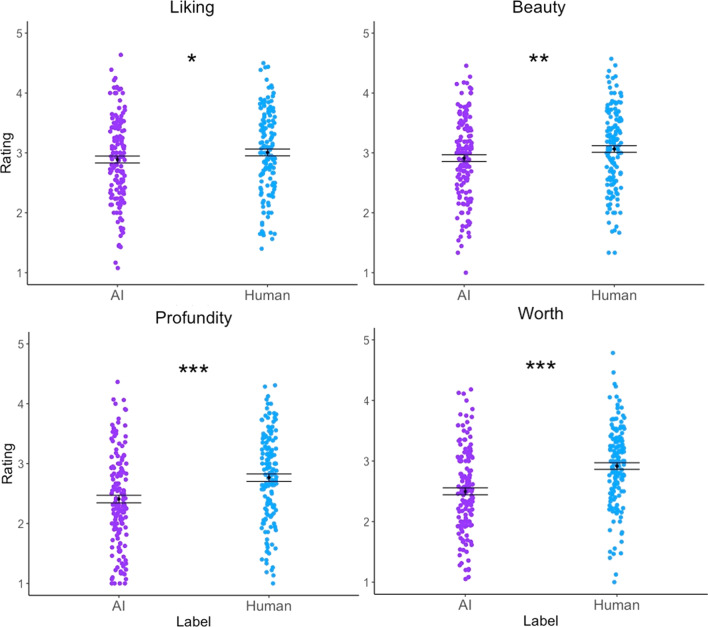
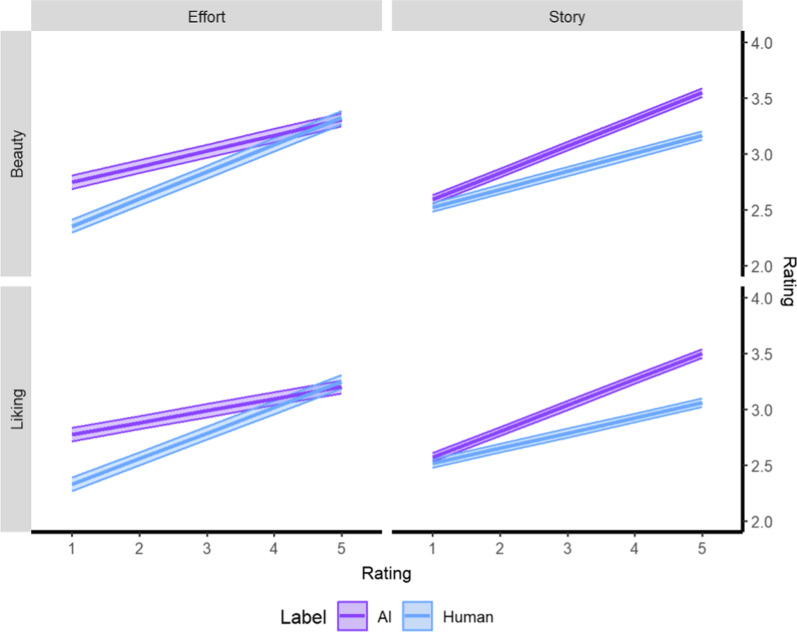
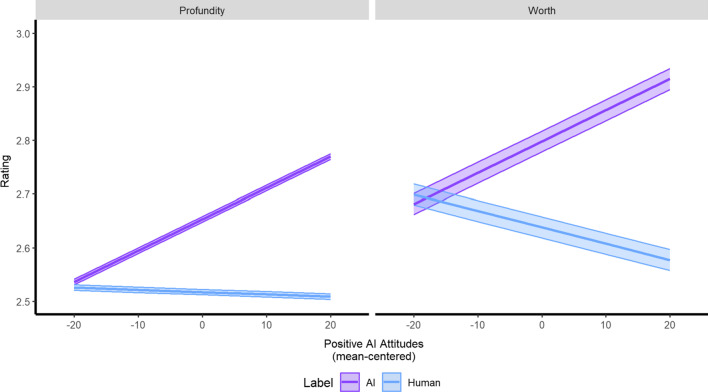
With the recent proliferation of advanced artificial intelligence (AI) models capable of mimicking human artworks, AI creations might soon replace products of human creativity, although skeptics argue that this outcome is unlikely. One possible reason this may be unlikely is that, independent of the physical properties of art, we place great value on the imbuement of the human experience in art. An interesting question, then, is whether and why people might prefer human-compared to AI-created artworks. To explore these questions, we manipulated the purported creator of pieces of art by randomly assigning a “Human-created” or “AI-created” label to paintings actually created by AI, and then assessed participants’ judgements of the artworks across four rating criteria (Liking, Beauty, Profundity, and Worth). Study 1 found increased positive judgements for human- compared to AI-labelled art across all criteria. Study 2 aimed to replicate and extend Study 1 with additional ratings (Emotion, Story, Meaningful, Effort, and Time to create) intended to elucidate why people more-positively appraise Human-labelled artworks. The main findings from Study 1 were replicated, with narrativity (Story) and perceived effort behind artworks (Effort) moderating the label effects (“Human-created” vs. “AI-created”), but only for the sensory-level judgements (Liking, Beauty). Positive personal attitudes toward AI moderated label effects for more-communicative judgements (Profundity, Worth). These studies demonstrate that people tend to be negatively biased against AI-created artworks relative to purportedly human-created artwork, and suggest that knowledge of human engagement in the artistic process contributes positively to appraisals of art.
Overview
The claims and statistics of this paper haven’t been checked yet.
Run the check — free, no account needed. It reads the open-access text and checks the sources it cites.
Integrity signals
Registry
Cites
Statistics
Figures
Verification
Claims the paper makes
The claims and statistics of this paper haven’t been checked yet.
Run the check — free, no account needed. It reads the open-access text and checks the sources it cites.
Self-check
Percentages, sums and reported differences re-computed from the paper’s own numbers.
The self-check needs the paper’s full text.
Citations
Cites
Fitting Linear Mixed-Effects Models Using lme4
Bates, D., Mächler, M., Bolker, B., & Walker, S. (2015) · Journal of Statistical Software · doi:10.18637/jss.v067.i01 · Cited by 86,835 · cited 1×
“Linear mixed-effects models using maximum likelihood estimation were estimated in R (version 4.2.0; R Core Team, 2022) using the {lme4} package (version 1.1.33; Bates et al., 2015).”
MethodInfluentialConflict, arousal, and curiosity.
Berlyne, D. E. (1960) · McGraw-Hill Book Company · doi:10.1037/11164-000 · Cited by 6,018 · cited 1×
“…cascade of evaluations, implicating more-complex and elaborative processes in judgements of art that seek to understand meaning and communication through the piece (Berlyne, 1960, 1971; Chatterjee & Vartanian, 2016; Cupchik & Berlyn, 1979; Graf & Landwehr, 2015; Leder et al., 2004; Silvia, 2005).”
BackgroundCognitive Reflection and Decision Making
Frederick, S. (2005) · Journal of Economic Perspectives · doi:10.1257/089533005775196732 · Cited by 5,256
Guilford, J. P. (1950) · American Psychologist · doi:10.1037/h0063487 · Cited by 3,588
Social psychology of creativity: A consensual assessment technique.
Amabile, T. M. (1982) · Journal of Personality and Social Psychology · doi:10.1037/0022-3514.43.5.997 · Cited by 2,278 · cited 2×
“Though contention ensues over whether artificial programs are capable of producing “creative” products (in line with the computer science principle known as the Lovelace Objection; Natale & Henrickson, 2022), it is nonetheless critical to understand how audiences perceive such art given that contemporary psychological…”
BackgroundA model of aesthetic appreciation and aesthetic judgments
Leder, H., Belke, B., Oeberst, A., & Augustin, D. (2004) · British Journal of Psychology · doi:10.1348/0007126042369811 · Cited by 1,968 · cited 4×
“…e.g., Margulis et al., 2019; McAuley et al., 2021), the act of deriving meaning from artwork that is often posited in models of aesthetics (e.g., Leder et al., 2004; Pelowski et al., 2017), and that effort and time involved in creation of a product is often a heuristic for quality (Kruger…”
BackgroundResultInfluentialNeural Correlates of Behavioral Preference for Culturally Familiar Drinks
McClure, S. M., Li, J., Tomlin, D., Cypert, K. S., Montague, L. M., & Montague, P. R. (2004) · Neuron · doi:10.1016/j.neuron.2004.09.019 · Cited by 1,413 · cited 2×
“…the extant literature on the role of labels in subjective evaluations—both in aesthetics and other domains of preferences (e.g., Kirk et al., 2009; McClure et al., 2004; Newman & Bloom, 2012; Plassmann et al., 2008; Turpin et al., 2019)—our findings demonstrate that labels significantly…”
BackgroundResultMotion, emotion and empathy in esthetic experience
Freedberg, D., & Gallese, V. (2007) · Trends in Cognitive Sciences · doi:10.1016/j.tics.2007.02.003 · Cited by 1,334
The Cambridge Handbook of Creativity
(2010) · doi:10.1017/cbo9780511763205 · Cited by 1,291
Spreng*, R. N., McKinnon*, M. C., Mar, R. A., & Levine, B. (2009) · Journal of Personality Assessment · doi:10.1080/00223890802484381 · Cited by 1,161
Research works printed but not linked: 1
- Moffat, D., & Kelly, M. G. (2006). An investigation into people’s bias against computational creativity in music composition. Assessment, 13(11), 1–8.
Cited by
Sorted by citations
Items 201–229 of 229
Evaluation of ethical response to the use of artificial intelligence in aesthetics
Silk, M. S. W. (2026) · AI & Society · doi:10.1007/s00146-026-03158-8
“…reveal that people are generally bad at distinguishing AI-generated content from human-generated content in blind comparisons even though people generally prefer human-generated content to AI-generated content when informed (Gangadharbatla 2022; Bellaiche et al. 2023; Samo and Highhouse 2023).”
Dolese, M. J. (2026) · Frontiers in Psychology · doi:10.3389/fpsyg.2026.1716814 · Cited by 1
“Appreciation is enhanced when viewers can construct a narrative or perceived “aboutness” behind a work, an inference more readily anchored to human creators (Bellaiche et al., 2023).”
InfluentialPOST-DİJİTAL ÇAĞDA RESİM SANATI: YAPAY ZEKA, HAPTİK ALGI VE ONTOLOJİK DİRENÇ
Yavuzyılmaz, B. (2026) · The Turkish Online Journal of Design Art and Communication · doi:10.7456/tojdac.1929018
Authorship, Bias, and Collaboration: Navigating AI Integration in Creative Industries
Kerdvibulvech, C. (2026) · Asia Pacific Information Technology Conference (APIT) · doi:10.1145/3796130.3796151
“Consequently, AI outputs tend to replicate majority norms, marginalizing minority aesthetics, and underrepresenting diverse cultural expressions [15].”
Designing for Label-Bias Mitigation in AI-Generated Art: Synart’s Audience-to-Creator Feedback Loop
Xiao, L., Duan, Y., Chen, X., et al. (2026) · Lecture notes in computer science · doi:10.1007/978-3-032-30846-7_13
The Psychology of Artistic Authenticity
Dillion, D., Hester, N., Bigman, Y., Smith, M. M., Court, J., Sarkar, A., & Gray, K. J. (2026) · Empirical Studies of the Arts · doi:10.1177/02762374261463519
L’IA dans les achats des industries culturelles et créatives : cas d’une institution audiovisuelle
Bendimerad, S., Agulhon, S., & Haouari, M. (2026) · Logistique & Management · doi:10.1080/12507970.2026.2692925
“D’un côté, elle est valorisée pour sa capacité à catalyser la création artistique et à s’inscrire dans des dynamiques de cocréation avec les artistes (Avlonitou et Eirini Papadaki 2025; Bellaiche et al. 2023).”
Mo, L., Zhu, N., Wu, Y., & Deng, F. (2026) · Journal of Retailing and Consumer Services · doi:10.1016/j.jretconser.2026.104994
Shi, Z., Hua, W., & Liang, J. (2026) · Resonance Journal of Global Music Studies · doi:10.63802/rjgms.v2.i2.333
Overcoming the Uncanny Valley Effect in AI-Generated Emotional Ads: Matching AI to Ad Themes
Choi, C., & Magee, R. G. (2026) · Journal of Interactive Advertising · doi:10.1080/15252019.2026.2701061
(A)I Did That: Toward a Model of Leaders’ AI use and Disclosure Effects on Employees
Baum, H. M., Gerpott, F. H., & Kerschreiter, R. (2026) · Journal of Leadership & Organizational Studies · doi:10.1177/15480518261469227
“Bellaiche et al., 2023; Chiarella et al., 2022; Wu et al., 2020 Benegal et al., 2026; Reif et al., 2025; Zhu & Molnar, 2026 Framing of AI disclosure”
Zhang, Y., Huang, X., Jia, D., & Cui, R. (2026) · Journal of theoretical and applied electronic commerce research · doi:10.3390/jtaer21080270
“Furthermore, because AGC is shaped by GenAI-supported design processes, this study incorporates AI-related design factors, including generative quality [14,15], AI creativity [16,17], and consumers’ perceived effort of the brand in design [5,18].”
Sarada, V., Davuri, P., & -, P. S. (2026) · International Conference on Sustainable Computing and Integrated Communication in Changing Landscape of AI (ICSCAI) · doi:10.1109/icscai68849.2026.11648563
Zhang, L., Fang, C., Wu, Y., Yuan, Y., Wang, S. J., Luo, S., & Yoon, S. (2026) · Computers in Human Behavior · doi:10.1016/j.chb.2026.109153
The Future Worker: Rethinking Human Value
Oksanen, A., & Savolainen, I. (2026) · Springer eBooks · doi:10.1007/978-3-032-35207-1_6
Chang, J., & Jing, Y. (2026) · Frontiers in Psychology · doi:10.3389/fpsyg.2026.1903971
Behavior, Perception, and Physiological Responses to AI-Generated Safety Training Materials
Shu, Y., Sammour, F., Zhang, Z., Wang, X., & Hu, M. (2026) · ASCE Construction Research Congress (CRC) · doi:10.1061/9780784486993.001
User Trust Formation in Generative AI Design: Roles of Aesthetic Evaluation and AI Disclosure
Baek, E.-J., & Cho, D.-M. (2026) · Journal of Digital Contents Society · doi:10.9728/dcs.2026.27.8.2253
Sama, R., Shukla, Y. S., Yousaf, A., & Thaichon, P. (2026) · Journal of Creative Communications · doi:10.1177/09732586261485792
“Moreover, the feeling of autonomy in an AI system can limit the consumer interaction and satisfaction with the resulting output, a constant anthro-pocentric premise of creativity that is uniquely human (Bellaiche et al., 2023; Millet et al., 2023).”
Popescu, A., Huțul, T., Huțul, A., Holman, A. C., & Karner‐Huțuleac, A. (2026) · Human Behavior and Emerging Technologies · doi:10.1155/hbe2/2380712 · Cited by 1
Psychotherapy remains a human endeavor: Human therapy is valued more than AI-integrated therapyPreprint
Xu, C., & Kim, T. T. (2026) · medRxiv · doi:10.64898/2026.09.29.26364234
Song, Y., Song, D., Guo, Q., et al. (2026) · Journal on Computing and Cultural Heritage · doi:10.1145/3849385
Wang, C., 陈苗, & Yang, W. (2026) · Frontiers in Psychology · doi:10.3389/fpsyg.2026.1986050
“Relevant studies suggest that evaluations of AI art depend not only on visual quality but also on authorship, creative intent, source disclosure, and social cognitive biases (Moffat and Kelly, 2006; Chamberlain et al., 2018; Hong and Curran, 2019; Bellaiche et al., 2023; Horton et al., 2023).”
Kara, S. (2026) · Journal of Ethnic and Cultural Studies · doi:10.66815/ejecs/3311
“The greater preference for human-made works over AI-produced works also supports this trend (Bellaiche et al., 2023).”
Васильева, И. В., & Tikhonova, S. S. (2026) · Herald of Omsk University Series Psychology · doi:10.24147/2410-6364.2026.2.5-13
Zhu, S., Hu, J., Cheng, Z., Hu, Y., & Sun, J. (2026) · Research Square · doi:10.21203/rs.3.rs-10520041/v1
패션 제품 구매에 대한 디자인 주체(인간 vs. AI)의 영향
尹前进, & Yoon, N. (2026) · Journal of the Korean Society of Clothing and Textiles · doi:10.5850/jksct.2026.50.4.707
Gao, M., Zhao, Y., & Kwon, S. (2026) · Lecture notes in networks and systems · doi:10.1007/978-3-032-36036-6_34
Wei, K., Liu, J., Wang, S., & Sun, Y. (2026) · Frontiers in Psychology · doi:10.3389/fpsyg.2026.1905449
Metadata
- Authors
- Bellaiche, L., Shahi, R., Turpin, M. H., Ragnhildstveit, A., Sprockett, S., Barr, N., Christensen, A., & Seli, P.
- Affiliations
- Duke University (US)
- University of Waterloo (CA)
- University of Cambridge (GB)
- California College of the Arts (US)
- Sheridan College (US)
- Vanderbilt University (US)
- Corresponding author
- Bellaiche, Lucas
- ORCID
- Venue
- Cognitive Research: Principles and Implications
- Published
- 2023-07-04
- Volume
- 8
- Issue
- 1
- Pages
- 42-42
- ISSN
- 2365-7464 (ISSN-L)
- PMC
- PMC10319694
- OpenAlex
- W4383058345
- Cited by
- 233
- References
- 83
- Citations by year
- 2026: 82 · 2025: 98 · 2024: 48 · 2023: 4
- FWCI
- 34.66
- Type
- journal article
- Language
- en
- Open access
- gold
- doi.org
- Locations
- Cognitive Research Principles and Implications (publishedVersion, cc-by)
- PubMed Central (publishedVersion, cc-by)
- PubMed (publishedVersion)
- Apollo (University of Cambridge) (submittedVersion, cc-by)
- DOAJ (DOAJ: Directory of Open Access Journals) (submittedVersion, cc-by-sa)
- SOURCE Sheridan's Institutional Repository (Sheridan College) (submittedVersion, cc-by)
- Funders
- National Science Foundation
- Topics
- Life Sciences › Neuroscience › Cognitive Neuroscience › Aesthetic Perception and Analysis
- Social Sciences › Arts and Humanities › Visual Arts and Performing Arts › Art, Technology, and Culture
- Physical Sciences › Computer Science › Computer Graphics and Computer-Aided Design › Digital Media and Visual Art
- Keywords
- AI-generated art, art evaluation, aesthetic judgment, narrativity, perceived effort, attitudes toward AI
- MeSH terms
- Artificial Intelligence, Beauty, Emotions, Humans, Judgment, Paintings
About these checks
Registry, retraction, Cites and statistics results are computed, not judged, with one exception: a printed reference that no index lists is read once by a model before it counts as a citation error. Claims are extracted by a model and kept only when their quote appears verbatim in the text; each cited source is then checked, with a model’s help, for whether it says what the claim relies on. Those verdicts can be wrong — read the claim’s quote and the cited source before relying on one.
Statistics and arithmetic are recomputed, not judged.
Confidence bands are shown only for fields calibrated on our annotated test set. None is calibrated yet, so no band is shown.
What counts as a claim ›How we measure confidence ›How we check this ›
Are you an author, or do you see a problem with this page? Request a review
