

Higher education dominance and siloed knowledge: a systematic review of flipped classroom research
Open accessThe DOI matches its Crossref record; 58 of the 59 references it cites were found in a registry or an index.
Abstract
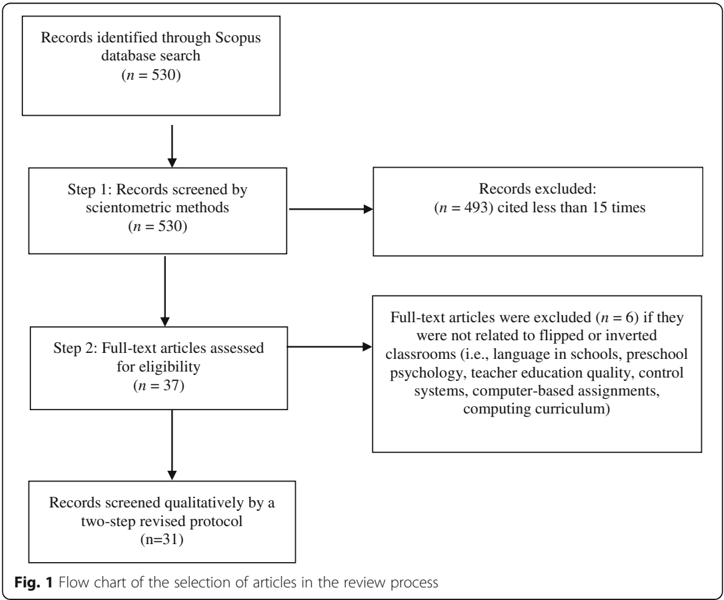
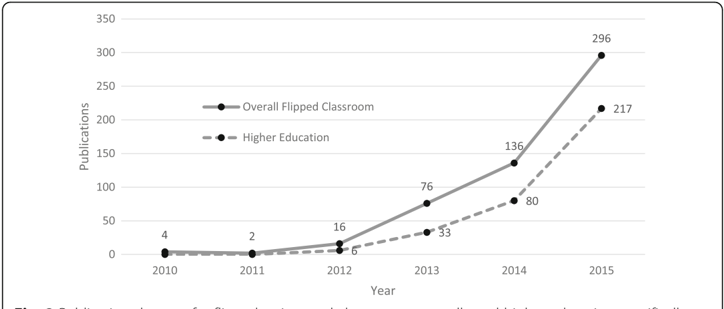
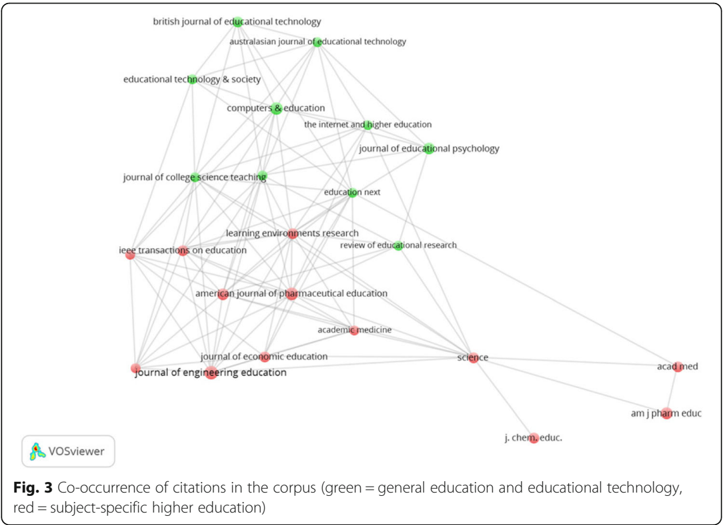
This structured review examined (academic) publications on flipped or inverted classrooms based on all Scopus database ( n = 530) references available until mid-June 2016. The flipped or inverted classroom approach has gained widespread attention during the latest decade and is based on the idea of improving student learning by prepared self-studies via technology-based resources (‘flips’) followed by high-quality, in-class teaching and learning activities. However, only a few attempts have been made to review the knowledge of the field of interest more systematically. This article seeks to address this problem and investigates what constitutes the research on flipped classrooms and, in particular, to examine the knowledge contributions with the field so far in relation to the wider research topic of educational technology. This review found that the current state of flipped classrooms as a field of interest is growing fast, with a slight conference preference and a focus on higher education and STEM (science, technology, engineering and math) area contributions, with the US as the predominant geographical context. It is concluded that studies on flipped classrooms are dominated by studies in higher education sector and are relatively local in character. The research tends not to interact beyond the two clusters of general education/educational technology and subject-specific areas. This implies that knowledge contributions related to the flipped classroom approach are relatively siloed and fragmented and have yet to stabilise. Academically and socially, the research is quite scattered, and only local evidence and experiences are available. The knowledge contributions within this field of interest seem to be anecdotal rather than systematically researched. To a large extent, the research lacks anchoring in, for example, learning theory or instructional design known from educational technology traditions and which would have helped much of the flipped classroom research to examine aspects of the flipped classroom approach more fully.
Overview
The claims and statistics of this paper haven’t been checked yet.
Free: it reads the open-access text and checks the first 5 claims that cite a source we can check. Create a free account to check every claim.
Integrity signals
Registry
Cites
Statistics
Figures


Verification
Claims the paper makes
The claims and statistics of this paper haven’t been checked yet.
Free: it reads the open-access text and checks the first 5 claims that cite a source we can check. Create a free account to check every claim.
Claims other papers make about this one
Each is checked against this paper’s own text: does it say what the citing paper says it does?
The source backs part of the claim, not all of it — or backs it for a different population, condition or comparison.
In the citing paper
“Linked to this, educational technology research has, however, lacked theoretical guidance (Al-Sakkaf, Omar, & Ahmad, 2019; Hew, Lan, Tang, Jia, & Lo, 2019; Lundin, Bergviken Rensfeldt, Hillman, Lantz-Andersson, & Peterson, 2018).”
From Mapping research in student engagement and educational technology in higher education: a systematic evidence map (2020) · cites this paper as Lundin, Bergviken Rensfeldt, Hillman, Lantz-Andersson, & Peterson, 2018
Experimental — accuracy not yet measuredThe cited source says what the claim attributes to it.
In the citing paper
“Reviews that have included research using a range of methodologies, have found a limited number of studies employing qualitative methods (e.g. Connolly, Boyle, MacArthur, Hainey, & Boyle, 2012; Kay & LeSage, 2009; Lundin et al., 2018).”
From Mapping research in student engagement and educational technology in higher education: a systematic evidence map (2020) · cites this paper as Lundin et al., 2018
Self-check
Percentages, sums and reported differences re-computed from the paper’s own numbers.
The self-check needs the paper’s full text.
Citations
Cites
Software survey: VOSviewer, a computer program for bibliometric mapping
van Eck, N. J., & Waltman, L. (2010) · Scientometrics · doi:10.1007/s11192-009-0146-3 · Cited by 21,484 · cited 1×
“Co-occurrence analyses were conducted using VOSviewer (van Eck & Waltman, 2010) and Yasu Imao’s CasualConc application (sites.google.com/site/casualconc/), and the results are presented in the step 1 subsection of the results section.”
MethodFlip Your Classroom: Reach Every Student in Every Class Every Day
Sams, A., & Bergmann, J. (2012) · Medical Entomology and Zoology · Cited by 3,810
Inverting the Classroom: A Gateway to Creating an Inclusive Learning Environment
Lage, M. J., Platt, G. J., & Treglia, M. (2000) · The Journal of Economic Education · doi:10.1080/00220480009596759 · Cited by 2,774
The use of flipped classrooms in higher education: A scoping review
O'Flaherty, J., & Phillips, C. (2015) · The Internet and Higher Education · doi:10.1016/j.iheduc.2015.02.002 · Cited by 2,152 · cited 4×
“Our results and recommendations therefore support the conclusions of the earlier review by O’Flaherty et al. (2015) but also foreground the relative impact of the higher education sector, provide more systematic knowledge and offer a problematising stance on the siloed character of the research and…”
BackgroundMethodResultInfluentialAbeysekera, L., & Dawson, P. (2015) · Higher Education Research & Development · doi:10.1080/07294360.2014.934336 · Cited by 1,847
Biesta, G. (2007) · Educational Theory · doi:10.1111/j.1741-5446.2006.00241.x · Cited by 1,655 · cited 1×
“As part of our work, we also considered the impact of systematic, evidence-based research methodology, including how it has been criticised, e.g., in educational science (Biesta, 2007; Denzin, 2009; Hammersley, 2001).”
BackgroundHow learning in an inverted classroom influences cooperation, innovation and task orientation
Strayer, J. F. (2012) · Learning Environments Research · doi:10.1007/s10984-012-9108-4 · Cited by 1,621 · cited 11×
“Instead, the novelty of the flipped classroom approach is described as ‘the regular and systematic use of interactive technology in the learning process’ (Strayer, 2012, p. 172).”
BackgroundInfluentialFlip your classroom reach every student in every class every day
Bergmann, J., & Sams, A. (2012) · Cited by 1,601
The Intellectual and Social Organization of the Sciences
Barber, B., & Whitley, R. (1986) · Canadian Journal of Sociology / Cahiers canadiens de sociologie · doi:10.2307/3341122 · Cited by 1,213
McLaughlin, J. E., Roth, M. T., Glatt, D. M., Gharkholonarehe, N., Davidson, C. A., Griffin, L. M., Esserman, D. A., & Mumper, R. J. (2014) · Academic Medicine · doi:10.1097/acm.0000000000000086 · Cited by 1,167 · cited 12×
“242), and overall, optimising classroom time is often specifically emphasised (Gannod et al., 2008; Mason et al., 2013; McLaughlin et al., 2014; Tucker, 2012).”
BackgroundResultInfluential
Research works printed but not linked: 2
- 2. Ash, K. (2012). Educators view flipped model with a more critical eye. Education Week, 32(2), 6-8.
- 7. Bishop, J. L., & Verlinger, M. A. (2013). The flipped classroom: A survey of the research. Paper presented at the ASEE Annual Conference & Exposition. Atlanta: American Society for Engineering Education.
Cited by
Items 101–200 of 264
Clark, R. M., Kaw, A. K., Lou, Y., & Scott, A. R. (2022) · International Journal of Mathematical Education in Science and Technology · doi:10.1080/0020739x.2022.2052198 · Cited by 13
“These constraints imply that few of these studies can make generalizable claims; therefore, future research should aim to make connections with prior research (Lundin et al., 2018).”
BackgroundResultInfluentialFlipped Classroom: Promoting Active Learning On Students’ Engagement At A Higher Level
Ajmal, B., Ansari, M., & Akhtar, S. (2024) · Journal of Policy Research · doi:10.61506/02.00245 · Cited by 13
Empirical Effect: Flipped Classroom-Based E-Learning to Face Learning on Covid-19 Pandemic
Sakti, R. H., & Sukardi, S. (2021) · Jurnal Pendidikan dan Pengajaran · doi:10.23887/jpp.v54i1.31645 · Cited by 14
“This is mainly because students can learn online faster; e-learning requires 40-60% less time to study than in a traditional classroom because students can learn at their own pace, go back and reread, skip, or accelerate through their chosen concept (Lundin et al., 2018).”
BackgroundEngaging Students in Searching the Literature
Shannon, C. (2019) · Medical Reference Services Quarterly · doi:10.1080/02763869.2019.1657726 · Cited by 11
A systematic review of classroom technologies supporting student centered teaching
Swai, C. T. (2025) · Discover Education · doi:10.1007/s44217-025-00932-6 · Cited by 12
“To sum up, university learners seem to be the most significant sample of Supportive technologies on SCT strategies research, as previous reviews show [48].”
Gopalan, C., Halpin, P. A., Selvam, A. A. A., & Hung, W. (2024) · AJP Advances in Physiology Education · doi:10.1152/advan.00027.2024 · Cited by 11
An evaluation of online flipped instruction methods during the COVID-19 pandemic
Sanandaji, A., & Ghanbartehrani, S. (2021) · Journal of Information Technology Case and Application Research · doi:10.1080/15228053.2021.1901360 · Cited by 10
The impact of the flipped classroom in higher education: a case study
Díaz, M. J. S., & Narciso, D. (2019) · Aloma: revista de psicologia, ciències de l'educació i de l'esport Blanquerna · doi:10.51698/aloma.2019.37.2.15-23 · Cited by 10
The freedom to teach (at the best)
Hortsch, M., & Rompolski, K. (2022) · Anatomical Sciences Education · doi:10.1002/ase.2240 · Cited by 10
Teaching, learning and assessment methods for sustainability education on the land–sea interface
Bryhn, A. C., & Belgrano, A. (2023) · Discover Sustainability · doi:10.1007/s43621-023-00120-2 · Cited by 9
“Flipped classroom techniques [77, 78] and problem-based learning [87, 88] may be suitable for some LSI related modules, courses and programmes, but less so for others.”
BackgroundInfluentialFlipped Classroom among Minorities in the Context of Mathematics Learning: The Israeli Case
Sharkia, H., & Kohen, Z. (2021) · Mathematics · doi:10.3390/math9131500 · Cited by 10
“Research shows that in the FC environment, students appear to be more satisfied, enjoy inverting their classroom, and cooperate better with both their teachers and peers [23,27,29,58], especially as this learning approach allows them to do their assignments at school along with their classmates and teacher, rather tha…”
BackgroundResultInfluentialLearning-oriented assessment in action: impact on students of physics for engineering
Pérez, O. E. G., & Treviño, J. P. (2019) · International Journal on Interactive Design and Manufacturing (IJIDeM) · doi:10.1007/s12008-019-00606-2 · Cited by 11
Global emergency remote education in secondary schools during the COVID-19 pandemicPreprint
Lab, S. (2021) · OSF Preprints (OSF Preprints) · doi:10.31219/osf.io/7k59g · Cited by 8
Insights from an Umbrella Review of Flipped Learning in Higher Education
ElGamal, H., & Zawacki‐Richter, O. (2025) · The International Review of Research in Open and Distributed Learning · doi:10.19173/irrodl.v26i4.8301 · Cited by 14
Myagmarkhorloo, C., & Habók, A. (2026) · Cogent Education · doi:10.1080/2331186x.2026.2644673 · Cited by 7
Flipped classroom strategies in biology learning: A systematic literature review
Jasman, M. W., Sulisetijono, S., & Mahanal, S. (2024) · JPBI (Jurnal Pendidikan Biologi Indonesia) · doi:10.22219/jpbi.v10i1.32298 · Cited by 11
Students’ Perceptions of Factors Contributing to Performance in Accounting Principle Courses
Alfordy, F. D., & Othman, R. (2021) · International Journal of Higher Education · doi:10.5430/ijhe.v10n5p18 · Cited by 10
“Additionally, numerous studies highlighted active learning strategies (Röhl et al, 2013; Bishop & Verleger, 2012; Tomas et al, 2019; Lundin et al, 2018; Gwo-Jen Hwang, 2019), including visual aids during lectures and encouraging students to write during lectures (note-taking).”
BackgroundYouhasan, P., Lyndon, M., Chen, Y., & Henning, M. A. (2022) · Medical Science Educator · doi:10.1007/s40670-022-01706-7 · Cited by 7
“Advancements in educational technology provide a plethora of opportunities to click and collect subject-related information and learning materials at learners’ fingertips through smart devices [3, 4].”
BackgroundRutkienė, A., Kaçar, I. G., Karakuş, E., Baltacı, H. Ş., Altun, M., Şahintaş, Z. A., Barendsen, R., Bos-Wierda, R., & Crespo, B. (2022) · Pedagogika · doi:10.15823/p.2022.147.12 · Cited by 9
Kosonen, J., Vekkaila, J., & Pullinen, H. (2023) · Scandinavian Journal of Military Studies · doi:10.31374/sjms.182 · Cited by 9
Reviewing Assessment in Online and Blended Flipped Classroom
Divjak, B., Rienties, B., Svetec, B., Vondra, P., & Žižak, M. (2024) · Journal of University Teaching and Learning Practice · doi:10.53761/wfmhvt17 · Cited by 6
Active Methodologies to Enhance Blended Learning: Exploring the Perceptions of Pre-Service Teachers
Ortega-Ruipérez, B., & Gorospe, J. M. C. (2024) · International Journal of Instruction · doi:10.29333/iji.2024.1737a · Cited by 6
Unleashing the potential of flipped learning in K–12: A review of experimental studies
Kaya, Ş., & Çebi, A. (2025) · Journal of Research on Technology in Education · doi:10.1080/15391523.2025.2456052 · Cited by 7
“The reason for the scarcity of FL studies at the K–12 level is that FL is generally used at higher education levels (Chen et al., 2022; Ekici, 2021; Lo & Hew, 2021; Lundin et al., 2018; Turan, 2023; Turan & Akdağ-Çimen, 2020; Yang et al., 2021).”
The integration of flipped learning in Moroccan higher education: benefits and challenges
Mjahad, R. A., Boukranaa, A. M., Karfa, A. E., & Sandy, K. (2025) · Cogent Education · doi:10.1080/2331186x.2025.2546573 · Cited by 7
“Although it is more widespread in higher education, the application of flipped learning is extended to a wide variety of subjects (Jeong et al., 2016; Kurt, 2017; Yildirim, 2017), particularly in STEM (Lundin et al., 2018).”
Mohseni, S., Motlagh, M. K., Ashrafifard, H., & Rasti, A. (2024) · Nurse Education Today · doi:10.1016/j.nedt.2024.106314 · Cited by 6
The effectiveness of flipped classroom in the hospitality education
Ермолаева, П. О., & Barron, P. (2022) · Training Language and Culture · doi:10.22363/2521-442x-2022-6-4-31-49 · Cited by 6
Yang, J., & Valcke, M. (2026) · Sustainability · doi:10.3390/su18073582 · Cited by 9
Evaluation of the Activity Engagement Survey (AcES) for Use with Clicker Questions
Nayyar, P., Dougherty, B., & Lewis, S. E. (2024) · Journal of Chemical Education · doi:10.1021/acs.jchemed.4c00848 · Cited by 5
Beyond Lectures: The Flipped Learning Model
Gerges, E. (2024) · Advances in educational technologies and instructional design book series · doi:10.4018/979-8-3693-4407-1.ch005 · Cited by 10
A Flipped Classroom Framework for Teaching and Learning of Programming
Eusoff, R., Zın, A. M., & Salleh, S. M. (2022) · International Journal on Advanced Science Engineering and Information Technology · doi:10.18517/ijaseit.12.2.14909 · Cited by 6
Ryoo, J., & Winkelmann, K. (2021) · SpringerBriefs in statistics · doi:10.1007/978-3-030-58948-6_1 · Cited by 5
The Flipped Classroom: A Guide to Making Evidence-Based Decisions About Implementation
Lee, M. W., & Butler, A. C. (2022) · Methods in physiology · doi:10.1007/978-3-030-95633-2_6 · Cited by 8
Shaping a Sustainable Future: Innovative Teaching Practices for Educating Responsible Leaders
Bustamante, S., Saltevo, E., Schmitz, M., Martinović, M., & Verlagsgesellschaft, N. (2022) · Nomos Verlagsgesellschaft mbH & Co. KG eBooks · doi:10.5771/9783748933090 · Cited by 8
Real-time Interaction Platform for Classroom Teaching Based on Smart Phone APP
Wang, F., Hu, Y., & Lin, L. (2019) · Journal of Physics Conference Series · doi:10.1088/1742-6596/1168/6/062024 · Cited by 5
“In recent years, with the rapid development of network information technology, many new teaching modes and methods have emerged in education [1, 2], such as network course [3], MOOC [4], and flipped classroom [5].”
BackgroundTechnology- facilitated Socialised Learning in A Flipped Classroom: Towards A Conceptual Framework
Lin, H., & Pryor, M. (2019) · International Conference on Information Technology Based Higher Education and Training (ITHET) · doi:10.1109/ithet46829.2019.8937343 · Cited by 5
“One gap identified from studies on student learning through socialisation is that most previous research has been undertaken without an explicit and systematic theoretical framework, instead adopting a hybrid of pedagogical strategies or terms [10].”
BackgroundHontvedt, M., Oddvik, M., & Næss, R. R. (2020) · Acta Didactica Norden · doi:10.5617/adno.7916 · Cited by 5
Park, K., & Bang, Y. (2021) · International Journal of Emerging Technologies in Learning (iJET) · doi:10.3991/ijet.v16i17.23375 · Cited by 5
“To achieve this goal, the role of a professional educator who understands the FL plays a major role in the classroom [6].”
BackgroundInfluentialExamining the Emotional Semantic Orientation of Gifted Students Towards the Flipped Learning Model
Nacaroğlu, O., Bektaş, O., & Tüysüz, M. (2021) · Technology Knowledge and Learning · doi:10.1007/s10758-021-09581-8 · Cited by 6
(2022) · The Journal of Educators Online · doi:10.9743/jeo.2022.19.3.7 · Cited by 7
“…the impact of the flipped classroom in terms of meta-analyses (Cheng et al., 2019; Shi et al., 2019; Strelan et al., 2020), systematic review (Karabulut-Ilgu et al., 2018; Lundin et al., 2018), and literature review (Al-samarraie et al., 2019; Brewer & Movahedazarhouligh, 2018; Chung et al., 2021).”
van Alten, D. C. D. (2021) · Utrecht University Repository (Utrecht University) · doi:10.33540/375 · Cited by 6
Kämpf, L., Bauer, J., & Stallmach, F. (2025) · Frontiers in Education · doi:10.3389/feduc.2025.1641893 · Cited by 5
Flipped learning in business and economics higher education: A systematic literature review
Wittmann, S., Wulf, T., & Wieser, K. (2026) · The International Journal of Management Education · doi:10.1016/j.ijme.2026.101366 · Cited by 8
Mazandarani, A. A., & Taghaddomi, M. S. (2026) · Journal of Computer Assisted Learning · doi:10.1002/jcal.70202 · Cited by 5
Benefits of Flipped Learning for Developmental Mathematics
Romaker, D. (2021) · Community College Journal of Research and Practice · doi:10.1080/10668926.2021.1919241 · Cited by 4
“Several important studies contributed to the overall understanding of the benefits and best practices for using flipped learning (Green, 2015; Lundin et al., 2018) and in-depth qualitative analysis of the student perspective to design curriculum (Steen-Utheim & Foldnes, 2018).”
BackgroundMerits of the Technology-enhanced Flipped Classroom (TEFC) Concept in Higher Education
Fuchs, K., Ferati, M., & Aghaee, N. (2021) · Figshare · doi:10.6084/m9.figshare.13546640 · Cited by 4
Shifting from Lecturing to Flipped Learning—Unpacking Lecturers’ Implementation Considerations
Koh, J. H. L., Scott, N., Lucas, A., Kataoka, M., & MacDonell, S. O. (2021) · New Zealand Journal of Educational Studies · doi:10.1007/s40841-021-00234-z · Cited by 4
“While designing suitable learning activities often challenges lecturers (Brewer & Movahedazarhouligh, 2018; Persky & McLaughlin, 2018), the four kinds of coherences articulated in this study present examples of critical implementation considerations that can inform extant research gaps about flipped learning practices…”
BackgroundInfluentialVirtual Flipped Classroom in HCI Courses: Case Studies on the Experience of Brazilian Students
Zaina, L. A. M., & Martinelli, S. (2023) · Interacting with Computers · doi:10.1093/iwc/iwad015 · Cited by 4
Chankvetadze, A. (2024) · The Proceedings of the International Conference on Innovative Research in Education. · doi:10.33422/ireconf.v1i1.442 · Cited by 4
“(Lundin et al., 2018:2).”
de Málaga, U., López, J. L. O., & Cremades, R. (2021) · Tejuelo Didáctica de la Lengua y la Literatura Educación · doi:10.17398/1988-8430.33.319 · Cited by 4
Reimagining Learner Engagement Through Flipped Classrooms in the Post COVID-19 Era
Matiso, N. H. (2024) · Research in Social Sciences and Technology · doi:10.46303/ressat.2024.57 · Cited by 4
Amalia, I. N., Irwanto, I., & Khan, K.-U.-H. (2025) · Journal of Computers for Science and Mathematics Learning · doi:10.70232/jcsml.v2i2.38 · Cited by 4
Teacher’s agency orientations in flipped learning: An ecological perspective
Toivola, M., Rajala, A., & Kumpulainen, K. (2025) · International Journal of Educational Research · doi:10.1016/j.ijer.2025.102837 · Cited by 3
Wang, Y., Xie, N., & Liu, Y. (2025) · Frontiers in Education · doi:10.3389/feduc.2025.1639273 · Cited by 4
Flipped Classroom Learning Design in Mathematics Learning on Vector Material
Fajar, M. W. H. (2020) · Jurnal Riset Pendidikan Matematika Jakarta · doi:10.21009/jrpmj.v2i1.12125 · Cited by 3
“…telah mendapatkan perhatian luas selama dekade terakhir dan didasarkan pada gagasan untuk meningkatkan pembelajaran siswa dengan studi mandiri yang disiapkan melalui sumber daya berbasis teknologi diikuti dengan aktivitas belajar mengajar di kelas yang berkualitas tinggi (Lundin et al., 2018).”
BackgroundBlogging in EFL: a Writing Project using ICT
Martínez, N. M., García-Pinar, A., & Fons, I. T. (2024) · The EuroCALL Review · doi:10.4995/eurocall.2023.15722 · Cited by 3
Students' Initial Experience of Flipped Classroom in Business and Management Education in China
Liu, D., & Zhu, W. (2019) · International Conference on Educational and Information Technology · doi:10.1145/3318396.3318429 · Cited by 3
“Although the flipped classroom approach has gained recognition in different academic settings, primarily in engineering, computer sciences and mathematics education [1], its feasibility in Business and Management education in the Chinese context is yet to be found.”
BackgroundFlipped Classroom Evaluation using the Teaching Analysis Poll
Vogelsang, K., & Ollermann, F. (2019) · International Conference on Higher Education Advances (HEAd) · doi:10.4995/head19.2019.9203 · Cited by 3
May the Change Be with You: The Need for New Roles to Support Flipped Classroom Development
Blömer, L., Droit, A., & Vogelsang, K. (2020) · Lecture notes in computer science · doi:10.1007/978-3-030-44999-5_44 · Cited by 4
“As the concept is rather new, much research only deals with siloed - and therefore, often heterogeneous case presentations [3].”
BackgroundSosyal Bilimler Alanında Yapılmış Dönüştürülmüş Sınıf Araştırmalarının İçerik Analizi
Pehlivan, F., & Arabacıoğlu, T. (2020) · İnönü Üniversitesi Eğitim Fakültesi Dergisi · doi:10.17679/inuefd.686077 · Cited by 4
Implementation of ARCS models to improve teachers’ ability in flipped classroom learning
Bhakti, Y. B., Astuti, I. A. D., Sumarni, R. A., Sulisworo, D., & Toifur, M. (2021) · Journal of Physics Conference Series · doi:10.1088/1742-6596/1816/1/012009 · Cited by 5
“The Flipped Classroom method is able to increase the interaction between teachers and students and reduce the dominance of teachers in classroom learning [33].”
MethodFlipped Classroom Approach of Teaching Chemistry in Higher Education
Ardhaoui, K. (2023) · Education and human development · doi:10.5772/intechopen.109235 · Cited by 3
The Effect of Flipped Classroom in Learning: A Meta-analysis
Sakti, R. H., Jalinus, N., Sukardi, S., & Wulansari, R. E. (2023) · Advances in Social Science, Education and Humanities Research/Advances in social science, education and humanities research · doi:10.2991/978-2-38476-050-3_21 · Cited by 5
Zheng, S., & Ong, E. T. (2023) · International Conference on Social Sciences (ICONESS) · doi:10.4108/eai.22-7-2023.2335115 · Cited by 3
Wulansari, R. E. (2025) · International Journal of Information and Education Technology · doi:10.18178/ijiet.2025.15.4.2275 · Cited by 3
“In a flipped classroom environment, students can develop their problem-solving skills with guidance and support from lecturers, as evidenced by the significant improvements observed in the experimental group [75].”
Liu, D. (2021) · International Conference on E-Business, Information Management and Computer Science (EBIMCS) · doi:10.1145/3511716.3511792 · Cited by 3
“During the epidemic, people were greatly affected and restricted to a certain extent in terms of production, life, and education [1].”
BackgroundHarz, D., Esparza-Pérez, R. I., Sullivan, A. M., Delgado-Figueroa, N., Colunga‐Lozano, L. E., Fischer, K., Campos‐Zamora, M., & Besche, H. C. (2025) · Journal of Medical Education and Curricular Development · doi:10.1177/23821205251385013 · Cited by 2
“22 In addition, in settings such as Mexico, where the teaching is mostly teacher-centered and lecture-based, 23 and with signi fi cant heterogeneity in the quality and strategies implemented across educational institutions, 24 there are only limited studies on the use of AL.”
Pérez‐Guillén, S., Carrasco‐Uribarren, A., Rodríguez-Rubio, P. R., Ceballos‐Laita, L., Jiménez‐del‐Barrio, S., Serra-Llobet, P., Pantaleón-Hernández, D., & Cabanillas‐Barea, S. (2026) · Journal of Manual & Manipulative Therapy · doi:10.1080/10669817.2026.2670530 · Cited by 2
Cuervo, C. M., & Fernández, A. G. (2021) · Revista de educación y derecho · doi:10.1344/reyd2021.23.34457 · Cited by 2
Setyanto, S. R., Putra, T. K., & Purnama, A. P. S. (2023) · Utamax Journal of Ultimate Research and Trends in Education · doi:10.31849/utamax.v5i3.16705 · Cited by 2
“It is important to note that flipped classroom is still in its early stage of development (Lundin et al., 2018; O’Flaherty & Phillips, 2015; Zou et al., 2020).”
BackgroundGök, M., TAŞTEPE, M., & Sarımurat, A. A. (2025) · Problems of Education in the 21st Century · doi:10.33225/pec/25.83.342 · Cited by 2
Xia, J. (2020) · International Conference on Information Science and Education (ICISE-IE) · doi:10.1109/icise51755.2020.00144 · Cited by 2
Flipped Classroom: mejor presencial
Jiménez, R. M., Jiménez, M. C. R., Gutiérrez, A. L., Martí, E. G., Moreno-Fuentes, E., & Martínez, J. J. R. (2022) · Congreso de Innovación Educativa y Docencia en Red (IN-RED) · doi:10.4995/inred2022.2022.15801 · Cited by 2
The Relevance of Flipped Classrooms for ESP Courses in the Post COVID-19 Scenario
Baby, K. T., & Kappalumakkel Thomas Baby, Y. S. (2023) · Hong Kong Journal of Social Sciences · doi:10.55463/hkjss.issn.1021-3619.60.39 · Cited by 2
5E-Based Flipped classroom Teaching Model Templates for STEM Education
Shofiyah, N., Wulandari, F. E., Mauliana, M. I., & Maghfiroh, L. (2023) · Indonesian Journal of Cultural and Community Development · doi:10.21070/ijccd2023917 · Cited by 2
The impact of flipped learning on learners’ foreign language anxiety
Siahpoosh, H., & Bagherin, M. (2024) · International journal of advanced research in humanities and law. · doi:10.63053/ijrel.10 · Cited by 2
Matematik Öğretiminde Ters Yüz Öğrenme Yaklaşımının Kullanımı: Sistematik Derleme
Lafcı-Tor, D., & Tangut, E. (2025) · Buca eğitim fakültesi dergisi (Online)/Buca Eğitim Fakültesi dergisi · doi:10.53444/deubefd.1557132 · Cited by 1
Mapping the Scientific Landscape of the Flipped Classroom Model in K-12 Education During 2014-2024
Tieu, T. M. H., Tung, N. T. T., Luu, T. T. H., Tô, Đ. A., & Dao, T. N. M. (2025) · European Journal of Educational Research · doi:10.12973/eu-jer.14.4.1309 · Cited by 1
Rivillas, C. I. S., Restrepo-Ramírez, C. G., & Rave, J. I. P. (2025) · Total Quality Management & Business Excellence · doi:10.1080/14783363.2025.2592597 · Cited by 1
“…11, 2023), both of which are acknowledged as leading scienti fi c abstract and citation databases globally (e.g. Bonfanti et al., 2024; Kamal & Irani, 2014; Lundin et al., 2018; Marino-Romero et al., 2024; Mora-Cruz & Palos-Sanchez, 2023; Munodawafa & Johl, 2019; Singh et al., 2023; Wu & Wu, 2017).”
Järnerot, A. (2025) · Frontiers in Education · doi:10.3389/feduc.2025.1697114 · Cited by 1
Bégin‐Caouette, O., & Pelletier, L. (2023) · Les dossiers des sciences de l éducation · doi:10.4000/15i1b · Cited by 1
Students' Engagement with Online Quiz-Based Flipped Classroom: The role of Gender
Samaila, K., Al‐Samarraie, H., & Swinnerton, B. J. (2026) · Journal of University Teaching and Learning Practice · doi:10.53761/f4f2f811 · Cited by 2
“It is expected that students in flipped classrooms can engage in deeper discussions, solve problems, and take control of their own learning pace (Lundin et al., 2018).”
Majola, C. N. (2026) · Library Management · doi:10.1108/lm-09-2024-0094 · Cited by 1
Orozco, A. M. M., Rivillas, C. I. S., & Rave, J. I. P. (2026) · Management Review Quarterly · doi:10.1007/s11301-026-00608-x · Cited by 1
Osman, S. Z. M., Masood, M., & Mokmin, N. A. M. (2019) · International Conference on Information and Education Technology (ICIET) · doi:10.1145/3323771.3323790 · Cited by 1
“As one of the country that has high contribution on flipped classroom publication [4], it shows that most of the lecturers in Malaysia preferred flipped classroom method in their teaching and learning.”
BackgroundMartins, E. R., & Gouveia, L. B. (2019) · Revista Thema · doi:10.15536/thema.v16.2019.405-414.1161 · Cited by 1
13. «Poenget er at du gjer klasserommet tilein stad der det skjer meir dynamisk aktivitet»
Sekkingstad, D., & Fossøy, I. (2020) · Universitetsforlaget eBooks · doi:10.18261/9788215037394-2020-13 · Cited by 1
Regulation of Flipped Learning Activities in Programming
Gonçalves, A. C., Ferreira, D. J., de Campos, D. S., & Silva, U. F. (2021) · International Journal for Innovation Education and Research · doi:10.31686/ijier.vol9.iss8.3265 · Cited by 1
“However, there are challenges and problems that need to be overcome to help the teacher structure flipped classes (Lundin et al., 2018; O'Flaherty & Phillips, 2015).”
BackgroundPassey, D. (2021) · Malta Journal of Education · doi:10.62695/awgd8184 · Cited by 1
“Flipped learning was a pedagogical approach that received some attention prior to the COVID-19 pandemic (Lundin et al., 2018).”
BackgroundMathCient - An Innovative Solution for Flipped Learning in Higher Education
Kurambayev, Y., Yazov, B., Annacharyyeva, H., & Ishangulyyev, R. (2022) · International Conference on Computer Systems and Technologies (CompSysTech) · doi:10.1145/3546118.3546150 · Cited by 1
“Many investigations on flipped leaning are different from each other, mainly using case-study researches focusing on a single course, providing evidence for local implementation [13].”
BackgroundLi, N. (2022) · Security and Communication Networks · doi:10.1155/2022/6540710 · Cited by 1
RetractedEnhancing Students’ Engagement and Understanding in Organic Chemistry by Participative Learning
Shridhar, G., Ladage, S., & Ravishankar, L. (2021) · ACS symposium series · doi:10.1021/bk-2021-1378.ch001 · Cited by 1
Khan, M. S., Dkhar, S. A., & Quansar, R. (2023) · Journal of Integrative Medicine and Public Health · doi:10.4103/jimph.jimph_14_23 · Cited by 1
McMullen, K. F., Carlson, D., Davis, B. G., Barron, J., Barry, B. E., & Bruhl, J. C. (2024) · ASEE Annual Conference & Exposition · doi:10.18260/1-2--40974 · Cited by 1
Passey, D. (2024) · Journal of Information Processing · doi:10.2197/ipsjjip.32.53 · Cited by 1
“Flipped learning was a pedagogical approach that had been discussed in research studies prior to the Covid-19 pandemic [21], and some teachers took this teaching mode on board during the pandemic [22], specifically to enable young people to initially work on topics remotely through pre-recorded…”
Karppinen, P., Niemitalo-Haapola, E., & Sandbacka, K. (2023) · Hawaii International Conference on System Sciences (HICSS) · doi:10.24251/hicss.2023.012 · Cited by 1
Christiansen, M. A., Colver, M., Thurston, T. N., Lewis, M., & Beales, J. L. (2024) · Journal of Chemical Education · doi:10.1021/acs.jchemed.3c01086 · Cited by 1
Hairuddin, N. H., Halim, S., Sahriana, S., & Irmawati, I. (2025) · Research and Innovation in Applied Linguistics-Electronic Journal · doi:10.31963/rial.v3i2.5529 · Cited by 1
Experiences of Flipped Classroom in an Engineering CollegePreprint
Kumar, A., Singh, R. K., & Tiwari, L. M. (2019) · SSRN Electronic Journal · doi:10.2139/ssrn.3375704 · Cited by 1
Flipped Classroom em unidade curricular optativa do 2º Ciclo
Silva, C. (2019) · Portuguese National Funding Agency for Science, Research and Technology (RCAAP Project by FCT)
Metadata
- Authors
- Lundin, M., Bergviken Rensfeldt, A., Hillman, T., Lantz-Andersson, A., & Peterson, L.
- Affiliations
- University of Gothenburg (SE)
- Corresponding author
- Lundin, Mona
- Venue
- International Journal of Educational Technology in Higher Education
- Published
- 2018-05-24
- Volume
- 15
- Issue
- 1
- ISSN
- 2365-9440 (ISSN-L)
- OpenAlex
- W2805683247
- Cited by
- 227
- References
- 59
- Citations by year
- 2026: 15 · 2025: 16 · 2024: 29 · 2023: 37 · 2022: 39 · 2021: 33 · 2020: 30 · 2019: 26 · 2018: 1
- FWCI
- 8.80
- Type
- journal article
- Language
- en
- Open access
- diamond
- doi.org
- Licence
- cc-by
- creativecommons.org/licenses/by/4.0 (tdm)
- Locations
- International Journal of Educational Technology in Higher Education (publishedVersion, cc-by)
- DOAJ (DOAJ: Directory of Open Access Journals) (submittedVersion, cc-by-sa)
- Funders
- Vetenskapsrådet (2014-47308-111109-49)
- Topics
- Social Sciences › Education › Innovative Teaching Methods
- Social Sciences › Education › Evaluation of Teaching Practices
- Social Sciences › Education › Online and Blended Learning
- Keywords
- flipped classroom, higher education, educational technology, research trends, STEM education, self-directed learning, instructional design, learning theory
About these checks
Registry, retraction, Cites and statistics results are computed, not judged, with one exception: a printed reference that no index lists is read once by a model before it counts as a citation error. Claims are extracted by a model and kept only when their quote appears verbatim in the text; each cited source is then checked, with a model’s help, for whether it says what the claim relies on. Those verdicts can be wrong — read the claim’s quote and the cited source before relying on one.
Statistics and arithmetic are recomputed, not judged.
Confidence bands are shown only for fields calibrated on our annotated test set. None is calibrated yet, so no band is shown.
What counts as a claim ›How we measure confidence ›How we check this ›
Are you an author, or do you see a problem with this page? Request a review
Data sources
Bibliographic data: Semantic Scholar, OpenAlex, Crossref.
Contains information from the Semantic Scholar Academic Graph Datasets, made available under the ODC Attribution License (ODC-BY 1.0).
Semantic Scholar’s data is described in: Kinney, R., et al. (2023). The Semantic Scholar Open Data Platform. arXiv:2301.10140.
