

Higher education dominance and siloed knowledge: a systematic review of flipped classroom research
Open accessThe DOI matches its Crossref record; 58 of the 59 references it cites were found in a registry or an index.
Abstract
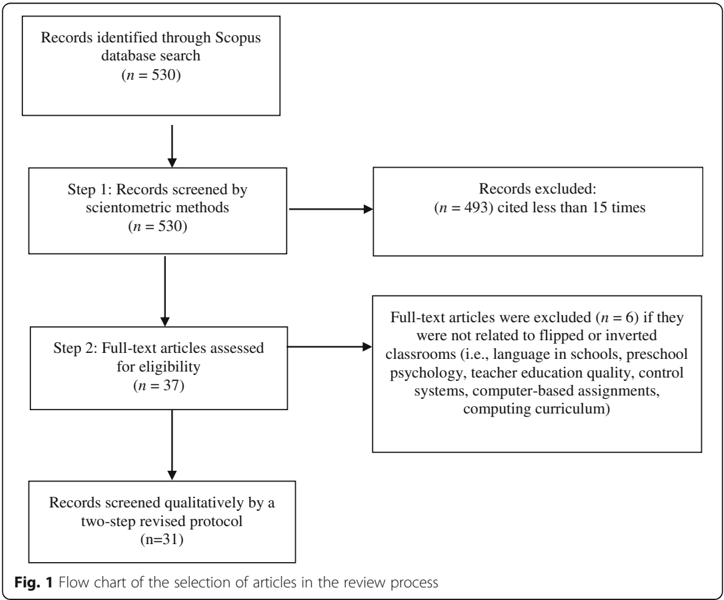
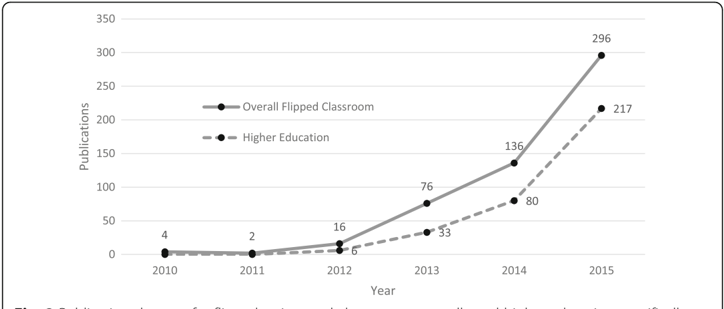
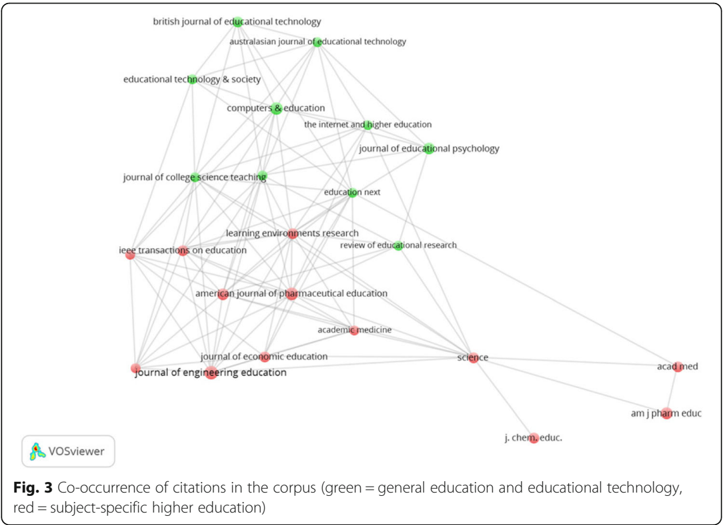
This structured review examined (academic) publications on flipped or inverted classrooms based on all Scopus database ( n = 530) references available until mid-June 2016. The flipped or inverted classroom approach has gained widespread attention during the latest decade and is based on the idea of improving student learning by prepared self-studies via technology-based resources (‘flips’) followed by high-quality, in-class teaching and learning activities. However, only a few attempts have been made to review the knowledge of the field of interest more systematically. This article seeks to address this problem and investigates what constitutes the research on flipped classrooms and, in particular, to examine the knowledge contributions with the field so far in relation to the wider research topic of educational technology. This review found that the current state of flipped classrooms as a field of interest is growing fast, with a slight conference preference and a focus on higher education and STEM (science, technology, engineering and math) area contributions, with the US as the predominant geographical context. It is concluded that studies on flipped classrooms are dominated by studies in higher education sector and are relatively local in character. The research tends not to interact beyond the two clusters of general education/educational technology and subject-specific areas. This implies that knowledge contributions related to the flipped classroom approach are relatively siloed and fragmented and have yet to stabilise. Academically and socially, the research is quite scattered, and only local evidence and experiences are available. The knowledge contributions within this field of interest seem to be anecdotal rather than systematically researched. To a large extent, the research lacks anchoring in, for example, learning theory or instructional design known from educational technology traditions and which would have helped much of the flipped classroom research to examine aspects of the flipped classroom approach more fully.
Overview
The claims and statistics of this paper haven’t been checked yet.
Free: it reads the open-access text and checks the first 5 claims that cite a source we can check. Create a free account to check every claim.
Integrity signals
Registry
Cites
Statistics
Figures


Verification
Claims the paper makes
The claims and statistics of this paper haven’t been checked yet.
Free: it reads the open-access text and checks the first 5 claims that cite a source we can check. Create a free account to check every claim.
Claims other papers make about this one
Each is checked against this paper’s own text: does it say what the citing paper says it does?
The source backs part of the claim, not all of it — or backs it for a different population, condition or comparison.
In the citing paper
“Linked to this, educational technology research has, however, lacked theoretical guidance (Al-Sakkaf, Omar, & Ahmad, 2019; Hew, Lan, Tang, Jia, & Lo, 2019; Lundin, Bergviken Rensfeldt, Hillman, Lantz-Andersson, & Peterson, 2018).”
From Mapping research in student engagement and educational technology in higher education: a systematic evidence map (2020) · cites this paper as Lundin, Bergviken Rensfeldt, Hillman, Lantz-Andersson, & Peterson, 2018
Experimental — accuracy not yet measuredThe cited source says what the claim attributes to it.
In the citing paper
“Reviews that have included research using a range of methodologies, have found a limited number of studies employing qualitative methods (e.g. Connolly, Boyle, MacArthur, Hainey, & Boyle, 2012; Kay & LeSage, 2009; Lundin et al., 2018).”
From Mapping research in student engagement and educational technology in higher education: a systematic evidence map (2020) · cites this paper as Lundin et al., 2018
Self-check
Percentages, sums and reported differences re-computed from the paper’s own numbers.
The self-check needs the paper’s full text.
Citations
Cites
Software survey: VOSviewer, a computer program for bibliometric mapping
van Eck, N. J., & Waltman, L. (2010) · Scientometrics · doi:10.1007/s11192-009-0146-3 · Cited by 21,484 · cited 1×
“Co-occurrence analyses were conducted using VOSviewer (van Eck & Waltman, 2010) and Yasu Imao’s CasualConc application (sites.google.com/site/casualconc/), and the results are presented in the step 1 subsection of the results section.”
MethodFlip Your Classroom: Reach Every Student in Every Class Every Day
Sams, A., & Bergmann, J. (2012) · Medical Entomology and Zoology · Cited by 3,810
Inverting the Classroom: A Gateway to Creating an Inclusive Learning Environment
Lage, M. J., Platt, G. J., & Treglia, M. (2000) · The Journal of Economic Education · doi:10.1080/00220480009596759 · Cited by 2,774
The use of flipped classrooms in higher education: A scoping review
O'Flaherty, J., & Phillips, C. (2015) · The Internet and Higher Education · doi:10.1016/j.iheduc.2015.02.002 · Cited by 2,152 · cited 4×
“Our results and recommendations therefore support the conclusions of the earlier review by O’Flaherty et al. (2015) but also foreground the relative impact of the higher education sector, provide more systematic knowledge and offer a problematising stance on the siloed character of the research and…”
BackgroundMethodResultInfluentialAbeysekera, L., & Dawson, P. (2015) · Higher Education Research & Development · doi:10.1080/07294360.2014.934336 · Cited by 1,847
Biesta, G. (2007) · Educational Theory · doi:10.1111/j.1741-5446.2006.00241.x · Cited by 1,655 · cited 1×
“As part of our work, we also considered the impact of systematic, evidence-based research methodology, including how it has been criticised, e.g., in educational science (Biesta, 2007; Denzin, 2009; Hammersley, 2001).”
BackgroundHow learning in an inverted classroom influences cooperation, innovation and task orientation
Strayer, J. F. (2012) · Learning Environments Research · doi:10.1007/s10984-012-9108-4 · Cited by 1,621 · cited 11×
“Instead, the novelty of the flipped classroom approach is described as ‘the regular and systematic use of interactive technology in the learning process’ (Strayer, 2012, p. 172).”
BackgroundInfluentialFlip your classroom reach every student in every class every day
Bergmann, J., & Sams, A. (2012) · Cited by 1,601
The Intellectual and Social Organization of the Sciences
Barber, B., & Whitley, R. (1986) · Canadian Journal of Sociology / Cahiers canadiens de sociologie · doi:10.2307/3341122 · Cited by 1,213
McLaughlin, J. E., Roth, M. T., Glatt, D. M., Gharkholonarehe, N., Davidson, C. A., Griffin, L. M., Esserman, D. A., & Mumper, R. J. (2014) · Academic Medicine · doi:10.1097/acm.0000000000000086 · Cited by 1,167 · cited 12×
“242), and overall, optimising classroom time is often specifically emphasised (Gannod et al., 2008; Mason et al., 2013; McLaughlin et al., 2014; Tucker, 2012).”
BackgroundResultInfluential
Research works printed but not linked: 2
- 2. Ash, K. (2012). Educators view flipped model with a more critical eye. Education Week, 32(2), 6-8.
- 7. Bishop, J. L., & Verlinger, M. A. (2013). The flipped classroom: A survey of the research. Paper presented at the ASEE Annual Conference & Exposition. Atlanta: American Society for Engineering Education.
Cited by
Items 201–264 of 264
Effekter av flippat klassrum på grundskoleelevers prestationer, resultat och motivation
Ouattara, L. (2019) · Malmö University Publications (Malmö University)
Wolz, K. M. (2019) · ePublications at Regis University (Regis University)
Alebrahim, F., & Ku, H. (2019) · Scholarship & Creative Works - Digital UNC a service of University Libraries (University of Northern Colorado)
Design and implementation of blended learning in higher education
Thai, N. T. T. (2019) · Ghent University Academic Bibliography (Ghent University)
Jiménez, R. M., & Jiménez, C. R. (2020) · Revista de estudios empresariales · doi:10.17561//ree.v2019n2.3 · Cited by 3
Alreshidi, H. A. (2020) · Scientific Journal of King Faisal University Humanities and Management Sciences · doi:10.37575/h/edu/2128
Schöpf, C., Dobrovits, I., Brunner, K., & Gehringer, N. (2020) · Springer eBooks · doi:10.1007/978-3-658-31146-9_16
O’Brien-Richardson, P. (2020) · Advances in educational technologies and instructional design book series · doi:10.4018/978-1-7998-4360-3.ch014
Analysis and Research on Educational Technology Trends Based on High Quality Online Course
Xue, W. (2021) · International Conference on Computers, Information Processing and Advanced Education (CIPAE) · doi:10.1145/3456887.3459684
“In sociology, researchers often draw social relationships as social network diagrams in which nodes represent actors and edges represent the relationships between actors, and use scientific measurement methods to analyze characteristic data and interpret data in the network through the drawn graphics [5].”
BackgroundMwila, N. K. (2022) · International Journal of Teaching and Case Studies · doi:10.1504/ijtcs.2022.122953
Flipped Classroom Applied to Teaching Artificial Intelligence
Gonçalves, A. C., Ferreira, D. J., & Neto, V. V. G. (2022) · International Journal for Innovation Education and Research · doi:10.31686/ijier.vol10.iss9.3893
Chapter 17. Business Ethics – Reflecting on Sustainability Issues in Business
Győri, Z. (2022) · Nomos Verlagsgesellschaft mbH & Co. KG eBooks · doi:10.5771/9783748933090-299
SALA DE AULA INVERTIDA E APRENDIZAGEM COMPORTAMENTAL APLICADA AO ENSINO DE PROGRAMAÇÃO
Gonçalves, A. C., & Ferreira, D. J. (2022) · Revista Mediação · doi:10.31668/mediacao.2022.v17e1.13565
Alharbi, H. E. (2023) · مجلة العلوم التربوية و النفسية · doi:10.26389/ajsrp.m140223
Bastos, N. R. O. (2023) · EDULEARN proceedings · doi:10.21125/edulearn.2023.1273
Cardoso-Espinosa, E. O., Ruiz, J. A. C., & Zepeda-Hurtado, M. E. (2023) · TEM Journal · doi:10.18421/tem123-64
“Technology and digitization have caused various changes in classroom training practices oriented towards student participation that motivates them not only to acquire knowledge but to discover it, reflect on it and even determine its application in real life [2].”
BackgroundInquiring Minds Want to Know What HBCU Students Say About a STEM Master Course Model
Graham, D. A. (2023) · Lecture notes in networks and systems · doi:10.1007/978-3-031-37717-4_59
Zainuddin, Z., Chu, S. K. W., & Perera, C. J. (2024) · Springer eBooks · doi:10.1007/978-981-97-2219-8_6
Garcia, O., & Kittur, J. (2024) · ASEE Annual Conference & Exposition · doi:10.18260/1-2--47119
Intelligent Educational Information Resource Sharing Platform Based on Zope/Plone
Hou, J. (2024) · Procedia Computer Science · doi:10.1016/j.procs.2024.10.077
Liu, K., Tan, W. H., & Saari, E. M. (2022) · Journal Of ICT In Education · doi:10.37134/jictie.vol9.2.1.2022
Pedagogical Lessons from the Pandemic
Saad-Lessler, J., & Ryan, K. (2024) · Lecture notes in information systems and organisation · doi:10.1007/978-3-031-65782-5_27
Psychodramatic Techniques in Education: A Dynamic Approach to Learning
Maya, J., Maraver, J., & Pickman, B. (2024) · Psychodrama in Counselling, Coaching and Education · doi:10.1007/978-981-97-8377-9_6
WIP: SEmi-Automated Second-Order Incentive Driven Engagement of College Students
Nazhandali, L. (2024) · IEEE Frontiers in Education Conference (FIE) · doi:10.1109/fie61694.2024.10893113
“Flipped classrooms [1], where students review lecture materials in advance and engage in hands-on activities in class, encourage active participation and attendance.”
Betti, A., Biderbost, P., & Lafuente, E. V. (2025) · SAGE Open · doi:10.1177/21582440251351357
“The first studies on the FC primarily focused on describing and reporting its possible implementations, but they were seldom accompanied by systematic investigations on learning outcomes (Lundin et al., 2018, p. 16).”
Perspektif Staf Pengajar terhadap Teori dan Praktik Terbaik dalam Penerapan Flipped Classroom
Vardhani, A. K., & Soemantri, D. (2025) · eJournal Kedokteran Indonesia · doi:10.23886/ejki.13.1004.125
John, W. (2025) · SSRN Electronic Journal · doi:10.2139/ssrn.5691055
Boakye, A. A., Essel, H. B., Appiah, E., & Essuman, M. A. (2023) · Research Square · doi:10.21203/rs.3.rs-3197805/v1
Fischer, K., Sullivan, A. M., Cohen, A., King, R. W., Cockrill, B. A., & Besche, H. C. (2023) · Figshare · doi:10.6084/m9.figshare.22914470
Fischer, K., Sullivan, A. M., Cohen, A., King, R. W., Cockrill, B. A., & Besche, H. C. (2023) · Figshare · doi:10.6084/m9.figshare.22914461
Proceedings Chalmers Conference on Teaching and Learning 2023
Chalmers University of Technology, Bengmark, S., Ingelhammar, C., Gustafsson, M., & Stöhr, C. (2023) · Chalmers Research (Chalmers University of Technology) · doi:10.5281/zenodo.10245610
Buhl-Wiggers, J., la Cour, L., & Kjærgaard, A. (2024) · Figshare · doi:10.6084/m9.figshare.26602159
Fischer, K., Sullivan, A. M., Cohen, A., King, R. W., Cockrill, B. A., & Besche, H. C. (2023) · Figshare · doi:10.6084/m9.figshare.22914464
Fischer, K., Sullivan, A. M., Cohen, A., King, R. W., Cockrill, B. A., & Besche, H. C. (2023) · Figshare · doi:10.6084/m9.figshare.22914467
Castillo, K. E. T. (2021) · LA Referencia (Red Federada de Repositorios Institucionales de Publicaciones Científicas) · Cited by 2
Procrastinação e sucesso académico em tempos de pandemia
Oliveira, J. M. A. (2022) · Portuguese National Funding Agency for Science, Research and Technology (RCAAP Project by FCT)
Timonen, P. (2025) · Lauda (University of Lapland) · Cited by 1
Flipped Classroom – How I Ended Up in Front of an Empty Room
Fischer, T. (2023) · University Library of Skövde (University of Skövde)
Aliupseerioppilaan oppimisen valmiudet käänteisessä luokkahuoneessa
Kurikka, M. (2024) · Doria (University of Helsinki)
Lau, K. L., & Li, N. (2025) · SAGE Open · doi:10.1177/21582440251408276
“While research on the FC is growing rapidly, scholarly attention has largely focused on higher education sector and science, technology, engineering, and mathematics (STEM) fields, with a predominant geographical context in the United States (Lundin et al., 2018).”
TÜRKİYE’DE MATEMATİK EĞİTİMİNDE TERS YÜZ SINIF MODELİ İLE İLGİLİ YAPILAN ÇALIŞMALARIN İNCELENMESİ
Güzel, G., & Battal, A. (2026) · Eğitim Teknolojisi Kuram ve Uygulama · doi:10.17943/etku.1739566
Giang, N. T. (2026) · American Journal of Education and Learning · doi:10.55284/ajel.v11i1.1712
Lin, C.-K., & Chen, J. (2026) · Journal of Psycholinguistic Research · doi:10.1007/s10936-025-10187-9
“Overcoming this challenge can also change the practitioners’ perceptions of FLLA as a non-supervised arbitrary approach that arbi - trarily integrates instructional designs and learning theories with educational technology (Lundin et al., 2018a, 2018b).”
Effects of Different Environments on Interactions Among University Students: A Systematic Review
Schmoele, A. F., Tuzinkievicz, M. A., Peralta, N. S., & Castellaro, M. (2026) · Persona · doi:10.26439/persona2025.n2.8061
Shange, L. N. L. (2024) · ResearchSpace (University of KwaZulu-Natal)
Zhou, C., & Ding, X. (2026) · Research Square · doi:10.21203/rs.3.rs-8999924/v1
A MULTIDISCIPLINARY UMBRELLA REVIEW ON FLIPPED LEARNING OUTCOMES
Arslan, A. N., & İşeri, A. (2026) · Turkish Online Journal of Distance Education · doi:10.17718/tojde.1722976
Thaba, S. C., & Jacobs, L. L. (2026) · Contributions to management science · doi:10.1007/978-3-032-17560-1_9
Flipped classroom en acción: aprendizaje activo, liderazgo y coevaluación en entornos universitarios
González, M. P. (2025) · DeustoTeka
Bravo-Oñate, I. B., Vivero, R. E. O., & Maliza-Cruz, W. I. (2026) · MQRInvestigar · doi:10.56048/mqr.2026.e341
Investigating the impact of the flipped classroom model on graduate student motivation
Monkoski-Takamure, A. (2026) · ScholarSpace (University of Hawaii at Manoa)
Kunwar, R., Lamsal, U., & Acharya, N. (2026) · Education and Development · doi:10.66412/ed.v35i2.120
Wong, L. (2026) · Journal of Higher Education Policy and Management · doi:10.1080/1360080x.2026.2708377
PASIYIKALA, J. M. (2026) · Journal of Social Sciences · doi:10.52326/jss.utm.2026.9(2).07
Mangoba, C., & Dayaganon, A. J. B. (2025) · International Journal of Education Research · doi:10.17158/d6sa0s14
Irene, E. C., 罗公波, Ego, E. F., & Terver, A. D. (2026) · International Journal of Research and Innovation in Social Science · doi:10.47772/ijriss.2026.100800239
Shetty, R. M., Yadadi, S. S., Gopinath, V. K., Narasimhan, S., Jayaraman, J., Shetty, S. R., & Walia, T. (2026) · European Journal Of Dental Education · doi:10.1111/eje.70306
Marfuah, S., Farwati, R., Ariwati, N., & Lukviani, R. (2024) · Proceeding International Conference on Religion Science and Education · Cited by 2
Ayçiçek, B., & Yelken, T. Y. (2021) · International online journal of education and teaching · Cited by 2
The Role of Generative AI in Supporting Students’ Group Work in Flipped Law Courses
Hyttinen, M., & Isomöttönen, V. (2026) · International Journal of Studies in Education and Science · doi:10.46328/ijses.8444
Wandira, I. C., & Sawiji, H. (2026) · Jurnal Informasi dan Komunikasi Administrasi Perkantoran. · doi:10.20961/jikap.v10i1.104861
“Flipped learning provides opportunities for interaction and direct feedback typically unavailable in traditional learning (Lundin et al., 2018).”
Implementación y evaluación del aula invertida en la cátedra de Programación Básica
Zambrano-Solorzano, E. T., Bowen-Mendoza, L. E., Vaca-Cárdenas, M. E., Santana-Campoverde, F. J., & Meza-Hormaza, J. A. (2021) · Revista Cognosis
Ters Yüz Öğrenmeye Dayalı Program Dışı Etkinlikler: Öğretmen Eğitiminde Tasarım Temelli Bir Yaklaşım
İleritürk, D. (2026) · Ulusal Eğitim Akademisi Dergisi · doi:10.32960/uead.1869880
Veintimilla, G. N., Nicolalde, B. F., & Pazmiño, A. (2026) · The Physics Teacher · doi:10.1119/5.0278631
Metadata
- Authors
- Lundin, M., Bergviken Rensfeldt, A., Hillman, T., Lantz-Andersson, A., & Peterson, L.
- Affiliations
- University of Gothenburg (SE)
- Corresponding author
- Lundin, Mona
- Venue
- International Journal of Educational Technology in Higher Education
- Published
- 2018-05-24
- Volume
- 15
- Issue
- 1
- ISSN
- 2365-9440 (ISSN-L)
- OpenAlex
- W2805683247
- Cited by
- 227
- References
- 59
- Citations by year
- 2026: 15 · 2025: 16 · 2024: 29 · 2023: 37 · 2022: 39 · 2021: 33 · 2020: 30 · 2019: 26 · 2018: 1
- FWCI
- 8.80
- Type
- journal article
- Language
- en
- Open access
- diamond
- doi.org
- Licence
- cc-by
- creativecommons.org/licenses/by/4.0 (tdm)
- Locations
- International Journal of Educational Technology in Higher Education (publishedVersion, cc-by)
- DOAJ (DOAJ: Directory of Open Access Journals) (submittedVersion, cc-by-sa)
- Funders
- Vetenskapsrådet (2014-47308-111109-49)
- Topics
- Social Sciences › Education › Innovative Teaching Methods
- Social Sciences › Education › Evaluation of Teaching Practices
- Social Sciences › Education › Online and Blended Learning
- Keywords
- flipped classroom, higher education, educational technology, research trends, STEM education, self-directed learning, instructional design, learning theory
About these checks
Registry, retraction, Cites and statistics results are computed, not judged, with one exception: a printed reference that no index lists is read once by a model before it counts as a citation error. Claims are extracted by a model and kept only when their quote appears verbatim in the text; each cited source is then checked, with a model’s help, for whether it says what the claim relies on. Those verdicts can be wrong — read the claim’s quote and the cited source before relying on one.
Statistics and arithmetic are recomputed, not judged.
Confidence bands are shown only for fields calibrated on our annotated test set. None is calibrated yet, so no band is shown.
What counts as a claim ›How we measure confidence ›How we check this ›
Are you an author, or do you see a problem with this page? Request a review
Data sources
Bibliographic data: Semantic Scholar, OpenAlex, Crossref.
Contains information from the Semantic Scholar Academic Graph Datasets, made available under the ODC Attribution License (ODC-BY 1.0).
Semantic Scholar’s data is described in: Kinney, R., et al. (2023). The Semantic Scholar Open Data Platform. arXiv:2301.10140.
