

Higher education dominance and siloed knowledge: a systematic review of flipped classroom research
Open accessThe DOI matches its Crossref record; 58 of the 59 references it cites were found in a registry or an index.
Abstract
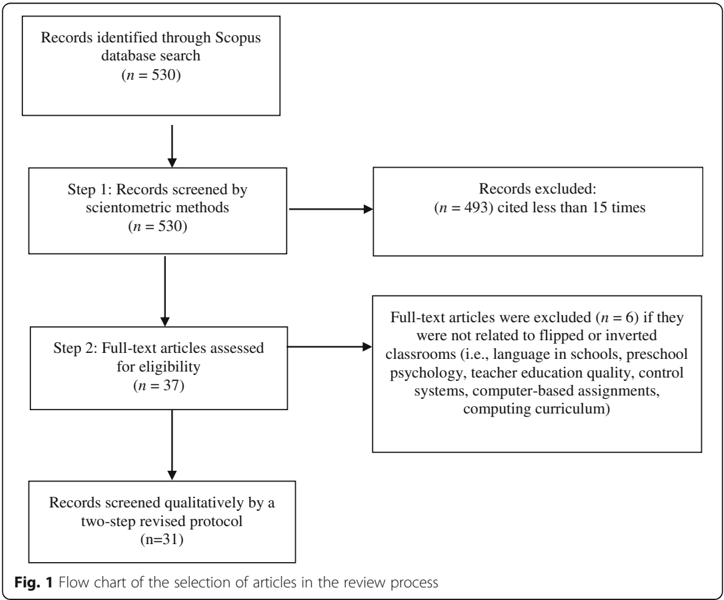
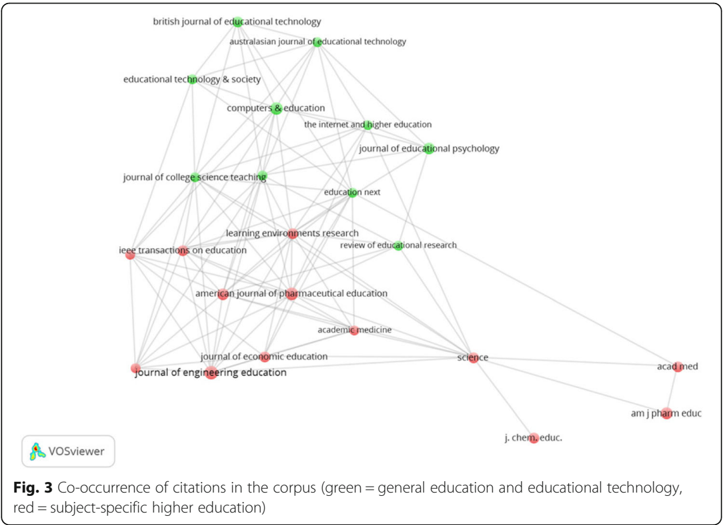
This structured review examined (academic) publications on flipped or inverted classrooms based on all Scopus database ( n = 530) references available until mid-June 2016. The flipped or inverted classroom approach has gained widespread attention during the latest decade and is based on the idea of improving student learning by prepared self-studies via technology-based resources (‘flips’) followed by high-quality, in-class teaching and learning activities. However, only a few attempts have been made to review the knowledge of the field of interest more systematically. This article seeks to address this problem and investigates what constitutes the research on flipped classrooms and, in particular, to examine the knowledge contributions with the field so far in relation to the wider research topic of educational technology. This review found that the current state of flipped classrooms as a field of interest is growing fast, with a slight conference preference and a focus on higher education and STEM (science, technology, engineering and math) area contributions, with the US as the predominant geographical context. It is concluded that studies on flipped classrooms are dominated by studies in higher education sector and are relatively local in character. The research tends not to interact beyond the two clusters of general education/educational technology and subject-specific areas. This implies that knowledge contributions related to the flipped classroom approach are relatively siloed and fragmented and have yet to stabilise. Academically and socially, the research is quite scattered, and only local evidence and experiences are available. The knowledge contributions within this field of interest seem to be anecdotal rather than systematically researched. To a large extent, the research lacks anchoring in, for example, learning theory or instructional design known from educational technology traditions and which would have helped much of the flipped classroom research to examine aspects of the flipped classroom approach more fully.
Overview
The claims and statistics of this paper haven’t been checked yet.
Free: it reads the open-access text and checks the first 5 claims that cite a source we can check. Create a free account to check every claim.
Integrity signals
Registry
Cites
Statistics
Figures


Verification
Claims the paper makes
The claims and statistics of this paper haven’t been checked yet.
Free: it reads the open-access text and checks the first 5 claims that cite a source we can check. Create a free account to check every claim.
Claims other papers make about this one
Each is checked against this paper’s own text: does it say what the citing paper says it does?
The source backs part of the claim, not all of it — or backs it for a different population, condition or comparison.
In the citing paper
“Linked to this, educational technology research has, however, lacked theoretical guidance (Al-Sakkaf, Omar, & Ahmad, 2019; Hew, Lan, Tang, Jia, & Lo, 2019; Lundin, Bergviken Rensfeldt, Hillman, Lantz-Andersson, & Peterson, 2018).”
From Mapping research in student engagement and educational technology in higher education: a systematic evidence map (2020) · cites this paper as Lundin, Bergviken Rensfeldt, Hillman, Lantz-Andersson, & Peterson, 2018
Experimental — accuracy not yet measuredThe cited source says what the claim attributes to it.
In the citing paper
“Reviews that have included research using a range of methodologies, have found a limited number of studies employing qualitative methods (e.g. Connolly, Boyle, MacArthur, Hainey, & Boyle, 2012; Kay & LeSage, 2009; Lundin et al., 2018).”
From Mapping research in student engagement and educational technology in higher education: a systematic evidence map (2020) · cites this paper as Lundin et al., 2018
Self-check
Percentages, sums and reported differences re-computed from the paper’s own numbers.
The self-check needs the paper’s full text.
Citations
Cites
Software survey: VOSviewer, a computer program for bibliometric mapping
van Eck, N. J., & Waltman, L. (2010) · Scientometrics · doi:10.1007/s11192-009-0146-3 · Cited by 21,484 · cited 1×
“Co-occurrence analyses were conducted using VOSviewer (van Eck & Waltman, 2010) and Yasu Imao’s CasualConc application (sites.google.com/site/casualconc/), and the results are presented in the step 1 subsection of the results section.”
MethodFlip Your Classroom: Reach Every Student in Every Class Every Day
Sams, A., & Bergmann, J. (2012) · Medical Entomology and Zoology · Cited by 3,810
Inverting the Classroom: A Gateway to Creating an Inclusive Learning Environment
Lage, M. J., Platt, G. J., & Treglia, M. (2000) · The Journal of Economic Education · doi:10.1080/00220480009596759 · Cited by 2,774
The use of flipped classrooms in higher education: A scoping review
O'Flaherty, J., & Phillips, C. (2015) · The Internet and Higher Education · doi:10.1016/j.iheduc.2015.02.002 · Cited by 2,152 · cited 4×
“Our results and recommendations therefore support the conclusions of the earlier review by O’Flaherty et al. (2015) but also foreground the relative impact of the higher education sector, provide more systematic knowledge and offer a problematising stance on the siloed character of the research and…”
BackgroundMethodResultInfluentialAbeysekera, L., & Dawson, P. (2015) · Higher Education Research & Development · doi:10.1080/07294360.2014.934336 · Cited by 1,847
Biesta, G. (2007) · Educational Theory · doi:10.1111/j.1741-5446.2006.00241.x · Cited by 1,655 · cited 1×
“As part of our work, we also considered the impact of systematic, evidence-based research methodology, including how it has been criticised, e.g., in educational science (Biesta, 2007; Denzin, 2009; Hammersley, 2001).”
BackgroundHow learning in an inverted classroom influences cooperation, innovation and task orientation
Strayer, J. F. (2012) · Learning Environments Research · doi:10.1007/s10984-012-9108-4 · Cited by 1,621 · cited 11×
“Instead, the novelty of the flipped classroom approach is described as ‘the regular and systematic use of interactive technology in the learning process’ (Strayer, 2012, p. 172).”
BackgroundInfluentialFlip your classroom reach every student in every class every day
Bergmann, J., & Sams, A. (2012) · Cited by 1,601
The Intellectual and Social Organization of the Sciences
Barber, B., & Whitley, R. (1986) · Canadian Journal of Sociology / Cahiers canadiens de sociologie · doi:10.2307/3341122 · Cited by 1,213
McLaughlin, J. E., Roth, M. T., Glatt, D. M., Gharkholonarehe, N., Davidson, C. A., Griffin, L. M., Esserman, D. A., & Mumper, R. J. (2014) · Academic Medicine · doi:10.1097/acm.0000000000000086 · Cited by 1,167 · cited 12×
“242), and overall, optimising classroom time is often specifically emphasised (Gannod et al., 2008; Mason et al., 2013; McLaughlin et al., 2014; Tucker, 2012).”
BackgroundResultInfluentialThe Intellectual and Social Organization Of the Sciences
Whitley, R. (2000) · doi:10.1093/oso/9780199240531.001.0001 · Cited by 1,076
Davies, R. S., Dean, D. L., & Ball, N. (2013) · Educational Technology Research and Development · doi:10.1007/s11423-013-9305-6 · Cited by 1,019
Mason, G. S., Shuman, T. R., & Cook, K. E. (2013) · IEEE Transactions on Education · doi:10.1109/te.2013.2249066 · Cited by 997 · cited 7×
“They also indicate that the approach allows teachers to cover more course material (Mason et al., 2013) and engage directly with students when they are involved in in-depth learning activities (Gannod et al., 2008; Prober & Khan, 2013; Strayer, 2012).”
BackgroundInfluentialMcKimm, J., Cotton, P., Garden, A., & Needham, G. (2013) · Oxford Textbook of Medical Education · doi:10.1093/med/9780199652679.003.0061 · Cited by 991
Kim, M. K., Kim, S. M., Khera, O., & Getman, J. (2014) · The Internet and Higher Education · doi:10.1016/j.iheduc.2014.04.003 · Cited by 932
Weight of Evidence: a framework for the appraisal of the quality and relevance of evidence
Gough, D. (2007) · Research Papers in Education · doi:10.1080/02671520701296189 · Cited by 830
Flipping the Classroom to Improve Student Performance and Satisfaction
Missildine, K., Fountain, R., Summers, L., & Gosselin, K. (2013) · Journal of Nursing Education · doi:10.3928/01484834-20130919-03 · Cited by 696
Pierce, R., & Fox, J. (2012) · American Journal of Pharmaceutical Education · doi:10.5688/ajpe7610196 · Cited by 664
Tune, J. D., Sturek, M., & Basile, D. P. (2013) · Advances in Physiology Education · doi:10.1152/advan.00091.2013 · Cited by 593
Enfield, J. (2013) · TechTrends · doi:10.1007/s11528-013-0698-1 · Cited by 569
Medical Education Reimagined: A Call to Action
Prober, C. G., & Khan, S. (2013) · Academic Medicine · doi:10.1097/acm.0b013e3182a368bd · Cited by 490 · cited 6×
“They also indicate that the approach allows teachers to cover more course material (Mason et al., 2013) and engage directly with students when they are involved in in-depth learning activities (Gannod et al., 2008; Prober & Khan, 2013; Strayer, 2012).”
BackgroundInfluentialThe flipped classroom: for active, effective and increased learning – especially for low achievers
Nouri, J. (2016) · International Journal of Educational Technology in Higher Education · doi:10.1186/s41239-016-0032-z · Cited by 477 · cited 1×
“This is illustrated by several recent articles in international journals on higher education studies (Flores, del-Arco, & Silva, 2016; Kim, Kim, Khera, & Getman, 2014; Nouri, 2016; O’Flaherty, Phillips, Karanicolas, Snelling, & Winning, 2015; Park, Yu, & Jo, 2016; Westerman, Daniel, & Bowman, 2016).”
The Flipped Classroom: Online Instruction at Home Frees Class Time for Learning
Tucker, B. (2012) · Education next · Cited by 460
Student learning and perceptions in a flipped linear algebra course
Love, B., Hodge, A., Grandgenett, N., & Swift, A. W. (2014) · International Journal of Mathematical Education in Science and Technology · doi:10.1080/0020739x.2013.822582 · Cited by 458
The elephant in the living room: or extending the conversation about the politics of evidence
Denzin, N. K. (2009) · Qualitative Research · doi:10.1177/1468794108098034 · Cited by 445 · cited 1×
“As part of our work, we also considered the impact of systematic, evidence-based research methodology, including how it has been criticised, e.g., in educational science (Biesta, 2007; Denzin, 2009; Hammersley, 2001).”
BackgroundPharmacy Student Engagement, Performance, and Perception in a Flipped Satellite Classroom
McLaughlin, J. E., Griffin, L. M., Esserman, D. A., Davidson, C. A., Glatt, D. M., Roth, M. T., Gharkholonarehe, N., & Mumper, R. J. (2013) · American Journal of Pharmaceutical Education · doi:10.5688/ajpe779196 · Cited by 416
On ‘Systematic’ Reviews of Research Literatures: A ‘narrative’ response to Evans & Benefield
Hammersley, M. (2001) · British Educational Research Journal · doi:10.1080/01411920120095726 · Cited by 407 · cited 1×
“As part of our work, we also considered the impact of systematic, evidence-based research methodology, including how it has been criticised, e.g., in educational science (Biesta, 2007; Denzin, 2009; Hammersley, 2001).”
BackgroundUsing the inverted classroom to teach software engineering
Gannod, G. C., Burge, J. E., & Helmick, M. T. (2008) · Proceedings of the 13th international conference on Software engineering - ICSE '08 · doi:10.1145/1368088.1368198 · Cited by 387
The Flipped Class: A Method to Address the Challenges of an Undergraduate Statistics Course
Wilson, S. G. (2013) · Teaching of Psychology · doi:10.1177/0098628313487461 · Cited by 364
Teachers making connections: Online communities as a source of professional learning
Duncan‐Howell, J. (2010) · British Journal of Educational Technology · doi:10.1111/j.1467-8535.2009.00953.x · Cited by 331 · cited 1×
“…to share educational resources with students, social media communities have also become important sites for mobilising educators within the flipped or inverted classroom movement through the sharing of experiences and resources (e.g., Cho, Ro, & LittenbergTobias, 2013; Duncan-Howell, 2010).”
BackgroundJust Imagine: New Paradigms for Medical Education
Mehta, N. B., Hull, A. L., Young, J. B., & Stoller, J. K. (2013) · Academic Medicine · doi:10.1097/acm.0b013e3182a36a07 · Cited by 323
Tight, M. (2003) · Cited by 285
Using the Flipped Classroom in Graduate Nursing Education
Critz, C. M., & Knight, D. (2013) · Nurse Educator · doi:10.1097/nne.0b013e3182a0e56a · Cited by 282
Redesign of a Large Lecture Course Into a Small-Group Learning Course
Ferreri, S. P., & O’Connor, S. K. (2013) · American Journal of Pharmaceutical Education · doi:10.5688/ajpe77113 · Cited by 266
Using Lean in the Flipped Classroom for At Risk Students.
Flumerfelt, S., & Green, G. (2013) · Educational Technology & Society · Cited by 255
Researching Higher Education: International perspectives on theory, policy and practice
(2015) · Routledge eBooks · doi:10.4324/9781315675404 · Cited by 191
Halving fail rates using peer instruction: a study of four computer science courses
Porter, L., Bailey Lee, C., & Simon, B. (2013) · Proceeding of the 44th ACM technical symposium on Computer science education · doi:10.1145/2445196.2445250 · Cited by 187
Park, Y., Yu, J. H., & Jo, I. (2015) · The Internet and Higher Education · doi:10.1016/j.iheduc.2015.11.001 · Cited by 186
Student attitudes toward flipping the general chemistry classroom
Smith, J. D. (2013) · Chem. Educ. Res. Pract. · doi:10.1039/c3rp00083d · Cited by 180
Fulton, K. P. (2012) · Phi Delta Kappan · doi:10.1177/003172171209400205 · Cited by 176
Before You Flip, Consider This
Bergmann, J., & Sams, A. (2012) · Phi Delta Kappan · doi:10.1177/003172171209400206 · Cited by 170
The Internet and the Inverted Classroom
Lage, M. J., & Platt, G. (2000) · The Journal of Economic Education · doi:10.1080/00220480009596756 · Cited by 155 · cited 1×
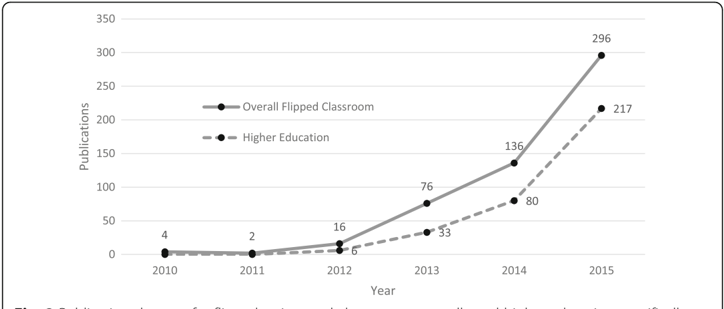
“…contributions in the period between 2012 and mid-June 2016 and in particular from the higher education area, with the term ‘flipped classroom’ becoming more common and the previously widespread term ‘inverted classroom’, used in the first publication on the topic (Lage & Platt, 2000, losing ground.”
BackgroundTen suggestions for improving academic research in education and technology
Selwyn, N. (2012) · Learning Media and Technology · doi:10.1080/17439884.2012.680213 · Cited by 127 · cited 1×
“As argued by Selwyn (2012), research on educational technology is constituted by ‘different tribes’, each with a ‘particular interest and motives for studying technology and education’ (p. 213).”
BackgroundFlores, Ò., Bravo, I. D. A., & García, P. S. (2016) · International Journal of Educational Technology in Higher Education · doi:10.1186/s41239-016-0022-1 · Cited by 126
Valiente, C., Swanson, J., & Lemery‐Chalfant, K. (2012) · Social Development · doi:10.1111/j.1467-9507.2011.00640.x · Cited by 116
Berridge, C. W., Shumsky, J. S., Andrzejewski, M. E., McGaughy, J. A., Spencer, R. C., Devilbiss, D. M., & Waterhouse, B. D. (2012) · Biological Psychiatry · doi:10.1016/j.biopsych.2011.07.022 · Cited by 93
Observed classroom quality during teacher education and two years of professional practice.
Malmberg, L.-E., Hagger, H., Burn, K., Mutton, T., & Colls, H. (2010) · Journal of Educational Psychology · doi:10.1037/a0020920 · Cited by 89
Tight, M. (2014) · Higher Education · doi:10.1007/s10734-014-9718-0 · Cited by 82 · cited 1×
“The problem of siloed research and an absence of a shared knowledge base and ‘contribution awareness’ beyond the clusters of educational technology and the STEM areas, for example, are well known within higher education research (Tight, 2014).”
BackgroundRitual and foreign language practices at school
RAMPTON, B. (2002) · Language in Society · doi:10.1017/s0047404502314015 · Cited by 80
The inverted classroom and the CS curriculum
Lockwood, K., & Esselstein, R. (2013) · ACM Technical Symposium on Computer Science Education (SIGCSE) · doi:10.1145/2445196.2445236 · Cited by 79
How ASCD Supports the Common Core.
Mercado, E., & Britt, S. (2013) · Educational leadership · Cited by 60
Westerman, D., Daniel, E. S., & Bowman, N. D. (2016) · The Internet and Higher Education · doi:10.1016/j.iheduc.2016.06.004 · Cited by 52
Bulfin, S., Henderson, M., Johnson, N. F., & Selwyn, N. (2014) · British Journal of Educational Technology · doi:10.1111/bjet.12145 · Cited by 49
Flipped Classroom Research: From “Black Box” to “White Box” Evaluation
Stöhr, C., & Adawi, T. (2018) · Education Sciences · doi:10.3390/educsci8010022 · Cited by 48 · cited 1×
“…reviews have been published and compiled in special issues, indicating that the instructional approach and research designs around flipped classroom studies are gaining interest (see e.g. Song, Jong, Chang, & Chen, 2017; Stöhr & Adawi, 2018) which testifies to an expanding research field.”
BackgroundYou Can Load a Die, But You Can't Bias a Coin
Gelman, A., & Nolan, D. (2002) · The American Statistician · doi:10.1198/000313002605 · Cited by 41
Guest editorial: “HOW” to design, implement and evaluate the flipped classroom?: A synthesis
Song, Y., Jong, M. S., Chang, M., & Chen, W. (2017) · Educational Technology & Society · Cited by 37
What Twitter Will and Will Not Do: Theorizing About Teachers’ Online Professional Communities
Cho, V., Ro, J., & Littenberg-Tobias, J. (2013) · LEARNing Landscapes · doi:10.36510/learnland.v6i2.604 · Cited by 33
Kalz, M., & Specht, M. M. (2013) · British Journal of Educational Technology · doi:10.1111/bjet.12092 · Cited by 19
Research works printed but not linked: 2
- 2. Ash, K. (2012). Educators view flipped model with a more critical eye. Education Week, 32(2), 6-8.
- 7. Bishop, J. L., & Verlinger, M. A. (2013). The flipped classroom: A survey of the research. Paper presented at the ASEE Annual Conference & Exposition. Atlanta: American Society for Engineering Education.
Cited by
Bond, M., Buntins, K., Bedenlier, S., Zawacki-Richter, O., & Kerres, M. (2020) · International Journal of Educational Technology in Higher Education · doi:10.1186/s41239-019-0176-8 · Cited by 1,097
“…other reviews of educational technology and student engagement have found studies to be largely STEM focused (Boyle et al., 2016; Li et al., 2017; Lundin et al., 2018; Nikou & Economides, 2018), this corpus features a more balanced scope of research, with the fields of Arts & Humanities (42…”
BackgroundInfluentialEffects of flipping the classroom on learning outcomes and satisfaction: A meta-analysis
van Alten, D. C. D., Phielix, C., Janssen, J., & Kester, L. (2019) · Educational Research Review · doi:10.1016/j.edurev.2019.05.003 · Cited by 546
“Generalization of their conclusions is difficult because the number of studies considered in these reviews was small, and the included studies often lack the use of a control group (Lundin et al., 2018; O'Flaherty & Phillips, 2015).”
BackgroundStrelan, P., Osborn, A., & Palmer, E. (2020) · Educational Research Review · doi:10.1016/j.edurev.2020.100314 · Cited by 526
Facilitating student engagement through the flipped learning approach in K-12: A systematic review
Bond, M. (2020) · Computers & Education · doi:10.1016/j.compedu.2020.103819 · Cited by 380
“1 Geographical characteristics Mirroring previous reviews (Lo & Hew, 2017; Lundin et al., 2018), the majority of studies in this corpus were undertaken within the US (51.”
BackgroundMethodResultInfluentialLåg, T., & Sæle, R. G. (2019) · AERA Open · doi:10.1177/2332858419870489 · Cited by 265
“…reflected in our definition, may be seen as an advantage, it may also be that it leads to a lack of pedagogical rationale (Bishop & Verleger, 2013; Lundin et al., 2018) on which to design the specifics of a flipped classroom intervention, thus leaving teachers and students to more of a…”
Background
Metadata
- Authors
- Lundin, M., Bergviken Rensfeldt, A., Hillman, T., Lantz-Andersson, A., & Peterson, L.
- Affiliations
- University of Gothenburg (SE)
- Corresponding author
- Lundin, Mona
- Venue
- International Journal of Educational Technology in Higher Education
- Published
- 2018-05-24
- Volume
- 15
- Issue
- 1
- ISSN
- 2365-9440 (ISSN-L)
- OpenAlex
- W2805683247
- Cited by
- 227
- References
- 59
- Citations by year
- 2026: 15 · 2025: 16 · 2024: 29 · 2023: 37 · 2022: 39 · 2021: 33 · 2020: 30 · 2019: 26 · 2018: 1
- FWCI
- 8.80
- Type
- journal article
- Language
- en
- Open access
- diamond
- doi.org
- Licence
- cc-by
- creativecommons.org/licenses/by/4.0 (tdm)
- Locations
- International Journal of Educational Technology in Higher Education (publishedVersion, cc-by)
- DOAJ (DOAJ: Directory of Open Access Journals) (submittedVersion, cc-by-sa)
- Funders
- Vetenskapsrådet (2014-47308-111109-49)
- Topics
- Social Sciences › Education › Innovative Teaching Methods
- Social Sciences › Education › Evaluation of Teaching Practices
- Social Sciences › Education › Online and Blended Learning
- Keywords
- flipped classroom, higher education, educational technology, research trends, STEM education, self-directed learning, instructional design, learning theory
About these checks
Registry, retraction, Cites and statistics results are computed, not judged, with one exception: a printed reference that no index lists is read once by a model before it counts as a citation error. Claims are extracted by a model and kept only when their quote appears verbatim in the text; each cited source is then checked, with a model’s help, for whether it says what the claim relies on. Those verdicts can be wrong — read the claim’s quote and the cited source before relying on one.
Statistics and arithmetic are recomputed, not judged.
Confidence bands are shown only for fields calibrated on our annotated test set. None is calibrated yet, so no band is shown.
What counts as a claim ›How we measure confidence ›How we check this ›
Are you an author, or do you see a problem with this page? Request a review
Data sources
Bibliographic data: Semantic Scholar, OpenAlex, Crossref.
Contains information from the Semantic Scholar Academic Graph Datasets, made available under the ODC Attribution License (ODC-BY 1.0).
Semantic Scholar’s data is described in: Kinney, R., et al. (2023). The Semantic Scholar Open Data Platform. arXiv:2301.10140.
