

Higher education dominance and siloed knowledge: a systematic review of flipped classroom research
Open accessThe DOI matches its Crossref record; 58 of the 59 references it cites were found in a registry or an index.
Abstract
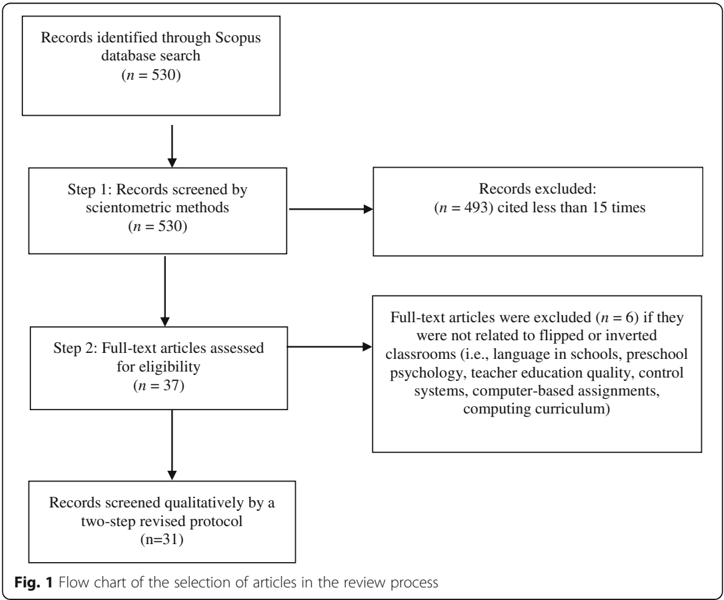
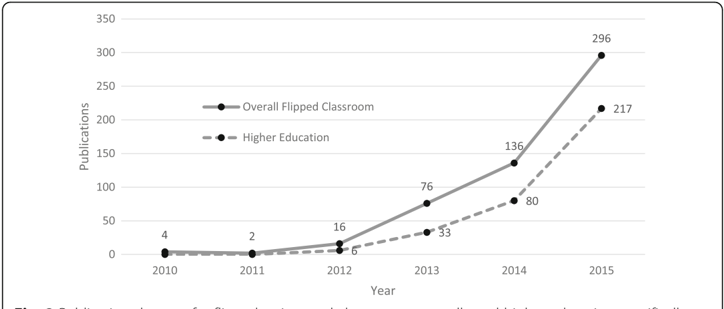
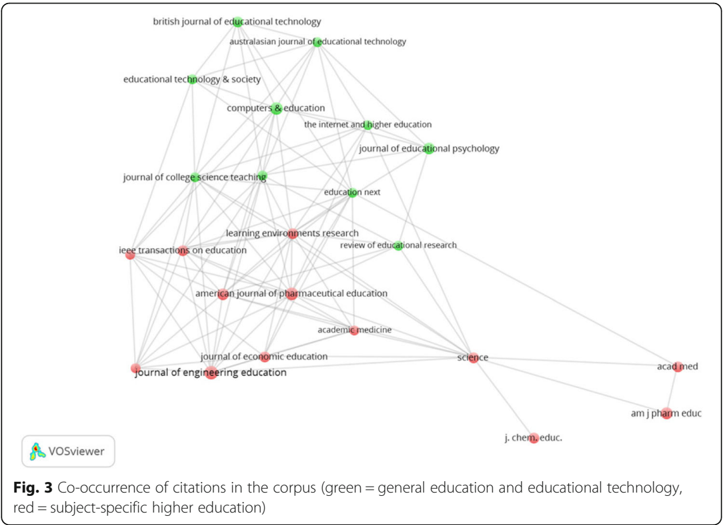
This structured review examined (academic) publications on flipped or inverted classrooms based on all Scopus database ( n = 530) references available until mid-June 2016. The flipped or inverted classroom approach has gained widespread attention during the latest decade and is based on the idea of improving student learning by prepared self-studies via technology-based resources (‘flips’) followed by high-quality, in-class teaching and learning activities. However, only a few attempts have been made to review the knowledge of the field of interest more systematically. This article seeks to address this problem and investigates what constitutes the research on flipped classrooms and, in particular, to examine the knowledge contributions with the field so far in relation to the wider research topic of educational technology. This review found that the current state of flipped classrooms as a field of interest is growing fast, with a slight conference preference and a focus on higher education and STEM (science, technology, engineering and math) area contributions, with the US as the predominant geographical context. It is concluded that studies on flipped classrooms are dominated by studies in higher education sector and are relatively local in character. The research tends not to interact beyond the two clusters of general education/educational technology and subject-specific areas. This implies that knowledge contributions related to the flipped classroom approach are relatively siloed and fragmented and have yet to stabilise. Academically and socially, the research is quite scattered, and only local evidence and experiences are available. The knowledge contributions within this field of interest seem to be anecdotal rather than systematically researched. To a large extent, the research lacks anchoring in, for example, learning theory or instructional design known from educational technology traditions and which would have helped much of the flipped classroom research to examine aspects of the flipped classroom approach more fully.
Overview
The claims and statistics of this paper haven’t been checked yet.
Free: it reads the open-access text and checks the first 5 claims that cite a source we can check. Create a free account to check every claim.
Integrity signals
Registry
Cites
Statistics
Figures


Verification
Claims the paper makes
The claims and statistics of this paper haven’t been checked yet.
Free: it reads the open-access text and checks the first 5 claims that cite a source we can check. Create a free account to check every claim.
Claims other papers make about this one
Each is checked against this paper’s own text: does it say what the citing paper says it does?
The source backs part of the claim, not all of it — or backs it for a different population, condition or comparison.
In the citing paper
“Linked to this, educational technology research has, however, lacked theoretical guidance (Al-Sakkaf, Omar, & Ahmad, 2019; Hew, Lan, Tang, Jia, & Lo, 2019; Lundin, Bergviken Rensfeldt, Hillman, Lantz-Andersson, & Peterson, 2018).”
From Mapping research in student engagement and educational technology in higher education: a systematic evidence map (2020) · cites this paper as Lundin, Bergviken Rensfeldt, Hillman, Lantz-Andersson, & Peterson, 2018
Experimental — accuracy not yet measuredThe cited source says what the claim attributes to it.
In the citing paper
“Reviews that have included research using a range of methodologies, have found a limited number of studies employing qualitative methods (e.g. Connolly, Boyle, MacArthur, Hainey, & Boyle, 2012; Kay & LeSage, 2009; Lundin et al., 2018).”
From Mapping research in student engagement and educational technology in higher education: a systematic evidence map (2020) · cites this paper as Lundin et al., 2018
Self-check
Percentages, sums and reported differences re-computed from the paper’s own numbers.
The self-check needs the paper’s full text.
Citations
Cites
Software survey: VOSviewer, a computer program for bibliometric mapping
van Eck, N. J., & Waltman, L. (2010) · Scientometrics · doi:10.1007/s11192-009-0146-3 · Cited by 21,484 · cited 1×
“Co-occurrence analyses were conducted using VOSviewer (van Eck & Waltman, 2010) and Yasu Imao’s CasualConc application (sites.google.com/site/casualconc/), and the results are presented in the step 1 subsection of the results section.”
MethodFlip Your Classroom: Reach Every Student in Every Class Every Day
Sams, A., & Bergmann, J. (2012) · Medical Entomology and Zoology · Cited by 3,810
Inverting the Classroom: A Gateway to Creating an Inclusive Learning Environment
Lage, M. J., Platt, G. J., & Treglia, M. (2000) · The Journal of Economic Education · doi:10.1080/00220480009596759 · Cited by 2,774
The use of flipped classrooms in higher education: A scoping review
O'Flaherty, J., & Phillips, C. (2015) · The Internet and Higher Education · doi:10.1016/j.iheduc.2015.02.002 · Cited by 2,152 · cited 4×
“Our results and recommendations therefore support the conclusions of the earlier review by O’Flaherty et al. (2015) but also foreground the relative impact of the higher education sector, provide more systematic knowledge and offer a problematising stance on the siloed character of the research and…”
BackgroundMethodResultInfluentialAbeysekera, L., & Dawson, P. (2015) · Higher Education Research & Development · doi:10.1080/07294360.2014.934336 · Cited by 1,847
Biesta, G. (2007) · Educational Theory · doi:10.1111/j.1741-5446.2006.00241.x · Cited by 1,655 · cited 1×
“As part of our work, we also considered the impact of systematic, evidence-based research methodology, including how it has been criticised, e.g., in educational science (Biesta, 2007; Denzin, 2009; Hammersley, 2001).”
BackgroundHow learning in an inverted classroom influences cooperation, innovation and task orientation
Strayer, J. F. (2012) · Learning Environments Research · doi:10.1007/s10984-012-9108-4 · Cited by 1,621 · cited 11×
“Instead, the novelty of the flipped classroom approach is described as ‘the regular and systematic use of interactive technology in the learning process’ (Strayer, 2012, p. 172).”
BackgroundInfluentialFlip your classroom reach every student in every class every day
Bergmann, J., & Sams, A. (2012) · Cited by 1,601
The Intellectual and Social Organization of the Sciences
Barber, B., & Whitley, R. (1986) · Canadian Journal of Sociology / Cahiers canadiens de sociologie · doi:10.2307/3341122 · Cited by 1,213
McLaughlin, J. E., Roth, M. T., Glatt, D. M., Gharkholonarehe, N., Davidson, C. A., Griffin, L. M., Esserman, D. A., & Mumper, R. J. (2014) · Academic Medicine · doi:10.1097/acm.0000000000000086 · Cited by 1,167 · cited 12×
“242), and overall, optimising classroom time is often specifically emphasised (Gannod et al., 2008; Mason et al., 2013; McLaughlin et al., 2014; Tucker, 2012).”
BackgroundResultInfluential
Research works printed but not linked: 2
- 2. Ash, K. (2012). Educators view flipped model with a more critical eye. Education Week, 32(2), 6-8.
- 7. Bishop, J. L., & Verlinger, M. A. (2013). The flipped classroom: A survey of the research. Paper presented at the ASEE Annual Conference & Exposition. Atlanta: American Society for Engineering Education.
Cited by
Bond, M., Buntins, K., Bedenlier, S., Zawacki-Richter, O., & Kerres, M. (2020) · International Journal of Educational Technology in Higher Education · doi:10.1186/s41239-019-0176-8 · Cited by 1,097
“…other reviews of educational technology and student engagement have found studies to be largely STEM focused (Boyle et al., 2016; Li et al., 2017; Lundin et al., 2018; Nikou & Economides, 2018), this corpus features a more balanced scope of research, with the fields of Arts & Humanities (42…”
BackgroundInfluentialEffects of flipping the classroom on learning outcomes and satisfaction: A meta-analysis
van Alten, D. C. D., Phielix, C., Janssen, J., & Kester, L. (2019) · Educational Research Review · doi:10.1016/j.edurev.2019.05.003 · Cited by 546
“Generalization of their conclusions is difficult because the number of studies considered in these reviews was small, and the included studies often lack the use of a control group (Lundin et al., 2018; O'Flaherty & Phillips, 2015).”
BackgroundStrelan, P., Osborn, A., & Palmer, E. (2020) · Educational Research Review · doi:10.1016/j.edurev.2020.100314 · Cited by 526
Facilitating student engagement through the flipped learning approach in K-12: A systematic review
Bond, M. (2020) · Computers & Education · doi:10.1016/j.compedu.2020.103819 · Cited by 380
“1 Geographical characteristics Mirroring previous reviews (Lo & Hew, 2017; Lundin et al., 2018), the majority of studies in this corpus were undertaken within the US (51.”
BackgroundMethodResultInfluentialLåg, T., & Sæle, R. G. (2019) · AERA Open · doi:10.1177/2332858419870489 · Cited by 265
“…reflected in our definition, may be seen as an advantage, it may also be that it leads to a lack of pedagogical rationale (Bishop & Verleger, 2013; Lundin et al., 2018) on which to design the specifics of a flipped classroom intervention, thus leaving teachers and students to more of a…”
BackgroundDivjak, B., Rienties, B., Iniesto, F., Vondra, P., & Žižak, M. (2022) · International Journal of Educational Technology in Higher Education · doi:10.1186/s41239-021-00316-4 · Cited by 220
Gamification of in‐class activities in flipped classroom lectures
Sailer, M., & Sailer, M. (2021) · British Journal of Educational Technology · doi:10.1111/bjet.12948 · Cited by 234
Are first year students ready for a flipped classroom? A case for a flipped learning continuum
Tomas, L., Evans, N. (., Doyle, T., & Skamp, K. (2019) · International Journal of Educational Technology in Higher Education · doi:10.1186/s41239-019-0135-4 · Cited by 185
Integrating students’ perspectives about online learning: a hierarchy of factors
Wart, M. V., Ni, A. Y., Medina, P. S., Canelón, J., Kordrostami, M., Zhang, J., & Liu, Y. (2020) · International Journal of Educational Technology in Higher Education · doi:10.1186/s41239-020-00229-8 · Cited by 241
“…Nouri, 2016; Vlachopoulos & Makri, 2017) and the flipped classroom approach in particular (Flores, del-Arco, & Silva, 2016; Gong, Yang, & Cai, 2020; Lundin, et al., 2018; Maycock, 2019; McGivney-Burelle, 2013; O ’ Flaherty & Phillips, 2015; Tucker , 2012) along with extraordinary shifts in the…”
Effectiveness of online and blended learning from schools: A systematic review
Topping, K. J., Douglas, W., Robertson, D. P., & Ferguson, N. (2022) · Review of Education · doi:10.1002/rev3.3353 · Cited by 233
The flipped classroom in second language learning: A meta-analysis
Vitta, J. P., & Al-Hoorie, A. H. (2023) · Language Teaching Research · doi:10.1177/1362168820981403 · Cited by 123
“As with Lundin et al. (2018), our report pool was dominated by university-level learners by ratio approaching 5:1.”
ResultThe link between flipped and active learning: a scoping review
Li, R., Lund, A., & Nordsteien, A. (2021) · Teaching in Higher Education · doi:10.1080/13562517.2021.1943655 · Cited by 198
“Technology and digitalization have brought about tremendous changes in classroom practices, compelling the academic world to think beyond the traditional style of mono-directional teaching and learning as acquisition or even consumption and reproduction (Lundin et al. 2018; Sfard 1998).”
BackgroundMethodResultInfluentialImproving students’ satisfaction and learning performance using flipped classroom
Jiménez, R. M., & Jiménez, C. R. (2020) · The International Journal of Management Education · doi:10.1016/j.ijme.2020.100422 · Cited by 182
Hossein-Mohand, H., Torres, J. M. T., García, M. G., Hossein-Mohand, H., & Soto, A. C. (2021) · Sustainability · doi:10.3390/su13052606 · Cited by 179
Weller, M. (2020) · Athabasca University Press eBooks · doi:10.15215/aupress/9781771993050.01 · Cited by 268
Jiang, M. Y., Jong, M. S., Lau, W. W. F., Chai, C. S., Liu, K. S.-X., & Park, M. (2020) · Computer Assisted Language Learning · doi:10.1080/09588221.2020.1789171 · Cited by 149
“First, as a pedagogical approach, its theoretical foundations seem to be anecdotal rather than systematic (Lundin et al., 2018).”
BackgroundReview of flipped learning in engineering education: Scientific mapping and research horizon
Mamun, M. A. A., Azad, M. A. K., Mamun, M. A. A., & Boyle, M. (2021) · Education and Information Technologies · doi:10.1007/s10639-021-10630-z · Cited by 123
“Mason et al. (2013) also found that students were satisfied more with the flipped classroom than they were with the traditional learning arrangement.”
BackgroundResultInfluentialFlipped Classroom in the Context of Higher Education: Learning, Satisfaction and Interaction
Díaz, M. J. S., Antequera, J. G., & Cerezo-Pizarro, M. (2021) · Education Sciences · doi:10.3390/educsci11080416 · Cited by 124
“In this sense, the attractive aspect of the Flipped Classroom (FC) has grown, becoming increasingly more frequently used [23], especially lately, due to the COVID-19 situation, since it allows the teaching model to be changed quickly [24].”
Han, S. (2022) · Frontiers in Psychology · doi:10.3389/fpsyg.2022.996294 · Cited by 128
Koh, J. H. L. (2019) · Educational Sciences Theory & Practice · doi:10.12738/estp.2019.4.002 · Cited by 121
“Consequently, systematic reviews of higher education flipped classrooms call for stronger pedagogical theorisation of its practices (e.g., Brewer & Movahedazarhouligh, 2018; Lundin et al., 2018; O'Flaherty & Phillips, 2015).”
BackgroundLai, H., Hsieh, P.-J., Uden, L., & Yang, C.-H. (2021) · Computers & Education · doi:10.1016/j.compedu.2021.104318 · Cited by 124
Exploring Realistic Mathematics Education in a Flipped Classroom Context at the Tertiary Level
Fredriksen, H. (2020) · International Journal of Science and Mathematics Education · doi:10.1007/s10763-020-10053-1 · Cited by 105
Effectiveness of flipped classroom practices in teaching of science: a mixed research synthesis
Doğan, Y., Batdı, V., & Yaşar, M. D. (2021) · Research in Science & Technological Education · doi:10.1080/02635143.2021.1909553 · Cited by 111
“…the present study There are a few reviews and systematic reviews in the literature on advantages and disadvantages of the FCA in the general sense (Lundin et al. 2018; Akçayır and Akçayır 2018; Ozdamli and Asiksoy 2016; Zainuddin and Halili 2016; Abeysekera and Dawson 2015; Bishop and Verleger…”
BackgroundJia, C., Hew, K. F., Du, J., & Li, L. (2022) · The Internet and Higher Education · doi:10.1016/j.iheduc.2022.100878 · Cited by 93
Awuor, N. O., Weng, C., Piedad, E., & Militar, R. (2021) · Computers & Education · doi:10.1016/j.compedu.2021.104357 · Cited by 90
Liu, D., & Hai, Z. (2022) · Education and Information Technologies · doi:10.1007/s10639-022-10922-y · Cited by 91
“A literature review on the FC concluded that most FC research has been in the higher education sector (Lundin et al., 2018).”
BackgroundFisher, R., Tran, Q., & Verezub, E. (2024) · Innovation in Language Learning and Teaching · doi:10.1080/17501229.2024.2302984 · Cited by 85
“Lundin et al. (2018) acknowledged the knowledge contribution of many articles about FL tends towards anecdotal and recent meta-analysis papers point to shortcomings in the research designs used in studies into FLC (Shahnama, Ghonsooly, and Elahi Shirvan 2021; Vitta and Al-Hoorie 2021).”
Gutiérrez, W. R., Barber, J. P., & Villar, C. (2022) · European Management Journal · doi:10.1016/j.emj.2022.10.009 · Cited by 93
Flipped Classroom to Improve University Student Centered Learning and Academic Performance
Mingorance-Estrada, Á. C., Vera, J. G., Ruiz, G. R., & Arrebola, I. A. (2019) · Social Sciences · doi:10.3390/socsci8110315 · Cited by 93
“Most of the Faculties of Education, specifically in the field of future teachers’ training, do not analyze the results of this method at the final stage, though (Zainuddin and Hajar 2016; Lundin et al. 2018; Cabi 2018).”
MethodPetillion, R. J., & McNeil, W. S. (2020) · Journal of Chemical Education · doi:10.1021/acs.jchemed.9b01105 · Cited by 84
Integration of good practices of active methodologies with the reuse of student-generated content
Arruabarrena, R., Sánchez, A., Blanco, J. M., Zorita, J. Á. V., & Usandizaga, I. (2019) · International Journal of Educational Technology in Higher Education · doi:10.1186/s41239-019-0140-7 · Cited by 86
“…approach by an approach in which activities previously performed outside the classroom now occur within the classroom (Akçayır & Akçayır, 2018; Lundin et al., 2018; Nouri, 2016; O’Flaherty & Phillips, 2015) That is, instead of attending class and working at home afterwards, now, students…”
BackgroundMethodHew, K. F., Bai, S., Huang, W., Dawson, P., Du, J., Huang, G., Jia, C., & Thankrit, K. (2021) · Australasian Journal of Educational Technology · doi:10.14742/ajet.6475 · Cited by 46
“The flipped classroom approach has been growing fast, particularly in higher education settings (Lundin et al., 2018).”
BackgroundGonzález‐Gómez, D., Jeong, J. S., & Cañada, F. C. (2019) · Interactive Learning Environments · doi:10.1080/10494820.2019.1696843 · Cited by 84
van Alten, D. C. D., Phielix, C., Janssen, J. J. H. M., & Kester, L. (2020) · Computers in Human Behavior · doi:10.1016/j.chb.2020.106676 · Cited by 80
Jiménez, C. R., Jiménez, R. M., Gutiérrez, A. L., & Martí, E. G. (2022) · The International Journal of Management Education · doi:10.1016/j.ijme.2022.100635 · Cited by 80
Yılmaz, F. G. K., & Yılmaz, R. (2022) · Journal of Computers in Education · doi:10.1007/s40692-022-00226-y · Cited by 78
“In this sense, FC can be stated to be one of those teaching methods used in educational contexts and included in scientific inquiries in terms of efficiency (Kazanidis et al., 2019; Lo & Hew, 2017; Yilmaz et al., 2017; Lundin et al., 2018).”
BackgroundMethodBibliometric Analysis of Construction Education Research from 1982 to 2017
Zheng, L., Chen, K., & Lu, W. (2019) · Journal of Professional Issues in Engineering Education and Practice · doi:10.1061/(asce)ei.1943-5541.0000412 · Cited by 62
Betti, A., Biderbost, P., & Domonte, A. G. (2022) · PLoS ONE · doi:10.1371/journal.pone.0265408 · Cited by 64
Shehata, B., Tlili, A., Huang, R., Adarkwah, M. A., Liu, M., & Chang, T. (2023) · Education and Information Technologies · doi:10.1007/s10639-023-12112-w · Cited by 67
Limaymanta, C. H., Apaza-Tapia, L., Vidal, E., & Gregorio-Chaviano, O. (2021) · International Journal of Emerging Technologies in Learning (iJET) · doi:10.3991/ijet.v16i09.21267 · Cited by 50
Findings and implications of flipped science learning research: A review of journal publications
Chen, C.-K., Huang, N.-T. N., & Hwang, G. (2019) · Interactive Learning Environments · doi:10.1080/10494820.2019.1690528 · Cited by 48
Gu, J., Tang, L., Liu, X., & Xu, J. (2022) · Frontiers in Psychology · doi:10.3389/fpsyg.2022.810275 · Cited by 50
Tunggyshbay, M., Balta, N., & Admiraal, W. (2023) · Eurasia Journal of Mathematics Science and Technology Education · doi:10.29333/ejmste/13258 · Cited by 55
“Although a few narrative reviews have been carried to examine the effects of FC (e.g., Akcayir & Akcayir, 2018; Lo & Hew, 2017; Lundin et al., 2018), generalization of their conclusions on effects of FC need to be interpreted with caution.”
Systematic Reviews on Flipped Learning in Various Education Contexts
Lo, C. K. (2019) · Springer eBooks · doi:10.1007/978-3-658-27602-7_8 · Cited by 45
“Apart from the aforementioned databases, other researchers (e.g., Lundin et al. 2018; O’Flaherty and Phillips 2015; Ramnanan and Pound 2017) have used the following databases in their systematic reviews of flipped learning: Cochrane library, EMBASE, Joanna Briggs Institute, Scopus, and Web of…”
BackgroundInfluentialEffectiveness of the Flipped Classroom Strategy in Learning Outcomes (Bibliometric Study)
Alshabibi, T., & Al-Ayasra, M. A.-K. (2017) · International Journal of Learning Teaching and Educational Research · doi:10.26803/ijlter.18.3.6 · Cited by 45
“The researchers found only four bibliometric studies conducted on this strategy, including: Lundin et al. (2018) study which investigated the previous studies conducted on the flipped classroom strategy in the database (Scopus database) including (530) studies, published in the period from (2011 -…”
BackgroundSilva, E. C. E., Lino‐Neto, T., Ribeiro, E., Rocha, M., & Costa, M. J. (2021) · Education and Information Technologies · doi:10.1007/s10639-021-10683-0 · Cited by 43
The impact of flipped classroom teaching on college English language learning: A meta-analysis
Ni, A., Cheung, A., & Shi, J. (2023) · International Journal of Educational Research · doi:10.1016/j.ijer.2023.102230 · Cited by 45
Hasumi, T., & Chiu, M.-S. (2022) · Scientometrics · doi:10.1007/s11192-022-04441-3 · Cited by 43
Teacher educator in a digital age: A study of transformative agency
Aagaard, T., Bueie, A. A., & Hjukse, H. (2022) · Nordic Journal of Digital Literacy · doi:10.18261/njdl.17.1.3 · Cited by 42
Flipped learning: Turning medical education upside down
Chowdhury, T. A., Khan, H., Druce, M. R., Drake, W. M., Rajakariar, R., Thuraisingham, R. C., Dobbie, H., Parvanta, L., Chinegwundoh, F., Almushatat, A., et al. (2019) · Future Healthcare Journal · doi:10.7861/fhj.2018-0017 · Cited by 44
An Overview of Trends and Challenges in Higher Education on the Worldwide Research Agenda
Тихонова, Е. В., & Raitskaya, L. (2018) · Journal of language and Education · doi:10.17323/2411-7390-2018-4-4-4-7 · Cited by 38
“The concept of ‘self-studies via technologybased resources (called ‘flips’)’ (Lundin et al., 2018) followed by comprehensive in-class activities has gained popularity at all levels of education.”
BackgroundMethodBawaneh, A. K., & Moumene, A. B. H. (2020) · Eurasia Journal of Mathematics Science and Technology Education · doi:10.29333/ejmste/8561 · Cited by 32
“Today, one of the most researched methodologies in higher education is the flipped classroom (Broman & Johnels, 2019; Lundin et al. 2018; Seery, 2015; Tütüncü & Aksu, 2018).”
BackgroundYılmaz, F. G. K., Zhang, K., Üstün, A. B., & Yılmaz, R. (2022) · Interactive Learning Environments · doi:10.1080/10494820.2022.2091603 · Cited by 41
“Worldwide, FL is one of the widely applied blended models both before and during the pandemic (e.g. Al-Samarraie & Hurmuzan, 2018; Korkmaz & Mirici, 2021; Latorre-Cosculluela et al., 2021; Lundin et al., 2018; McNally et al., 2017; Nerantzi, 2020; O ’ Flaherty & Phillips, 2015; Tang et al., 2020).”
BackgroundMethodBravo, I. D. A., Melé, P. M., Ramos-Pla, A., & Flores, Ò. (2022) · Frontiers in Education · doi:10.3389/feduc.2022.1022295 · Cited by 39
“The main reason for this is that the FC model tends to have a very positive effect on the performance of the students (Enfield, 2013; Velegol et al., 2015; Betihavas et al., 2016; Lai and Hwang, 2016; Akçayir and Akçayir, 2018; Cho and Lee, 2018; Hew and Lo, 2018; Lundin et al., 2018; Tang et al., 2018; Namaziandost a…”
BackgroundCuervo, C. M., & González, L. (2021) · Formación universitaria · doi:10.4067/s0718-50062021000600097 · Cited by 30
Tonkin, K., Page, S., & Forsey, M. (2019) · Foreign Language Annals · doi:10.1111/flan.12412 · Cited by 33
Combination of concept maps and case-based learning in a flipped classroom: A mixed-methods study
Xu, G., Lin, Y., Ye, Y., Wu, W., Zhang, X., & Xiao, H. (2024) · Nurse Education in Practice · doi:10.1016/j.nepr.2024.103918 · Cited by 29
Afonso, A. P., Morgado, L., Carvalho, I. C., & Spilker, M. J. (2025) · Education Sciences · doi:10.3390/educsci15081013 · Cited by 30
Fischer, K., Sullivan, A. M., Cohen, A. P., King, R. W., Cockrill, B. A., & Besche, H. C. (2023) · BMC Medical Education · doi:10.1186/s12909-023-04325-x · Cited by 28
Sarvary, M. A., Castelli, F. R., & Asgari, M. (2022) · Journal of Microbiology and Biology Education · doi:10.1128/jmbe.00289-21 · Cited by 33
“Additionally, providing lecture recordings along with synchronous laboratory sections is like a “flipped” or inverted classroom design (46), where students engage with the material (prerecorded lecture) and then attend the laboratory sections to build on that knowledge and discuss it (47, 48).”
BackgroundBond, M. (2024) · International Journal of Educational Technology in Higher Education · doi:10.1186/s41239-024-00492-z · Cited by 33
“The influential review by Lundin et al. (2018) was also published in this period, finding that research on and students (see students-learning-environment-knowledge-skills ) was also analysed in this period, including in one of the highest cited articles (Bond et al., 2018).”
Kang, K., Kushnarev, S., Pin, W. W., Ortiz, O., & Chen, J. S. (2020) · IEEE Access · doi:10.1109/access.2020.2982972 · Cited by 27
“classroom environment with a flipped classroom [17] with the aid of VR.”
BackgroundInvestigating the impact of a flipped programming course using the DT-CDIO approach
Lai, C.-F., Zhong, H.-X., & Chiu, P. (2021) · Computers & Education · doi:10.1016/j.compedu.2021.104287 · Cited by 29
Factors affecting Active Flipped Learning on Underrepresented students in Three STEM Courses
Yan, J., Liu, S., Armwood-Gordon, C. K., & Li, L. (2023) · Education and Information Technologies · doi:10.1007/s10639-023-12234-1 · Cited by 27
“The flipped classroom was introduced to promote collaborative learning and higher-order learning objectives (Lundin et al., 2018).”
Enhancing mathematics education through AI Chatbots in a Flipped Learning Environment
Martínez-Téllez, R., & Camacho-Zúñiga, C. (2023) · World Engineering Education Forum - Global Engineering Deans Council (WEEF-GEDC) · doi:10.1109/weef-gedc59520.2023.10343838 · Cited by 32
“This method encourages learners to prepare prior to interacting with the instructor, subsequently engaging more actively and profoundly in their learning [11].”
BackgroundMethodInfluentialEffect of interactive e-book use on learning engagement, satisfaction and perceived learning
Chen, C., & Tsai, Y.-H. (2025) · Education and Information Technologies · doi:10.1007/s10639-025-13415-w · Cited by 31
Factors affecting students’ perception of flipped learning over time in a teacher training program
Pablo-Lerchundi, I., Rio, M. C. N. D., Jiménez-Rivero, A., Sastre-Merino, S., Míguez-Souto, A., & Núñez, J. L. M. (2023) · Heliyon · doi:10.1016/j.heliyon.2023.e21318 · Cited by 27
“For its part, a systematic review of flipped classroom research on higher education found that an argument used by many highly cited publications is that the flipped classroom improves student learning, but the claim is mainly based on improved test results or self-reported motivation [17].”
BackgroundXin, X., & Zhang, M. (2024) · Journal of Computer Assisted Learning · doi:10.1111/jcal.12978 · Cited by 27
Fang, J., Vong, J., & Fang, J. (2021) · Journal of Education for Business · doi:10.1080/08832323.2021.1890539 · Cited by 28
Students’ perceptions of their learning outcomes in a flipped classroom environment
Jiménez, C. R., Jiménez, R. M., & Gutiérrez, A. L. (2023) · Educational Technology Research and Development · doi:10.1007/s11423-023-10289-y · Cited by 25
“…to be spent solv‑ ing questions, collaborating and working in teams, to reinforce the contents thus learned, using several ICTs (Martínez & Ruiz, 2020); this model allows for creative learning situ‑ ations to characterize the interaction between teachers and students (Lundin et al., 2018).”
Núñez, J. A. L., López-Belmonte, J., Moreno-Guerrero, A.-J., & Marín, J. A. M. (2020) · International Journal of Environmental Research and Public Health · doi:10.3390/ijerph17093007 · Cited by 28
“However, the research results focus on specific contexts, the evidence for which must be treated with caution [30].”
BackgroundChen, X., Zou, D., Cheng, G., Xie, H., & Su, F. (2023) · Australasian Journal of Educational Technology · doi:10.14742/ajet.8019 · Cited by 25
“Literature review There have been several systematic reviews on flipped classrooms (e.g., Akçayır & Akçayır, 2018; Lo & Hew, 2017; Lundin et al., 2018).”
BackgroundBond, M., Bedenlier, S., Buntins, K., Kerres, M., & Zawacki‐Richter, O. (2020) · Contemporary issues in technology and teacher education · Cited by 105
Comprehensive Physical Chemistry Learning Based on Blended Learning: A New Laboratory Course
Kuroki, N., & Mori, H. (2021) · Journal of Chemical Education · doi:10.1021/acs.jchemed.1c00666 · Cited by 22
Barber, S., Lima, L. A. M., Sakagami, Y., Quick, J., Latiffianti, E., Liu, Y., Ferrari, R., Letzgus, S., Zhang, X., & Hammer, F. (2022) · Energies · doi:10.3390/en15155638 · Cited by 25
Avakyan, E. I., & Taylor, D. (2024) · BMC Medical Education · doi:10.1186/s12909-024-06113-7 · Cited by 28
“Additionally, Lundin et al. showed that most studies are related to local context and research is “quite scattered”, while systematic evidence based on empirical data is still limited [24].”
BackgroundSupporting Students’ Visualization of Multivariable Calculus Partial Derivatives via Virtual Reality
Cheong, K. H., Chen, J. S., Kang, K., & Yeo, D. J. S. (2023) · Mathematics · doi:10.3390/math11040831 · Cited by 21
Qin, Y., Yan, R., & Sun, Y. (2020) · Frontiers in Psychology · doi:10.3389/fpsyg.2020.01587 · Cited by 21
“The results are affected by many factors, but the result analysis based on the Markov chain can effectively avoid the interference caused by differences (Lundin et al., 2018; Wu Y. et al., 2019; Zainuddin and Perera, 2019).”
BackgroundBroman, K., & Johnels, D. (2019) · Chemistry Teacher International · doi:10.1515/cti-2018-0004 · Cited by 24
Buhl-Wiggers, J., la Cour, L., & Kjærgaard, A. (2023) · International Journal of Educational Technology in Higher Education · doi:10.1186/s41239-023-00413-6 · Cited by 24
“The growing body of research on the effects of the FC counts several reviews and meta-analyses (Akçayır & Akçayır, 2018; Cheng et al., 2019; Lundin et al., 2018; Strelan et al., 2020; van Alten et al., 2019) measuring both direct indicators of learning, such as academic achievement, and indirect…”
BackgroundMathematics for Computer Science: A Flipped Classroom with an Optional Project
Dori, Y. J., Kohen, Z., & Rizowy, B. (2020) · Eurasia Journal of Mathematics Science and Technology Education · doi:10.29333/ejmste/9149 · Cited by 23
“Studies on this topic that focus on PBL are even less prevalent, particularly in higher education (Lundin et al., 2018).”
BackgroundImpact of the flipped classroom model on democratic education of student teachers in Spain
Ferrer, J. M. C., & Martínez, P. M. (2022) · Education Citizenship and Social Justice · doi:10.1177/17461979221084111 · Cited by 22
“…the number of studies focusing on research on the attitudinal and academic impact of FC learning has increased in recent years, more empirical studies are needed to gather the necessary information to design democracy-based educational programs using this teaching strategy (Lundin et al., 2018).”
BackgroundFlipping the classroom: is it the type of flipping that adds value?
Webb, R., Watson, D., Shepherd, C., & Cook, S. (2019) · Studies in Higher Education · doi:10.1080/03075079.2019.1698535 · Cited by 26
“Unsurprisingly, 617 (54%) were in the field of education (for example, Blair, Maharaj, and Primus 2016; Lundin et al. 2018; Taylor 2015; Zhai et al. 2017).”
BackgroundInfluentialAbdolmaleki, N., & Saeedi, Z. (2024) · International Journal of Educational Technology in Higher Education · doi:10.1186/s41239-024-00442-9 · Cited by 26
“Therefore, Lundin, et.al.”
BackgroundThe flipped-classroom effect on vocational high school students’ learning outcomes
Herlambang, A. D., Ririn, R., & Rachmadi, A. (2024) · International Journal of Evaluation and Research in Education (IJERE) · doi:10.11591/ijere.v13i3.26757 · Cited by 23
“However, the computer science question is for higher academic institutions, not vocational or secondary education [15], [16].”
BackgroundChiang, F., & Wu, Z. (2021) · Australasian Journal of Educational Technology · doi:10.14742/ajet.6330 · Cited by 21
“(Betihavas et al., 2016; F. Chen et al., 2017; Karabulut-Ilgu et al., 2018; Lundin et al., 2018).”
Backgroundvan Leeuwen, A. (2023) · Technology Pedagogy and Education · doi:10.1080/1475939x.2023.2254297 · Cited by 18
“Reviews do show that the flipped classroom indeed enables teachers to spend more time interacting with students (Al-Samarraie et al., 2020; Lundin et al., 2018), that the flipped classroom requires other skills from teachers including offering personalised support during sessions (Brewer &…”
BackgroundSPOC-based Flipped Learning Model Applied in Interpreting Teaching
Chen, J. (2020) · International Journal of Emerging Technologies in Learning (iJET) · doi:10.3991/ijet.v15i17.14581 · Cited by 18
“[9] stated, “for realising the flipped or inverted classroom approach, social media has become an important platform for sharing educational resources in the form of blog posts, YouTube videos or other media through social networking sites”.”
BackgroundMshigeni, S., Arroyo-Romano, J. E., & Becerra, M. B. (2022) · Journal of Latinos and Education · doi:10.1080/15348431.2022.2056463 · Cited by 20
“Students can provide valuable insights especially when technology is involved and its effectiveness in the implementation (Gong et al., 2020; Lundin et al., 2018; Van Wart et al., 2020).”
BackgroundWalsh, J. N. (2024) · The International Journal of Management Education · doi:10.1016/j.ijme.2024.100936 · Cited by 21
Pedagogical rationales of flipped learning in the accounts of Finnish mathematics teachers
Toivola, M., Rajala, A. J., & Kumpulainen, K. (2022) · Pedagogies An International Journal · doi:10.1080/1554480x.2022.2077341 · Cited by 17
“They also allow teachers to engage directly with students (Gannod et al., 2008; Lo et al., 2017; Lundin et al., 2018; Mason et al., 2013; McLaughlin et al., 2014; Prober & Khan, 2013; Strayer, 2012).”
BackgroundMethodInfluentialYin, T., Yin, J., & Xu, Z. (2023) · Heliyon · doi:10.1016/j.heliyon.2023.e21686 · Cited by 18
“The students can confer their knowledge to colleagues and educators [60 – 62].”
BackgroundTHE FLIPPED CLASSROOM: MEDIA HYPE OR EMPIRICALLY BASED EFFECTIVENESS?
Weiß, L.-F., & Friege, G. (2021) · Problems of Education in the 21st Century · doi:10.33225/pec/21.79.312 · Cited by 20
ASLAN, S. A. (2022) · Journal of Educational Technology and Online Learning · doi:10.31681/jetol.1094205 · Cited by 20
Khatoon, R., & Jones, E. M. (2021) · Assessment & Evaluation in Higher Education · doi:10.1080/02602938.2021.1981823 · Cited by 17
“See, e.g. Lundin et al. 2018 for a recent systematic review, and Strelan, Osborn, and Palmer 2020 for a meta-analysis).”
BackgroundLearning Analytics: Gamification in Flipped Classroom for Higher Education
Priyaadharshini, M., & Maiti, M. (2023) · Journal of Engineering Education/Journal of engineering education transformations/Journal of engineering education transformation · doi:10.16920/jeet/2023/v37i1/23137 · Cited by 13
The educator’s experience of using flipped classrooms in a higher education setting
Verdonck, M., Wright, H. H., Hamilton, A., & Taylor, J. (2022) · Active Learning in Higher Education · doi:10.1177/14697874221091596 · Cited by 16
“The flipped classroom approach (FCA) has increased in popularity in the higher education sector over the last decade (Akçayır and Akçayır, 2018; Brewer and Movahedazarhouligh, 2018; Fisher et al., 2021; Lundin et al., 2018).”
BackgroundJiménez, C. R., Gutiérrez, A. L., & Jiménez, R. M. (2022) · Active Learning in Higher Education · doi:10.1177/14697874221133459 · Cited by 13
“Creative and meaningful learning situations are thus created within the classroom through interaction between students themselves and teachers (Lundin et al., 2018).”
Exploring the Affordance of Distance Learning Platform (DLP) in COVID19 Remote Learning Environment
Hysaj, A., & Hamam, D. (2020) · Lecture notes in computer science · doi:10.1007/978-3-030-60128-7_32 · Cited by 14
Metadata
- Authors
- Lundin, M., Bergviken Rensfeldt, A., Hillman, T., Lantz-Andersson, A., & Peterson, L.
- Affiliations
- University of Gothenburg (SE)
- Corresponding author
- Lundin, Mona
- Venue
- International Journal of Educational Technology in Higher Education
- Published
- 2018-05-24
- Volume
- 15
- Issue
- 1
- ISSN
- 2365-9440 (ISSN-L)
- OpenAlex
- W2805683247
- Cited by
- 227
- References
- 59
- Citations by year
- 2026: 15 · 2025: 16 · 2024: 29 · 2023: 37 · 2022: 39 · 2021: 33 · 2020: 30 · 2019: 26 · 2018: 1
- FWCI
- 8.80
- Type
- journal article
- Language
- en
- Open access
- diamond
- doi.org
- Licence
- cc-by
- creativecommons.org/licenses/by/4.0 (tdm)
- Locations
- International Journal of Educational Technology in Higher Education (publishedVersion, cc-by)
- DOAJ (DOAJ: Directory of Open Access Journals) (submittedVersion, cc-by-sa)
- Funders
- Vetenskapsrådet (2014-47308-111109-49)
- Topics
- Social Sciences › Education › Innovative Teaching Methods
- Social Sciences › Education › Evaluation of Teaching Practices
- Social Sciences › Education › Online and Blended Learning
- Keywords
- flipped classroom, higher education, educational technology, research trends, STEM education, self-directed learning, instructional design, learning theory
About these checks
Registry, retraction, Cites and statistics results are computed, not judged, with one exception: a printed reference that no index lists is read once by a model before it counts as a citation error. Claims are extracted by a model and kept only when their quote appears verbatim in the text; each cited source is then checked, with a model’s help, for whether it says what the claim relies on. Those verdicts can be wrong — read the claim’s quote and the cited source before relying on one.
Statistics and arithmetic are recomputed, not judged.
Confidence bands are shown only for fields calibrated on our annotated test set. None is calibrated yet, so no band is shown.
What counts as a claim ›How we measure confidence ›How we check this ›
Are you an author, or do you see a problem with this page? Request a review
Data sources
Bibliographic data: Semantic Scholar, OpenAlex, Crossref.
Contains information from the Semantic Scholar Academic Graph Datasets, made available under the ODC Attribution License (ODC-BY 1.0).
Semantic Scholar’s data is described in: Kinney, R., et al. (2023). The Semantic Scholar Open Data Platform. arXiv:2301.10140.
