

The DOI matches its Crossref record; 86 of the 87 references it cites were found in a registry or an index; 6 of the 46 sources its claims cite were checked for support.
Adaptive e-learning environment based on learning styles and its impact on development students' engagement
Open accessAbstract
Abstract Adaptive e-learning is viewed as stimulation to support learning and improve student engagement, so designing appropriate adaptive e-learning environments contributes to personalizing instruction to reinforce learning outcomes. The purpose of this paper is to design an adaptive e-learning environment based on students' learning styles and study the impact of the adaptive e-learning environment on students’ engagement. This research attempts as well to outline and compare the proposed adaptive e-learning environment with a conventional e-learning approach. The paper is based on mixed research methods that were used to study the impact as follows: Development method is used in designing the adaptive e-learning environment, a quasi-experimental research design for conducting the research experiment. The student engagement scale is used to measure the following affective and behavioral factors of engagement (skills, participation/interaction, performance, emotional). The results revealed that the experimental group is statistically significantly higher than those in the control group. These experimental results imply the potential of an adaptive e-learning environment to engage students towards learning. Several practical recommendations forward from this paper: how to design a base for adaptive e-learning based on the learning styles and their implementation; how to increase the impact of adaptive e-learning in education; how to raise cost efficiency of education. The proposed adaptive e-learning approach and the results can help e-learning institutes in designing and developing more customized and adaptive e-learning environments to reinforce student engagement.
Overview
CoChat Summary
TL;DR
This paper designed an adaptive e-learning environment based on VARK learning styles and tested its impact on first-year university students’ engagement in a learning skills course. The experimental group showed significantly higher post-test engagement than the conventional e-learning control group across skills, participation/interaction, performance, and emotional factors.
Key findings
- Pre-test equivalence: no significant differences between experimental and control groups on engagement overall or on any factor (t values 0.464, 0.514, 0.321, 0.397, 0.632; p > 0.05).
- Post-test: the experimental group scored significantly higher than the control group on all engagement factors: skills 34.81 vs 23.34 (t = 4.086, p = 0.001); participation/interaction 21.05 vs 13.26 (t = 2.210, p = 0.002); performance 25.86 vs 14.60 (t = 2.071, p = 0.003); emotional 24.93 vs 13.07 (t = 2.909, p = 0.001); average score 38.87 vs 26.13 (t = 4.738, p = 0.003).
- Effect size: Cohen’s d = 0.826 and effect-size r = 0.401; the paper describes this as a large effect, with the treated group’s mean at the 79th percentile of the control group.
- Instrument reliability: VARK questionnaire Cronbach’s alpha = 0.83; engagement scale full alpha = 0.81, with subscale alphas from 0.80 to 0.87.
Methods
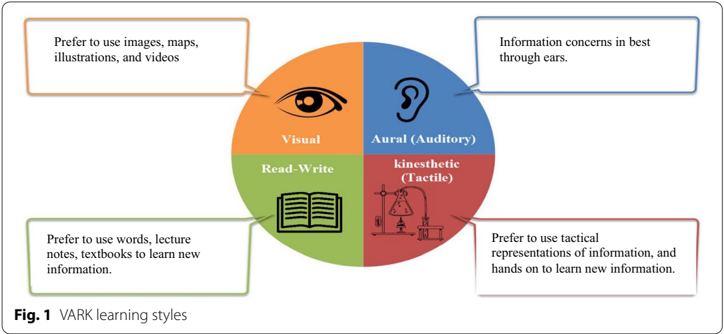
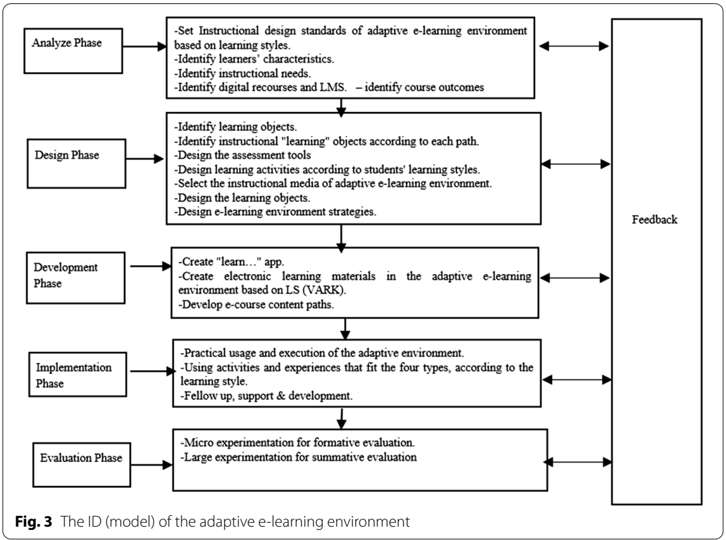
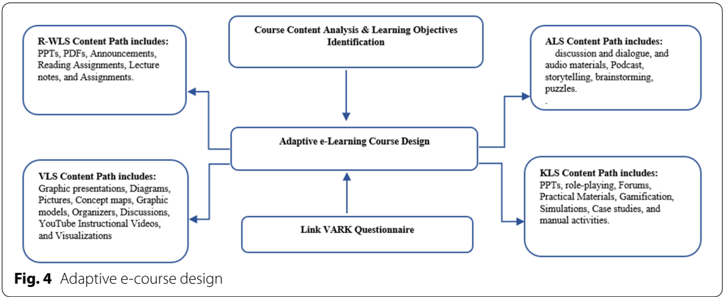
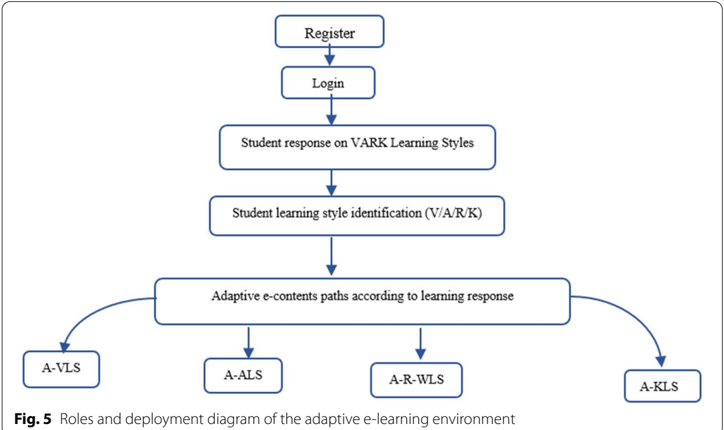
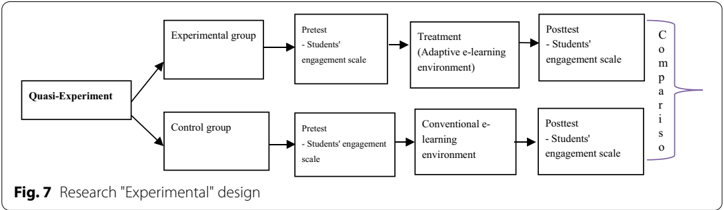
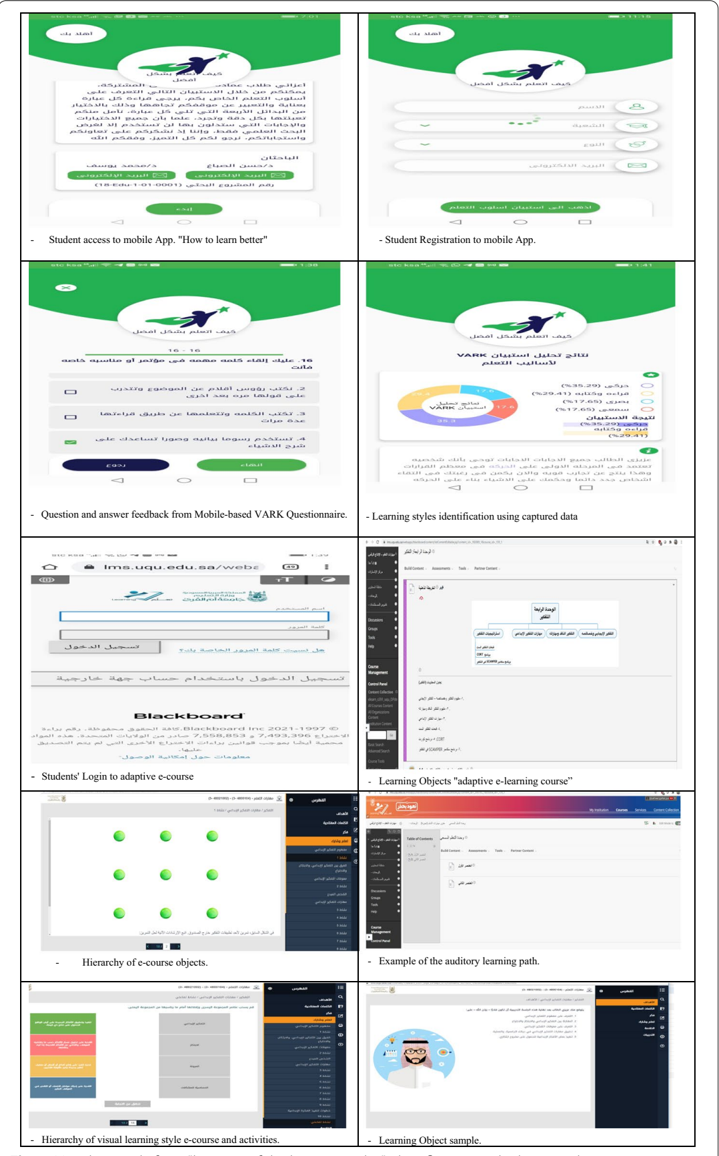
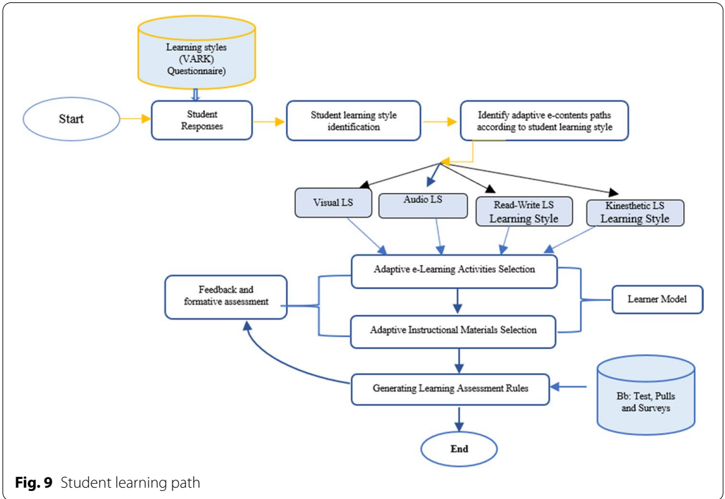
- Quasi-experimental pretest-posttest design; the adaptive e-learning environment was developed using the ADDIE instructional design model, with content paths based on VARK learning styles (visual, auditory, read/write, kinesthetic).
- Participants were 118 first-year “learning skills” students aged 17–18 at Umm Al-Qura University in the 2019/2020 academic year: control group N = 58 (31 males, 27 females) and experimental group N = 60 (36 males, 24 females), taught by the same instructors.
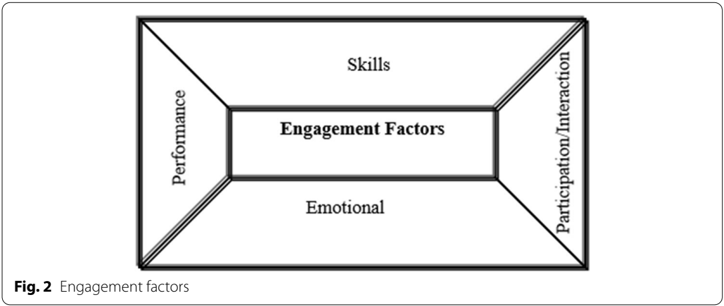
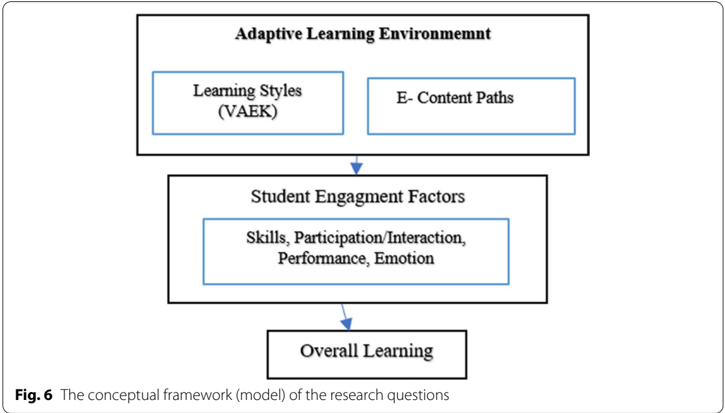
- Instruments and analysis: electronic VARK questionnaire (16 MCQ items); adapted Dixson student engagement scale (27 items, 5-point, four factors: skills, participation/interaction, performance, emotional), piloted on 20 students; independent-sample t-tests and Cohen’s d were used.
Limitations
- Stated in the paper: the study is restricted to one aspect of content adaptation—learning materials adapted based on learning styles—and notes that other considerations include content-dependent adaptation. It also states that empirical findings on adapting instruction to learning style are mixed and that Murray and Pérez found adaptive learning environments have a limited impact on learning outcome.
- Evident from the text: the study is limited to a single institution and a single “learning skills” course with first-year students, uses a short pretest-posttest window, and measures engagement through a self-report scale, which limits broader generalization and long-term conclusions.
Model-written summary. Check it against the paper before relying on it.
Integrity signals
Registry
Cites
Statistics
Figures
Verification
Claims the paper makes
5 Valid · 1 Not valid · 25 Not checked · 46 Own results and interpretations
Every source the paper cites for this claim was checked and supports it.
In the paper
“There is also evidence that an adaptive environment positively impacts other aspects of quality such as student engagement (Murray & Pérez, 2015).”
§ Adaptive e-learning environment based on learning styles and its impact on development students' engagement > Discussions and limitations
What the sources say
- Supportedcites Murray & Pérez, 2015 source
The Conclusion states that there is evidence adaptive systems positively affect aspects of quality including student engagement. The claim closely paraphrases that statement; the paper cites Jarrett (2013) and Zimmer (2014) for the evidence. (LLM, conf=0.94)
plainstates a cause- Asserted: passes — The authors put it forward as true.
- Checkable: passes — It can be checked against evidence.
- Load-bearing: unclear — It is unclear whether the paper’s conclusions depend on it.
- Based: passes — The paper gives a reason why it holds.
- Supported
Every source the paper cites for this claim was checked and supports it.
In the paper
“(Chun-Hui et al., 2017) demonstrated that adaptive eLearning technologies can be beneficial to students' learning and development.”
§ Adaptive e-learning environment based on learning styles and its impact on development students' engagement > Discussions and limitations
What the sources say
- Supportedcites Chun-Hui et al., 2017 source
The Abstract (p. 1) states that 'the developed adaptive e-learning system can effectively support students with personalized learning materials and successfully helps students acquired knowledge and develop cognitive abilities,' which is exactly the benefit to students' learning and development the citing sentence attributes. The hedged wording ('can be beneficial') matches the source's own claim, though the underlying evidence is a single experimental study of 60 undergraduates in an Excel spreadsheet course, with the authors flagging limited generalizability — so the generalization to adaptive e-learning technologies broadly rests on that narrow base. No contrary statement was found in our copy. (LLM, conf=0.85)
boostedstates a cause- Asserted: passes — The authors put it forward as true.
- Checkable: passes — It can be checked against evidence.
- Load-bearing: passes — The paper’s conclusions depend on it.
- Based: passes — The paper gives a reason why it holds.
- Supported
A result the paper reports from its own data — it cites no other source for it, so there is none to check. The quote shows it is in the paper.
In the paper
“Table 4. indicates that students in the experimental group had significantly higher mean of engagement post-test (engagement factors items) scores than students in the control group (p < 0.05).”
§ Adaptive e-learning environment based on learning styles and its impact on development students' engagement > Findings
hedgedstates a cause- Asserted: passes — The authors put it forward as true.
- Checkable: passes — It can be checked against evidence.
- Load-bearing: passes — The paper’s conclusions depend on it.
- Based: passes — The paper gives a reason why it holds.
A result the paper reports from its own data — it cites no other source for it, so there is none to check. The quote shows it is in the paper.
In the paper
“The results revealed that the experimental group is statistically significantly higher than those in the control group.”
§ Adaptive e-learning environment based on learning styles and its impact on development students' engagement > Abstract
plainstates a cause- Asserted: passes — The authors put it forward as true.
- Checkable: passes — It can be checked against evidence.
- Load-bearing: passes — The paper’s conclusions depend on it.
- Based: passes — The paper gives a reason why it holds.
A result the paper reports from its own data — it cites no other source for it, so there is none to check. The quote shows it is in the paper.
In the paper
“Students (82%) agreed that they lack adaptive educational content that helps them to be engaged in the learning process.”
§ Adaptive e-learning environment based on learning styles and its impact on development students' engagement > Introduction
plain- Asserted: passes — The authors put it forward as true.
- Checkable: passes — It can be checked against evidence.
- Load-bearing: passes — The paper’s conclusions depend on it.
- Based: passes — The paper gives a reason why it holds.
- Rests on an assumption not shown here.
15 more claims
Create a free account to see all 77 claims and to verify the 15 references still open.
- Probably not a substantial claim. 26
- It may state two separate claims as one. 39
- The quote only partly states this claim. 6
Claims other papers make about this one
Each is checked against this paper’s own text: does it say what the citing paper says it does?
In the citing paper
“Additionally, compliance with theoretical learning can be enhanced among trainees with customized sessions, supporting individual learning styles accessible anywhere and anytime17 compared with conventional lectures.”
From Neurosurgery resident training using blended learning concepts: Course development and participant evaluation (2022) · cites this paper as [17]
In the citing paper
“These systems enable trainees to individually study theoretical content based on their respective preferences, needs, and prior knowledge.17”
From Neurosurgery resident training using blended learning concepts: Course development and participant evaluation (2022) · cites this paper as [17]
Self-check
Percentages, sums and reported differences re-computed from the paper’s own numbers.
Each contradiction between two passages listed here was confirmed by an independent check.
Rated major: it would touch a result — a value a result rests on, reported and recomputed p-values on opposite sides of the significance level, two passages that conflict with no sign which is right, or a cited work retracted before this paper was published.
In the paper
“| Whole engagement scale | Experiment | 60 | 26.76 | 1.84 | 0.632 |”
§ Adaptive e-learning environment based on learning styles and its impact on development students' engagement > Research implication
Reported 26.76 · recomputed 58.57
Rated minor: it would not touch a result — a value no result rests on, a p-value that stays on the same side of the significance level, or a conflict that is clerical, resolved elsewhere in the paper, or outside its own findings.
In the paper
§ Adaptive e-learning environment based on learning styles and its impact on development students' engagement > Research implication
“Table: 4 Table 4 Descriptive data and independent sample t-tests of the pre-test results”
§ Adaptive e-learning environment based on learning styles and its impact on development students' engagement > Findings
“Table 4. indicates that students in the experimental group had significantly higher mean of engagement post-test (engagement factors items) scores than students in the control group (p < 0.05).”
Rated minor: it would not touch a result — a value no result rests on, a p-value that stays on the same side of the significance level, or a conflict that is clerical, resolved elsewhere in the paper, or outside its own findings.
In the paper
§ Adaptive e-learning environment based on learning styles and its impact on development students' engagement > Research participants
“All participants were chosen in the academic year 2109-2020 at the first term which was taught by the same instructors.”
§ Adaptive e-learning environment based on learning styles and its impact on development students' engagement > Learner content path in adaptive e-learning environment
“The present study covered the 1st semester during the 2019/2020 academic year.”
Citations
Cites
School Engagement: Potential of the Concept, State of the Evidence
Fredricks, J. A., Blumenfeld, P. C., & Paris, A. H. (2004) · Review of Educational Research · doi:10.3102/00346543074001059 · Cited by 12,581 · cited 1×
“Previous research has emphasized that student participation is a key factor in overcoming academic problems such as poor academic performance, isolation, and high dropout rates (Fredricks et al., 2004).”
BackgroundCohen, J. (1992) · Current Directions in Psychological Science · doi:10.1111/1467-8721.ep10768783 · Cited by 5,870
Research in Education: Evidence Based Inquiry
McMillan, J. H., & Schumacher, S. (2005) · Medical Entomology and Zoology · Cited by 3,945
Cohen, J. (1992) · doi:10.1093/acprof:oso/9780195315493.003.0002 · Cited by 3,383
Pashler, H., McDaniel, M., Rohrer, D., & Bjork, R. (2008) · Psychological Science in the Public Interest · doi:10.1111/j.1539-6053.2009.01038.x · Cited by 2,147
How video production affects student engagement: an empirical study of MOOC videos
Guo, P. J., Kim, J., & Rubin, R. (2014) · Proceedings of the first ACM conference on Learning @ scale conference · doi:10.1145/2556325.2566239 · Cited by 1,850 · cited 1×
“Guo et al. (2014) checked the participation of students when they watched videos.”
BackgroundHinton, P., McMurray, I., & Brownlow, C. (2014) · Routledge eBooks · doi:10.4324/9781315797298 · Cited by 1,022
Handbook of Individual Differences, Learning, and Instruction
Jonassen, D. H., & Grabowski, B. L. (2012) · Routledge eBooks · doi:10.4324/9780203052860 · Cited by 934
Engaging online learners: The impact of Web-based learning technology on college student engagement
Chen, P.-S. D., Lambert, A. D., & Guidry, K. R. (2010) · Computers & Education · doi:10.1016/j.compedu.2009.11.008 · Cited by 785 · cited 1×
“E-learning produces constructive learning outcomes, as it allows students to actively participate in learning at anytime and any-place (Chen et al., 2010; Lee et al., 2019).”
BackgroundStudent Engagement Techniques: A Handbook for College Faculty
Barkley, E. F. (2009) · Cited by 757
Research works printed but not linked: 8
- Ali, N., Eassa, F., & Hamed, E. (2019). Personalized Learning Style for Adaptive E-Learning System, International Journal of Advanced Trends in Computer Science and Engineering. 223-230. Retrieved June 26, 2020 from http://www.warse.org/IJATCSE/static/pdf/file/ijatcse4181.12019.pdf.
- Behaz, A., & Djoudi, M. (2012). Adaptation of learning resources based on the MBTI theory of psychological types. IJCSI International Journal of Computer Science, 9(2), 135–141.
- Cletus, D., & Eneluwe, D. (2020). The impact of learning style on student performance: mediate by personality. International Journal of Education, Learning and Training. https://doi.org/10.24924/ijelt/2019.11/v4.iss2/22.47Desmond. · doi:10.24924/ijelt/2019.11/v4.iss2/22.47desmond
- Jaleel, S., & Thomas, A. (2019). Learning styles theories and implications for teaching learning. Horizon Research Publishing. 978-1-943484-25-6.
- Lévy, P. & Wakabayashi, N. (2008). User's appreciation of engagement in service design: The case of food service design. Proceedings of International Service Innovation Design Conference 2008 - ISIDC08. Busan, Korea. Retrieved October 28, 2019 from https://www.researchgate.net/publication/230584075.
- Liang, J. S. (2012). The effects of learning styles and perceptions on application of interactive learning guides for web-based. Proceedings of Australasian Association for Engineering Education Conference AAEE. Melbourne, Australia. Retrieved October 22, 2019 from https://aaee.net.au/wpcontent/uploads/2018/10/AAEE2012-Liang.-Learning_styles_and_perceptions_effects_on_interactive_learning_guide_application.pdf.
- Roy, S., & Roy, D. (2011). Adaptive e-learning system: a review. International Journal of Computer Trends and Technology (IJCTT), 1(1), 78–81. ISSN:2231-2803.
- Velázquez, A., & Assar, S. (2009). Student learning styles adaptation method based on teaching strategies and electronic media. Educational Technology & SocieTy., 12, 15–29.
Cited by
Adaptive Learning Using Artificial Intelligence in e-Learning: A Literature Review
Gligorea, I., Cioca, M., Oancea, R., Gorski, A.-T., Gorski, H., & Tudorache, P. (2023) · Education Sciences · doi:10.3390/educsci13121216 · Cited by 980
“The various learning preferences and styles of pupils are not taken into consideration in this sort of learning [5].”
BackgroundHalkiopoulos, C., & Gkintoni, E. (2024) · Electronics · doi:10.3390/electronics13183762 · Cited by 328
“This has led to growing interest in AA techniques, with substantial ongoing research exploring their application in e-learning environments [76–81].”
Artificial intelligence-enabled adaptive learning platforms: A review
Tan, L. Y., Hu, S., Yeo, D. J., & Cheong, K. H. (2025) · Computers and Education: Artificial Intelligence · doi:10.1016/j.caeai.2025.100429 · Cited by 207
Yaseen, H., Mohammad, A. S., Ashal, N., Abusaimeh, H., Ali, A., & Sharabati, A.-A. A. (2025) · Sustainability · doi:10.3390/su17031133 · Cited by 207
Mohebbi, A. (2025) · Cogent Education · doi:10.1080/2331186x.2024.2433814 · Cited by 161
Metadata
- Authors
- El-Sabagh, H. A.
- Affiliations
- Mansoura University (EG)
- Corresponding author
- El-Sabagh, Hassan A.
- ORCID
- El-Sabagh, Hassan A.
- Venue
- International Journal of Educational Technology in Higher Education
- Published
- 2021-10-01
- Volume
- 18
- Issue
- 1
- ISSN
- 2365-9440 (ISSN-L)
- OpenAlex
- W3203800336
- Cited by
- 566
- References
- 87
- Citations by year
- 2026: 108 · 2025: 190 · 2024: 143 · 2023: 95 · 2022: 28 · 2021: 2
- FWCI
- 23.69
- Type
- journal article
- Language
- en
- Open access
- diamond
- doi.org
- Licence
- cc-by
- creativecommons.org/licenses/by/4.0 (tdm)
- creativecommons.org/licenses/by/4.0 (vor)
- Locations
- International Journal of Educational Technology in Higher Education (publishedVersion, cc-by)
- DOAJ (DOAJ: Directory of Open Access Journals) (submittedVersion, cc-by-sa)
- Funders
- Umm Al-Qura University (18-EDU-1-01-0001)
- Topics
- Physical Sciences › Computer Science › Artificial Intelligence › Intelligent Tutoring Systems and Adaptive Learning
- Social Sciences › Psychology › Developmental and Educational Psychology › Learning Styles and Cognitive Differences
- Social Sciences › Education › Online and Blended Learning
- Keywords
- adaptive e-learning, learning styles, student engagement, personalized instruction, emotional engagement, behavioral engagement, e-learning environment design
About these checks
Registry, retraction, Cites and statistics results are computed, not judged, with one exception: a printed reference that no index lists is read once by a model before it counts as a citation error. Claims are extracted by a model and kept only when their quote appears verbatim in the text; each cited source is then checked, with a model’s help, for whether it says what the claim relies on. Those verdicts can be wrong — read the claim’s quote and the cited source before relying on one.
The claim verdicts this report counts are experimental: their accuracy is not yet measured.
A language model drew the claims from the paper on 2026-10-10, under version 3 of the claim definition (model deepseek-v4.1-flash, prompt extract-v3).
A second model labelled each claim on 2026-10-10 (model jev-1.13-20260917, definition revision gold-guideline-v0.2).
Cited sources are checked with a language model’s help (gpt-6-sol and qwen3.8-omni-flash).
Statistics and arithmetic are recomputed, not judged.
Confidence bands are shown only for fields calibrated on our annotated test set. None is calibrated yet, so no band is shown.
What counts as a claim ›How we measure confidence ›How we check this ›
Are you an author, or do you see a problem with this page? Request a review
How to cite
Cite CoChat for the checks on this page, and the paper for its own findings.
- This page
- CoChat. (2026). Citation check: Adaptive e-learning environment based on learning styles and its impact on development students' engagement. https://app.cochat.ai/papers/10.1186/s41239-021-00289-4
- The paper
- El-Sabagh, H. A. (2021). Adaptive e-learning environment based on learning styles and its impact on development students' engagement. International Journal of Educational Technology in Higher Education. https://doi.org/10.1186/s41239-021-00289-4
Data sources
Bibliographic data: Semantic Scholar, OpenAlex, Crossref.
Contains information from the Semantic Scholar Academic Graph Datasets, made available under the ODC Attribution License (ODC-BY 1.0).
Semantic Scholar’s data is described in: Kinney, R., et al. (2023). The Semantic Scholar Open Data Platform. arXiv:2301.10140.
