

Adaptive e-learning environment based on learning styles and its impact on development students' engagement
Open accessThe DOI matches its Crossref record; 86 of the 87 references it cites were found in a registry or an index; 7 of the 46 sources its claims cite were checked for support.
Abstract
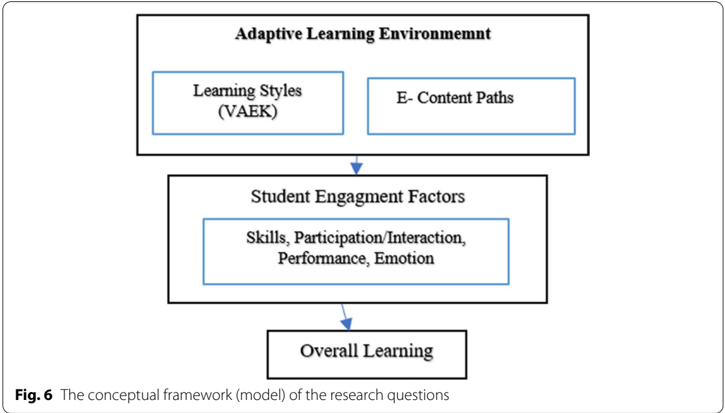
Abstract Adaptive e-learning is viewed as stimulation to support learning and improve student engagement, so designing appropriate adaptive e-learning environments contributes to personalizing instruction to reinforce learning outcomes. The purpose of this paper is to design an adaptive e-learning environment based on students' learning styles and study the impact of the adaptive e-learning environment on students’ engagement. This research attempts as well to outline and compare the proposed adaptive e-learning environment with a conventional e-learning approach. The paper is based on mixed research methods that were used to study the impact as follows: Development method is used in designing the adaptive e-learning environment, a quasi-experimental research design for conducting the research experiment. The student engagement scale is used to measure the following affective and behavioral factors of engagement (skills, participation/interaction, performance, emotional). The results revealed that the experimental group is statistically significantly higher than those in the control group. These experimental results imply the potential of an adaptive e-learning environment to engage students towards learning. Several practical recommendations forward from this paper: how to design a base for adaptive e-learning based on the learning styles and their implementation; how to increase the impact of adaptive e-learning in education; how to raise cost efficiency of education. The proposed adaptive e-learning approach and the results can help e-learning institutes in designing and developing more customized and adaptive e-learning environments to reinforce student engagement.
Overview
CoChat Summary
TL;DR
This paper designed an adaptive e-learning environment based on VARK learning styles and tested its impact on first-year university students’ engagement in a learning skills course. The experimental group showed significantly higher post-test engagement than the conventional e-learning control group across skills, participation/interaction, performance, and emotional factors.
Key findings
- Pre-test equivalence: no significant differences between experimental and control groups on engagement overall or on any factor (t values 0.464, 0.514, 0.321, 0.397, 0.632; p > 0.05).
- Post-test: the experimental group scored significantly higher than the control group on all engagement factors: skills 34.81 vs 23.34 (t = 4.086, p = 0.001); participation/interaction 21.05 vs 13.26 (t = 2.210, p = 0.002); performance 25.86 vs 14.60 (t = 2.071, p = 0.003); emotional 24.93 vs 13.07 (t = 2.909, p = 0.001); average score 38.87 vs 26.13 (t = 4.738, p = 0.003).
- Effect size: Cohen’s d = 0.826 and effect-size r = 0.401; the paper describes this as a large effect, with the treated group’s mean at the 79th percentile of the control group.
- Instrument reliability: VARK questionnaire Cronbach’s alpha = 0.83; engagement scale full alpha = 0.81, with subscale alphas from 0.80 to 0.87.
Methods
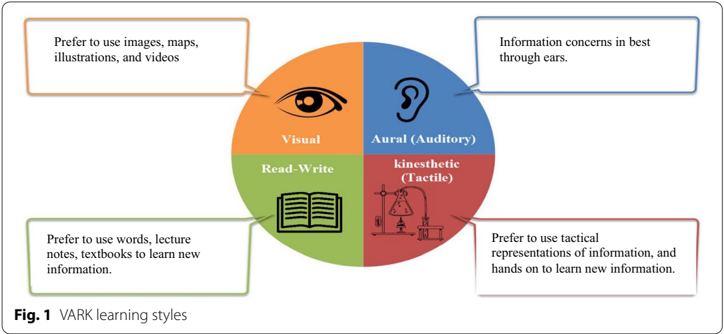
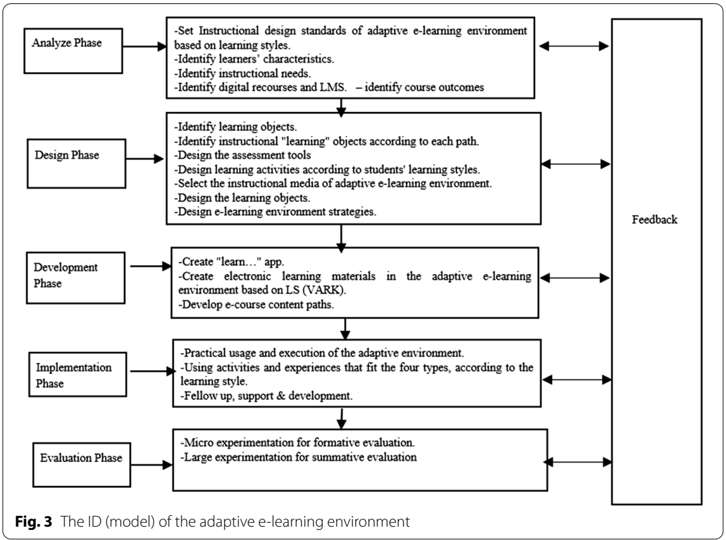
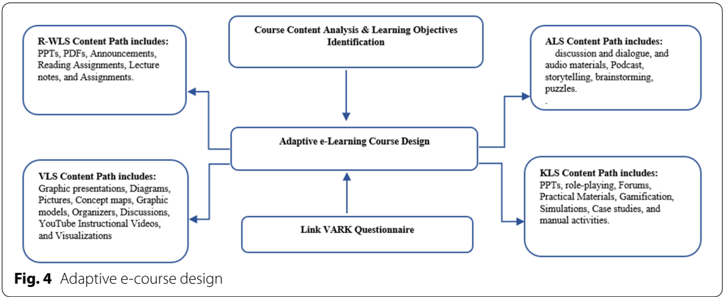
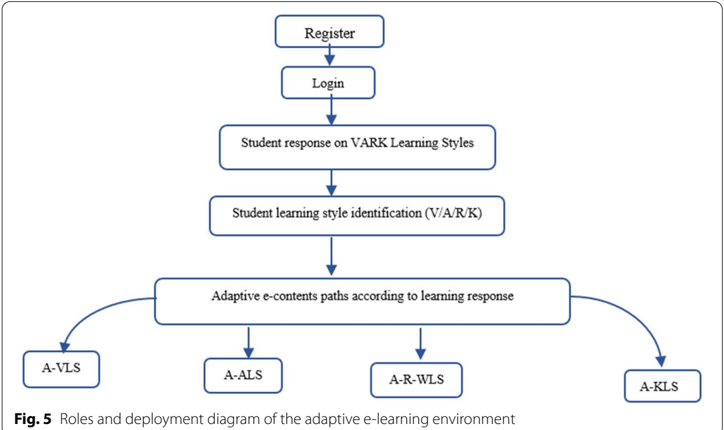
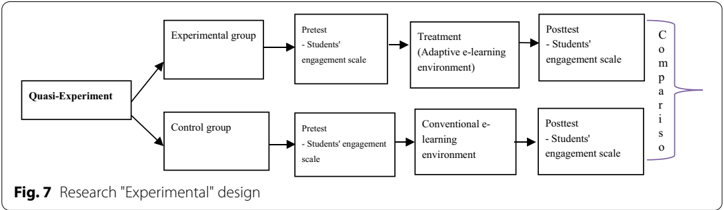
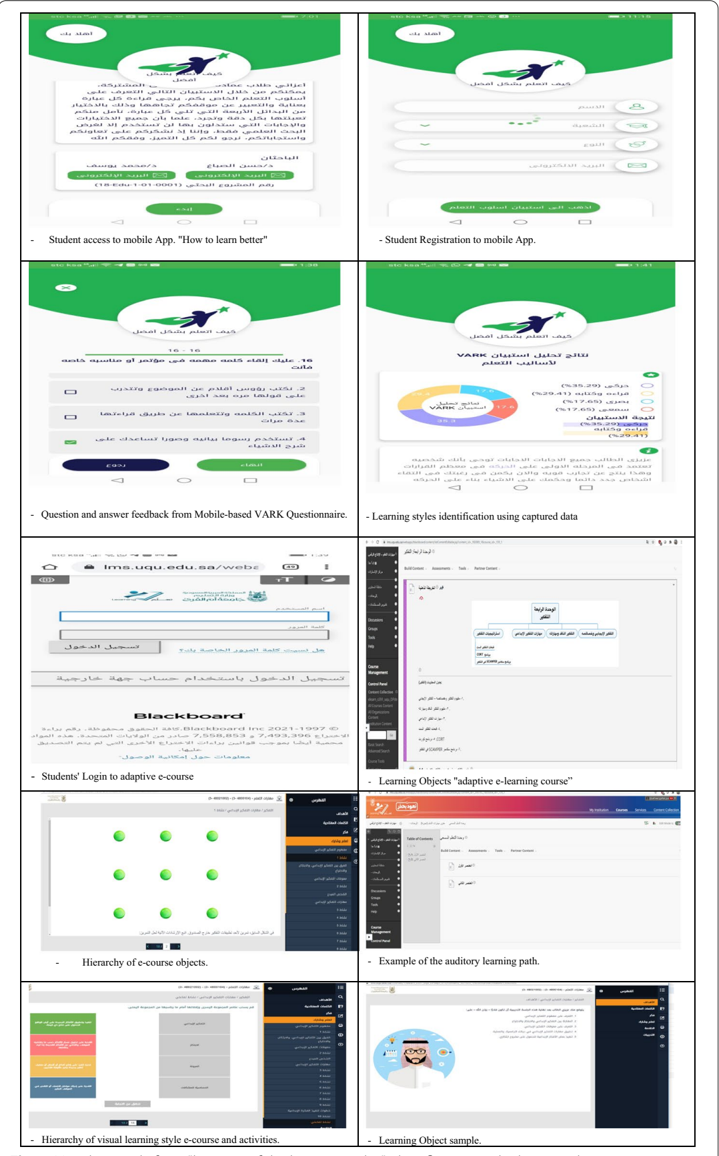
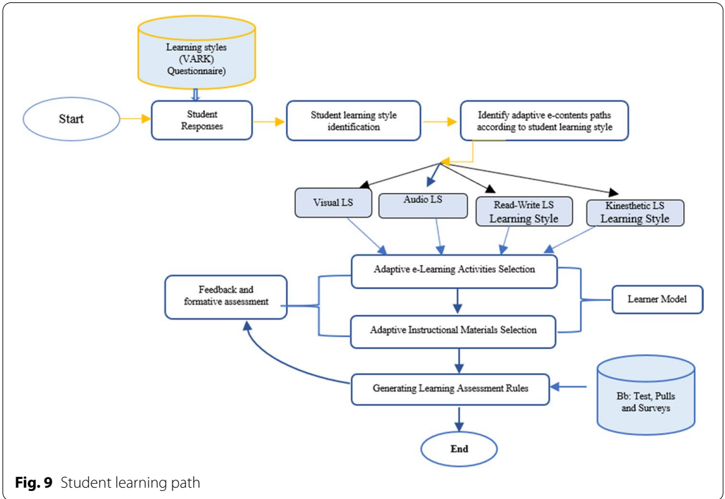
- Quasi-experimental pretest-posttest design; the adaptive e-learning environment was developed using the ADDIE instructional design model, with content paths based on VARK learning styles (visual, auditory, read/write, kinesthetic).
- Participants were 118 first-year “learning skills” students aged 17–18 at Umm Al-Qura University in the 2019/2020 academic year: control group N = 58 (31 males, 27 females) and experimental group N = 60 (36 males, 24 females), taught by the same instructors.
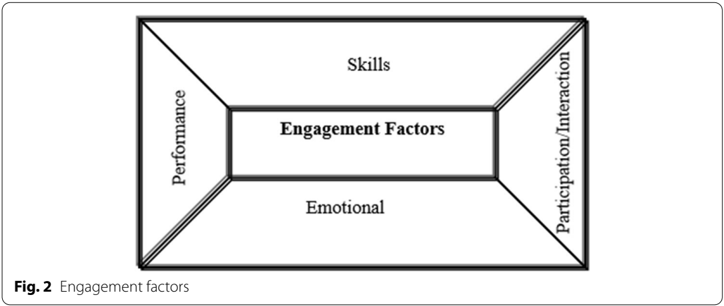
- Instruments and analysis: electronic VARK questionnaire (16 MCQ items); adapted Dixson student engagement scale (27 items, 5-point, four factors: skills, participation/interaction, performance, emotional), piloted on 20 students; independent-sample t-tests and Cohen’s d were used.
Limitations
- Stated in the paper: the study is restricted to one aspect of content adaptation—learning materials adapted based on learning styles—and notes that other considerations include content-dependent adaptation. It also states that empirical findings on adapting instruction to learning style are mixed and that Murray and Pérez found adaptive learning environments have a limited impact on learning outcome.
- Evident from the text: the study is limited to a single institution and a single “learning skills” course with first-year students, uses a short pretest-posttest window, and measures engagement through a self-report scale, which limits broader generalization and long-term conclusions.
Model-written summary. Check it against the paper before relying on it.
Integrity signals
Registry
Cites
Statistics
Figures
Verification
Claims the paper makes
5 Valid · 2 Not valid · 24 Not checked · 46 Own results and interpretations
The cited sources that could be checked couldn’t confirm or dispute this claim.
In the paper
“According to the findings of (Akbulut & Cardak, 2012;Alshammari & Qtaish, 2019;Alzain et al., 2018a, b;Shi et al., 2013;Truong, 2016), adaptation based on a combination of learning style, and information level yields significantly better learning gains.”
§ Adaptive e-learning environment based on learning styles and its impact on development students' engagement > Adaptive e-learning environments based on learning styles
What the sources say
- Not checked — no full text of the sourcecites Akbulut & Cardak, 2012 matched to “Adaptive educational hypermedia accommodating learning styles: A content analysis of publications from 2000 to 2011” (2012) source
- Not matchedcites Shi et al., 2013
An author–year citation the paper’s reference list doesn’t settle. We don’t search these by name.
- Could not verifycites Truong, 2016 matched to “Integrating learning styles and adaptive e-learning system: Current developments, problems and opportunities” (2016) sourceExperimental — accuracy not yet measured
Our copy of Truong (2016) is a systematic review of learning-styles integration into adaptive e-learning systems; its retrievable passages cover the Introduction (learning-styles theories, drawbacks of questionnaire measurement), Section 2 Search methods (51 papers, 2004-2014) and Section 3.1 (the integration-process classification). None of them mentions adapting on a combination of learning style AND information level, nor reports significantly better learning gains; the nearest statement is the generic Introduction claim of 'several positive results in both learning styles detection... and applications'. Searched: 'information level', 'learning gains / achievement test scores / statistically significant difference', 'combining learning styles with other characteristics such as prior knowledge', 'evaluation of adaptive system effect on student performance' — no supporting or contrary passage returned. (LLM, conf=0.68)
plainstates a cause- Asserted: passes — The authors put it forward as true.
- Checkable: passes — It can be checked against evidence.
- Load-bearing: passes — The paper’s conclusions depend on it.
- Based: passes — The paper gives a reason why it holds.
Every source the paper cites for this claim was checked and supports it.
In the paper
“There is also evidence that an adaptive environment positively impacts other aspects of quality such as student engagement (Murray & Pérez, 2015).”
§ Adaptive e-learning environment based on learning styles and its impact on development students' engagement > Discussions and limitations
What the sources say
- Supportedcites Murray & Pérez, 2015 matched to “Informing and Performing: A Study Comparing Adaptive Learning to Traditional Learning” (2015) source
The Conclusion states that there is evidence adaptive systems positively affect aspects of quality including student engagement. The claim closely paraphrases that statement; the paper cites Jarrett (2013) and Zimmer (2014) for the evidence. (LLM, conf=0.94)
plainstates a cause- Asserted: passes — The authors put it forward as true.
- Checkable: passes — It can be checked against evidence.
- Load-bearing: unclear — It is unclear whether the paper’s conclusions depend on it.
- Based: passes — The paper gives a reason why it holds.
- Supported
Every source the paper cites for this claim was checked and supports it.
In the paper
“(Chun-Hui et al., 2017) demonstrated that adaptive eLearning technologies can be beneficial to students' learning and development.”
§ Adaptive e-learning environment based on learning styles and its impact on development students' engagement > Discussions and limitations
What the sources say
- Supportedcites Chun-Hui et al., 2017 matched to “An Adaptive e-Learning System for Enhancing Learning Performance: Based on Dynamic Scaffolding Theory” (2017) source
The Abstract (p. 1) states that 'the developed adaptive e-learning system can effectively support students with personalized learning materials and successfully helps students acquired knowledge and develop cognitive abilities,' which is exactly the benefit to students' learning and development the citing sentence attributes. The hedged wording ('can be beneficial') matches the source's own claim, though the underlying evidence is a single experimental study of 60 undergraduates in an Excel spreadsheet course, with the authors flagging limited generalizability — so the generalization to adaptive e-learning technologies broadly rests on that narrow base. No contrary statement was found in our copy. (LLM, conf=0.85)
boostedstates a cause- Asserted: passes — The authors put it forward as true.
- Checkable: passes — It can be checked against evidence.
- Load-bearing: passes — The paper’s conclusions depend on it.
- Based: passes — The paper gives a reason why it holds.
- Supported
A result the paper reports from its own data — it cites no other source for it, so there is none to check. The quote shows it is in the paper.
In the paper
“Table 4. indicates that students in the experimental group had significantly higher mean of engagement post-test (engagement factors items) scores than students in the control group (p < 0.05).”
§ Adaptive e-learning environment based on learning styles and its impact on development students' engagement > Findings
hedgedstates a cause- Asserted: passes — The authors put it forward as true.
- Checkable: passes — It can be checked against evidence.
- Load-bearing: passes — The paper’s conclusions depend on it.
- Based: passes — The paper gives a reason why it holds.
A result the paper reports from its own data — it cites no other source for it, so there is none to check. The quote shows it is in the paper.
In the paper
“The results revealed that the experimental group is statistically significantly higher than those in the control group.”
§ Adaptive e-learning environment based on learning styles and its impact on development students' engagement > Abstract
plainstates a cause- Asserted: passes — The authors put it forward as true.
- Checkable: passes — It can be checked against evidence.
- Load-bearing: passes — The paper’s conclusions depend on it.
- Based: passes — The paper gives a reason why it holds.
15 more claims
Create a free account to see all 77 claims and to verify the 18 references still open.
- Probably not a substantial claim. 26
- It may state two separate claims as one. 39
- The quote only partly states this claim. 6
Claims other papers make about this one
Each is checked against this paper’s own text: does it say what the citing paper says it does?
In the citing paper
“Additionally, compliance with theoretical learning can be enhanced among trainees with customized sessions, supporting individual learning styles accessible anywhere and anytime17 compared with conventional lectures.”
From Neurosurgery resident training using blended learning concepts: Course development and participant evaluation (2022) · cites this paper as [17]
In the citing paper
“These systems enable trainees to individually study theoretical content based on their respective preferences, needs, and prior knowledge.17”
From Neurosurgery resident training using blended learning concepts: Course development and participant evaluation (2022) · cites this paper as [17]
Self-check
Percentages, sums and reported differences re-computed from the paper’s own numbers.
Each contradiction between two passages listed here was confirmed by an independent check.
Rated major: it would touch a result — a value a result rests on, reported and recomputed p-values on opposite sides of the significance level, two passages that conflict with no sign which is right, or a cited work retracted before this paper was published.
In the paper
“| Whole engagement scale | Experiment | 60 | 26.76 | 1.84 | 0.632 |”
§ Adaptive e-learning environment based on learning styles and its impact on development students' engagement > Research implication
Reported 26.76 · recomputed 58.57
Rated minor: it would not touch a result — a value no result rests on, a p-value that stays on the same side of the significance level, or a conflict that is clerical, resolved elsewhere in the paper, or outside its own findings.
In the paper
§ Adaptive e-learning environment based on learning styles and its impact on development students' engagement > Research implication
“Table: 4 Table 4 Descriptive data and independent sample t-tests of the pre-test results”
§ Adaptive e-learning environment based on learning styles and its impact on development students' engagement > Findings
“Table 4. indicates that students in the experimental group had significantly higher mean of engagement post-test (engagement factors items) scores than students in the control group (p < 0.05).”
Rated minor: it would not touch a result — a value no result rests on, a p-value that stays on the same side of the significance level, or a conflict that is clerical, resolved elsewhere in the paper, or outside its own findings.
In the paper
§ Adaptive e-learning environment based on learning styles and its impact on development students' engagement > Research participants
“All participants were chosen in the academic year 2109-2020 at the first term which was taught by the same instructors.”
§ Adaptive e-learning environment based on learning styles and its impact on development students' engagement > Learner content path in adaptive e-learning environment
“The present study covered the 1st semester during the 2019/2020 academic year.”
Citations
Cites
School Engagement: Potential of the Concept, State of the Evidence
Fredricks, J. A., Blumenfeld, P. C., & Paris, A. H. (2004) · Review of Educational Research · doi:10.3102/00346543074001059 · Cited by 12,581 · cited 1×
“Previous research has emphasized that student participation is a key factor in overcoming academic problems such as poor academic performance, isolation, and high dropout rates (Fredricks et al., 2004).”
BackgroundCohen, J. (1992) · Current Directions in Psychological Science · doi:10.1111/1467-8721.ep10768783 · Cited by 5,870
Research in Education: Evidence Based Inquiry
McMillan, J. H., & Schumacher, S. (2005) · Medical Entomology and Zoology · Cited by 3,999
Pashler, H., McDaniel, M., Rohrer, D., & Bjork, R. (2008) · Psychological Science in the Public Interest · doi:10.1111/j.1539-6053.2009.01038.x · Cited by 2,147
How video production affects student engagement: an empirical study of MOOC videos
Guo, P. J., Kim, J., & Rubin, R. (2014) · Proceedings of the first ACM conference on Learning @ scale conference · doi:10.1145/2556325.2566239 · Cited by 1,850 · cited 1×
“Guo et al. (2014) checked the participation of students when they watched videos.”
BackgroundHinton, P., McMurray, I., & Brownlow, C. (2014) · Routledge eBooks · doi:10.4324/9781315797298 · Cited by 1,022
Handbook of Individual Differences, Learning, and Instruction
Jonassen, D. H., & Grabowski, B. L. (2012) · Routledge eBooks · doi:10.4324/9780203052860 · Cited by 934
Engaging online learners: The impact of Web-based learning technology on college student engagement
Chen, P.-S. D., Lambert, A. D., & Guidry, K. R. (2010) · Computers & Education · doi:10.1016/j.compedu.2009.11.008 · Cited by 785 · cited 1×
“E-learning produces constructive learning outcomes, as it allows students to actively participate in learning at anytime and any-place (Chen et al., 2010; Lee et al., 2019).”
BackgroundStudent Engagement Techniques: A Handbook for College Faculty
Barkley, E. F. (2009) · Cited by 765
Measuring Student Engagement in the Online Course: The Online Student Engagement Scale (OSE)
Dixson, M. D. (2015) · Online Learning · doi:10.24059/olj.v19i4.561 · Cited by 707 · cited 5×
“Hence, previous research has moved beyond comparing online and face-to-face classes to investigating ways to improve online learning (Dixson, 2015; Gaytan & McEwen, 2007; Lévy & Wakabayashi, 2008; Mutahi et al., 2017).”
BackgroundInfluentialNew Benchmarks in Higher Education: Student Engagement in Online Learning
Robinson, C. C., & Hullinger, H. (2008) · Journal of Education for Business · doi:10.3200/joeb.84.2.101-109 · Cited by 618
E-Learning personalization based on hybrid recommendation strategy and learning style identification
Klašnja-Milićević, A., Vesin, B., Ivanović, M., & Budimac, Z. (2011) · Computers & Education · doi:10.1016/j.compedu.2010.11.001 · Cited by 580
Effective Online Instructional and Assessment Strategies
Gaytan, J., & McEwen, B. C. (2007) · American Journal of Distance Education · doi:10.1080/08923640701341653 · Cited by 541
Truong, H. M. (2016) · Computers in Human Behavior · doi:10.1016/j.chb.2015.02.014 · Cited by 531 · cited 3×
“The extensive scholarly literature on learning styles is distributed with few strong experimental findings (Truong, 2016), and a few findings on the effect of adapting instruction to learning style.”
BackgroundWSEAS TRANSACTIONS ON INFORMATION SCIENCE AND APPLICATIONS
(2020) · WSEAS Transactions on Information Science and Applications archive · doi:10.37394/23209 · Cited by 393
The Scientific Status of Learning Styles Theories
Willingham, D. T., Hughes, E. M., & Dobolyi, D. G. (2015) · Teaching of Psychology · doi:10.1177/0098628315589505 · Cited by 387
Hussain, M., Zhu, W., Zhang, W., & Abidi, S. M. R. (2018) · Computational Intelligence and Neuroscience · doi:10.1155/2018/6347186 · Cited by 382 · cited 1×
“For instance, using a variety of methods and input features to test the relationship between student data and student participation (Hussain et al., 2018).”
MethodExploring Factors, and Indicators for Measuring Students’ Sustainable Engagement in e-Learning
Lee, J., Song, H.-D., & Hong, A. J. (2019) · Sustainability · doi:10.3390/su11040985 · Cited by 323
Student Learning Preferences and Teaching Implications
Murphy, R. J., Gray, S. A., Straja, S. R., & Bogert, M. C. (2004) · Journal of Dental Education · doi:10.1002/j.0022-0337.2004.68.8.tb03835.x · Cited by 282
Student Learning Styles Adaptation Method Based on Teaching Strategies and Electronic Media
Franzoni, A. L., Assar, S., Defude, B., & Rojas, J. (2008) · 2008 Eighth IEEE International Conference on Advanced Learning Technologies · doi:10.1109/icalt.2008.149 · Cited by 277
Akbulut, Y., & Cardak, C. S. (2012) · Computers & Education · doi:10.1016/j.compedu.2011.10.008 · Cited by 269 · cited 1×
“According to the findings of (Akbulut & Cardak, 2012; Alshammari & Qtaish, 2019; Alzain et al., 2018a, b; Shi et al., 2013; Truong, 2016), adaptation based on a combination of learning style, and information level yields significantly better learning gains.”
ResultJournal of Economics and Economic Education Research
Abdullaevich, B. R., Вакифович, Г. Л., & Ilinichna, E. O. (2016) · zvestiya of the National Academy of Sciences of Belarus (National Academy of Sciences of Belarus) · Cited by 247
(1972) · The British Journal of Psychiatry · doi:10.1192/s0007125072301765 · Cited by 205
Identification of personal traits in adaptive learning environment: Systematic literature review
Afini Normadhi, N. B., Shuib, L., Md Nasir, H. N., Bimba, A., Idris, N., & Balakrishnan, V. (2019) · Computers & Education · doi:10.1016/j.compedu.2018.11.005 · Cited by 204
Shih, M., Feng, J., & Tsai, C.-C. (2008) · Computers & Education · doi:10.1016/j.compedu.2007.10.004 · Cited by 202 · cited 1×
“According to some studies (Alshammari & Qtaish, 2019; Lee & Kim, 2012; Shih et al., 2008; Verdú, et al., 2008; Yalcinalp & Avc, 2019), there is little attention paid to the needs and preferences of individual learners, and as a result, all learners are treated in the same way.”
BackgroundInternational Journal of Multimedia and Ubiquitous Engineering
(2019) · International Journal of Multimedia and Ubiquitous Engineering · doi:10.14257/ijmue · Cited by 192
Özyurt, Ö., & Özyurt, H. (2015) · Computers in Human Behavior · doi:10.1016/j.chb.2015.06.020 · Cited by 186
Providing Adaptive Courses in Learning Management Systems with Respect to Learning Styles
Graf, S., & Kinshuk, K. (2007) · E-Learn: World Conference on E-Learning in Corporate, Government, Healthcare, and Higher Education · Cited by 159
Dixson, M. D., Greenwell, M. R., Rogers-Stacy, C., Weister, T., & Lauer, S. (2017) · Communication Education · doi:10.1080/03634523.2016.1209222 · Cited by 152
Personalized recommender system for e-Learning environment
Benhamdi, S., Babouri, A., & Chiky, R. (2017) · Education and Information Technologies · doi:10.1007/s10639-016-9504-y · Cited by 146
Informing and Performing: A Study Comparing Adaptive Learning to Traditional Learning
Coffin Murray, M., & Pérez, J. (2015) · InSITE Conference · doi:10.28945/2140 · Cited by 139
Informing and Performing: A Study Comparing Adaptive Learning to Traditional Learning
Coffin Murray, M., & Pérez, J. (2015) · Informing Science: The International Journal of an Emerging Transdiscipline · doi:10.28945/2165 · Cited by 139 · cited 2×
“There is also evidence that an adaptive environment positively impacts other aspects of quality such as student engagement (Murray & Pérez, 2015).”
BackgroundAn overview of adaptive e-learning systems
Ennouamani, S., & Mahani, Z. (2017) · 2017 Eighth International Conference on Intelligent Computing and Information Systems (ICICIS) · doi:10.1109/intelcis.2017.8260060 · Cited by 105
Hinton, P. R. (2014) · doi:10.4324/9781315797564 · Cited by 94
IADIS INTERNATIONAL JOURNAL ON WWW/INTERNET
(2019) · IADIS INTERNATIONAL JOURNAL ON WWW/INTERNET · doi:10.33965/ijwi · Cited by 91
Prediction of Learner’s Profile based on Learning Styles in Adaptive E-learning System
Kolekar, S. V., Pai, R. M., & M M, M. P. (2017) · International Journal of Emerging Technologies in Learning (iJET) · doi:10.3991/ijet.v12i06.6579 · Cited by 87 · cited 2×
“( Franzoni & Assar, 2009; Kolekar et al., 2017).”
Journal of Literature, Languages and Linguistics
Torusdağ, G., & Torusdağ, M. (2019) · doi:10.7176/jlll · Cited by 82
Aldosari, M., Aljabaa, A., Al-Sehaibany, F. S., & Albarakati, S. F. (2018) · Advances in Medical Education and Practice · doi:10.2147/amep.s157686 · Cited by 80
Illustrating an ideal adaptive e-learning: A conceptual framework
Beldagli, B., & Adiguzel, T. (2010) · Procedia - Social and Behavioral Sciences · doi:10.1016/j.sbspro.2010.03.939 · Cited by 79 · cited 2×
“(Beldagli & Adiguzel, 2010; Kolekar et al., 2017).”
BackgroundThe Evaluation of a Moodle Based Adaptive e-Learning System
Dwi, H. D. H. (2013) · International Journal of Information and Education Technology · doi:10.7763/ijiet.2014.v4.375 · Cited by 76
Chen, Y.-S., Wu, C.-H., & Chen, T.-G. (2017) · EURASIA Journal of Mathematics, Science and Technology Education · doi:10.12973/ejmste/81061 · Cited by 70
E-Learning personalization based on Dynamic learners' preference
Bachari, E. E., Abelwahed, E. H., & El Adnani, M. (2011) · International Journal of Computer Science and Information Technology · doi:10.5121/ijcsit.2011.3314 · Cited by 67
An analysis of the research on adaptive learning: the next generation of e-learning
Verdú, E., Regueras, L. M., Pérez, M., Fernández, J. P. D. C., & Pérez-Juárez, M. A. (2008) · UVaDOC UVaDOC University of Valladolid Documentary Repository (University of Valladolid) · Cited by 59
Adaptive Education based on Learning Styles: Are Learning Style Instruments Precise Enough?
Alzain, A., Clark, S., Ireson, G., & Jwaid, A. E. (2018) · International Journal of Emerging Technologies in Learning (iJET) · doi:10.3991/ijet.v13i09.8554 · Cited by 58
Atherton, M., Shah, M., Vazquez, J., Griffiths, Z., Jackson, B., & Burgess, C. (2017) · Open Learning: The Journal of Open, Distance and e-Learning · doi:10.1080/02680513.2017.1309646 · Cited by 55
Creativity and Emerging Digital Educational Technologies: A Systematic Review.
Yalçınalp, S., & Avcı, Ü. (2019) · The Turkish Online Journal of Educational Technology · Cited by 54
Effective Adaptive E-Learning Systems According to Learning Style and Knowledge Level
T Alshammari, M., & Qtaish, A. (2019) · Journal of Information Technology Education: Research · doi:10.28945/4459 · Cited by 53 · cited 5×
“According to some studies (Alshammari & Qtaish, 2019; Lee & Kim, 2012; Shih et al., 2008; Verdú, et al., 2008; Yalcinalp & Avc, 2019), there is little attention paid to the needs and preferences of individual learners, and as a result, all learners are treated in the same way.”
BackgroundResultInfluentialAdaptive E-learning Content Design and Delivery Based on Learning Styles and Knowledge Level
Vassileva, D. (2012) · Serdica Journal of Computing · doi:10.55630/sjc.2012.6.207-252 · Cited by 53
Hypothesized Learners' Technology Preferences Based on Learning Style Dimensions.
Naimie, Z., Siraj, S., Abuzaid, R. A., & Shagholi, R. (2010) · The Turkish Online Journal of Educational Technology · Cited by 46
Pardo, A., Han, F., & Ellis, R. A. (2016) · Proceedings of the Sixth International Conference on Learning Analytics & Knowledge - LAK '16 · doi:10.1145/2883851.2883883 · Cited by 46
Alshammari, M., Anane, R., & Hendley, R. J. (2015) · Lecture Notes in Computer Science · doi:10.1007/978-3-319-22668-2_45 · Cited by 43 · cited 1×
“Adaptive e-learning focused on learner experience and learning style has a higher degree of perceived usability than a non-adaptive e-learning system, according to Alshammari et al. (2015).”
BackgroundEvaluation of Learning Style for First Year Medical Students
Johnson, M. (2009) · International Journal for the Scholarship of Teaching and Learning · doi:10.20429/ijsotl.2009.030120 · Cited by 35
Nuankaew, P., Nuankaew, W. S., Phanniphong, K., Imwut, S., & Bussaman, S. (2019) · International Journal of Emerging Technologies in Learning (iJET) · doi:10.3991/ijet.v14i12.10352 · Cited by 32
(2013) · Warwick Research Archive Portal (University of Warwick) · Cited by 25
Pedagogical Agents in an Adaptive E-learning System
M. Ali. Hussein, A., & Al-Chalabi, H. K. M. (2020) · SAR Journal - Science and Research · doi:10.18421/sar31-04 · Cited by 25 · cited 1×
“This leads to improved learning outcomes (Al-Chalabi & Hussein, 2020; Chun-Hui et al., 2017; Hussein & Al-Chalabi, 2020; Pashler et al., 2008).”
BackgroundPedagogical Implications of VARK Model of Learning
(2017) · Cited by 24
Studying engagement and performance with learning technology in an African classroom
Mutahi, J., Kinai, A., Bore, N., Diriye, A., & Weldemariam, K. (2017) · International Conference on Learning Analytics and Knowledge (LAK) · doi:10.1145/3027385.3027395 · Cited by 23
A Model of Adaptive e-learning Hypermedia System based on Thinking and Learning Styles
Lamia, M., Laskri, M. T., & Trigano, P. (2013) · Cited by 22
Dattalo, P. (2008) · Oxford University Press eBooks · doi:10.1093/acprof:oso/9780195315493.003.0002 · Cited by 22
A Framework to Formulate Adaptivity for Adaptive e-Learning System Using User Response Theory
Dominic, M., Xavier, B. A., & Francis, S. (2015) · International Journal of Modern Education and Computer Science · doi:10.5815/ijmecs.2015.01.04 · Cited by 21
Adaptation based on Learning Style and Knowledge Level in E-Learning Systems
(2016) · University of Birmingham Institutional Research Archive (University of Birmingham) · doi:10.13140/rg.2.1.2724.1849 · Cited by 20
AeLF: Mixing Adaptive Learning System with Learning Management System
Qazdar, A., Cherkaoui, C., Er-Raha, B., & Mammass, D. (2015) · International Journal of Computer Applications · doi:10.5120/21140-4171 · Cited by 18
Daines, J., Troka, T., & Santiago, J. (2016) · 2016 ASEE Annual Conference & Exposition Proceedings · doi:10.18260/p.25624 · Cited by 17
Students’ engagement in school: analysis according to self-concept and grade level
Veiga, F. H., Robu, V., Appleton, J. J., Festas, I., & Galvão, D. (2014) · Portuguese National Funding Agency for Science, Research and Technology (RCAAP Project by FCT) · Cited by 15
Enhancing Student Engagement through Personalized Motivations
Staikopoulos, A., OKeeffe, I., Yousuf, B., Conlan, O., Walsh, E., & Wade, V. (2015) · 2015 IEEE 15th International Conference on Advanced Learning Technologies · doi:10.1109/icalt.2015.116 · Cited by 14
Adaptive Learning System Applied Bruner’ EIS Theory
Lee, J., & Kim, D.-G. (2012) · IERI Procedia · doi:10.1016/j.ieri.2012.06.173 · Cited by 13 · cited 1×
“According to some studies (Alshammari & Qtaish, 2019; Lee & Kim, 2012; Shih et al., 2008; Verdú, et al., 2008; Yalcinalp & Avc, 2019), there is little attention paid to the needs and preferences of individual learners, and as a result, all learners are treated in the same way.”
BackgroundStudent engagement techniques: a handbook for college faculty, 2nd ed.
(2020) · Cited by 13
Designing social personalized adaptive e-learning
Shi, L., Qudah, D. A., & Cristea, A. I. (2013) · ACM Conference on Innovation and Technology in Computer Science Education (ITiCSE) · doi:10.1145/2462476.2466520 · Cited by 13
Vark Learning Styles and Student Performance in Principles of Micro- vs. Macro-Economics
Leung, A., McGregor, M., Sabiston, D., & Vriliotis, S. (2014) · Journal of economics and economic education research · Cited by 12
Learning Personalization Based on Learning Style instruments
Alzain, A., Clark, S., Ireson, G., & Jwaid, A. E. (2018) · Advances in Science Technology and Engineering Systems Journal · doi:10.25046/aj030315 · Cited by 8
A Model for an Adaptive e-Learning Hypermedia System
Lamia, M., Laskri, M. T., & Trigano, P. (2013) · International Journal of Information and Communication Technology Education · doi:10.4018/ijicte.2013100102 · Cited by 8
Al-Chalabi, H. K. M., & Ali. Hussein, A. M. (2020) · SAR Journal - Science and Research · doi:10.18421//sar31-01 · Cited by 7 · cited 6×
“Adaptive e-learning is likely to increase at an accelerating pace at all levels of instruction (Hussein & Al-Chalabi, 2020; Oxman & Wong, 2014).”
BackgroundInfluential"Developing Competency Model of Learners in Distance Universities "
Hong, S. (2009) · Journal of Educational Technology · doi:10.17232/kset.25.4.159 · Cited by 6
Management and object behavior of statecharts through statechart DNA
(2009) · Cited by 5
Sprock, A. S. (2020) · Revista de Estilos de Aprendizaje · doi:10.55777/rea.v13i25.1853 · Cited by 4
العلاقة بین أنماط التعلم والدافعیة للتعلم لدى طلاب جامعة أم القرى
الصباغ, ح., & حامد, ع. (2020) · المجلة العلمیة المحکمة للجمعیة المصریة للکمبیوتر التعلیمی · doi:10.21608/eaec.2020.25868.1015 · Cited by 4
Nkomo (2021) · doi:10.1186/s41239-021-00270-1
Research works printed but not linked: 8
- 4. Ali, N., Eassa, F., & Hamed, E. (2019). Personalized Learning Style for Adaptive E-Learning System, International Journal of Advanced Trends in Computer Science and Engineering. 223-230. Retrieved June 26, 2020 from http:// www. warse. org/ IJATC SE/ static/ pdf/ file/ ijatc se4181. 12019. pdf.
- 13. Behaz, A., & Djoudi, M. (2012). Adaptation of learning resources based on the MBTI theory of psychological types. IJCSI International Journal of Computer Science, 9(2), 135-141.
- 18. Cletus, D., & Eneluwe, D. (2020). The impact of learning style on student performance: mediate by personality. Interna- tional Journal of Education, Learning and Training. https:// doi. org/ 10. 24924/ ijelt/ 2019. 11/ v4. iss2/ 22. 47Des mond. · doi:10.24924/ijelt/2019.11/v4.iss2/22.47desmond
- 37. Jaleel, S., & Thomas, A. (2019). Learning styles theories and implications for teaching learning. Horizon Research Publishing. 978-1-943484-25-6.
- 45. Lévy, P. & Wakabayashi, N. (2008). User's appreciation of engagement in service design: The case of food service design. Proceedings of International Service Innovation Design Conference 2008 -ISIDC08. Busan, Korea. Retrieved October 28, 2019 from https:// www. resea rchga te. net/ publi cation/ 23058 4075.
- 46. Liang, J. S. (2012). The effects of learning styles and perceptions on application of interactive learning guides for web- based. Proceedings of Australasian Association for Engineering Education Conference AAEE. Melbourne, Australia. Retrieved October 22, 2019 from https:// aaee. net. au/ wpcon tent/ uploa ds/ 2018/ 10/ AAEE2 012-Liang.-Learn ing_ styles_ and_ perce ptions_ effec ts_ on_ inter active_ learn ing_ guide_ appli cation. pdf.
- 65. Roy, S., & Roy, D. (2011). Adaptive e-learning system: a review. International Journal of Computer Trends and Technology (IJCTT), 1(1), 78-81. ISSN:2231-2803.
- 75. Velázquez, A., & Assar, S. (2009). Student learning styles adaptation method based on teaching strategies and electronic media. Educational Technology & SocieTy., 12, 15-29.
Cited by
Adaptive Learning Using Artificial Intelligence in e-Learning: A Literature Review
Gligorea, I., Cioca, M., Oancea, R., Gorski, A.-T., Gorski, H., & Tudorache, P. (2023) · Education Sciences · doi:10.3390/educsci13121216 · Cited by 980
“The various learning preferences and styles of pupils are not taken into consideration in this sort of learning [5].”
BackgroundHalkiopoulos, C., & Gkintoni, E. (2024) · Electronics · doi:10.3390/electronics13183762 · Cited by 328
“This has led to growing interest in AA techniques, with substantial ongoing research exploring their application in e-learning environments [76–81].”
Yaseen, H., Mohammad, A. S., Ashal, N., Abusaimeh, H., Ali, A., & Sharabati, A.-A. A. (2025) · Sustainability · doi:10.3390/su17031133 · Cited by 207
Artificial intelligence-enabled adaptive learning platforms: A review
Tan, L. Y., Hu, S., Yeo, D. J., & Cheong, K. H. (2025) · Computers and Education: Artificial Intelligence · doi:10.1016/j.caeai.2025.100429 · Cited by 207
Mohebbi, A. (2025) · Cogent Education · doi:10.1080/2331186x.2024.2433814 · Cited by 161
“This adaptive approach ensures that learners are consistently challenged without being overwhelmed, which is crucial for maintaining motivation and engagement in the language learning process (El-Sabagh, 2021).”
Metadata
- Authors
- El-Sabagh, H. A.
- Affiliations
- Mansoura University (EG)
- Corresponding author
- El-Sabagh, Hassan A.
- ORCID
- El-Sabagh, Hassan A.
- Venue
- International Journal of Educational Technology in Higher Education
- Published
- 2021-10-01
- Volume
- 18
- Issue
- 1
- ISSN
- 2365-9440 (ISSN-L)
- OpenAlex
- W3203800336
- Cited by
- 566
- References
- 87
- Citations by year
- 2026: 108 · 2025: 190 · 2024: 143 · 2023: 95 · 2022: 28 · 2021: 2
- FWCI
- 23.69
- Type
- journal article
- Language
- en
- Open access
- diamond
- doi.org
- Licence
- cc-by
- creativecommons.org/licenses/by/4.0 (tdm)
- creativecommons.org/licenses/by/4.0 (vor)
- Locations
- International Journal of Educational Technology in Higher Education (publishedVersion, cc-by)
- DOAJ (DOAJ: Directory of Open Access Journals) (submittedVersion, cc-by-sa)
- Funders
- Umm Al-Qura University (18-EDU-1-01-0001)
- Topics
- Physical Sciences › Computer Science › Artificial Intelligence › Intelligent Tutoring Systems and Adaptive Learning
- Social Sciences › Psychology › Developmental and Educational Psychology › Learning Styles and Cognitive Differences
- Social Sciences › Education › Online and Blended Learning
- Keywords
- adaptive e-learning, learning styles, student engagement, personalized instruction, emotional engagement, behavioral engagement, e-learning environment design
About these checks
Registry, retraction, Cites and statistics results are computed, not judged, with one exception: a printed reference that no index lists is read once by a model before it counts as a citation error. Claims are extracted by a model and kept only when their quote appears verbatim in the text; each cited source is then checked, with a model’s help, for whether it says what the claim relies on. Those verdicts can be wrong — read the claim’s quote and the cited source before relying on one.
The claim verdicts this report counts are experimental: their accuracy is not yet measured.
A language model drew the claims from the paper on 2026-10-10, under version 3 of the claim definition (model deepseek-v4.1-flash, prompt extract-v3).
A second model labelled each claim on 2026-10-10 (model jev-1.13-20260917, definition revision gold-guideline-v0.2).
Cited sources are checked with a language model’s help (qwen3.8-omni-flash and gpt-6-sol).
Statistics and arithmetic are recomputed, not judged.
Confidence bands are shown only for fields calibrated on our annotated test set. None is calibrated yet, so no band is shown.
What counts as a claim ›How we measure confidence ›How we check this ›
Are you an author, or do you see a problem with this page? Request a review
Data sources
Bibliographic data: Semantic Scholar, OpenAlex, Crossref.
Contains information from the Semantic Scholar Academic Graph Datasets, made available under the ODC Attribution License (ODC-BY 1.0).
Semantic Scholar’s data is described in: Kinney, R., et al. (2023). The Semantic Scholar Open Data Platform. arXiv:2301.10140.
