

Adaptive e-learning environment based on learning styles and its impact on development students' engagement
Open accessThe DOI matches its Crossref record; 86 of the 87 references it cites were found in a registry or an index; 7 of the 46 sources its claims cite were checked for support.
Abstract
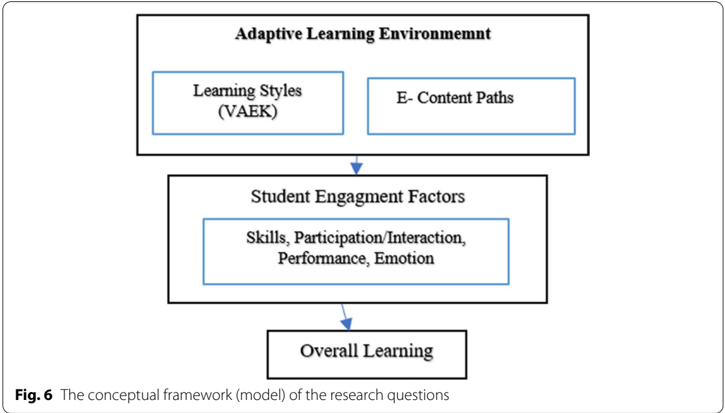
Abstract Adaptive e-learning is viewed as stimulation to support learning and improve student engagement, so designing appropriate adaptive e-learning environments contributes to personalizing instruction to reinforce learning outcomes. The purpose of this paper is to design an adaptive e-learning environment based on students' learning styles and study the impact of the adaptive e-learning environment on students’ engagement. This research attempts as well to outline and compare the proposed adaptive e-learning environment with a conventional e-learning approach. The paper is based on mixed research methods that were used to study the impact as follows: Development method is used in designing the adaptive e-learning environment, a quasi-experimental research design for conducting the research experiment. The student engagement scale is used to measure the following affective and behavioral factors of engagement (skills, participation/interaction, performance, emotional). The results revealed that the experimental group is statistically significantly higher than those in the control group. These experimental results imply the potential of an adaptive e-learning environment to engage students towards learning. Several practical recommendations forward from this paper: how to design a base for adaptive e-learning based on the learning styles and their implementation; how to increase the impact of adaptive e-learning in education; how to raise cost efficiency of education. The proposed adaptive e-learning approach and the results can help e-learning institutes in designing and developing more customized and adaptive e-learning environments to reinforce student engagement.
Overview
CoChat Summary
TL;DR
This paper designed an adaptive e-learning environment based on VARK learning styles and tested its impact on first-year university students’ engagement in a learning skills course. The experimental group showed significantly higher post-test engagement than the conventional e-learning control group across skills, participation/interaction, performance, and emotional factors.
Key findings
- Pre-test equivalence: no significant differences between experimental and control groups on engagement overall or on any factor (t values 0.464, 0.514, 0.321, 0.397, 0.632; p > 0.05).
- Post-test: the experimental group scored significantly higher than the control group on all engagement factors: skills 34.81 vs 23.34 (t = 4.086, p = 0.001); participation/interaction 21.05 vs 13.26 (t = 2.210, p = 0.002); performance 25.86 vs 14.60 (t = 2.071, p = 0.003); emotional 24.93 vs 13.07 (t = 2.909, p = 0.001); average score 38.87 vs 26.13 (t = 4.738, p = 0.003).
- Effect size: Cohen’s d = 0.826 and effect-size r = 0.401; the paper describes this as a large effect, with the treated group’s mean at the 79th percentile of the control group.
- Instrument reliability: VARK questionnaire Cronbach’s alpha = 0.83; engagement scale full alpha = 0.81, with subscale alphas from 0.80 to 0.87.
Methods
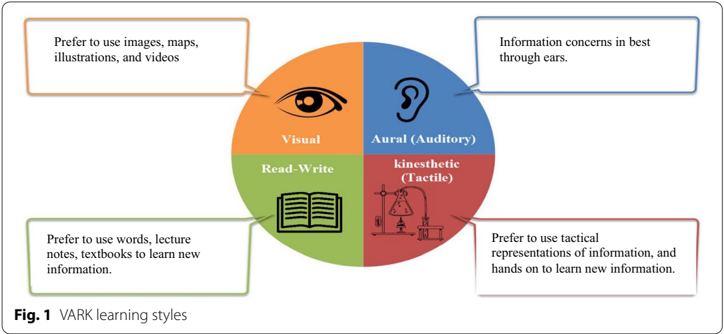
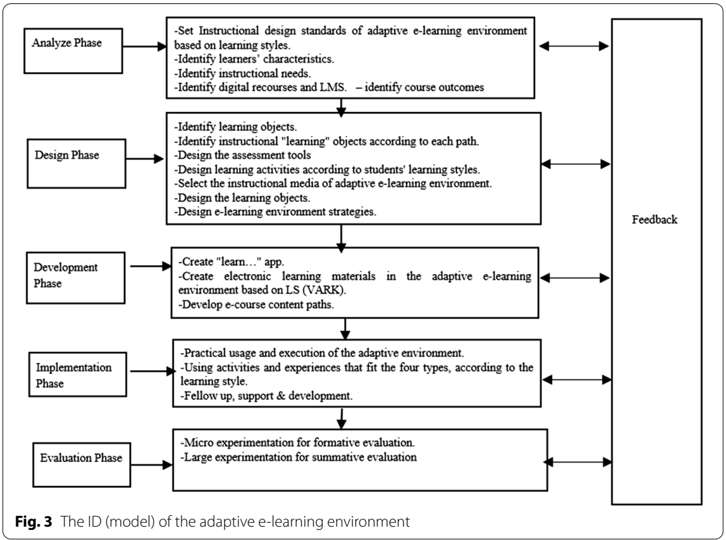
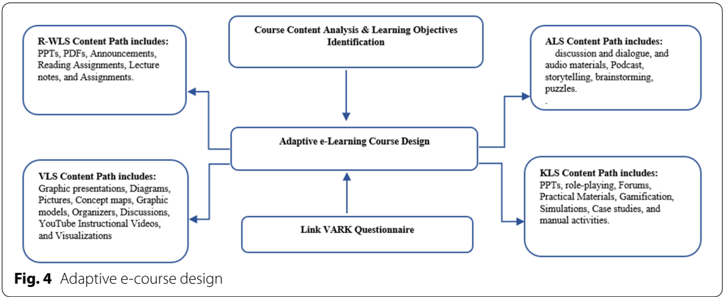
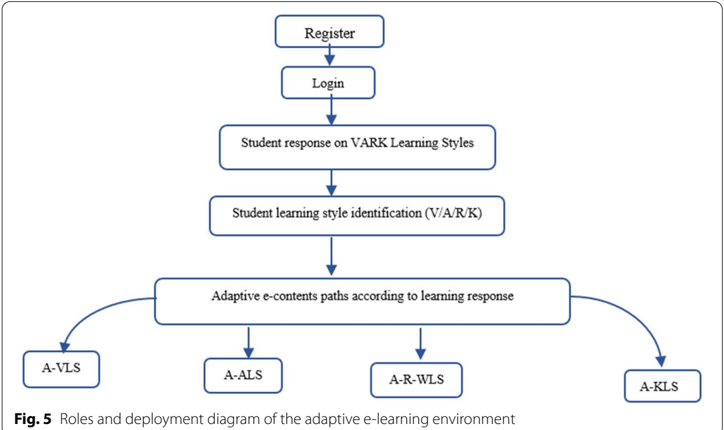
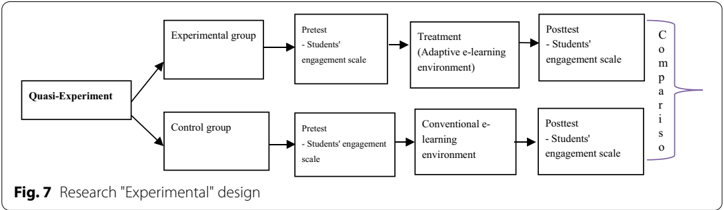
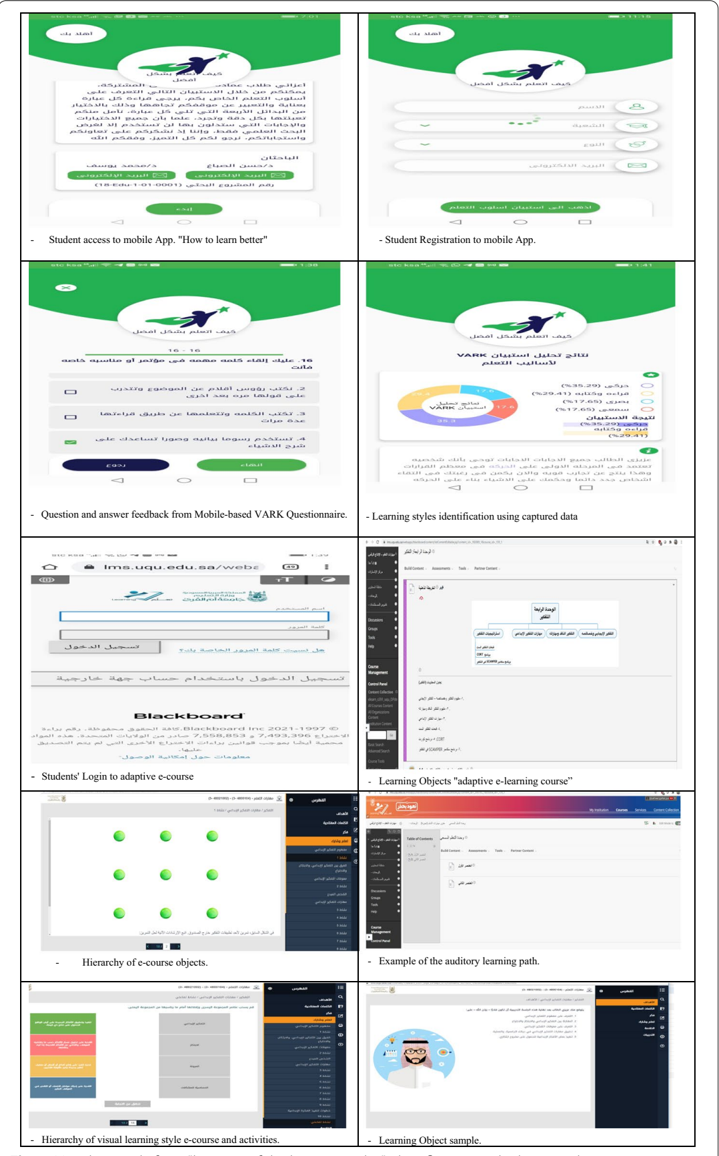
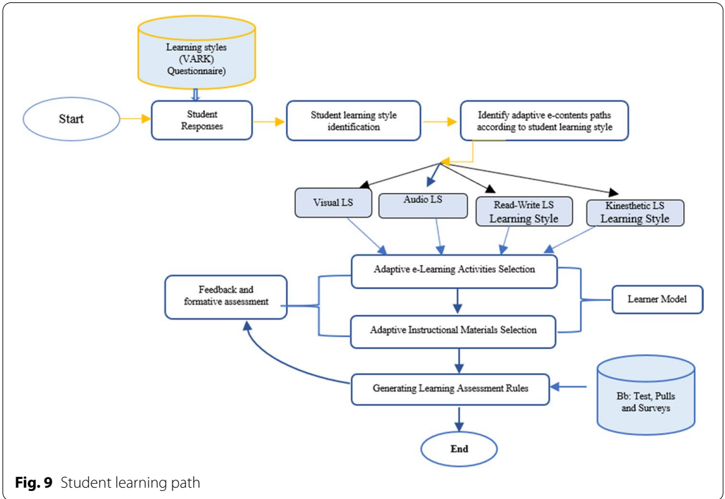
- Quasi-experimental pretest-posttest design; the adaptive e-learning environment was developed using the ADDIE instructional design model, with content paths based on VARK learning styles (visual, auditory, read/write, kinesthetic).
- Participants were 118 first-year “learning skills” students aged 17–18 at Umm Al-Qura University in the 2019/2020 academic year: control group N = 58 (31 males, 27 females) and experimental group N = 60 (36 males, 24 females), taught by the same instructors.
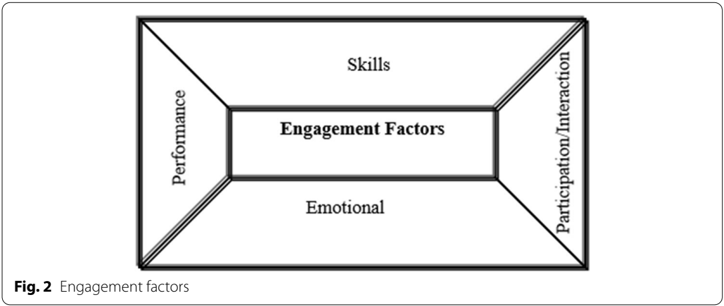
- Instruments and analysis: electronic VARK questionnaire (16 MCQ items); adapted Dixson student engagement scale (27 items, 5-point, four factors: skills, participation/interaction, performance, emotional), piloted on 20 students; independent-sample t-tests and Cohen’s d were used.
Limitations
- Stated in the paper: the study is restricted to one aspect of content adaptation—learning materials adapted based on learning styles—and notes that other considerations include content-dependent adaptation. It also states that empirical findings on adapting instruction to learning style are mixed and that Murray and Pérez found adaptive learning environments have a limited impact on learning outcome.
- Evident from the text: the study is limited to a single institution and a single “learning skills” course with first-year students, uses a short pretest-posttest window, and measures engagement through a self-report scale, which limits broader generalization and long-term conclusions.
Model-written summary. Check it against the paper before relying on it.
Integrity signals
Registry
Cites
Statistics
Figures
Verification
Claims the paper makes
5 Valid · 2 Not valid · 24 Not checked · 46 Own results and interpretations
The cited sources that could be checked couldn’t confirm or dispute this claim.
In the paper
“According to the findings of (Akbulut & Cardak, 2012;Alshammari & Qtaish, 2019;Alzain et al., 2018a, b;Shi et al., 2013;Truong, 2016), adaptation based on a combination of learning style, and information level yields significantly better learning gains.”
§ Adaptive e-learning environment based on learning styles and its impact on development students' engagement > Adaptive e-learning environments based on learning styles
What the sources say
- Not checked — no full text of the sourcecites Akbulut & Cardak, 2012 matched to “Adaptive educational hypermedia accommodating learning styles: A content analysis of publications from 2000 to 2011” (2012) source
- Not matchedcites Shi et al., 2013
An author–year citation the paper’s reference list doesn’t settle. We don’t search these by name.
- Could not verifycites Truong, 2016 matched to “Integrating learning styles and adaptive e-learning system: Current developments, problems and opportunities” (2016) sourceExperimental — accuracy not yet measured
Our copy of Truong (2016) is a systematic review of learning-styles integration into adaptive e-learning systems; its retrievable passages cover the Introduction (learning-styles theories, drawbacks of questionnaire measurement), Section 2 Search methods (51 papers, 2004-2014) and Section 3.1 (the integration-process classification). None of them mentions adapting on a combination of learning style AND information level, nor reports significantly better learning gains; the nearest statement is the generic Introduction claim of 'several positive results in both learning styles detection... and applications'. Searched: 'information level', 'learning gains / achievement test scores / statistically significant difference', 'combining learning styles with other characteristics such as prior knowledge', 'evaluation of adaptive system effect on student performance' — no supporting or contrary passage returned. (LLM, conf=0.68)
plainstates a cause- Asserted: passes — The authors put it forward as true.
- Checkable: passes — It can be checked against evidence.
- Load-bearing: passes — The paper’s conclusions depend on it.
- Based: passes — The paper gives a reason why it holds.
Every source the paper cites for this claim was checked and supports it.
In the paper
“There is also evidence that an adaptive environment positively impacts other aspects of quality such as student engagement (Murray & Pérez, 2015).”
§ Adaptive e-learning environment based on learning styles and its impact on development students' engagement > Discussions and limitations
What the sources say
- Supportedcites Murray & Pérez, 2015 matched to “Informing and Performing: A Study Comparing Adaptive Learning to Traditional Learning” (2015) source
The Conclusion states that there is evidence adaptive systems positively affect aspects of quality including student engagement. The claim closely paraphrases that statement; the paper cites Jarrett (2013) and Zimmer (2014) for the evidence. (LLM, conf=0.94)
plainstates a cause- Asserted: passes — The authors put it forward as true.
- Checkable: passes — It can be checked against evidence.
- Load-bearing: unclear — It is unclear whether the paper’s conclusions depend on it.
- Based: passes — The paper gives a reason why it holds.
- Supported
Every source the paper cites for this claim was checked and supports it.
In the paper
“(Chun-Hui et al., 2017) demonstrated that adaptive eLearning technologies can be beneficial to students' learning and development.”
§ Adaptive e-learning environment based on learning styles and its impact on development students' engagement > Discussions and limitations
What the sources say
- Supportedcites Chun-Hui et al., 2017 matched to “An Adaptive e-Learning System for Enhancing Learning Performance: Based on Dynamic Scaffolding Theory” (2017) source
The Abstract (p. 1) states that 'the developed adaptive e-learning system can effectively support students with personalized learning materials and successfully helps students acquired knowledge and develop cognitive abilities,' which is exactly the benefit to students' learning and development the citing sentence attributes. The hedged wording ('can be beneficial') matches the source's own claim, though the underlying evidence is a single experimental study of 60 undergraduates in an Excel spreadsheet course, with the authors flagging limited generalizability — so the generalization to adaptive e-learning technologies broadly rests on that narrow base. No contrary statement was found in our copy. (LLM, conf=0.85)
boostedstates a cause- Asserted: passes — The authors put it forward as true.
- Checkable: passes — It can be checked against evidence.
- Load-bearing: passes — The paper’s conclusions depend on it.
- Based: passes — The paper gives a reason why it holds.
- Supported
A result the paper reports from its own data — it cites no other source for it, so there is none to check. The quote shows it is in the paper.
In the paper
“Table 4. indicates that students in the experimental group had significantly higher mean of engagement post-test (engagement factors items) scores than students in the control group (p < 0.05).”
§ Adaptive e-learning environment based on learning styles and its impact on development students' engagement > Findings
hedgedstates a cause- Asserted: passes — The authors put it forward as true.
- Checkable: passes — It can be checked against evidence.
- Load-bearing: passes — The paper’s conclusions depend on it.
- Based: passes — The paper gives a reason why it holds.
A result the paper reports from its own data — it cites no other source for it, so there is none to check. The quote shows it is in the paper.
In the paper
“The results revealed that the experimental group is statistically significantly higher than those in the control group.”
§ Adaptive e-learning environment based on learning styles and its impact on development students' engagement > Abstract
plainstates a cause- Asserted: passes — The authors put it forward as true.
- Checkable: passes — It can be checked against evidence.
- Load-bearing: passes — The paper’s conclusions depend on it.
- Based: passes — The paper gives a reason why it holds.
15 more claims
Create a free account to see all 77 claims and to verify the 18 references still open.
- Probably not a substantial claim. 26
- It may state two separate claims as one. 39
- The quote only partly states this claim. 6
Claims other papers make about this one
Each is checked against this paper’s own text: does it say what the citing paper says it does?
In the citing paper
“Additionally, compliance with theoretical learning can be enhanced among trainees with customized sessions, supporting individual learning styles accessible anywhere and anytime17 compared with conventional lectures.”
From Neurosurgery resident training using blended learning concepts: Course development and participant evaluation (2022) · cites this paper as [17]
In the citing paper
“These systems enable trainees to individually study theoretical content based on their respective preferences, needs, and prior knowledge.17”
From Neurosurgery resident training using blended learning concepts: Course development and participant evaluation (2022) · cites this paper as [17]
Self-check
Percentages, sums and reported differences re-computed from the paper’s own numbers.
Each contradiction between two passages listed here was confirmed by an independent check.
Rated major: it would touch a result — a value a result rests on, reported and recomputed p-values on opposite sides of the significance level, two passages that conflict with no sign which is right, or a cited work retracted before this paper was published.
In the paper
“| Whole engagement scale | Experiment | 60 | 26.76 | 1.84 | 0.632 |”
§ Adaptive e-learning environment based on learning styles and its impact on development students' engagement > Research implication
Reported 26.76 · recomputed 58.57
Rated minor: it would not touch a result — a value no result rests on, a p-value that stays on the same side of the significance level, or a conflict that is clerical, resolved elsewhere in the paper, or outside its own findings.
In the paper
§ Adaptive e-learning environment based on learning styles and its impact on development students' engagement > Research implication
“Table: 4 Table 4 Descriptive data and independent sample t-tests of the pre-test results”
§ Adaptive e-learning environment based on learning styles and its impact on development students' engagement > Findings
“Table 4. indicates that students in the experimental group had significantly higher mean of engagement post-test (engagement factors items) scores than students in the control group (p < 0.05).”
Rated minor: it would not touch a result — a value no result rests on, a p-value that stays on the same side of the significance level, or a conflict that is clerical, resolved elsewhere in the paper, or outside its own findings.
In the paper
§ Adaptive e-learning environment based on learning styles and its impact on development students' engagement > Research participants
“All participants were chosen in the academic year 2109-2020 at the first term which was taught by the same instructors.”
§ Adaptive e-learning environment based on learning styles and its impact on development students' engagement > Learner content path in adaptive e-learning environment
“The present study covered the 1st semester during the 2019/2020 academic year.”
Citations
Cites
School Engagement: Potential of the Concept, State of the Evidence
Fredricks, J. A., Blumenfeld, P. C., & Paris, A. H. (2004) · Review of Educational Research · doi:10.3102/00346543074001059 · Cited by 12,581 · cited 1×
“Previous research has emphasized that student participation is a key factor in overcoming academic problems such as poor academic performance, isolation, and high dropout rates (Fredricks et al., 2004).”
BackgroundCohen, J. (1992) · Current Directions in Psychological Science · doi:10.1111/1467-8721.ep10768783 · Cited by 5,870
Research in Education: Evidence Based Inquiry
McMillan, J. H., & Schumacher, S. (2005) · Medical Entomology and Zoology · Cited by 4,006
Pashler, H., McDaniel, M., Rohrer, D., & Bjork, R. (2008) · Psychological Science in the Public Interest · doi:10.1111/j.1539-6053.2009.01038.x · Cited by 2,147
How video production affects student engagement: an empirical study of MOOC videos
Guo, P. J., Kim, J., & Rubin, R. (2014) · Proceedings of the first ACM conference on Learning @ scale conference · doi:10.1145/2556325.2566239 · Cited by 1,850 · cited 1×
“Guo et al. (2014) checked the participation of students when they watched videos.”
BackgroundHinton, P., McMurray, I., & Brownlow, C. (2014) · Routledge eBooks · doi:10.4324/9781315797298 · Cited by 1,022
Handbook of Individual Differences, Learning, and Instruction
Jonassen, D. H., & Grabowski, B. L. (2012) · Routledge eBooks · doi:10.4324/9780203052860 · Cited by 934
Engaging online learners: The impact of Web-based learning technology on college student engagement
Chen, P.-S. D., Lambert, A. D., & Guidry, K. R. (2010) · Computers & Education · doi:10.1016/j.compedu.2009.11.008 · Cited by 785 · cited 1×
“E-learning produces constructive learning outcomes, as it allows students to actively participate in learning at anytime and any-place (Chen et al., 2010; Lee et al., 2019).”
BackgroundStudent Engagement Techniques: A Handbook for College Faculty
Barkley, E. F. (2009) · Cited by 765
Measuring Student Engagement in the Online Course: The Online Student Engagement Scale (OSE)
Dixson, M. D. (2015) · Online Learning · doi:10.24059/olj.v19i4.561 · Cited by 707 · cited 5×
“Hence, previous research has moved beyond comparing online and face-to-face classes to investigating ways to improve online learning (Dixson, 2015; Gaytan & McEwen, 2007; Lévy & Wakabayashi, 2008; Mutahi et al., 2017).”
BackgroundInfluential
Research works printed but not linked: 8
- 4. Ali, N., Eassa, F., & Hamed, E. (2019). Personalized Learning Style for Adaptive E-Learning System, International Journal of Advanced Trends in Computer Science and Engineering. 223-230. Retrieved June 26, 2020 from http:// www. warse. org/ IJATC SE/ static/ pdf/ file/ ijatc se4181. 12019. pdf.
- 13. Behaz, A., & Djoudi, M. (2012). Adaptation of learning resources based on the MBTI theory of psychological types. IJCSI International Journal of Computer Science, 9(2), 135-141.
- 18. Cletus, D., & Eneluwe, D. (2020). The impact of learning style on student performance: mediate by personality. Interna- tional Journal of Education, Learning and Training. https:// doi. org/ 10. 24924/ ijelt/ 2019. 11/ v4. iss2/ 22. 47Des mond. · doi:10.24924/ijelt/2019.11/v4.iss2/22.47desmond
- 37. Jaleel, S., & Thomas, A. (2019). Learning styles theories and implications for teaching learning. Horizon Research Publishing. 978-1-943484-25-6.
- 45. Lévy, P. & Wakabayashi, N. (2008). User's appreciation of engagement in service design: The case of food service design. Proceedings of International Service Innovation Design Conference 2008 -ISIDC08. Busan, Korea. Retrieved October 28, 2019 from https:// www. resea rchga te. net/ publi cation/ 23058 4075.
- 46. Liang, J. S. (2012). The effects of learning styles and perceptions on application of interactive learning guides for web- based. Proceedings of Australasian Association for Engineering Education Conference AAEE. Melbourne, Australia. Retrieved October 22, 2019 from https:// aaee. net. au/ wpcon tent/ uploa ds/ 2018/ 10/ AAEE2 012-Liang.-Learn ing_ styles_ and_ perce ptions_ effec ts_ on_ inter active_ learn ing_ guide_ appli cation. pdf.
- 65. Roy, S., & Roy, D. (2011). Adaptive e-learning system: a review. International Journal of Computer Trends and Technology (IJCTT), 1(1), 78-81. ISSN:2231-2803.
- 75. Velázquez, A., & Assar, S. (2009). Student learning styles adaptation method based on teaching strategies and electronic media. Educational Technology & SocieTy., 12, 15-29.
Cited by
Adaptive Learning Using Artificial Intelligence in e-Learning: A Literature Review
Gligorea, I., Cioca, M., Oancea, R., Gorski, A.-T., Gorski, H., & Tudorache, P. (2023) · Education Sciences · doi:10.3390/educsci13121216 · Cited by 980
“The various learning preferences and styles of pupils are not taken into consideration in this sort of learning [5].”
BackgroundHalkiopoulos, C., & Gkintoni, E. (2024) · Electronics · doi:10.3390/electronics13183762 · Cited by 328
“This has led to growing interest in AA techniques, with substantial ongoing research exploring their application in e-learning environments [76–81].”
Yaseen, H., Mohammad, A. S., Ashal, N., Abusaimeh, H., Ali, A., & Sharabati, A.-A. A. (2025) · Sustainability · doi:10.3390/su17031133 · Cited by 207
Artificial intelligence-enabled adaptive learning platforms: A review
Tan, L. Y., Hu, S., Yeo, D. J., & Cheong, K. H. (2025) · Computers and Education: Artificial Intelligence · doi:10.1016/j.caeai.2025.100429 · Cited by 207
Mohebbi, A. (2025) · Cogent Education · doi:10.1080/2331186x.2024.2433814 · Cited by 161
“This adaptive approach ensures that learners are consistently challenged without being overwhelmed, which is crucial for maintaining motivation and engagement in the language learning process (El-Sabagh, 2021).”
Design and assessment of AI-based learning tools in higher education: a systematic review
Luo, J., Zheng, C., Yin, J., & Teo, H. (2025) · International Journal of Educational Technology in Higher Education · doi:10.1186/s41239-025-00540-2 · Cited by 352
Harnessing AI for education 4.0: Drivers of personalized learning.
Barrera Castro, G. P., Chiappe, A., Becerra Rodriguez, D. F., & Sepulveda, F. G. (2024) · Electronic Journal of e-Learning · doi:10.34190/ejel.22.5.3467 · Cited by 132
Digital Platforms and the Improvement of Learning Outcomes: Evidence Extracted from Meta-Analysis
Alshammary, F. M., & Alhalafawy, W. S. (2023) · Sustainability · doi:10.3390/su15021305 · Cited by 308
AI-based learning style detection in adaptive learning systems: a systematic literature review
Ezzaim, A., Dahbi, A., Aqqal, A., & Haidine, A. (2025) · Journal of Computers in Education · doi:10.1007/s40692-024-00328-9 · Cited by 109
Alnasyan, B., Basheri, M., & Alassafi, M. O. (2024) · Computers and Education Artificial Intelligence · doi:10.1016/j.caeai.2024.100231 · Cited by 208
Song, C., Shin, S.-Y., & Shin, K.-S. (2024) · Applied Sciences · doi:10.3390/app14020916 · Cited by 208
An early warning system to identify and intervene online dropout learners
Bañeres, D., Rodríguez, M. E., Guerrero‐Roldán, A., & Cortadas, P. (2023) · International Journal of Educational Technology in Higher Education · doi:10.1186/s41239-022-00371-5 · Cited by 158
Wu, T.-T., Lee, H.-Y., Wang, W.-S., Lin, C.-J., & Huang, Y.-M. (2023) · International Journal of Educational Technology in Higher Education · doi:10.1186/s41239-023-00422-5 · Cited by 82
Akram, H., & Li, S. (2024) · Perceptual and Motor Skills · doi:10.1177/00315125241248709 · Cited by 189
Yang, Y., Chen, J., & Zhuang, X. (2025) · Frontiers in Psychology · doi:10.3389/fpsyg.2025.1545980 · Cited by 169
Personalized learning through AI: Pedagogical approaches and critical insights
Vorobyeva, K. I., Belous, S. V., Savchenko, N. V., Smirnova, L. M., Nikitina, S. A., & Zhdanov, S. P. (2025) · Contemporary Educational Technology · doi:10.30935/cedtech/16108 · Cited by 186
Adeleye, O. O., Eden, C. A., & Adeniyi, I. S. (2024) · World Journal of Advanced Engineering Technology and Sciences · doi:10.30574/wjaets.2024.11.2.0091 · Cited by 125
Shahbazi, Z., & Byun, Y.-C. (2022) · Mathematics · doi:10.3390/math10071192 · Cited by 64
Gumasing, M. J. J., & Castro, F. M. F. (2023) · Sustainability · doi:10.3390/su15031970 · Cited by 102
Methodological and Technological Advancements in E-Learning
Dritsas, E., & Τρίγκα, Μ. (2025) · Information · doi:10.3390/info16010056 · Cited by 124
In-service teachers' TPACK development through an adaptive e-learning environment (ALE)
Elmaadaway, M. A. N., & Abouelenein, Y. A. M. (2023) · Education and Information Technologies · doi:10.1007/s10639-022-11477-8 · Cited by 55
Kaouni, M., Lakrami, F., & Labouidya, O. (2023) · International Journal of Emerging Technologies in Learning (iJET) · doi:10.3991/ijet.v18i06.35839 · Cited by 70
Wagiran, W., Suharjana, S., Nurtanto, M., & Mutohhari, F. (2022) · Heliyon · doi:10.1016/j.heliyon.2022.e11160 · Cited by 96
Aslam, S., Alghamdi, A. A., Abid, N., & Kumar, T. (2023) · Sustainability · doi:10.3390/su151914455 · Cited by 98
Fakhar, H., Lamrabet, M., Echantoufi, N., khattabi, K. E., & Ajana, L. (2024) · International Journal of Advanced Computer Science and Applications · doi:10.14569/ijacsa.2024.0150450 · Cited by 91
Ogundiya, O., Rahman, T. J., Valnarov-Boulter, I., & Young, T. (2024) · Journal of Medical Internet Research · doi:10.2196/60312 · Cited by 74
Naseer, F., Khan, M. N., Addas, A., Awais, Q., & Ayub, N. (2025) · Education Sciences · doi:10.3390/educsci15030301 · Cited by 92
Beauchemin, N., Charland, P., Karran, A. J., Boasen, J., Tadson, B., Sénécal, S., & Léger, P. (2024) · Frontiers in Human Neuroscience · doi:10.3389/fnhum.2024.1416683 · Cited by 65
Elsaftawy, E. A., Latif, A. A. A., ShamsEldeen, A. M., Alghamdi, M. A., Mahfoz, A. M., & Aboulhoda, B. E. (2024) · BMC Medical Education · doi:10.1186/s12909-024-05979-x · Cited by 78
Design of a virtual reality serious game for experiencing the colors of Dunhuang frescoes
Liu, Z., Chen, D., Zhang, C., & Yao, J. (2024) · Heritage Science · doi:10.1186/s40494-024-01477-x · Cited by 49
Predicting Student Adaptability to Online Education Using Machine Learning
Salloum, S. A., Salloum, A., Alfaisal, R., Basiouni, A., & Shaalan, K. F. (2024) · Communications in computer and information science · doi:10.1007/978-3-031-65996-6_16 · Cited by 38
Handoyo, S. (2024) · The International Journal of Management Education · doi:10.1016/j.ijme.2024.100998 · Cited by 72
Challenges and strategies in e-learning adoption in emerging economies: a scoping review
Barikzai, S., Bharathi, S. V., & Perdana, A. (2024) · Cogent Education · doi:10.1080/2331186x.2024.2400415 · Cited by 86
Xiong, X. (2025) · Education for Chemical Engineers · doi:10.1016/j.ece.2025.02.005 · Cited by 99
The Effect of AI ‐Based Systems on Mathematics Achievement in Rural Context: A Quantitative Study
Khazanchi, R., Mitri, D. D., & Drachsler, H. (2024) · Journal of Computer Assisted Learning · doi:10.1111/jcal.13098 · Cited by 68
AI-Based Adaptive Learning: A Systematic Mapping of the Literature
Ezzaim, A., Dahbi, A., Haidine, A., & Aqqal, A. (2023) · JUCS - Journal of Universal Computer Science · doi:10.3897/jucs.90528 · Cited by 76
A one stop shop? Perspectives on the value of adaptive learning technologies in K-12 education
Divanji, R. A., Bindman, S. W., Tung, A., Chen, K., Castaneda, L. M., & Scanlon, M. (2023) · Computers and Education Open · doi:10.1016/j.caeo.2023.100157 · Cited by 43
Nurses' perspectives, attitudes and experiences related to e-learning: A systematic review
Alfaleh, R., East, L., Smith, Z., & Wang, S. (2023) · Nurse Education Today · doi:10.1016/j.nedt.2023.105800 · Cited by 45
Gaze-Driven Adaptive Learning System With ChatGPT-Generated Summaries
Santhosh, J., Dengel, A. R., & Ishimaru, S. (2024) · IEEE Access · doi:10.1109/access.2024.3503059 · Cited by 41
Exploring interactive video learning: Techniques, applications, and pedagogical insights
Dahlan, M. M., Halim, N. S. A., Kamarudin, N. S., & Ahmad, F. S. Z. (2023) · International Journal of ADVANCED AND APPLIED SCIENCES · doi:10.21833/ijaas.2023.12.024 · Cited by 97
Effects of an adaptive computer agent-based digital game on EFL students’ English learning outcomes
Hwang, G., & Zhang, D. (2024) · Educational Technology Research and Development · doi:10.1007/s11423-024-10396-4 · Cited by 41
Development and techniques in learner model in adaptive e-learning system: A systematic review
Wang, X., Maeda, Y., & Chang, H. (2024) · Computers & Education · doi:10.1016/j.compedu.2024.105184 · Cited by 61
A New Hybrid Approach to Detect and Track Learner’s Engagement in e-Learning
Benabbes, K., Housni, K., Hmedna, B., Zellou, A., & Mezouary, A. E. (2023) · IEEE Access · doi:10.1109/access.2023.3293827 · Cited by 35
AlGhamdi, S. A., Soh, B., & Li, A. (2025) · Multimodal Technologies and Interaction · doi:10.3390/mti9010003 · Cited by 32
Transforming Education: Adaptive Learning, AI, and Online Platforms for Personalization
Rizvi, I., Bose, C., & Tripathi, N. (2025) · Springer eBooks · doi:10.1007/978-981-96-1721-0_4 · Cited by 52
The Role of E-Content Development in Medical Teaching: How Far Have We Come?
Bankar, M., Bankar, N. J., Singh, B. R., Bandre, G. R., & Shelke, Y. P. (2023) · Cureus · doi:10.7759/cureus.43208 · Cited by 33
Enhancing Language Teaching Materials Through Artificial Intelligence: Opportunities and Challenges
Singha, S., Singha, R., & Jasmine, E. (2024) · Advances in educational technologies and instructional design book series · doi:10.4018/979-8-3693-0872-1.ch002 · Cited by 34
Ezzaim, A., Dahbi, A., Haidine, A., & Aqqal, A. (2024) · International Journal of Interactive Mobile Technologies (iJIM) · doi:10.3991/ijim.v18i01.46309 · Cited by 40
Budiarto, M. K., ASROWİ, A., Gunarhadi, G., Karsidi, R., & Rahman, A. (2024) · The Electronic Journal of e-Learning · doi:10.34190/ejel.22.5.3417 · Cited by 73
Zaremohzzabieh, Z., Ahrari, S., Abdullah, H. B., Abdullah, R., & Moosivand, M. (2024) · Interactive Technology and Smart Education · doi:10.1108/itse-11-2023-0224 · Cited by 39
Wang, H., Wang, M., & Li, G. (2022) · Frontiers in Psychology · doi:10.3389/fpsyg.2022.1005313 · Cited by 34
Examining Adaptive E-Learning Approaches to Enhance Learning and Individual Experiences
Benkhalfallah, F., Laouar, M. R., & Benkhalfallah, M. S. (2024) · Acta Informatica Pragensia · doi:10.18267/j.aip.240 · Cited by 37
Exploring electricity in early childhood education: A 5E-based learning approach
Gavrilas, L., Papanikolaou, M.-S., & Kotsis, K. Τ. (2024) · Science Activities · doi:10.1080/00368121.2024.2406208 · Cited by 21
Li, L., & Zeng, D. (2025) · BMC Psychology · doi:10.1186/s40359-025-02685-1 · Cited by 48
The Position of Artificial Intelligence in the Future of Education: An Overview
Mijwil, M. M., Aggarwal, K., Mutar, D. S., Mansour, N., & Singh, R. (2022) · Asian Journal of Applied Sciences · doi:10.24203/ajas.v10i2.6956 · Cited by 37
Bagunaid, W., Chilamkurti, N., Shahraki, A. S., & Bamashmos, S. H. (2024) · Future Internet · doi:10.3390/fi16060206 · Cited by 29
Hickmann, A.-K., Ferrari, A., Bozinov, O., Stienen, M. N., & Ostendorp, C. (2022) · Neurosurgical Focus · doi:10.3171/2022.5.focus22193 · Cited by 17
Akinsemolu, A. A., & Onyeaka, H. N. (2025) · Journal of language and Education · doi:10.17323/jle.2025.22118 · Cited by 40
Lasala, N. J. (2023) · Recoletos Multidisciplinary Research Journal · doi:10.32871/rmrj2311.01.07 · Cited by 40
Subiyantoro, S., Degeng, I. N. S., Kuswandi, D., & Ulfa, S. U. (2024) · International Journal of Information and Education Technology · doi:10.18178/ijiet.2024.14.1.2020 · Cited by 46
Abulibdeh, A. O. (2025) · Sustainable Futures · doi:10.1016/j.sftr.2025.101033 · Cited by 47
Basikabio, P. M. (2023) · Preprints.org · doi:10.20944/preprints202309.0562.v1 · Cited by 29
Ismaili, Y. (2024) · Research on Education and Media · doi:10.2478/rem-2024-0017 · Cited by 26
Uzorka, A., & Kalabuki, K. (2024) · Education and Information Technologies · doi:10.1007/s10639-024-12714-y · Cited by 35
Setyadi, A., Pawirosumarto, S., Damaris, A., & Dharma, R. (2025) · Education and Information Technologies · doi:10.1007/s10639-025-13380-4 · Cited by 51
Ahmed, H. M. M., El-Sabagh, H. A., & Elbourhamy, D. M. (2025) · International Journal of Educational Technology in Higher Education · doi:10.1186/s41239-025-00541-1 · Cited by 68
Self-citationAssassi, T. (2025) · Computer Assisted Language Learning · doi:10.1080/09588221.2024.2428943 · Cited by 22
Huang, C., Zhong, Y., Li, Y., Wang, X., Han, Z., Zhang, D., & Liu, M. (2025) · Humanities and Social Sciences Communications · doi:10.1057/s41599-025-04919-4 · Cited by 39
Dhouib, A., Hijab, M. H. F., Chemnad, K., Al‐Thani, D., & Othman, A. (2025) · Smart Learning Environments · doi:10.1186/s40561-025-00416-y · Cited by 27
Effect of interactive e-book use on learning engagement, satisfaction and perceived learning
Chen, C., & Tsai, Y.-H. (2025) · Education and Information Technologies · doi:10.1007/s10639-025-13415-w · Cited by 31
Rad, H. S., Alipour, J., Jafarpour, A., & Hashemian, M. (2024) · System · doi:10.1016/j.system.2024.103454 · Cited by 30
Imjai, N., Chansamran, S., Sungthong, S., Usman, B., & Aujirapongpan, S. (2025) · The International Journal of Management Education · doi:10.1016/j.ijme.2025.101219 · Cited by 25
Multi-level feature decomposition and fusion model for video-based multimodal emotion recognition
Liu, X., He, G.-T., Li, S., Yang, F., He, S., & Chen, L. (2025) · Engineering applications of artificial intelligence · doi:10.1016/j.engappai.2025.110744 · Cited by 13
Hutahaean, B., Telaumbanua, S., Tamba, L., Hutabarat, R. G. N., & Sumani, S. (2024) · International Journal of Learning Teaching and Educational Research · doi:10.26803/ijlter.23.4.5 · Cited by 58
Obeng, A. Y. (2023) · Cogent Education · doi:10.1080/2331186x.2023.2218960 · Cited by 16
Transforming business interpretation education with AI: Perspectives from instructors and learners
Sun, L. (2025) · Education and Information Technologies · doi:10.1007/s10639-024-13270-1 · Cited by 21
Jalmasco, A. C., Loberes, J. M., & Lasala, N. J. (2025) · Journal of Basic Education Research · doi:10.37251/jber.v6i2.1480 · Cited by 25
An improved adaptive personalization model for instructional video-based e-learning environments
Kumar, T. S. S., & Thandeeswaran, R. (2024) · Journal of Computers in Education · doi:10.1007/s40692-023-00310-x · Cited by 15
Engagement and Attention in XR for Learning: Literature Review
Taborda, C. A. L., Nguyen, H. N., & Bourdot, P. (2024) · Lecture notes in computer science · doi:10.1007/978-3-031-78593-1_13 · Cited by 17
Ramesh, M., & Jayashree, R. (2024) · SN Computer Science · doi:10.1007/s42979-024-03114-7 · Cited by 17
User Engagement in an Online Digital Health Intervention to Promote Problem Solving
O'Brien, H. L., Chen, A., Kaneshiro, J., & Zaslavsky, O. (2024) · Interacting with Computers · doi:10.1093/iwc/iwae030 · Cited by 14
Adaptive and Personalized Learning in Higher Education: An Artificial Intelligence-Based Approach
Hernández-Herrera, J. R., Ortiz-Bejar, J., & Ortiz-Bejar, J. (2026) · Education Sciences · doi:10.3390/educsci16010109 · Cited by 30
El empleo de los recursos audiovisuales como herramienta de aprendizaje
Díaz, M. M., & García, J. I. R. (2021) · TECHNO REVIEW International Technology Science and Society Review /Revista Internacional de Tecnología Ciencia y Sociedad · doi:10.37467/gkarevtechno.v10.3118 · Cited by 19
Research Trends in Adaptive Online Learning: Systematic Literature Review (2011–2020)
Ochukut, S. A., Oboko, R. O., Miriti, E. K., & Maina, E. M. (2022) · Technology Knowledge and Learning · doi:10.1007/s10758-022-09615-9 · Cited by 18
Teacher Readiness in Implementing “the Merdeka Curriculum”
Gurion, S. B., & Nasir, N. (2024) · Journal of Education and Teaching (JET) · doi:10.51454/jet.v5i1.321 · Cited by 57
Alnasyan, B., Basheri, M., & Alassafi, M. O. (2025) · IEEE Access · doi:10.1109/access.2025.3564719 · Cited by 20
Adaptivo: A Personalized Adaptive E-Learning System based on Learning Styles and Prior Knowledge
Rishard, M. A. M., Jayasekara, S. L., Ekanayake, E. M. P. E., Wickramathilake, K. M. J. S., Reyal, S., Manathunga, K., & Wickramarathne, J. (2022) · International Conference on Informatics and Computing (ICIC) · doi:10.1109/icic56845.2022.10007006 · Cited by 15
Use of Digital Technology to Support the Entrepreneurship Education Process
Sulistianingsih, S. (2023) · Indo-MathEdu Intellectuals Journal · doi:10.54373/imeij.v4i2.203 · Cited by 19
A Personalized Virtual Learning Environment Using Multiple Modeling Techniques
Maaliw, R. R., III (2021) · IEEE Annual Ubiquitous Computing, Electronics & Mobile Communication Conference (UEMCON) · doi:10.1109/uemcon53757.2021.9666645 · Cited by 9
Ganepola, D., Maduranga, M. W. P., Tilwari, V., & Karunaratne, I. (2024) · Signals · doi:10.3390/signals5020013 · Cited by 11
Suprijono, A., Abbas, E. W., & Riyadi, R. (2025) · Cogent Education · doi:10.1080/2331186x.2025.2458915 · Cited by 27
Digitalization of Higher Education: Students’ Perspectives
Potočan, V., Nedelko, Z., & Rosi, M. (2025) · Education Sciences · doi:10.3390/educsci15070847 · Cited by 26
Abdasalam, M., Alzubi, A. B., & Iyiola, K. (2024) · Education and Information Technologies · doi:10.1007/s10639-024-13224-7 · Cited by 14
Li, D., & Wang, H. (2024) · Applied Mathematics and Nonlinear Sciences · doi:10.2478/amns-2024-3290 · Cited by 12
Sutrisno, S., Azis, A., Setyawan, M. B., Dewi, D. A., Hidayah, Y., Hakiki, M. A., Hamid, M. A., & Fadli, R. (2025) · Cogent Education · doi:10.1080/2331186x.2025.2582948 · Cited by 47
Metadata
- Authors
- El-Sabagh, H. A.
- Affiliations
- Mansoura University (EG)
- Corresponding author
- El-Sabagh, Hassan A.
- ORCID
- El-Sabagh, Hassan A.
- Venue
- International Journal of Educational Technology in Higher Education
- Published
- 2021-10-01
- Volume
- 18
- Issue
- 1
- ISSN
- 2365-9440 (ISSN-L)
- OpenAlex
- W3203800336
- Cited by
- 566
- References
- 87
- Citations by year
- 2026: 108 · 2025: 190 · 2024: 143 · 2023: 95 · 2022: 28 · 2021: 2
- FWCI
- 23.69
- Type
- journal article
- Language
- en
- Open access
- diamond
- doi.org
- Licence
- cc-by
- creativecommons.org/licenses/by/4.0 (tdm)
- creativecommons.org/licenses/by/4.0 (vor)
- Locations
- International Journal of Educational Technology in Higher Education (publishedVersion, cc-by)
- DOAJ (DOAJ: Directory of Open Access Journals) (submittedVersion, cc-by-sa)
- Funders
- Umm Al-Qura University (18-EDU-1-01-0001)
- Topics
- Physical Sciences › Computer Science › Artificial Intelligence › Intelligent Tutoring Systems and Adaptive Learning
- Social Sciences › Psychology › Developmental and Educational Psychology › Learning Styles and Cognitive Differences
- Social Sciences › Education › Online and Blended Learning
- Keywords
- adaptive e-learning, learning styles, student engagement, personalized instruction, emotional engagement, behavioral engagement, e-learning environment design
About these checks
Registry, retraction, Cites and statistics results are computed, not judged, with one exception: a printed reference that no index lists is read once by a model before it counts as a citation error. Claims are extracted by a model and kept only when their quote appears verbatim in the text; each cited source is then checked, with a model’s help, for whether it says what the claim relies on. Those verdicts can be wrong — read the claim’s quote and the cited source before relying on one.
The claim verdicts this report counts are experimental: their accuracy is not yet measured.
A language model drew the claims from the paper on 2026-10-10, under version 3 of the claim definition (model deepseek-v4.1-flash, prompt extract-v3).
A second model labelled each claim on 2026-10-10 (model jev-1.13-20260917, definition revision gold-guideline-v0.2).
Cited sources are checked with a language model’s help (qwen3.8-omni-flash and gpt-6-sol).
Statistics and arithmetic are recomputed, not judged.
Confidence bands are shown only for fields calibrated on our annotated test set. None is calibrated yet, so no band is shown.
What counts as a claim ›How we measure confidence ›How we check this ›
Are you an author, or do you see a problem with this page? Request a review
Data sources
Bibliographic data: Semantic Scholar, OpenAlex, Crossref.
Contains information from the Semantic Scholar Academic Graph Datasets, made available under the ODC Attribution License (ODC-BY 1.0).
Semantic Scholar’s data is described in: Kinney, R., et al. (2023). The Semantic Scholar Open Data Platform. arXiv:2301.10140.
