

The DOI matches its Crossref record; 82 of the 82 references it cites were found in a registry or an index.
Educational chatbots for project-based learning: investigating learning outcomes for a team-based design course
Open accessAbstract
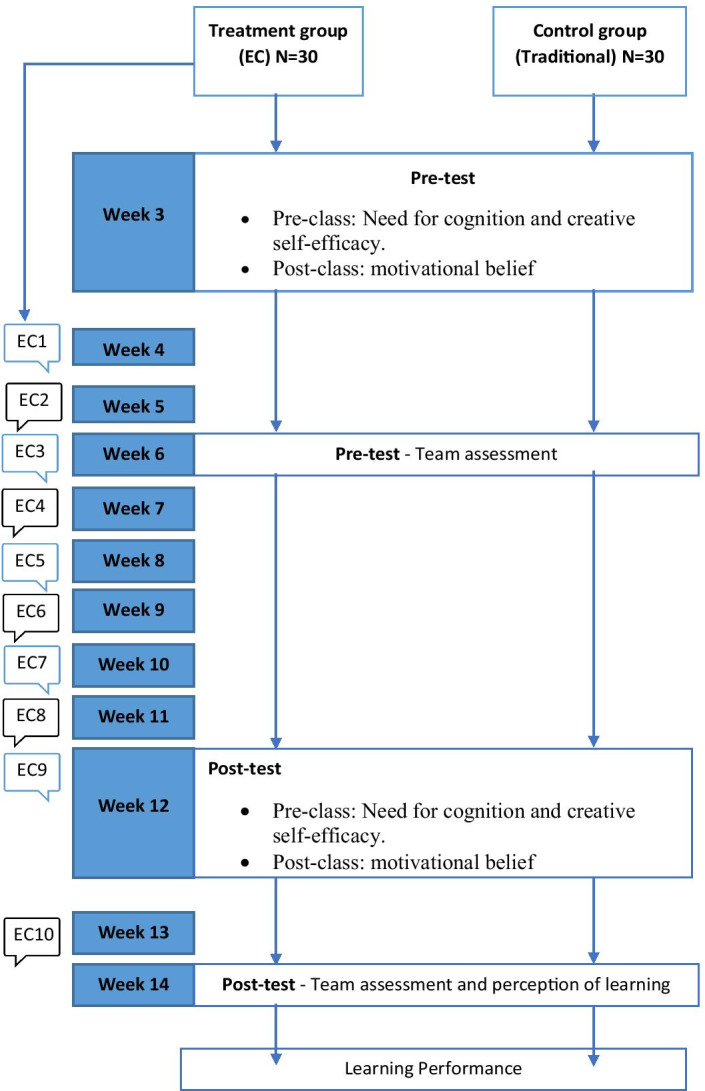
Educational chatbots (ECs) are chatbots designed for pedagogical purposes and are viewed as an Internet of Things (IoT) interface that could revolutionize teaching and learning. These chatbots are strategized to provide personalized learning through the concept of a virtual assistant that replicates humanized conversation. Nevertheless, in the education paradigm, ECs are still novel with challenges in facilitating, deploying, designing, and integrating it as an effective pedagogical tool across multiple fields, and one such area is project-based learning. Therefore, the present study investigates how integrating ECs to facilitate team-based projects for a design course could influence learning outcomes. Based on a mixed-method quasi-experimental approach, ECs were found to improve learning performance and teamwork with a practical impact. Moreover, it was found that ECs facilitated collaboration among team members that indirectly influenced their ability to perform as a team. Nevertheless, affective-motivational learning outcomes such as perception of learning, need for cognition, motivation, and creative self-efficacy were not influenced by ECs. Henceforth, this study aims to add to the current body of knowledge on the design and development of EC by introducing a new collective design strategy and its pedagogical and practical implications.
Overview
The claims and statistics of this paper haven’t been checked yet.
Run the check — free, no account needed. It reads the open-access text and checks the sources it cites.
Integrity signals
Registry
Cites
Statistics
Figures
Verification
Claims the paper makes
The claims and statistics of this paper haven’t been checked yet.
Run the check — free, no account needed. It reads the open-access text and checks the sources it cites.
Claims other papers make about this one
Each is checked against this paper’s own text: does it say what the citing paper says it does?
The cited source says what the claim attributes to it.
In the citing paper
“Only two studies reported chatbot use to have a non-significant effect on learning outcomes (Deveci Topal et al., 2021), cognition, motivation, and self-efficacy (Kumar, 2021).”
From Implementing the bashayer chatbot in Saudi higher education: measuring the influence on students' motivation and learning strategies (2023) · cites this paper as Kumar, 2021
In the citing paper
“Using chatbots as teaching assistants, learners significantly outperformed those in traditional classroom settings in terms of projected-based learning performance [51].”
From A Meta-Analysis and Systematic Review of the Effect of Chatbot Technology Use in Sustainable Education (2023) · cites this paper as [51]
In the citing paper
“The students were thus motivated by this learning environment that they considered important and of great benefit, which was as advocated by the learning-based chatbot technology of many studies (Pereira et al., 2019; Yueh and Chiang, 2020; Kumar, 2021; Chang et al., 2022; Troussas et al., 2022).”
From Implementing the bashayer chatbot in Saudi higher education: measuring the influence on students' motivation and learning strategies (2023) · cites this paper as Kumar, 2021
In the citing paper
“Despite recent studies (e.g., Deveci Topal et al., 2021; Kumar, 2021) that found no significant influence of chatbot use on K-12 and undergraduate students' cognition and learning achievements, the results of our study highlight the significant potential of chatbot-based learning environments in enhancing and supporting cognitive learning strategies among postgraduate students.”
From Implementing the bashayer chatbot in Saudi higher education: measuring the influence on students' motivation and learning strategies (2023) · cites this paper as Kumar, 2021
In the citing paper
“In the educational field, chatbots are increasingly adopted since they support immediate and personalized feedback (Kumar, 2021; Okonkwo & Ade-Ibijola, 2021; Winkler & Söllner, 2018).”
From Designing learning technology collaboratively: analysis of a chatbot co-design (2023) · cites this paper as Kumar, 2021
Self-check
Percentages, sums and reported differences re-computed from the paper’s own numbers.
The self-check needs the paper’s full text.
Citations
Cites
Motivational and self-regulated learning components of classroom academic performance.
Pintrich, P. R., & De Groot, E. V. (1990) · Journal of Educational Psychology · doi:10.1037/0022-0663.82.1.33 · Cited by 8,332 · cited 5×
“Subsequently, motivational beliefs are reflected by perceived self-efficacy and intrinsic values students have towards their cognitive engagement and academic performance (Pintrich & de Groot, 1990).”
BackgroundMethodInfluentialMotivational beliefs, values, and goals
Eccles, J. S., & Wigfield, A. (2002) · Annual Review of Psychology · doi:10.1146/annurev.psych.53.100901.135153 · Cited by 7,587
Reliability and Predictive Validity of the Motivated Strategies for Learning Questionnaire (Mslq)
Pintrich, P. R., Smith, D. A. F., Garcia, T., & Mckeachie, W. J. (1993) · Educational and Psychological Measurement · doi:10.1177/0013164493053003024 · Cited by 3,646
Cacioppo, J. T., Petty, R. E., Feinstein, J. A., & Jarvis, W. B. G. (1996) · Psychological Bulletin · doi:10.1037/0033-2909.119.2.197 · Cited by 2,517 · cited 1×
“The need for cognition also indicates positive acceptance towards problem-solving (Cacioppo et al., 1996), enjoyment (Park et al., 2008), and it is critical for teamwork, as it fosters team performance and information-processing motivation (Kearney et al., 2009).”
BackgroundAn Overview of Chatbot Technology
Adamopoulou, E., & Moussiades, L. (2020) · IFIP advances in information and communication technology · doi:10.1007/978-3-030-49186-4_31 · Cited by 1,300
The interpersonal communication book
DeVito, J. A. (1976) · Cited by 799
Chatbots for learning: A review of educational chatbots for the Facebook Messenger
Smutny, P., & Schreiberova, P. (2020) · Computers & Education · doi:10.1016/j.compedu.2020.103862 · Cited by 770
In the shades of the uncanny valley: An experimental study of human–chatbot interaction
Ciechanowski, L., Przegalińska, A., Magnuski, M., & Gloor, P. A. (2018) · Future Generation Computer Systems · doi:10.1016/j.future.2018.01.055 · Cited by 680
The applicability of Visible Learning to higher education
Hattie, J. (2015) · Scholarship of Teaching and Learning in Psychology · doi:10.1037/stl0000021 · Cited by 656
WHEN AND HOW DIVERSITY BENEFITS TEAMS: THE IMPORTANCE OF TEAM MEMBERS' NEED FOR COGNITION
Kearney, E., Gebert, D., & Voelpel, S. C. (2009) · Academy of Management Journal · doi:10.5465/amj.2009.41331431 · Cited by 591
Research works printed but not linked: 7
- Brockhus, S., van der Kolk, T. E. C., Koeman, B., & Badke-Schaub, P. G. (2014). The influence of ambient green on creative performance. Proceeding of International Design Conference (DESIGN 2014), Croatia, 437–444.
- Chan, T. J., Yong, W. K. Y., & Harmizi, A. (2020). Usage of whatsapp and interpersonal communication skills among private university students. Journal of Arts & Social Sciences, 3(January), 15–25.
- Creswell, J. W. (2012). Educational Research : Planning, Conducting and Evaluating Quantitative and Qualitative Research (4th ed.). Pearson Education.
- Haristiani, N., Danuwijaya, A. A., Rifai, M. M., & Sarila, H. (2019). Gengobot: A chatbot-based grammar application on mobile instant messaging as language learning medium. Journal of Engineering Science and Technology, 14(6), 3158–3173.
- Khan, A., Ranka, S., Khakare, C., & Karve, S. (2019). NEEV: An education informational chatbot. International Research Journal of Engineering and Technology, 6(4), 492–495.
- Lapina, A. (2020). Does exposure to problem-based learning strategies increase postformal thought and need for cognition in higher education students? A quasi-experimental study (Publication No. 28243240) Doctoral dissertation, Texas State University-San Marcos. ProQuest Dissertations & Theses Global.
- Riel, J. (2020). Essential features and critical issues with educational chatbots: toward personalized learning via digital agents. In: M. Khosrow-Pour (Ed.), Handbook of research on modern educational technologies, applications, and management (pp. 246–262). IGI Global. https://doi.org/10.1142/S0218194019400163. · DOI
Cited by
Sorted by citations
Do AI chatbots improve students learning outcomes? Evidence from a meta‐analysis
Wu, R., & Yu, Z. (2024) · British Journal of Educational Technology · doi:10.1111/bjet.13334 · Cited by 576
The role of ChatGPT in higher education: Benefits, challenges, and future research directions
(2023) · Journal of Applied Learning & Teaching · doi:10.37074/jalt.2023.6.1.29 · Cited by 561
Essel, H. B., Vlachopoulos, D., Tachie-Menson, A., Johnson, E. E., & Baah, P. K. (2022) · International Journal of Educational Technology in Higher Education · doi:10.1186/s41239-022-00362-6 · Cited by 428
Deng, X., & Yu, Z. (2023) · Sustainability · doi:10.3390/su15042940 · Cited by 298
“19 Kumar (2021) [51] 60 (30/30) 10 weeks Teaching assistant Instructional technology Learning achievement”
BackgroundAl-Zahrani, A. M., & Alasmari, T. M. (2024) · Humanities and Social Sciences Communications · doi:10.1057/s41599-024-03432-4 · Cited by 292
Metadata
- Authors
- Kumar, J. A.
- Affiliations
- Universiti Sains Malaysia (MY)
- Corresponding author
- Kumar, Jeya Amantha
- ORCID
- Kumar, Jeya Amantha
- Venue
- International Journal of Educational Technology in Higher Education
- Published
- 2021-12
- Volume
- 18
- Issue
- 1
- Pages
- 65-65
- ISSN
- 2365-9440 (ISSN-L)
- PMC
- PMC8670881
- OpenAlex
- W4200531362
- Cited by
- 183
- References
- 82
- Citations by year
- 2026: 27 · 2025: 59 · 2024: 45 · 2023: 39 · 2022: 13
- FWCI
- 8.54
- Type
- journal article
- Language
- en
- Open access
- diamond
- doi.org
- Licence
- Locations
- International Journal of Educational Technology in Higher Education (publishedVersion, cc-by)
- PubMed Central (publishedVersion, cc-by)
- PubMed (publishedVersion)
- DOAJ (DOAJ: Directory of Open Access Journals) (submittedVersion, cc-by-sa)
- Funders
- Universiti Sains Malaysia (304/PMEDIA/6315219)
- Topics
- Physical Sciences › Computer Science › Artificial Intelligence › Intelligent Tutoring Systems and Adaptive Learning
- Social Sciences › Education › Artificial Intelligence in Education
- Social Sciences › Education › Problem and Project Based Learning
- Keywords
- educational chatbots, project-based learning, team design, learning outcomes, teamwork, collaboration, need for cognition, creative self-efficacy, virtual assistants, design education
About these checks
Registry, retraction, Cites and statistics results are computed, not judged, with one exception: a printed reference that no index lists is read once by a model before it counts as a citation error. Claims are extracted by a model and kept only when their quote appears verbatim in the text; each cited source is then checked, with a model’s help, for whether it says what the claim relies on. Those verdicts can be wrong — read the claim’s quote and the cited source before relying on one.
Statistics and arithmetic are recomputed, not judged.
Confidence bands are shown only for fields calibrated on our annotated test set. None is calibrated yet, so no band is shown.
What counts as a claim ›How we measure confidence ›How we check this ›
Are you an author, or do you see a problem with this page? Request a review
