

The DOI matches its Crossref record; 82 of the 82 references it cites were found in a registry or an index.
Educational chatbots for project-based learning: investigating learning outcomes for a team-based design course
Open accessAbstract
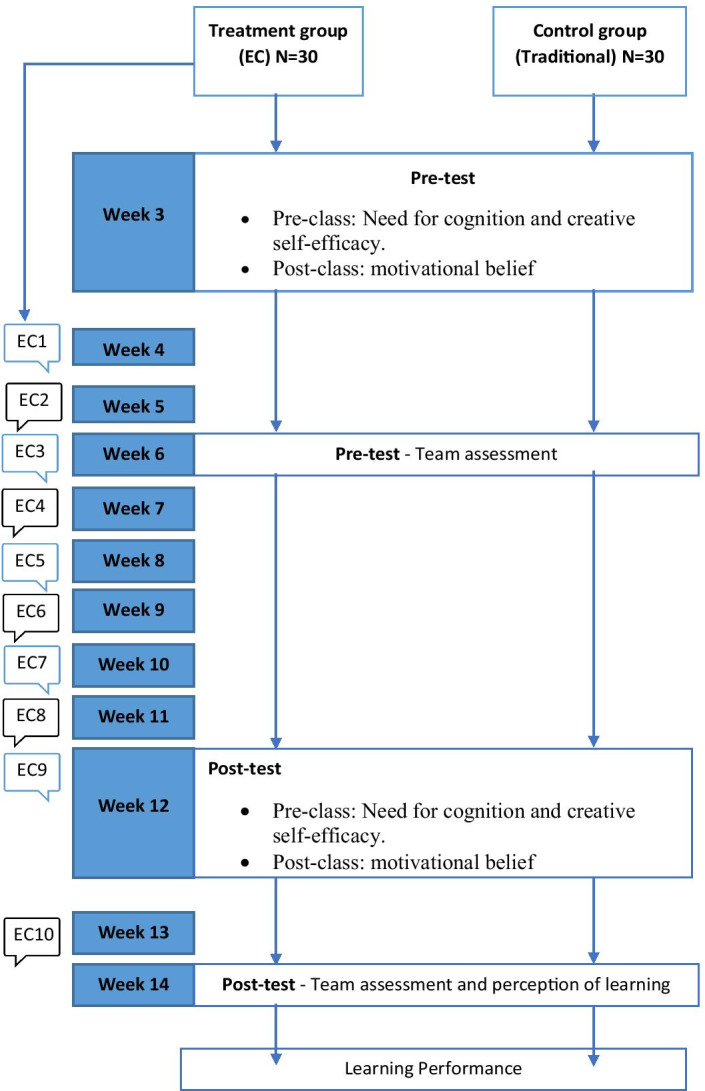
Educational chatbots (ECs) are chatbots designed for pedagogical purposes and are viewed as an Internet of Things (IoT) interface that could revolutionize teaching and learning. These chatbots are strategized to provide personalized learning through the concept of a virtual assistant that replicates humanized conversation. Nevertheless, in the education paradigm, ECs are still novel with challenges in facilitating, deploying, designing, and integrating it as an effective pedagogical tool across multiple fields, and one such area is project-based learning. Therefore, the present study investigates how integrating ECs to facilitate team-based projects for a design course could influence learning outcomes. Based on a mixed-method quasi-experimental approach, ECs were found to improve learning performance and teamwork with a practical impact. Moreover, it was found that ECs facilitated collaboration among team members that indirectly influenced their ability to perform as a team. Nevertheless, affective-motivational learning outcomes such as perception of learning, need for cognition, motivation, and creative self-efficacy were not influenced by ECs. Henceforth, this study aims to add to the current body of knowledge on the design and development of EC by introducing a new collective design strategy and its pedagogical and practical implications.
Overview
The claims and statistics of this paper haven’t been checked yet.
Run the check — free, no account needed. It reads the open-access text and checks the sources it cites.
Integrity signals
Registry
Cites
Statistics
Figures
Verification
Claims the paper makes
The claims and statistics of this paper haven’t been checked yet.
Run the check — free, no account needed. It reads the open-access text and checks the sources it cites.
Claims other papers make about this one
Each is checked against this paper’s own text: does it say what the citing paper says it does?
The cited source says what the claim attributes to it.
In the citing paper
“Only two studies reported chatbot use to have a non-significant effect on learning outcomes (Deveci Topal et al., 2021), cognition, motivation, and self-efficacy (Kumar, 2021).”
From Implementing the bashayer chatbot in Saudi higher education: measuring the influence on students' motivation and learning strategies (2023) · cites this paper as Kumar, 2021
In the citing paper
“Using chatbots as teaching assistants, learners significantly outperformed those in traditional classroom settings in terms of projected-based learning performance [51].”
From A Meta-Analysis and Systematic Review of the Effect of Chatbot Technology Use in Sustainable Education (2023) · cites this paper as [51]
In the citing paper
“The students were thus motivated by this learning environment that they considered important and of great benefit, which was as advocated by the learning-based chatbot technology of many studies (Pereira et al., 2019; Yueh and Chiang, 2020; Kumar, 2021; Chang et al., 2022; Troussas et al., 2022).”
From Implementing the bashayer chatbot in Saudi higher education: measuring the influence on students' motivation and learning strategies (2023) · cites this paper as Kumar, 2021
In the citing paper
“Despite recent studies (e.g., Deveci Topal et al., 2021; Kumar, 2021) that found no significant influence of chatbot use on K-12 and undergraduate students' cognition and learning achievements, the results of our study highlight the significant potential of chatbot-based learning environments in enhancing and supporting cognitive learning strategies among postgraduate students.”
From Implementing the bashayer chatbot in Saudi higher education: measuring the influence on students' motivation and learning strategies (2023) · cites this paper as Kumar, 2021
In the citing paper
“In the educational field, chatbots are increasingly adopted since they support immediate and personalized feedback (Kumar, 2021; Okonkwo & Ade-Ibijola, 2021; Winkler & Söllner, 2018).”
From Designing learning technology collaboratively: analysis of a chatbot co-design (2023) · cites this paper as Kumar, 2021
Self-check
Percentages, sums and reported differences re-computed from the paper’s own numbers.
The self-check needs the paper’s full text.
Citations
Cites
Motivational and self-regulated learning components of classroom academic performance.
Pintrich, P. R., & De Groot, E. V. (1990) · Journal of Educational Psychology · doi:10.1037/0022-0663.82.1.33 · Cited by 8,332 · cited 5×
“Subsequently, motivational beliefs are reflected by perceived self-efficacy and intrinsic values students have towards their cognitive engagement and academic performance (Pintrich & de Groot, 1990).”
BackgroundMethodInfluentialMotivational beliefs, values, and goals
Eccles, J. S., & Wigfield, A. (2002) · Annual Review of Psychology · doi:10.1146/annurev.psych.53.100901.135153 · Cited by 7,587
Reliability and Predictive Validity of the Motivated Strategies for Learning Questionnaire (Mslq)
Pintrich, P. R., Smith, D. A. F., Garcia, T., & Mckeachie, W. J. (1993) · Educational and Psychological Measurement · doi:10.1177/0013164493053003024 · Cited by 3,646
Cacioppo, J. T., Petty, R. E., Feinstein, J. A., & Jarvis, W. B. G. (1996) · Psychological Bulletin · doi:10.1037/0033-2909.119.2.197 · Cited by 2,517 · cited 1×
“The need for cognition also indicates positive acceptance towards problem-solving (Cacioppo et al., 1996), enjoyment (Park et al., 2008), and it is critical for teamwork, as it fosters team performance and information-processing motivation (Kearney et al., 2009).”
BackgroundAn Overview of Chatbot Technology
Adamopoulou, E., & Moussiades, L. (2020) · IFIP advances in information and communication technology · doi:10.1007/978-3-030-49186-4_31 · Cited by 1,300
The interpersonal communication book
DeVito, J. A. (1976) · Cited by 799
Chatbots for learning: A review of educational chatbots for the Facebook Messenger
Smutny, P., & Schreiberova, P. (2020) · Computers & Education · doi:10.1016/j.compedu.2020.103862 · Cited by 770
In the shades of the uncanny valley: An experimental study of human–chatbot interaction
Ciechanowski, L., Przegalińska, A., Magnuski, M., & Gloor, P. A. (2018) · Future Generation Computer Systems · doi:10.1016/j.future.2018.01.055 · Cited by 680
The applicability of Visible Learning to higher education
Hattie, J. (2015) · Scholarship of Teaching and Learning in Psychology · doi:10.1037/stl0000021 · Cited by 656
WHEN AND HOW DIVERSITY BENEFITS TEAMS: THE IMPORTANCE OF TEAM MEMBERS' NEED FOR COGNITION
Kearney, E., Gebert, D., & Voelpel, S. C. (2009) · Academy of Management Journal · doi:10.5465/amj.2009.41331431 · Cited by 591
Research works printed but not linked: 7
- Brockhus, S., van der Kolk, T. E. C., Koeman, B., & Badke-Schaub, P. G. (2014). The influence of ambient green on creative performance. Proceeding of International Design Conference (DESIGN 2014), Croatia, 437–444.
- Chan, T. J., Yong, W. K. Y., & Harmizi, A. (2020). Usage of whatsapp and interpersonal communication skills among private university students. Journal of Arts & Social Sciences, 3(January), 15–25.
- Creswell, J. W. (2012). Educational Research : Planning, Conducting and Evaluating Quantitative and Qualitative Research (4th ed.). Pearson Education.
- Haristiani, N., Danuwijaya, A. A., Rifai, M. M., & Sarila, H. (2019). Gengobot: A chatbot-based grammar application on mobile instant messaging as language learning medium. Journal of Engineering Science and Technology, 14(6), 3158–3173.
- Khan, A., Ranka, S., Khakare, C., & Karve, S. (2019). NEEV: An education informational chatbot. International Research Journal of Engineering and Technology, 6(4), 492–495.
- Lapina, A. (2020). Does exposure to problem-based learning strategies increase postformal thought and need for cognition in higher education students? A quasi-experimental study (Publication No. 28243240) Doctoral dissertation, Texas State University-San Marcos. ProQuest Dissertations & Theses Global.
- Riel, J. (2020). Essential features and critical issues with educational chatbots: toward personalized learning via digital agents. In: M. Khosrow-Pour (Ed.), Handbook of research on modern educational technologies, applications, and management (pp. 246–262). IGI Global. https://doi.org/10.1142/S0218194019400163. · DOI
Cited by
Sorted by citations
Do AI chatbots improve students learning outcomes? Evidence from a meta‐analysis
Wu, R., & Yu, Z. (2024) · British Journal of Educational Technology · doi:10.1111/bjet.13334 · Cited by 576
The role of ChatGPT in higher education: Benefits, challenges, and future research directions
(2023) · Journal of Applied Learning & Teaching · doi:10.37074/jalt.2023.6.1.29 · Cited by 561
Essel, H. B., Vlachopoulos, D., Tachie-Menson, A., Johnson, E. E., & Baah, P. K. (2022) · International Journal of Educational Technology in Higher Education · doi:10.1186/s41239-022-00362-6 · Cited by 428
Deng, X., & Yu, Z. (2023) · Sustainability · doi:10.3390/su15042940 · Cited by 298
“19 Kumar (2021) [51] 60 (30/30) 10 weeks Teaching assistant Instructional technology Learning achievement”
BackgroundAl-Zahrani, A. M., & Alasmari, T. M. (2024) · Humanities and Social Sciences Communications · doi:10.1057/s41599-024-03432-4 · Cited by 292
Tai, T., & Chen, H. H.-J. (2024) · Computers & Education · doi:10.1016/j.compedu.2024.105112 · Cited by 308
Xia, Q., Chiu, T. K. F., Chai, C. S., & Xie, K. (2023) · British Journal of Educational Technology · doi:10.1111/bjet.13305 · Cited by 203
Effects of Generative Chatbots in Higher Education
Ilieva, G., Yankova, T., Klisarova-Belcheva, S., Dimitrov, A., Bratkov, M., & Angelov, D. (2023) · Information · doi:10.3390/info14090492 · Cited by 258
Lan, Y. (2024) · Teaching and Teacher Education · doi:10.1016/j.tate.2024.104736 · Cited by 124
How educational chatbots support self-regulated learning? A systematic review of the literature
Guan, R., Raković, M., Chen, G., & Gašević, D. (2024) · Education and Information Technologies · doi:10.1007/s10639-024-12881-y · Cited by 182
Yusuf, H., Money, A., & Daylamani-Zad, D. (2025) · Educational technology research and development · doi:10.1007/s11423-025-10447-4 · Cited by 112
Sharma, K., Nguyen, A., & Hong, Y. (2024) · British Journal of Educational Technology · doi:10.1111/bjet.13459 · Cited by 149
Zhang, R., Zou, D., & Cheng, G. (2023) · Interactive Learning Environments · doi:10.1080/10494820.2023.2202704 · Cited by 135
Decision-guided chatbots and cognitive styles in interdisciplinary learning
Iku-Silan, A., Hwang, G., & Chen, C. (2023) · Computers & Education · doi:10.1016/j.compedu.2023.104812 · Cited by 124
Eşiyok, E., Gökçearslan, Ş., & Küçükergi̇n, K. G. (2024) · International Journal of Human-Computer Interaction · doi:10.1080/10447318.2024.2303557 · Cited by 122
A bibliometric analysis of artificial intelligence chatbots in educational contexts
Lin, Y., & Yu, Z. (2024) · Interactive Technology and Smart Education · doi:10.1108/itse-12-2022-0165 · Cited by 99
AI-Aided Teaching Model in Education 5.0
Khang, A., Muthmainnah, M., Seraj, P. M. I., Yakin, A. M. A., & Obaid, A. J. (2023) · Advances in computational intelligence and robotics book series · doi:10.4018/978-1-6684-8851-5.ch004 · Cited by 101
Debets, T., Banihashem, S. K., Brinke, D. J.-T., Vos, T. E. J., Wenniger, G. M. D. B., & Camp, G. (2025) · Computers & Education · doi:10.1016/j.compedu.2025.105323 · Cited by 124
Durak, H. Y. (2022) · Education and Information Technologies · doi:10.1007/s10639-022-11149-7 · Cited by 91
Wang, K., Cui, W., & Xue, Y. (2025) · Behavioral Sciences · doi:10.3390/bs15020165 · Cited by 139
Al-Abdullatif, A. M., Al-Dokhny, A. A., & Drwish, A. M. (2023) · Frontiers in Psychology · doi:10.3389/fpsyg.2023.1129070 · Cited by 80
“Despite recent studies (e.g., Deveci Topal et al., 2021; Kumar, 2021) that found no significant influence of chatbot use on K-12 and undergraduate students’ cognition and learning achievements, the results of our study highlight the significant potential of chatbot-based learning environments in…”
BackgroundResultInfluentialZhu, Y., Liu, Q., & Zhao, L. (2025) · Education and Information Technologies · doi:10.1007/s10639-025-13420-z · Cited by 101
The effect of chatbots on learning: a meta-analysis of empirical research
Alemdağ, E. (2023) · Journal of Research on Technology in Education · doi:10.1080/15391523.2023.2255698 · Cited by 87
Ren, X., & Wu, M. L. (2025) · TechTrends · doi:10.1007/s11528-025-01055-3 · Cited by 162
Empathic pedagogical conversational agents: A systematic literature review
Ortega‐Ochoa, E., Arguedas, M., & Daradoumis, T. (2024) · British Journal of Educational Technology · doi:10.1111/bjet.13413 · Cited by 61
Here's to the future: Conversational agents in higher education- a scoping review
Pereira, D. S. M., Falcão, F., Costa, L., Lunn, B. S., Pêgo, J. M., & Costa, P. (2023) · International Journal of Educational Research · doi:10.1016/j.ijer.2023.102233 · Cited by 82
Ochoa, E. G. O., Pérez, J. Q., Arguedas, M., Daradoumis, Τ., & Puig, J. M. M. (2024) · Internet of Things · doi:10.1016/j.iot.2024.101101 · Cited by 50
Fang, Q., Reynaldi, R., Araminta, A. S., Kamal, I., Saini, P., Afshari, F. S., Tan, S.-C., Yuan, J. C.-C., Qomariyah, N. N., & Sukotjo, C. (2025) · The Journal of Prosthetic Dentistry · doi:10.1016/j.prosdent.2024.03.038 · Cited by 52
Chatbots and student motivation: a scoping review
Huang, W., Jiang, J., King, R. B., & Fryer, L. K. (2025) · International Journal of Educational Technology in Higher Education · doi:10.1186/s41239-025-00524-2 · Cited by 86
Designing learning technology collaboratively: analysis of a chatbot co-design
Durall Gazulla, E., Martins, L., & Fernández-Ferrer, M. (2023) · Education and Information Technologies · doi:10.1007/s10639-022-11162-w · Cited by 46
Designing and building OSCEBot ® for virtual OSCE – Performance evaluation
Pereira, D. S. M., Falcão, F., Nunes, A., Santos, N., Costa, P., & Pêgo, J. M. (2023) · Medical Education Online · doi:10.1080/10872981.2023.2228550 · Cited by 44
Wang, L., & Ren, B. (2024) · Education Sciences · doi:10.3390/educsci14121329 · Cited by 38
Al‐Mamary, Y. H., & Abubakar, A. A. (2025) · The Internet and Higher Education · doi:10.1016/j.iheduc.2025.101015 · Cited by 59
IoT Integration Approaches into Personalized Online Learning: Systematic Review
Spaho, E., Çiço, B., & Shabani, I. (2025) · Computers · doi:10.3390/computers14020063 · Cited by 33
Abedi, M., Alshybani, I., Shahadat, M., & Murillo, M. S. (2023) · Qeios · doi:10.32388/md04b0 · Cited by 51
Influence of artificial intelligence and chatbots on research integrity and publication ethics
Kasani, P. H., Cho, K. H., Jang, J., & Yun, C. (2024) · Science Editing · doi:10.6087/kcse.323 · Cited by 35
Using Educational Chatbots with Metacognitive Feedback to Improve Science Learning
Yin, J., Zhu, Y., Goh, T., Wu, W., & Hu, Y. (2024) · Applied Sciences · doi:10.3390/app14209345 · Cited by 39
Chen, D. M., Aaltonen, K., Lampela, H., & Kujala, J. (2024) · Technology Knowledge and Learning · doi:10.1007/s10758-024-09807-5 · Cited by 41
Al-Hafdi, F. S., & AlNajdi, S. M. (2024) · Education and Information Technologies · doi:10.1007/s10639-024-12671-6 · Cited by 38
Chatbot technology in the education sector: a bibliometrics analysis using VOS viewer
Traymbak, S., Sharma, M., Anand, A., & Shukla, A. (2024) · International Journal of Systems Assurance Engineering and Management · doi:10.1007/s13198-023-02230-6 · Cited by 27
Mobile Learning Acceptance Post Pandemic: A Behavioural Shift among Engineering Undergraduates
Kumar, J. A., Osman, S. B., Sanmugam, M., & Rasappan, R. (2022) · Sustainability · doi:10.3390/su14063197 · Cited by 22
Self-citationBrown, G., & Foster, C. (2023) · Advanced sciences and technologies for security applications · doi:10.1007/978-3-031-33627-0_6 · Cited by 21
ChatbotSQL: Conversational agent to support relational database query language learning
Pérez-Mercado, R., Balderas, A., Muñoz, A., Cabrera-Sánchez, J.-F., Palomo‐Duarte, M., & Dodero, J. M. (2023) · SoftwareX · doi:10.1016/j.softx.2023.101346 · Cited by 21
Generative Artificial Intelligence in Instructional System Design
Chai, D. S., Kim, H. S., Kim, K. N., Ha, Y., Shin, S. S. H., & Yoon, S. W. (2025) · Human Resource Development Review · doi:10.1177/15344843251320256 · Cited by 20
Wu, X.-Y., Radloff, J., Yeter, I. H., Wang, L., & Chiu, T. K. F. (2025) · Interactive Learning Environments · doi:10.1080/10494820.2025.2563086 · Cited by 32
Problem-Based Blended Training via Chatbot to Enhance the Problem-Solving Skill in the Workplace
Saengrith, W., Viriyavejakul, C., & Pimdee, P. (2022) · Emerging Science Journal · doi:10.28991/esj-2022-sied-01 · Cited by 25
Abedi, M., Alshybani, I., Shahadat, M., & Murillo, M. S. (2023) · Qeios · doi:10.32388/md04b0.2 · Cited by 21
Zhong, Y., Lian, J., Huang, H., & Deng, H. (2025) · Education and Information Technologies · doi:10.1007/s10639-024-13237-2 · Cited by 32
Design recommendations for chatbots to support people with depression
de Souza, P. M., Pires, I. D. C., Motti, V. G., Caseli, H. D. M., Neto, J. B. B., Martini, L. C., & Néris, V. P. D. A. (2022) · Brazilian Symposium on Human Factors in Computing Systems (IHC) · doi:10.1145/3554364.3559119 · Cited by 20
Abdallah, A. K., Alkaabi, A. M., Mehiar, D. A. F., & Aradat, Z. A. J. (2024) · Advances in educational technologies and instructional design book series · doi:10.4018/979-8-3693-0880-6.ch012 · Cited by 23
Implementing AI-based Conversational Chatbots in EFL Speaking Classes: An Evolutionary PerspectivePreprint
Mahmoud, R. H. (2022) · Research Square · doi:10.21203/rs.3.rs-1911791/v1 · Cited by 31
Yang, X., Liu, X., & Gao, Y. (2025) · Educational Technology Research and Development · doi:10.1007/s11423-025-10540-8 · Cited by 26
Suchánek, P., & Kŕaĺová, M. (2025) · Journal of Innovation & Knowledge · doi:10.1016/j.jik.2025.100781 · Cited by 23
AI-Enhanced Project-Based Learning
Tariq, M. U. (2025) · Advances in computational intelligence and robotics book series · doi:10.4018/979-8-3693-7332-3.ch008 · Cited by 16
Rücker, C. R., & Becker, S. (2025) · Computers and Education Open · doi:10.1016/j.caeo.2025.100315 · Cited by 15
Current Trends in AI-Based Educational Processes—An Overview
Ivanović, M. D., Klašnja‐Milićević, A., Paprzycki, M., Ganzha, M., Bădică, C., Bădică, A., & Jain, L. C. (2022) · Learning and analytics in intelligent systems · doi:10.1007/978-3-031-04662-9_1 · Cited by 20
Černý, M. (2023) · European Journal of Investigation in Health Psychology and Education · doi:10.3390/ejihpe13020022 · Cited by 22
Students Collaboratively Prompting ChatGPT
Perifanou, M. A., & Economides, A. A. (2025) · Computers · doi:10.3390/computers14050156 · Cited by 17
Qiu, W., Chit, L. S., Jamil, N. B., Thway, M., Ng, S. S. H., Zhang, L., Lim, F. S., & Lai, J. W. (2025) · Computers · doi:10.3390/computers14070270 · Cited by 24
An Examination of Studies on the Use of Chatbot Technology in the Field of Education
Durak, H. Y., & Onan, A. (2023) · International Conference on Applied Engineering and Natural Sciences · doi:10.59287/icaens.978 · Cited by 14
Joko, J., Putra, A. A. P., & Isnawan, B. H. (2023) · TEM Journal · doi:10.18421/tem121-26 · Cited by 13
Mobile E-Portfolios on Google Sites: A Tool for Enhancing Project-Based Learning
Ánh, T. T. N., & Ngoc, T. N. (2023) · International Journal of Interactive Mobile Technologies (iJIM) · doi:10.3991/ijim.v17i11.39673 · Cited by 32
Kumar, J. A., Ibrahim, N., McEvoy, D., & Sehsu, J. (2022) · Education and Information Technologies · doi:10.1007/s10639-022-11504-8 · Cited by 13
Self-citationBui, T. A., Pohl, M., Rosenfelt, C. S., Ogourtsova, T., Yousef, M., Whitlock, K., Majnemer, A., Nicholas, D. B., Epp, C. D., Zai͏̈ane, O. R., et al. (2022) · JMIR Human Factors · doi:10.2196/31991 · Cited by 14
Ba, S., Xuechun, S. H. I., Wu, S., & Lu, G. (2026) · Computers and Education Artificial Intelligence · doi:10.1016/j.caeai.2026.100579 · Cited by 14
Kathole, A. B., Patil, S. N., Jadhav, D. B., Pathak, H. V., & Mirge, A. S. (2025) · MethodsX · doi:10.1016/j.mex.2025.103542 · Cited by 14
Ingason, H. Þ., Aaltonen, K., Asmundarson, A. S., Friðgeirsson, Þ. V., Huemann, D., Huemann, M., Kujala, J., Lampela, H., Mancini, M., Mariani, C., et al. (2025) · Project Leadership and Society · doi:10.1016/j.plas.2025.100193 · Cited by 17
A Blueprint for Integrating Task-Oriented Conversational Agents in Education
Farah, J. C., Spaenlehauer, B., Ingram, S., & Gillet, D. (2022) · ACM Conference on Conversational User Interfaces (CUI) · doi:10.1145/3543829.3544525 · Cited by 11
Students’ Attitudes toward Using Chatbot in EFL Learning
Mohamed, S. S. A., & Alian, E. M. I. (2023) · Arab World English Journal · doi:10.24093/awej/vol14no3.2 · Cited by 17
Dünya, B. A., & Durak, H. Y. (2023) · Quality & Quantity · doi:10.1007/s11135-023-01800-x · Cited by 14
Liu, Z., Yan, Z., Zuo, H., & Lu, Y. (2025) · Frontiers in Psychology · doi:10.3389/fpsyg.2025.1599478 · Cited by 12
EDUCATIONAL CHATBOTS FOR COLLABORATIVE LEARNING: RESULTS OF A DESIGN EXPERIMENT IN A MIDDLE SCHOOL
Burkhard, M., Seufert, S., & Handschuh, M. C. A. S. (2022) · Cognition and Exploratory Learning in Digital Age · doi:10.33965/celda2022_202207l027 · Cited by 8
A aplicação da inteligência artificial (ia) na educação e suas tendências atuais
dos Santos, A. A., Lúcio, E. O., Barbosa, V. G., Barreto, M. S., Alberti, R., Silva, J. A. D., Joerke, G. A. O., Plácido, R. L., Plácido, I. T. M., & Saraiva, M. D. S. G. (2023) · Cuadernos de Educación y Desarrollo · doi:10.55905/cuadv15n2-011 · Cited by 16
Sageengrana, S., Selvakumar, S., & Srinivasan, S. (2024) · Expert Systems with Applications · doi:10.1016/j.eswa.2024.123267 · Cited by 8
ChatGPT Implementation in the Metaverse: Towards Another Level of Immersiveness in Education
Adarkwah, M. A., Tlili, A., Shehata, B., Huang, R., Amoako, P. Y. O., & Wang, H. (2024) · Springer eBooks · doi:10.1007/978-3-031-46238-2_21 · Cited by 11
A Study on the Application of ChatGPT by Instructional Design Stage of ADDIE Model
Lim, S., & Kim, E. (2024) · The Journal of Korean Association of Computer Education · doi:10.32431/kace.2024.27.1.013 · Cited by 8
Motivations and Affordances of ChatGPT Usage for College Students’ Learning
Lee, S. K., Ryu, J., Jie, Y., & Ma, D. H. (2025) · Media and Communication · doi:10.17645/mac.9508 · Cited by 7
“Finally, ChatGPT facilitates innovative assessments by generating unique questions and case studies, and fostering critical thinking, creativity, collaboration, and real‐time feedback, ultimately improving knowledge acquisition (Boud & Soler, 2016; Kumar, 2021).”
Alsayed, W. O., Al-Hafdi, F. S., & Alhalafawy, W. S. (2024) · Advances in educational technologies and instructional design book series · doi:10.4018/979-8-3693-9806-7.ch006 · Cited by 26
Javed, U., Rohilla, A. R. K., Adnan, G., & Taj, N. (2025) · Review of Applied Management and Social Sciences · doi:10.47067/ramss.v8i1.441 · Cited by 9
Productivity of incident management with conversational bots-a review
Iparraguirre-Villanueva, O., Obregon-Palomino, L., Pujay-Iglesias, W., Sierra-Liñan, F., & Cabanillas-Carbonell, M. (2023) · IAES International Journal of Artificial Intelligence · doi:10.11591/ijai.v12.i4.pp1543-1556 · Cited by 12
Exploring the Potential of ChatGPT to improve experiential learning in Education
Rawat, S., Mittal, S., Nehra, D., Sharma, C., & Kamboj, D. (2023) · Proceedings of the 5th International Conference on Information Management & Machine Intelligence · doi:10.1145/3647444.3647910 · Cited by 7
Sain, Z. H., & Kurniati, V. S. D. (2023) · TAMANSISWA INTERNATIONAL JOURNAL IN EDUCATION AND SCIENCE · doi:10.30738/tijes.v5i1.16274 · Cited by 11
ChatGPT - opportunities or threats in the educational process
Ubowska, A., & Królikowski, T. (2023) · Procedia Computer Science · doi:10.1016/j.procs.2023.10.453 · Cited by 6
Yeon, J., Lee, D., & Park, I. (2024) · International Journal of Human-Computer Interaction · doi:10.1080/10447318.2024.2400406 · Cited by 7
The Impact of AI on Higher Education Trends and Educational Horizons
Li, T., Yusof, S. B. M., Abuhassna, H., & Qi, P. (2025) · Advances in computational intelligence and robotics book series · doi:10.4018/979-8-3373-5550-4.ch001 · Cited by 6
Liang, C., Shi, H., Wu, Y., & Li, F. (2025) · Journal of Educational Computing Research · doi:10.1177/07356331251400540 · Cited by 8
Gudonienė, D., Blažauskas, T., Butkienė, R., Čeponienė, L., & Stanevičienė, E. (2024) · Advances in human resources management and organizational development book series · doi:10.4018/979-8-3693-0556-0.ch005 · Cited by 6
Successful chatbot design for polytechnic students in Singapore
Zhang, H., & Fang, L. (2023) · Educational Media International · doi:10.1080/09523987.2023.2324585 · Cited by 7
A Systematic Review on Using Chatbots in Computer-Supported Collaborative Learning
Liu, Y., & Tang, Y. (2025) · International Conference on Educational and Information Technology · doi:10.1109/iceit64364.2025.10975978 · Cited by 5
Pedagogical Influence of AI-Chatbots on Learning Outcomes: A Systematic Review
Elkot, M. A., Alhalangy, A., AbdAlgane, M., & Ali, R. (2025) · International Journal of Educational Methodology · doi:10.12973/ijem.11.4.527 · Cited by 5
Hu, Y.-H., Yu, H.-Y., & Hsieh, C.-L. (2025) · Education and Information Technologies · doi:10.1007/s10639-025-13784-2 · Cited by 9
AI ChatBots as Inherent Tools for Comprehensive Learning of Engineering Design: A Systematic review
Mthombeni, N. H., Maladzhi, R. W., Moloi, K., Mashifana, T., Tšoeu, M. S., & Nemavhola, F. J. (2023) · World Engineering Education Forum - Global Engineering Deans Council (WEEF-GEDC) · doi:10.1109/weef-gedc59520.2023.10343866 · Cited by 6
Eğitim Amaçlı Tasarlanan Sohbet Robotları Üzerine Yapılan Çalışmaların İncelenmesi
Cevher, A. Y., & Yıldırım, S. (2024) · Türk Eğitim Bilimleri Dergisi · doi:10.37217/tebd.1301877 · Cited by 5
A Systematic Review of the Role of AI-Enabled Chatbots in Modern Education
Olugbade, D. (2025) · Advances in computational intelligence and robotics book series · doi:10.4018/979-8-3373-0122-8.ch018 · Cited by 5
Farah, J. C., Spaenlehauer, B., Bergram, K., Holzer, A., & Gillet, D. (2022) · EDULEARN proceedings · doi:10.21125/edulearn.2022.0932 · Cited by 5
Bridging learning gaps through Discord: peer-to-peer learning in computer graphics education
AlGhamdi, R. A. (2025) · Learning and Teaching in Higher Education Gulf Perspectives · doi:10.1108/lthe-12-2024-0001 · Cited by 4
Tu, Y., Guo, X.-G., Fang, J.-W., Meng, X.-P., & Hwang, G. (2025) · Educational Technology Research and Development · doi:10.1007/s11423-025-10579-7 · Cited by 8
Nannim, F. A., & Mosia, M. S. (2026) · Journal for STEM Education Research · doi:10.1007/s41979-025-00165-0 · Cited by 5
AI Chatbots in Higher Education
Bolambao, F. J., Pogoy, A. M., & Plaisent, M. (2024) · Advances in higher education and professional development book series · doi:10.4018/979-8-3693-3904-6.ch003 · Cited by 4
Ahn, H. Y. (2025) · Systems · doi:10.3390/systems13100915 · Cited by 6
Metadata
- Authors
- Kumar, J. A.
- Affiliations
- Universiti Sains Malaysia (MY)
- Corresponding author
- Kumar, Jeya Amantha
- ORCID
- Kumar, Jeya Amantha
- Venue
- International Journal of Educational Technology in Higher Education
- Published
- 2021-12
- Volume
- 18
- Issue
- 1
- Pages
- 65-65
- ISSN
- 2365-9440 (ISSN-L)
- PMC
- PMC8670881
- OpenAlex
- W4200531362
- Cited by
- 183
- References
- 82
- Citations by year
- 2026: 27 · 2025: 59 · 2024: 45 · 2023: 39 · 2022: 13
- FWCI
- 8.54
- Type
- journal article
- Language
- en
- Open access
- diamond
- doi.org
- Licence
- Locations
- International Journal of Educational Technology in Higher Education (publishedVersion, cc-by)
- PubMed Central (publishedVersion, cc-by)
- PubMed (publishedVersion)
- DOAJ (DOAJ: Directory of Open Access Journals) (submittedVersion, cc-by-sa)
- Funders
- Universiti Sains Malaysia (304/PMEDIA/6315219)
- Topics
- Physical Sciences › Computer Science › Artificial Intelligence › Intelligent Tutoring Systems and Adaptive Learning
- Social Sciences › Education › Artificial Intelligence in Education
- Social Sciences › Education › Problem and Project Based Learning
- Keywords
- educational chatbots, project-based learning, team design, learning outcomes, teamwork, collaboration, need for cognition, creative self-efficacy, virtual assistants, design education
About these checks
Registry, retraction, Cites and statistics results are computed, not judged, with one exception: a printed reference that no index lists is read once by a model before it counts as a citation error. Claims are extracted by a model and kept only when their quote appears verbatim in the text; each cited source is then checked, with a model’s help, for whether it says what the claim relies on. Those verdicts can be wrong — read the claim’s quote and the cited source before relying on one.
Statistics and arithmetic are recomputed, not judged.
Confidence bands are shown only for fields calibrated on our annotated test set. None is calibrated yet, so no band is shown.
What counts as a claim ›How we measure confidence ›How we check this ›
Are you an author, or do you see a problem with this page? Request a review
