

The DOI matches its Crossref record; 48 of the 48 references it cites were found in a registry or an index.
Teaching the Process of Science: Faculty Perceptions and an Effective Methodology
Open accessAbstract
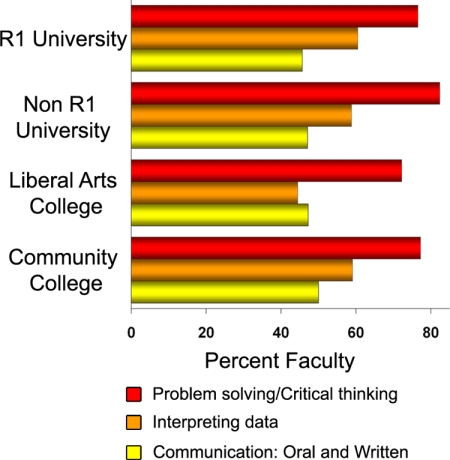
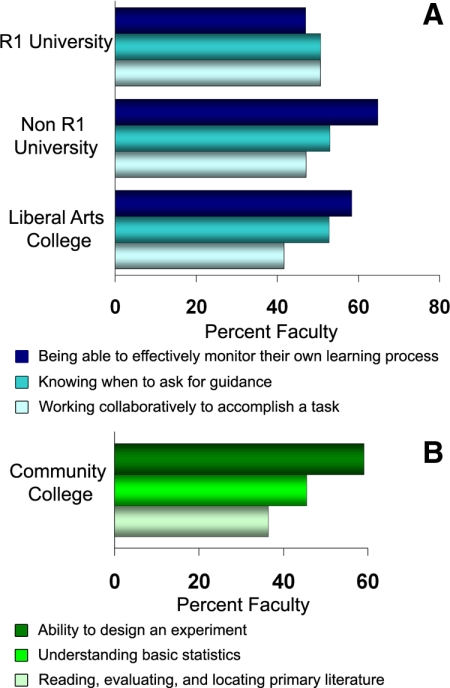
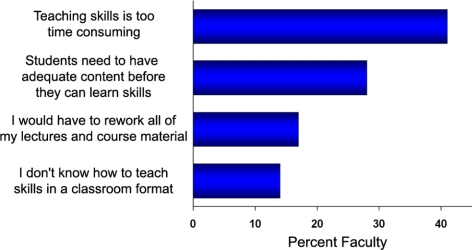
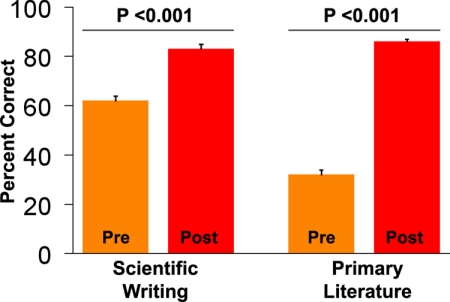
Most scientific endeavors require science process skills such as data interpretation, problem solving, experimental design, scientific writing, oral communication, collaborative work, and critical analysis of primary literature. These are the fundamental skills upon which the conceptual framework of scientific expertise is built. Unfortunately, most college science departments lack a formalized curriculum for teaching undergraduates science process skills. However, evidence strongly suggests that explicitly teaching undergraduates skills early in their education may enhance their understanding of science content. Our research reveals that faculty overwhelming support teaching undergraduates science process skills but typically do not spend enough time teaching skills due to the perceived need to cover content. To encourage faculty to address this issue, we provide our pedagogical philosophies, methods, and materials for teaching science process skills to freshman pursuing life science majors. We build upon previous work, showing student learning gains in both reading primary literature and scientific writing, and share student perspectives about a course where teaching the process of science, not content, was the focus. We recommend a wider implementation of courses that teach undergraduates science process skills early in their studies with the goals of improving student success and retention in the sciences and enhancing general science literacy.
Overview
The claims and statistics of this paper haven’t been checked yet.
Run the check — free, no account needed. It reads the open-access text and checks the sources it cites.
Integrity signals
Registry
Cites
Statistics
Figures
Verification
Claims the paper makes
The claims and statistics of this paper haven’t been checked yet.
Run the check — free, no account needed. It reads the open-access text and checks the sources it cites.
Claims other papers make about this one
Each is checked against this paper’s own text: does it say what the citing paper says it does?
The source backs part of the claim, not all of it — or backs it for a different population, condition or comparison.
In the citing paper
“Similarly, instructors of science, technology, engineering, and math (STEM) courses report that science process skills associated with the reading of PSL, such as the interpretation of graphs and tables, are among the most important skills for undergraduate students to acquire (Coil et al., 2010).”
From Reading Primary Scientific Literature: Approaches for Teaching Students in the Undergraduate STEM Classroom (2023) · cites this paper as Coil et al., 2010
Experimental — accuracy not yet measuredThe cited source says what the claim attributes to it.
In the citing paper
“Faculty members are assumed to be ‘experts’ possessing both good content knowledge and science processing skills [18].”
From Perceptions of scientific research literature and strategies for reading papers depend on academic career stage (2017) · cites this paper as [18]
Self-check
Percentages, sums and reported differences re-computed from the paper’s own numbers.
The self-check needs the paper’s full text.
Citations
Cites
(1999) · Cited by 12,812
Dewey, J. (1910) · D C Heath eBooks · doi:10.1037/10903-000 · Cited by 9,538
DEWEY, J. M. (1910) · Cited by 6,801
(1956) · Medical Entomology and Zoology · Cited by 4,596
Talking about Leaving: Why Undergraduates Leave the Sciences
Correll, S. J., Seymour, E., & Hewitt, N. M. (1997) · Contemporary Sociology A Journal of Reviews · doi:10.2307/2655673 · Cited by 3,088
In Search of Understanding: The Case for Constructivist Classrooms
Brooks, J. G., & Brooks, M. G. (1993) · Cited by 2,138
Creating Significant Learning Experiences: An Integrated Approach to Designing College Courses
Fink, L. D. (2003) · Thammasat University Digital Collections · Cited by 1,719
Benchmarks for Science Literacy
McComas, W. F. (2013) · SensePublishers eBooks · doi:10.1007/978-94-6209-497-0_11 · Cited by 1,718
Concept mapping: A useful tool for science education
Novak, J. D. (1990) · Journal of Research in Science Teaching · doi:10.1002/tea.3660271003 · Cited by 1,032
Handelsman, J., Ebert-May, D., Beichner, R., Bruns, P., Chang, A., DeHaan, R., Gentile, J., Lauffer, S., Stewart, J., Tilghman, S. M., et al. (2004) · Science · doi:10.1126/science.1096022 · Cited by 928
Research works printed but not linked: 19
- Alberts B., 2009, Issues Sci. Tech., 77
- American Association of Medical Colleges and Howard Hughes Medical Institute, 2009, Scientific Foundations for Future physicians
- Brickman P., 2009, Internat. J. Schol. Teach. Learn., 3, 1
- Carnegie Institute for Advanced Study Commission on Mathematics and Science Education, 2009, The Opportunity Equation
- Cota-Robles E. H., 1999, Reaching the Top: A Report of the National Task Force on Minority High Achievement
- Duckworth E., 1990, Science Education: A Minds-On Apporach for the Elementary Years
- Fortner R. W., 1999, J. Coll. Sci. Teach., 281, 261
- Gandara P., 1999, Priming the Pump: Strategies for Increasing Under-Represented Minority Graduates
- Handelsman J., 2007, Scientific Teaching
- Henderson L., 2000, J. Coll. Sci. Teach., 30, 109
- Hermann C., 1999, J. Coll. Sci. Teach., 29, 252
- Janick-Buckner D., 1997, J. Coll. Sci. Teach., 27, 29
- Leonard W. H., 2000, Coll. Sci. Teach., 29, 385
- Muench S. B., 2000, J. Coll. Sci. Teach., 29, 255
- National Research Council (NRC), 2005, How Student Learn: History, Mathematics, and Science in the Classroom
- Preszler R. W., 2006, Bioscene, 32, 21
- Shepard L. A., 2005, Educ. Leadership., 63, 66
- Sirum K. L., 2009, J. Coll. Sci. Teach., 38, 38
- Wright R., 2005, Educ., 4, 189
Cited by
Sorted by citations
Singer, S. R., & Smith, K. A. (2013) · Journal of Engineering Education · doi:10.1002/jee.20030 · Cited by 852
Gormally, C., Brickman, P., & Lutz, M. (2012) · CBE—Life Sciences Education · doi:10.1187/cbe.12-03-0026 · Cited by 437
Drawing-to-Learn: A Framework for Using Drawings to Promote Model-Based Reasoning in Biology
Quillin, K., & Thomas, S. R. (2015) · CBE—Life Sciences Education · doi:10.1187/cbe.14-08-0128 · Cited by 378
Brownell, S. E., Hekmat-Scafe, D. S., Singla, V., Chandler Seawell, P., Conklin Imam, J. F., Eddy, S. L., Stearns, T., & Cyert, M. S. (2015) · CBE—Life Sciences Education · doi:10.1187/cbe.14-05-0092 · Cited by 287
Developing research skills in medical students: AMEE Guide No. 69
Laidlaw, A. H., Aiton, J., Struthers, J., & Guild, S. (2012) · Medical Teacher · doi:10.3109/0142159x.2012.704438 · Cited by 230
El Soufi, N., & See, B. H. (2019) · Studies in Educational Evaluation · doi:10.1016/j.stueduc.2018.12.006 · Cited by 183
Active Teaching and Learning Methodologies: Some Considerations
Konopka, C. L., Adaime, M. B., & Mosele, P. H. C. (2015) · Creative Education · doi:10.4236/ce.2015.614154 · Cited by 160
Brownell, S. E., Price, J. V., & Steinman, L. (2013) · Advances in Physiology Education · doi:10.1152/advan.00138.2012 · Cited by 135
Andreucci-Annunziata, P., Riedemann, A., Cortés, S., Mellado, A., del Río, M. T., & Vega-Muñoz, A. (2023) · Frontiers in Education · doi:10.3389/feduc.2023.1141686 · Cited by 128
Gottesman, A. J., & Hoskins, S. G. (2013) · CBE—Life Sciences Education · doi:10.1187/cbe.12-11-0201 · Cited by 123
Clemmons, A. W., Timbrook, J., Herron, J. C., & Crowe, A. J. (2020) · CBE—Life Sciences Education · doi:10.1187/cbe.19-11-0259 · Cited by 122
Starr, C. R., Hunter, L., Dunkin, R. C., Honig, S. E., Palomino, R., & Leaper, C. (2020) · Journal of Research in Science Teaching · doi:10.1002/tea.21623 · Cited by 132
Hubbard, K. E., & Dunbar, S. D. (2017) · PLoS ONE · doi:10.1371/journal.pone.0189753 · Cited by 119
Petersen, C. I., Baepler, P., Beitz, A., Ching, P., Gorman, K. S., Neudauer, C. L., Rozaitis, W., Walker, J. D., & Wingert, D. (2020) · CBE—Life Sciences Education · doi:10.1187/cbe.19-04-0079 · Cited by 123
Improving Science Process Skills of Students: A Review of Literature
Gizaw, G. G., & Sota, S. S. (2023) · Science education international · doi:10.33828/sei.v34.i3.5 · Cited by 70
Students’ Views on Difficulties in Learning Histology
Garcı́a, M., Victory, N., Navarro‐Sempere, A., & Segovia, Y. (2018) · Anatomical Sciences Education · doi:10.1002/ase.1838 · Cited by 79
Reviewing affective, behavioural and cognitive learning gains in higher education
Rogaten, J., Rienties, B., Sharpe, R., Cross, S., Whitelock, D., Lygo-Baker, S., & Littlejohn, A. (2019) · Assessment & Evaluation in Higher Education · doi:10.1080/02602938.2018.1504277 · Cited by 67
How Students Think about Experimental Design: Novel Conceptions Revealed by in-Class Activities
Brownell, S. E., Wenderoth, M. P., Theobald, R. J., Okoroafor, N., Koval, M., Freeman, S., Walcher-Chevillet, C. L., & Crowe, A. J. (2013) · BioScience · doi:10.1093/biosci/bit016 · Cited by 63
Self-citationUsing Primary Literature to Teach Science Literacy to Introductory Biology Students
Krontiris-Litowitz, J. (2013) · Journal of Microbiology & Biology Education · doi:10.1128/jmbe.v14i1.538 · Cited by 62
Irwanto, I., Rohaeti, E., & Prodjosantoso, A. K. (2018) · Journal of Baltic Science Education · doi:10.33225/jbse/18.17.751 · Cited by 58
Scientific Teaching: Defining a Taxonomy of Observable Practices
Couch, B. A., Brown, T. L., Schelpat, T. J., Graham, M. J., & Knight, J. (2015) · CBE—Life Sciences Education · doi:10.1187/cbe.14-01-0002 · Cited by 57
Solé-Llussà, A., Camaño, D. A., & Ibáñez, M. (2020) · Research in Science & Technological Education · doi:10.1080/02635143.2020.1786361 · Cited by 57
Development of the Biological Experimental Design Concept Inventory (BEDCI)
Deane, T., Nomme, K., Jeffery, E., Pollock, C. A., & Bírol, G. (2014) · CBE—Life Sciences Education · doi:10.1187/cbe.13-11-0218 · Cited by 56
van Lacum, E., Ossevoort, M. A., & Goedhart, M. J. (2014) · CBE—Life Sciences Education · doi:10.1187/cbe.13-06-0110 · Cited by 63
Papaneophytou, C. P., & Nicolaou, S. A. (2025) · Trends in Higher Education · doi:10.3390/higheredu4020024 · Cited by 62
Nelms, A. A., & Segura-Totten, M. (2019) · CBE—Life Sciences Education · doi:10.1187/cbe.18-05-0077 · Cited by 50
Revisiting Generic Science Skills as 21st Century Skills on Biology Learning
Haviz, M., Karomah, H., Delfita, R., Umar, M. I. A., & Maris, I. M. (2018) · Jurnal Pendidikan IPA Indonesia · doi:10.15294/jpii.v7i3.12438 · Cited by 48
Bravo, A., Porzecanski, A. L., Sterling, E. J., Bynum, N., Cawthorn, M., Fernández, D. S., Freeman, L., Ketcham, S. R., Leslie, T. W., Mull, J. F., et al. (2016) · Ecosphere · doi:10.1002/ecs2.1290 · Cited by 47
Durham, M. F., Knight, J., & Couch, B. A. (2017) · CBE—Life Sciences Education · doi:10.1187/cbe.17-02-0033 · Cited by 47
Abdullah, C., Parris, J., Lie, R., Guzdar, A., & Tour, E. (2015) · CBE—Life Sciences Education · doi:10.1187/cbe.14-10-0180 · Cited by 46
The Intersection of Information and Science Literacy
Klucevsek, K. M. (2017) · Communications in Information Literacy · doi:10.15760/comminfolit.2017.11.2.7 · Cited by 46
The effect of an instructional intervention on elementary students' science process skills
Durmaz, H., & Mutlu, S. (2016) · The Journal of Educational Research · doi:10.1080/00220671.2015.1118003 · Cited by 47
Train, T. L., & Miyamoto, Y. (2017) · The journal of college science teaching · doi:10.2505/4/jcst17_046_04_76 · Cited by 41
Development of the Statistical Reasoning in Biology Concept Inventory (SRBCI)
Deane, T., Nomme, K., Jeffery, E., Pollock, C. A., & Bírol, G. (2016) · CBE—Life Sciences Education · doi:10.1187/cbe.15-06-0131 · Cited by 48
Broadening the voice of science: Promoting scientific communication in the undergraduate classroom
Cirino, L. A., Emberts, Z., Joseph, P., Allen, P. E., Lopatto, D. E., & Miller, C. W. (2017) · Ecology and Evolution · doi:10.1002/ece3.3501 · Cited by 41
Durham, M. F., Knight, J., Bremers, E. K., DeFreece, J., Paine, A. R., & Couch, B. A. (2018) · International Journal of STEM Education · doi:10.1186/s40594-018-0128-1 · Cited by 38
Information literacy in science writing: how students find, identify, and use scientific literature
Klucevsek, K. M., & Brungard, A. B. (2016) · International Journal of Science Education · doi:10.1080/09500693.2016.1253120 · Cited by 37
Stanfield, E., Slown, C. D., Sedlacek, Q. C., & Worcester, S. E. (2022) · CBE—Life Sciences Education · doi:10.1187/cbe.20-12-0300 · Cited by 37
Wrighting, D. M., Dombach, J. L., Walker, M., Cook, J. M., Duncan, M., Vélez-Ruiz, G. A., Colón‐Carmona, A., & Birren, B. W. (2021) · CBE—Life Sciences Education · doi:10.1187/cbe.20-03-0052 · Cited by 37
Orhan, T. Y., & Şahin, N. (2018) · Education Sciences · doi:10.3390/educsci8040213 · Cited by 36
Doing peer review and receiving feedback: impact on scientific literacy and writing skills
Geithner, C. A., & Pollastro, A. N. (2016) · Advances in Physiology Education · doi:10.1152/advan.00071.2015 · Cited by 35
Self-Efficacy and Performance of Research Skills among First-Semester Bioscience Doctoral Students
Lachance, K., Heustis, R. J., Loparo, J. J., & Venkatesh, M. J. (2020) · CBE—Life Sciences Education · doi:10.1187/cbe.19-07-0142 · Cited by 35
Willard, A. M., & Brasier, D. J. (2014) · Europe PMC (PubMed Central) · Cited by 33
Nuhfer, E. B., Cogan, C. B., Kloock, C. T., Wood, G. G., Goodman, A. L., Delgado, N. Z., & Wheeler, C. W. (2016) · Journal of Microbiology and Biology Education · doi:10.1128/jmbe.v17i1.1036 · Cited by 33
Design and assessment of online, interactive tutorials that teach science process skills
Kramer, M., Olson, D., & Walker, J. D. (2018) · CBE—Life Sciences Education · doi:10.1187/cbe.17-06-0109 · Cited by 31
Guided inquiry in a biochemistry laboratory course improves experimental design ability
Goodey, N. M., & Talgar, C. P. (2016) · Chemistry Education Research and Practice · doi:10.1039/c6rp00142d · Cited by 31
Segura‐Totten, M., & Dalman, N. (2013) · Journal of Microbiology and Biology Education · doi:10.1128/jmbe.v14i2.506 · Cited by 29
Subali, B., Ellianawati, E., Faizah, Z., & Sidiq, M. (2023) · International Journal of Evaluation and Research in Education (IJERE) · doi:10.11591/ijere.v12i3.24794 · Cited by 28
Valls, C., Solé-Llussà, A., & Casanoves, M. (2021) · Higher Education Skills and Work-based Learning · doi:10.1108/heswbl-07-2020-0161 · Cited by 27
Goudsouzian, L. K., & Hsu, J. L. (2023) · CBE - Life Sciences Education · doi:10.1187/cbe.22-10-0211 · Cited by 26
“Similarly, instructors of science, technology, engineering, and math (STEM) courses report that science process skills associated with the reading of PSL, such as the interpretation of graphs and tables, are among the most important skills for undergraduate students to acquire (Coil et al., 2010).”
BackgroundLaungani, R., Tanner, C. J., Brooks, T. D., Clement, B., Clouse, M. A., Doyle, E., Dworak, S., Elder, B., Marley, K., & Schofield, B. J. (2018) · Journal of Microbiology and Biology Education · doi:10.1128/jmbe.v19i2.1517 · Cited by 27
Li, X., Zhang, Y., Yu, F., Zhang, X., Zhao, X., & Pi, Z. (2024) · Disciplinary and Interdisciplinary Science Education Research · doi:10.1186/s43031-023-00089-y · Cited by 25
Amadalo, M. M., Ocholla, A. A., & Biyoyo, M. E. (2012) · Cited by 25
Klug, J. L., Carey, C. C., Richardson, D. C., & Darner, R. (2017) · Ecosphere · doi:10.1002/ecs2.1733 · Cited by 25
Killpack, T. L., Fulmer, S. M., Roden, J. A., Dolce, J. L., & Skow, C. D. (2020) · Journal of Microbiology and Biology Education · doi:10.1128/jmbe.v21i2.2143 · Cited by 26
Scaffolded Instruction Improves Student Understanding of the Scientific Method & Experimental Design
D’Costa, A. R., & Schlueter, M. A. (2012) · The American Biology Teacher · doi:10.1525/abt.2013.75.1.6 · Cited by 25
Do-it-yourself physiology labs: Can hands-on laboratory classes be effectively replicated online?
Colthorpe, K. L., & Ainscough, L. (2021) · AJP Advances in Physiology Education · doi:10.1152/advan.00205.2020 · Cited by 24
Biango‐Daniels, M. N., & Sarvary, M. A. (2020) · Assessment & Evaluation in Higher Education · doi:10.1080/02602938.2020.1812512 · Cited by 23
Divan, A., & Mason, S. (2015) · Journal of Further and Higher Education · doi:10.1080/0309877x.2014.1000276 · Cited by 23
Revealing Student Thinking about Experimental Design and the Roles of Control Experiments
Shi, J., Power, J., & Klymkowsky, M. W. (2011) · International Journal for the Scholarship of Teaching and Learning · doi:10.20429/ijsotl.2011.050208 · Cited by 22
Sasson, I., & Tifferet, S. (2024) · European Journal of Education · doi:10.1111/ejed.12888 · Cited by 23
Lázaro-Silva, D. N., de Mattos, J. C. P., Castro, H. C., Alves, G., & de Amorim, L. M. D. F. (2015) · Creative Education · doi:10.4236/ce.2015.68079 · Cited by 21
Designing and implementing an inquiry-based undergraduate curriculum in pharmaceutical sciences
Meijerman, I., Nab, J., & Koster, A. S. (2016) · Currents in Pharmacy Teaching and Learning · doi:10.1016/j.cptl.2016.08.001 · Cited by 22
Scientific literacy and the medical student: A cross-sectional study
Cariappa, M., Mohan, L., Singh, Y., Kathrotia, R., Khera, A., & Ghosh, S. (2020) · The National Medical Journal of India · doi:10.4103/0970-258x.308242 · Cited by 21
Rhetoric and Reality: Science Teacher Educators' Views and Practice Regarding Science Process Skills
Molefe, L., & Stears, M. (2014) · African Journal of Research in Mathematics Science and Technology Education · doi:10.1080/10288457.2014.942961 · Cited by 21
Views from academia and industry on skills needed for the modern research environment
Talgar, C. P., & Goodey, N. M. (2015) · Biochemistry and Molecular Biology Education · doi:10.1002/bmb.20883 · Cited by 21
A course‐based undergraduate research experience investigating p300 bromodomain mutations
Shanle, E. K., Tsun, I. K., & Strahl, B. D. (2015) · Biochemistry and Molecular Biology Education · doi:10.1002/bmb.20927 · Cited by 21
Grzyb, K., Snyder, W., & Field, K. G. (2018) · Journal of Microbiology and Biology Education · doi:10.1128/jmbe.v19i1.1338 · Cited by 21
Lennox, R., Hepburn, K. J., Leaman, E., & van Houten, N. E. (2020) · International Journal of Science Education · doi:10.1080/09500693.2020.1765044 · Cited by 21
Molefe, L., & Aubin, J.-B. (2021) · South African Journal of Education · doi:10.15700/saje.v41n2a1878 · Cited by 20
Gliddon, C. M., & Rosengren, R. J. (2012) · Biochemistry and Molecular Biology Education · doi:10.1002/bmb.20645 · Cited by 20
Improving quantitative writing one sentence at a time
Ruscetti, T., Krueger, K. C., & Sabatier, C. (2018) · PLoS ONE · doi:10.1371/journal.pone.0203109 · Cited by 20
Exploring Resonance Raman Scattering with 4-Nitrophenol
Jahncke, C. L., Zhang, W., DeMuynck, B. M., & Hill, A. D. (2022) · Journal of Chemical Education · doi:10.1021/acs.jchemed.2c00210 · Cited by 19
Brickman, P., Gormally, C. L., Francom, G., Jardeleza, S. E., Schutte, V. G. W., Jordan, C. N., & Kanizay, L. B. (2012) · The American Biology Teacher · doi:10.1525/abt.2012.74.6.4 · Cited by 19
Teaching science writing in an introductory lab course.
Holstein, S. E., Steinmetz, K. R. M., & Miles, J. D. (2015) · Europe PMC (PubMed Central) · Cited by 19
Catalyzing Curriculum Evolution in Graduate Science Education
Gutlerner, J. L., & Vactor, D. V. (2013) · Cell · doi:10.1016/j.cell.2013.04.027 · Cited by 18
Development of a Tool to Assess Interrelated Experimental Design in Introductory Biology
Killpack, T. L., & Fulmer, S. M. (2018) · Journal of Microbiology and Biology Education · doi:10.1128/jmbe.v19i3.1627 · Cited by 19
Rofieq, A., Latifa, R., Susetyarini, E., & Purwatiningsih, P. (2019) · JPBI (Jurnal Pendidikan Biologi Indonesia) · doi:10.22219/jpbi.v5i1.7456 · Cited by 21
A Comparison of Nonmajors' & Majors' Incoming Science Process Skills
Hebert, S. L., & Cotner, S. H. (2019) · The American Biology Teacher · doi:10.1525/abt.2019.81.8.554 · Cited by 18
Undergraduate students’ science process skills: A systematic review
Fugarasti, H., Ramli, M., & MUZZAZINAH, M. (2019) · AIP conference proceedings · doi:10.1063/1.5139762 · Cited by 18
Starting small: using microbiology to foster scientific literacy
Savage, A., & Jude, B. A. (2014) · Trends in Microbiology · doi:10.1016/j.tim.2014.04.005 · Cited by 18
Sumarni, W., Sudarmin, S., Wiyanto, W., & Supartono, S. (2016) · International Journal of Evaluation and Research in Education (IJERE) · doi:10.11591/ijere.v5i4.5961 · Cited by 18
The College Science Learning Cycle: An Instructional Model for Reformed Teaching
Withers, M. D. (2016) · CBE—Life Sciences Education · doi:10.1187/cbe.15-04-0101 · Cited by 16
Snell‐Rood, E. C., Smirnoff, D., Cantrell, H., Chapman, K., Kirscht, E., & Stretch, E. (2021) · Ecology and Evolution · doi:10.1002/ece3.8044 · Cited by 17
Thinking and Reading like a Scientist: Librarians as Facilitators of Primary Literature Literacy
Carroll, A. J. (2020) · Medical Reference Services Quarterly · doi:10.1080/02763869.2020.1778336 · Cited by 16
Klucevsek, K. M. (2016) · Journal of the Scholarship of Teaching and Learning · doi:10.14434/josotl.v16i6.20077 · Cited by 15
Defining Science Literacy in General Education Courses for Undergraduate Non-Science Majors
Vandegrift, E. V. H., Beghetto, R. A., Eisen, J. S., O’Day, P. M., Raymer, M. G., & Barber, N. C. (2020) · Journal of the Scholarship of Teaching and Learning · doi:10.14434/josotl.v20i2.25640 · Cited by 15
Facilitating Long-Term Changes in Student Approaches to Learning Science
Buchwitz, B. J., Beyer, C. H., Peterson, J. E., Pitre, E., Lalic, N., Sampson, P. D., & Wakimoto, B. T. (2012) · CBE—Life Sciences Education · doi:10.1187/cbe.12-01-0011 · Cited by 15
Glaser, R. (2014) · Journal of Learning Design · doi:10.5204/jld.v7i2.202 · Cited by 15
Letchford, J., Corradi, H. R., & Day, T. (2017) · Biochemistry and Molecular Biology Education · doi:10.1002/bmb.21072 · Cited by 15
Smith, M. K., Wenderoth, M. P., & Tyler, M. (2013) · CBE—Life Sciences Education · doi:10.1187/cbe.12-09-0161 · Cited by 15
Self-citationKenyon, K. L., Cosentino, B. J., Gottesman, A. J., Onorato, M. E., Hoque, J., & Hoskins, S. G. (2018) · BioScience · doi:10.1093/biosci/biy145 · Cited by 15
The DNA Landscape: Development and Application of a New Framework for Visual Communication about DNA
Wright, L. K., Wrightstone, E. A., Trumpore, L. J., Steele, J., Abid, D. M., & Newman, D. L. (2022) · CBE—Life Sciences Education · doi:10.1187/cbe.22-01-0007 · Cited by 14
Nasrudin, H., & Azizah, U. (2020) · Jurnal Pendidikan IPA Indonesia · doi:10.15294/jpii.v9i1.21630 · Cited by 14
Bunch, G. C., Schlaman, H., Lang, N. W., & Kenner, K. (2020) · Community College Review · doi:10.1177/0091552120920358 · Cited by 14
Rybarczyk, B. J., Walton, K. L. W., & Grillo, W. H. (2014) · Journal of Microbiology and Biology Education · doi:10.1128/jmbe.v15i2.703 · Cited by 14
Solé-Llussà, A., Camaño, D. A., & Ibáñez, M. (2022) · International Journal of Education in Mathematics Science and Technology · doi:10.46328/ijemst.2158 · Cited by 13
Beichumila, F., Kafanabo, E. J., & Bahati, B. (2022) · International Journal of Learning Teaching and Educational Research · doi:10.26803/ijlter.21.8.2 · Cited by 13
Mini-review: CREATE-ive use of primary literature in the science classroom
Pugh-Bernard, A. E., & Kenyon, K. L. (2020) · Neuroscience Letters · doi:10.1016/j.neulet.2020.135532 · Cited by 13
Sun, E., Graves, M. L., & Oliver, D. C. (2020) · Frontiers in Microbiology · doi:10.3389/fmicb.2020.589025 · Cited by 13
Metadata
- Authors
- Coil, D., Wenderoth, M. P., Cunningham, M., & Dirks, C.
- Affiliations
- University of Washington (US)
- Corresponding author
- Dirks, Clarissa
- Venue
- CBE—Life Sciences Education
- Published
- 2010-12
- Volume
- 9
- Issue
- 4
- Pages
- 524-535
- ISSN
- 1931-7913 (ISSN-L)
- PMC
- PMC2995770
- OpenAlex
- W2115994980
- Cited by
- 282
- References
- 48
- Citations by year
- 2026: 8 · 2025: 21 · 2024: 18 · 2023: 24 · 2022: 23 · 2021: 20 · 2020: 30 · 2019: 10 · 2018: 22 · 2017: 19 · 2016: 19 · 2015: 20 · 2014: 15 · 2013: 16 · 2012: 11
- FWCI
- 49.43
- Type
- journal article
- Language
- en
- Open access
- green
- www.ncbi.nlm.nih.gov
- Licence
- cc-by-nc-sa
- Locations
- CBE—Life Sciences Education (publishedVersion)
- PubMed Central (publishedVersion, cc-by-nc-sa)
- PubMed (publishedVersion)
- Funders
- Howard Hughes Medical Institute (52003841)
- University of Washington
- Directorate for Biological Sciences
- Topics
- Social Sciences › Education › Science Education and Pedagogy
- Social Sciences › Education › Innovative Teaching Methods
- Social Sciences › Education › Educational Methods and Outcomes
- Keywords
- scientific method, science process skills, undergraduate science education, teacher perceptions, scientific writing, experimental design, data interpretation, problem solving, scientific literacy, teaching methods
- MeSH terms
- Curriculum, Faculty, Science, Students, Teaching, Universities
About these checks
Registry, retraction, Cites and statistics results are computed, not judged, with one exception: a printed reference that no index lists is read once by a model before it counts as a citation error. Claims are extracted by a model and kept only when their quote appears verbatim in the text; each cited source is then checked, with a model’s help, for whether it says what the claim relies on. Those verdicts can be wrong — read the claim’s quote and the cited source before relying on one.
Statistics and arithmetic are recomputed, not judged.
Confidence bands are shown only for fields calibrated on our annotated test set. None is calibrated yet, so no band is shown.
What counts as a claim ›How we measure confidence ›How we check this ›
Are you an author, or do you see a problem with this page? Request a review
