

The DOI matches its Crossref record; 48 of the 48 references it cites were found in a registry or an index.
Teaching the Process of Science: Faculty Perceptions and an Effective Methodology
Open accessAbstract
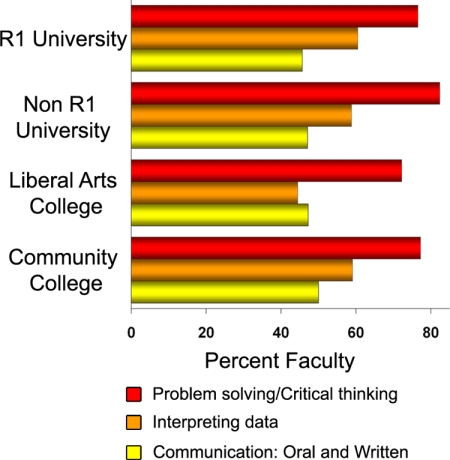
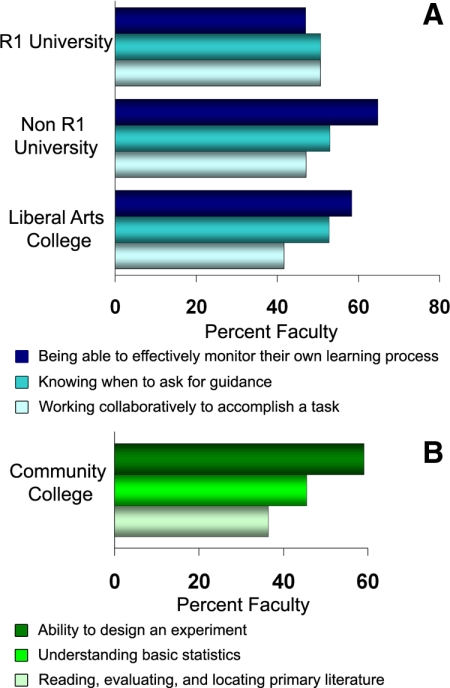
Most scientific endeavors require science process skills such as data interpretation, problem solving, experimental design, scientific writing, oral communication, collaborative work, and critical analysis of primary literature. These are the fundamental skills upon which the conceptual framework of scientific expertise is built. Unfortunately, most college science departments lack a formalized curriculum for teaching undergraduates science process skills. However, evidence strongly suggests that explicitly teaching undergraduates skills early in their education may enhance their understanding of science content. Our research reveals that faculty overwhelming support teaching undergraduates science process skills but typically do not spend enough time teaching skills due to the perceived need to cover content. To encourage faculty to address this issue, we provide our pedagogical philosophies, methods, and materials for teaching science process skills to freshman pursuing life science majors. We build upon previous work, showing student learning gains in both reading primary literature and scientific writing, and share student perspectives about a course where teaching the process of science, not content, was the focus. We recommend a wider implementation of courses that teach undergraduates science process skills early in their studies with the goals of improving student success and retention in the sciences and enhancing general science literacy.
Overview
The claims and statistics of this paper haven’t been checked yet.
Run the check — free, no account needed. It reads the open-access text and checks the sources it cites.
Integrity signals
Registry
Cites
Statistics
Figures
Verification
Claims the paper makes
The claims and statistics of this paper haven’t been checked yet.
Run the check — free, no account needed. It reads the open-access text and checks the sources it cites.
Claims other papers make about this one
Each is checked against this paper’s own text: does it say what the citing paper says it does?
The source backs part of the claim, not all of it — or backs it for a different population, condition or comparison.
In the citing paper
“Similarly, instructors of science, technology, engineering, and math (STEM) courses report that science process skills associated with the reading of PSL, such as the interpretation of graphs and tables, are among the most important skills for undergraduate students to acquire (Coil et al., 2010).”
From Reading Primary Scientific Literature: Approaches for Teaching Students in the Undergraduate STEM Classroom (2023) · cites this paper as Coil et al., 2010
Experimental — accuracy not yet measuredThe cited source says what the claim attributes to it.
In the citing paper
“Faculty members are assumed to be ‘experts’ possessing both good content knowledge and science processing skills [18].”
From Perceptions of scientific research literature and strategies for reading papers depend on academic career stage (2017) · cites this paper as [18]
Self-check
Percentages, sums and reported differences re-computed from the paper’s own numbers.
The self-check needs the paper’s full text.
Citations
Cites
(1999) · Cited by 12,812
Dewey, J. (1910) · D C Heath eBooks · doi:10.1037/10903-000 · Cited by 9,538
DEWEY, J. M. (1910) · Cited by 6,801
(1956) · Medical Entomology and Zoology · Cited by 4,596
Talking about Leaving: Why Undergraduates Leave the Sciences
Correll, S. J., Seymour, E., & Hewitt, N. M. (1997) · Contemporary Sociology A Journal of Reviews · doi:10.2307/2655673 · Cited by 3,088
In Search of Understanding: The Case for Constructivist Classrooms
Brooks, J. G., & Brooks, M. G. (1993) · Cited by 2,138
Creating Significant Learning Experiences: An Integrated Approach to Designing College Courses
Fink, L. D. (2003) · Thammasat University Digital Collections · Cited by 1,719
Benchmarks for Science Literacy
McComas, W. F. (2013) · SensePublishers eBooks · doi:10.1007/978-94-6209-497-0_11 · Cited by 1,718
Concept mapping: A useful tool for science education
Novak, J. D. (1990) · Journal of Research in Science Teaching · doi:10.1002/tea.3660271003 · Cited by 1,032
Handelsman, J., Ebert-May, D., Beichner, R., Bruns, P., Chang, A., DeHaan, R., Gentile, J., Lauffer, S., Stewart, J., Tilghman, S. M., et al. (2004) · Science · doi:10.1126/science.1096022 · Cited by 928
BIO2010 : Transforming Undergraduate Education for Future Research Biologists
Earth, D. O. (2003) · Cited by 854
Effects of Inquiry-based Learning on Students’ Science Literacy Skills and Confidence
Gormally, C. L., Brickman, P., Hallar, B. L., & Armstrong, N. A. (2009) · International Journal for the Scholarship of Teaching and Learning · doi:10.20429/ijsotl.2009.030216 · Cited by 593
Kardash, C. M. (2000) · Journal of Educational Psychology · doi:10.1037/0022-0663.92.1.191 · Cited by 563
Creating Significant Learning Experiences: An Integrated Approach to Designing College Courses
Cox, D. (2004) · Teachers College Record The Voice of Scholarship in Education · doi:10.1177/01614681200410602283 · Cited by 507
Review of Graph Comprehension Research: Implications for Instruction
Shah, P., & Hoeffner, J. (2002) · Educational Psychology Review · doi:10.1023/a:1013180410169 · Cited by 431
Airey, J., & Linder, C. (2008) · Journal of Research in Science Teaching · doi:10.1002/tea.20265 · Cited by 345
Seymour, E. (1995) · Science Education · doi:10.1002/sce.3730790406 · Cited by 344
Learning and Scientific Reasoning
Bao, L., Cai, T., Koenig, K., Fang, K., Han, J. L., Wang, J., Liu, Q., Ding, L., Cui, L., Luo, Y., et al. (2009) · Science · doi:10.1126/science.1167740 · Cited by 300
Comparing the epistemological underpinnings of students' and scientists' reasoning about conclusions
Hogan, K., & Maglienti, M. (2001) · Journal of Research in Science Teaching · doi:10.1002/tea.1025 · Cited by 288
Linking Formative Assessment to Scaffolding
Shepard, L. A. (2005) · Educational leadership · Cited by 242
Selective Use of the Primary Literature Transforms the Classroom Into a Virtual Laboratory
Hoskins, S. G., Stevens, L. M., & Nehm, R. H. (2007) · Genetics · doi:10.1534/genetics.107.071183 · Cited by 220
Scientific Teaching in Practice
Miller, S., Pfund, C., Pribbenow, C. M., & Handelsman, J. (2008) · Science · doi:10.1126/science.1166032 · Cited by 159
Assessment and Active Learning Strategies for Introductory Geology Courses
McCONNELL, D. A., Steer, D. N., & Owens, K. D. (2003) · Journal of Geoscience Education · doi:10.5408/1089-9995-51.2.205 · Cited by 157
Kozeracki, C. A., Carey, M. F., Colicelli, J., & Levis-Fitzgerald, M. (2006) · CBE—Life Sciences Education · doi:10.1187/cbe.06-02-0144 · Cited by 124
DebBurman, S. K. (2002) · Cell Biology Education · doi:10.1187/cbe.02-07-0024 · Cited by 117
An Investigation of the Factors Influencing Student Performance in Physical Chemistry
Nicoll, G., & Francisco, J. S. (2001) · Journal of Chemical Education · doi:10.1021/ed078p99 · Cited by 104
Bunce, D. M., & Hutchinson, K. D. (1993) · Journal of Chemical Education · doi:10.1021/ed070p183 · Cited by 91
Getting Undergraduates To Critically Read and Discuss Primary Literature.
Janick‐Buckner, D. (1997) · The journal of college science teaching · Cited by 82
Enhancing diversity in science: Is teaching science process skills the answer?
Dirks, C., & Cunningham, M. (2006) · CBE—Life Sciences Education · doi:10.1187/cbe.05-10-0121 · Cited by 80
Self-citationGehring, K. M., & Eastman, D. A. (2008) · CBE—Life Sciences Education · doi:10.1187/cbe.07-10-0091 · Cited by 69
Allen, D. E., & Tanner, K. D. (2007) · CBE—Life Sciences Education · doi:10.1187/cbe.07-03-0017 · Cited by 62
Kitchen, E., Bell, J. D., Reeve, S., Sudweeks, R. R., & Bradshaw, W. S. (2003) · Cell Biology Education · doi:10.1187/cbe.02-11-0055 · Cited by 62
(2000) · The journal of college science teaching · Cited by 60
Effective Practices in Undergraduate STEM Education Part 1: Examining the Evidence
Labov, J. B., Singer, S. R., George, M. D., Schweingruber, H. A., & Hilton, M. L. (2009) · CBE—Life Sciences Education · doi:10.1187/cbe.09-06-0038 · Cited by 60
Revising the AP Biology Curriculum
Wood, W. B. (2009) · Science · doi:10.1126/science.1180821 · Cited by 50
Practical Advice for Teaching Inquiry-Based Science Process Skills in the Biological Sciences
Wilke, R. R., & Straits, W. J. (2005) · The American Biology Teacher · doi:10.1662/0002-7685(2005)067[0534:paftis]2.0.co;2 · Cited by 49
Using Self-Reflection To Increase Science Process Skills in the General Chemistry Laboratory
Taylor, D., Rogers, A. L., & Veal, W. R. (2009) · Journal of Chemical Education · doi:10.1021/ed086p393 · Cited by 45
Points of View: Content versus Process: Is This a Fair Choice?
Wright, R. L. (2005) · Cell Biology Education · doi:10.1187/cbe.05-04-0075 · Cited by 43
Alberts, B. (2009) · Science · doi:10.1126/science.1169941 · Cited by 40
How Do College Students Best Learn Science
Leonard, W. H. (2000) · The journal of college science teaching · Cited by 39
Investigating the Impact on Skill Development of an Undergraduate Scientific Research Skills Course
Yeoman, K. H., & Zamorski, B. (2008) · Bioscience Education · doi:10.3108/beej.11.5 · Cited by 31
Points of View: Content versus Process: Is This a Fair Choice?
Klymkowsky, M. W. (2005) · Cell Biology Education · doi:10.1187/cbe.05-04-0073 · Cited by 31
Wilensky, U. J., & Reisman, K. (1998) · Cited by 28
Sirum, K. L., Madigan, D., & Kilionsky, D. J. (2009) · The journal of college science teaching · Cited by 26
Teaching Information Literacy and Scientific Process Skills: An Integrated Approach
Souchek, R. D., & Meier, M. (1997) · College Teaching · doi:10.1080/87567559709596213 · Cited by 15
A Peer-Reviewed Research Assignment for Large Classes.
Henderson, L. L., & Buising, C. M. (2000) · The journal of college science teaching · Cited by 14
A Gentle Discovery Method: (The Modified Texas Method)
Mahavier, W. T. (1997) · College Teaching · doi:10.1080/87567559709596214 · Cited by 13
Student- and Teacher-Centered Learning in a Supplemental Learning Biology Course.
Preszler, R. W. (2006) · Bioscene: The Journal Of College Biology Teaching · Cited by 9
Research works printed but not linked: 19
- Alberts B., 2009, Issues Sci. Tech., 77
- American Association of Medical Colleges and Howard Hughes Medical Institute, 2009, Scientific Foundations for Future physicians
- Brickman P., 2009, Internat. J. Schol. Teach. Learn., 3, 1
- Carnegie Institute for Advanced Study Commission on Mathematics and Science Education, 2009, The Opportunity Equation
- Cota-Robles E. H., 1999, Reaching the Top: A Report of the National Task Force on Minority High Achievement
- Duckworth E., 1990, Science Education: A Minds-On Apporach for the Elementary Years
- Fortner R. W., 1999, J. Coll. Sci. Teach., 281, 261
- Gandara P., 1999, Priming the Pump: Strategies for Increasing Under-Represented Minority Graduates
- Handelsman J., 2007, Scientific Teaching
- Henderson L., 2000, J. Coll. Sci. Teach., 30, 109
- Hermann C., 1999, J. Coll. Sci. Teach., 29, 252
- Janick-Buckner D., 1997, J. Coll. Sci. Teach., 27, 29
- Leonard W. H., 2000, Coll. Sci. Teach., 29, 385
- Muench S. B., 2000, J. Coll. Sci. Teach., 29, 255
- National Research Council (NRC), 2005, How Student Learn: History, Mathematics, and Science in the Classroom
- Preszler R. W., 2006, Bioscene, 32, 21
- Shepard L. A., 2005, Educ. Leadership., 63, 66
- Sirum K. L., 2009, J. Coll. Sci. Teach., 38, 38
- Wright R., 2005, Educ., 4, 189
Cited by
Sorted by citations
Singer, S. R., & Smith, K. A. (2013) · Journal of Engineering Education · doi:10.1002/jee.20030 · Cited by 852
Gormally, C., Brickman, P., & Lutz, M. (2012) · CBE—Life Sciences Education · doi:10.1187/cbe.12-03-0026 · Cited by 437
Drawing-to-Learn: A Framework for Using Drawings to Promote Model-Based Reasoning in Biology
Quillin, K., & Thomas, S. R. (2015) · CBE—Life Sciences Education · doi:10.1187/cbe.14-08-0128 · Cited by 378
Brownell, S. E., Hekmat-Scafe, D. S., Singla, V., Chandler Seawell, P., Conklin Imam, J. F., Eddy, S. L., Stearns, T., & Cyert, M. S. (2015) · CBE—Life Sciences Education · doi:10.1187/cbe.14-05-0092 · Cited by 287
Developing research skills in medical students: AMEE Guide No. 69
Laidlaw, A. H., Aiton, J., Struthers, J., & Guild, S. (2012) · Medical Teacher · doi:10.3109/0142159x.2012.704438 · Cited by 230
Metadata
- Authors
- Coil, D., Wenderoth, M. P., Cunningham, M., & Dirks, C.
- Affiliations
- University of Washington (US)
- Corresponding author
- Dirks, Clarissa
- Venue
- CBE—Life Sciences Education
- Published
- 2010-12
- Volume
- 9
- Issue
- 4
- Pages
- 524-535
- ISSN
- 1931-7913 (ISSN-L)
- PMC
- PMC2995770
- OpenAlex
- W2115994980
- Cited by
- 282
- References
- 48
- Citations by year
- 2026: 8 · 2025: 21 · 2024: 18 · 2023: 24 · 2022: 23 · 2021: 20 · 2020: 30 · 2019: 10 · 2018: 22 · 2017: 19 · 2016: 19 · 2015: 20 · 2014: 15 · 2013: 16 · 2012: 11
- FWCI
- 49.43
- Type
- journal article
- Language
- en
- Open access
- green
- www.ncbi.nlm.nih.gov
- Licence
- cc-by-nc-sa
- Locations
- CBE—Life Sciences Education (publishedVersion)
- PubMed Central (publishedVersion, cc-by-nc-sa)
- PubMed (publishedVersion)
- Funders
- Howard Hughes Medical Institute (52003841)
- University of Washington
- Directorate for Biological Sciences
- Topics
- Social Sciences › Education › Science Education and Pedagogy
- Social Sciences › Education › Innovative Teaching Methods
- Social Sciences › Education › Educational Methods and Outcomes
- Keywords
- scientific method, science process skills, undergraduate science education, teacher perceptions, scientific writing, experimental design, data interpretation, problem solving, scientific literacy, teaching methods
- MeSH terms
- Curriculum, Faculty, Science, Students, Teaching, Universities
About these checks
Registry, retraction, Cites and statistics results are computed, not judged, with one exception: a printed reference that no index lists is read once by a model before it counts as a citation error. Claims are extracted by a model and kept only when their quote appears verbatim in the text; each cited source is then checked, with a model’s help, for whether it says what the claim relies on. Those verdicts can be wrong — read the claim’s quote and the cited source before relying on one.
Statistics and arithmetic are recomputed, not judged.
Confidence bands are shown only for fields calibrated on our annotated test set. None is calibrated yet, so no band is shown.
What counts as a claim ›How we measure confidence ›How we check this ›
Are you an author, or do you see a problem with this page? Request a review
