

A Longitudinal Study of How Quality Mentorship and Research Experience Integrate Underrepresented Minorities into STEM Careers
Open accessThe DOI matches its Crossref record; 64 of the 66 references it cites were found in a registry or an index, and 1 are not checked yet.
Abstract
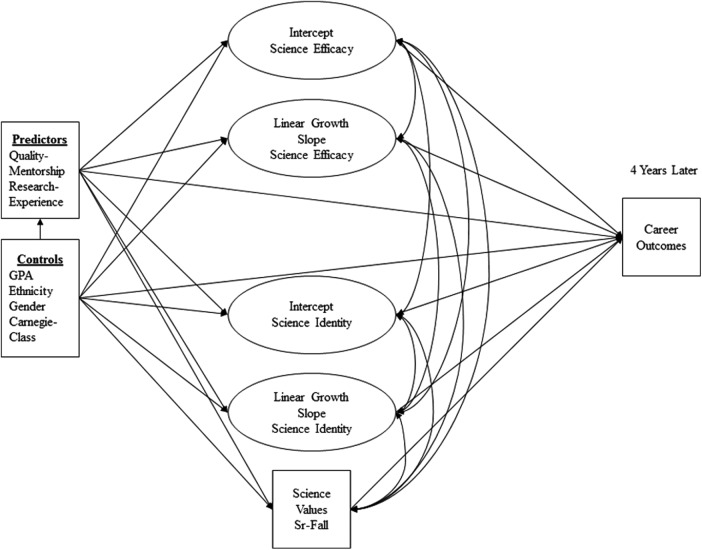
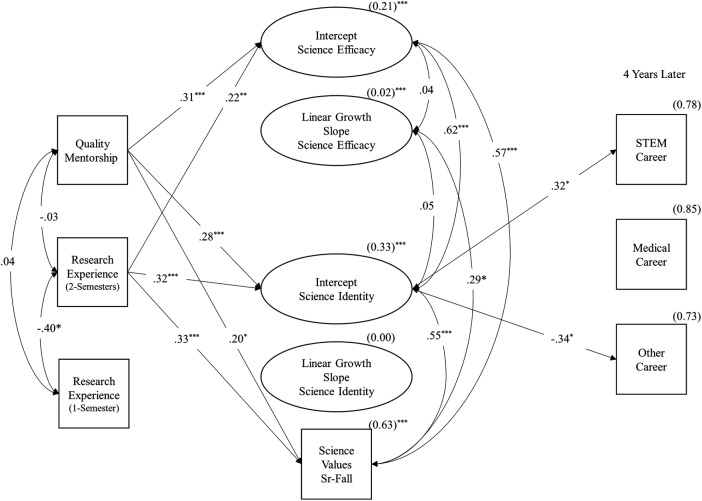
African Americans, Latinos, and Native Americans are historically underrepresented minorities (URMs) among science, technology, engineering, and mathematics (STEM) degree earners. Viewed from a perspective of social influence, this pattern suggests that URMs do not integrate into the STEM academic community at the same rate as non-URM students. Estrada and colleagues recently showed that Kelman’s tripartite integration model of social influence (TIMSI) predicted URM persistence into science fields. In this paper, we longitudinally examine the integration of URMs into the STEM community by using growth-curve analyses to measure the development of TIMIS’s key variables (science efficacy, identity, and values) from junior year through the postbaccalaureate year. Results showed that quality mentorship and research experience occurring in the junior and senior years were positively related to student science efficacy, identity, and values at that same time period. Longitudinal modeling of TIMSI further shows that, while efficacy is important, and perhaps a necessary predictor of moving toward a STEM career, past experiences of efficacy may not be sufficient for maintaining longer-term persistence. In contrast, science identity and values do continue to be predictive of STEM career pathway persistence up to 4 years after graduation.
Overview
The claims and statistics of this paper haven’t been checked yet.
Free: it reads the open-access text and checks the first 5 claims that cite a source we can check. Create a free account to check every claim.
Integrity signals
Registry
Cites
Statistics
Figures
Verification
Claims the paper makes
The claims and statistics of this paper haven’t been checked yet.
Free: it reads the open-access text and checks the first 5 claims that cite a source we can check. Create a free account to check every claim.
Claims other papers make about this one
Each is checked against this paper’s own text: does it say what the citing paper says it does?
The source backs part of the claim, not all of it — or backs it for a different population, condition or comparison.
In the citing paper
“Multiyear undergraduate research experiences have been shown to increase the number of PEER students who graduate from college and subsequently earn a PhD (Maton et al., 2012, 2016; Estrada et al., 2018).”
From Improving Academic Performance and Retention of First-Year Biology Students through a Scalable Peer Mentorship Program (2021) · cites this paper as Estrada et al., 2018
Experimental — accuracy not yet measuredThe source backs part of the claim, not all of it — or backs it for a different population, condition or comparison.
In the citing paper
“The measures in the model, which are referred to as social influence process indicators (e.g., scientific self-efficacy, scientific identity, value orientation, mentorship, and career intent), were developed in an exclusively URM sample.”
From Gains in Scientific Identity, Scientific Self-Efficacy, and Career Intent Distinguish Upper-Level CUREs from Traditional Experiences in the Classroom (2022) · cites this paper as [11]
Experimental — accuracy not yet measuredThe cited source says what the claim attributes to it.
In the citing paper
“A longitudinal study of URMs indicated that scientific identity uniquely predicts STEM employment (11).”
From Gains in Scientific Identity, Scientific Self-Efficacy, and Career Intent Distinguish Upper-Level CUREs from Traditional Experiences in the Classroom (2022) · cites this paper as [11]
The cited source says what the claim attributes to it.
In the citing paper
“The scientific self-efficacy, scientific identity, and value orientation scales operationalize the compliance, identification, and internalization processes of Kelman’s model, respectively.”
From Gains in Scientific Identity, Scientific Self-Efficacy, and Career Intent Distinguish Upper-Level CUREs from Traditional Experiences in the Classroom (2022) · cites this paper as [11]
The cited source says what the claim attributes to it.
In the citing paper
“The TIMSI model was designed to predict URM persistence in STEM career pathways by examining integration into the scientific community.”
From Gains in Scientific Identity, Scientific Self-Efficacy, and Career Intent Distinguish Upper-Level CUREs from Traditional Experiences in the Classroom (2022) · cites this paper as [11]
Self-check
Percentages, sums and reported differences re-computed from the paper’s own numbers.
The self-check needs the paper’s full text.
Citations
Cites
Hu, L., & Bentler, P. M. (1999) · Structural Equation Modeling A Multidisciplinary Journal · doi:10.1080/10705519909540118 · Cited by 108,788 · cited 1×
“Consistent with current standards, we evaluated model fit indices relative to recommended cutoff values (Hu and Bentler, 1999).”
MethodSelf-efficacy: The exercise of control
Bandura, A., Freeman, W. H., & Lightsey, R. (1999) · Journal of Cognitive Psychotherapy · doi:10.1891/0889-8391.13.2.158 · Cited by 46,835
Missing data: our view of the state of the art
Schafer, J. L., & Graham, J. W. (2002) · Psychological Methods · doi:10.1037/1082-989x.7.2.147 · Cited by 11,638 · cited 1×
“To determine whether the patterns of missing data met the strict assumption of being missing completely at random (MCAR) required for unbiased parameter estimates under ordinary least-squares (OLS) regression, we conducted Little’s MCAR test (Little, 1988; Schafer and Graham, 2002).”
MethodMediation in experimental and nonexperimental studies: New procedures and recommendations.
Shrout, P. E., & Bolger, N. (2002) · Psychological Methods · doi:10.1037/1082-989x.7.4.422 · Cited by 11,335 · cited 2×
“…a percentile bootstrap (with 5000 repetitions) was used to estimate the 95% CIs around the indirect effects of quality mentorship and research experiences on STEM or other career choice through the science identity intercept (Shrout and Bolger, 2002; MacKinnon et al. 2004, 2007, MacKinnon, 2008).”
MethodA test of missing completely at random for multivariate data with missing values
Little, R. J. A. (1988) · Journal of the American Statistical Association · doi:10.1080/01621459.1988.10478722 · Cited by 8,963 · cited 1×
“To determine whether the patterns of missing data met the strict assumption of being missing completely at random (MCAR) required for unbiased parameter estimates under ordinary least-squares (OLS) regression, we conducted Little’s MCAR test (Little, 1988; Schafer and Graham, 2002).”
MethodConfidence Limits for the Indirect Effect: Distribution of the Product and Resampling Methods
MacKinnon, D. P., Lockwood, C. M., & Williams, J. (2004) · Multivariate Behavioral Research · doi:10.1207/s15327906mbr3901_4 · Cited by 7,806 · cited 1×
“…a percentile bootstrap (with 5000 repetitions) was used to estimate the 95% CIs around the indirect effects of quality mentorship and research experiences on STEM or other career choice through the science identity intercept (Shrout and Bolger, 2002; MacKinnon et al. 2004, 2007, MacKinnon, 2008).”
MethodMotivational beliefs, values, and goals
Eccles, J. S., & Wigfield, A. (2002) · Annual Review of Psychology · doi:10.1146/annurev.psych.53.100901.135153 · Cited by 7,587 · cited 1×
“Kelman’s conception of values also differs slightly from Eccles and colleagues’ research on subjective task value, which focuses more upon the value of specific tasks and assesses the intrinsic value of a task (Eccles and Wigfield, 2002; Durik et al., 2006).”
Result(2010) · Cited by 7,034
A threat in the air: How stereotypes shape intellectual identity and performance
Steele, C. M. (1997) · American Psychologist · doi:10.1037/0003-066x.52.6.613 · Cited by 6,770 · cited 2×
“Stereotype threat research has shown that when there are “signals” or context contingencies that communicate to minority students that they do not belong in the scientific community, students’ performances decline, while cognitive vigilance increases (Steele, 1997; Ambady et al., 2001; Murphy et al., 2007).”
BackgroundSocial Influence: Compliance and Conformity
Cialdini, R. B., & Goldstein, N. J. (2004) · Annual Review of Psychology · doi:10.1146/annurev.psych.55.090902.142015 · Cited by 6,077 · cited 1×
“Social Influence Literature In their review of the social influence literature, Cialdini and Goldstein (2004) focused on specific influence tactics (e.g., the foot-in-the door or door-in-the-face techniques) and emphasized the circumstances under which the tactics do or do not work.”
Background
Research works printed but not linked: 13
- Council on Graduate Medical Education. (2005). Minorities in medicine: An ethnic and cultural challenge for physician training. Rockville, MD
- DePass A. Chubin D. (2009). Understanding interventions that encourage minorities to pursue research careers: Building a community of research and practice. Bethesda, MD: American Society for Cell Biology.
- Dreher G. F. Ash R. A. (1990). A comparative study of mentoring among men and women in managerial, professional, and technical positions. Journal of Applied Psychology, (5), 539– 546. 10.1037/0021.9010.75.5.539 · doi:10.1037/0021.9010.75.5.539
- Flaxman E. Ascher C. Harrington C. (1988). Youth mentoring: Programs and practices. New York: ERIC Clearinghouse on Urban Education.
- Johnson W. B. Rose G. Schlosser L. Z. (2007). Student-faculty mentoring: Theoretical and methodological issues. In Allen T. D. Eby L. T. (Eds.), The Blackwell handbook of mentoring: A multiple perspectives approach (pp. 49– 69). Oxford, UK: Blackwell.
- Kelman H. C. Hamilton V. L. (1989). Crimes of obedience. New Haven, CT: Yale University Press.
- Kram K. (1985). Mentoring at work. Glenview, IL: Scott Foresman.
- Lent R. Social cognitive career theory: What attracts students to−and keeps them in STEM fields? A theoretical perspective 2007 Washington, DC: National Academies Press 7– 11. In Understanding interventions that encourage minorities to pursue research careers: Summary of a workshop
- Muthén L. Muthén B. (1998–2009). Mplus (Version 5.21). Los Angeles, CA: Muthén & Muthén.
- National Academies of Sciences, Engineering, and Medicine. (2016). Barriers and opportunities for 2-year and 4-year STEM degrees: Systemic change to support students’ diverse pathways. Washington, DC: National Academies Press. 27336114
- National Academies of Sciences, Engineering, and Medicine. (2017). Undergraduate research experiences for STEM students: Successes, challenges, and opportunities. Washington, DC: National Academies Press.
- National Research Council. (2005). Assessment of NIH minority research and training programs: Phase 3. Washington, DC: National Academies Press. 20669454
- Ragins B. R. (2010). Relational mentoring: A positive approach to mentoring at work. In Cameron K. S. Spreitzer G. M. (Eds.), The handbook of positive organizational scholarship (pp. 519– 536). New York: Oxford University Press.
Cited by
Items 101–200 of 607
Sancheznieto, F., Asquith, P., Báez, A., Meagher, E. A., & Pfund, C. (2024) · Journal of Clinical and Translational Science · doi:10.1017/cts.2024.524 · Cited by 19
An open letter to past, current and future mentors of Black neuroscientists
Singleton, K. S., Tesfaye, R., Dominguez, E. N., & Dukes, A. J. (2020) · Nature reviews. Neuroscience · doi:10.1038/s41583-020-00421-9 · Cited by 19
Leonetti, C. T., Lindberg, H. M., Schwake, D. O., & Cotter, R. L. (2023) · CBE—Life Sciences Education · doi:10.1187/cbe.21-11-0318 · Cited by 19
“As a high-impact practice, UREs can be particularly beneficial for underrepresented student populations (Villarejo et al., 2008; Hurtado et al., 2010; Espinosa, 2011; Hernandez et al., 2013; Estrada et al., 2016, 2018).”
BackgroundWillis, L. M., Mehta, D., & Davis, A. C. D. (2020) · ACS Central Science · doi:10.1021/acscentsci.0c01120 · Cited by 20
Chase, L., McMurray, M. S., Stavnezer, A. J., Buffalari, D. M., Fernandes, J. J., Lom, B., & Morrison, M. E. (2020) · PubMed Central · Cited by 20
Why we shouldn’t blame women for gender disparity in academia: perspectives of women in zoology
Slobodian, V., Soares, K. D. A., Falaschi, R. L., Prado, L. R., Camelier, P., Guedes, T., Leal, L. C., Hsiou, A. S., Del‐Rio, G., Costa, E. R., et al. (2021) · Zoologia (Curitiba) · doi:10.3897/zoologia.38.e61968 · Cited by 18
“…missed interdisciplinary hubs, which are more prevalent in gender and ethnically diverse groups (Adams 2013, Uzzi et al. 2013, Campbell et al. 2013, Franzoni et al. 2014, Freeman and Huang 2015); furthermore, even though they endeavored to embrace a broader sense of mentorship when examining the…”
BackgroundKang, H., Talafian, H., & Tschida, P. (2022) · Journal of Research in Science Teaching · doi:10.1002/tea.21824 · Cited by 18
A new way of evaluating effectiveness of URM summer pipeline programs
Hill, K., Raney, C., Jackson, K., Murdock, H. M., Dawson, E., Hamilton, R., DeLisser, H., Mamtani, M., & Aysola, J. (2021) · Advances in Medical Education and Practice · doi:10.2147/amep.s293744 · Cited by 17
A Cultural Wealth Approach to Understanding Latin@s’ STEM Mentee and Mentor Experiences
Morales‐Chicas, J., Gomez, M., Gussman, M., & Kouyoumdjian, C. (2022) · Equity & Excellence in Education · doi:10.1080/10665684.2022.2047411 · Cited by 17
“Mentorship promotes career success, achievement, confidence, less attrition, social capital, and self-efficacy across various educational levels for Latin@s pursuing STEM fields (Cole & Espinoza, 2008; Estrada et al., 2018; Sánchez et al., 2021; San Miguel & Kim, 2015).”
BackgroundVirtually the Same? Evaluating the Effectiveness of Remote Undergraduate Research Experiences
Hess, R. A., Erickson, O. A., Cole, R. B., Isaacs, J. M., Álvarez-Clare, S., Arnold, J., Augustus‐Wallace, A., Ayoob, J. C., Berkowitz, A. R., Branchaw, J. L., et al. (2023) · CBE—Life Sciences Education · doi:10.1187/cbe.22-01-0001 · Cited by 17
“Estrada et al. (2018) studied the effects of UREs on the self-efficacy, scientific identity, and values alignment of a cohort of underrepresented minority students in their junior and senior years.”
BackgroundHowe, M. E., Schaffer, L. V., Styles, M. J., & Pazicni, S. (2021) · Journal of Chemical Education · doi:10.1021/acs.jchemed.1c00502 · Cited by 17
A Diverse View of Science to Catalyse Change
Urbina‐Blanco, C. A., Jilani, S. Z., Speight, I. R., Bojdys, M. J., Friščić, T., Stoddart, J. F., Nelson, T. L., Mack, J., Robinson, R. A. S., Waddell, E. A., et al. (2020) · Journal of the American Chemical Society · doi:10.1021/jacs.0c07877 · Cited by 17
Rocha, J., Cabral, B., Chen, E., Rodriguez, C., & Yancy, C. W. (2022) · Gifted Child Quarterly · doi:10.1177/00169862221119209 · Cited by 16
“Recent research has recognized various attributes that influence students’ ongoing determination in pursuing STEM-M careers, attributes which include robust mentorship (Ma et al., 2020), research opportunities (Estrada et al., 2018), and participation in enrichment programs (Rocha et al., 2021).”
BackgroundWhite, D. T., Miles, M. L., McGee, E. O., & Brockman, A. J. (2023) · Frontiers in Education · doi:10.3389/feduc.2023.1062556 · Cited by 16
Okochi, C., Gold, A. U., Christensen, A., & Batchelor, R. L. (2023) · PLoS ONE · doi:10.1371/journal.pone.0293674 · Cited by 16
“…opportunity for participants to develop a vision for STEM careers early in their career path and a vision of themselves as researchers, through exposure to role models in their peer mentors and research mentors and through the experience of completing an independent research project [15, 44, 45].”
BackgroundHow Southeast Asian Students Develop Their Science Self-Efficacy During the First Year of College
Nhien, C. (2024) · The Journal of Higher Education · doi:10.1080/00221546.2024.2339173 · Cited by 16
“…between science self-efficacy and a variety of STEM-related outcomes (e.g., intent to pursue a science career, grades; Chemers et al., 2011; Estrada et al., 2018), there are few studies examining how science self-efficacy develops during the first college year, which extensive scholarship…”
Lee, H., Du, W., Pedersen, R. M., Estrada, M., Adams, A. S., Barnes, R. T., Bloodhart, B., Burt, M., Clinton, S. M., Pollack, I. B., et al. (2024) · Contemporary Educational Psychology · doi:10.1016/j.cedpsych.2024.102324 · Cited by 16
Self-citationSTEM doctoral mentoring: a call for a conscious, culturally responsive journey
Sanczyk, A., Merriweather, L. R., Howell, C. D., & Douglas, N. C. (2021) · International Journal of Mentoring and Coaching in Education · doi:10.1108/ijmce-07-2020-0034 · Cited by 16
Tuladhar, A., Queener, C., Mondisa, J., & Okwudire, C. E. (2021) · International Journal of Mentoring and Coaching in Education · doi:10.1108/ijmce-06-2020-0032 · Cited by 16
Gray, M. J., Gunarathne, S. A., Nguyen, N. N., & Shortlidge, E. E. (2022) · CBE—Life Sciences Education · doi:10.1187/cbe.21-09-0261 · Cited by 16
“There is evidence in the literature that these constructs are important characteristics for STEM students’ persistence (Estrada et al. , 2011, 2018; Simon et al. , 2015; Rainey et al. , 2018; Strayhorn, 2018), and we wanted to explore what they mean to students in this study; the focus group…”
BackgroundInfluentialSTEM postdoc mentoring: a social exchange theory-based conceptual framework
Rida, P., Noel, T. K., & Miles, M. L. (2023) · Mentoring & Tutoring Partnership in Learning · doi:10.1080/13611267.2023.2178708 · Cited by 16
Sun, E., Graves, M. L., & Oliver, D. C. (2020) · Frontiers in Microbiology · doi:10.3389/fmicb.2020.589025 · Cited by 17
Ten simple rules for succeeding as an underrepresented STEM undergraduate
Massey, M. D. B., Arif, S., Embuldeniya, S., Nanglu, K., & Bielawski, J. P. (2022) · PLoS Computational Biology · doi:10.1371/journal.pcbi.1010101 · Cited by 16
“But, more importantly, they are excellent learning experiences [31] that train you in skills like writing, technical laboratory or fieldwork, and importantly, communicating with professors and colleagues.”
BackgroundChallenges, Successes, and the Future of Firearm Injury Prevention
ROCHE, J. S., CARTER, P. M., ZEOLI, A. M., CUNNINGHAM, R. M., & ZIMMERMAN, M. A. (2023) · The Milbank Quarterly · doi:10.1111/1468-0009.12621 · Cited by 15
Examining Educational and Career Transition Points Among a Diverse, Virtual Mentoring Network
Thompson, E. L., Syed, T. A., Latif, Z., Stinson, K., Javier, D., Saleh, G., & Vishwanatha, J. K. (2024) · Journal for STEM Education Research · doi:10.1007/s41979-024-00119-y · Cited by 15
“…support aspect to increase the persistence and progression of individuals as well as a major positive influence in an individual’s career progression and personal and professional development (Burton et al., 2019; Estrada et al., 2018; Haggard et al., 2011; Mendez et al., 2020; Packard, 2016).”
Broadening Participation in Computing: Promoting Affective and Cognitive Learning in Informal Spaces
Yang, H., Codding, D., Mouza, C., & Pollock, L. (2021) · TechTrends · doi:10.1007/s11528-020-00562-9 · Cited by 15
Smith, K., Geddis, D. L., & Dumas, J. E. (2021) · Advanced Drug Delivery Reviews · doi:10.1016/j.addr.2021.113866 · Cited by 15
High school science fair: Ethnicity trends in student participation and experience
Grinnell, F., Dalley, S., & REISCH, J. S. (2022) · PLoS ONE · doi:10.1371/journal.pone.0264861 · Cited by 15
“Under representation of Black and Hispanic individuals in STEM careers does not result from an initial lack of student interest in STEM but from subsequent differences in persistence and overall graduation rates in STEM degree programs compared to Asian and White students [29, 30].”
BackgroundYim, A., Juarez, J. K., Goliath, J. R., & Melhado, I. S. (2022) · Forensic Science International Synergy · doi:10.1016/j.fsisyn.2022.100280 · Cited by 15
“research experience all contribute to the effective retention of BIPOC individuals in STEM education [71,97].”
BackgroundCUREing Biochemistry Lab Monotony
Satusky, M., Wilkins, H., Hutson, B., Nasiri, M., King, D. E., Erie, D. A., & Freeman, T. C. (2022) · Journal of Chemical Education · doi:10.1021/acs.jchemed.2c00357 · Cited by 15
Pedersen, D. E., Kubátová, A., & Simmons, R. B. (2022) · Teaching & Learning Inquiry The ISSOTL Journal · doi:10.20343/teachlearninqu.10.31 · Cited by 14
Pedersen, R. M., Woodcock, A., Schultz, P. W., & Hernandez, P. R. (2024) · International Journal of STEM Education · doi:10.1186/s40594-024-00480-9 · Cited by 15
“…characteristics of mentors, mentees, or their demographic similarity with mentoring support and relationship satisfaction (Blake-Beard et al., 2011; Estrada et al., 2018a; Hernandez et al., 2017, 2023a; Kuchynka et al., 2023; Morales et al., 2021; Pedersen et al., 2022; Robnett et al., 2019).”
BackgroundInfluentialSelf-citationMentorship for Transfer Student Success in STEM Research: Mentor Approaches and Reflections
Zuckerman, A. L., Lo, S. M., & Juavinett, A. (2024) · CBE—Life Sciences Education · doi:10.1187/cbe.23-08-0156 · Cited by 14
“…has largely focused on the effects of mentoring relationships on mentee’s affective dispositions and skill development in their research experiences (Haeger and Fresquez, 2016; Pfund et al. , 2016; Thiry et al. , 2012; Byars-Winston et al. , 2015; Estrada et al. , 2018; Atkins et al. , 2020).”
BackgroundThe influence of kindness on academics’ identity, well-being and stress
Hosoda, K. K., & Estrada, M. (2024) · PLoS ONE · doi:10.1371/journal.pone.0312269 · Cited by 14
Self-citationTiny Earth CURE Demonstrates Equitable Benefits for U.S. College Science Students
Miller, S., Hernandez, P. R., Du, W., Lee, H., Maldonado, N., Maldonado, N., Sandoval, P. J., Young, G. R., Handelsman, J., Handelsman, J., et al. (2025) · CBE—Life Sciences Education · doi:10.1187/cbe.23-06-0117 · Cited by 14
“Previous TIMSI research has examined the impact of science training programs and mentorship on integration and long-term persistence for STEM students who are from HECs and HICs (Estrada et al. , 2011; Estrada et al. , 2018b; Hernandez et al. , 2020).”
InfluentialSelf-citationThe Report of the 2021-2022 AACP Research and Graduate Affairs Committee
Crismon, M. L., West-Strum, D. S., Dowling-McClay, K., Drame, I., Hastings, T. J., Jumbo‐Lucioni, P. P., Marwitz, K. K., Spence, A. L., Farrell, D. F., & Walker, R. (2023) · American Journal of Pharmaceutical Education · doi:10.5688/ajpe9454 · Cited by 14
“In addition, quality mentoring contributes to identity formation as a scientist for underrepresented students and enhances their entry into and retention in graduate programs.(16) Mentoring is a crucial element of programs targeting learners at all levels, frommiddle-school students(17) to faculty.”
BackgroundLearners’ career choices in STEM education: A review of empirical studies
Shulga, T. I., Zaripova, Z. F., Sakhieva, R. G., Сергеевич, Д. Г., Арнольдовна, Ч. В., & Zhdanov, S. P. (2023) · Eurasia Journal of Mathematics Science and Technology Education · doi:10.29333/ejmste/13154 · Cited by 14
Borlee, G. I., Kinkel, T. L., Broeckling, B., Borlee, B. R., Mayo, C. E., & Mehaffy, C. (2023) · Journal of Microbiology and Biology Education · doi:10.1128/jmbe.00140-23 · Cited by 15
“…we are serving our increasingly diverse population, especially because scientific identity, self-efficacy, and scientific value orientation can predict intention to pursue a science career and application to graduate programs when measured in the final year of undergraduate education (14, 15).”
BackgroundMethodInfluentialRevelo, R., Mejia, J. A., Mejía, J., & Villanueva, I. (2024) · Journal of Engineering Education · doi:10.1002/jee.20598 · Cited by 15
Mantzourani, E., Chang, H., Fleming, G., & Desselle, S. P. (2020) · Research in Social and Administrative Pharmacy · doi:10.1016/j.sapharm.2020.04.024 · Cited by 14
“35 Women might carry an extra challenge in work-home balance beyond that of most men.”
van Zyl, M., Haynes, E. M. K., Batchelar, D. L., & Jakobi, J. M. (2020) · Medical Physics · doi:10.1002/mp.14524 · Cited by 14
“Mentors and role models not only support the development of talent within and recruitment to the field but also aid in building a diverse and inclusive workplace.(58) Although an individual can be both role model and mentor, each position serves a different purpose.”
BackgroundErichsen, K., Šaras, E. D., & Perez‐Felkner, L. (2024) · Frontiers in Education · doi:10.3389/feduc.2024.1328574 · Cited by 13
Mathematics education and technology: Bibliometric analysis and systematic review (2000-2024)
Navarro-Ibarra, L. A., Salazar, O. C., Michel, L. L. A., & Valenzuela-Ochoa, J. M. (2025) · Eurasia Journal of Mathematics Science and Technology Education · doi:10.29333/ejmste/16072 · Cited by 16
“In addition, Estrada et al. (2018) in a longitudinal investigation determined that quality mentoring and research experiences in junior and senior years favor the integration of underrepresented minorities in STEM programs.”
The Persistent Problem of Undergraduate Student Attrition in STEM
Oliveira, A. W., Musah, R. A., Zacharia, Z. C., avlou, Y., Sgro, C. M., Lathrop, R. L., Kim, Y., Espinosa, K., Japashov, N., & Park, J. (2025) · International Educational Review · doi:10.58693/ier.316 · Cited by 15
“Estrada et al. Under-represented youth expressed positive views of mentoring, stating that it had affected their sense of social connection.”
Palepu, S., Nitsch, A., Narayan, M., Kim, S., & Osier, N. D. (2020) · Frontiers in Education · doi:10.3389/feduc.2020.00102 · Cited by 13
“, 2017) and professional STEM careers (Carpi et al., 2017; Estrada et al., 2018).”
Mabrouk, P. A., & Remijan, M. G. (2023) · Mentoring & Tutoring Partnership in Learning · doi:10.1080/13611267.2023.2164988 · Cited by 13
Creating a Pipeline for Minority Physicians: Medical-Student-Led Programming
Muppala, V., Janwadkar, R., Rootes, A., & Prakash, N. (2021) · Cureus · doi:10.7759/cureus.14384 · Cited by 13
“Embedding the Outreach Programming over a longitudinal pathway provides educational, mentorship and enrichment opportunities for local 6-12th grade students, strengthens their confidence in the sciences and promotes retention and success along their educational and health career pathway [6].”
BackgroundUndergraduate researchers’ graduate school intentions during COVID‐19
Morales, D. X., Grineski, S. E., & Collins, T. W. (2021) · Annals of the New York Academy of Sciences · doi:10.1111/nyas.14698 · Cited by 14
Development of the Mentoring in Undergraduate Research Survey
Limeri, L. B., Carter, N. T., Hess, R. A., Tuma, T. T., Koscik, I., Morrison, A. J., Outlaw, B., Royston, K. S., Bridges, B. H. T., & Dolan, E. L. (2024) · CBE—Life Sciences Education · doi:10.1187/cbe.23-07-0141 · Cited by 12
“Multiple qualitative and quantitative studies have shown that mentoring plays a critical role in STEM undergraduate researchers’ personal and professional development (Thiry and Laursen, 2011; Aikens et al. , 2016; Estrada et al. , 2018; Hernandez, Hopkins et al. , 2018; Joshi et al. , 2019).”
BackgroundInfluentialFactors Influencing Science Career Intention: The Power of Counterspace
Lin, J. C. P., Moon, S., Guan, S. A., Kwan, P. P., Flores, G. E., & Chavira, G. (2024) · Innovative Higher Education · doi:10.1007/s10755-024-09752-2 · Cited by 12
“…with previous investigations that have revealed positive linkages between UREs and the retention of women and students from URG backgrounds in STEM fields and careers (Estrada et al., 2018; Lane, 2016; Lisberg & Woods, 2018; Maton et al., 2012; Myers & Pavel, 2011; Toven-Lindsey et al., 2015).”
Alm, C. O., & Bailey, R. (2022) · The Journal of Computational Science Education · doi:10.22369/issn.2153-4136/13/1/1 · Cited by 12
“Results produced by Estrada at al. suggested that identifying as a scientist was highly important for downstream making STEM one’s career, as opposed to other professions [19].”
BackgroundDonis, K., Aikens, M. L., Swamy, U., Delgado, M., Gillespie, M., Graves, P., & Eddy, S. L. (2024) · Journal of Chemical Education · doi:10.1021/acs.jchemed.3c01137 · Cited by 13
Zajdel, R. A., Rodriquez, E. J., Méjía, R., & Pérez‐Stable, E. J. (2025) · The Lancet Regional Health - Americas · doi:10.1016/j.lana.2024.100975 · Cited by 12
Mutegi, J. W., Sorge, B., Fore, G., & Gibau, G. S. (2019) · Science Education · doi:10.1002/sce.21548 · Cited by 14
Summer Research Internships Prepare High School Students for 21st Century Biomedical Careers
Patel, A. A., Bulger, A., Jarrett, K., Ginwright, S. S., Chandran, K. B., & Wyss, J. M. (2021) · The Journal of STEM Outreach · doi:10.15695/jstem/v4i1.13 · Cited by 12
“The underrepresentation of Black, Hispanic, and Native Americans is a well-documented disparity in STEM careers (Estrada et al., 2018; Hurtado et al., 2010; Stockard et al., 2021), and many historically underrepresented minority students feel more challenged and have a lower sense of belonging in…”
BackgroundInadequate mentoring in undergraduate research experiences: Exploring protective factors
Morales, D. X., Grineski, S. E., & Collins, T. W. (2024) · Annals of the New York Academy of Sciences · doi:10.1111/nyas.15186 · Cited by 11
Anderson, B. L., & Deil‐Amen, R. (2024) · Education Sciences · doi:10.3390/educsci14090956 · Cited by 12
Postgraduate perspectives on mentoring undergraduate researchers for talent development
Asif, M. Z., Edison, A. S., & Dolan, E. L. (2023) · Annals of the New York Academy of Sciences · doi:10.1111/nyas.14966 · Cited by 11
“This organism is ideal for undergraduate investigation because: (1) it is simple and low-cost to maintain; (2) it is widely studied and thus has a wealth of experimental resources and information that can inform investigations; and (3) it does not require specialized animal approval or training.”
BackgroundMethodInfluentialZewail‐Foote, M., & Gonzalez, M. (2023) · Journal of Chemical Education · doi:10.1021/acs.jchemed.2c00341 · Cited by 11
Du, W., Lee, H., Broderick, N. A., Aldana, C. C., Estrada, M., Handelsman, J., Maldonado, N., Miller, S., Patterson, M. S., Sandoval, P. J., et al. (2023) · Frontiers in Education · doi:10.3389/feduc.2023.1293885 · Cited by 11
“For example, a recent longitudinal study with African American and Hispanic undergraduates in STEM majors found that faculty mentor support promoted scientific self-efficacy, identity, and values in college, which in turn predicted persistence in STEM 4 years after graduation (Estrada et al., 2018).”
Self-citationKleinschmit, A. J., Genné-Bacon, E. A., Drace, K., Govindan, B., Larson, J. R., Qureshi, A. A., & Bascom‐Slack, C. (2024) · Journal of Microbiology and Biology Education · doi:10.1128/jmbe.00149-23 · Cited by 11
“Historically, CURE curricula have been prescribed as semester-long laboratory interven tions, and previous studies have pointed toward duration and intensity level of research experiences being paramount for such interventions to be impactful (49, 75).”
BackgroundA Diverse View of Science to Catalyse Change
Urbina‐Blanco, C. A., Jilani, S. Z., Speight, I. R., Bojdys, M. J., Friščić, T., Stoddart, J. F., Nelson, T. L., Mack, J., Robinson, R. A. S., Waddell, E. A., et al. (2020) · Angewandte Chemie International Edition · doi:10.1002/anie.202009834 · Cited by 11
DeChenne‐Peters, S. E., Sargent, E., Mateer, S. C., Machingura, M. C., Zettler, J. A., Ness, T. L., DeMars, G., Cannon, S., & BrofttBailey, J. (2022) · International Journal for the Scholarship of Teaching and Learning · doi:10.20429/ijsotl.2022.160105 · Cited by 11
“…identity is the student’s sense of themselves as a scientist and it is important in student persistence in science and may be even more important for PEER students (Estrada, Hernandez, and Schultz, 2018; National Academies of Sciences and Medicine, 2017; Robnett, Chemers, and Zurbriggen, 2015).”
BackgroundWhitehead, A., & Alves, N. J. (2022) · PLoS ONE · doi:10.1371/journal.pone.0263848 · Cited by 11
Developing a Robotics Program to Support Students’ Computational Thinking: a Design-based Study
Cai, Q. V., Hong, H., McNary, S. W., & Song, L. (2023) · TechTrends · doi:10.1007/s11528-023-00907-0 · Cited by 12
“…computing identity (Yang et al., 2021) and advocates for culturally relevant experiences that enhance peer relationships (Shah et al., 2013; Zhong & Li, 2020) and the development of belongingness in the CT and STEM fields to maximize interest, engagement, and competence (Estrada et al., 2018).”
BackgroundInvestigating Prior Mentoring Experiences of Medical Students and Its Perceived Benefits
Wekam, V., & Vance-Chalcraft, H. D. (2022) · Journal of Microbiology & Biology Education · doi:10.1128/jmbe.00209-21 · Cited by 10
“Studies researching positive outcomes of mentorship have shown that undergraduate mentored research experiences in STEMM are particularly beneficial for underrepresented (UR) students (10, 11).”
BackgroundBarker, D. C., Messier, V., Marcotte, D. E., Hammersley, L. C., & Quiñones-Soto, S. (2023) · Journal for STEM Education Research · doi:10.1007/s41979-023-00107-8 · Cited by 10
“These include enhancing the learning process (Lopatto, 2007), motivation, and engagement (Seymour & Hewitt, 1997) and enhancing confidence (Estrada et al., 2018; Hunter et al., 2007).”
The Making of Future Scientists: Faculty Mentor Cultural Awareness and Inclusive Science Labs
Hernandez, I. A., Segura, O. M., Gonzalez, R. A. R., Flores, L., Villodas, M. T., Sohl, C. D., Smith, J. L., & Thoman, D. B. (2024) · CBE—Life Sciences Education · doi:10.1187/cbe.24-01-0032 · Cited by 10
“Science identity is an essential indicator of integration into the scientific community and a robust predictor of persistence in STEM (Carlone and Johnson, 2007; Chang et al. , 2011; Estrada et al. , 2011, 2018; Osborne and Jones, 2011; Woodcock et al. , 2012).”
BackgroundFoster, K., Lambert, L., Solomon, R., Perkins, H., & Masani, S. (2024) · Journal of Microbiology and Biology Education · doi:10.1128/jmbe.00137-24 · Cited by 10
“Furthermore, performing well in this setting (mastery experiences) and receiving feedback and encouragement (verbal persuasion) reduced associated anxiety and stress (emotional/physiological states) and were key sources of self-efficacy (Table 1, Quotes 10, 11) (21, 29, 30 ).”
InfluentialCaraballo-Cueto, J., Godreau, I. P., & Tremblay, R. L. (2022) · Journal of Hispanic Higher Education · doi:10.1177/15381927221074026 · Cited by 10
“…recognized as providing an effective path to graduate school in the sciences, especially for students from traditionally underrepresented backgrounds (Eagan et al., 2013; Estrada et al., 2018; Hathaway et al., 2002; P. R. Hernandez et al., 2018; Mastronardi et al., 2021; Schultz et al., 2011).”
BackgroundNavigating Barriers and Mentoring Support: The Career Goals of Women Doctoral Students in Chemistry
Zhang, Q. (2024) · Journal of Chemical Education · doi:10.1021/acs.jchemed.3c00197 · Cited by 10
Exploring factors within an introductory course that influence students’ perception of chemistry
Glenn, C. D., & Odeleye, O. O. (2024) · Chemistry Education Research and Practice · doi:10.1039/d4rp00008k · Cited by 10
Esparza, D., Reilly-Sanchez, L., & Smith, M. K. (2024) · CBE—Life Sciences Education · doi:10.1187/cbe.24-02-0046 · Cited by 10
“Further, a student’s science identity can influence their long-term professional trajectory, guiding their choices toward further education and career paths in STEM fields (Seymour et al. , 2004; Stets et al. , 2017; Estrada et al. , 2018; Vincent-Ruz and Schunn, 2018).”
What’s Next? Soon-to-be STEM Graduates on Their Post-graduate Plans
Park, J. J., Kim, Y. K., Lue, K., & Parikh, R. M. (2022) · Research in Higher Education · doi:10.1007/s11162-022-09685-9 · Cited by 11
“For women and URMS in particular, research experience, enrichment programs, and faculty mentorship are strong predictors of matriculation into STEM graduate studies (Carpi et al., 2016; Estrada et al., 2018; Maton et al., 2009; Myers & Pavel, 2011).”
BackgroundCasillas-Martínez, L., Ortiz, M. F., Carrasquillo, R. E., & González-Espada, W. J. (2023) · Journal of Latinos and Education · doi:10.1080/15348431.2023.2184370 · Cited by 10
“The strategies need to start in the science classroom by creating active learning environments, which are known to increase the retention of all students (Estrada et al., 2018; Shamir et al., 2019; Tanner, 2013).”
BackgroundMusgrove, M. M. C., Petrie, K., Cooley, A., & Schussler, E. E. (2025) · Journal of Microbiology and Biology Education · doi:10.1128/jmbe.00032-25 · Cited by 10
A model of mentorship for students from historically underrepresented groups in STEMPreprint
Wimberly, M. K. R., Rudolph, A., Hood, C., Scherr, R. E., & Pfund, C. (2022) · arXiv (Cornell University) · doi:10.48550/arxiv.2209.03395 · Cited by 11
“In addition, quality mentorship increases HU students’ sense of belonging, disciplinary identity development, and overall confidence to be a scientist (Estrada et al., 2018).”
BackgroundWoods, N. N., Leggett, Z. H., & Miriti, M. N. (2023) · Journal of Geoscience Education · doi:10.1080/10899995.2022.2154935 · Cited by 10
“Studies have shown the importance of representation as it relates to student success and when students are choosing their career/major (Castro & Calzada, 2021; Estrada et al., 2018; Gershenson et al., 2018; Will, 2018).”
BackgroundAguirre‐Muñoz, Z., Viveros, M., Salazar, B., Tokman, M., Oka, L. G., Thompson, K., Rutter, E. M., Tran, K., Kim, C., de Sousa, C., et al. (2025) · International Journal of STEM Education · doi:10.1186/s40594-025-00586-8 · Cited by 9
“URM students often face “iden-tity dissonance” in STEM contexts, and enhancing these psychosocial resources can mitigate that dissonance, empowering students to persist (Estrada et al., 2018; Frederick et al., 2021).”
Measurement of student STEM identity: A systematic literature review
Tripp, J. N., & Liu, X. L. (2026) · Educational Research Review · doi:10.1016/j.edurev.2026.100778 · Cited by 9
Lessons from the Stories of Women in Neuroscience
Sibener, L. J., Kirchgessner, M. A., Steiner, S., Santiago, C. I., Cassataro, D., Rossa, M., Profaci, C. P., & Padilla-Coreano, N. (2022) · Journal of Neuroscience · doi:10.1523/jneurosci.0536-22.2022 · Cited by 9
Ahmad, Z., Ammar, M., Siby, N., Bhadra, J., Sellami, A., & Al-Thani, N. J. (2023) · Heliyon · doi:10.1016/j.heliyon.2023.e22071 · Cited by 9
“Much attention in the literature has been focused on opportunities for UGs in STEM to develop the interests of underrepresented communities and expand their aspiration to pursue research apprenticeships [21 – 23].”
BackgroundBusch, C. A., Nadile, E. M., Mohammed, T. F., Gin, L. E., Brownell, S. E., & Cooper, K. M. (2024) · Journal of Research in Science Teaching · doi:10.1002/tea.21965 · Cited by 9
Zheng, J., Duffy, M. C., & Zhu, G. (2024) · Discover Education · doi:10.1007/s44217-024-00232-5 · Cited by 9
“Although expectancies or efficacy belief is an important predictor of the initial choice, past experiences of efficacy may not be enough for maintaining persistence in the long run [21].”
Liberatory Race-Conscious Mentorship Practices: Collaborating for Change
Saetermoe, C. L., Vargas, J. H., Páez, J. M. G., & Garrow, W. (2024) · Action in Teacher Education · doi:10.1080/01626620.2024.2430767 · Cited by 10
“Educators receive little to no training regarding how to mentor, and teacher training programs rarely offer courses or workshops on LRCM (Crisp & Cruz, 2009; Estrada et al., 2018).”
Coté, L. E., Doren, S. V., Zamora, A. N., Salcido, J. J., Law, E. W., Munoz, G. O., Manocha, A., Flood, C. L., & Baranger, A. M. (2025) · PLoS ONE · doi:10.1371/journal.pone.0317403 · Cited by 9
Xia, K. T., Toste, F. D., Francis, M. B., & Baranger, A. M. (2025) · Chemical Science · doi:10.1039/d4sc03261f · Cited by 9
Visions by WIMIN: Global Mentorship to Retain Underrepresented Trainees
Edwards, K. J., Akam, E. A., Ijoma, J. N., Mack, K. N., Pereira, P. M. R., Dhanvantari, S., Ta, H. T., Wang, X., Alt, K., & Henry, K. E. (2022) · Molecular Imaging and Biology · doi:10.1007/s11307-022-01716-2 · Cited by 9
Phaswana-Mafuya, N. R. (2023) · UJ Press eBooks · doi:10.36615/9781776444632 · Cited by 9
Developmental Trajectories of Student Self-Perception over a Yearlong Introductory Biology Sequence
Cole, M. F., & Beck, C. W. (2022) · CBE—Life Sciences Education · doi:10.1187/cbe.21-12-0326 · Cited by 9
“…model of social influence (TIMSI) suggests that self-efficacy, science identity, and scientific community values, although likely correlated, independently contribute to a student’s sense of belonging in the scientific community, thus leading to persistence in science (Estrada et al., 2011, 2018).”
BackgroundResultInfluentialCastillo-Cruz, B., González-Espada, W. J., Vedrine-Pauléus, J., & Casillas-Martínez, L. (2025) · Journal of Chemical Education · doi:10.1021/acs.jchemed.5c00123 · Cited by 8
Wang, M., Wu, S., Sang, W., Zhang, Y., Liu, W. X., & Yang, Y. (2022) · Frontiers in Public Health · doi:10.3389/fpubh.2022.870301 · Cited by 8
Mentoring and Supporting Our Next Generation of Women Toxicologists
Swanson, H. I. (2022) · Frontiers in Toxicology · doi:10.3389/ftox.2022.920664 · Cited by 8
Orton, G., Barnes, M. A., Syed, S. B., Reid, J. W., & Smith, A. C. (2025) · Journal of Microbiology and Biology Education · doi:10.1128/jmbe.00099-24 · Cited by 8
“However, targeted efforts to recruit diverse students are often not the focal point of UREs (4).”
Arnone, K., Hutson, J., & Woodruff, K. (2023) · Journal of Innovation and Technology · doi:10.61453/joit.v2023no18 · Cited by 8
Sprowls, E. D. (2020) · Journal of Microbiology and Biology Education · doi:10.1128/jmbe.v21i1.2079 · Cited by 8
“The supportive system of structured feedback created a safe space for high school students to try on the role of microbiologist, and for scientists to practice inclusive mentorship (14).”
BackgroundAssessment in Undergraduate Research
Singer, J. K., Weiler, D., Zimmerman, B., Fox, S. P., & Ambos, E. L. (2022) · Cambridge University Press eBooks · doi:10.1017/9781108869508.021 · Cited by 8
Advancing understanding of discordant mentoring relationships in STEMM: A method and framework
Morales, D. X., Grineski, S. E., & Collins, T. W. (2023) · Annals of the New York Academy of Sciences · doi:10.1111/nyas.15035 · Cited by 8
Zheng, E. J., Oakes, E., & Roden, J. A. (2023) · Biochemistry and Molecular Biology Education · doi:10.1002/bmb.21788 · Cited by 8
“59 However, we have observed across several cohorts of students from previous in-person versions of the program that participation in Research Week can serve as the first step to identifying research opportunities that may have larger effects on long-term outcomes.”
BackgroundMichel, B. C., Fulp, S. L., Drayton, D., & White, K. B. (2021) · The Journal of STEM Outreach · doi:10.15695/jstem/v4i3.01 · Cited by 9
“Each of the CURE umbrella programs operate under the same research education framework (Figure 2) that focuses on enhancing self-efficacy and scientific identity, two critical precursors to persistence in STEM (Estrada et al., 2018; Hernandez and Schultz, 2018; Maton et al., 2017).”
Background
Metadata
- Authors
- Estrada, M., Hernandez, P. R., & Schultz, P. W.
- Affiliations
- University of California, San Francisco (US)
- West Virginia University (US)
- California State University, San Marcos (US)
- Corresponding author
- Estrada, Mica
- Venue
- CBE—Life Sciences Education
- Published
- 2018-03
- Volume
- 17
- Issue
- 1
- Pages
- ar9
- ISSN
- 1931-7913 (ISSN-L)
- PMC
- PMC6007776
- OpenAlex
- W2784521714
- Cited by
- 507
- References
- 66
- Citations by year
- 2026: 68 · 2025: 72 · 2024: 98 · 2023: 75 · 2022: 72 · 2021: 60 · 2020: 44 · 2019: 13 · 2018: 4
- FWCI
- 60.31
- Type
- journal article
- Language
- en
- Open access
- hybrid
- doi.org
- Licence
- cc-by-nc-sa
- Locations
- CBE—Life Sciences Education (publishedVersion, cc-by-nc-sa)
- Europe PMC (PubMed Central) (publishedVersion, cc-by-nc-sa)
- PubMed Central (publishedVersion, cc-by-nc-sa)
- PubMed (publishedVersion)
- Funders
- National Institutes of Health
- National Institute of General Medical Sciences (R01GM075316)
- Topics
- Social Sciences › Psychology › Applied Psychology › Career Development and Diversity
- Social Sciences › Education › Higher Education Research Studies
- Social Sciences › Education › Mentoring and Academic Development
- Keywords
- underrepresented minorities, mentoring, research experience, science identity, values in science, African American students, Hispanic students, Native American students
- MeSH terms
- Mentoring, Career Choice, Engineering, Female, Humans, Longitudinal Studies, Male, Mathematics, Mentors, Minority Groups, Research, Science, Students, Technology, Models, Educational, Young Adult
About these checks
Registry, retraction, Cites and statistics results are computed, not judged, with one exception: a printed reference that no index lists is read once by a model before it counts as a citation error. Claims are extracted by a model and kept only when their quote appears verbatim in the text; each cited source is then checked, with a model’s help, for whether it says what the claim relies on. Those verdicts can be wrong — read the claim’s quote and the cited source before relying on one.
Statistics and arithmetic are recomputed, not judged.
Confidence bands are shown only for fields calibrated on our annotated test set. None is calibrated yet, so no band is shown.
What counts as a claim ›How we measure confidence ›How we check this ›
Are you an author, or do you see a problem with this page? Request a review
Data sources
Bibliographic data: Semantic Scholar, OpenAlex, Crossref.
Contains information from the Semantic Scholar Academic Graph Datasets, made available under the ODC Attribution License (ODC-BY 1.0).
Semantic Scholar’s data is described in: Kinney, R., et al. (2023). The Semantic Scholar Open Data Platform. arXiv:2301.10140.
