

A Longitudinal Study of How Quality Mentorship and Research Experience Integrate Underrepresented Minorities into STEM Careers
Open accessThe DOI matches its Crossref record; 64 of the 66 references it cites were found in a registry or an index, and 1 are not checked yet.
Abstract
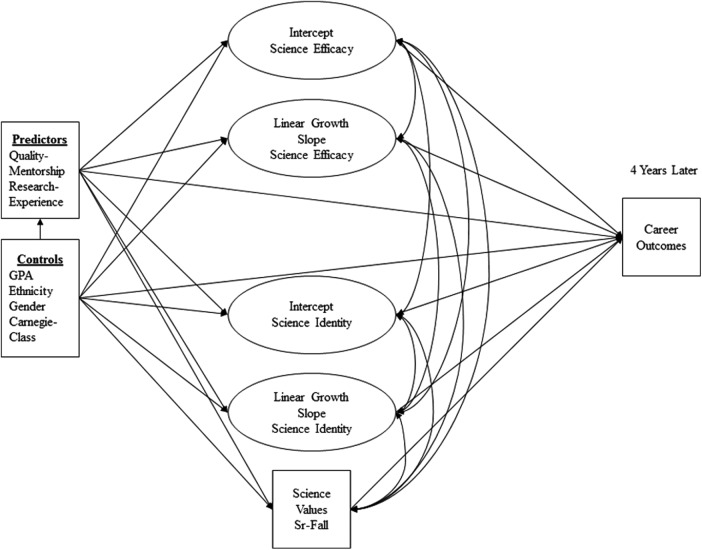
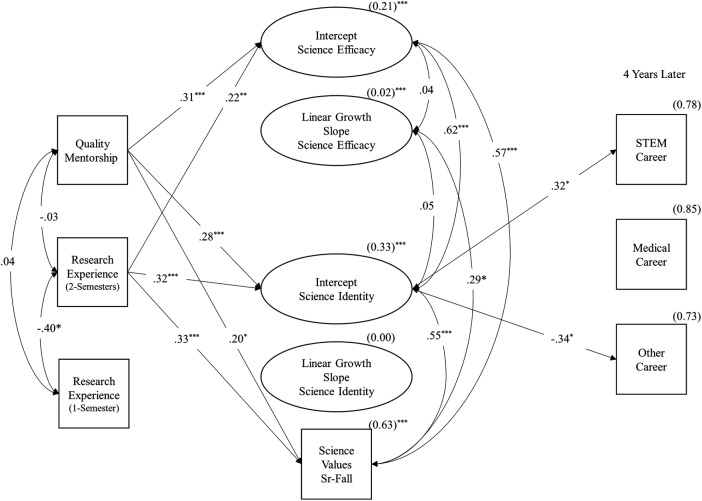
African Americans, Latinos, and Native Americans are historically underrepresented minorities (URMs) among science, technology, engineering, and mathematics (STEM) degree earners. Viewed from a perspective of social influence, this pattern suggests that URMs do not integrate into the STEM academic community at the same rate as non-URM students. Estrada and colleagues recently showed that Kelman’s tripartite integration model of social influence (TIMSI) predicted URM persistence into science fields. In this paper, we longitudinally examine the integration of URMs into the STEM community by using growth-curve analyses to measure the development of TIMIS’s key variables (science efficacy, identity, and values) from junior year through the postbaccalaureate year. Results showed that quality mentorship and research experience occurring in the junior and senior years were positively related to student science efficacy, identity, and values at that same time period. Longitudinal modeling of TIMSI further shows that, while efficacy is important, and perhaps a necessary predictor of moving toward a STEM career, past experiences of efficacy may not be sufficient for maintaining longer-term persistence. In contrast, science identity and values do continue to be predictive of STEM career pathway persistence up to 4 years after graduation.
Overview
The claims and statistics of this paper haven’t been checked yet.
Free: it reads the open-access text and checks the first 5 claims that cite a source we can check. Create a free account to check every claim.
Integrity signals
Registry
Cites
Statistics
Figures
Verification
Claims the paper makes
The claims and statistics of this paper haven’t been checked yet.
Free: it reads the open-access text and checks the first 5 claims that cite a source we can check. Create a free account to check every claim.
Claims other papers make about this one
Each is checked against this paper’s own text: does it say what the citing paper says it does?
The source backs part of the claim, not all of it — or backs it for a different population, condition or comparison.
In the citing paper
“Multiyear undergraduate research experiences have been shown to increase the number of PEER students who graduate from college and subsequently earn a PhD (Maton et al., 2012, 2016; Estrada et al., 2018).”
From Improving Academic Performance and Retention of First-Year Biology Students through a Scalable Peer Mentorship Program (2021) · cites this paper as Estrada et al., 2018
Experimental — accuracy not yet measuredThe source backs part of the claim, not all of it — or backs it for a different population, condition or comparison.
In the citing paper
“The measures in the model, which are referred to as social influence process indicators (e.g., scientific self-efficacy, scientific identity, value orientation, mentorship, and career intent), were developed in an exclusively URM sample.”
From Gains in Scientific Identity, Scientific Self-Efficacy, and Career Intent Distinguish Upper-Level CUREs from Traditional Experiences in the Classroom (2022) · cites this paper as [11]
Experimental — accuracy not yet measuredThe cited source says what the claim attributes to it.
In the citing paper
“A longitudinal study of URMs indicated that scientific identity uniquely predicts STEM employment (11).”
From Gains in Scientific Identity, Scientific Self-Efficacy, and Career Intent Distinguish Upper-Level CUREs from Traditional Experiences in the Classroom (2022) · cites this paper as [11]
The cited source says what the claim attributes to it.
In the citing paper
“The scientific self-efficacy, scientific identity, and value orientation scales operationalize the compliance, identification, and internalization processes of Kelman’s model, respectively.”
From Gains in Scientific Identity, Scientific Self-Efficacy, and Career Intent Distinguish Upper-Level CUREs from Traditional Experiences in the Classroom (2022) · cites this paper as [11]
The cited source says what the claim attributes to it.
In the citing paper
“The TIMSI model was designed to predict URM persistence in STEM career pathways by examining integration into the scientific community.”
From Gains in Scientific Identity, Scientific Self-Efficacy, and Career Intent Distinguish Upper-Level CUREs from Traditional Experiences in the Classroom (2022) · cites this paper as [11]
Self-check
Percentages, sums and reported differences re-computed from the paper’s own numbers.
The self-check needs the paper’s full text.
Citations
Cites
Hu, L., & Bentler, P. M. (1999) · Structural Equation Modeling A Multidisciplinary Journal · doi:10.1080/10705519909540118 · Cited by 108,788 · cited 1×
“Consistent with current standards, we evaluated model fit indices relative to recommended cutoff values (Hu and Bentler, 1999).”
MethodSelf-efficacy: The exercise of control
Bandura, A., Freeman, W. H., & Lightsey, R. (1999) · Journal of Cognitive Psychotherapy · doi:10.1891/0889-8391.13.2.158 · Cited by 46,835
Missing data: our view of the state of the art
Schafer, J. L., & Graham, J. W. (2002) · Psychological Methods · doi:10.1037/1082-989x.7.2.147 · Cited by 11,638 · cited 1×
“To determine whether the patterns of missing data met the strict assumption of being missing completely at random (MCAR) required for unbiased parameter estimates under ordinary least-squares (OLS) regression, we conducted Little’s MCAR test (Little, 1988; Schafer and Graham, 2002).”
MethodMediation in experimental and nonexperimental studies: New procedures and recommendations.
Shrout, P. E., & Bolger, N. (2002) · Psychological Methods · doi:10.1037/1082-989x.7.4.422 · Cited by 11,335 · cited 2×
“…a percentile bootstrap (with 5000 repetitions) was used to estimate the 95% CIs around the indirect effects of quality mentorship and research experiences on STEM or other career choice through the science identity intercept (Shrout and Bolger, 2002; MacKinnon et al. 2004, 2007, MacKinnon, 2008).”
MethodA test of missing completely at random for multivariate data with missing values
Little, R. J. A. (1988) · Journal of the American Statistical Association · doi:10.1080/01621459.1988.10478722 · Cited by 8,963 · cited 1×
“To determine whether the patterns of missing data met the strict assumption of being missing completely at random (MCAR) required for unbiased parameter estimates under ordinary least-squares (OLS) regression, we conducted Little’s MCAR test (Little, 1988; Schafer and Graham, 2002).”
MethodConfidence Limits for the Indirect Effect: Distribution of the Product and Resampling Methods
MacKinnon, D. P., Lockwood, C. M., & Williams, J. (2004) · Multivariate Behavioral Research · doi:10.1207/s15327906mbr3901_4 · Cited by 7,806 · cited 1×
“…a percentile bootstrap (with 5000 repetitions) was used to estimate the 95% CIs around the indirect effects of quality mentorship and research experiences on STEM or other career choice through the science identity intercept (Shrout and Bolger, 2002; MacKinnon et al. 2004, 2007, MacKinnon, 2008).”
MethodMotivational beliefs, values, and goals
Eccles, J. S., & Wigfield, A. (2002) · Annual Review of Psychology · doi:10.1146/annurev.psych.53.100901.135153 · Cited by 7,587 · cited 1×
“Kelman’s conception of values also differs slightly from Eccles and colleagues’ research on subjective task value, which focuses more upon the value of specific tasks and assesses the intrinsic value of a task (Eccles and Wigfield, 2002; Durik et al., 2006).”
Result(2010) · Cited by 7,034
A threat in the air: How stereotypes shape intellectual identity and performance
Steele, C. M. (1997) · American Psychologist · doi:10.1037/0003-066x.52.6.613 · Cited by 6,770 · cited 2×
“Stereotype threat research has shown that when there are “signals” or context contingencies that communicate to minority students that they do not belong in the scientific community, students’ performances decline, while cognitive vigilance increases (Steele, 1997; Ambady et al., 2001; Murphy et al., 2007).”
BackgroundSocial Influence: Compliance and Conformity
Cialdini, R. B., & Goldstein, N. J. (2004) · Annual Review of Psychology · doi:10.1146/annurev.psych.55.090902.142015 · Cited by 6,077 · cited 1×
“Social Influence Literature In their review of the social influence literature, Cialdini and Goldstein (2004) focused on specific influence tactics (e.g., the foot-in-the door or door-in-the-face techniques) and emphasized the circumstances under which the tactics do or do not work.”
Background
Research works printed but not linked: 13
- Council on Graduate Medical Education. (2005). Minorities in medicine: An ethnic and cultural challenge for physician training. Rockville, MD
- DePass A. Chubin D. (2009). Understanding interventions that encourage minorities to pursue research careers: Building a community of research and practice. Bethesda, MD: American Society for Cell Biology.
- Dreher G. F. Ash R. A. (1990). A comparative study of mentoring among men and women in managerial, professional, and technical positions. Journal of Applied Psychology, (5), 539– 546. 10.1037/0021.9010.75.5.539 · doi:10.1037/0021.9010.75.5.539
- Flaxman E. Ascher C. Harrington C. (1988). Youth mentoring: Programs and practices. New York: ERIC Clearinghouse on Urban Education.
- Johnson W. B. Rose G. Schlosser L. Z. (2007). Student-faculty mentoring: Theoretical and methodological issues. In Allen T. D. Eby L. T. (Eds.), The Blackwell handbook of mentoring: A multiple perspectives approach (pp. 49– 69). Oxford, UK: Blackwell.
- Kelman H. C. Hamilton V. L. (1989). Crimes of obedience. New Haven, CT: Yale University Press.
- Kram K. (1985). Mentoring at work. Glenview, IL: Scott Foresman.
- Lent R. Social cognitive career theory: What attracts students to−and keeps them in STEM fields? A theoretical perspective 2007 Washington, DC: National Academies Press 7– 11. In Understanding interventions that encourage minorities to pursue research careers: Summary of a workshop
- Muthén L. Muthén B. (1998–2009). Mplus (Version 5.21). Los Angeles, CA: Muthén & Muthén.
- National Academies of Sciences, Engineering, and Medicine. (2016). Barriers and opportunities for 2-year and 4-year STEM degrees: Systemic change to support students’ diverse pathways. Washington, DC: National Academies Press. 27336114
- National Academies of Sciences, Engineering, and Medicine. (2017). Undergraduate research experiences for STEM students: Successes, challenges, and opportunities. Washington, DC: National Academies Press.
- National Research Council. (2005). Assessment of NIH minority research and training programs: Phase 3. Washington, DC: National Academies Press. 20669454
- Ragins B. R. (2010). Relational mentoring: A positive approach to mentoring at work. In Cameron K. S. Spreitzer G. M. (Eds.), The handbook of positive organizational scholarship (pp. 519– 536). New York: Oxford University Press.
Cited by
Items 401–500 of 607
Fares, O., Hernandez, T., Rudkowski, J., & Gunn, F. (2026) · Marketing Education Review · doi:10.1080/10528008.2026.2690012 · Cited by 1
Gao, C., Gates, A. E., & Rivera, L. M. (2026) · Social Psychology of Education · doi:10.1007/s11218-026-10264-4 · Cited by 1
“URG students with strong STEM self-efficacy are more likely to choose STEM majors, achieve higher academic performance (Lin et al., 2018 ), and demonstrate greater commitment and persistence in STEM careers than those with lower STEM self-efficacy (Estrada et al., 2018).”
Huvard, H., Bayat, H., Way, S. M., & Brewer, C. E. (2025) · Journal of STEM Education Innovations and Research · Cited by 1
Salami, M. O., Fang, L., & Torvik, V. I. (2026) · ACM/IEEE Joint Conference on Digital Libraries · doi:10.1145/3805696.3846065 · Cited by 1
Schmid, K. M. (2020) · Syracuse University Libraries (Syracuse University) · Cited by 1
Schill, S., & Bielefeldt, A. R. (2024) · ASEE Annual Conference & Exposition · doi:10.18260/1-2--37500 · Cited by 1
“Estrada et al. [15] found that when combined with quality mentorship, research experiences positively impacted URM students’ science efficacy, identity, and values.”
BackgroundKey Measures for the Implementation of Undergraduate Research
Galli, D. (2022) · Cambridge University Press eBooks · doi:10.1017/9781108869508.017 · Cited by 1
Predicting undergraduate career goal change in a research‐intensive community
Stiles, T. W., Adams, T. H., Yalvaç, B., & Quick, C. M. (2022) · Journal of Research in Science Teaching · doi:10.1002/tea.21837 · Cited by 1
Watkins-Lewis, K., Domingo, M. R. S., Singh, R., Telfer, N. A., Harrington, E., Moraga, R. W., & Matón, K. I. (2022) · Journal of Women and Minorities in Science and Engineering · doi:10.1615/jwomenminorscieneng.2022038088 · Cited by 1
Factors affecting mentoring services - cross-national perspective
Rollnik‐Sadowska, E., Ryciuk, U., Glińska, E., Bartkutė-Norkūnienė, V., Jodienė, R., Sprudzāne, S., Zvaigzne, A., Marzano, G., & Jecheva, V. G. (2023) · Engineering Management in Production and Services · doi:10.2478/emj-2023-0008 · Cited by 1
Birney, L., Evans, B. R., Solanki, V., Mojica, E. E., Scharff, C., & Kong, J. (2023) · Journal of Curriculum and Teaching · doi:10.5430/jct.v12n4p125 · Cited by 1
Expanded US mentorship requires accountability
Shinbrot, X. A., Gerson, J., Gutmann, B., Ikossi, K., & Ulmer, L. (2023) · Science · doi:10.1126/science.adk1696 · Cited by 1
Griggs, L., Cohan, C. L., Vanderhoof, C., Mattingly, A. J., & Peeples, T. L. (2024) · ASEE Annual Conference & Exposition · doi:10.18260/1-2--41608 · Cited by 1
Morrison, M. E. (2022) · Journal of Undergraduate Neuroscience Education · doi:10.59390/xcgj3727 · Cited by 1
“…learning strategies including hands-on labs and exercises that require students to grapple with data analysis boost STEM retention, especially among underrepresented minorities (Theobald et al., 2020; Estrada 2018; Hrabowski 2015; Graham et al., 2013; Kanter and Konstantopoulos, 2010; Kuh, 2008).”
BackgroundEnhancing Educators’ Cultural and Digital Literacies through Makerspace Development Activities
Miller, J. L. (2024) · Education and human development · doi:10.5772/intechopen.112613 · Cited by 1
Cameron, C. A., Lee, H. Y., Anderson, C. B., Dahlstrom, E. K., & Chang, S. (2024) · International Journal of STEM Education · doi:10.1186/s40594-024-00497-0 · Cited by 2
“…to be an important influence on the career intentions and subjective experience of STEM undergraduate (Aikens et al., 2016; Atkins et al., 2020; Estrada et al., 2018; Findley-Van Nostrand & Pollenz, 2017; Hernandez et al., 2017), postbaccalaureate students (Remich et al., 2016; Gazley et al.,…”
BackgroundBroadening participation in environmental data science: Insights from practitioners
Fong, C. R., García, C. G., Abbasi, E., Gubbins, N., & Jouzi, Z. (2024) · Environmental Data Science · doi:10.1017/eds.2024.9 · Cited by 1
“Like for much ofSTEM, this will require recruitmentand retention ofdiverse trainees in academic institutionsas well as implementationof effective pedagogy (Haak et al., 2011; Toven-Lindsey et al., 2015; Estrada et al., 2016, 2018; Burke et al., 2020; Markle et al., 2022).”
MENTORSHIP PROGRAMS IN ROBOTICS AND THEIR IMPACT ON STUDENT DEVELOPMENT
Hamad, N. M. A., Adewusi, O. E., Unachukwu, C. C., Osawaru, B., & Chisom, O. N. (2024) · Malaysian Journal Of Human Resources Management · doi:10.26480/mjhrm.01.2024.69.77 · Cited by 1
Sun, Y., Dong, Q., & Tang, F. (2025) · ACM Technical Symposium on Computer Science Education (SIGCSE) · doi:10.1145/3641554.3701895 · Cited by 1
“Sense of belonging can highly influence underrepresented groups’ persistence in computing [7, 11].”
Hernandez, P. R., Du, W., Aldana, C. C., Broderick, N. A., Handelsman, J., Lee, H., Luo, L., Maldonado, N., Miller, H. A., Miller, S., et al. (2025) · Journal of Clinical and Translational Science · doi:10.1017/cts.2025.81 · Cited by 1
“Studies indicate these orientations were correlated with career choices in STEMM [8,9], with a longitudinal study showing that science identity predicted persistence even four years after undergraduate graduation [8].”
Self-citationSikhosana, H. N., Malatji, H., Munyoro, A. T., & Nkomo, T. S. (2025) · Education Sciences · doi:10.3390/educsci15060758 · Cited by 1
Cáceres, C., English-Clarke, T., & Graham, J. (2025) · Integrative and Comparative Biology · doi:10.1093/icb/icaf144 · Cited by 1
zhang, Y., Carroll, B. F., Shin, J., & Crippen, K. J. (2025) · ASEE Annual Conference & Exposition · doi:10.18260/1-2--57031 · Cited by 1
Finding the Inner Researcher and Leader through an Engineering Mentored Research Program at an HSI
Aguirre, H. C. C., Zackery, S., & Carrillo, L. R. G. (2025) · ASEE Annual Conference & Exposition · doi:10.18260/1-2--56572 · Cited by 1
Aguirre, H. C. C., Zackery, S., & Carrillo, L. R. G. (2025) · IEEE Frontiers in Education Conference (FIE) · doi:10.1109/fie63693.2025.11328213 · Cited by 1
“Both research experiences and high-quality mentorship have been positively associated with science self-efficacy and science identity as well as valuing the objectives within the scientific community [11], [12].”
Issues that Prevent Students of Color from Majoring in Teacher Education
Napier, E. J. (2019) · ScholarWorks (Walden University) · Cited by 1
An Examination of the Impacts of the WVU Research Apprenticeship Program (RAP)
Hashemi, M. (2020) · The Research Repository @ WVU (West Virginia University) · doi:10.33915/etd.7565 · Cited by 1
The Research Premium: Undergraduate Research Experiences and Early EmploymentPreprint
VanEseltine, M., Coty, V., Noy, M. V., & Owen-Smith, J. D. (2022) · SocArXiv (OSF Preprints) · doi:10.31235/osf.io/4dxze · Cited by 1
Bravo, E. I. (2021) · FIU - Digital Commons (Florida International University) · doi:10.25148/etd.fidc010183 · Cited by 1
Szakács, É. (2023) · Nemzeti Közszolgálati Egyetem · doi:10.17625/nke.2023.028 · Cited by 1
Coté, L. E., Zamora, A. N., Salcido, J. J., Doren, S. V., Manocha, A., Munoz, G. O., Law, E. W., & Baranger, A. M. (2025) · bioRxiv (Cold Spring Harbor Laboratory) · doi:10.1101/2025.03.24.645145 · Cited by 1
Javier, D. (2024) · University of North Texas Digital Library (University of North Texas) · doi:10.12794/metadc2415945 · Cited by 1
A Story Of A Scientist: A Researcher, Mentor, Teacher, Leader, And Advocate
Jilani, S. Z. (2021) · Figshare · doi:10.6084/m9.figshare.16563717 · Cited by 1
Khong, H. (2022) · K-State Research Exchange (Kansas State University) · Cited by 1
Experiences of African American Students in a STEM-Focused Community Program
Blount, A. (2023) · ScholarWorks (Walden University) · Cited by 1
Niccum, H. N., & Niccum, H. N. (2025) · UA Campus Repository (The University of Arizona) · Cited by 1
Undergraduate Research Experience Programs in Natural Resources, 2012-2016
Kidd, J. B. (2024) · VTechWorks (Virginia Tech) · Cited by 1
Coté, L. E. (2024) · eScholarship (California Digital Library) · Cited by 1
How Mentoring Networks Shape Early-Career Grant Success: Evidence from NIH K-awardeesPreprint
Setiono, F., Ho, E., & Lambert, W. M. (2026) · bioRxiv (Cold Spring Harbor Laboratory) · doi:10.64898/2026.08.11.743320 · Cited by 1
“Others, stress the importance of mentors who can reinforce science identity for UR individuals (38,42).”
Babar, A., Davin, K. J., & Dornburg, A. (2026) · arXiv · doi:10.48550/arxiv.2608.27638
“Across undergraduate research environments, high-quality mentorship has repeatedly been associated with greater scientific self-efficacy, scientific identity, and development of research performance (Estrada et al. 2018; Monarrez et al. 2020; Goodwin et al. 2022, 2023; Shortlidge et al. 2023).”
Moreno, K., Cascelli, L., Chavira, G., Escobedo, P., Flores, G. E., Kwan, P., & Khachikian, C. (2026) · Trends in Higher Education · doi:10.3390/higheredu5040102
Washington, D. F. (2020) · University of North Florida Digital Commons (University of North Florida)
Kurimoto, L. (2020) · USF Scholarship Repository (University of San Francisco)
Han, J., & Procter, N. G. (2020) · Crisis · doi:10.1027/0227-5910/a000685
Khasawneh, M., Kilburn, J. C., Dmello, J. R., Sanchez, D., & Segovia, A. (2020) · ASEE Annual Conference & Exposition · doi:10.18260/1-2--34038
“Literature Review The longitudinal study conducted by Estrada, Hernandez, and Schultz [5] determined that it takes more than one semester of undergraduate research experience to predict student overall science efficacy.”
BackgroundInfluentialReal-World Connections With Conservation Science Through Zoos and Aquariums
Kubarek, J., & Johnson, B. (2021) · Advances in educational technologies and instructional design book series · doi:10.4018/978-1-7998-4966-7.ch011
Persistence of Undergraduate Women in STEM through TIMSI
Henderson, H. L. (2019) · The Research Repository @ WVU (West Virginia University) · doi:10.33915/etd.7435
Mott, L. S. (2021) · Lincoln (University of Nebraska)
Clarke, N. A. (2021) · Digital Commons (Liberty University)
Senior undergraduate students developing and envisioning possible selves after graduation
Khong, H., Lohman, B. C., Foth, N., & Sayre, E. C. (2021) · Physics Education Research Conference (PERC) · doi:10.1119/perc.2021.pr.khong · Cited by 1
“Similarly, Ricky’s interest grew from a mentorship found at a conference, agreeing with previous studies that mentorship is critical to the development of careers plans [5, 26].”
BackgroundJohnson-Anderson, S., Lingutla, R., & Riley, M. (2022) · Elsevier eBooks · doi:10.1016/b978-0-323-90469-8.00003-2
Real-World Connections With Conservation Science Through Zoos and Aquariums
Kubarek, J., & Johnson, B. (2022) · IGI Global eBooks · doi:10.4018/978-1-6684-5678-1.ch004
Burdick, L. C. (2021) · Digital Repository Service (Northeastern University) · doi:10.17760/d20406268
Culturally Relevant Mentoring: A Differentiator for Institutional Change
Thomas, S. W., Austin, S. J., Lane, T. B., Rowley, A., Watson, A. L., Walker, B., Kos, L., Dome, C., Mariella-Walrond, H., & Lee-Thomas, G. (2022) · Advances in educational marketing, administration, and leadership book series · doi:10.4018/978-1-6684-4803-8.ch015
Patrick, P. G., & Farmer, M. (2022) · SN Social Sciences · doi:10.1007/s43545-022-00433-5
“The mentoring provided by faculty, graduate students, and/or postdoctoral researchers becomes a model for undergraduates as they develop personally and professionally (Aikens et al. 2016; Estrada et al. 2018; Hernandez et al. 2017; Joshi et al. 2019).”
BackgroundThe Motivations of STEM Mentors
Rangel, V. S. (2019) · American Educational Research Association Annual Meeting (AERA) · doi:10.3102/1439119
Virtual Research Group Modules: Scalable Simulations of STEM Research
Tousley, M. E., Dyer, A., Grzenda, M. J., Kovacevich, D. A., & Singer, J. P. (2022) · Journal of Chemical Education · doi:10.1021/acs.jchemed.2c00625
From Cancer Microenvironment to Myofibroblasts
Cervantes-Valencia, J. L., & Kao, R. M. (2023) · The American Biology Teacher · doi:10.1525/abt.2023.85.1.12
“Life science education research has demonstrated the importance of mentorship quality for underrepresented minorities in STEM fields (Estrada et al., 2018; Pedersen et al., 2022).”
BackgroundSullivan, M. M. (2022) · Digital Repository Service (Northeastern University) · doi:10.17760/d20467335
BLACK MALES IN NON-STEM AND STEM OCCUPATIONS
López, O. S. (2023) · Journal of Women and Minorities in Science and Engineering · doi:10.1615/jwomenminorscieneng.2023042913
Mentoring Applications From Applied Plant Systems Research Experiences With Undergraduates
Speth, C. A., Ramirez, S., II, Ibach, R., Lee, D., Sandall, L., Mamo, M., Keshwani, J., Lambe, D. P., Matkin, G. S., & Schacht, W. H. (2023) · NACTA Journal · doi:10.56103/nactaj.v66i1.25
(2023) · Frontiers research topics · doi:10.3389/978-2-8325-3977-4
The STEM Center to Promote Undergraduate Education and Research at Sam Houston State University
Yıldız, F., Villalta‐Cerdas, A., Swarthout, M. B., Thompson, D. E., & Martin, T. E. (2024) · ASEE Annual Conference & Exposition · doi:10.18260/1-2--40700
An Overview of the Multi-Disciplinary Data Science (MDaS) S-STEM Scholarship Program
Rossetti, M. D., POHL, E. A., Hill, B., Wu, X., Turner, R., Lo, W., & Offord, J. (2024) · ASEE Annual Conference & Exposition · doi:10.18260/1-2--40908
Vempala, V., Buten, E., & Mondisa, J. (2024) · ASEE Annual Conference & Exposition · doi:10.18260/1-2--42954
“Marginalized students with mentors were more likely to identify as belonging in their field [5] and have higher self-efficacy [11].”
BackgroundHolden, W. M., Krakowiak, P. A., Krakowiak, K. M., & Fowler, J. (2024) · The Journal of STEM Outreach · doi:10.15695/jstem/v7i2.02
Automating Pharmacokinetic Predictions in Artemisia
Younan, C. (2023) · ScholarWorks (Boise State University) · doi:10.18122/td.2088.boisestate
Birney, L., & McNamara, D. M. (2024) · Journal of Curriculum and Teaching · doi:10.5430/jct.v13n2p244
Student Perceptions: How STEM Students Value Belonging Interventions
Baez, E. (2024) · PDXScholar (Portland State University) · doi:10.15760/honors.1564
Undergraduate Service Course Research Infusion
Yilmaz, M. (2023) · International Conference on Computational Science and Computational Intelligence (CSCI) · doi:10.1109/csci62032.2023.00271
Exploring STEM disciplinary differences in students' university study decisions
Shirmohammadi, M. (2024) · Queensland University of Technology · doi:10.5204/thesis.eprints.250813
Fleming, G. C., Julien, C., & Fernandez, K. (2024) · ASEE Annual Conference & Exposition · doi:10.18260/1-2--48107
Doon, R. A. (2024) · Caribbean Journal of Education and Development · doi:10.46425/cjed701035178
Skynet Astromancer Suite: Gravitymancer
Selph, L., Keohane, M., Torian, J., Reichart, D. E., Moffett, D., & Keohane, J. W. (2024) · Astronomy Education Journal · doi:10.32374/aej.aecon.2023.101aepw
“…(CURE) (Auchincloss et al., 2014), such as data collection and analysis, collaboration, and iteration, can also provide research opportunities to many students who would not normally have access to such opportunities, particularly underserved students and minorities (Estrada et al., 2018).”
BackgroundEmpowering Underrepresented Researchers Through Effective Writing Support
Elliott, B., Mehravaran, S., & Höhmann, C. F. (2024) · Medical Research Archives · doi:10.18103/mra.v12i10.5969
Dass, L. W., Williams, A., Varner, J. D., Taylor, T., Hough, H. J., Sperling, J. B., Sparks, M. A., McElvaine, A. T., & Gbadegesin, R. (2024) · Clinical Journal of the American Society of Nephrology · doi:10.2215/cjn.0000000601
Miller, J., Brown, A. E., Ritzi, C. M., Morales, C., Williamson, S., Qvarnstrom, J., & Perez-Gallego, J. (2024) · doi:10.3847/25c2cfeb.dcdd4f81
Bodenstedt, K. (2022) · University of North Texas Digital Library (University of North Texas) · doi:10.12794/metadc1986081
Fletcher, T. L., Alharbi, A. M., Qasim, M., Hooper, K., & Collins, E. (2025) · Journal for STEM Education Research · doi:10.1007/s41979-024-00142-z
Gerace, E. L., & Wojiski, S. A. (2025) · Journal of Cancer Education · doi:10.1007/s13187-025-02594-2
“Studies indicate that these experiences for undergraduates are particularly impactful and contribute to persistence of those traditionally underrepresented in STEM [4–6].”
Gates, A. Q., Hall, E. F., & Moghadam, S. H. (2024) · IEEE Frontiers in Education Conference (FIE) · doi:10.1109/fie61694.2024.10893491
“The effort included involvement of African Americans/ Blacks, Hispanics/Latinx, Native Americans/ Alaskan Natives ( AHN ) students in STEM fields [8][9].”
Birney, L., & McNamara, D. M. (2025) · Journal of Curriculum and Teaching · doi:10.5430/jct.v14n2p73
Development of the McLean Hospital MENTOR Program to enhance mental health career pathways
Beard, C., Swee, M. B., McGhee, Z., Barth, F., Hall, K. A. A., Rossi, N., Gildesgame, C., & Ressler, K. J. (2025) · Neuropsychopharmacology · doi:10.1038/s41386-025-02118-y
Stanton, M. A., & Miller, A. (2025) · Journal of Veterinary Medical Education · doi:10.3138/jvme-2024-0128
Papendieck, A. S., Tucker, M., Martinez, S. R., Boss, S. K., Long, E., Ellins, K. K., & Clarke, J. A. (2025) · Proceedings. · doi:10.22318/icls2025.857921
Embodying well-being in research: key principles and praxis
Rahrig, H., Lipsett, M., David, A. B., Richter, C. G., Chen, Y.-Y., Adams, E. V., Wilson, C. L., Mabry, S. A., Lai, V. D., Whitman, K., et al. (2026) · Frontiers in Education · doi:10.3389/feduc.2026.1836519
“…are more likely to envision themselves in research careers when they see successful researchers with similar backgrounds and experiences (Estrada et al., 2018), departments can further affirm diverse identities by providing resources for mentorship and network building with scholars of…”
Keating, K., O’Connell, K., Mount, G. J., Hayes, J. L., DiBiase, R. A., Brantley, S. L., Donaldson, Y., & Tarzona, A. (2025) · Journal of Geoscience Education · doi:10.1080/10899995.2025.2535029
“The diverse demographics of the mentors was an important feature of the program as diverse representation in STEM and geosciences fields positively impacts the retention of minoritized and marginalized students (Finney, 2014; NASEM, 2019).”
InfluentialCardiovascular Epidemiology Training Program Evaluation: The Jackson Heart Study
Jenkins, B. C., Addison, C. C., White, M. S., & Payton, M. (2025) · Open Journal of Preventive Medicine · doi:10.4236/ojpm.2025.156007
Kakebeen, A. D., Fandel, J. Y., & Niswander, L. A. (2025) · Developmental Biology · doi:10.1016/j.ydbio.2025.07.010
Ajayi, A. A., Güler, O. E., & Dupont, R. (2025) · Journal of Constructivist Psychology · doi:10.1080/10720537.2025.2535725
“…compare underrepresented and dominant populations, it aligns with the broader literature suggesting that the development of a coherent science identity may be especially critical for underrepresented students in overcoming systemic obstacles (Estrada et al., 2018; Rodriguez & Lehman, 2017).”
Chisholm, K. (2025) · ASEE Annual Conference & Exposition · doi:10.18260/1-2--55558
DeAngelo, L., Winkler, C. E., Stone, B. D., & Díaz, C. (2025) · ASEE Annual Conference & Exposition · doi:10.18260/1-2--55360
Lee, S. W., Miyasato, H., Tirado, J., Dingwall, S., & Cardullo, R. A. (2025) · PLoS ONE · doi:10.1371/journal.pone.0332153
Locke, S., Sani, M., Lingane, M., Black, A. W., Hu, S., & Martinez, A. (2025) · Geological Society of America eBooks · doi:10.1130/2025.2564(04
Schubert, K. D., Gattis, C. S., Solorzano, X. D., Popp, J. S., Cao, C., Massey, L. B., & Carter, T. (2025) · ASEE Midwest Section Conference · doi:10.18260/1-2-1126.1153-57812
Ghosh, R., & Montogomery, A. (2025) · Mentoring & Tutoring Partnership in Learning · doi:10.1080/13611267.2025.2571493
“…with minoritized identities in higher education and the potential for mentoring to buffer them from the negative impact of such experiences (Estrada et al., 2018; Robnett et al., 2019), it is incumbent on higher education 1 Harper (2013) stated that an individual’s social identities do not…”
Chandipwisa, S. R., & Shimilimo, A. (2025) · Research Square · doi:10.21203/rs.3.rs-7908683/v1
Metadata
- Authors
- Estrada, M., Hernandez, P. R., & Schultz, P. W.
- Affiliations
- University of California, San Francisco (US)
- West Virginia University (US)
- California State University, San Marcos (US)
- Corresponding author
- Estrada, Mica
- Venue
- CBE—Life Sciences Education
- Published
- 2018-03
- Volume
- 17
- Issue
- 1
- Pages
- ar9
- ISSN
- 1931-7913 (ISSN-L)
- PMC
- PMC6007776
- OpenAlex
- W2784521714
- Cited by
- 507
- References
- 66
- Citations by year
- 2026: 68 · 2025: 72 · 2024: 98 · 2023: 75 · 2022: 72 · 2021: 60 · 2020: 44 · 2019: 13 · 2018: 4
- FWCI
- 60.31
- Type
- journal article
- Language
- en
- Open access
- hybrid
- doi.org
- Licence
- cc-by-nc-sa
- Locations
- CBE—Life Sciences Education (publishedVersion, cc-by-nc-sa)
- Europe PMC (PubMed Central) (publishedVersion, cc-by-nc-sa)
- PubMed Central (publishedVersion, cc-by-nc-sa)
- PubMed (publishedVersion)
- Funders
- National Institutes of Health
- National Institute of General Medical Sciences (R01GM075316)
- Topics
- Social Sciences › Psychology › Applied Psychology › Career Development and Diversity
- Social Sciences › Education › Higher Education Research Studies
- Social Sciences › Education › Mentoring and Academic Development
- Keywords
- underrepresented minorities, mentoring, research experience, science identity, values in science, African American students, Hispanic students, Native American students
- MeSH terms
- Mentoring, Career Choice, Engineering, Female, Humans, Longitudinal Studies, Male, Mathematics, Mentors, Minority Groups, Research, Science, Students, Technology, Models, Educational, Young Adult
About these checks
Registry, retraction, Cites and statistics results are computed, not judged, with one exception: a printed reference that no index lists is read once by a model before it counts as a citation error. Claims are extracted by a model and kept only when their quote appears verbatim in the text; each cited source is then checked, with a model’s help, for whether it says what the claim relies on. Those verdicts can be wrong — read the claim’s quote and the cited source before relying on one.
Statistics and arithmetic are recomputed, not judged.
Confidence bands are shown only for fields calibrated on our annotated test set. None is calibrated yet, so no band is shown.
What counts as a claim ›How we measure confidence ›How we check this ›
Are you an author, or do you see a problem with this page? Request a review
Data sources
Bibliographic data: Semantic Scholar, OpenAlex, Crossref.
Contains information from the Semantic Scholar Academic Graph Datasets, made available under the ODC Attribution License (ODC-BY 1.0).
Semantic Scholar’s data is described in: Kinney, R., et al. (2023). The Semantic Scholar Open Data Platform. arXiv:2301.10140.
