

A Longitudinal Study of How Quality Mentorship and Research Experience Integrate Underrepresented Minorities into STEM Careers
Open accessThe DOI matches its Crossref record; 64 of the 66 references it cites were found in a registry or an index, and 1 are not checked yet.
Abstract
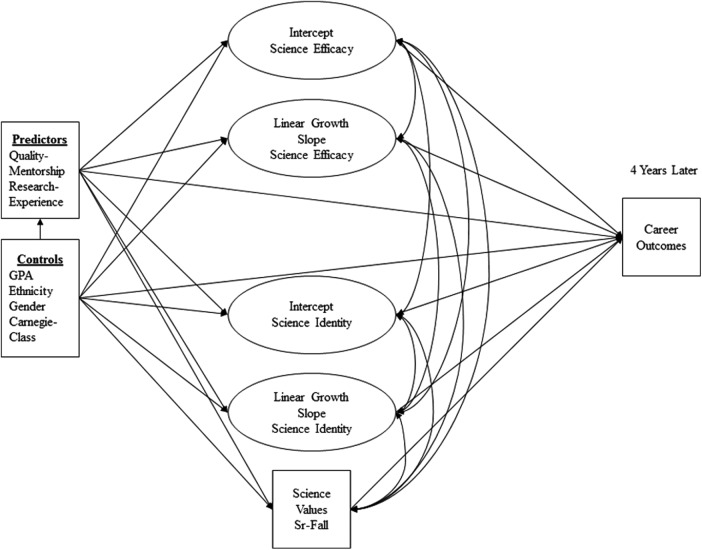
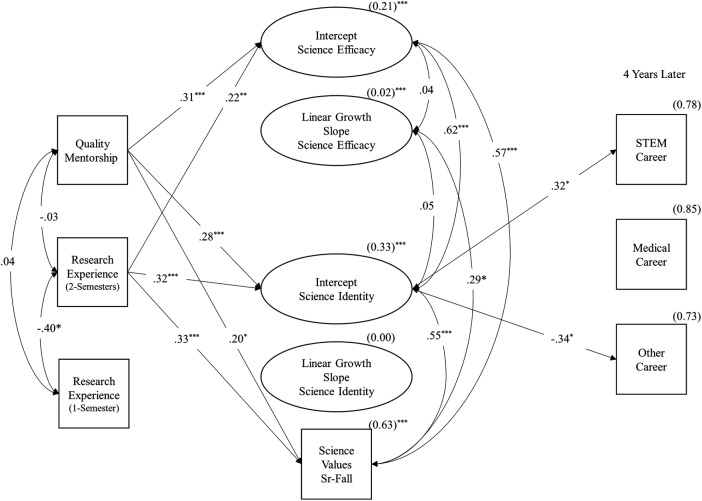
African Americans, Latinos, and Native Americans are historically underrepresented minorities (URMs) among science, technology, engineering, and mathematics (STEM) degree earners. Viewed from a perspective of social influence, this pattern suggests that URMs do not integrate into the STEM academic community at the same rate as non-URM students. Estrada and colleagues recently showed that Kelman’s tripartite integration model of social influence (TIMSI) predicted URM persistence into science fields. In this paper, we longitudinally examine the integration of URMs into the STEM community by using growth-curve analyses to measure the development of TIMIS’s key variables (science efficacy, identity, and values) from junior year through the postbaccalaureate year. Results showed that quality mentorship and research experience occurring in the junior and senior years were positively related to student science efficacy, identity, and values at that same time period. Longitudinal modeling of TIMSI further shows that, while efficacy is important, and perhaps a necessary predictor of moving toward a STEM career, past experiences of efficacy may not be sufficient for maintaining longer-term persistence. In contrast, science identity and values do continue to be predictive of STEM career pathway persistence up to 4 years after graduation.
Overview
The claims and statistics of this paper haven’t been checked yet.
Free: it reads the open-access text and checks the first 5 claims that cite a source we can check. Create a free account to check every claim.
Integrity signals
Registry
Cites
Statistics
Figures
Verification
Claims the paper makes
The claims and statistics of this paper haven’t been checked yet.
Free: it reads the open-access text and checks the first 5 claims that cite a source we can check. Create a free account to check every claim.
Claims other papers make about this one
Each is checked against this paper’s own text: does it say what the citing paper says it does?
The source backs part of the claim, not all of it — or backs it for a different population, condition or comparison.
In the citing paper
“Multiyear undergraduate research experiences have been shown to increase the number of PEER students who graduate from college and subsequently earn a PhD (Maton et al., 2012, 2016; Estrada et al., 2018).”
From Improving Academic Performance and Retention of First-Year Biology Students through a Scalable Peer Mentorship Program (2021) · cites this paper as Estrada et al., 2018
Experimental — accuracy not yet measuredThe source backs part of the claim, not all of it — or backs it for a different population, condition or comparison.
In the citing paper
“The measures in the model, which are referred to as social influence process indicators (e.g., scientific self-efficacy, scientific identity, value orientation, mentorship, and career intent), were developed in an exclusively URM sample.”
From Gains in Scientific Identity, Scientific Self-Efficacy, and Career Intent Distinguish Upper-Level CUREs from Traditional Experiences in the Classroom (2022) · cites this paper as [11]
Experimental — accuracy not yet measuredThe cited source says what the claim attributes to it.
In the citing paper
“A longitudinal study of URMs indicated that scientific identity uniquely predicts STEM employment (11).”
From Gains in Scientific Identity, Scientific Self-Efficacy, and Career Intent Distinguish Upper-Level CUREs from Traditional Experiences in the Classroom (2022) · cites this paper as [11]
The cited source says what the claim attributes to it.
In the citing paper
“The scientific self-efficacy, scientific identity, and value orientation scales operationalize the compliance, identification, and internalization processes of Kelman’s model, respectively.”
From Gains in Scientific Identity, Scientific Self-Efficacy, and Career Intent Distinguish Upper-Level CUREs from Traditional Experiences in the Classroom (2022) · cites this paper as [11]
The cited source says what the claim attributes to it.
In the citing paper
“The TIMSI model was designed to predict URM persistence in STEM career pathways by examining integration into the scientific community.”
From Gains in Scientific Identity, Scientific Self-Efficacy, and Career Intent Distinguish Upper-Level CUREs from Traditional Experiences in the Classroom (2022) · cites this paper as [11]
Self-check
Percentages, sums and reported differences re-computed from the paper’s own numbers.
The self-check needs the paper’s full text.
Citations
Cites
Hu, L., & Bentler, P. M. (1999) · Structural Equation Modeling A Multidisciplinary Journal · doi:10.1080/10705519909540118 · Cited by 108,788 · cited 1×
“Consistent with current standards, we evaluated model fit indices relative to recommended cutoff values (Hu and Bentler, 1999).”
MethodSelf-efficacy: The exercise of control
Bandura, A., Freeman, W. H., & Lightsey, R. (1999) · Journal of Cognitive Psychotherapy · doi:10.1891/0889-8391.13.2.158 · Cited by 46,835
Missing data: our view of the state of the art
Schafer, J. L., & Graham, J. W. (2002) · Psychological Methods · doi:10.1037/1082-989x.7.2.147 · Cited by 11,638 · cited 1×
“To determine whether the patterns of missing data met the strict assumption of being missing completely at random (MCAR) required for unbiased parameter estimates under ordinary least-squares (OLS) regression, we conducted Little’s MCAR test (Little, 1988; Schafer and Graham, 2002).”
MethodMediation in experimental and nonexperimental studies: New procedures and recommendations.
Shrout, P. E., & Bolger, N. (2002) · Psychological Methods · doi:10.1037/1082-989x.7.4.422 · Cited by 11,335 · cited 2×
“…a percentile bootstrap (with 5000 repetitions) was used to estimate the 95% CIs around the indirect effects of quality mentorship and research experiences on STEM or other career choice through the science identity intercept (Shrout and Bolger, 2002; MacKinnon et al. 2004, 2007, MacKinnon, 2008).”
MethodA test of missing completely at random for multivariate data with missing values
Little, R. J. A. (1988) · Journal of the American Statistical Association · doi:10.1080/01621459.1988.10478722 · Cited by 8,963 · cited 1×
“To determine whether the patterns of missing data met the strict assumption of being missing completely at random (MCAR) required for unbiased parameter estimates under ordinary least-squares (OLS) regression, we conducted Little’s MCAR test (Little, 1988; Schafer and Graham, 2002).”
MethodConfidence Limits for the Indirect Effect: Distribution of the Product and Resampling Methods
MacKinnon, D. P., Lockwood, C. M., & Williams, J. (2004) · Multivariate Behavioral Research · doi:10.1207/s15327906mbr3901_4 · Cited by 7,806 · cited 1×
“…a percentile bootstrap (with 5000 repetitions) was used to estimate the 95% CIs around the indirect effects of quality mentorship and research experiences on STEM or other career choice through the science identity intercept (Shrout and Bolger, 2002; MacKinnon et al. 2004, 2007, MacKinnon, 2008).”
MethodMotivational beliefs, values, and goals
Eccles, J. S., & Wigfield, A. (2002) · Annual Review of Psychology · doi:10.1146/annurev.psych.53.100901.135153 · Cited by 7,587 · cited 1×
“Kelman’s conception of values also differs slightly from Eccles and colleagues’ research on subjective task value, which focuses more upon the value of specific tasks and assesses the intrinsic value of a task (Eccles and Wigfield, 2002; Durik et al., 2006).”
Result(2010) · Cited by 7,034
A threat in the air: How stereotypes shape intellectual identity and performance
Steele, C. M. (1997) · American Psychologist · doi:10.1037/0003-066x.52.6.613 · Cited by 6,770 · cited 2×
“Stereotype threat research has shown that when there are “signals” or context contingencies that communicate to minority students that they do not belong in the scientific community, students’ performances decline, while cognitive vigilance increases (Steele, 1997; Ambady et al., 2001; Murphy et al., 2007).”
BackgroundSocial Influence: Compliance and Conformity
Cialdini, R. B., & Goldstein, N. J. (2004) · Annual Review of Psychology · doi:10.1146/annurev.psych.55.090902.142015 · Cited by 6,077 · cited 1×
“Social Influence Literature In their review of the social influence literature, Cialdini and Goldstein (2004) focused on specific influence tactics (e.g., the foot-in-the door or door-in-the-face techniques) and emphasized the circumstances under which the tactics do or do not work.”
Background
Research works printed but not linked: 13
- Council on Graduate Medical Education. (2005). Minorities in medicine: An ethnic and cultural challenge for physician training. Rockville, MD
- DePass A. Chubin D. (2009). Understanding interventions that encourage minorities to pursue research careers: Building a community of research and practice. Bethesda, MD: American Society for Cell Biology.
- Dreher G. F. Ash R. A. (1990). A comparative study of mentoring among men and women in managerial, professional, and technical positions. Journal of Applied Psychology, (5), 539– 546. 10.1037/0021.9010.75.5.539 · doi:10.1037/0021.9010.75.5.539
- Flaxman E. Ascher C. Harrington C. (1988). Youth mentoring: Programs and practices. New York: ERIC Clearinghouse on Urban Education.
- Johnson W. B. Rose G. Schlosser L. Z. (2007). Student-faculty mentoring: Theoretical and methodological issues. In Allen T. D. Eby L. T. (Eds.), The Blackwell handbook of mentoring: A multiple perspectives approach (pp. 49– 69). Oxford, UK: Blackwell.
- Kelman H. C. Hamilton V. L. (1989). Crimes of obedience. New Haven, CT: Yale University Press.
- Kram K. (1985). Mentoring at work. Glenview, IL: Scott Foresman.
- Lent R. Social cognitive career theory: What attracts students to−and keeps them in STEM fields? A theoretical perspective 2007 Washington, DC: National Academies Press 7– 11. In Understanding interventions that encourage minorities to pursue research careers: Summary of a workshop
- Muthén L. Muthén B. (1998–2009). Mplus (Version 5.21). Los Angeles, CA: Muthén & Muthén.
- National Academies of Sciences, Engineering, and Medicine. (2016). Barriers and opportunities for 2-year and 4-year STEM degrees: Systemic change to support students’ diverse pathways. Washington, DC: National Academies Press. 27336114
- National Academies of Sciences, Engineering, and Medicine. (2017). Undergraduate research experiences for STEM students: Successes, challenges, and opportunities. Washington, DC: National Academies Press.
- National Research Council. (2005). Assessment of NIH minority research and training programs: Phase 3. Washington, DC: National Academies Press. 20669454
- Ragins B. R. (2010). Relational mentoring: A positive approach to mentoring at work. In Cameron K. S. Spreitzer G. M. (Eds.), The handbook of positive organizational scholarship (pp. 519– 536). New York: Oxford University Press.
Cited by
Items 201–300 of 607
Freeman, S., Mukerji, J., Sievers, M., Beltran, I. B., Dickinson, K., Dy, G. E. C., Gardiner, A., Glenski, E. H., Hill, M. J., Kerr, B., et al. (2023) · CBE—Life Sciences Education · doi:10.1187/cbe.21-12-0331 · Cited by 8
“Mentoring relationships are a primary driver of both positive and negative student responses in UREs (Estrada et al., 2018; Joshi et al., 2019).”
BackgroundFaculty Mentor Training to Change Mentoring Practices at a Diverse R2 University.
Young, K. A., Marayong, P., & Vu, K. L. (2022) · PubMed · Cited by 8
Cultivating a New “SEED”: From an On-Ground to Online Chemistry Summer Camp
Nadelson, L. S., Jemison, R. C., Soto, E., & Warner, D. L. (2021) · Journal of Chemical Education · doi:10.1021/acs.jchemed.1c00280 · Cited by 8
Urbina‐Blanco, C. A., Jilani, S. Z., Speight, I. R., Bojdys, M. J., Friščić, T., Stoddart, J. F., Nelson, T. L., Mack, J., Robinson, R. A. S., Waddell, E. A., et al. (2020) · Canadian Journal of Chemistry · doi:10.1139/cjc-2020-0323 · Cited by 8
Tuma, T. T. (2025) · bioRxiv (Cold Spring Harbor Laboratory) · doi:10.1101/2025.01.22.633242 · Cited by 8
“Our results are also consistent with existing social influence theories used to study college student integration into STEM fields, particularly the tripartite integration model of social influence (TIMSI) which examines how individuals orient to a social system (Estrada et al., 2011, 2018).”
Carmona-Galindo, V. D., Ung, H., Zeng, M. D., Broussard, C., Taranenko, E., Daneshbod, Y., Chappell, D., & Lorenz, T. (2025) · Knowledge · doi:10.3390/knowledge5030018 · Cited by 7
“These studies will disaggregate results by gender, race/ethnicity, and socioeconomic status to ensure that GenAI interventions are advancing—rather than bypassing—equity goals [106].”
Greenall, R. F., de Alba, J. G., Nichols, S., Allen, G. E. K., & Bailey, E. G. (2023) · CBE—Life Sciences Education · doi:10.1187/cbe.23-01-0010 · Cited by 7
“Social influence theory has been used to study minority students’ integration into the scientific community, though the populations have been predominantly Black and Hispanic students (Estrada et al. , 2011; Hanauer et al. , 2016; Estrada et al. , 2018; Hernandez et al. , 2018).”
Ramos, H. V., Cobian, K. P., Srinivasan, J., Christie, C. A., Crespi, C. M., & Seeman, T. E. (2023) · Evaluation and Program Planning · doi:10.1016/j.evalprogplan.2023.102380 · Cited by 7
“Research mentoring strongly predicts a variety of academic and career outcomes, including science identity (see, Merolla & Serpe, 2013; Chang et al., 2014) and research self-efficacy (see, Estrada et al., 2018; Schwitzer & Thomas, 1998).”
Li, T., Oseguera, L., & Kirk, C. M. (2023) · Research in Higher Education · doi:10.1007/s11162-023-09764-5 · Cited by 7
“Within the context of this study, it is plausible that the STEM Scholars Program, encompassing research experiences and quality mentorship, initiates simultaneous changes in social influence processes and facili - tates the process of scientific integration (Estrada et al., 2018 ).”
McSween, V. K. (2024) · International Journal on Social and Education Sciences · doi:10.46328/ijonses.653 · Cited by 7
“…bridge programs (Johnson, 2016; Kitchen et al., 2018), undergraduate research opportunities and mentoring (Salto et al., 2014; Carpi et al., 2017; Estrada et al., 2018; Atkins et al., 2020), psychosocial interventions (Falco & Summers, 2019; Kricorian et al., 2020; Estrada et al., 2018), and…”
BackgroundBrowning, B. D., Glover, J. S., Meredith, L. R., Kirkland, A. E., Gex, K. S., Tomko, R. L., Duong, F., & Squeglia, L. M. (2025) · Journal of Clinical and Translational Science · doi:10.1017/cts.2025.19 · Cited by 7
“There has been significant growth in the number of STEM mentorship programs in the United States; however, individuals who are traditionally underrepresented in STEM fields may be less likely to know about or have access to these opportunities [2,3].”
Elkhider, I. A., Edwards, N. T., Goodwin, R. L., Chosed, R. J., Lowe, L. L., Driggins, S. N., Harris, R. H., Shorter, K., Gao, Z., Ojo, S., et al. (2025) · Innovative Higher Education · doi:10.1007/s10755-025-09797-x · Cited by 7
“A major component of any URM education research program is the integration of URM students into the culture of a research career (Estrada et al., 2016, 2018; Jehangir et al., 2022).”
Black Lives Matter and other signs of solidarity: Perspectives from Black STEM graduate students
Stone‐Sabali, S., Mills, K. J., Mallory, A. B., & Alexander, E. (2023) · Journal of Research in Science Teaching · doi:10.1002/tea.21896 · Cited by 7
Vannier, D. M., Torok‐Storb, B., Stromholt, S., & Chowning, J. T. (2023) · The Journal of STEM Outreach · doi:10.15695/jstem/v6i2.07 · Cited by 7
“…at Fred Hutch is an especially important component that can positively impact student outcomes, especially when mentors provide support for student goal attainment, sense of competence and identity, and building respect and connectedness (e.g., Estrada et al., 2018, 2021; Termini et al., 2021).”
BackgroundWalker, D. K., Bustamante, V. P., Blomgren, H. E., Edwards, J. D., & Frey, R. F. (2024) · Journal of Chemical Education · doi:10.1021/acs.jchemed.3c00781 · Cited by 7
Kaljo, K., Ngui, E. M., Treat, R. W., & Rader, J. S. (2022) · Journal of Cancer Education · doi:10.1007/s13187-021-02127-7 · Cited by 7
“Accessibility to mentors in science, technology, engineering, and mathematics (STEM) and mentors who match a student’s race/ethnicity or gender is critical for increasing URM into STEM careers [8, 9].”
BackgroundRomo, J. A., & Rokop, M. E. (2022) · Journal of Microbiology and Biology Education · doi:10.1128/jmbe.00123-22 · Cited by 7
Hur, J. W., Thomas, C., Huang, L., & Chang, X. (2024) · Trends in Higher Education · doi:10.3390/higheredu3040053 · Cited by 7
Head, M. L., & Wilson, S. B. (2025) · Studies in Higher Education · doi:10.1080/03075079.2025.2505927 · Cited by 6
Changemakers: Influences on Engagement in STEM Curricula Among Underrepresented Youth
Konowitz, L. S., Lund, T. J., Lincoln, B., Reed, M., Liang, B., Barnett, M., & Blustein, D. L. (2022) · European Journal of Psychology and Educational Research · doi:10.12973/ejper.5.2.103 · Cited by 6
Oral History in Evaluation: A New Partnership to Expand and Enhance Both Fields
Sharp, S. R., Lin, J. C. P., Kwan, P. P., Mason, S., Wilkerson, J., & Grayson, A. (2024) · The Oral History Review · doi:10.1080/00940798.2023.2284391 · Cited by 6
“19 Because BUILD PODER student participants are primarily female (71”
BackgroundHow Latiné STEM Students' Identities Shaped Community Engagement: A Case Study
Alam, I., Olimpo, J. T., & Corwin, L. A. (2025) · CBE—Life Sciences Education · doi:10.1187/cbe.24-11-0268 · Cited by 6
“…often emphasizes the impact of formal mentors or educators on marginalized science identity (Byars-Winston et al. , 2015; Haeger and Fresquez, 2016; Estrada et al. , 2018), this study illustrates how family members from diverse professional backgrounds inspire students to pursue science-related…”
The Role of Mentoring on the Retention of Women From Diverse Backgrounds in STEM
Lopez, P. D., & Duran, A. (2020) · Advances in human resources management and organizational development book series · doi:10.4018/978-1-7998-4745-8.ch010 · Cited by 6
CS@Mines Successful S-STEM Scholarship Ecosystem for Low-Income and Underrepresented Students
Camp, T. K., Liebe, C., & Thiry, H. (2021) · ACM Technical Symposium on Computer Science Education (SIGCSE) · doi:10.1145/3408877.3432524 · Cited by 6
“their careers four years after graduation [10].”
Hankerson, S., & Williams, O. A. (2023) · International Journal of Mentoring and Coaching in Education · doi:10.1108/ijmce-01-2022-0007 · Cited by 6
Wozniak, L., Guzman, A., McLaughlin, S., & Halpern‐Felsher, B. L. (2023) · The Journal of STEM Outreach · doi:10.15695/jstem/v6i1.07 · Cited by 6
Avramovska, O., & Rokop, M. E. (2023) · Biochemistry and Molecular Biology Education · doi:10.1002/bmb.21793 · Cited by 6
“5,7,21,22 Using popular science books and highlighting stories of classic experiments have also both been shown to foster students' interest and curiosity in research and science careers.”
BackgroundD’Arcy, C. E., Lapsov, L., Navarro, V. I., Nevarez, D., & Olimpo, J. T. (2022) · AJP Advances in Physiology Education · doi:10.1152/advan.00168.2021 · Cited by 6
Stray, S. J., Gordy, X. Z., Sullivan, D. C., Bender, S., Cook, C., McKone, K., Stokes, J., & Rockhold, R. W. (2020) · The Journal of STEM Outreach · doi:10.15695/jstem/v3i3.05 · Cited by 6
“This result is echoed by the results of others (Estrada et al., 2018).”
ResultA Quantitative Analysis of a Customized Peer Mentoring Program with STEM Underrepresented Students
Asempapa, R. S., Morales, A. W., & Agili, S. S. (2021) · Journal of Research in STEM Education · doi:10.51355/jstem.2021.94 · Cited by 6
“Underrepresented students in science, technology, engineering, and mathematics (STEM) disciplines, including females, receiving scholarships and mentoring are likely to succeed in STEM related disciplines in their college education (Doerschuk et al., 2016; Estrada et al., 2018).”
BackgroundInfluentialEscobedo, P., Garcia, D. I., Cascelli, L., Chavira, G., Flores, G. E., Brown, J. L. C., Boyns, D. E., & Ainsworth, A. T. (2023) · PLoS ONE · doi:10.1371/journal.pone.0295901 · Cited by 5
Gutierrez, S., Seuferer, J. A., Guerrero, A.-M., Carrasco, Y. P., Bibbins-Domingo, K. B., Nguyen, T. T., Márquez-Magaña, L. M., Nystul, T. G., & Morris, M. D. (2025) · BMC Medical Education · doi:10.1186/s12909-024-06410-1 · Cited by 6
Benn, E. K. T., Tabb, L. P., Exum, P., Moore, R. H., Morales, K. H., Simpson, F. R., Lawrence, S. A., & Bellamy, S. L. (2020) · Journal of Statistics Education · doi:10.1080/10691898.2020.1820409 · Cited by 5
Building Undergraduate Life Science Research Skills Remotely, During and Beyond a Pandemic
Cheng, A. L., Falvey, C. H., Stefanovic, F., & Rokop, M. E. (2023) · The Journal of STEM Outreach · doi:10.15695/jstem/v6i1.05 · Cited by 5
“Building research skills and mentoring opportunities is key to addressing issues of the “leaky pipeline” in STEM, which particularly impacts student populations such as those at our highly diverse public university (Byars-Winston et al., 2015; Estrada et al., 2018).”
InfluentialPlass, K. E., Krebs, J. K., Morford, J. L., Schaak, R. E., Stapleton, J. J., & van Duin, A. C. T. (2024) · ACS Nanoscience Au · doi:10.1021/acsnanoscienceau.4c00005 · Cited by 5
Bustamante, V. P., Blomgren, H. E., Walker, D. K., Edwards, J. D., & Frey, R. F. (2024) · Physical Review Physics Education Research · doi:10.1103/physrevphyseducres.20.020112 · Cited by 5
Chenoweth, E. M., Cotter, P. A., Straley, J. M., & Lanphier, K. (2025) · Innovative Higher Education · doi:10.1007/s10755-025-09819-8 · Cited by 6
“…a sense of science self-efficacy – they perceive they can succeed in tasks, activities, and courses—however, many secondary school teachers have limited practical science experience (Estrada et al., 2018; Hurtado et al., 2009; Lofgran et al., 2015; Newell & Ulrich, 2022; Webb-Williams, 2018).”
Programmatic innovations that accord with the retention of women in STEM careers
Balasubramanian, R., Nostrand, D. F.-V., & Fleenor, M. C. (2023) · Frontiers in Education · doi:10.3389/feduc.2023.1018241 · Cited by 5
“note that completing multiple semesters of research and/or internship within STEM correlates strongly with establishing identity within STEM [42].”
BackgroundInfluentialSchmid, K. M., & Wiles, J. R. (2022) · The American Biology Teacher · doi:10.1525/abt.2022.84.5.273 · Cited by 5
“…with a positive and productive mentorship experience has been shown to increase the retention of these students in the sciences (Carpi et al., 2017; Estrada et al., 2018; Griffin et al., 2010; Hippel et al., 1998; Wilson et al., 2012), and it helps to work toward the broader goal of making science…”
BackgroundZuckerman, A. L., Juavinett, A., Macagno, E. R., Bloodgood, B. L., Gaasterland, T., Artis, D., & Lo, S. M. (2022) · Disciplinary and Interdisciplinary Science Education Research · doi:10.1186/s43031-022-00067-w · Cited by 5
“Research experiences offer a suite of academic and psychosocial benefits to participating students, including transformative impacts on career ambitions (Carpi et al., 2017; Estrada et al., 2018; Fechheimer et al., 2011; Russell et al., 2007), professional self-efficacy (Robnett et al.”
BackgroundThakar, M. S., Mitchell-Miland, C., Morone, N. E., Althouse, A. D., Murrell, A. J., Rubio, D. M., & White, G. E. (2023) · Journal of Clinical and Translational Science · doi:10.1017/cts.2023.523 · Cited by 5
Hoyt, C. R., Pearson, A., Skowronski, J., Lancaster, S., Smith, C. R., & Daniel, A. G. S. (2021) · Education in the Health Professions · doi:10.4103/ehp.ehp_11_21 · Cited by 5
“[8] The founding members of COTAD were brought together through an emerging leaders development program hosted by the American Occupational Therapy Association (AOTA) and were encouraged to share their experiences in OT related to their different cultural backgrounds.”
Jones, P. A., Frischer, D., Mueller, S., Le, T. K., Schwanes, A., Govindaraju, A. M., Shalvarjian, K. E., Leducq, J., Marx, C. J., Martinez-Gomez, N. C., et al. (2022) · Journal of Microbiology and Biology Education · doi:10.1128/jmbe.00227-21 · Cited by 5
“This is due to its potential to improve enthusiasm for and learning retention in sciences, technology, engineering, and math (STEM), and to increase confidence and generate learning gains in important skills, especially for students from underrepresented minorities (URM) or students who are the least academically prep…”
BackgroundExpanding Pathways for Hispanic Students to Enter and Succeed in Computing Graduate Studies
Rivera, J., Gates, A. Q., Villa, E., & Morreale, P. A. (2023) · IEEE Frontiers in Education Conference (FIE) · doi:10.1109/fie58773.2023.10343367 · Cited by 5
“Undergraduate research experiences strengthen students’ scientific identities, bolster their aspirations to STEM research careers and sharpen their understanding of tools and practice of scientific research [58], [18], especially for minoritized students in STEM fields [59], [60].”
BackgroundSun, E., Graves, M. L., & Oliver, D. C. (2020) · Scholarship and Practice of Undergraduate Research · doi:10.18833/spur/4/1/16 · Cited by 5
Villaseñor, V., Bui, A., Guan, S. A., Jain, D., Saetermoe, C. L., Chavira, G., & Khachikian, C. (2021) · PubMed · Cited by 5
Lee, H. Y., Chang, S., Anderson, C. B., Dahlstrom, E. K., & Cameron, C. A. (2022) · International Education Studies · doi:10.5539/ies.v15n3p61 · Cited by 5
“Within STEM doctoral and postdoctoral training environments, mentors, who provide high quality career and psychosocial support for trainees, play a crucial role in helping trainees as they shape their research career intentions (Estrada et al., 2018; Fleming et al., 2013; Leggon, 2010).”
BackgroundDesenvolvimento de carreira de mulheres em STEM: o papel dos autoconceitos
Martins, B. (2022) · doi:10.14393/ufu.di.2022.295 · Cited by 5
Banwo, B. O., Navarrete-Burks, L., McGee, S., & McGee‐Tekula, R. (2024) · Education Sciences · doi:10.3390/educsci14080831 · Cited by 4
“Estrada et al. [24] and their research on mentor–prot é g é dynamics show how their understanding of mentorship opportunities collated with how our participants entered the CS field.”
BackgroundInfluentialEvaluating the Importance of Mentoring in Undergraduate Research Education Programs
Edwards, N. T., Goodwin, R. L., McPhail, B. T., Fowler, L. A., Lowe, L. L., Driggins, S. N., Igwe, N. C., Harris, R. H., Shorter, K., Gao, Z., et al. (2024) · The International Journal of Aging and Human Development · doi:10.1177/00914150241253243 · Cited by 4
“Our fi nding is supported by other studies that research mentors play a major in increasing the interest of URMs in science careers (Estrada et al., 2018; Martinez et al., 2018) and motivating them to attend graduate and professional school (Morales et al., 2017; Rodríguez Amaya et al., 2018).”
Saha, S., McKenzie, V. J., Emery, N., Resasco, J., Taylor, S. A., Krishnan, S., & Corwin, L. A. (2025) · Ecology and Evolution · doi:10.1002/ece3.71981 · Cited by 4
“All these components which influence identity affect motivation, interest, and student learning (Bell et al. 2019; Estrada et al. 2018) and can be impacted by place (Figure 1).”
Ewart, S., Maves, B., Latona, O., Young, L., Sawtelle, V., Watts, S. W., & Yuzbasiyan‐Gurkan, V. (2024) · Journal of Veterinary Medical Education · doi:10.3138/jvme-2024-0045 · Cited by 4
Mandt, B. H., Blake, N. M. J., & Swartz, T. H. (2025) · Academic Medicine · doi:10.1097/acm.0000000000006114 · Cited by 4
Ianni, P. A., Samuels, E. M., Champagne, E., Nehl, E. J., & DiazGranados, D. (2025) · Journal of Clinical and Translational Science · doi:10.1017/cts.2025.10096 · Cited by 4
“Rigorous studies of the impact of mentorship in STEM fields could provide a guide for evaluation of mentorship programs in clinical and translational science [59 – 61].”
Douglas, N. C., Howell, C. D., Merriweather, L. R., & Sanczyk, A. (2024) · Collaborative Network for Engineering and Computing Diversity Conference (CoNECD) · doi:10.18260/1-2--36056 · Cited by 4
Using stakeholder insights to enhance engagement in PhD professional development
Ramadoss, D., Bolgioni, A. F., Layton, R. L., Alder, J., Lundsteen, N., Stayart, C. A., Yellin, J. B., Smart, C. L., & Varvayanis, S. S. (2022) · PLoS ONE · doi:10.1371/journal.pone.0262191 · Cited by 4
Battaglia, S., Echegoyen, L. E., & Díaz-Martínez, L. A. (2022) · Scholarship and Practice of Undergraduate Research · doi:10.18833/spur/5/3/9 · Cited by 4
Faheem, A., Higson‐Sweeney, N., Eyüboğlu, Ö., Wilczoch, S., Patel, K. V., Gandhi, M., & Millar, J. F. A. (2024) · Mentoring & Tutoring Partnership in Learning · doi:10.1080/13611267.2024.2329126 · Cited by 4
“Theoretical frameworks such as the Tripartite Integration Model of Social Influence (TIMSI) have been particularly beneficial in integrating minority students into the scientific community (e.g. Estrada et al., 2011, 2018).”
BackgroundYoung, G. R., Srivastava, A., Estrada, M., Woodcock, A., Schultz, P. W., & Hernandez, P. R. (2024) · Self and Identity · doi:10.1080/15298868.2024.2447253 · Cited by 4
“Following the procedures of Estrada and colleagues (Estrada, Hernandez, et al., 2018) (who restructured TheScienceStudy data as we have here), we identified background/ demographic characteristics and academic motivation variables associated with the missing data at enrollment into TheScienceStudy .”
Self-citationRomero, A. L., Cobian, K. P., & Martín, P. A. (2025) · Frontiers in Education · doi:10.3389/feduc.2025.1445151 · Cited by 4
“…of BUILD funding was on students’ entry into and decision to pursue biomedical research activities and experiences, like internships, that are critical for graduate school competitiveness and science identity development (Byars-Winston and Rogers, 2019; Eagan et al., 2024; Estrada et al., 2018).”
Caspi, A., & Gorsky, P. (2025) · International Journal of Science and Mathematics Education · doi:10.1007/s10763-025-10581-8 · Cited by 4
“…positively associated with the further pursuit of STEM learning (Bøe & Henriksen, 2013; Caspi et al., 2019, 2023; Perez et al., 2019; Willie et al., 2020), STEM career expectations (Ahmed & Mudrey, 2019; Estrada et al., 2018; Lauer-mann et al., 2017; Wang et al., 2017), or both (Zheng, 2022).”
Chatterjee, D., Nogueira, A. T., Wefes, I., Chalkley, R. G., Varvayanis, S. S., Fuhrmann, C. N., Varadarajan, J., Jacob, G. A., Gaines, C. H., Hubbard, N., et al. (2024) · PLoS ONE · doi:10.1371/journal.pone.0296246 · Cited by 4
Transitioning from Teaching to Mentoring: Supporting Students to Adopt Mentee Roles
Alm, C. O., & Bailey, R. (2020) · Journal for STEM Education Research · doi:10.1007/s41979-020-00045-9 · Cited by 4
Soares, K. D. A., & Petean, F. F. (2023) · Neotropical Ichthyology · doi:10.1590/1982-0224-2023-0027 · Cited by 4
Sauceda, J. A., Watabe, J. M., Sterling, L. A., Fuchs, J. D., Parangan-Smith, A., Uwaezuoke, K., Gandhi, M., & Marquez, C. (2023) · JAIDS Journal of Acquired Immune Deficiency Syndromes · doi:10.1097/qai.0000000000003259 · Cited by 4
Mentoring the Mentors: A Workshop Series to Support Inclusive Mentoring Practices
Hofmann, G. E., Beaufort, V., Clare, X. S., & Phommasa, M. (2023) · Oceanography · doi:10.5670/oceanog.2024.127 · Cited by 4
Answering prospective student e-mails: The effect of student gender, individuation, and goals.
Young, C. K., Fa-Kaji, N. M., Cheng, S. K., Beier, M. E., & Hebl, M. R. (2019) · Archives of Scientific Psychology · doi:10.1037/arc0000058 · Cited by 4
What Was Not Said and What to Do About It
Kuncel, N. R., & Worrell, F. C. (2022) · Perspectives on Psychological Science · doi:10.1177/17456916221100461 · Cited by 4
Scheitle, C. P., Dabbs, E., & Darragh, R. (2021) · SAGE Open · doi:10.1177/21582440211060832 · Cited by 4
“Previous research has found that not only does the presence of a mentor promote this development (Hernandez et al., 2017; Hunter et al., 2007), but the quality of the relationship does as well (Estrada et al., 2018; Pfund et al., 2016).”
BackgroundHjelm, L. L., Francis, C. D., & Antolin, N. (2025) · Evaluation and Program Planning · doi:10.1016/j.evalprogplan.2025.102563 · Cited by 3
Srinivasan, J., Cobian, K. P., Ramos, H. V., Christie, C. A., Crespi, C. M., & Seeman, T. E. (2025) · Education Sciences · doi:10.3390/educsci15070825 · Cited by 3
“Receipt of mentorship in STEMM is associated with increased confidence in research skills, higher researcher self-efficacy, and science identity (A. M. Byars-Winston et al., 2015; Estrada et al., 2018), which increases STEMM persistence.”
Chaves, A. L. F., Kowalski, L. P., Marta, G. N., Santos‐Silva, A. R., Muniz, L. V., Mak, M. P., Gössling, G. C. D. L., Guimaraes, V. S., Junior, D. O. D. C., de Oliveira, T. B., et al. (2025) · JCO Global Oncology · doi:10.1200/go-25-00207 · Cited by 3
Tuma, T. T., Fedesco, H. N., Rosenzweig, E. Q., Chen, X., & Dolan, E. L. (2025) · CBE—Life Sciences Education · doi:10.1187/cbe.25-05-0099 · Cited by 4
“Thus, it is not surprising that prior research shows a connection between students’ mentoring relationships and their scientific self-efficacy (Chemers et al. , 2011; Aikens et al. , 2016; Estrada et al. , 2018; Joshi et al. , 2019; Limeri et al. , 2024).”
Resilience Through Cultural Connections: Peer Mentorship Among Latinas in STEM at an HSI
White, J. A., Perez, E. C., González, E., & Corral, J. (2025) · Education Sciences · doi:10.3390/educsci15111504 · Cited by 4
Saavedra, J. A., Wong‐Padoongpatt, G., Beltran, D. R., Robnett, R. D., Chang, R., & Luedke, C. L. (2026) · Feminism & Psychology · doi:10.1177/09593535251413315 · Cited by 3
“…its impact appears to be especially potent for students from marginalized backgrounds, who often bene fi t from support and capital from their mentors as they navigate an inequitable system (Estrada et al., 2018; Hunter et al., 2007; Limeri et al., 2019; Luedke et al., 2019; Syed et al., 2019).”
Akman, J., Bitting, K. S., & Merricks, J. A. (2026) · Journal of Experiential Education · doi:10.1177/10538259261421544 · Cited by 3
“Such disparities exist despite these students having similar intrinsic motives for pursuing STEM careers as nonun-derrepresented students (Chemers et al., 2011; Estrada et al., 2018; Owens et al., 2020).”
Science Identity and Growth Mindset as Mechanisms to Support STEM Students’ Career Self-Efficacy
Nguyen, R. L., Stolle-McAllister, K., & Sun, S. (2026) · Canadian Journal of Science Mathematics and Technology Education · doi:10.1007/s42330-026-00450-z · Cited by 3
“Additionally, (2026) 26:27 research indicates that providing students with recognition as an emerging scientist is vital to developing scientist identity, especially for minorities in STEM (i.e., women, racial minority students; Carlone & Johnson, 2007; Estrada et al., 2018).”
Bioarchaeology, Activism and Social Justice: Equitable and Sustainable Global Futures
Halcrow, S. E., Agarwal, S. C., de la Cova, C., Gowland, R. L., & Schug, G. R. (2026) · Bioarchaeology and social theory · doi:10.1007/978-3-032-10354-3 · Cited by 3
Chang, R. C., Beltran, D. R., Wong‐Padoongpatt, G., & Robnett, R. D. (2026) · Analyses of Social Issues and Public Policy · doi:10.1111/asap.70070 · Cited by 3
Ai, S., & Eagan, M. K. (2026) · Research in Higher Education · doi:10.1007/s11162-026-09892-8 · Cited by 3
“Prior scholarship has shown that informal learning environments support students’ confidence, motivation, knowledge, and skills in ways that may foster sustained interest in STEM (Chan et al., 2020; Chen et al., 2024 ; Estrada et al., 2018 ; Gottfried & Williams, 2013 ; Wang & Degol, 2013).”
A diverse view of science to catalyse change
Urbina‐Blanco, C. A., Mack, J., Yang, Y., Wadle, A., Titirici, M., Masters, S. L., Fung, F. M., Borges, J., Aderinto, S. O., Lutkenhaus, J. L., et al. (2020) · Croatica Chemica Acta · doi:10.5562/diversity2020 · Cited by 3
Cracks in Doctoral STEM Mentoring Relationships: Students’ Perceptions
Sanczyk, A., Merriweather, L. R., Howell, C. D., & Douglas, N. C. (2021) · International Journal for Cross-Disciplinary Subjects in Education · doi:10.20533/ijcdse.2042.6364.2021.0534 · Cited by 3
Wachtell, L., Gardiner, A., Sievers, M., Dickinson, K., Dy, G. E. C., Glenski, E. H., Mukerji, J., Theobald, E. J., Tran, E. T., Velasco, V., et al. (2023) · Journal of Microbiology and Biology Education · doi:10.1128/jmbe.00187-22 · Cited by 3
“Examining these questions could be particularly valuable if researchers have access to data that are disaggregated, allowing them to test the hypothesis that when students abandon a “white-guy-in-a-labcoat” stereotype in favor of more sophisticated views of science culture, disproportionate benefits accrue for student…”
BackgroundInfluentialA Successful 2-week Innovation- and Student Success-Focused Bridge Program for First-Year Students
Schubert, K. D., Solorzano, X. D., Massey, L. B., Gattis, C. S., Popp, J. S., Cao, C., Carter, T., & Muralidhara, D. (2024) · ASEE Annual Conference & Exposition · doi:10.18260/1-2--42080 · Cited by 3
Lacalle, S. D., & Soenke, M. (2024) · The Chronicle of Mentoring & Coaching · doi:10.62935/gu7271 · Cited by 3
Achkar, M. A., Weidner, A. K. H., Rogers, T., Seehusen, D. A., & South-Paul, J. E. (2024) · Family Medicine · doi:10.22454/fammed.2024.121883 · Cited by 3
Fernandez, N., Argueta, T., DeLeon, I. G., Talhelm, P., León, Y., Gravina, N. E., & Bacotti, J. K. (2024) · Behavior Analysis in Practice · doi:10.1007/s40617-024-00981-7 · Cited by 3
Comparing mentored research experiences for undergraduates across institutional contexts
Waugh, J. K., Gray, M. J., Surya, S., & Keller, T. E. (2025) · Journal of Clinical and Translational Science · doi:10.1017/cts.2025.59 · Cited by 3
“For students, the nature and quality of mentoring received in the URE influences their research engagement, gains in research knowledge and skills, and development of self-efficacy and science identity [15 – 17].”
A Pathway to Completion: Student Veterans Pursuing Engineering Degrees
Bullington, K. E., Tomovic, C. L., Dean, A., & Jovanović, V. (2025) · Higher Education Quarterly · doi:10.1111/hequ.70067 · Cited by 3
Wieczerak, T., Rynerson, D., Prasad, A., Wolde, B. T., Lal, P., Vasishth, A., Goodey, N. M., & Tuininga, A. R. (2022) · SN Social Sciences · doi:10.1007/s43545-022-00314-x · Cited by 3
What can we learn from the science identity narratives of first-generation college students?
Pelch, M. A. (2022) · SN Social Sciences · doi:10.1007/s43545-022-00417-5 · Cited by 3
“Prospective studies avoid many of the biases found in retrospective studies that rely on asking participants to recount their thoughts or feelings about a phenomena (Farrall 1996).”
BackgroundMeasuring change within next‐generation agricultural and natural resources professionals
Speth, C. A., Ramírez, S. V., Ibach, R., Lee, D., Sandall, L., Mamo, M., Keshwani, J., Lambe, D. P., Matkin, G. S., & Schacht, W. H. (2023) · Natural sciences education · doi:10.1002/nse2.20133 · Cited by 3
Nousak, S., Barry, L., & Fisk, S. R. (2024) · Teaching Sociology · doi:10.1177/0092055x231222280 · Cited by 3
“In addition, conducting research fosters statistical literacy and research efficacy in all students but, again, particularly benefits underrepresented students (Estrada, Hernandez, and Schultz 2018; Finkel 2016).”
Ambrosino, C. M., Gorospe, K. D., Limeri, L. B., Correa-Garcia, S., & Rivera, M. A. J. (2024) · CBE—Life Sciences Education · doi:10.1187/cbe.24-02-0038 · Cited by 3
Goodwin, E. C., Cooper, K. M., Gin, L. E., & Brownell, S. E. (2024) · Journal of Microbiology and Biology Education · doi:10.1128/jmbe.00090-24 · Cited by 4
Impacts of Value Alignment for Pursuing Graduate Chemistry Research
Xia, K. T., Bumann, S., Yates, B., Toste, F. D., Francis, M. B., & Baranger, A. M. (2024) · Journal of Chemical Education · doi:10.1021/acs.jchemed.4c00299 · Cited by 3
Adapting Undergraduate Research to Remote Work to Increase Engagement
Cohen, S., Hashmi, S. M., Jones, A. D., Lykourinou, V., Ondrechen, M. J., Sridhar, S., van de Ven, A. L., Waters, L. S., & Beuning, P. J. (2021) · The Biophysicist · doi:10.35459/tbp.2021.000199 · Cited by 3
“In general, there is an unmet demand for undergraduate research opportunities in STEM fields.”
BackgroundHan, S., Kennedy, N. S., Samaroo, D., & Duttagupta, U. (2023) · PRIMUS · doi:10.1080/10511970.2023.2241461 · Cited by 3
“Additionally, students who are mentored by faculty with a vested interest in the student’s academic success are more likely to be retained and graduate from that major [8].”
BackgroundChallenges and opportunities for research clinicians interested in pain: results of a survey
Siddons, A., Wandner, L. D., & Porter, L. L. (2023) · Frontiers in Pain Research · doi:10.3389/fpain.2023.1194818 · Cited by 3
“(13) How is or was your research activity funded? Select all that apply.”
Background
Metadata
- Authors
- Estrada, M., Hernandez, P. R., & Schultz, P. W.
- Affiliations
- University of California, San Francisco (US)
- West Virginia University (US)
- California State University, San Marcos (US)
- Corresponding author
- Estrada, Mica
- Venue
- CBE—Life Sciences Education
- Published
- 2018-03
- Volume
- 17
- Issue
- 1
- Pages
- ar9
- ISSN
- 1931-7913 (ISSN-L)
- PMC
- PMC6007776
- OpenAlex
- W2784521714
- Cited by
- 507
- References
- 66
- Citations by year
- 2026: 68 · 2025: 72 · 2024: 98 · 2023: 75 · 2022: 72 · 2021: 60 · 2020: 44 · 2019: 13 · 2018: 4
- FWCI
- 60.31
- Type
- journal article
- Language
- en
- Open access
- hybrid
- doi.org
- Licence
- cc-by-nc-sa
- Locations
- CBE—Life Sciences Education (publishedVersion, cc-by-nc-sa)
- Europe PMC (PubMed Central) (publishedVersion, cc-by-nc-sa)
- PubMed Central (publishedVersion, cc-by-nc-sa)
- PubMed (publishedVersion)
- Funders
- National Institutes of Health
- National Institute of General Medical Sciences (R01GM075316)
- Topics
- Social Sciences › Psychology › Applied Psychology › Career Development and Diversity
- Social Sciences › Education › Higher Education Research Studies
- Social Sciences › Education › Mentoring and Academic Development
- Keywords
- underrepresented minorities, mentoring, research experience, science identity, values in science, African American students, Hispanic students, Native American students
- MeSH terms
- Mentoring, Career Choice, Engineering, Female, Humans, Longitudinal Studies, Male, Mathematics, Mentors, Minority Groups, Research, Science, Students, Technology, Models, Educational, Young Adult
About these checks
Registry, retraction, Cites and statistics results are computed, not judged, with one exception: a printed reference that no index lists is read once by a model before it counts as a citation error. Claims are extracted by a model and kept only when their quote appears verbatim in the text; each cited source is then checked, with a model’s help, for whether it says what the claim relies on. Those verdicts can be wrong — read the claim’s quote and the cited source before relying on one.
Statistics and arithmetic are recomputed, not judged.
Confidence bands are shown only for fields calibrated on our annotated test set. None is calibrated yet, so no band is shown.
What counts as a claim ›How we measure confidence ›How we check this ›
Are you an author, or do you see a problem with this page? Request a review
Data sources
Bibliographic data: Semantic Scholar, OpenAlex, Crossref.
Contains information from the Semantic Scholar Academic Graph Datasets, made available under the ODC Attribution License (ODC-BY 1.0).
Semantic Scholar’s data is described in: Kinney, R., et al. (2023). The Semantic Scholar Open Data Platform. arXiv:2301.10140.
