

The DOI matches its Crossref record; 79 of the 81 references it cites were found in a registry or an index.
COVID-19 pandemic effects on health worker's mental health: systematic review and meta-analysis
Open accessAbstract
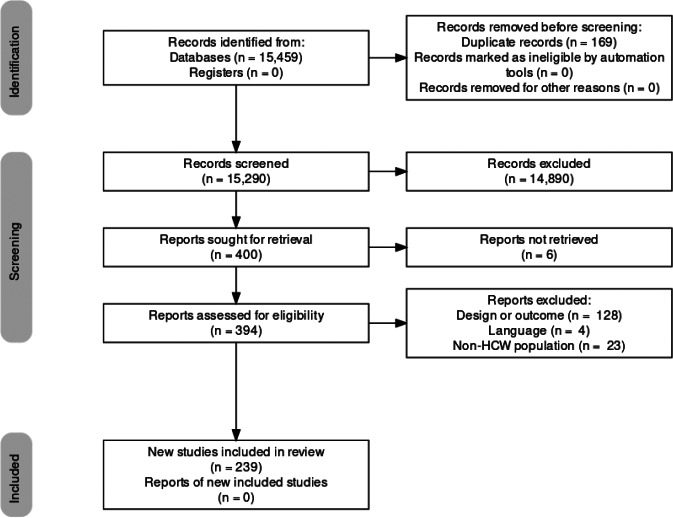
BACKGROUND: Healthcare workers (HCWs) exposed to coronavirus 19 (COVID-19) are at high risk of developing mental health concerns across several domains. The aim of this study is to determine the updated, global frequency of these outcomes. METHODS: A multistep literature search was performed from database inception until March 1, 2021. PRISMA/MOOSE-compliant systematic review and PROSPERO protocol were used to identify studies reporting on depression, anxiety, acute stress, post-traumatic symptoms, insomnia, and burnout in HCWs exposed to COVID-19. A quantitative meta-analysis with random effects was conducted to analyze the proportion rate of the mental health disorders. Sensitivity analyses were performed to investigate the effect of the different continents and scales. Meta-regression analyses were conducted to examine the effect of gender, age, and work position. RESULTS: 239 articles were included (n = 271,319 HCWs, mean age = 36.08 ± 8.33 (66.99% female). 33% HCWs exposed to COVID-19 reported depressive symptoms (95% confidence intervals [CI] = 28-38%), 42% anxiety features (95% CI = 35-48), 40% acute stress (95% CI = 32-47), 32% post-traumatic symptoms (95% CI = 26-37%), 42% insomnia (95% CI = 36-48), 37% burnout (95% CI = 31-42). Sensitivity analyses did not show statistically significant differences. Meta-regressions found a statistically significant lower prevalence of post-traumatic symptoms in Asia. CONCLUSIONS: HCWs exposed to COVID-19 were found to have a significant prevalence of mental health concerns in all domains analyzed. The effects of COVID-19 on HCWs' mental health could be underestimated and the future consequences dismissed.
Overview
The claims and statistics of this paper haven’t been checked yet.
Run the check — free, no account needed. It reads the open-access text and checks the sources it cites.
Integrity signals
Registry
Cites
Statistics
Figures
Verification
Claims the paper makes
The claims and statistics of this paper haven’t been checked yet.
Run the check — free, no account needed. It reads the open-access text and checks the sources it cites.
Claims other papers make about this one
Each is checked against this paper’s own text: does it say what the citing paper says it does?
The source backs part of the claim, not all of it — or backs it for a different population, condition or comparison.
In the citing paper
“Studies reported that a considerable proportion of nurses were experiencing high levels of depression, anxiety, psychological distress, post-traumatic symptoms, burnout, and insomnia (4–6).”
From Translation, adaptation, and initial evaluation of a guided self-help intervention to reduce psychological distress among nurses during COVID-19 in China (2023) · cites this paper as [4]
Experimental — accuracy not yet measured
Self-check
Percentages, sums and reported differences re-computed from the paper’s own numbers.
The self-check needs the paper’s full text.
Citations
Cites
1 retracted
Huang, Y., & Zhao, N. (2020) · Psychology Health & Medicine · doi:10.1080/13548506.2020.1754438 · Cited by 329
RetractedBias in meta-analysis detected by a simple, graphical test
Egger, M., Smith, G. D., Schneider, M., & Minder, C. (1997) · BMJ · doi:10.1136/bmj.315.7109.629 · Cited by 56,722
The CES-D Scale: A Self-Report Depression Scale for Research in the General Population
Radloff, L. S. (1977) · Applied Psychological Measurement · doi:10.1177/014662167700100306 · Cited by 53,267
The PHQ-9: Validity of a brief depression severity measure
Kroenke, K., Spitzer, R. L., & Williams, J. B. W. (2001) · Journal of General Internal Medicine · doi:10.1046/j.1525-1497.2001.016009606.x · Cited by 44,910
An inventory for measuring depression
BECK, A. T. (1961) · Archives of General Psychiatry · doi:10.1001/archpsyc.1961.01710120031004 · Cited by 38,032
Preferred reporting items for systematic reviews and meta-analyses: The PRISMA statement
Moher, D., Liberati, A., Tetzlaff, J., Altman, D. G., & the PRISMA Group* (2009) · Annals of Internal Medicine · doi:10.7326/0003-4819-151-4-200908180-00135 · Cited by 37,554
The Pittsburgh Sleep Quality Index: a new instrument for psychiatric practice and research
Buysse, D. J., Reynolds, C. F., Monk, T. H., Berman, S. R., & Kupfer, D. J. (1989) · Psychiatry Research · doi:10.1016/0165-1781(89)90047-4 · Cited by 35,234
A Global Measure of Perceived Stress
Cohen, S., Kamarck, T., & Mermelstein, R. (1983) · Journal of Health and Social Behavior · doi:10.2307/2136404 · Cited by 32,807
A Brief Measure for Assessing Generalized Anxiety Disorder: The GAD-7
Spitzer, R. L., Kroenke, K., Williams, J. B. W., & Löwe, B. (2006) · Archives of Internal Medicine · doi:10.1001/archinte.166.10.1092 · Cited by 31,765
Dermyshi, E., Wang, Y., Yan, C., Hong, W., Qiu, G., Gong, X., & Zhang, T. (2017) · Neonatology · doi:10.1159/000454668 · Cited by 24,586
Research works printed but not linked: 2
- Weiss, 1997, Assessing psychological trauma and PTSD: a handbook for practitioners, 399
- 1993, Annual meeting of the international society for traumatic stress studies
Cited by
Sorted by citations
Witteveen, A. B., Young, S. Y., Cuijpers, P. J., Ayuso‐Mateos, J. L., Barbui, C., Bertolini, F., Cabello, M., Cadorin, C., Downes, N., Franzoi, D., et al. (2023) · PLoS Medicine · doi:10.1371/journal.pmed.1004206 · Cited by 150
Catapano, P., Cipolla, S., Sampogna, G., Perris, F., Luciano, M., Catapano, F., & Fiorillo, A. (2023) · Medicina · doi:10.3390/medicina59101866 · Cited by 104
Liu, Y., Zou, L., Yan, S., Zhang, P., Zhang, J., Wen, J., Mao, J., Li, L., Wang, Y., & Fu, W. (2023) · Journal of Affective Disorders · doi:10.1016/j.jad.2022.10.027 · Cited by 59
Silva, P. I. C. C. D. S. E., Gunarathne, N., & Kumar, S. (2024) · Meditari Accountancy Research · doi:10.1108/medar-02-2024-2383 · Cited by 85
Huang, J., Huang, Z.-T., Sun, X.-C., Chen, T., & Wu, X.-T. (2024) · PLoS ONE · doi:10.1371/journal.pone.0289454 · Cited by 71
Metadata
- Authors
- Aymerich, C., Pedruzo, B., Pérez, J. L., Laborda, M., Herrero, J., Blanco, J., Mancebo, G., Andrés, L., Estévez, O., Fernandez, M., Salazar de Pablo, G., Catalan, A., & González-Torres, M. Á.
- Affiliations
- Hospital de Basurto (ES)
- ORCID
- Venue
- European Psychiatry
- Publisher
- Royal College of Psychiatrists
- Published
- 2022
- Volume
- 65
- Issue
- 1
- Pages
- e10-e10
- ISSN
- 0924-9338 (ISSN-L)
- 1778-3585
- PMC
- PMC8828390
- OpenAlex
- W4205390693
- Cited by
- 234
- References
- 81
- Citations by year
- 2026: 18 · 2025: 34 · 2024: 74 · 2023: 82 · 2022: 26
- FWCI
- 9.00
- Type
- journal article
- Language
- en
- Open access
- gold
- doi.org
- Locations
- European Psychiatry (publishedVersion, cc-by)
- PubMed Central (publishedVersion, cc-by)
- PubMed (publishedVersion)
- Communities in ADDI (Universidad del Pais Vasco) (submittedVersion, other-oa)
- Communities in ADDI (University of the Basque Country) (submittedVersion, cc-by)
- DOAJ (DOAJ: Directory of Open Access Journals) (submittedVersion)
- Hispana (submittedVersion, cc-by)
- Research Portal (King's College London) (submittedVersion, other-oa)
- Topics
- Social Sciences › Psychology › Clinical Psychology › COVID-19 and Mental Health
- Health Sciences › Health Professions › General Health Professions › Healthcare professionals’ stress and burnout
- Health Sciences › Medicine › Public Health, Environmental and Occupational Health › Occupational Health and Burnout
- Keywords
- COVID-19 pandemic, healthcare workers, mental health, depression, anxiety, acute stress, posttraumatic stress symptoms, insomnia, burnout, prevalence, occupational exposure
- MeSH terms
- COVID-19, SARS-CoV-2, Depression, Female, Humans, Male, Mental Health, Pandemics
About these checks
Registry, retraction, Cites and statistics results are computed, not judged, with one exception: a printed reference that no index lists is read once by a model before it counts as a citation error. Claims are extracted by a model and kept only when their quote appears verbatim in the text; each cited source is then checked, with a model’s help, for whether it says what the claim relies on. Those verdicts can be wrong — read the claim’s quote and the cited source before relying on one.
Statistics and arithmetic are recomputed, not judged.
Confidence bands are shown only for fields calibrated on our annotated test set. None is calibrated yet, so no band is shown.
What counts as a claim ›How we measure confidence ›How we check this ›
Are you an author, or do you see a problem with this page? Request a review
