

Anti-repulsive Guidance Molecule C (RGMc) Antibodies Increases Serum Iron in Rats and Cynomolgus Monkeys by Hepcidin Downregulation
Open accessThe DOI matches its Crossref record; 19 of the 19 references it cites were found in a registry or an index.
Abstract
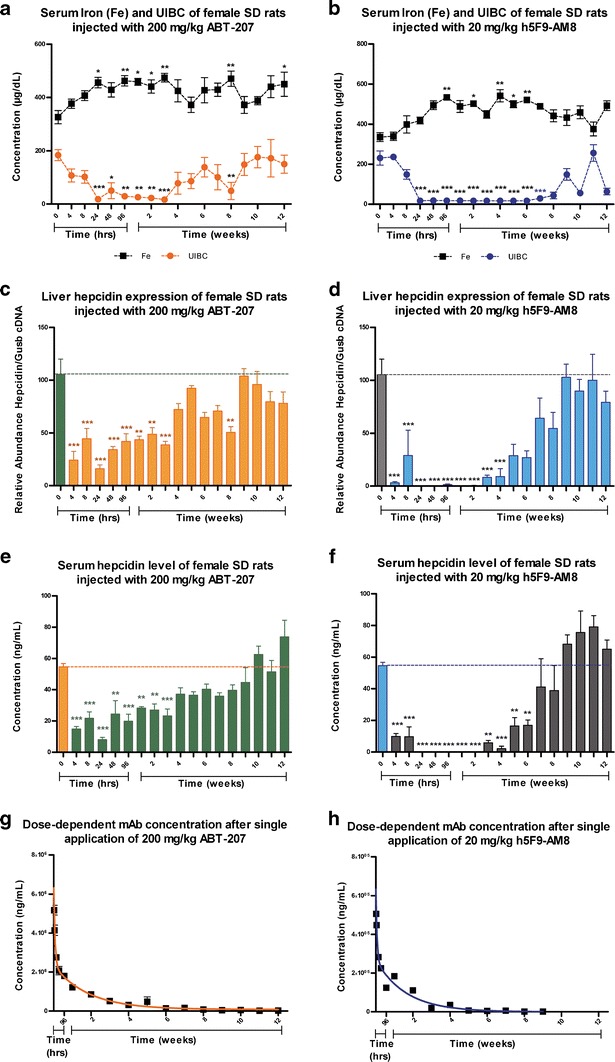
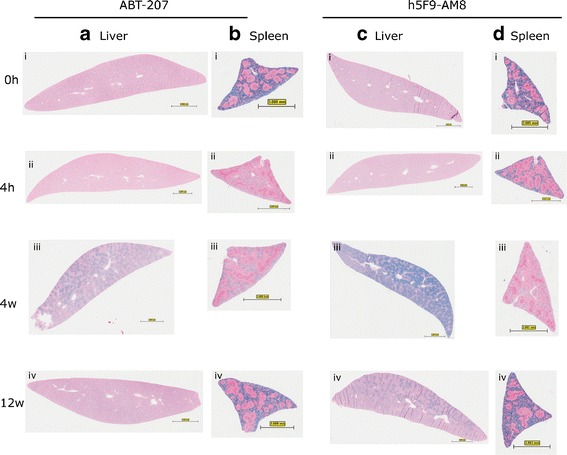
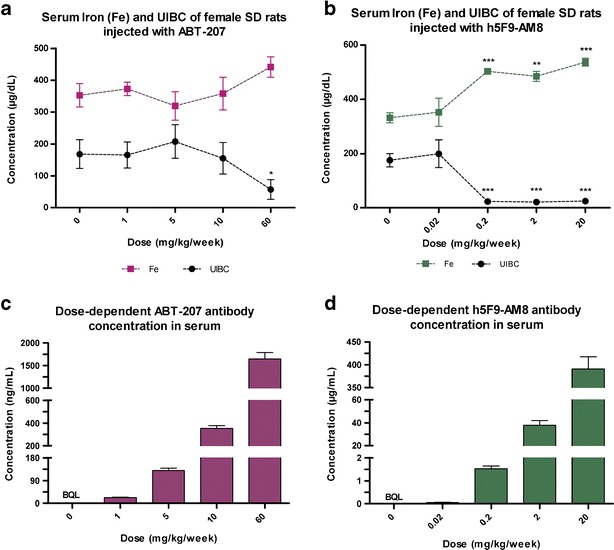
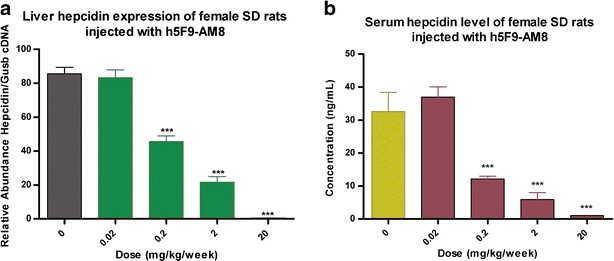
High levels of hepcidin, the main regulator of systemic iron metabolism, lead to various diseases. Targeting hepcidin and lowering its concentration is a possible form of intervention in order to treat these diseases. High turnover rate of hepcidin is a major drawback of therapies directly targeting this peptide. We developed two monoclonal antibodies ABT-207 and h5F9-AM8 which inhibit hemojuvelin/repulsive guidance molecule C (RGMc) and downregulate hepcidin. We conducted single-application and dose response studies to understand the antibodies' mechanism and subchronic toxicology studies to exclude safety-related concerns. Investigation was carried out at different biological levels through qPCR, Affymetrix, liquid chromatography coupled with mass spectrometry (LC-MS/MS), histopathology, serum iron, unsaturated iron binding capacity (UIBC), and drug concentration measurements. After a single application of these antibodies, hepcidin expression in liver and its serum protein levels were reduced. Serum iron increased for several weeks. The RGMc antibodies show a pronounced dose response relationship in rats with h5F9-AM8 having an IC50 (UIBC) of approximately 80-fold higher than ABT-207. When hepcidin levels were downregulated, iron deposition in the liver was visible histologically 1 week post application. These antibody-mediated iron depositions were not associated with any adverse toxicologically relevant effect at the doses and time points evaluated. Iron depositions seen after 14 weekly treatments with ABT-207 were reversible in rats and in cynomolgus monkeys. Due to their long-lasting effects and excellent safety profile, both RGMc-blocking antibodies ABT-207 and h5F9-AM8 are favorable clinical candidates for diseases characterized by high serum hepcidin levels like anemia of chronic disease.
Overview
The claims and statistics of this paper haven’t been checked yet.
Free: it reads the open-access text and checks the first 5 claims that cite a source we can check. Create a free account to check every claim.
Integrity signals
Registry
Cites
Statistics
Figures
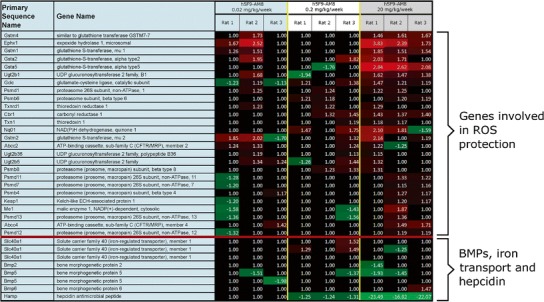
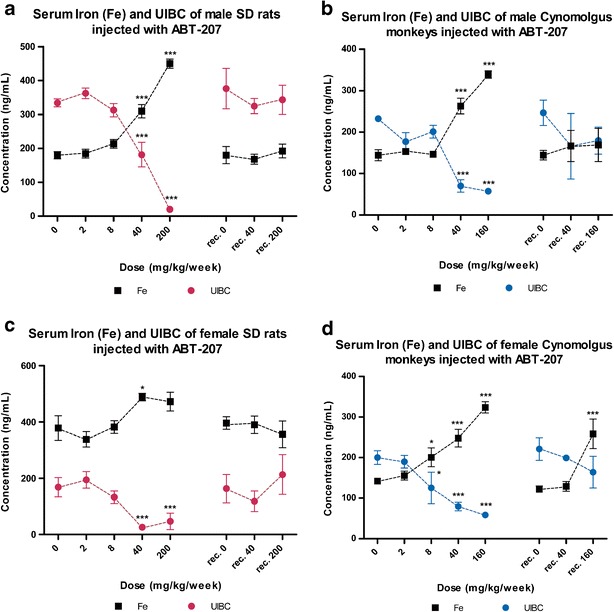
Verification
Claims the paper makes
The claims and statistics of this paper haven’t been checked yet.
Free: it reads the open-access text and checks the first 5 claims that cite a source we can check. Create a free account to check every claim.
Claims other papers make about this one
Each is checked against this paper’s own text: does it say what the citing paper says it does?
In the citing paper
“Its neutralization by using humanized monoclonal HJV antibodies (developed by Abbvie) reduced hepcidin expression in rats and cynomolgus monkeys (Böser et al., 2015).”
From Pharmacological Targeting of the Hepcidin/Ferroportin Axis (2016) · cites this paper as Böser et al., 2015
Self-check
Percentages, sums and reported differences re-computed from the paper’s own numbers.
The self-check needs the paper’s full text.
Citations
Cites
Gene Expression Omnibus: NCBI gene expression and hybridization array data repository
Edgar, R. (2002) · Nucleic Acids Research · doi:10.1093/nar/30.1.207 · Cited by 13,288 · cited 2×
“The data discussed in this publication have been deposited inNCBI’s Gene Expression Omnibus (18) and are accessible through GEO Series accession number GSE63200 (http:/ / www.ncbi.nlm.nih.gov/geo/query/acc.cgi?acc=GSE63200).”
MethodTheory and Practice of Histological Techniques
Bancroft, J. D., & Gamble, M. (1990) · Cited by 6,948
Weiss, G., & Goodnough, L. T. (2005) · New England Journal of Medicine · doi:10.1056/nejmra041809 · Cited by 3,800
Two to tango: Regulation of Mammalian iron metabolism
Hentze, M. W., Muckenthaler, M. U., Galy, B., & Camaschella, C. (2010) · Cell · doi:10.1016/j.cell.2010.06.028 · Cited by 2,120 · cited 1×
“In addition, interleukin-6 stimulates hepatic hepcidin expression and hepcidin in turn induces degradation of ferroportin thereby blocking iron release from macrophages and enterocytes into the circulation (3).”
BackgroundBone morphogenetic protein signaling by hemojuvelin regulates hepcidin expression
Babitt, J. L., Huang, F. W., Wrighting, D. M., Xia, Y., Sidis, Y., Samad, T. A., Campagna, J. A., Chung, R. T., Schneyer, A. L., Woolf, C. J., et al. (2006) · Nature Genetics · doi:10.1038/ng1777 · Cited by 1,026 · cited 1×
“reduced liver hepcidin expression (6, 7) suggesting that they jointly regulated the BMP/Smad-mediated signaling pathway of hepcidin regulation (8).”
BackgroundBone morphogenetic proteins: a critical review
Bragdon, B., Moseychuk, O., Saldanha, S., King, D., Julian, J., & Nohe, A. (2011) · Cellular Signalling · doi:10.1016/j.cellsig.2010.10.003 · Cited by 691 · cited 1×
“All current approaches targeting hepcidin and bone morphogenetic protein receptor (BMPR) directly may have major drawbacks due to hepcidin’s high turnover rate and BMPR’s involvement in many other cellular processes (19,20).”
BackgroundLack of the bone morphogenetic protein BMP6 induces massive iron overload
Meynard, D., Kautz, L., Darnaud, V., Canonne-Hergaux, F., Coppin, H., & Roth, M.-P. (2009) · Nature Genetics · doi:10.1038/ng.320 · Cited by 587 · cited 1×
“reduced liver hepcidin expression (6, 7) suggesting that they jointly regulated the BMP/Smad-mediated signaling pathway of hepcidin regulation (8).”
BackgroundRecent advances in BMP receptor signaling
Sieber, C., Kopf, J., Hiepen, C., & Knaus, P. (2009) · Cytokine & Growth Factor Reviews · doi:10.1016/j.cytogfr.2009.10.007 · Cited by 455 · cited 1×
“All current approaches targeting hepcidin and bone morphogenetic protein receptor (BMPR) directly may have major drawbacks due to hepcidin’s high turnover rate and BMPR’s involvement in many other cellular processes (19,20).”
BackgroundHemojuvelin is essential for dietary iron sensing, and its mutation leads to severe iron overload
Niederkofler, V. (2005) · Journal of Clinical Investigation · doi:10.1172/jci25683 · Cited by 372 · cited 1×
“glycosyl-phosphatidylinositol (GPI)-linked glycoprotein (aka hemojuvelin) (4).”
Pathogenesis and treatment of anaemia of chronic disease
Weiss, G. (2002) · Blood Reviews · doi:10.1054/blre.2002.0193 · Cited by 277 · cited 2×
“Anemia of chronic disease (ACD), also known as anemia of inflammation, is the most common anemia in hospitalized patients (1).”
BackgroundNeogenin inhibits HJV secretion and regulates BMP-induced hepcidin expression and iron homeostasis
Lee, D.-H., Zhou, L.-J., Zhou, Z., Xie, J.-X., Jung, J.-U., Liu, Y., Xi, C.-X., Mei, L., & Xiong, W.-C. (2010) · Blood · doi:10.1182/blood-2009-11-251199 · Cited by 138 · cited 1×
“reduced liver hepcidin expression (6, 7) suggesting that they jointly regulated the BMP/Smad-mediated signaling pathway of hepcidin regulation (8).”
BackgroundWaring, J. F., Liguori, M. J., Luyendyk, J. P., Maddox, J. F., Ganey, P. E., Stachlewitz, R. F., North, C. M., Blomme, E. A. G., & Roth, R. A. (2006) · Journal of Pharmacology and Experimental Therapeutics · doi:10.1124/jpet.105.096347 · Cited by 136 · cited 2×
“RNA was prepared (n=3) (17) and microarray analysis was performed using the standard protocol provided by Affymetrix, Inc.”
MethodSelf-citationManipulation of the hepcidin pathway for therapeutic purposes
Fung, E., & Nemeth, E. (2013) · Haematologica · doi:10.3324/haematol.2013.084624 · Cited by 123
The iron-regulatory hormone hepcidin: A possible therapeutic target?
Rochette, L., Gudjoncik, A., Guénancia, C., Zeller, M., Cottin, Y., & Vergely, C. (2014) · Pharmacology & Therapeutics · doi:10.1016/j.pharmthera.2014.09.004 · Cited by 119 · cited 1×
“Due to the increased serum hepcidin levels in ACD, many strategies target hepcidin to reduce its serum levels to prevent ferroportin degradation (9, 10).”
BackgroundNeogenin: One receptor, many functions
Wilson, N. H., & Key, B. (2006) · The International Journal of Biochemistry & Cell Biology · doi:10.1016/j.biocel.2006.10.023 · Cited by 118 · cited 1×
“RGMc has been shown to bind to neogenin, an ubiquitously expressed transmembrane protein with numerous functions (5), and to bone morphogenetic protein 6 (BMP6).”
BackgroundPharmacokinetics of Anti-hepcidin Monoclonal Antibody Ab 12B9m and Hepcidin in Cynomolgus Monkeys
Xiao, J. J., Krzyżański, W., Wang, Y., Li, H., Rose, M. J., Ma, M., Wu, Y., Hinkle, B., & Ruixo, J. J. P. (2010) · The AAPS Journal · doi:10.1208/s12248-010-9222-0 · Cited by 88 · cited 2×
“3 min in cynomolgus monkeys (11), inhibition of hepcidin can only be Electronic supplementary material The online version of this article”
BackgroundLudwiczek, S., Theurl, I., Artner-Dworzak, E., Chorney, M., & Weiss, G. (2004) · Journal of Molecular Medicine · doi:10.1007/s00109-004-0542-3 · Cited by 57 · cited 1×
“Two milligrams of frozen liver tissue was reverse transcribed and TaqMan real-time PCR was carried out for hepcidin as previously described (16).”
MethodMueller, B. K., Yamashita, T., Schaffar, G., & Mueller, R. (2006) · Philosophical Transactions of the Royal Society B: Biological Sciences · doi:10.1098/rstb.2006.1888 · Cited by 52 · cited 1×
“RGMa shares 47% amino acid identity with RGMc (12) and RGMc is conserved in rat, in monkey, and in human (13).”
BackgroundSelf-citationHall, A. P., Davies, W. J., Stamp, K., Clamp, I., & Bigley, A. L. (2013) · Toxicologic Pathology · doi:10.1177/0192623313476576 · Cited by 31
Research works printed but not linked: 1
- NCBI. HomoleGene: 17060. Gene conserved in Euteleostomi. NCBI 2014 September 11Available from: URL: http://www.ncbi.nlm.nih.gov/homologene/17060.
Cited by
Hepcidin regulation in the anemia of inflammation
Wang, C.-Y., & Babitt, J. L. (2016) · Current Opinion in Hematology · doi:10.1097/moh.0000000000000236 · Cited by 250
Fraenkel, P. G. (2017) · Medical Clinics of North America · doi:10.1016/j.mcna.2016.09.005 · Cited by 192
Pharmacological Targeting of the Hepcidin/Ferroportin Axis
Sebastiani, G., Wilkinson, N., & Pantopoulos, K. (2016) · Frontiers in Pharmacology · doi:10.3389/fphar.2016.00160 · Cited by 127
Hepcidin: A Promising Therapeutic Target for Iron Disorders A Systematic Review
Liu, J. L., Sun, B., Yin, H.-J., & Liu, S. (2016) · Medicine · doi:10.1097/md.0000000000003150 · Cited by 156
Anemia of chronic disorders: new diagnostic tools and new treatment strategies
Weiss, G. (2015) · Seminars in Hematology · doi:10.1053/j.seminhematol.2015.07.004 · Cited by 116
Metadata
- Authors
- Böser, P., Seemann, D., Liguori, M. J., Fan, L., Huang, L., Hafner, M., Popp, A., & Mueller, B. K.
- Affiliations
- AbbVie (Germany) (DE)
- AbbVie (United States) (US)
- Heidelberg University (DE)
- Corresponding author
- Popp, Andreas
- Mueller, Bernhard K.
- Venue
- The AAPS Journal
- Published
- 2015-04-22
- Volume
- 17
- Issue
- 4
- Pages
- 930-938
- ISSN
- 1550-7416 (ISSN-L)
- PMC
- PMC4476998
- OpenAlex
- W2005653877
- Cited by
- 35
- References
- 19
- Citations by year
- 2024: 2 · 2023: 3 · 2021: 4 · 2020: 2 · 2019: 2 · 2018: 3 · 2017: 7 · 2016: 9 · 2015: 3
- FWCI
- 5.76
- Type
- journal article
- Language
- en
- Open access
- hybrid
- doi.org
- Locations
- The AAPS Journal (publishedVersion, cc-by)
- Europe PMC (PubMed Central) (publishedVersion, cc-by)
- PubMed Central (publishedVersion, cc-by)
- PubMed (publishedVersion)
- Topics
- Health Sciences › Medicine › Hematology › Iron Metabolism and Disorders
- Life Sciences › Immunology and Microbiology › Immunology › Monoclonal and Polyclonal Antibodies Research
- Life Sciences › Biochemistry, Genetics and Molecular Biology › Cancer Research › Ferroptosis and cancer prognosis
- Keywords
- hemojuvelin, hepcidin, monoclonal antibodies, serum iron, iron metabolism, iron accumulation, dose-response relationship, anemia of chronic disease, subchronic toxicity, Macaca fascicularis, rats
- MeSH terms
- Animals, Chromatography, Liquid, Dose-Response Relationship, Drug, Female, Iron, Macaca fascicularis, Male, Membrane Proteins, Time Factors, Down-Regulation, Rats, Sprague-Dawley, Inhibitory Concentration 50, Rats, Tandem Mass Spectrometry, Antibodies, Monoclonal, Humanized, Hepcidins
About these checks
Registry, retraction, Cites and statistics results are computed, not judged, with one exception: a printed reference that no index lists is read once by a model before it counts as a citation error. Claims are extracted by a model and kept only when their quote appears verbatim in the text; each cited source is then checked, with a model’s help, for whether it says what the claim relies on. Those verdicts can be wrong — read the claim’s quote and the cited source before relying on one.
Statistics and arithmetic are recomputed, not judged.
Confidence bands are shown only for fields calibrated on our annotated test set. None is calibrated yet, so no band is shown.
What counts as a claim ›How we measure confidence ›How we check this ›
Are you an author, or do you see a problem with this page? Request a review
Data sources
Bibliographic data: Semantic Scholar, OpenAlex, Crossref.
Contains information from the Semantic Scholar Academic Graph Datasets, made available under the ODC Attribution License (ODC-BY 1.0).
Semantic Scholar’s data is described in: Kinney, R., et al. (2023). The Semantic Scholar Open Data Platform. arXiv:2301.10140.
