

Semaglutide added to basal insulin in type 2 diabetes (SUSTAIN 5): a randomized, controlled trial.
Open accessThe DOI matches its Crossref record; 43 of the 43 references it cites were found in a registry or an index.
Abstract
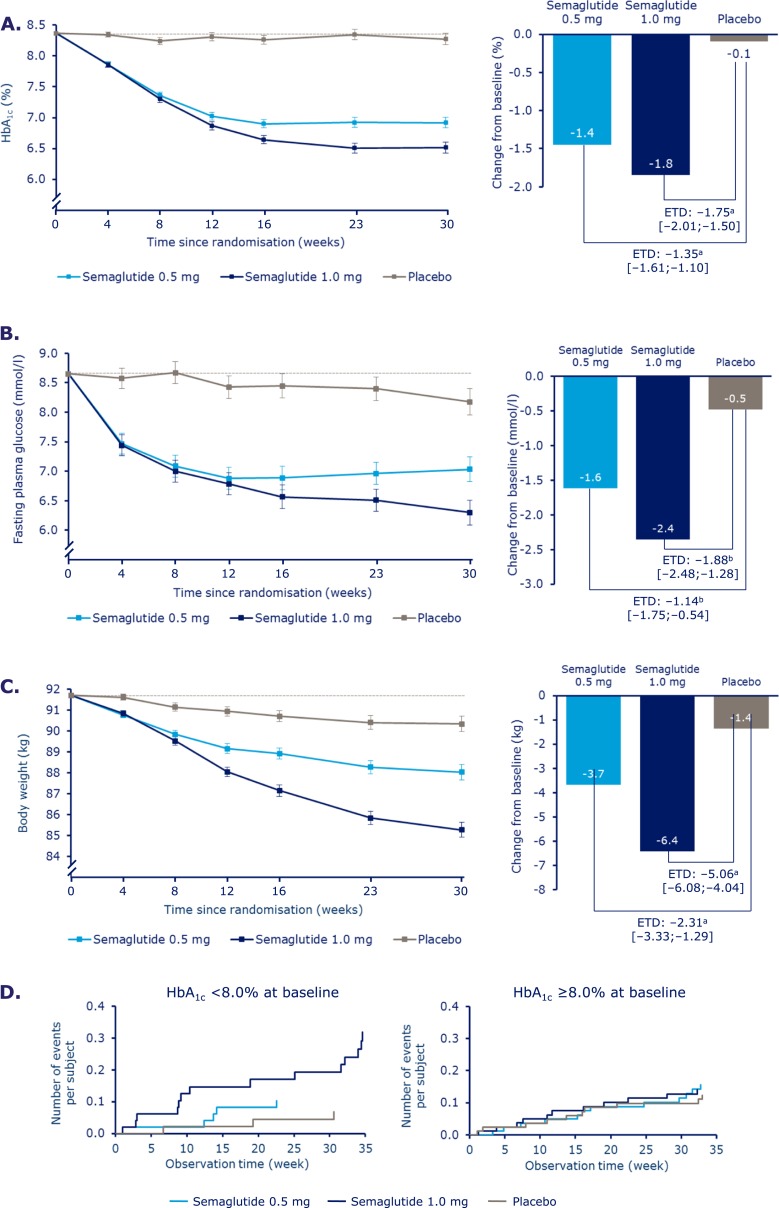
Context: Combination therapy with insulin and glucagon-like peptide-1 receptor agonists (GLP-1RAs) is important for treating type 2 diabetes (T2D). This trial assesses the efficacy and safety of semaglutide, a GLP-1RA, as an add-on to basal insulin. Objective: To demonstrate the superiority of semaglutide vs placebo on glycemic control as an add-on to basal insulin in patients with T2D. Design: Phase 3a, double-blind, placebo-controlled, 30-week trial. Setting: This study included 90 sites in five countries. Patients: We studied 397 patients with uncontrolled T2D receiving stable therapy with basal insulin with or without metformin. Interventions: Subcutaneous semaglutide 0.5 or 1.0 mg once weekly or volume-matched placebo. Main Outcome Measures: Primary endpoint was change in glycated Hb (HbA1c) from baseline to week 30. Confirmatory secondary endpoint was change in body weight from baseline to week 30. Results: At week 30, mean HbA1c reductions [mean baseline value, 8.4% (67.9 mmol/mol)] with semaglutide 0.5 and 1.0 mg were 1.4% (15.8 mmol/mol) and 1.8% (20.2 mmol/mol) vs 0.1% (1.0 mmol/mol) with placebo [estimated treatment difference (ETD) vs placebo, -1.35 (14.8 mmol/mol); 95% CI, -1.61 to -1.10 and ETD, -1.75% (19.2 mmol/mol); 95% CI, -2.01 to -1.50; both P < 0.0001]. Severe or blood glucose-confirmed hypoglycemic episodes were reported in 11 patients (17 events) and 14 patients (25 events) with semaglutide 0.5 and 1.0 mg, respectively, vs seven patients (13 events) with placebo (estimated rate ratio vs placebo, 2.08; 95% CI, 0.67 to 6.51 and estimated rate ratio vs placebo, 2.41; 95% CI, 0.84 to 6.96 for 0.5 and 1.0 mg; both P = nonsignificant). Mean body weight decreased with semaglutide 0.5 and 1.0 mg vs placebo from baseline to end of treatment: 3.7, 6.4, and 1.4 kg (ETD, -2.31; 95% CI, -3.33 to -1.29 and ETD, -5.06; 95% CI, -6.08 to -4.04 kg; both P < 0.0001). Premature treatment discontinuation due to adverse events was higher for semaglutide 0.5 and 1.0 mg vs placebo (4.5%, 6.1%, and 0.8%), mainly due to gastrointestinal disorders. Conclusions: Semaglutide, added to basal insulin, significantly reduced HbA1c and body weight in patients with uncontrolled T2D vs placebo.
Overview
The claims and statistics of this paper haven’t been checked yet.
Free: it reads the open-access text and checks the first 5 claims that cite a source we can check. Create a free account to check every claim.
Integrity signals
Registry
Cites
Statistics
Figures
Verification
Claims the paper makes
The claims and statistics of this paper haven’t been checked yet.
Free: it reads the open-access text and checks the first 5 claims that cite a source we can check. Create a free account to check every claim.
Claims other papers make about this one
Each is checked against this paper’s own text: does it say what the citing paper says it does?
The source backs part of the claim, not all of it — or backs it for a different population, condition or comparison.
In the citing paper
“hsCRP data collected in SUSTAIN 2, 4, and 5 trials [22–24] were not used due to technical issues during sample collection — the hsCRP analysis assay was found to have a negative bias (an under-recovery of up to –25% at hsCRP concentrations below 5 mg/L), which affected a proportion of the samples.”
From Impact of semaglutide on high-sensitivity C-reactive protein: exploratory patient-level analyses of SUSTAIN and PIONEER randomized clinical trials (2022) · cites this paper as [24]
Experimental — accuracy not yet measuredThe source backs part of the claim, not all of it — or backs it for a different population, condition or comparison.
In the citing paper
“When compared with placebo, subcutaneous semaglutide for 30 weeks induced nausea in 11.4 to 20% of the semaglutide-treated patients (placebo 3.3–8%), vomiting in 4 to 11.5% (placebo 2–3%) and diarrhea in 4.5 to 11.3% (placebo 1.5–6%) (10, 27, 31).”
From Safety of Semaglutide (2021) · cites this paper as [27]
Experimental — accuracy not yet measuredThe source backs part of the claim, not all of it — or backs it for a different population, condition or comparison.
In the citing paper
“None of these were medullary carcinoma.”
From Safety of Semaglutide (2021) · cites this paper as [27]
Experimental — accuracy not yet measuredThe source backs part of the claim, not all of it — or backs it for a different population, condition or comparison.
In the citing paper
“The events mainly included cholelithiasis.”
From Safety of Semaglutide (2021) · cites this paper as [27]
Experimental — accuracy not yet measured
5 more claims about this paper
Create a free account to see every claim other papers make about this one.
Self-check
Percentages, sums and reported differences re-computed from the paper’s own numbers.
The self-check needs the paper’s full text.
Citations
Cites
Cook, R. J., Dickens, B. M., & Fathalla, M. F. (2003) · Reproductive Health and Human Rights · doi:10.1093/acprof:oso/9780199241323.003.0025 · Cited by 10,769
Stratton, I. M. (2000) · BMJ · doi:10.1136/bmj.321.7258.405 · Cited by 9,059
Standards of Medical Care in Diabetes
Power, D. (2006) · Diabetes Care · doi:10.2337/diacare.29.02.06.dc05-1593 · Cited by 8,673
Turner, R. C., Fox, C., Matthews, McElroy, H. H., Cull, C. A., Holman, R. R., Neil, P., Hadden, D. R., Wright, D., Manley, E., et al. (1998) · The Lancet · Cited by 8,419
10-year follow-up of intensive glucose control in type 2 diabetes
Holman, R. R., Paul, S. K., Bethel, M. A., Matthews, D. R., & Neil, H. A. W. (2008) · New England Journal of Medicine · doi:10.1056/nejmoa0806470 · Cited by 7,751
Semaglutide and Cardiovascular Outcomes in Patients with Type 2 Diabetes
Marso, S. P., Bain, S. C., Consoli, A., Eliaschewitz, F. G., Jódar, E., Leiter, L. A., Lingvay, I., Rosenstock, J., Seufert, J., Warren, M. L., et al. (2016) · New England Journal of Medicine · doi:10.1056/nejmoa1607141 · Cited by 6,900
Self-citationStandards of medical care in diabetes—2014
American Diabetes Association (2014) · Diabetes Care · doi:10.2337/dc14-s014 · Cited by 4,572
Gupta, A., & Uribarri, J. (2016) · Hormone Research in Paediatrics · doi:10.1159/000444053 · Cited by 4,006
Research works printed but not linked: 1
- Marbury T, Flint A, Segel S, Lindegaard M, Lasseter K Pharmacokinetics and tolerability of a single dose of semaglutide, a once-weekly human GLP-1 analogue, in subjects with and without renal impairment. Diabetologia. 2014; 57: S358.
Cited by
Items 101–200 of 412
Arredouani, A. (2025) · Pharmacology & Therapeutics · doi:10.1016/j.pharmthera.2025.108824 · Cited by 36
Ngabea, M. A., & Dimeji, I. Y. (2025) · Biochemical and Biophysical Research Communications · doi:10.1016/j.bbrc.2025.152822 · Cited by 35
Muzurović, E., & Mikhailidis, D. P. (2020) · Expert Opinion on Pharmacotherapy · doi:10.1080/14656566.2020.1795132 · Cited by 35
Anam, M., Maharjan, S., Amjad, Z., Abaza, A., Vasavada, A. M., Sadhu, A., Valencia, C., Fatima, H., & Nwankwo, I. (2022) · Cureus · doi:10.7759/cureus.32610 · Cited by 35
“When added to basal insulin, subcutaneous semaglutide in patients with uncontrolled T2DM it remarkably reduced HbA1c and body weight when compared to placebo in Sustain 5 Trial, a double-blinded RCT [23].”
BackgroundInfluentialJódar, E., Michelsen, M. M., Polonsky, W. H., Rea, R. R., Sandberg, A., Vilsbøll, T., Warren, M., Østoft, S. H., Ziegler, U. E., & Bain, S. C. (2020) · Diabetes Obesity and Metabolism · doi:10.1111/dom.14039 · Cited by 43
Kokkorakis, M., Katsarou, A., Katsiki, N., & Mantzoros, C. S. (2023) · Metabolism · doi:10.1016/j.metabol.2023.155689 · Cited by 34
Marzullo, P., Daffara, T., Mele, C., Zavattaro, M., Ferrero, A., Caputo, M., Prodam, F., & Aimaretti, G. (2022) · Journal of Endocrinological Investigation · doi:10.1007/s40618-022-01799-2 · Cited by 34
Kommu, S., & Berg, R. L. (2024) · Obesity Reviews · doi:10.1111/obr.13792 · Cited by 52
Maiorino, M. I., Chiodini, P., Bellastella, G., Scappaticcio, L., Longo, M., Giugliano, D., & Esposito, K. (2019) · Diabetes Research and Clinical Practice · doi:10.1016/j.diabres.2019.06.009 · Cited by 36
Aroda, V. R., Capehorn, M. S., Chaykin, L., Frias, J. P., Lausvig, N. L., Macura, S., Lüdemann, J., Madsbad, S., Rosenstock, J., Tabak, O., et al. (2020) · Diabetes, Obesity and Metabolism · doi:10.1111/dom.13896 · Cited by 31
“The trials have been previously published (Table 1).(5-9)”
BackgroundMethodResultInfluentialNapoli, R., Berra, C., Catarig, A., Di Loreto, C., Donatiello, E., Berentzen, T. L., Pitocco, D., & Giorgino, F. (2023) · Diabetes, Obesity and Metabolism · doi:10.1111/dom.15020 · Cited by 32
Glucagon-Like Peptide 1 Receptor Agonists: A Medication for Obesity Management
Taha, M. B., Yahya, T., Satish, P., Laird, R., Agatston, A. S., Cainzos-Achirica, M., Patel, K. V., & Nasir, K. (2022) · Current Atherosclerosis Reports · doi:10.1007/s11883-022-01041-7 · Cited by 31
Ding, Y., Shi, Y., Guan, R., Yan, S., Liu, H., Wang, Z., Li, J., Wang, T., Cai, W., & Ma, G. (2024) · Pharmacological Research · doi:10.1016/j.phrs.2023.107031 · Cited by 31
Williams, D. M., Ruslan, A. M., Khan, R., Vijayasingam, D., Iqbal, F., Shaikh, A., Lim, J., Chudleigh, R., Peter, R., Udiawar, M., et al. (2021) · Diabetes Therapy · doi:10.1007/s13300-021-01015-z · Cited by 31
Pathophysiological Mechanisms in Non-Alcoholic Fatty Liver Disease: From Drivers to Targets
Santos‐Laso, Á., Gutiérrez‐Larrañaga, M., Alonso‐Peña, M., Medina, J. M., Iruzubieta, P., Arias, M., López‐Hoyos, M., & Crespo, J. (2021) · Biomedicines · doi:10.3390/biomedicines10010046 · Cited by 40
Cherney, D. Z. I., Hadjadj, S., Lawson, J., Mosenzon, O., Tuttle, K. R., Vrhnjak, B., Rasmussen, S., & Bain, S. C. (2022) · Kidney International Reports · doi:10.1016/j.ekir.2022.07.167 · Cited by 35
“relevant reductions in HbA1c and BW compared with placebo and active comparators in adults with T2D; the safety profile of semaglutide was consistent with its class.(9-20) There is no apparent effect of reduced kidney function or hemodialysis on the pharmacokinetics of semaglutide,(21) and no dose adjustment of semagl…”
MethodLingvay, I., Benamar, M., Chen, L., Fu, A., Jódar, E., Nishida, T., Riveline, J., Yabe, D., Züger, T., & Rea, R. R. (2025) · Diabetologia · doi:10.1007/s00125-024-06348-5 · Cited by 40
“These rates were low and comparable for both the IcoSema and semaglutide treatment groups, indicating that IcoSema has a similar hypoglycaemia rate to semaglutide, which is known to have a low hypoglycaemia risk profile [9–12, 14–16, 18].”
Self-citationAlkhouri, N., Charlton, M., Gray, M. E., & Noureddin, M. (2025) · Expert Opinion on Investigational Drugs · doi:10.1080/13543784.2025.2473062 · Cited by 34
Cavaiola, T. S., Kiriakov, Y., & Reid, T. (2019) · Clinical Therapeutics · doi:10.1016/j.clinthera.2018.11.015 · Cited by 33
Clinical potential of treatment with semaglutide in type 2 diabetes patients
Røder, M. E. (2019) · Drugs in Context · doi:10.7573/dic.212585 · Cited by 37
Glucagon-Like Peptide 1 Receptor Agonists – Potential Game Changers in the Treatment of Glaucoma?
Mouhammad, Z. A., Vohra, R., Horwitz, A., Thein, A., Andreasen, J. R., Cvenkel, B., Williams, P. A., Azuara‐Blanco, A., & Kolko, M. (2022) · Frontiers in Neuroscience · doi:10.3389/fnins.2022.824054 · Cited by 36
Menzen, M., Berentzen, T. L., Catarig, A.-M., Pieperhoff, S., Simon, J., & Jacob, S. (2023) · Experimental and Clinical Endocrinology & Diabetes · doi:10.1055/a-2007-2061 · Cited by 29
Tilinca, M. C., Tiucă, R. A., Niculas, C., Varga, A., & Ţilea, I. (2021) · Experimental and Therapeutic Medicine · doi:10.3892/etm.2021.10601 · Cited by 34
Johansen, P., Håkan‐Bloch, J., Liu, A. R., Bech, P. G., Persson, S., & Leiter, L. A. (2019) · PharmacoEconomics - Open · doi:10.1007/s41669-019-0131-6 · Cited by 32
Berra, C. C., Rossi, M. C., Mirani, M., Ceccarelli Ceccarelli, D., Romano, C., Sassi, L., Peretti, E., Favacchio, G., Pastore, I., Folini, L., et al. (2023) · Frontiers in Endocrinology · doi:10.3389/fendo.2022.1099451 · Cited by 28
Hu, S., Su, X., & Fan, G. (2023) · Diabetology & Metabolic Syndrome · doi:10.1186/s13098-023-01195-7 · Cited by 28
Antza, C., Nirantharakumar, K., Doundoulakis, I., Tahrani, A. A., & Toulis, K. A. (2019) · Drug Design Development and Therapy · doi:10.2147/dddt.s166765 · Cited by 30
“27 30 In addition to its glucose-and weight-lowering ef fi - cacy, semaglutide, when used as add-on standard care in patients with T2DM and high cardiovascular disease, was found to be associated with signi fi cantly lower risk of cardiovascular death, nonfatal myocardial infarction, stroke and new…”
Jordy, A. B., Albayaty, M., Breitschaft, A., Anderson, T. W., Christiansen, E., Houshmand-Øregaard, A., Manigandan, E., & Bækdal, T. A. (2021) · Clinical Pharmacokinetics · doi:10.1007/s40262-020-00976-x · Cited by 27
Wan, J., Ferrari, C., & Tadros, M. S. (2024) · Gastroenterology Insights · doi:10.3390/gastroent15010014 · Cited by 34
Małyszczak, A., Przeździecka-Dołyk, J., Szydełko-Paśko, U., & Misiuk‐Hojło, M. (2024) · Journal of Clinical Medicine · doi:10.3390/jcm13061797 · Cited by 30
“…change at the end of the study; Table S2: Risk of bias assessment; Table S3: Certainty assessment; Figure S2: Pairwise meta-analysis, GLP-1RA vs. DPP-4i [21,28,29,47,64,72]; Figure S3: Pairwise meta-analysis, Semaglutide vs. placebo [6,20,22,61–63, 71 , 73 , 74 ] ; Figure S4: Pairwise meta-analysis”
BackgroundPharmacologic Glycemic Management of Type 2 Diabetes in Adults---2024 Update
Shah, B. R., BAJAJ, H. S., Butalia, S., Dasgupta, K., Eurich, D. T., Jain, R., Leung, K., Mansell, K. D., & Simpson, S. H. (2024) · Canadian Journal of Diabetes · doi:10.1016/j.jcjd.2024.08.002 · Cited by 44
Mathieu, C., Giorgino, F., Kim, S. G., Larsen, J. S., Philis‐Tsimikas, A., Ramachandran, A., da Rocha, T. J. C. M., Shankarappa, V. B., Terauchi, Y., & Ji, L. (2025) · The Lancet Diabetes & Endocrinology · doi:10.1016/s2213-8587(25)00096-8 · Cited by 34
Shi, A., Xie, P., Nielsen, L. L., Skjøth, T. V., He, X., & Haugaard, S. P. (2020) · Advances in Therapy · doi:10.1007/s12325-020-01548-y · Cited by 32
Gomez-Peralta, F., & Abreu, C. (2019) · Drug Design, Development and Therapy · doi:10.2147/dddt.s165372 · Cited by 27
“In the RCT SUSTAIN 5 (addition of semaglutide to basal insulin), the dose of insulin was reduced by 20% at randomization in patients with HbA 1c ,8%.(25)”
BackgroundWolffenbuttel, B. H. R., Brugts, M. P., Catarig, A.-M., Clark, A., Kok, M., Lieverse, A. G., & van Soest, J. (2023) · Advances in Therapy · doi:10.1007/s12325-022-02385-x · Cited by 26
“ously treated with a GLP-1RA [10–18], only the participants in SUSTAIN 5 were taking basal insulin [14], and baseline medication was lar-”
MethodTirzepatide: A Promising Drug for Type 2 Diabetes and Beyond
Dutta, P., Kumar, Y., Babu, A. T., Ravindran, S. G., Salam, A., Rai, B., Baskar, A., Dhawan, A., & Jomy, M. (2023) · Cureus · doi:10.7759/cureus.38379 · Cited by 46
“Semaglutide, also known as Ozempic or Wegovy, is a GLP-1 analog approved for the treatment of T2DM, cardiovascular risk reduction in patients with T2DM, and treatment of obesity [50-59].”
BackgroundMarassi, M., & Fadini, G. P. (2024) · Clinical Therapeutics · doi:10.1016/j.clinthera.2024.11.005 · Cited by 27
Glucagon-like peptide-1 receptor agonists in neurodegenerative diseases: Promises and challenges
Zhou, Z., Yi, L., Popławska-Domaszewicz, K., Chaudhuri, К. R., Jankovic, J. J., & Tan, E. K. (2025) · Pharmacological Research · doi:10.1016/j.phrs.2025.107770 · Cited by 35
Billings, L. K., Andreozzi, F., Frederiksen, M., Gourdy, P., Gowda, A., Ji, L., Pletsch‐Borba, L., Suzuki, R., Unnikrishnan, A. G., & Vianna, A. G. D. (2025) · The Lancet Diabetes & Endocrinology · doi:10.1016/s2213-8587(25)00052-x · Cited by 31
Ericsson, Å., & Fridhammar, A. (2019) · Journal of Medical Economics · doi:10.1080/13696998.2019.1614009 · Cited by 25
New Horizons: Next-Generation Insulin Analogues: Structural Principles and Clinical Goals
Jarosinski, M. A., Chen, Y., Varas, N., Dhayalan, B., Chatterjee, D., & Weiss, M. A. (2021) · The Journal of Clinical Endocrinology & Metabolism · doi:10.1210/clinem/dgab849 · Cited by 27
Mohammedi, K., Belhatem, N., Berentzen, T. L., Catarig, A., & Potier, L. (2023) · Diabetes Obesity and Metabolism · doi:10.1111/dom.15045 · Cited by 26
“The safety profile of semaglutide was similar to that of other GLP-1RAs, in particular, gastrointestinal adverse events (AEs), which were most frequently non-serious nausea, diarrhoea and vomiting.(15-25) Semaglutide is reimbursed in France for the treatment of insufficiently controlled T2D, as dual therapy in combina…”
BackgroundResultWu, W., Tong, H.-M., Li, Y., & Cui, J. (2023) · Endocrine · doi:10.1007/s12020-023-03636-9 · Cited by 30
Bellido, V., Padín, C. A., Catarig, A., Clark, A., Pittol, S. B., & Delgado, E. (2022) · Journal of Clinical Medicine · doi:10.3390/jcm11174938 · Cited by 25
Glucagon-like peptide 1-receptor agonists and A1c: Good for the heart but less so for the eyes?
Albert, S. G., Wood, E. M., & Ahir, V. (2022) · Diabetes & Metabolic Syndrome Clinical Research & Reviews · doi:10.1016/j.dsx.2022.102696 · Cited by 26
Use of Dulaglutide, Semaglutide, and Tirzepatide in Diabetes and Weight Management
Powell, J., & Taylor, J. (2024) · Clinical Therapeutics · doi:10.1016/j.clinthera.2023.12.014 · Cited by 27
Hansen, K. B., Svendstrup, M., Lund, A., Knop, F. K., Vilsbøll, T., & Vestergaard, H. (2021) · Diabetic Medicine · doi:10.1111/dme.14655 · Cited by 23
Pratley, R. E., Aroda, V. R., Catarig, A., Lingvay, I., Lüdemann, J., Yildirim, E., & Viljoen, A. (2020) · BMJ Open · doi:10.1136/bmjopen-2020-037883 · Cited by 31
Self-citationYabe, D., Yamada, Y., Kaku, K., Nishida, T., Sato, T., & Seino, Y. (2022) · Journal of Diabetes Investigation · doi:10.1111/jdi.13773 · Cited by 24
Landgraf, R., Kellerer, M., Fach, E.-M., Gallwitz, B., Hamann, A., Joost, H., Klein, H., Müller‐Wieland, D., Nauck, M. A., Reuter, H., et al. (2017) · Diabetologie und Stoffwechsel · doi:10.1055/s-0043-115964 · Cited by 26
Ren, X., Hua, H., Wu, Y., Zhang, W., Long, X., Bai, Y., & Cheng, N. (2025) · Scientific Reports · doi:10.1038/s41598-025-09807-0 · Cited by 38
Tsukamoto, S., Tanaka, S., Yamada, T., Uneda, K., Azushima, K., Kinguchi, S., Wakui, H., & Tamura, K. (2023) · Diabetes Obesity and Metabolism · doi:10.1111/dom.15312 · Cited by 29
Acute pancreatitis due to different semaglutide regimens: An updated meta-analysis
Masson, W., Lobo, M., Barbagelata, L., Lavalle-Cobo, A., & Nogueira, J. P. (2024) · Endocrinología, Diabetes y Nutrición (English ed.) · doi:10.1016/j.endien.2024.03.012 · Cited by 22
Li, X., Qie, S., Wang, X., Zheng, Y., Liu, Y., & Liu, G. (2018) · Endocrine · doi:10.1007/s12020-018-1708-z · Cited by 29
Di Loreto, C., Minarelli, V., Nasini, G., Norgiolini, R., & Del Sindaco, P. (2022) · Diabetes Therapy · doi:10.1007/s13300-022-01218-y · Cited by 21
Structured lifestyle modification as an adjunct to obesity pharmacotherapy: there is much to learn
Murphy, E. E., & Finucane, F. M. (2024) · International Journal of Obesity · doi:10.1038/s41366-024-01499-2 · Cited by 23
Semaglutide: a key medication for managing cardiovascular-kidney-metabolic syndrome
MacIsaac, R. J. (2025) · Future Cardiology · doi:10.1080/14796678.2025.2511412 · Cited by 31
“In the SUSTAIN 1, 2, 4, and 5 trials, participants receiving once-weekly semaglutide 0.5 mg achieved reductions in glycated hemoglobin (HbA1c) ranging from −1.20% to −1.45%, while those randomized to once-weekly semaglutide 1.0 mg experienced HbA1c reductions between −1.50% and −1.80% [7,68,69,71].”
InfluentialLandgraf, R., Aberle, J., Birkenfeld, A. L., Gallwitz, B., Kellerer, M., Klein, H. H., Müller‐Wieland, D., Nauck, M. A., Reuter, H., & Siegel, E. G. (2020) · Diabetologie und Stoffwechsel · doi:10.1055/a-1193-3793 · Cited by 33
Clinical Impact of Glucagon-Like Peptide-1 Receptor Analogs on the Complications of Obesity
Yazıcı, D., Eser, H. Y., Kiyici, S. K., Sancak, S., Sezer, H., Uygur, M., & Yumuk, V. (2022) · Obesity Facts · doi:10.1159/000526808 · Cited by 29
Martínez, J. J. G., Malkin, S. J. P., Martín, V., Hallén, N., & Hunt, B. (2019) · Journal of Medical Economics · doi:10.1080/13696998.2019.1681436 · Cited by 24
Pratley, R. E., Crowley, M. J., Gislum, M., HERTZ, C. L., Jensen, T. B., Khunti, K., Mosenzon, O., & Buse, J. B. (2021) · Diabetes Therapy · doi:10.1007/s13300-020-00994-9 · Cited by 27
Zhong, P., Zeng, H., Huang, M., He, G., & Chen, Z. (2021) · Frontiers in Pharmacology · doi:10.3389/fphar.2021.695182 · Cited by 27
GLP-1 receptor agonists in the context of cancer: the road ahead
Miousse, I. R. (2025) · American Journal of Physiology-Cell Physiology · doi:10.1152/ajpcell.00245.2025 · Cited by 23
“…a result of these combined effects, most patients with T2D using GLP-1RAs experience an improvement in fasting serum insulin and insulin sensitivity (homeostasis model assessment for insulin resistance), a lowering of hemoglobin A1c levels, and a decreased reliance on supplemental insulin (12, 31).”
Lisco, G., Tullio, A. D., Disoteo, O., Geronimo, V. D., Piazzolla, G., Pergola, G. D., Giagulli, V. A., Jirillo, E., Guastamacchia, E., Sabbà, C., et al. (2022) · Frontiers in Endocrinology · doi:10.3389/fendo.2022.920541 · Cited by 25
“SUSTAIN 5 (51) NCT02305381 (2018) Individually randomized parallelgroup, T2D; HbA1c 8.”
Catrina, S., Amadid, H., Braae, U. C., Dereke, J., Ekberg, N. R., Klanger, B., & Jansson, S. P. O. (2024) · Diabetes Therapy · doi:10.1007/s13300-024-01614-6 · Cited by 22
Yale, J., Major‐Pedersen, A., Catarig, A., Jain, R., Menzen, M., & Holmes, P. (2024) · Diabetes Obesity and Metabolism · doi:10.1111/dom.15794 · Cited by 21
Recent achievements and future directions of anti-obesity medications
Grandl, G., Novikoff, A., Liu, X., & Müller, T. D. (2024) · The Lancet Regional Health - Europe · doi:10.1016/j.lanepe.2024.101100 · Cited by 33
Rodbard, H. W., Bellary, S., HRAMIAK, I. M., Seino, Y., Silver, R., Damgaard, L. H., Nayak, G., Zacho, J., & Aroda, V. R. (2019) · Endocrine Practice · doi:10.4158/ep-2018-0444 · Cited by 20
Self-citationBain, E. K., & Bain, S. C. (2021) · Diabetes, Obesity and Metabolism · doi:10.1111/dom.14487 · Cited by 20
Glucagon-like Peptide-1 Agonists: What the Orthopaedic Surgeon Needs to Know
Chan, P. Y. W., Mika, A. P., Martin, J. R., & Wilson, J. M. (2024) · JBJS Reviews · doi:10.2106/jbjs.rvw.23.00167 · Cited by 21
Comprehensive Cardiovascular and Renal Protection in Patients with Type 2 Diabetes
Conde, A. C., Martín, D. M., Ruíz, R. C., Olmo, M. R. F., Ariño, C. M., Gómez‐Doblas, J. J., Górriz, J. L., Mazón‐Ramos, P., García–Moll, X., Soler, M. J., et al. (2023) · Journal of Clinical Medicine · doi:10.3390/jcm12123925 · Cited by 23
Jendle, J., Birkenfeld, A. L., Polonsky, W. H., Silver, R., Uusinarkaus, K., Hansen, T., Håkan‐Bloch, J., Tadayon, S., & Davies, M. J. (2019) · Diabetes, Obesity and Metabolism · doi:10.1111/dom.13816 · Cited by 19
“5%, SUSTAIN 2, 3 and 7).(19-22,24) Key exclusion criteria included: estimated glomerular filtration rate <60 mL/min/1.”
BackgroundMethodResultInfluentialJiao, X., Peng, P., Zhang, Q., & Shen, Y. (2023) · Clinical Drug Investigation · doi:10.1007/s40261-023-01319-x · Cited by 24
Safety of injectable semaglutide for type 2 diabetes
Peter, R., & Bain, S. C. (2020) · Expert Opinion on Drug Safety · doi:10.1080/14740338.2020.1772230 · Cited by 17
Recent progress in the pharmacotherapy for obesity
Lu, J., Liu, P., Cai, M., Lv, T., Zhang, M., Yin, K., Cheng, J., & Zhang, G. (2025) · European Journal of Pharmacology · doi:10.1016/j.ejphar.2025.177850 · Cited by 17
Kurtzhals, P., Kreiner, F. F., & Bindra, R. S. (2023) · Diabetes Research and Clinical Practice · doi:10.1016/j.diabres.2023.110881 · Cited by 22
Chae, Y., Kwon, S., Nam, J. H., Kang, E., Im, J., Kim, H.-J., & Lee, E. (2024) · Expert Review of Clinical Pharmacology · doi:10.1080/17512433.2024.2363838 · Cited by 18
Khan, T. T. S., Sheikh, Z., Maleknia, S. D., Oveissi, F., Fathi, A., Abrams, T., Ong, H. X., & Traini, D. (2024) · Expert Opinion on Drug Delivery · doi:10.1080/17425247.2024.2387110 · Cited by 21
Alsheikh, A., Alshehri, A., Alzahrani, S., Jammah, A. A., Alqahtani, F., Alotaibi, M., Aldahash, R., Alhozali, A. M., Alsabaan, F., Almehthel, M., et al. (2024) · Diabetes Therapy · doi:10.1007/s13300-023-01516-z · Cited by 16
Capehorn, M., Ghani, Y., Hindsberger, C., Johansen, P., & Jódar, E. (2020) · Diabetes Therapy · doi:10.1007/s13300-020-00796-z · Cited by 19
Weight Loss Blockbuster Development: A Role for Unimolecular Polypharmacology
Zhou, Q., Li, G., Hang, K., Li, J., Yang, D., & Wang, M. (2024) · The Annual Review of Pharmacology and Toxicology · doi:10.1146/annurev-pharmtox-061324-011832 · Cited by 16
Insulin Withdrawal in Diabetic Kidney Disease: What Are We Waiting for?
Morillas, C., D’Marco, L., Puchades, M. J., Solá-Izquierdo, E., Górriz-Zambrano, C., Bermúdez, V., & Górriz, J. L. (2021) · International Journal of Environmental Research and Public Health · doi:10.3390/ijerph18105388 · Cited by 16
“As an example, in the SUSTAIN 5 study with semaglutide, the BI dose was reduced by 20% before adding GLP1-RA [20].”
MethodTham, L. S., Pantalone, K. M., Dungan, K. M., Munir, K. M., Tang, C. C., Кониг, М., & Kwan, A. Y. M. (2021) · Diabetes Obesity and Metabolism · doi:10.1111/dom.14582 · Cited by 16
Dalmazi, G. D., Coluzzi, S., BALDASSARRE, M. P. A., Ghit, A., Graziano, G., Rossi, M. C., Ciappini, B., Milo, M., Carrieri, F., Nicolucci, A., et al. (2022) · Frontiers in Endocrinology · doi:10.3389/fendo.2022.892702 · Cited by 22
Ruan, Z., Yang, L., Shi, H., Yue, X., Wang, Y., Liang, M., & Hu, H. (2021) · Expert Review of Pharmacoeconomics & Outcomes Research · doi:10.1080/14737167.2021.1860022 · Cited by 15
Buse, J. B., Christensen, H. N., Harty, B. J., Mitchell, J., Soule, B. P., Zacherle, E. W., Cziraky, M. J., & Willey, V. J. (2023) · BMJ Open Diabetes Research & Care · doi:10.1136/bmjdrc-2022-003206 · Cited by 21
Poly-Agonist Pharmacotherapies for Metabolic Diseases: Hopes and New Challenges
Allard, C., Cota, D., & Quarta, C. (2023) · Drugs · doi:10.1007/s40265-023-01982-6 · Cited by 17
Ali, S., Baig, S., Wanninayake, S., Xavier, G. D. S., Dawson, C., Paisey, R., & Geberhiwot, T. (2023) · Diabetes Obesity and Metabolism · doi:10.1111/dom.15398 · Cited by 19
“50 – 54 Our real-world observation of a cohort with difficult to control T2D showed HbA1c reductions of 1.1%, highlighting non-inferiority to the available GLP-1 RA-use data across clinical trials.”
MethodInfluentialSarzani, R., Landolfo, M., Pentima, C. D., Ortensi, B., Falcioni, P., Sabbatini, L., Massacesi, A., Rampino, I., Spannella, F., & Giulietti, F. (2024) · Frontiers in Medicine · doi:10.3389/fmed.2024.1365183 · Cited by 26
Formichi, C., Baronti, W., Gennaro, G., Ceroni, M. C., Nigi, L., Rizzo, L., & Dotta, F. (2024) · Journal of Endocrinological Investigation · doi:10.1007/s40618-024-02369-4 · Cited by 17
Siebert, M., Gaba, J. F., Renault, A., Laviolle, B., Locher, C., Moher, D., & Naudet, F. (2022) · BMC Medicine · doi:10.1186/s12916-022-02377-2 · Cited by 17
Pinto, M., Brennan, L., Diehl, K., Lin, S., & Heacock, S. (2024) · Journal of Pharmacy Technology · doi:10.1177/87551225241289959 · Cited by 18
“18,19 We found a baseline HbA 1C concentration of 8.5% associated with achieving an HbA 1C concentration of 7% in the oral and injectable semaglutide groups, respectively, at any time point during the study in exploratory analyses.”
InfluentialHandelsman, Y., Wyne, K., Cannon, A., Shannon, M., & Schneider, D. (2018) · Journal of Managed Care & Specialty Pharmacy · doi:10.18553/jmcp.2018.24.9-a.s14 · Cited by 14
Lee, J., Cho, Y. K., Kim, H. S., Jung, C. H., Park, J., & Lee, W. J. (2019) · Diabetes Metabolic Syndrome and Obesity · doi:10.2147/dmso.s231272 · Cited by 14
Patel, D. K. (2020) · Journal of Clinical Pharmacy and Therapeutics · doi:10.1111/jcpt.13224 · Cited by 15
Hayek, A. A., & Dawish, M. A. A. (2022) · Advances in Therapy · doi:10.1007/s12325-022-02053-0 · Cited by 15
Ruan, Z., Ung, C. O. L., Shen, Y., Zhang, Y., Wang, W., Luo, J., Zou, H., Xue, Y., Wang, Y., Hu, H., et al. (2022) · Diabetes Therapy · doi:10.1007/s13300-022-01301-4 · Cited by 14
Wong, S. W., Yang, Y., Chen, H., Xie, L. H., Shen, X., Zhang, N., & Wu, J. H. (2025) · Acta Pharmacologica Sinica · doi:10.1038/s41401-024-01466-7 · Cited by 14
Current Weight Loss Medications: What Plastic Surgeons Should Know
Wirth, P. J., Shaffrey, E. C., Bay, C. C., & Rao, V. K. (2023) · Aesthetic Surgery Journal · doi:10.1093/asj/sjad304 · Cited by 13
Peng, D., Yang, L., Si, L., Zhu, B., Wu, P., Li, Y., Tang, D., Liu, Y., & Zhang, Y. (2024) · Protein Expression and Purification · doi:10.1016/j.pep.2024.106477 · Cited by 17
Metadata
- Authors
- Rodbard, H. W., Lingvay, I., Reed, J., de la Rosa, R., Rose, L., Sugimoto, D., Araki, E., Chu, P.-L., Wijayasinghe, N., & Norwood, P.
- Affiliations
- Endocrine and Metabolic Consultants, Rockville, Maryland
- The University of Texas Southwestern Medical Center (US)
- Endocrine Research Solutions (United States) (US)
- Four Rivers Clinical Research, Paducah, Kentucky
- Institute of Diabetes Research, Münster, Germany
- Cedar-Crosse Research Center, Chicago, Illinois
- Kumamoto University (JP)
- Novo Nordisk Inc., Plainsboro, New Jersey
- Novo Nordisk (Denmark) (DK)
- University of California, San Francisco (US)
- Corresponding author
- Rodbard, Helena W
- Venue
- The Journal of Clinical Endocrinology & Metabolism
- Publisher
- The Endocrine Society
- Published
- 2018-04-23
- Volume
- 103
- Issue
- 6
- Pages
- 2291-2301
- ISSN
- 0021-972X (ISSN-L)
- 1945-7197
- PMC
- PMC5991220
- OpenAlex
- W2801715295
- Semantic Scholar
- 27a6e1a3a80fc91de65f29515784aa546a8f31cf
- Cited by
- 412
- References
- 43
- Citations by year
- 2026: 50 · 2025: 63 · 2024: 69 · 2023: 44 · 2022: 57 · 2021: 40 · 2020: 46 · 2019: 31 · 2018: 10
- FWCI
- 25.27
- Type
- journal article
- Language
- en
- Open access
- hybrid
- doi.org
- Licence
- Locations
- The Journal of Clinical Endocrinology & Metabolism (publishedVersion, cc-by)
- Europe PMC (PubMed Central) (publishedVersion, cc-by)
- PubMed Central (publishedVersion, cc-by)
- PubMed (publishedVersion)
- Funders
- Novo Nordisk
- Japan Society for the Promotion of Science (17H04201, 18K08482)
- Topics
- Health Sciences › Medicine › Endocrinology, Diabetes and Metabolism › Diabetes Treatment and Management
- Health Sciences › Medicine › Endocrinology, Diabetes and Metabolism › Diabetes Management and Research
- Health Sciences › Medicine › Pharmacology (medical) › Pharmacology and Obesity Treatment
- Keywords
- semaglutide, basal insulin, type 2 diabetes, GLP-1 receptor agonists, adjunctive therapy, glycemic control, HbA1c, body weight, hypoglycemia, drug safety, metformin, weight loss, insulin dose reduction, HbA1c reduction, adverse events, drug discontinuation
- MeSH terms
- Semaglutide, Adult, Aged, Aged, 80 and over, Blood Glucose, Diabetes Mellitus, Type 2, Double-Blind Method, Drug Therapy, Combination, Glucagon-Like Peptides, Female, Glycated Hemoglobin, Humans, Hypoglycemic Agents, Insulin, Male, Middle Aged, Treatment Outcome, Young Adult
About these checks
Registry, retraction, Cites and statistics results are computed, not judged, with one exception: a printed reference that no index lists is read once by a model before it counts as a citation error. Claims are extracted by a model and kept only when their quote appears verbatim in the text; each cited source is then checked, with a model’s help, for whether it says what the claim relies on. Those verdicts can be wrong — read the claim’s quote and the cited source before relying on one.
Statistics and arithmetic are recomputed, not judged.
Confidence bands are shown only for fields calibrated on our annotated test set. None is calibrated yet, so no band is shown.
What counts as a claim ›How we measure confidence ›How we check this ›
Are you an author, or do you see a problem with this page? Request a review
Data sources
Bibliographic data: Semantic Scholar, OpenAlex, Crossref.
Contains information from the Semantic Scholar Academic Graph Datasets, made available under the ODC Attribution License (ODC-BY 1.0).
Semantic Scholar’s data is described in: Kinney, R., et al. (2023). The Semantic Scholar Open Data Platform. arXiv:2301.10140.
