

Semaglutide added to basal insulin in type 2 diabetes (SUSTAIN 5): a randomized, controlled trial.
Open accessThe DOI matches its Crossref record; 43 of the 43 references it cites were found in a registry or an index.
Abstract
Context: Combination therapy with insulin and glucagon-like peptide-1 receptor agonists (GLP-1RAs) is important for treating type 2 diabetes (T2D). This trial assesses the efficacy and safety of semaglutide, a GLP-1RA, as an add-on to basal insulin. Objective: To demonstrate the superiority of semaglutide vs placebo on glycemic control as an add-on to basal insulin in patients with T2D. Design: Phase 3a, double-blind, placebo-controlled, 30-week trial. Setting: This study included 90 sites in five countries. Patients: We studied 397 patients with uncontrolled T2D receiving stable therapy with basal insulin with or without metformin. Interventions: Subcutaneous semaglutide 0.5 or 1.0 mg once weekly or volume-matched placebo. Main Outcome Measures: Primary endpoint was change in glycated Hb (HbA1c) from baseline to week 30. Confirmatory secondary endpoint was change in body weight from baseline to week 30. Results: At week 30, mean HbA1c reductions [mean baseline value, 8.4% (67.9 mmol/mol)] with semaglutide 0.5 and 1.0 mg were 1.4% (15.8 mmol/mol) and 1.8% (20.2 mmol/mol) vs 0.1% (1.0 mmol/mol) with placebo [estimated treatment difference (ETD) vs placebo, -1.35 (14.8 mmol/mol); 95% CI, -1.61 to -1.10 and ETD, -1.75% (19.2 mmol/mol); 95% CI, -2.01 to -1.50; both P < 0.0001]. Severe or blood glucose-confirmed hypoglycemic episodes were reported in 11 patients (17 events) and 14 patients (25 events) with semaglutide 0.5 and 1.0 mg, respectively, vs seven patients (13 events) with placebo (estimated rate ratio vs placebo, 2.08; 95% CI, 0.67 to 6.51 and estimated rate ratio vs placebo, 2.41; 95% CI, 0.84 to 6.96 for 0.5 and 1.0 mg; both P = nonsignificant). Mean body weight decreased with semaglutide 0.5 and 1.0 mg vs placebo from baseline to end of treatment: 3.7, 6.4, and 1.4 kg (ETD, -2.31; 95% CI, -3.33 to -1.29 and ETD, -5.06; 95% CI, -6.08 to -4.04 kg; both P < 0.0001). Premature treatment discontinuation due to adverse events was higher for semaglutide 0.5 and 1.0 mg vs placebo (4.5%, 6.1%, and 0.8%), mainly due to gastrointestinal disorders. Conclusions: Semaglutide, added to basal insulin, significantly reduced HbA1c and body weight in patients with uncontrolled T2D vs placebo.
Overview
The claims and statistics of this paper haven’t been checked yet.
Free: it reads the open-access text and checks the first 5 claims that cite a source we can check. Create a free account to check every claim.
Integrity signals
Registry
Cites
Statistics
Figures
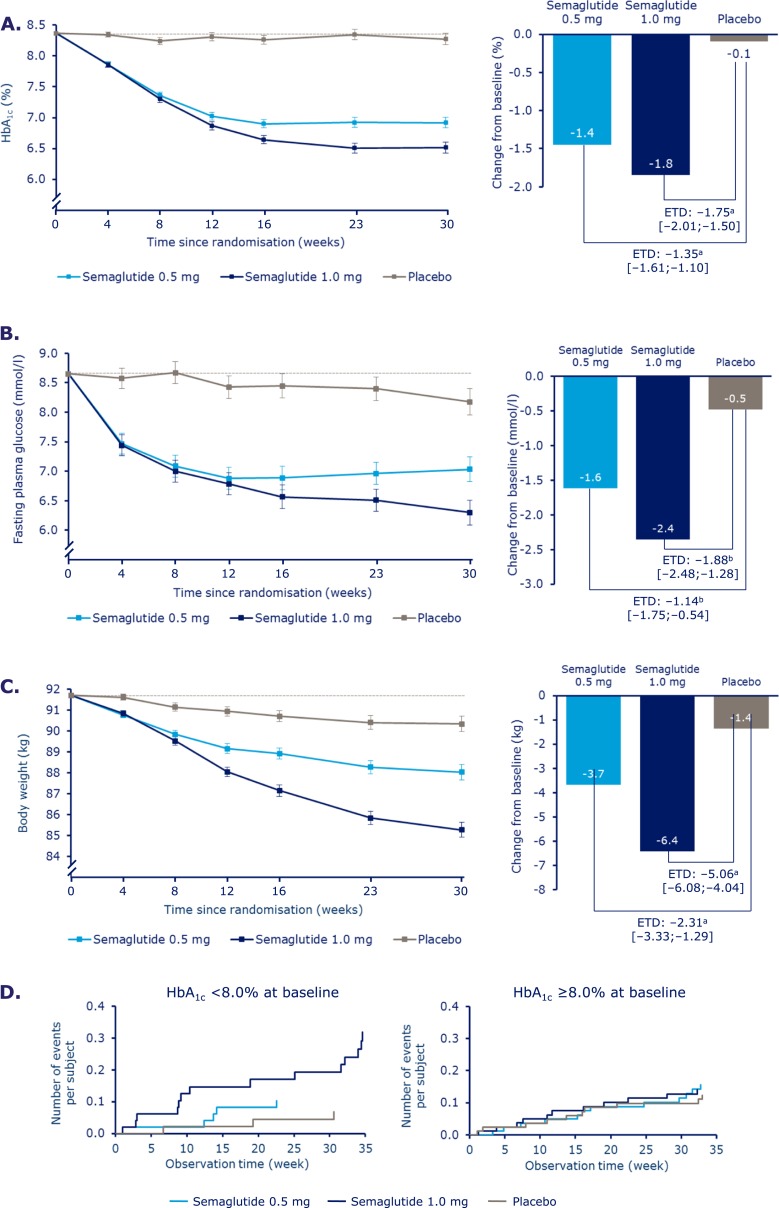
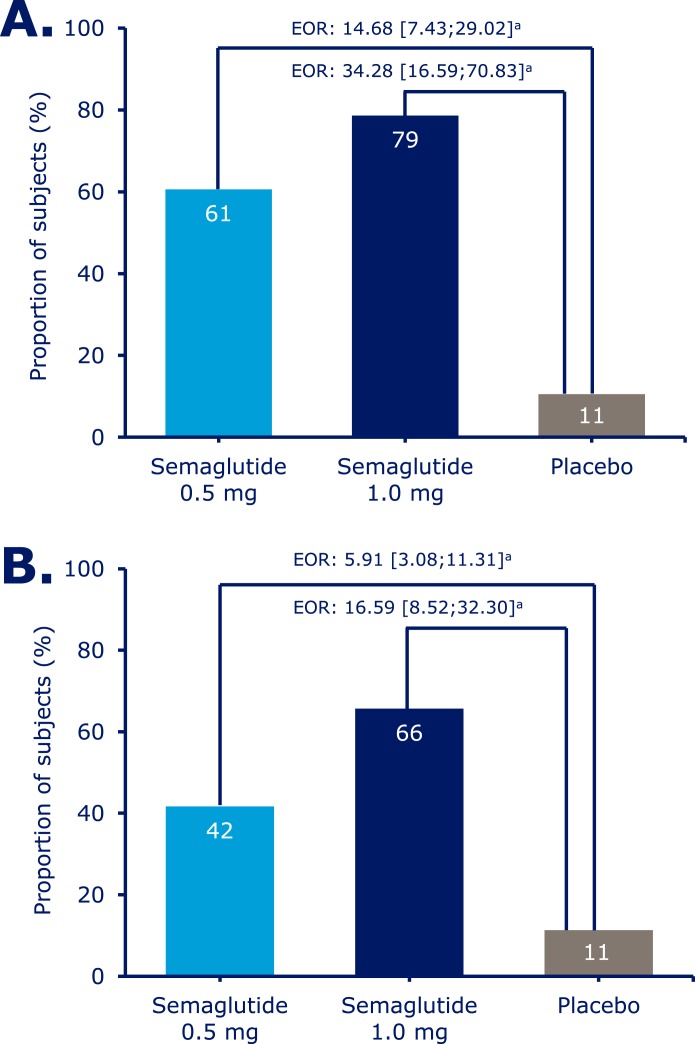
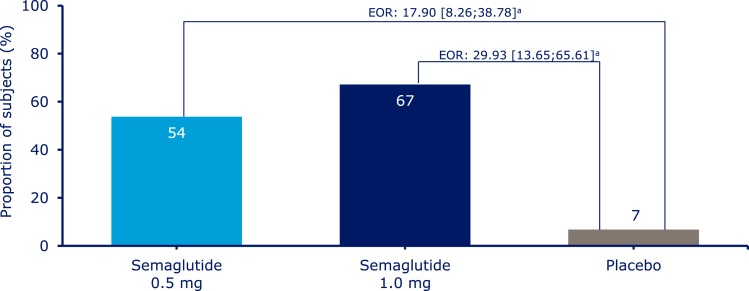
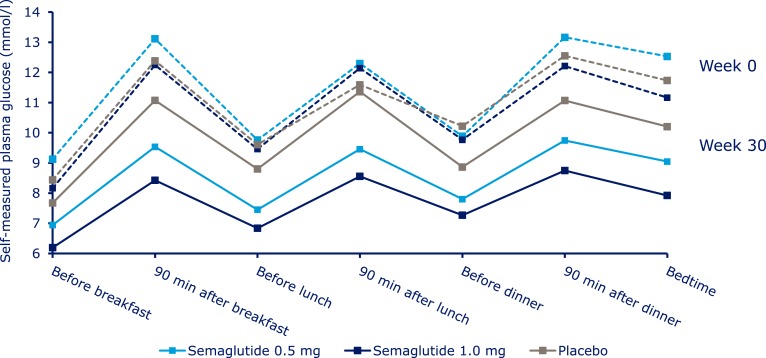
Verification
Claims the paper makes
The claims and statistics of this paper haven’t been checked yet.
Free: it reads the open-access text and checks the first 5 claims that cite a source we can check. Create a free account to check every claim.
Claims other papers make about this one
Each is checked against this paper’s own text: does it say what the citing paper says it does?
The source backs part of the claim, not all of it — or backs it for a different population, condition or comparison.
In the citing paper
“hsCRP data collected in SUSTAIN 2, 4, and 5 trials [22–24] were not used due to technical issues during sample collection — the hsCRP analysis assay was found to have a negative bias (an under-recovery of up to –25% at hsCRP concentrations below 5 mg/L), which affected a proportion of the samples.”
From Impact of semaglutide on high-sensitivity C-reactive protein: exploratory patient-level analyses of SUSTAIN and PIONEER randomized clinical trials (2022) · cites this paper as [24]
Experimental — accuracy not yet measuredThe source backs part of the claim, not all of it — or backs it for a different population, condition or comparison.
In the citing paper
“When compared with placebo, subcutaneous semaglutide for 30 weeks induced nausea in 11.4 to 20% of the semaglutide-treated patients (placebo 3.3–8%), vomiting in 4 to 11.5% (placebo 2–3%) and diarrhea in 4.5 to 11.3% (placebo 1.5–6%) (10, 27, 31).”
From Safety of Semaglutide (2021) · cites this paper as [27]
Experimental — accuracy not yet measuredThe source backs part of the claim, not all of it — or backs it for a different population, condition or comparison.
In the citing paper
“None of these were medullary carcinoma.”
From Safety of Semaglutide (2021) · cites this paper as [27]
Experimental — accuracy not yet measuredThe source backs part of the claim, not all of it — or backs it for a different population, condition or comparison.
In the citing paper
“The events mainly included cholelithiasis.”
From Safety of Semaglutide (2021) · cites this paper as [27]
Experimental — accuracy not yet measured
5 more claims about this paper
Create a free account to see every claim other papers make about this one.
Self-check
Percentages, sums and reported differences re-computed from the paper’s own numbers.
The self-check needs the paper’s full text.
Citations
Cites
Cook, R. J., Dickens, B. M., & Fathalla, M. F. (2003) · Reproductive Health and Human Rights · doi:10.1093/acprof:oso/9780199241323.003.0025 · Cited by 10,769
Stratton, I. M. (2000) · BMJ · doi:10.1136/bmj.321.7258.405 · Cited by 9,059
Standards of Medical Care in Diabetes
Power, D. (2006) · Diabetes Care · doi:10.2337/diacare.29.02.06.dc05-1593 · Cited by 8,673
Turner, R. C., Fox, C., Matthews, McElroy, H. H., Cull, C. A., Holman, R. R., Neil, P., Hadden, D. R., Wright, D., Manley, E., et al. (1998) · The Lancet · Cited by 8,419
10-year follow-up of intensive glucose control in type 2 diabetes
Holman, R. R., Paul, S. K., Bethel, M. A., Matthews, D. R., & Neil, H. A. W. (2008) · New England Journal of Medicine · doi:10.1056/nejmoa0806470 · Cited by 7,751
Semaglutide and Cardiovascular Outcomes in Patients with Type 2 Diabetes
Marso, S. P., Bain, S. C., Consoli, A., Eliaschewitz, F. G., Jódar, E., Leiter, L. A., Lingvay, I., Rosenstock, J., Seufert, J., Warren, M. L., et al. (2016) · New England Journal of Medicine · doi:10.1056/nejmoa1607141 · Cited by 6,900
Self-citationStandards of medical care in diabetes—2014
American Diabetes Association (2014) · Diabetes Care · doi:10.2337/dc14-s014 · Cited by 4,572
Gupta, A., & Uribarri, J. (2016) · Hormone Research in Paediatrics · doi:10.1159/000444053 · Cited by 4,006
Research works printed but not linked: 1
- Marbury T, Flint A, Segel S, Lindegaard M, Lasseter K Pharmacokinetics and tolerability of a single dose of semaglutide, a once-weekly human GLP-1 analogue, in subjects with and without renal impairment. Diabetologia. 2014; 57: S358.
Cited by
Items 301–400 of 412
Sedrak, P., Verma, R., Verma, M., & Connelly, K. A. (2025) · Canadian Journal of Cardiology · doi:10.1016/j.cjca.2025.03.037 · Cited by 6
Transitioning to non-insulin therapy in a patient receiving high dose insulin
Mishriky, B. M., Cummings, D. M., Mendez, C. E., Patil, S. P., & Powell, J. R. (2020) · Journal of the American Association of Nurse Practitioners · doi:10.1097/jxx.0000000000000403 · Cited by 2
“D in Weight (kg) D in Insulin Dose (Units) Adding lira to highdose insulin (Vanderheiden et al., 2016) Lira + U-500 insulin (35) Plac + U500 insulin (36) If baseline A1c was #8.0%, insulin dose was decreased by 20% Lira: 52.8 (8.1) Plac: 55.5 (6.6) Lira: 40.7 (6.7) Plac: 41.6 (10.4) Lira: 9.0 (1.2) Plac: 8.9 (1.0) Lir…”
BackgroundInfluentialOral Semaglutide in the Management of Type 2 DM: Clinical Status and Comparative Analysis
Bandyopadhyay, I., Dave, S., Rai, A., Nampoothiri, M., Chamallamudi, M. R., & Kumar, N. (2021) · Current Drug Targets · doi:10.2174/1389450122666210901125420 · Cited by 2
Milenković, T., Mitreva, B. C., Mishevska, S. J., Bitoska-Mileva, I., & Ahmeti, I. (2023) · Diabetes Research and Clinical Practice · doi:10.1016/j.diabres.2023.111018 · Cited by 3
Rosenstock, J. (2021) · Diabetes Care · doi:10.2337/dci21-0004 · Cited by 3
Kang, D., & Choi, D. (2026) · The Korean Journal of Internal Medicine · doi:10.3904/kjim.2025.277 · Cited by 1
“The injectable formulation is administered subcutaneously once weekly at doses of 0.25–2.0 mg for type 2 diabetes and up to 2.4 mg for obesity [18,19].”
InfluentialLandgraf, R., Aberle, J., Birkenfeld, A. L., Gallwitz, B., Kellerer, M., Klein, H., Müller‐Wieland, D., Nauck, M. A., Reuter, H., & Siegel, E. G. (2020) · Der Diabetologe · doi:10.1007/s11428-020-00608-9 · Cited by 2
Landgraf, R., Aberle, J., Birkenfeld, A. L., Gallwitz, B., Kellerer, M., Klein, H. H., Müller‐Wieland, D., Nauck, M. A., Wiesner, T., & Siegel, E. G. (2023) · Die Diabetologie · doi:10.1007/s11428-023-01047-y · Cited by 2
Person Centered Approach and Challenges in the Management of Obesity
Garcha, S. C., & Kalra, S. (2025) · Springer eBooks · doi:10.1007/978-981-96-1651-0_7 · Cited by 4
Sind GLP-1-Rezeptor-Agonisten und SGLT2-Inhibitoren auch im höheren Lebensalter geeignet?
Stüdemann, S., & Engeli, S. (2025) · Diabetologie und Stoffwechsel · doi:10.1055/a-2582-5787 · Cited by 1
Shaheer, A., Jallo, M. K. I., & Akhtar, S. (2025) · Biomedical & Pharmacology Journal · doi:10.13005/bpj/3192 · Cited by 1
Luo, Y., Ding, B., Xia, W., Liu, B., Ge, S., Lü, Y., & Ma, J. (2025) · Journal of Endocrinological Investigation · doi:10.1007/s40618-025-02665-7 · Cited by 1
Iwata, Y., Yoshikawa, F., Saito, M., Fuchigami, A., Sato, G. E., Saiki, A., Ichijyo, T., Sato, N., Ohashi, T., Hirose, T., et al. (2025) · Diabetes Therapy · doi:10.1007/s13300-025-01790-z · Cited by 2
Chang, L., Hassan, S., Chasse, J., Stern, G. M., Gabovitch, D., Zelle, D., Colling, C., Crossen, J., Aronson, S., Oates, M., et al. (2026) · American Heart Journal · doi:10.1016/j.ahj.2026.107359 · Cited by 1
Semaglutide Hype or Hope: Evidence-based Review in Diabesity
Gupta, S., Makkar, B. M., Kesavadev, J., & Kumar, A. M. V. (2026) · Journal of the Association of Physicians of India · doi:10.59556/japi.74.1439 · Cited by 1
Wang, S., Hu, P., Shen, Z., & Chen, L. (2026) · Diabetes Therapy · doi:10.1007/s13300-026-01848-6 · Cited by 2
Sato, G. E., Uchino, H., Takuma, K., Saito, M., Fuchigami, A., Iwata, Y., Yoshikawa, F., & Hirose, T. (2026) · Diabetes Therapy · doi:10.1007/s13300-026-01864-6 · Cited by 1
Min, E., Goyette, A., Young, E., Moon, K., Bellini, N. J., & Isaacs, D. M. (2026) · Canadian Journal of Physiology and Pharmacology · doi:10.1139/cjpp-2025-0142 · Cited by 1
Builes-Montaño, C. E., Suarez-Rodriguez, A. F., & Alzate-Vinasco, M. A. (2026) · Diabetes Therapy · doi:10.1007/s13300-026-01886-0 · Cited by 3
Xiao-yu, Z., Deng, C.-H., Zhong, J.-Y., Wu, Q., Chen, Q.-X., Gao, X.-Y., Xu, Y., Jiang, Z., Guo, M., & Teng, F. (2026) · Nutrition Metabolism and Cardiovascular Diseases · doi:10.1016/j.numecd.2026.104859 · Cited by 1
Ji, L., Andersen, J. S., Benamar, M., Ponzani, P., Unnikrishnan, A. G., VINTHER, S. M., & Rea, R. R. (2026) · Diabetes Obesity and Metabolism · doi:10.1111/dom.70895 · Cited by 2
Ortiz-Seller, A., Real, J. T., Morcillo, E. J., & Ortiz, J. L. (2026) · Survey of Ophthalmology · doi:10.1016/j.survophthal.2026.08.007 · Cited by 1
Zhong, Y., Tan, X., Zhang, L., & Wu, C. (2026) · Frontiers in Pharmacology · doi:10.3389/fphar.2026.1916932 · Cited by 1
“A fixed-effects meta-analysis of seven studies (Davies et al., 2025; Lingvay et al., 2025; Marso et al., 2016; Mu et al., 2024; Rodbard et al., 2018; Sorli et al., 2017; Warren et al., 2018) demonstrated a statistically significant increase in the risk of benign neoplasms among semaglutide users…”
InfluentialAbordaje práctico de la semaglutida en el paciente con diabetes tipo 2
Escobar, C., Castro, A., Cerezo, J. F. G., Górriz, J. L., Obaya, J. C., & Villar‐Taibo, R. (2022) · Revista Española de Cardiología Suplementos · doi:10.1016/s1131-3587(22)00013-9 · Cited by 7
Efficacy of semaglutide: an evidence-based review
Mkrtumyan, A. M., & Egshatyan, L. V. (2022) · Meditsinskiy sovet = Medical Council · doi:10.21518/ms2022-010 · Cited by 2
Pathophysiology-Oriented Treatment of Type 2 Diabetes: 10 Case Reports
Nováková, N., Nezval, M., & Molnárová, V. (2023) · IntechOpen eBooks · doi:10.5772/intechopen.1002857 · Cited by 1
Matovinović, M., Belančić, A., Jug, J., Mustač, F., Sirovica, M., Santini, M., Bošnjaković, A., Lovrić, M., & Benčić, M. L. (2024) · Diabetology · doi:10.3390/diabetology5010003 · Cited by 2
“Across all BMI subgroups, the individual SUSTAIN 1 to 5 trials [22–26] demonstrated that semaglutide resulted in significantly higher percentages of subjects achieving weight loss of ≥ 5% and ≥ 10% compared to the comparator groups, with a more pronounced effect observed with the 1.0 mg dose of…”
InfluentialLandgraf, R., Aberle, J., Birkenfeld, A. L., Gallwitz, B., Kellerer, M., Klein, H. H., Müller‐Wieland, D., Nauck, M. A., Wiesner, T., & Siegel, E. G. (2024) · Die Diabetologie · doi:10.1007/s11428-023-01144-y · Cited by 1
“[142] Rodbard HW, Lingvay I, Reed J et al.”
Serpa-Díaz, D., Llanos-Florez, C. A., Uribe, R. A. S., Molina, D. I., Giraldo, G. C., Urina‐Triana, M., Suarez-Rodriguez, A. F., & Alzate-Vinasco, M. A. (2024) · Diabetes Therapy · doi:10.1007/s13300-024-01586-7 · Cited by 2
“Compared to the glucose control outcomes reported in the SUSTAIN [18–24] clinical trial program, where a change in HbA1c ranged from − 1.1 to − 1.8%, results from COLIBRI are near the lower end.”
InfluentialZhang, K., Zhao, A., Wang, Z., Ye, K., Xu, Z., Gong, X., & Zhu, G. (2024) · Clinical Pharmacokinetics · doi:10.1007/s40262-024-01449-1 · Cited by 1
Evaluating semaglutide + LAI-287 (IcoSema) for the treatment of diabetes mellitus type II
Siamashvili, M., & Davis, S. N. (2024) · Expert Opinion on Pharmacotherapy · doi:10.1080/14656566.2024.2436593 · Cited by 1
Swift, C., Frazer, M., Sargent, A., Leszko, M., Buysman, E. K., Gronroos, N. N., Alvarez, S., Dunn, T. J., & Noone, J. M. (2025) · Clinical Therapeutics · doi:10.1016/j.clinthera.2024.12.014 · Cited by 2
Cohen, C. M., Mosenzon, O., Aharonovich, A., Karasik, A., & Schechter, M. (2025) · Diabetes Research and Clinical Practice · doi:10.1016/j.diabres.2025.112086 · Cited by 4
Weng, J., Xiao, D., & Chen, Y. (2025) · Diabetology & Metabolic Syndrome · doi:10.1186/s13098-025-01722-8 · Cited by 1
“[7, 28] The annual treatment costs for semaglutide added to basal insulin was CNY 22,555.75.”
InfluentialAchievement of time in range goals among patients with diabetes using continuous glucose monitoring
Azizi, F., Diehl, K., Enser, L., & Heacock, S. (2025) · Journal of the American Pharmacists Association · doi:10.1016/j.japh.2025.102924 · Cited by 1
Saudi Consensus for GLP-1 RAs Switching Guidance: Consensus Report
Alsifri, S. N., Elbadawi, H., Alsabaan, F., Almahfouz, A., Alyahya, K. A., Shesha, E., Esba, L. C. A., Alnais, M., Aldahash, R., Alharbi, T., et al. (2022) · International Journal of Clinical Medicine · doi:10.4236/ijcm.2022.131002 · Cited by 2
Diabetic Pharmacotherapies in Kidney Disease
Chon, D. A., Oxman, R. T., MULLUR, R. S., & Weinreb, J. E. (2019) · Springer eBooks · doi:10.1007/978-3-319-97765-2_5
SUSTAIN program: klinikai eredmények
Balogh, Z. (2019) · Diabetologia Hungarica · doi:10.24121/dh.2019.s2.2
“A vizsgálat idő előtti abbahagyása gyakoribb volt a szemaglutid esetén (sorrendben: 4,5%, 6,1%, illetve placebo esetén 0,8%), döntően emésztőrendszeri mellékhatások, émelygés, hányinger, hányás, hasmenés miatt.(9)”
Incretin‐Based Therapy for the Management of Type 2 Diabetes
Gonzales, K., & Vella, A. V. (2021) · Wiley eBooks · doi:10.1002/9781119603207.ch12
Ризвановна, А. М., & Zhernakova, J. (2021) · Systemic Hypertension · doi:10.26442/2075082x.2021.4.201305 · Cited by 1
Landgraf, R., Aberle, J., Birkenfeld, A. L., Gallwitz, B., Kellerer, M., Klein, H. H., Müller‐Wieland, D., Nauck, M. A., Reuter, H., & Siegel, E. G. (2021) · Der Diabetologe · doi:10.1007/s11428-021-00765-5
Proceedings of the IV International Conference on Obesity and Chronic Diseases (ICOCD-2019)
(2019) · Journal of Obesity and Chronic Diseases · doi:10.17756/jocd.2019-suppl1
New drug: Semaglutide for type 2 diabetes
(2020) · Australian Prescriber · doi:10.18773/austprescr.2020.046 · Cited by 1
Singh, G., Krauthamer, M., & Bjalme-Evans, M. (2021) · International Journal of Diabetes and Endocrinology · doi:10.11648/j.ijde.20210604.17
Whitley, H. P., & Smith, W. D. (2023) · Journal of Case Reports and Images in Medicine · doi:10.5348/100073z09hw2022cs · Cited by 1
Zhang, X.-H., Wu, A.-X., Yang, Z., Sun, K.-W., Yang, T., Wang, N.-S., & Zhang, J. (2023) · Research Square · doi:10.21203/rs.3.rs-3256039/v1 · Cited by 1
Inkretin-Agonisten: In 30 Jahren vom Geheimtipp zum Bestseller
Nauck, M. A. (2023) · Deutsches Ärzteblatt · doi:10.3238/persdia.2023.11.03.01
GLP-1 RECEPTORIŲ AGONISTŲ REIKŠMĖ 2 TIPO CUKRINIU DIABETU SERGANČIŲ PACIENČIŲ SVORIO MAŽINIMUI
Viliušytė, M., Maleckas, A., & Malinauskas, M. (2024) · Health Sciences · doi:10.35988/sm-hs.2024.021
Investigating incretins: a review of the use of GLP-1 and GIP receptor agonists for weight loss
Miller, A. (2024) · Journal of Aesthetic Nursing · doi:10.12968/joan.2024.13.1.6
Review of Efficacy and Safety of Semaglutide in the Management of Obesity
Han, S., & Park, T. E. (2024) · Korean Journal of Clinical Pharmacy · doi:10.24304/kjcp.2024.34.1.1
Semaglutide in the Treatment of Diabetes and Associated Obesity
Makuch, R., Chrościcka, A., Gała, K., Czajka, A., Lenard, P., Kucharski, A., Michalska, S., Pilarski, K., Dewicka, M., & Wawrzyniak, A. M. (2024) · Journal of Education Health and Sport · doi:10.12775/jehs.2024.73.51699
“Pancreatic cancer in the same study occurred in 1 patient receiving the drug and in 4 receiving placebo [14].”
BackgroundO emergente uso do Ozempic® no tratamento da obesidade
de Maria, E. D. O., Pereira, L. S. S., Felacio, M. D. S., & Shillo, R. S. I. (2024) · Research Society and Development · doi:10.33448/rsd-v13i6.46063 · Cited by 6
Diabetes tipo 2: contexto fisiopatológico e atualização terapêutica com o uso da semaglutida
de Paula, W. G., Pacheco, R. B., Neves, C. O. N., & Ligório, G. T. (2024) · Revista Eletrônica Acervo Médico · doi:10.25248/reamed.e16285.2024 · Cited by 1
Meyhöfer, S. M., Blüher, M., & Aberle, J. (2024) · Springer eBooks · doi:10.1007/978-3-662-58895-6_42
Garzaie, A. A. A., Taib, H., Dalbhi, S. A., Khan, M. S., & Kofi, M. A. (2024) · European Journal of Medical and Health Research · doi:10.59324/ejmhr.2024.2(5).07
Semaglutide: de la moda a la evidencia científica. A propósito de una Revisión Narrativa
Bueno, E., Jara-Ruiz, E., Jara, J., Arce, M., Ramírez, A. I., & Canata, G. (2024) · Anales de la Facultad de Ciencias Médicas (Asunción) · doi:10.18004/anales/2024.057.03.102 · Cited by 2
Browning, T. E., Coy, A., Sehgal, V., Singh, S., Jakhar, N. S., Sehgal, P., & Kukreja, M. (2025) · doi:10.25259/peak_19_2024 · Cited by 1
Sind GLP-1-Rezeptor-Agonisten und SGLT2-Inhibitoren auch im höheren Lebensalter geeignet?
Stüdemann, S., & Engeli, S. (2025) · Adipositas - Ursachen Folgeerkrankungen Therapie · doi:10.1055/a-2492-9440
McGuigan, A. (2025) · Drugs & Therapy Perspectives · doi:10.1007/s40267-025-01154-4
“Approval of subcutaneous semaglutide 2.0 mg for the treatment of T2D was based on the success of the SUSTAIN clinical development programme where it safely improved glycaemic control and induced significant weight loss in patients with T2D [6–12].”
InfluentialSind GLP-1-Rezeptor-Agonisten und SGLT2-Inhibitoren auch im höheren Lebensalter geeignet?
Stüdemann, S., & Engeli, S. (2025) · Diabetes aktuell · doi:10.1055/a-2588-6338
Carson, E., Khaleq, F., McDonald, C., Smith, N., & Colon, A. R. (2025) · Cureus · doi:10.7759/cureus.88898 · Cited by 1
Kempf, K., Röhling, M., & Martin, S. (2025) · Frontiers in Endocrinology · doi:10.3389/fendo.2025.1644442 · Cited by 1
Xu, Y., Ji, G., Shi, C., Tan, Y., Wang, L., & Gui, Y. (2025) · Diabetes Research and Clinical Practice · doi:10.1016/j.diabres.2025.112954
Pavlova, M. G. (2025) · Meditsinskiy sovet = Medical Council · doi:10.21518/ms2025-475
Eisa, N., & Barood, O. (2025) · Endocrine Practice · doi:10.1016/j.eprac.2025.11.018 · Cited by 3
Husain, M., Bain, S. C., Holst, A. G., Mark, T., Rasmussen, S., & Lingvay, I. (2020) · Figshare · doi:10.6084/m9.figshare.13031555
Self-citationHusain, M., Bain, S. C., Holst, A. G., Mark, T., Rasmussen, S., & Lingvay, I. (2020) · Figshare · doi:10.6084/m9.figshare.13031567
Self-citationHusain, M., Bain, S. C., Holst, A. G., Mark, T., Rasmussen, S., & Lingvay, I. (2020) · Figshare · doi:10.6084/m9.figshare.13031546
Self-citationHusain, M., Bain, S. C., Holst, A. G., Mark, T., Rasmussen, S., & Lingvay, I. (2020) · Figshare · doi:10.6084/m9.figshare.13031564
Self-citationHusain, M., Bain, S. C., Holst, A. G., Mark, T., Rasmussen, S., & Lingvay, I. (2020) · Figshare · doi:10.6084/m9.figshare.13031558
Self-citationHusain, M., Bain, S. C., Holst, A. G., Mark, T., Rasmussen, S., & Lingvay, I. (2020) · Figshare · doi:10.6084/m9.figshare.13031549
Self-citationSiebert, M., Gaba, J. F., Renault, A., Laviolle, B., Locher, C., Moher, D., & Naudet, F. (2022) · Figshare · doi:10.6084/m9.figshare.19802441
Siebert, M., Gaba, J. F., Renault, A., Laviolle, B., Locher, C., Moher, D., & Naudet, F. (2022) · Figshare · doi:10.6084/m9.figshare.19802426
Siebert, M., Gaba, J. F., Renault, A., Laviolle, B., Locher, C., Moher, D., & Naudet, F. (2022) · Figshare · doi:10.6084/m9.figshare.19802432
Husain, M., Bain, S. C., Holst, A. G., Mark, T., Rasmussen, S., & Lingvay, I. (2020) · Figshare · doi:10.6084/m9.figshare.13031561
Self-citationHusain, M., Bain, S. C., Holst, A. G., Mark, T., Rasmussen, S., & Lingvay, I. (2020) · Figshare · doi:10.6084/m9.figshare.13031552
Self-citationChu, L., Cai, X., Yang, W., Lv, F., Nie, L., & Ji, L. (2020) · Figshare · doi:10.6084/m9.figshare.13240350
Siebert, M., Gaba, J. F., Renault, A., Laviolle, B., Locher, C., Moher, D., & Naudet, F. (2022) · Figshare · doi:10.6084/m9.figshare.19802429
Husain, M., Bain, S. C., Holst, A. G., Mark, T., Rasmussen, S., & Lingvay, I. (2020) · Figshare · doi:10.6084/m9.figshare.13031570
Self-citationMosenzon, O., Capehorn, M. S., Remigis, A. D., Rasmussen, S., Weimers, P., & Rosenstock, J. (2022) · Figshare · doi:10.6084/m9.figshare.20882123
Siebert, M., Gaba, J. F., Renault, A., Laviolle, B., Locher, C., Moher, D., & Naudet, F. (2022) · Figshare · doi:10.6084/m9.figshare.19802438
Siebert, M., Gaba, J. F., Renault, A., Laviolle, B., Locher, C., Moher, D., & Naudet, F. (2022) · Figshare · doi:10.6084/m9.figshare.19802435
Assessing the Geriatric Risk: Excessive Weight Loss and Risk of Falls With GLP-1 Receptor Agonists
Ahmed, S. U., & Gadepalli, H. (2026) · Journal of the American Medical Directors Association · doi:10.1016/j.jamda.2026.106159
BAJAJ, H. S., Billings, L. K., Sharma, P., Levine, J. A., Rodriguez, A., & Patel, H. N. (2026) · Diabetes Therapy · doi:10.1007/s13300-026-01859-3 · Cited by 1
Kapoor, N., Shaikh, S. S., Bhattacharya, S., Kalra, S., Das, S., KOTA, S., Khandelwal, V., Naskar, A., Dange, A., Sorate, S., et al. (2026) · Cardiovascular Diabetology – Endocrinology Reports · doi:10.1186/s40842-026-00290-8 · Cited by 1
Weiss, A., & Ding, Y. (2026) · Brain Circulation · doi:10.4103/bc.bc_210_25
Ortiz‐Prado, E., Vasconez-Gonzalez, J., Izquierdo‐Condoy, J. S., & López-Jaramillo, P. A. (2026) · doi:10.2196/preprints.99738
Sümbül, H. E., Işık, B., Mustan, A. G., Alişan, İ., Erhan, Ç., Koca, F. I., Uçar, A., Erdevir, M., Avcı, B. Ş., Sumbul, M. S., et al. (2026) · Journal of Clinical Medicine · doi:10.3390/jcm15114105
Badgandi, M., Srinath, A., Mandora, V., Kandar, D. K., Shukla, P., PUNATAR, D. H., Jain, V., Kumar, S., Girish, P., Budhwar, A., et al. (2026) · International Journal of Diabetes and Technology · doi:10.4103/ijdt.ijdt_20_26
Semaglutide for Organ Protection
Kharb, S., Bhattacharjee, B., Karuppan, A., V, Khaire, S. S., Routray, P., Ganta, S., Pakhale, K., Pareek, R., Matta, R., Sabharwal, M., et al. (2026) · International Journal of Diabetes and Technology · doi:10.4103/ijdt.ijdt_27_26
Xiao-yu, Z., Wu, Q., Lu, H.-L., Xie, J.-J., Zhang, Y., Xu, Y., Guo, M., & Teng, F. (2026) · Diabetology & Metabolic Syndrome · doi:10.1186/s13098-026-02163-7 · Cited by 2
The systems medicine view of semaglutide: from clinical trials to molecular mechanisms
Vitorino, R. M. P. (2026) · Expert Review of Clinical Pharmacology · doi:10.1080/17512433.2026.2695172
“Semaglutide has shown efficacy as an adjunct to basal insulin (NCT02305381) and as an oral alternative to injectable agents (NCT02863419) [23,24].”
Sawamura, T., Maeno, M., Nishimoto, Y., Ohmori, A., Kometani, M., Karashima, S., & Yoneda, T. (2026) · Endocrine Practice · doi:10.1016/j.eprac.2026.06.008
Strojek, K., Liebl, A., Mumbaikar, N. N., Søgaard, S. B., Watt, S. K., & Philis‐Tsimikas, A. (2026) · Diabetes Obesity and Metabolism · doi:10.1111/dom.71049
“…intensifying basal insulin therapy with once-weekly semaglutide is effective, with a greater improvement in glycated haemoglobin (HbA1c), better weight management and similar or lower levels of hypoglycaemia with semaglutide added to basal insulin, compared with placebo or basal-bolus therapy [3].”
InfluentialChen, X. T., Tu, B. B., Li, Z., Gao, P., Xu, Y., & Yao, Y. (2026) · Frontiers in Bioscience-Landmark · doi:10.31083/fbl49873
Lipska, K. J., Zawack, K., Yan, L., Mutalik, P., Li, J., Gulanski, B., Ioannou, G. N., & Aslan, M. (2026) · Annals of Internal Medicine · doi:10.7326/annals-25-05216
As, A., Балыкова, Л. А., Zaslavskaya, K. Y., Shohin, I. E., Геннадьевна, Б. Т., Zorina, L. A., Shcherbakova, V. S., Куркин, Д. В., Koryanova, K. N., Mishchenko, E. S., et al. (2026) · Pharmacy & Pharmacology · doi:10.19163/2307-9266-2026-14-4-387-409
Rodbard, H. W., Irace, C., Lobo, J., Makrilakis, K., Priyadarshini, P., Sivalingam, S., Tofé, S., & Bhargava, A. (2026) · Diabetes Obesity and Metabolism · doi:10.1111/dom.71132
“SUSTAIN 5 investigated semaglutide as add-on to basal insulin, where HbA 1c reductions were − 1.4% and − 1.8% for 0.5 and 1.0 mg semaglutide, and BW reductions were − 3.7 and − 6.4 kg for 0.5 and 1.0 mg semaglutide, respectively [12].”
InfluentialSelf-citationDizdarević-Bostandžić, A., Hadzigrahic, E., & Nišić, A. (2026) · BMJ Nutrition Prevention & Health · doi:10.1136/bmjnph-2026-001616
Metadata
- Authors
- Rodbard, H. W., Lingvay, I., Reed, J., de la Rosa, R., Rose, L., Sugimoto, D., Araki, E., Chu, P.-L., Wijayasinghe, N., & Norwood, P.
- Affiliations
- Endocrine and Metabolic Consultants, Rockville, Maryland
- The University of Texas Southwestern Medical Center (US)
- Endocrine Research Solutions (United States) (US)
- Four Rivers Clinical Research, Paducah, Kentucky
- Institute of Diabetes Research, Münster, Germany
- Cedar-Crosse Research Center, Chicago, Illinois
- Kumamoto University (JP)
- Novo Nordisk Inc., Plainsboro, New Jersey
- Novo Nordisk (Denmark) (DK)
- University of California, San Francisco (US)
- Corresponding author
- Rodbard, Helena W
- Venue
- The Journal of Clinical Endocrinology & Metabolism
- Publisher
- The Endocrine Society
- Published
- 2018-04-23
- Volume
- 103
- Issue
- 6
- Pages
- 2291-2301
- ISSN
- 0021-972X (ISSN-L)
- 1945-7197
- PMC
- PMC5991220
- OpenAlex
- W2801715295
- Semantic Scholar
- 27a6e1a3a80fc91de65f29515784aa546a8f31cf
- Cited by
- 412
- References
- 43
- Citations by year
- 2026: 50 · 2025: 63 · 2024: 69 · 2023: 44 · 2022: 57 · 2021: 40 · 2020: 46 · 2019: 31 · 2018: 10
- FWCI
- 25.27
- Type
- journal article
- Language
- en
- Open access
- hybrid
- doi.org
- Licence
- Locations
- The Journal of Clinical Endocrinology & Metabolism (publishedVersion, cc-by)
- Europe PMC (PubMed Central) (publishedVersion, cc-by)
- PubMed Central (publishedVersion, cc-by)
- PubMed (publishedVersion)
- Funders
- Novo Nordisk
- Japan Society for the Promotion of Science (17H04201, 18K08482)
- Topics
- Health Sciences › Medicine › Endocrinology, Diabetes and Metabolism › Diabetes Treatment and Management
- Health Sciences › Medicine › Endocrinology, Diabetes and Metabolism › Diabetes Management and Research
- Health Sciences › Medicine › Pharmacology (medical) › Pharmacology and Obesity Treatment
- Keywords
- semaglutide, basal insulin, type 2 diabetes, GLP-1 receptor agonists, adjunctive therapy, glycemic control, HbA1c, body weight, hypoglycemia, drug safety, metformin, weight loss, insulin dose reduction, HbA1c reduction, adverse events, drug discontinuation
- MeSH terms
- Semaglutide, Adult, Aged, Aged, 80 and over, Blood Glucose, Diabetes Mellitus, Type 2, Double-Blind Method, Drug Therapy, Combination, Glucagon-Like Peptides, Female, Glycated Hemoglobin, Humans, Hypoglycemic Agents, Insulin, Male, Middle Aged, Treatment Outcome, Young Adult
About these checks
Registry, retraction, Cites and statistics results are computed, not judged, with one exception: a printed reference that no index lists is read once by a model before it counts as a citation error. Claims are extracted by a model and kept only when their quote appears verbatim in the text; each cited source is then checked, with a model’s help, for whether it says what the claim relies on. Those verdicts can be wrong — read the claim’s quote and the cited source before relying on one.
Statistics and arithmetic are recomputed, not judged.
Confidence bands are shown only for fields calibrated on our annotated test set. None is calibrated yet, so no band is shown.
What counts as a claim ›How we measure confidence ›How we check this ›
Are you an author, or do you see a problem with this page? Request a review
Data sources
Bibliographic data: Semantic Scholar, OpenAlex, Crossref.
Contains information from the Semantic Scholar Academic Graph Datasets, made available under the ODC Attribution License (ODC-BY 1.0).
Semantic Scholar’s data is described in: Kinney, R., et al. (2023). The Semantic Scholar Open Data Platform. arXiv:2301.10140.
