

Cumulative Genetic Risk and APOE ε4 Are Independently Associated With Dementia Status in a Multiethnic, Population-Based Cohort
Open accessThe DOI matches its Crossref record; 54 of the 54 references it cites were found in a registry or an index.
Abstract
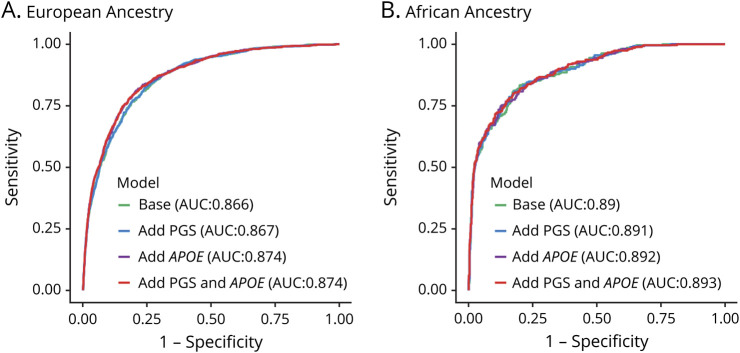
Objective Alzheimer disease (AD) is a common and costly neurodegenerative disorder. A large proportion of AD risk is heritable, and many genetic risk factors have been identified. The objective of this study was to test the hypothesis that cumulative genetic risk of known AD markers contributed to odds of dementia in a population-based sample. Methods In the US population-based Health and Retirement Study (waves 1995–2014), we evaluated the role of cumulative genetic risk of AD, with and without the APOE ε4 alleles, on dementia status (dementia, cognitive impairment without dementia, borderline cognitive impairment without dementia, and cognitively normal). We used logistic regression, accounting for demographic covariates and genetic principal components, and analyses were stratified by European and African genetic ancestry. Results In the European ancestry sample (n = 8,399), both AD polygenic score excluding the APOE genetic region (odds ratio [OR] = 1.10; 95% confidence interval [CI]: 1.00–1.20) and the presence of any APOE ε4 alleles (OR = 2.42; 95% CI: 1.99–2.95) were associated with the odds of dementia relative to normal cognition in a mutually adjusted model. In the African ancestry sample (n = 1,605), the presence of any APOE ε4 alleles was associated with 1.77 (95% CI: 1.20–2.61) times higher odds of dementia, whereas the AD polygenic score excluding the APOE genetic region was not significantly associated with the odds of dementia relative to normal cognition 1.06 (95% CI: 0.97–1.30). Conclusions Cumulative genetic risk of AD and APOE ε4 are both independent predictors of dementia in European ancestry. This study provides important insight into the polygenic nature of dementia and demonstrates the utility of polygenic scores in dementia research.
Overview
The claims and statistics of this paper haven’t been checked yet.
Free: it reads the open-access text and checks the first 5 claims that cite a source we can check. Create a free account to check every claim.
Integrity signals
Registry
Cites
Statistics
Figures
Verification
Claims the paper makes
The claims and statistics of this paper haven’t been checked yet.
Free: it reads the open-access text and checks the first 5 claims that cite a source we can check. Create a free account to check every claim.
Claims other papers make about this one
Each is checked against this paper’s own text: does it say what the citing paper says it does?
The source backs part of the claim, not all of it — or backs it for a different population, condition or comparison.
In the citing paper
“For example, some have found that having the e4 allele did not increase risk among Blacks, [80][81][82] while other studies have found that it significantly increased risk.[83][84][85][86]”
From 2023 Alzheimer's disease facts and figures (2023) · cites this paper as [86]
Experimental — accuracy not yet measuredIn the citing paper
“Indeed, multiple studies have demonstrated that individuals with high PRSs for AD, particularly when combined with APOE ε4, have up to a 5‐fold higher risk of AD than those with lower scores.”
From Shared genes and pathways in dementia: Insights from genome‐wide association studies (2025) · cites this paper as [127]
Self-check
Percentages, sums and reported differences re-computed from the paper’s own numbers.
The self-check needs the paper’s full text.
Citations
Cites
A global reference for human genetic variation
The 1000 Genomes Project Consortium, authors, C., Auton, A., Abecasis, G. R., Steering committee, Altshuler, D. M., Durbin, R. M., Abecasis, G. R., Bentley, D. R., Chakravarti, A., et al. (2015) · Nature · doi:10.1038/nature15393 · Cited by 18,247 · cited 1×
“«2, «2/«3, «2/«4, «3/«3, «3/«4, and «4/«4) was assigned using 1000 Genomes Project imputation.(13) Primary analyses indicated the binary presence of the «4 allele.”
Alzheimer Disease Genetics Consortium (ADGC), Kunkle, B. W., The European Alzheimer’s Disease Initiative (EADI), Cohorts for Heart and Aging Research in Genomic Epidemiology Consortium (CHARGE), Genetic and Environmental Risk in AD/Defining Genetic, P. A. E. R. F. A. D. C. (., Grenier-Boley, B., Sims, R., Bis, J. C., Damotte, V., Naj, A. C., et al. (2019) · Nature Genetics · doi:10.1038/s41588-019-0358-2 · Cited by 2,946 · cited 3×
“(IGAP, 2019).(6) b APOE status was genotyped using 2 single nucleotide polymorphisms (rs7412 and rs429358) resulting in 3 alleles of APOE.”
BackgroundMethodInfluentialClinical use of current polygenic risk scores may exacerbate health disparities
Martin, A. R., Kanai, M., Kamatani, Y., Okada, Y., Neale, B. M., & Daly, M. J. (2019) · Nature Genetics · doi:10.1038/s41588-019-0379-x · Cited by 2,821 · cited 1×
“In addition, current AD PGSs are not created with diverse populations as the reference weights, which may provide inaccurate risk for individuals of diverse ancestries,(47) and clinical use in their present form may exacerbate health disparities.(48)”
Background2019 Alzheimer’s disease facts and figures.
Alzheimer's Association (2019) · Alzheimer's & Dementia · doi:10.1016/j.jalz.2019.01.010 · Cited by 2,461
Role of Genes and Environments for Explaining Alzheimer Disease
Gatz, M., Reynolds, C. A., Fratiglioni, L., Johansson, B., Mortimer, J. A., Berg, S., Fiske, A., & Pedersen, N. L. (2006) · Archives of General Psychiatry · doi:10.1001/archpsyc.63.2.168 · Cited by 1,798 · cited 1×
“Heritability estimates for dementia attribute 50–80% of risk to genetic factors.(2) The most common dementia genetic susceptibility locus is in the APOE gene, represented by multiple alleles («2, «3, and «4).”
BackgroundAn Overview of the Health and Retirement Study
Juster, F. T., & Suzman, R. (1995) · The Journal of Human Resources · doi:10.2307/146277 · Cited by 1,435 · cited 1×
“Health and Retirement Study The HRS is a US nationally representative, longitudinal panel cohort study of adults older than 50 years (n; 22,000, per wave).(8) The HRS was collected biennially beginning in 1992, through face-to-face interviews, mail-in surveys, and leave-behind questionnaires, with samples obtained for…”
BackgroundHuman Demographic History Impacts Genetic Risk Prediction across Diverse Populations
Martin, A. R., Gignoux, C. R., Walters, R. K., Wojcik, G. L., Neale, B. M., Gravel, S., Daly, M. J., Bustamante, C. D., & Kenny, E. E. (2017) · The American Journal of Human Genetics · doi:10.1016/j.ajhg.2017.03.004 · Cited by 1,391
Diabetes mellitus and risk of Alzheimer disease and decline in cognitive function
Arvanitakis, Z., Wilson, R. S., Bienias, J. L., Evans, D. A., & Bennett, D. A. (2004) · Archives of Neurology · doi:10.1001/archneur.61.5.661 · Cited by 1,258
Crimmins, E. M., Kim, J. K., Langa, K. M., & Weir, D. R. (2011) · The Journals of Gerontology Series B: Psychological Sciences and Social Sciences · doi:10.1093/geronb/gbr048 · Cited by 1,056 · cited 1×
“The Langa-Weir method was validated against a clinically evaluated subsample of the HRS where 76% of self-respondents and 84% of proxy respondents were correctly classified with dementia.(11)”
MethodSelf-citationAnalysis of polygenic risk score usage and performance in diverse human populations
Duncan, L., Shen, H., Gelaye, B., Meijsen, J., Ressler, K., Feldman, M., Peterson, R., & Domingue, B. (2019) · Nature Communications · doi:10.1038/s41467-019-11112-0 · Cited by 1,038
Research works printed but not linked: 2
- Ware EB, Schmitz LL, Gard A, Faul J. HRS Polygenic Scores: Release 2. Ann Arbor: University of Michigan Survey Research Center; 2018.
- Bugliari D, Campbell N, Chan C, et al. RAND HRS Data Documentation, Version P. Philadelphia: RAND Center for the Study of Aging; 2016.
Cited by
2023 Alzheimer's disease facts and figures
(2023) · Alzheimer's & Dementia · doi:10.1002/alz.13016 · Cited by 3,212
2024 Alzheimer's disease facts and figures
(2024) · Alzheimer's & Dementia · doi:10.1002/alz.13809 · Cited by 2,536
2022 Alzheimer's disease facts and figures
(2022) · Alzheimer's & Dementia · doi:10.1002/alz.12638 · Cited by 2,341
2025 Alzheimer's disease facts and figures
(2025) · Alzheimer's & Dementia · doi:10.1002/alz.70235 · Cited by 474
2026 Alzheimer's disease facts and figures
Alzheimer's, T. S. O. A. D. A. A. W. S. C. I. T. B. I., neurons, T. B. N. A. E. A. A. H. A. B. H. B. O., long, E. W., connections, B. E. T. E. E. I. N. T. F. C. W. O. N. A. S., synapses, C., memories, I. F. I. T. B. O. C. T. A. R. B. O. N. A. T. U. B. A. N. T. B. C. T. O. S. T. A. S. T. T. R. T. T. B. T. S. F. T. C. B. O., thoughts, sensations, emotions, & skills., M. A. (2026) · Alzheimer s & Dementia · doi:10.1002/alz.71345 · Cited by 126
Association of Bone Mineral Density and Dementia: The Rotterdam Study
Xiao, T., Ghatan, S., Mooldijk, S. S., Trajanoska, K., Oei, L., Gomez, M. M., Ikram, M. K., Rivadeneira, F., & Ikram, M. A. (2023) · Neurology · doi:10.1212/wnl.0000000000207220 · Cited by 57
“In addition, we stratified analyses by sex and APOE-e4 allele carriership (carrier vs noncarrier), which were suggested as possible effect modifiers.(21,25,26)”
MethodProbability of Alzheimer’s disease based on common and rare genetic variants
Escott‐Price, V., & Schmidt, K. M. (2021) · Alzheimer s Research & Therapy · doi:10.1186/s13195-021-00884-7 · Cited by 19
Tang, J., Sheng, C., Wu, Y. Y., Yan, L. L., & Wu, C. (2023) · Journal of the American Heart Association · doi:10.1161/jaha.122.028200 · Cited by 14
Dou, J., Bakulski, K. M., Guo, K., Hur, J., Zhao, L., Sáez-Atiénzar, S., Stark, A. R., Chia, R., García‐Redondo, A., Rojas‐García, R., et al. (2023) · Neurology Genetics · doi:10.1212/nxg.0000000000200079 · Cited by 14
“34 Multiple fi elds use polygenic scores to explain risks such as cardiovascular disease, cancers, neurodegenerative diseases, 34,35 and other phenotypic traits.”
BackgroundSelf-citationGordon, S., Hoey, L., McNulty, H., Keenan, J., Pangilinan, F., Brody, L. C., Ward, M. H., Strain, J. J., McAnena, L. B., McCann, A., et al. (2025) · BMC Medicine · doi:10.1186/s12916-025-04276-8 · Cited by 13
“…Repeatable Battery for Neuropsychological Status; RBC, red blood cell; ref, reference category associated with a 15–70% increased risk of cognitive dysfunction in other cohort studies, including a US-based study of individuals of European ancestry [48] and two Chinese cohort studies [49, 50].”
Shared genes and pathways in dementia: Insights from genome‐wide association studies
Loi, K. J., Radtke, N., Kiriluk, C., Noureldein, M. H., Feldman, E. L., Bakulski, K. M., & Chen, K. S. (2025) · Alzheimer's & Dementia · doi:10.1002/alz.70845 · Cited by 9
“124 125–127 As a quantitative metric, PRSs hold considerable promise for improving risk stratification in dementia.”
Self-citationOi, K., & Frazier, C. G. (2024) · Scientific Reports · doi:10.1038/s41598-024-70388-5 · Cited by 6
Miller, J. B., Brandon, J. A., Harmon, L. M., Sabra, H. W., Lucido, C. C., Murcia, J. D. G., Nations, K. A., Payne, S. H., Ebbert, M., Kauwe, J. S. K., et al. (2025) · Biomedicines · doi:10.3390/biomedicines13030739 · Cited by 5
Tian, X., Fabiha, T., Li, W. F., Dey, K. K., Kellis, M., & Tanigawa, Y. (2025) · bioRxiv (Cold Spring Harbor Laboratory) · doi:10.1101/2025.11.13.688144 · Cited by 3
Unequal expression: Social position modulates APOE genotype risk of dementia
Aravena, J. M., Chen, X., & Levy, B. R. (2025) · PLoS ONE · doi:10.1371/journal.pone.0335846 · Cited by 2
Dagli, C. S., Armstrong, N. D., Kim, D., Raffield, L. M., Tiwari, H. K., Cushman, M., Judd, S. E., Crowe, M. G., Howard, V. J., & Irvin, M. R. (2025) · Journal of Stroke and Cerebrovascular Diseases · doi:10.1016/j.jstrokecerebrovasdis.2025.108535 · Cited by 1
“7 Consistent with prior literature, we observed a significant association between APOE ε 4 and dementia-related outcomes in AAs.”
New Vistas for Withania somnifera in Signal Transduction of Inflammation and Aging
Sharma, E., Mehta, D., Muthuraj, P., Panda, S., Ajgaonkar, S., Maniar, D., Biju, A., & Nair, S. (2026) · Pharmaceutical Research · doi:10.1007/s11095-026-04060-0 · Cited by 1
“Genetic factors like mutations in Amyloid Pre-cursor Protein (APP), Presenilin-1 (PSEN1), Presenilin-2 (PSEN2), and apolipoprotein ε4 (APOE ε4) allele also increase the risk of dementia [37].”
Krishnan, L., Gunasekaran, G., Dhore, T., Lauinger, A., Kolachalama, V. B., & Pappu, S. (2026) · Frontiers in Dementia · doi:10.3389/frdem.2026.1865441 · Cited by 1
“APOE is quintessential in the discussion of dementia (Belloy et al., 2023; Bakulski et al., 2021; Nguyen et al., 2020; Preman et al., 2024).”
Multiracial participants in Alzheimer's research: scoping review and recommendations
Moeller, S., Singsank, K. T., Goodwin, G. J., Lafont-Tanner, D., Lawrence, E., Renn, B. N., & John, S. E. (2026) · Alzheimer s & Dementia Translational Research & Clinical Interventions · doi:10.1002/trc2.70276 · Cited by 1
Roberg, B. L., Anzalone, C., Nicholson, J. D., Peruggia, P. E., & Buckley, T. (2022) · Archives of Clinical Neuropsychology · doi:10.1093/arclin/acac090 · Cited by 1
Sex variation in the relationship between APOE ε4, cognitive decline, and dementia
Kerr, E. M., Ailshire, J., Crimmins, E. M., & Walsemann, K. M. (2025) · Alzheimer s & Dementia Diagnosis Assessment & Disease Monitoring · doi:10.1002/dad2.70053 · Cited by 1
Ware, E. B., Zhu, P., Noppert, G. A., Fu, M., Benbow, M., Kobayashi, L. C., Ryan, L. H., & Bakulski, K. M. (2025) · PLoS ONE · doi:10.1371/journal.pone.0336403
“This is consistent with another study, which found that participants with any APOE-ε 4 allele had 2.42 times higher odds of developing dementia in European ancestry samples and 1.77 times higher odds in African ancestry samples compared to those without the allele [72].”
InfluentialSelf-citationAdditional file 1 of Probability of Alzheimer’s disease based on common and rare genetic variants
Escott‐Price, V., & Schmidt, K. M. (2021) · Figshare · doi:10.6084/m9.figshare.15184680
Kabir, S., Pahari, N., Maity, A., & Sarkar, R. (2026) · International Journal of Innovative Science and Research Technology (IJISRT) · doi:10.38124/ijisrt/26feb693
Dissecting Alzheimer’s disease heterogeneity by cross-trait polygenic predictionPreprint
Li, W. F., Mohammed, N., Bennett, D. A. A., Kellis, M., & Tanigawa, Y. (2026) · bioRxiv (Cold Spring Harbor Laboratory) · doi:10.64898/2026.05.15.725551
Multiracial perspectives on ethnoracial categorization in Alzheimer's disease research
Moeller, S., Hawley, N. A., Meana, M., Renn, B. N., Lawrence, E., & John, S. E. (2026) · Alzheimer s & Dementia Behavior & Socioeconomics of Aging · doi:10.1002/bsa3.70097
Li, Y., Ji, Y., Uzun, Ç., Islam, S. T., Hu, M., Zhao, D., Li, Y., Lee, H., Wang, Z., Li, H., et al. (2026) · Cells · doi:10.3390/cells15212038
Landon, B., Daniel, A. A., Fischer, T., Phillips, N., Barber, R. C., Reynolds, A. W., & The Health and Aging Brain Study: Health Disparities (HABS-HD) Study Team (2026) · medRxiv · doi:10.64898/2026.10.05.26364777
Metadata
- Authors
- Bakulski, K. M., Vadari, H. S., Faul, J. D., Heeringa, S. G., Kardia, S. L. R., Langa, K. M., Smith, J. A., Manly, J. J., Mitchell, C. M., Benke, K. S., & Ware, E. B.
- Affiliations
- Johns Hopkins University (US)
- Corresponding author
- Bakulski, Kelly M.
- ORCID
- Venue
- Neurology Genetics
- Published
- 2021-04
- Volume
- 7
- Issue
- 2
- Pages
- e576-e576
- ISSN
- 2376-7839 (ISSN-L)
- PMC
- PMC7938646
- OpenAlex
- W3134406075
- Semantic Scholar
- 77f0cc91fbdc23998c516fbecfb5f6686f463bcd
- Cited by
- 20
- References
- 47
- Citations by year
- 2026: 5 · 2025: 6 · 2024: 2 · 2023: 3 · 2022: 2 · 2021: 2
- FWCI
- 1.61
- Type
- journal article
- Language
- en
- Open access
- gold
- doi.org
- Licence
- cc-by-nc-nd
- Locations
- Neurology Genetics (publishedVersion, cc-by-nc-nd)
- PubMed Central (publishedVersion, cc-by-nc-nd)
- PubMed (publishedVersion)
- Funders
- National Institutes of Health
- National Institute on Aging (P30AG053760, RF1AG055654, R03AG048806, R01AG053972, R01AG055406, R01AG067592, R25AG053227, U01AG009740, P30AG024824)
- National Institute on Minority Health and Health Disparities (R01MD011716)
- Topics
- Health Sciences › Medicine › Psychiatry and Mental health › Dementia and Cognitive Impairment Research
- Life Sciences › Neuroscience › Cellular and Molecular Neuroscience › Alzheimer's disease research and treatments
- Life Sciences › Biochemistry, Genetics and Molecular Biology › Genetics › Genetic Associations and Epidemiology
- Keywords
- Alzheimer's disease, dementia, APOE ε4, cumulative genetic risk, polygenic risk score, genetic ancestry, European ancestry, African ancestry, cognitive impairment, genetic risk factors, Health and Retirement Study
About these checks
Registry, retraction, Cites and statistics results are computed, not judged, with one exception: a printed reference that no index lists is read once by a model before it counts as a citation error. Claims are extracted by a model and kept only when their quote appears verbatim in the text; each cited source is then checked, with a model’s help, for whether it says what the claim relies on. Those verdicts can be wrong — read the claim’s quote and the cited source before relying on one.
Statistics and arithmetic are recomputed, not judged.
Confidence bands are shown only for fields calibrated on our annotated test set. None is calibrated yet, so no band is shown.
What counts as a claim ›How we measure confidence ›How we check this ›
Are you an author, or do you see a problem with this page? Request a review
Data sources
Bibliographic data: Semantic Scholar, OpenAlex, Crossref.
Contains information from the Semantic Scholar Academic Graph Datasets, made available under the ODC Attribution License (ODC-BY 1.0).
Semantic Scholar’s data is described in: Kinney, R., et al. (2023). The Semantic Scholar Open Data Platform. arXiv:2301.10140.
