

Cumulative Genetic Risk and APOE ε4 Are Independently Associated With Dementia Status in a Multiethnic, Population-Based Cohort
Open accessThe DOI matches its Crossref record; 54 of the 54 references it cites were found in a registry or an index.
Abstract
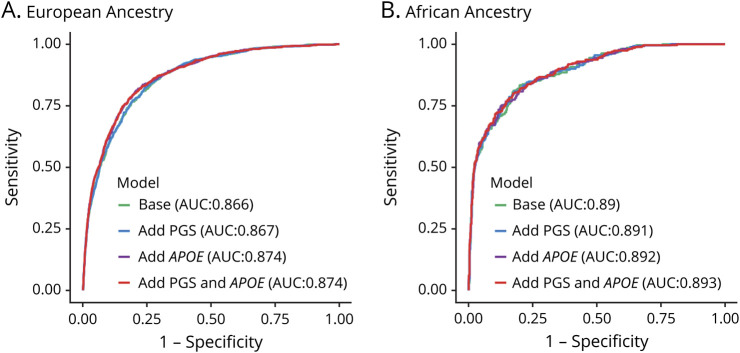
Objective Alzheimer disease (AD) is a common and costly neurodegenerative disorder. A large proportion of AD risk is heritable, and many genetic risk factors have been identified. The objective of this study was to test the hypothesis that cumulative genetic risk of known AD markers contributed to odds of dementia in a population-based sample. Methods In the US population-based Health and Retirement Study (waves 1995–2014), we evaluated the role of cumulative genetic risk of AD, with and without the APOE ε4 alleles, on dementia status (dementia, cognitive impairment without dementia, borderline cognitive impairment without dementia, and cognitively normal). We used logistic regression, accounting for demographic covariates and genetic principal components, and analyses were stratified by European and African genetic ancestry. Results In the European ancestry sample (n = 8,399), both AD polygenic score excluding the APOE genetic region (odds ratio [OR] = 1.10; 95% confidence interval [CI]: 1.00–1.20) and the presence of any APOE ε4 alleles (OR = 2.42; 95% CI: 1.99–2.95) were associated with the odds of dementia relative to normal cognition in a mutually adjusted model. In the African ancestry sample (n = 1,605), the presence of any APOE ε4 alleles was associated with 1.77 (95% CI: 1.20–2.61) times higher odds of dementia, whereas the AD polygenic score excluding the APOE genetic region was not significantly associated with the odds of dementia relative to normal cognition 1.06 (95% CI: 0.97–1.30). Conclusions Cumulative genetic risk of AD and APOE ε4 are both independent predictors of dementia in European ancestry. This study provides important insight into the polygenic nature of dementia and demonstrates the utility of polygenic scores in dementia research.
Overview
The claims and statistics of this paper haven’t been checked yet.
Free: it reads the open-access text and checks the first 5 claims that cite a source we can check. Create a free account to check every claim.
Integrity signals
Registry
Cites
Statistics
Figures
Verification
Claims the paper makes
The claims and statistics of this paper haven’t been checked yet.
Free: it reads the open-access text and checks the first 5 claims that cite a source we can check. Create a free account to check every claim.
Claims other papers make about this one
Each is checked against this paper’s own text: does it say what the citing paper says it does?
The source backs part of the claim, not all of it — or backs it for a different population, condition or comparison.
In the citing paper
“For example, some have found that having the e4 allele did not increase risk among Blacks, [80][81][82] while other studies have found that it significantly increased risk.[83][84][85][86]”
From 2023 Alzheimer's disease facts and figures (2023) · cites this paper as [86]
Experimental — accuracy not yet measuredIn the citing paper
“Indeed, multiple studies have demonstrated that individuals with high PRSs for AD, particularly when combined with APOE ε4, have up to a 5‐fold higher risk of AD than those with lower scores.”
From Shared genes and pathways in dementia: Insights from genome‐wide association studies (2025) · cites this paper as [127]
Self-check
Percentages, sums and reported differences re-computed from the paper’s own numbers.
The self-check needs the paper’s full text.
Citations
Cites
A global reference for human genetic variation
The 1000 Genomes Project Consortium, authors, C., Auton, A., Abecasis, G. R., Steering committee, Altshuler, D. M., Durbin, R. M., Abecasis, G. R., Bentley, D. R., Chakravarti, A., et al. (2015) · Nature · doi:10.1038/nature15393 · Cited by 18,247 · cited 1×
“«2, «2/«3, «2/«4, «3/«3, «3/«4, and «4/«4) was assigned using 1000 Genomes Project imputation.(13) Primary analyses indicated the binary presence of the «4 allele.”
Alzheimer Disease Genetics Consortium (ADGC), Kunkle, B. W., The European Alzheimer’s Disease Initiative (EADI), Cohorts for Heart and Aging Research in Genomic Epidemiology Consortium (CHARGE), Genetic and Environmental Risk in AD/Defining Genetic, P. A. E. R. F. A. D. C. (., Grenier-Boley, B., Sims, R., Bis, J. C., Damotte, V., Naj, A. C., et al. (2019) · Nature Genetics · doi:10.1038/s41588-019-0358-2 · Cited by 2,946 · cited 3×
“(IGAP, 2019).(6) b APOE status was genotyped using 2 single nucleotide polymorphisms (rs7412 and rs429358) resulting in 3 alleles of APOE.”
BackgroundMethodInfluentialClinical use of current polygenic risk scores may exacerbate health disparities
Martin, A. R., Kanai, M., Kamatani, Y., Okada, Y., Neale, B. M., & Daly, M. J. (2019) · Nature Genetics · doi:10.1038/s41588-019-0379-x · Cited by 2,821 · cited 1×
“In addition, current AD PGSs are not created with diverse populations as the reference weights, which may provide inaccurate risk for individuals of diverse ancestries,(47) and clinical use in their present form may exacerbate health disparities.(48)”
Background2019 Alzheimer’s disease facts and figures.
Alzheimer's Association (2019) · Alzheimer's & Dementia · doi:10.1016/j.jalz.2019.01.010 · Cited by 2,461
Role of Genes and Environments for Explaining Alzheimer Disease
Gatz, M., Reynolds, C. A., Fratiglioni, L., Johansson, B., Mortimer, J. A., Berg, S., Fiske, A., & Pedersen, N. L. (2006) · Archives of General Psychiatry · doi:10.1001/archpsyc.63.2.168 · Cited by 1,798 · cited 1×
“Heritability estimates for dementia attribute 50–80% of risk to genetic factors.(2) The most common dementia genetic susceptibility locus is in the APOE gene, represented by multiple alleles («2, «3, and «4).”
BackgroundAn Overview of the Health and Retirement Study
Juster, F. T., & Suzman, R. (1995) · The Journal of Human Resources · doi:10.2307/146277 · Cited by 1,435 · cited 1×
“Health and Retirement Study The HRS is a US nationally representative, longitudinal panel cohort study of adults older than 50 years (n; 22,000, per wave).(8) The HRS was collected biennially beginning in 1992, through face-to-face interviews, mail-in surveys, and leave-behind questionnaires, with samples obtained for…”
BackgroundHuman Demographic History Impacts Genetic Risk Prediction across Diverse Populations
Martin, A. R., Gignoux, C. R., Walters, R. K., Wojcik, G. L., Neale, B. M., Gravel, S., Daly, M. J., Bustamante, C. D., & Kenny, E. E. (2017) · The American Journal of Human Genetics · doi:10.1016/j.ajhg.2017.03.004 · Cited by 1,391
Diabetes mellitus and risk of Alzheimer disease and decline in cognitive function
Arvanitakis, Z., Wilson, R. S., Bienias, J. L., Evans, D. A., & Bennett, D. A. (2004) · Archives of Neurology · doi:10.1001/archneur.61.5.661 · Cited by 1,258
Crimmins, E. M., Kim, J. K., Langa, K. M., & Weir, D. R. (2011) · The Journals of Gerontology Series B: Psychological Sciences and Social Sciences · doi:10.1093/geronb/gbr048 · Cited by 1,056 · cited 1×
“The Langa-Weir method was validated against a clinically evaluated subsample of the HRS where 76% of self-respondents and 84% of proxy respondents were correctly classified with dementia.(11)”
MethodSelf-citationAnalysis of polygenic risk score usage and performance in diverse human populations
Duncan, L., Shen, H., Gelaye, B., Meijsen, J., Ressler, K., Feldman, M., Peterson, R., & Domingue, B. (2019) · Nature Communications · doi:10.1038/s41467-019-11112-0 · Cited by 1,038
A Comparison of the Prevalence of Dementia in the United States in 2000 and 2012
Langa, K. M., Larson, E. B., Crimmins, E. M., Faul, J. D., Levine, D. A., Kabeto, M. U., & Weir, D. R. (2017) · JAMA Internal Medicine · doi:10.1001/jamainternmed.2016.6807 · Cited by 910 · cited 1×
“Cognitive Outcome Cognition status at each wave was assigned using the LangaWeir method.(9) Cognition status at 3 levels (dementia, cognitive impairment–no dementia [CIND], and normal cognition) was assigned using survey instruments.”
MethodSelf-citationGao, S., Hendrie, H. C., Hall, K. S., & Hui, S. (1998) · Archives of General Psychiatry · doi:10.1001/archpsyc.55.9.809 · Cited by 754 · cited 1×
“Older participants with cognitive impairments may be more likely to die of other comorbid causes, and capturing cognitively impaired cases in older age groups may be difficult.(42) Individuals surviving to age 90 years with no cognitive impairment may skew estimates.”
BackgroundCalamia, M., Markon, K., & Tranel, D. (2012) · The Clinical Neuropsychologist · doi:10.1080/13854046.2012.680913 · Cited by 583
Modrego, P. J., & Ferrández, J. (2004) · Archives of Neurology · doi:10.1001/archneur.61.8.1290 · Cited by 537
Variable prediction accuracy of polygenic scores within an ancestry group
Mostafavi, H., Harpak, A., Agarwal, I., Conley, D., Pritchard, J. K., & Przeworski, M. (2020) · eLife · doi:10.7554/elife.48376 · Cited by 457 · cited 2×
“Also, the background of nongenetic risk factors differs across populations, likely affecting the observed genetic signal.(40) Furthermore, in population-based studies such as the HRS, accuracy of dementia classification algorithms varies across racial/ethnic groups(41) and the algorithm used in the current”
BackgroundCommon polygenic variation enhances risk prediction for Alzheimer’s disease
Escott-Price, V., Sims, R., Bannister, C., Harold, D., Vronskaya, M., Majounie, E., Badarinarayan, N., GERAD/PERADES, consortia, I., Morgan, K., et al. (2015) · Brain · doi:10.1093/brain/awv268 · Cited by 414 · cited 1×
“80).(25) This study used PGS weights from a GWAS that included the study sample.”
MethodChange in body mass index and risk of incident Alzheimer disease
Buchman, A. S., Wilson, R. S., Bienias, J. L., Shah, R. C., Evans, D. A., & Bennett, D. A. (2005) · Neurology · doi:10.1212/01.wnl.0000176061.33817.90 · Cited by 399
National estimates of the prevalence of Alzheimer's disease in the United States
Brookmeyer, R., Evans, D. A., Hebert, L., Langa, K. M., Heeringa, S. G., Plassman, B. L., & Kukull, W. A. (2011) · Alzheimer's & Dementia · doi:10.1016/j.jalz.2010.11.007 · Cited by 399
Self-citationSlooter, A. J. C., Cruts, M., Kalmijn, S., Hofman, A., Breteler, M. M. B., Van Broeckhoven, C., & van Duijn, C. M. (1998) · Archives of Neurology · doi:10.1001/archneur.55.7.964 · Cited by 399 · cited 2×
“In European and African ancestry samples, APOE e4 alleles increase the risk of dementia, although they are neither necessary nor sufficient for disease.(3,4) Understanding etiologic factors is essential for dementia prevention and potential treatment.”
BackgroundResultDesikan, R. S., Fan, C. C., Wang, Y., Schork, A. J., Cabral, H. J., Cupples, L. A., Thompson, W. K., Besser, L., Kukull, W. A., Holland, D., et al. (2017) · PLoS Medicine · doi:10.1371/journal.pmed.1002258 · Cited by 395 · cited 1×
“AD PGSs may also predict age at AD onset, where individuals with a top quartile AD PGS had an age at onset of 75 vs an age at onset of 95 for the lowest quartile.(31) Despite the motivation to use AD PGS in clinical practice, scientists are understandably hesitant to encourage PGS use outside of research.”
BackgroundHypertension and the Risk of Mild Cognitive Impairment
Reitz, C., Tang, M.-X., Manly, J., Mayeux, R., & Luchsinger, J. A. (2007) · Archives of Neurology · doi:10.1001/archneur.64.12.1734 · Cited by 360
Self-citationStroke and the Risk of Alzheimer Disease
Honig, L. S., Tang, M.-X., Albert, S., Costa, R., Luchsinger, J., Manly, J., Stern, Y., & Mayeux, R. (2003) · Archives of Neurology · doi:10.1001/archneur.60.12.1707 · Cited by 343 · cited 1×
“In sensitivity models, we included additional dementia risk factors: smoking behavior,(15) alcohol use,(16) body mass index (BMI),(17) and history of hypertension,(18) diabetes,(19) depressive symptoms,(20) and stroke.(21) History of hypertension (no/yes), diabetes (no/yes), smoking (never, former, or current), and al…”
MethodSelf-citationChen, J.-H., Lin, K.-P., & Chen, Y.-C. (2009) · Journal of the Formosan Medical Association · doi:10.1016/s0929-6646(09)60402-2 · Cited by 288
Alcohol consumption and dementia risk: a dose–response meta-analysis of prospective studies
Xu, W., Wang, H., Wan, Y., Tan, C., Li, J., Tan, L., & Yu, J.-T. (2017) · European Journal of Epidemiology · doi:10.1007/s10654-017-0225-3 · Cited by 283
De Jager, P. L., Chibnik, L. B., Cui, J., Reischl, J., Lehr, S., Simon, K. C., Aubin, C., Bauer, D., Heubach, J. F., Sandbrink, R., et al. (2009) · The Lancet Neurology · doi:10.1016/s1474-4422(09)70275-3 · Cited by 266
Weuve, J., Proust‐Lima, C., Power, M. C., Gross, A. L., Hofer, S. M., Thiébaut, R., Chêne, G., Glymour, M. M., Dufouil, C., & Initiative, M. (2015) · Alzheimer's & Dementia · doi:10.1016/j.jalz.2015.06.1885 · Cited by 243 · cited 1×
“There are documented learning effects—where scores are higher the second time a participant sees a similar examination—for these cognition tests.(43) Our summary cognition status excluded those with less than 3 visits, strengthening the cognitive status designation for each individual, and reducing practice effects.”
BackgroundRelation between smoking and risk of dementia and Alzheimer disease: The Rotterdam Study
Reitz, C., den Heijer, T., van Duijn, C., Hofman, A., & Breteler, M. M. B. (2007) · Neurology · doi:10.1212/01.wnl.0000271395.29695.9a · Cited by 195
Polygenic risk score analysis of pathologically confirmed Alzheimer disease
Escott‐Price, V., Myers, A. J., Huentelman, M., & Hardy, J. (2017) · Annals of Neurology · doi:10.1002/ana.24999 · Cited by 177
Polygenic risk of Alzheimer disease is associated with early- and late-life processes
Mormino, E. C., Sperling, R. A., Holmes, A. J., Buckner, R. L., De Jager, P. L., Smoller, J. W., Sabuncu, M. R., Initiative, F. T. A. D. N., Initiative, A. D. N., Weiner, M., et al. (2016) · Neurology · doi:10.1212/wnl.0000000000002922 · Cited by 176
Genetic Risk Prediction and a 2-Stage Risk Screening Strategy for Coronary Heart Disease
Tikkanen, E., Havulinna, A. S., Palotie, A., Salomaa, V., & Ripatti, S. (2013) · Arteriosclerosis, Thrombosis, and Vascular Biology · doi:10.1161/atvbaha.112.301120 · Cited by 175 · cited 1×
“The utility of PGS has helped to identify (for example) risk of MS,(44) Parkinson disease,(45) and cardiovascular disease.(46) AD PGSs may also predict age at AD onset, where individuals with a top quartile AD PGS had an age at onset of 75 vs an age at onset of 95 for the lowest quartile.”
BackgroundApolipoprotein E Genetic Variation and Alzheimer’s Disease
Rubinsztein, D. C., & Easton, D. F. (1999) · Dementia and Geriatric Cognitive Disorders · doi:10.1159/000017120 · Cited by 151
Cruchaga, C., Del‐Aguila, J. L., Saef, B., Black, K., Fernandez, M. V., Budde, J., Ibanez, L., Deming, Y., Kapoor, M., Tosto, G., et al. (2018) · Alzheimer's & Dementia · doi:10.1016/j.jalz.2017.08.013 · Cited by 138
Gianattasio, K. Z., Wu, Q., Glymour, M. M., & Power, M. C. (2019) · Epidemiology · doi:10.1097/ede.0000000000000945 · Cited by 128
The effect of increased genetic risk for Alzheimer's disease on hippocampal and amygdala volume
Lupton, M. K., Strike, L., Hansell, N. K., Wen, W., Mather, K. A., Armstrong, N. J., Thalamuthu, A., McMahon, K. L., de Zubicaray, G. I., Assareh, A. A., et al. (2016) · Neurobiology of Aging · doi:10.1016/j.neurobiolaging.2015.12.023 · Cited by 126
Heterogeneity in polygenic scores for common human traits
Ware, E. B., Schmitz, L. L., Faul, J., Gard, A., Mitchell, C., Smith, J. A., Zhao, W., Weir, D., & Kardia, S. L. (2017) · doi:10.1101/106062 · Cited by 123
Self-citationAssociation Between Apolipoprotein E Genotype and Alzheimer Disease in African American Subjects
Graff-Radford, N. R., Green, R. C., Go, R. C. P., Hutton, M. L., Edeki, T., Bachman, D., Adamson, J. L., Griffith, P., Willis, F. B., Williams, M., et al. (2002) · Archives of Neurology · doi:10.1001/archneur.59.4.594 · Cited by 113 · cited 2×
“In European and African ancestry samples, APOE e4 alleles increase the risk of dementia, although they are neither necessary nor sufficient for disease.(3,4) Understanding etiologic factors is essential for dementia prevention and potential treatment.”
BackgroundResultLogue, M. W., Panizzon, M. S., Elman, J. A., Gillespie, N. A., Hatton, S. N., Gustavson, D. E., Andreassen, O. A., Dale, A. M., Franz, C. E., Lyons, M. J., et al. (2019) · Molecular Psychiatry · doi:10.1038/s41380-018-0030-8 · Cited by 111
Alzheimer's Disease Genes and Cognition in the Nondemented General Population
Verhaaren, B. F. J., Vernooij, M. W., Koudstaal, P. J., Uitterlinden, A. G., van Duijn, C. M., Hofman, A., Breteler, M. M. B., & Ikram, M. A. (2012) · Biological Psychiatry · doi:10.1016/j.biopsych.2012.04.009 · Cited by 110
Interpreting polygenic scores, polygenic adaptation, and human phenotypic differences
Rosenberg, N. A., Edge, M. D., Pritchard, J. K., & Feldman, M. W. (2019) · Evolution, Medicine, and Public Health · doi:10.1093/emph/eoy036 · Cited by 105
Evaluation of a Genetic Risk Score to Improve Risk Prediction for Alzheimer’s Disease
Chouraki, V., for the International Genomics of Alzheimer’s Project, Reitz, C., Maury, F., Bis, J. C., Bellenguez, C., Yu, L., Jakobsdottir, J., Mukherjee, S., Adams, H. H., et al. (2016) · Journal of Alzheimer's Disease · doi:10.3233/jad-150749 · Cited by 98 · cited 8×
“We first compared those in the highest 20th percentile of AD PGS with those in the lowest 20th percentile of AD PGS.”
MethodInfluentialPolygenic hazard score: an enrichment marker for Alzheimer’s associated amyloid and tau deposition
Initiative, F. T. A. D. N., Tan, C. H., Fan, C. C., Mormino, E. C., Sugrue, L. P., Broce, I. J., Hess, C. P., Dillon, W. P., Bonham, L. W., Yokoyama, J. S., et al. (2018) · Acta Neuropathologica · doi:10.1007/s00401-017-1789-4 · Cited by 98
Carrasquillo, M. M., Crook, J. E., Pedraza, O., Thomas, C. S., Pankratz, V. S., Allen, M., Nguyen, T., Malphrus, K. G., Ma, L., Bisceglio, G. D., et al. (2015) · Neurobiology of Aging · doi:10.1016/j.neurobiolaging.2014.07.042 · Cited by 96
Adams, H. H. H., de Bruijn, R. F. A. G., Hofman, A., Uitterlinden, A. G., van Duijn, C. M., Vernooij, M. W., Koudstaal, P. J., & Ikram, M. A. (2015) · Alzheimer's & Dementia · doi:10.1016/j.jalz.2014.12.008 · Cited by 89
Marden, J. R., Mayeda, E. R., Walter, S., Vivot, A., Tchetgen, E. J. T., Kawachi, I. I., & Glymour, M. M. (2016) · Alzheimer Disease & Associated Disorders · doi:10.1097/wad.0000000000000137 · Cited by 82 · cited 1×
“023) in African ancestry (N = 1,081) samples.(37) Consistent with this prior study on impaired memory, in our analysis, we observed AD PGS was associated with increased odds of dementia.”
ResultPolygenic risk scores in familial Alzheimer disease
Tosto, G., Bird, T. D., Tsuang, D., Bennett, D. A., Boeve, B. F., Cruchaga, C., Faber, K., Foroud, T. M., Farlow, M., Goate, A. M., et al. (2017) · Neurology · doi:10.1212/wnl.0000000000003734 · Cited by 63 · cited 1×
“37), relative to unaffected family members.(7) The utility of a weighted AD PGS, independent of APOE, has not been tested in multiple ancestries or with population-based dementia outcomes.”
BackgroundSelf-citationProgress in Polygenic Composite Scores in Alzheimer’s and Other Complex Diseases
Chasioti, D., Yan, J., Nho, K., & Saykin, A. J. (2019) · Trends in Genetics · doi:10.1016/j.tig.2019.02.005 · Cited by 61 · cited 1×
“We may eventually be able to use PGSs for primary prevention (quantifying the genetic burden in subpopulations), secondary prevention (detecting high-risk individuals for disease screening), and tertiary prevention (a potential biomarker for optimizing treatment stratification).(49) However, current AD PGSs, though as…”
MethodVariable prediction accuracy of polygenic scores within an ancestry groupPreprint
Mostafavi, H., Harpak, A., Conley, D., et al. (2019) · bioRxiv (Cold Spring Harbor Laboratory) · doi:10.1101/629949 · Cited by 58
Acumulative genetic risk score predicts progression in Parkinson's disease
Pihlstrøm, L., Morset, K. R., Grimstad, E., Vitelli, V., & Toft, M. (2016) · Movement Disorders · doi:10.1002/mds.26505 · Cited by 52
Harris, S. E., the Genetic and Environmental Risk for Alzheimer's disease (GERAD1) Consortium, Davies, G., Luciano, M., Payton, A., Fox, H. C., Haggarty, P., Ollier, W., Horan, M., Porteous, D. J., et al. (2014) · Journal of Alzheimer's Disease · doi:10.3233/jad-131058 · Cited by 50
Ware, E. B., Faul, J. D., Mitchell, C. M., & Bakulski, K. M. (2020) · BMC Medical Genomics · doi:10.1186/s12920-020-00815-9 · Cited by 37
Self-citationZahodne, L. B., Nowinski, C. J., Gershon, R. C., & Manly, J. J. (2014) · Archives of Clinical Neuropsychology · doi:10.1093/arclin/acu045 · Cited by 35 · cited 1×
“Stratification is essential given genetic architecture varies by ancestry, the PGSs were created using European ancestry weights,(6) and risk factor profiles vary across groups.(23)”
BackgroundSelf-citationKunkle, B., Grenier-Boley, B., Sims, R., Bis, J., Naj, A., Boland, A., Vronskaya, M., van der Lee, S., Amlie-Wolf, A., Bellenguez, C., et al. (2018) · doi:10.1101/294629 · Cited by 35
Author response: Variable prediction accuracy of polygenic scores within an ancestry group
Mostafavi, H., Harpak, A., Agarwal, I., Conley, D., Pritchard, J. K., & Przeworski, M. (2019) · eLife · doi:10.7554/elife.48376.sa2 · Cited by 8
Considering the APOE locus in polygenic scores for Alzheimer’s diseasePreprint
Ware, E., Faul, J., Mitchell, C. M., & Bakulski, K. (2019) · medRxiv · doi:10.1101/2019.12.10.19014365 · Cited by 3
Self-citation
Research works printed but not linked: 2
- Ware EB, Schmitz LL, Gard A, Faul J. HRS Polygenic Scores: Release 2. Ann Arbor: University of Michigan Survey Research Center; 2018.
- Bugliari D, Campbell N, Chan C, et al. RAND HRS Data Documentation, Version P. Philadelphia: RAND Center for the Study of Aging; 2016.
Cited by
2023 Alzheimer's disease facts and figures
(2023) · Alzheimer's & Dementia · doi:10.1002/alz.13016 · Cited by 3,212
2024 Alzheimer's disease facts and figures
(2024) · Alzheimer's & Dementia · doi:10.1002/alz.13809 · Cited by 2,536
2022 Alzheimer's disease facts and figures
(2022) · Alzheimer's & Dementia · doi:10.1002/alz.12638 · Cited by 2,341
2025 Alzheimer's disease facts and figures
(2025) · Alzheimer's & Dementia · doi:10.1002/alz.70235 · Cited by 474
2026 Alzheimer's disease facts and figures
Alzheimer's, T. S. O. A. D. A. A. W. S. C. I. T. B. I., neurons, T. B. N. A. E. A. A. H. A. B. H. B. O., long, E. W., connections, B. E. T. E. E. I. N. T. F. C. W. O. N. A. S., synapses, C., memories, I. F. I. T. B. O. C. T. A. R. B. O. N. A. T. U. B. A. N. T. B. C. T. O. S. T. A. S. T. T. R. T. T. B. T. S. F. T. C. B. O., thoughts, sensations, emotions, & skills., M. A. (2026) · Alzheimer s & Dementia · doi:10.1002/alz.71345 · Cited by 126
Metadata
- Authors
- Bakulski, K. M., Vadari, H. S., Faul, J. D., Heeringa, S. G., Kardia, S. L. R., Langa, K. M., Smith, J. A., Manly, J. J., Mitchell, C. M., Benke, K. S., & Ware, E. B.
- Affiliations
- Johns Hopkins University (US)
- Corresponding author
- Bakulski, Kelly M.
- ORCID
- Venue
- Neurology Genetics
- Published
- 2021-04
- Volume
- 7
- Issue
- 2
- Pages
- e576-e576
- ISSN
- 2376-7839 (ISSN-L)
- PMC
- PMC7938646
- OpenAlex
- W3134406075
- Semantic Scholar
- 77f0cc91fbdc23998c516fbecfb5f6686f463bcd
- Cited by
- 20
- References
- 47
- Citations by year
- 2026: 5 · 2025: 6 · 2024: 2 · 2023: 3 · 2022: 2 · 2021: 2
- FWCI
- 1.61
- Type
- journal article
- Language
- en
- Open access
- gold
- doi.org
- Licence
- cc-by-nc-nd
- Locations
- Neurology Genetics (publishedVersion, cc-by-nc-nd)
- PubMed Central (publishedVersion, cc-by-nc-nd)
- PubMed (publishedVersion)
- Funders
- National Institutes of Health
- National Institute on Aging (P30AG053760, RF1AG055654, R03AG048806, R01AG053972, R01AG055406, R01AG067592, R25AG053227, U01AG009740, P30AG024824)
- National Institute on Minority Health and Health Disparities (R01MD011716)
- Topics
- Health Sciences › Medicine › Psychiatry and Mental health › Dementia and Cognitive Impairment Research
- Life Sciences › Neuroscience › Cellular and Molecular Neuroscience › Alzheimer's disease research and treatments
- Life Sciences › Biochemistry, Genetics and Molecular Biology › Genetics › Genetic Associations and Epidemiology
- Keywords
- Alzheimer's disease, dementia, APOE ε4, cumulative genetic risk, polygenic risk score, genetic ancestry, European ancestry, African ancestry, cognitive impairment, genetic risk factors, Health and Retirement Study
About these checks
Registry, retraction, Cites and statistics results are computed, not judged, with one exception: a printed reference that no index lists is read once by a model before it counts as a citation error. Claims are extracted by a model and kept only when their quote appears verbatim in the text; each cited source is then checked, with a model’s help, for whether it says what the claim relies on. Those verdicts can be wrong — read the claim’s quote and the cited source before relying on one.
Statistics and arithmetic are recomputed, not judged.
Confidence bands are shown only for fields calibrated on our annotated test set. None is calibrated yet, so no band is shown.
What counts as a claim ›How we measure confidence ›How we check this ›
Are you an author, or do you see a problem with this page? Request a review
Data sources
Bibliographic data: Semantic Scholar, OpenAlex, Crossref.
Contains information from the Semantic Scholar Academic Graph Datasets, made available under the ODC Attribution License (ODC-BY 1.0).
Semantic Scholar’s data is described in: Kinney, R., et al. (2023). The Semantic Scholar Open Data Platform. arXiv:2301.10140.
