

Certainty of genuine treatment increases drug responses among intellectually disabled patients
Open accessThe DOI matches its Crossref record; 41 of the 41 references it cites were found in a registry or an index.
Abstract
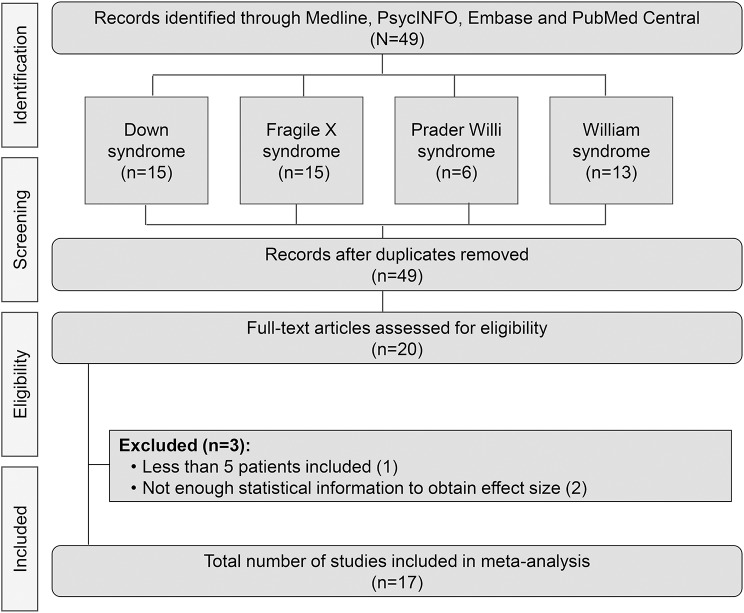
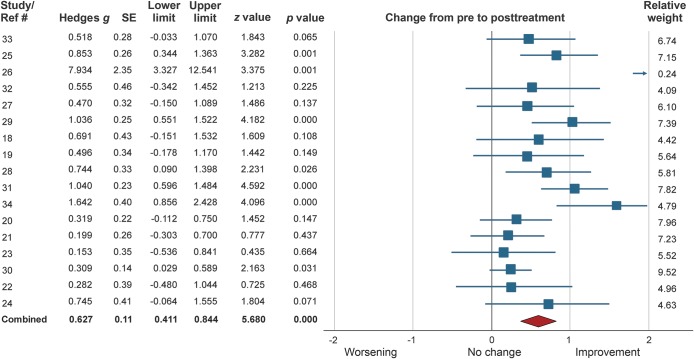
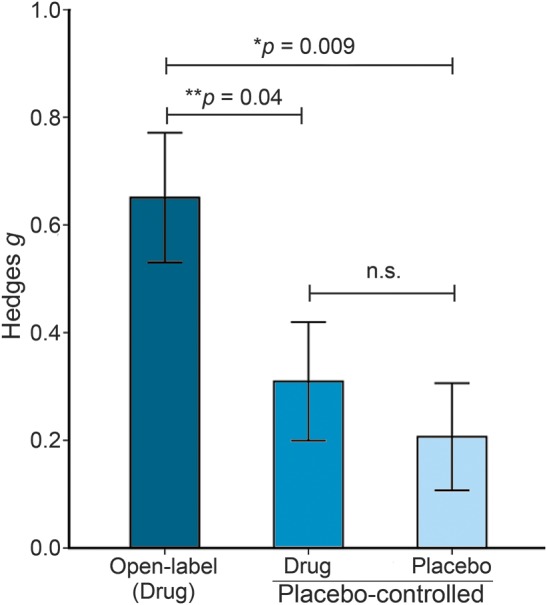
Objective: To determine the placebo component of treatment responses in patients with intellectual disability (ID). Methods: A statistical meta-analysis comparing bias-corrected effect sizes (Hedges g) of drug responses in open-label vs placebo-controlled clinical trials was performed, as these trial types represent different certainty of receiving genuine treatment (100% vs 50%). Studies in fragile X, Down, Prader-Willi, and Williams syndrome published before June 2015 were considered. Results: Seventeen open-label trials (n = 261, 65% male; mean age 23.6 years; mean trial duration 38 weeks) and 22 placebo-controlled trials (n = 721, 62% male; mean age 17.1 years; mean trial duration 35 weeks) were included. The overall effect size from pre to post treatment in open-label studies was g = 0.602 (p = 0.001). The effect of trial type was statistically significant (p = 0.001), and revealed higher effect sizes in studies with 100% likelihood of getting active drug, compared to both the drug and placebo arm of placebo-controlled trials. We thus provide evidence for genuine placebo effects, not explainable by natural history or regression toward the mean, among patients with ID. Conclusions: Our data suggest that clinical trials in patients with severe cognitive deficits are influenced by the certainty of receiving genuine medication, and open-label design should thus not be used to evaluate the effect of pharmacologic treatments in ID, as the results will be biased by an enhanced placebo component.
Overview
The claims and statistics of this paper haven’t been checked yet.
Free: it reads the open-access text and checks the first 5 claims that cite a source we can check. Create a free account to check every claim.
Integrity signals
Registry
Cites
Statistics
Figures
Verification
Claims the paper makes
The claims and statistics of this paper haven’t been checked yet.
Free: it reads the open-access text and checks the first 5 claims that cite a source we can check. Create a free account to check every claim.
Claims other papers make about this one
Each is checked against this paper’s own text: does it say what the citing paper says it does?
The cited source says what the claim attributes to it.
In the citing paper
“Of note, placebo effects are higher in open-label studies than in placebo-controlled trials (matched on drug category) in patients with intellectual disability and a genetic diagnosis109.”
From Drug development for neurodevelopmental disorders: lessons learned from fragile X syndrome (2018) · cites this paper as [109]
Self-check
Percentages, sums and reported differences re-computed from the paper’s own numbers.
The self-check needs the paper’s full text.
Citations
Cites
Borenstein, M., Hedges, L. V., Higgins, J. P. T., & Rothstein, H. R. (2009) · doi:10.1002/9780470743386 · Cited by 14,225
Borenstein, M., Hedges, L. V., Higgins, J. P. T., & Rothstein, H. R. (2021) · doi:10.1002/9781119558378 · Cited by 9,799
Biological, clinical, and ethical advances of placebo effects
Finniss, D. G., Kaptchuk, T. J., Miller, F., & Benedetti, F. (2010) · The Lancet · doi:10.1016/s0140-6736(09)61706-2 · Cited by 1,272
Self-citationThe double-blind, randomized, placebo-controlled trial
Kaptchuk, T. J. (2001) · Journal of Clinical Epidemiology · doi:10.1016/s0895-4356(00)00347-4 · Cited by 595
Self-citationOvert versus covert treatment for pain, anxiety, and Parkinson's disease
Colloca, L., Lopiano, L., Lanotte, M., & Benedetti, F. (2004) · The Lancet Neurology · doi:10.1016/s1474-4422(04)00908-1 · Cited by 552 · cited 1×
“In any pharmacologic treatment, contextual and cognitive factors contribute to the therapeutic response, such as patients’ treatment expectations and knowledge about the treatment.(1) These factors, referred to as nonspecific treatment mechanisms, are active ingredients in placebo responses.”
BackgroundClassical conditioning and the placebo effect
Montgomery, G. H., & Kirsch, I. (1997) · Pain · doi:10.1016/s0304-3959(97)00016-x · Cited by 468 · cited 1×
“There are several possible mechanisms involved in shaping treatment expectations and placebo effects, including implicit and explicit learning.(15) In addition to verbal information about the benefits of a drug (requiring cognitive learning abilities), treatment cues may be implicitly embedded in the patient–clinician…”
BackgroundSelf-citationPapakostas, G. I., & Fava, M. (2009) · European Neuropsychopharmacology · doi:10.1016/j.euroneuro.2008.08.009 · Cited by 382
Nocebo effects, patient–clinician communication, and therapeutic outcomes
Colloca, L., & Finniss, D. (2012) · JAMA · doi:10.1001/jama.2012.115 · Cited by 326
Effects of Expectation on Placebo-Induced Dopamine Release in Parkinson Disease
Lidstone, S. C., Schulzer, M., Dinelle, K., Mak, E., Sossi, V., Ruth, T. J., de la Fuente-Fernández, R., Phillips, A. G., & Stoessl, A. J. (2010) · Archives of General Psychiatry · doi:10.1001/archgenpsychiatry.2010.88 · Cited by 323 · cited 1×
“The effect of certainty in drug trials is previously reported among individuals with intact cognitive functions, and evidence suggests that certainty of receiving the real drug maximizes patients’ treatment expectations, leading to higher treatment responses.(10) Here we demonstrate, for the first time, that patients…”
BackgroundNonconscious activation of placebo and nocebo pain responses
Jensen, K. B., Kaptchuk, T. J., Kirsch, I., Raicek, J., Lindstrom, K. M., Berna, C., Gollub, R. L., Ingvar, M., & Kong, J. (2012) · Proceedings of the National Academy of Sciences · doi:10.1073/pnas.1202056109 · Cited by 305 · cited 1×
“In addition to verbal information about the benefits of a drug (requiring cognitive learning abilities), treatment cues may be implicitly embedded in the patient–clinician interaction and clinical environment.(16) In patients with ID, it is likely that the implicit social influence of placebo by proxy(17) plays a role…”
BackgroundSelf-citation
Cited by
Drug development for neurodevelopmental disorders: lessons learned from fragile X syndrome
Berry-Kravis, E. M., Lindemann, L., Jønch, A. E., Apostol, G., Bear, M. F., Carpenter, R. L., Crawley, J. N., Curie, A., Des Portes, V., Hossain, F., et al. (2018) · Nature Reviews Drug Discovery · doi:10.1038/nrd.2017.221 · Cited by 336
Self-citationImproving Public Health Requires Inclusion of Underrepresented Populations in Research
Spong, C. Y., & Bianchi, D. W. (2017) · JAMA · doi:10.1001/jama.2017.19138 · Cited by 133
Huneke, N. T. M., Veronesi, G. F., Garner, M. J., Baldwin, D. S., & Cortese, S. (2025) · JAMA Psychiatry · doi:10.1001/jamapsychiatry.2025.0085 · Cited by 73
Placebo Effects in Traumatic Brain Injury
Polich, G. R., Iaccarino, M. A., Kaptchuk, T. J., Morales-Quezada, L., & ZAFONTE, R. D. (2018) · Journal of Neurotrauma · doi:10.1089/neu.2017.5506 · Cited by 59
“82,83 The expectations ensuing after this higher-order processing trigger dopaminergic reward pathways in the nucleus accumbens of the ventral striatum.”
Self-citationFrisaldi, E., Shaibani, A. I., Benedetti, F., & Pagnini, F. (2023) · BMJ Open · doi:10.1136/bmjopen-2023-077243 · Cited by 58
“Social interactions among trial participants should be avoided to prevent possible effects on baseline clinical and biological variables.”
Background
Metadata
- Authors
- Jensen, K. B., Kirsch, I., Pontén, M., Rosén, A., Yang, K., Gollub, R. L., des Portes, V., Kaptchuk, T. J., & Curie, A.
- Affiliations
- Lyon 1 Université (FR)
- From the Department of Clinical Neuroscience (K.B.J., M.P., A.R.), Karolinska Institute, Sweden; Program in Placebo Studies (I.K., T.J.K.), BIDMC, Harvard Medical School; Department of Psychiatry (K.Y., R.L.G.), Massachusetts General Hospital, Boston; Institut des Sciences Cognitives (V.d.P., A.C.), Bron; Université Claude Bernard Lyon 1 (V.d.P., A.C.); Centre de Référence Déficiences Intellectuelles de Causes Rares (V.d.P., A.C.), Hôpital Femmes Mères Enfants, Hospices Civils de Lyon; and EPICIME...
- Corresponding author
- Jensen, Karin B.
- Venue
- Neurology
- Published
- 2017-05-16
- Volume
- 88
- Issue
- 20
- Pages
- 1912-1918
- ISSN
- 0028-3878 (ISSN-L)
- 1526-632X
- PMC
- PMC5444309
- OpenAlex
- W2606795278
- Cited by
- 17
- References
- 41
- Citations by year
- 2025: 1 · 2024: 1 · 2023: 3 · 2022: 1 · 2021: 2 · 2020: 3 · 2019: 2 · 2018: 2 · 2017: 2
- FWCI
- 0.28
- Type
- journal article
- Language
- en
- Open access
- hybrid
- doi.org
- Licence
- cc-by-nc-nd
- Locations
- Neurology (publishedVersion, cc-by-nc-nd)
- Europe PMC (PubMed Central) (publishedVersion, cc-by-nc-nd)
- PubMed Central (publishedVersion, cc-by-nc-nd)
- PubMed (publishedVersion)
- Digital Access to Scholarship at Harvard (DASH) (Harvard University) (submittedVersion, cc-by)
- Funders
- Karolinska Institutet
- National Center for Complementary and Integrative Health (K24AT004095)
- Topics
- Life Sciences › Neuroscience › Cognitive Neuroscience › Pain Management and Placebo Effect
- Health Sciences › Medicine › Public Health, Environmental and Occupational Health › Down syndrome and intellectual disability research
- Physical Sciences › Mathematics › Statistics and Probability › Statistical Methods in Clinical Trials
- Keywords
- intellectual disability, placebo effect, trial design bias, drug response, fragile X syndrome, Down syndrome, Prader-Willi syndrome, Williams syndrome, pharmacotherapy
- MeSH terms
- Humans, Intellectual Disability, Placebo Effect, Uncertainty
About these checks
Registry, retraction, Cites and statistics results are computed, not judged, with one exception: a printed reference that no index lists is read once by a model before it counts as a citation error. Claims are extracted by a model and kept only when their quote appears verbatim in the text; each cited source is then checked, with a model’s help, for whether it says what the claim relies on. Those verdicts can be wrong — read the claim’s quote and the cited source before relying on one.
Statistics and arithmetic are recomputed, not judged.
Confidence bands are shown only for fields calibrated on our annotated test set. None is calibrated yet, so no band is shown.
What counts as a claim ›How we measure confidence ›How we check this ›
Are you an author, or do you see a problem with this page? Request a review
How to cite
Cite CoChat for the checks on this page, and the paper for its own findings.
- This page
- CoChat. (2026). Citation check: Certainty of genuine treatment increases drug responses among intellectually disabled patients. https://app.cochat.ai/papers/10.1212/wnl.0000000000003934
- The paper
- Jensen, K. B., Kirsch, I., Pontén, M., Rosén, A., Yang, K., Gollub, R. L., des Portes, V., Kaptchuk, T. J., & Curie, A. (2017). Certainty of genuine treatment increases drug responses among intellectually disabled patients. Neurology. https://doi.org/10.1212/wnl.0000000000003934
Data sources
Bibliographic data: Semantic Scholar, OpenAlex, Crossref.
Contains information from the Semantic Scholar Academic Graph Datasets, made available under the ODC Attribution License (ODC-BY 1.0).
Semantic Scholar’s data is described in: Kinney, R., et al. (2023). The Semantic Scholar Open Data Platform. arXiv:2301.10140.
