

The DOI matches its Crossref record; 42 of the 42 references it cites were found in a registry or an index.
Double-blind, randomized, placebo-controlled study of trofinetide in pediatric Rett syndrome
Open accessAbstract
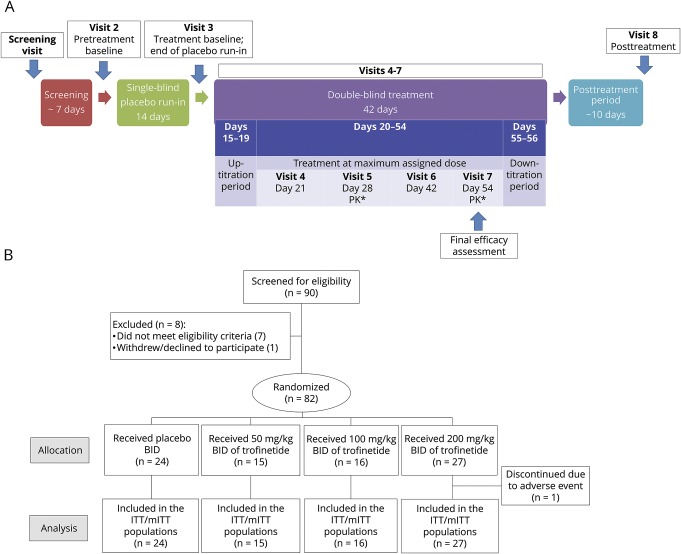
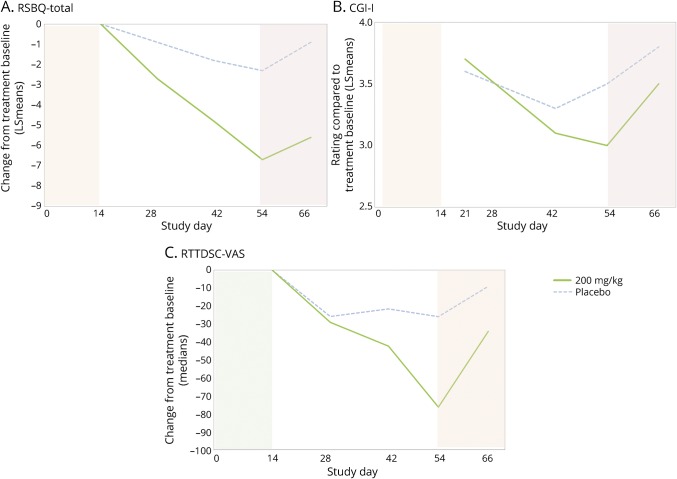
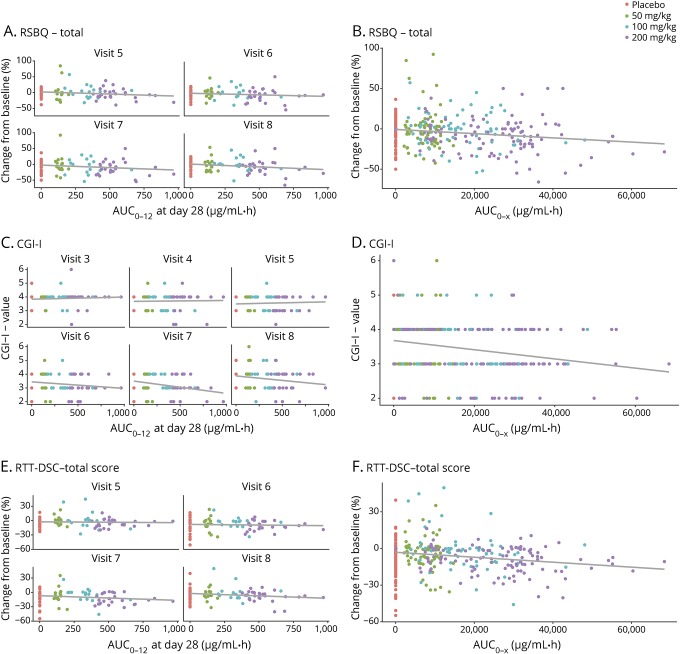
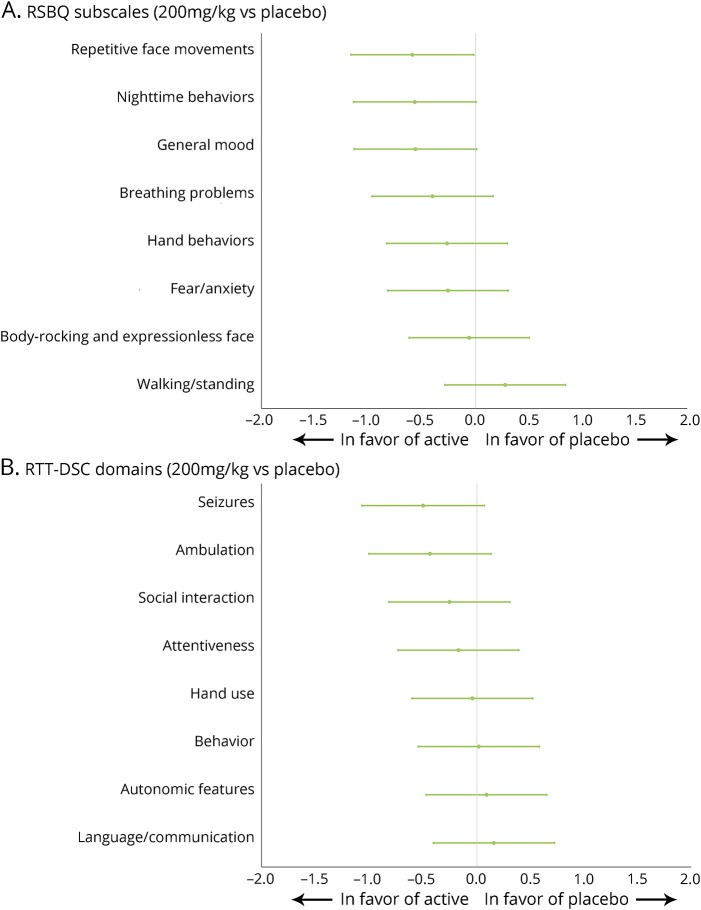
OBJECTIVE: To determine safety, tolerability, and pharmacokinetics of trofinetide and evaluate its efficacy in female children/adolescents with Rett syndrome (RTT), a debilitating neurodevelopmental condition for which no pharmacotherapies directed at core features are available. METHODS: This was a phase 2, multicenter, double-blind, placebo-controlled, parallel-group study, in which safety/tolerability, pharmacokinetics, and clinical response to trofinetide were characterized in 82 children/adolescents with RTT, aged 5 to 15 years. Sixty-two participants were randomized 1:1:1:1 to receive placebo twice a day (bid) for 14 days, followed by placebo, 50, 100, or 200 mg/kg bid of trofinetide for 42 days. Following blinded safety data review, 20 additional participants were randomized 1:1 to the 200 mg/kg or placebo bid groups. Safety assessments included adverse events, clinical laboratory tests, physical examinations, and concomitant medications. Clinician- and caregiver-based efficacy measurements assessed clinically relevant, phenotypic dimensions of impairment of RTT. RESULTS: All dose levels were well tolerated and generally safe. Trofinetide at 200 mg/kg bid showed statistically significant and clinically relevant improvements relative to placebo on the Rett Syndrome Behaviour Questionnaire, RTT-Clinician Domain Specific Concerns-Visual Analog Scale, and Clinical Global Impression Scale-Improvement. Exploratory analyses suggested that observed changes correlated with trofinetide exposure. CONCLUSION: These results, together with those from a previous adolescent/adult trial, indicate trofinetide's potential for treating core RTT symptoms and support further trials. CLASSIFICATION OF EVIDENCE: This study provides Class I evidence that for children/adolescents with RTT, trofinetide was safe, well-tolerated, and demonstrated improvement over placebo at 200 mg/kg bid in functionally important dimensions of RTT.
Overview
The claims and statistics of this paper haven’t been checked yet.
Run the check — free, no account needed. It reads the open-access text and checks the sources it cites.
Integrity signals
Registry
Cites
Statistics
Figures
Verification
Claims the paper makes
The claims and statistics of this paper haven’t been checked yet.
Run the check — free, no account needed. It reads the open-access text and checks the sources it cites.
Claims other papers make about this one
Each is checked against this paper’s own text: does it say what the citing paper says it does?
In the citing paper
“Significant benefits were seen in several measures including the Rett Syndrome Behavior Scale, the Rett Syndrome Clinician Rating Scale, and a visual analogue scale.”
From An Update on Psychopharmacological Treatment of Autism Spectrum Disorder (2022) · cites this paper as [137]
In the citing paper
“Trofinetide is glycyl-L-2-methylprolyl-L-glutamic acid, and it was studied in a controlled phase 2 trial in 82 children with Rett syndrome ages 5 to 15 years, and significant benefit was found in the high-dose group (200 mg/kg/day) compared to placebo [137].”
From An Update on Psychopharmacological Treatment of Autism Spectrum Disorder (2022) · cites this paper as [137]
Self-check
Percentages, sums and reported differences re-computed from the paper’s own numbers.
The self-check needs the paper’s full text.
Citations
Cites
Selective publication of antidepressant trials and its influence on apparent efficacy
Turner, E. H., Matthews, A. M., Linardatos, E., Tell, R. A., & Rosenthal, R. (2008) · New England Journal of Medicine · doi:10.1056/nejmsa065779 · Cited by 2,435
Hagberg, B. A., Aicardi, J. F., Dias, K., & Ramos, O. (1983) · Annals of Neurology · doi:10.1002/ana.410140412 · Cited by 1,515
Rett syndrome: Revised diagnostic criteria and nomenclature
Neul, J. L., Kaufmann, W. E., Glaze, D. G., Christodoulou, J., Clarke, A. J., Bahi‐Buisson, N., Leonard, H., Bailey, M. E. S., Schanen, N. C., Zappella, M., et al. (2010) · Annals of Neurology · doi:10.1002/ana.22124 · Cited by 1,437
Wild-type microglia arrest pathology in a mouse model of Rett syndrome
Derecki, N. C., Cronk, J. C., Lu, Z., Xu, E., Abbott, S. B. G., Guyenet, P. G., & Kipnis, J. (2012) · Nature · doi:10.1038/nature10907 · Cited by 607
Partial reversal of Rett Syndrome-like symptoms in MeCP2 mutant mice
Tropea, D., Giacometti, E., Wilson, N. R., Beard, C., McCurry, C., Fu, D. D., Flannery, R., Jaenisch, R., & Sur, M. (2009) · Proceedings of the National Academy of Sciences · doi:10.1073/pnas.0812394106 · Cited by 593
Specific mutations in Methyl-CpG-Binding Protein 2 confer different severity in Rett syndrome
Neul, J. L., Fang, P., Barrish, J., Lane, J., Caeg, E. B., Smith, E. O., Zoghbi, H., Percy, A., & Glaze, D. G. (2008) · Neurology · doi:10.1212/01.wnl.0000291011.54508.aa · Cited by 498
Self-citationRett syndrome in Australia: A review of the epidemiology
Laurvick, C. L., de Klerk, N. H., Bower, C. I., Christodoulou, J., Ravine, D., Ellaway, C., Williamson, S. L., & Leonard, H. (2006) · The Journal of Pediatrics · doi:10.1016/j.jpeds.2005.10.037 · Cited by 345
Cuddapah, V. A., Pillai, R. B., Shekar, K. V., Lane, J. B., Motil, K. J., Skinner, S. A., Tarquinio, D. C., Glaze, D. G., McGwin, G., Kaufmann, W. E., et al. (2014) · Journal of Medical Genetics · doi:10.1136/jmedgenet-2013-102113 · Cited by 311
ARNOLD, L. E., VITIELLO, B., MCDOUGLE, C., SCAHILL, L., SHAH, B., GONZALEZ, N. M., CHUANG, S., DAVIES, M., HOLLWAY, J., AMAN, M. G., et al. (2003) · Journal of the American Academy of Child & Adolescent Psychiatry · doi:10.1097/00004583-200312000-00011 · Cited by 218
Khwaja, O., Ho, E., Barnes, K. V., O’Leary, H. M., Pereira, L. M., Finkelstein, Y., Nelson, C. A., Vogel‐Farley, V. K., DeGregorio, G., Holm, I. A., et al. (2014) · Proceedings of the National Academy of Sciences · doi:10.1073/pnas.1311141111 · Cited by 212
Cited by
Sorted by citations
An Update on Psychopharmacological Treatment of Autism Spectrum Disorder
Aishworiya, R., Valica, T., Hagerman, R., & Restrepo, B. (2022) · Neurotherapeutics · doi:10.1007/s13311-022-01183-1 · Cited by 233
“Trofinetide is glycyl-L-2-methylprolylL-glutamic acid, and it was studied in a controlled phase 2 trial in 82 children with Rett syndrome ages 5 to 15 years, and significant benefit was found in the high-dose group (200 mg/kg/day) compared to placebo [137].”
BackgroundThe role of GABAergic signalling in neurodevelopmental disorders
Tang, X., Jaenisch, R., & Sur, M. (2021) · Nature reviews. Neuroscience · doi:10.1038/s41583-021-00443-x · Cited by 221
Trofinetide for the treatment of Rett syndrome: a randomized phase 3 study
Neul, J. L., Percy, A. K., Benke, T. A., Berry‐Kravis, E., Glaze, D. G., Marsh, E. D., Lin, T., Stankovic, S., Bishop, K. M., & Youakim, J. M. (2023) · Nature Medicine · doi:10.1038/s41591-023-02398-1 · Cited by 211
Sandweiss, A. J., Brandt, V. L., & Zoghbi, H. Y. (2020) · The Lancet Neurology · doi:10.1016/s1474-4422(20)30217-9 · Cited by 179
Global prevalence of Rett syndrome: systematic review and meta-analysis
Petriti, U., Dudman, D. C., Scosyrev, E., & López‐León, S. (2023) · Systematic Reviews · doi:10.1186/s13643-023-02169-6 · Cited by 128
Metadata
- Authors
- Glaze, D. G., Neul, J. L., Kaufmann, W. E., Berry-Kravis, E., Condon, S., Stoms, G., Oosterholt, S., Della Pasqua, O., Glass, L., Jones, N. E., Percy, A. K., Rett 002 Study Group, Glaze, D. G., Neul, J. L., Kaufmann, W. E., Berry-Kravis, E., Condon, S., Stoms, G., Oosterholt, S., Pasqua, O. D., Glass, L., Jones, N. E., & Percy, A.
- Affiliations
- From the Department of Pediatrics and Neurology (D.G.G.), Baylor College of Medicine, Houston, TX; Department of Neurosciences (J.L.N.), University of California, San Diego; Greenwood Genetic Center (W.E.K.), Center for Translational Research, Greenwood, SC; Pediatrics, Neurological Sciences, and Biochemistry (E.B.K.), Rush University Medical Center, Chicago, IL;Vital Systems, Inc. (S.C., G.S.), Rolling Meadows, IL; Clinical Pharmacology & Therapeutics Group (S.O., O.D.P.), University College...
- Rush University Medical Center (US)
- ORCID
- Della Pasqua, Oscar
- Venue
- Neurology
- Published
- 2019-04-16
- Volume
- 92
- Issue
- 16
- Pages
- e1912-e1925
- ISSN
- 0028-3878 (ISSN-L)
- 1526-632X
- PMC
- PMC6550498
- OpenAlex
- W2922881551
- Cited by
- 160
- References
- 42
- Citations by year
- 2026: 8 · 2025: 14 · 2024: 46 · 2023: 33 · 2022: 14 · 2021: 15 · 2020: 22 · 2019: 6
- FWCI
- 8.59
- Type
- journal article
- Language
- en
- Open access
- hybrid
- doi.org
- Licence
- cc-by-nc-nd
- Locations
- Neurology (publishedVersion, cc-by-nc-nd)
- Europe PMC (PubMed Central) (publishedVersion, cc-by-nc-nd)
- PubMed Central (publishedVersion, cc-by-nc-nd)
- PubMed (publishedVersion)
- UCL Discovery (University College London) (submittedVersion)
- Funders
- Eunice Kennedy Shriver National Institute of Child Health and Human Development (U54HD083211)
- Topics
- Life Sciences › Biochemistry, Genetics and Molecular Biology › Genetics › Genetics and Neurodevelopmental Disorders
- Health Sciences › Medicine › Pediatrics, Perinatology and Child Health › Pharmacological Effects and Toxicity Studies
- Life Sciences › Neuroscience › Cellular and Molecular Neuroscience › Alzheimer's disease research and treatments
- Keywords
- trofinetide, Rett syndrome, pediatric patients, safety and tolerability, pharmacokinetics, neurodevelopmental disorders, symptom improvement, Clinical Global Impression Scale, dose-response relationship
- MeSH terms
- Adolescent, Anti-Inflammatory Agents, Non-Steroidal, Child, Child, Preschool, Double-Blind Method, Female, Glutamates, Humans, Rett Syndrome, Treatment Outcome, Glutamic Acid
About these checks
Registry, retraction, Cites and statistics results are computed, not judged, with one exception: a printed reference that no index lists is read once by a model before it counts as a citation error. Claims are extracted by a model and kept only when their quote appears verbatim in the text; each cited source is then checked, with a model’s help, for whether it says what the claim relies on. Those verdicts can be wrong — read the claim’s quote and the cited source before relying on one.
Statistics and arithmetic are recomputed, not judged.
Confidence bands are shown only for fields calibrated on our annotated test set. None is calibrated yet, so no band is shown.
What counts as a claim ›How we measure confidence ›How we check this ›
Are you an author, or do you see a problem with this page? Request a review
