

Resistance training load effects on muscle hypertrophy and strength gain: systematic review and network meta-analysis.
Open accessThe DOI matches its Crossref record; 74 of the 74 references it cites were found in a registry or an index; 1 of the 45 sources its claims cite were checked for support.
Abstract
Purpose: This study aimed to analyze the effect of resistance training (RT) performed until volitional failure with low, moderate, and high loads on muscle hypertrophy and muscle strength in healthy adults and to assess the possible participant-, design-, and training-related covariates that may affect the adaptations. Methods: Using Preferred Reporting Items for Systematic Reviews and Meta-Analyses guidelines, MEDLINE, CINAHL, EMBASE, SPORTDiscus, and Web of Science databases were searched. Including only studies that performed sets to volitional failure, the effects of low- (>15 repetitions maximum (RM)), moderate- (9–15 RM), and high-load (≤8 RM) RTs were examined in healthy adults. Network meta-analysis was undertaken to calculate the standardized mean difference (SMD) between RT loads in overall and subgroup analyses involving studies deemed of high quality. Associations between participant-, design-, and training-related covariates with SMD were assessed by univariate and multivariate network meta-regression analyses. Results: Twenty-eight studies involving 747 healthy adults were included. Although no differences in muscle hypertrophy between RT loads were found in overall ( P = 0.113–0.469) or subgroup analysis ( P = 0.871–0.995), greater effects were observed in untrained participants ( P = 0.033) and participants with some training background who undertook more RT sessions ( P = 0.031–0.045). Muscle strength improvement was superior for both high-load and moderate-load compared with low-load RT in overall and subgroup analysis (SMD, 0.60–0.63 and 0.34–0.35, respectively; P < 0.001–0.003), with a nonsignificant but superior effect for high compared with moderate load (SMD, 0.26–0.28, P = 0.068). Conclusions: Although muscle hypertrophy improvements seem to be load independent, increases in muscle strength are superior in high-load RT programs. Untrained participants exhibit greater muscle hypertrophy, whereas undertaking more RT sessions provides superior gains in those with previous training experience.
Overview
CoChat Summary
TL;DR
Resistance training performed to volitional failure produced similar muscle hypertrophy across low, moderate, and high loads in healthy adults, while muscle strength gains were load-dependent and greater with high loads. The review supports high-load training for strength and either moderate or high loads for hypertrophy over short interventions.
Key findings
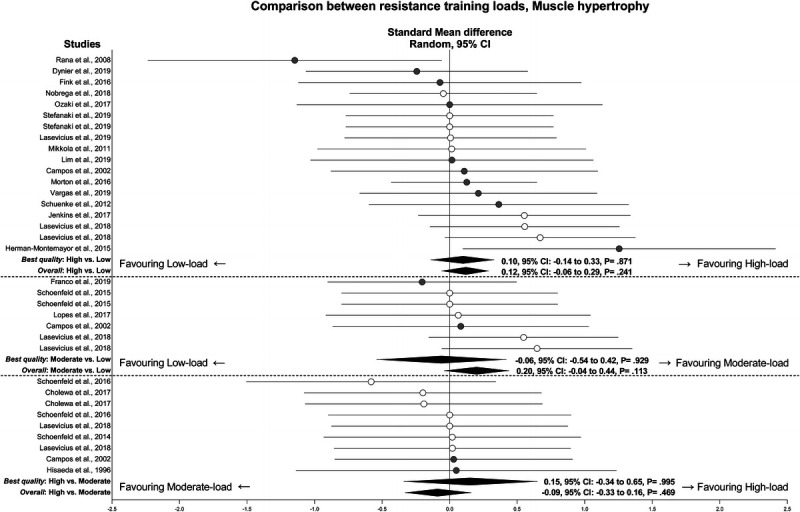
- In 28 studies (747 healthy adults; mean age 23.4 ± 3.0 yr), network meta-analysis found no significant differences in muscle hypertrophy between high vs low, moderate vs low, or high vs moderate loads (P = 0.113–0.469; I² = 0%). Best-intervention probabilities were 84.5% for moderate load overall and 75.8% for high load in best-quality studies, but effect sizes were small (range −0.09 to 0.15).
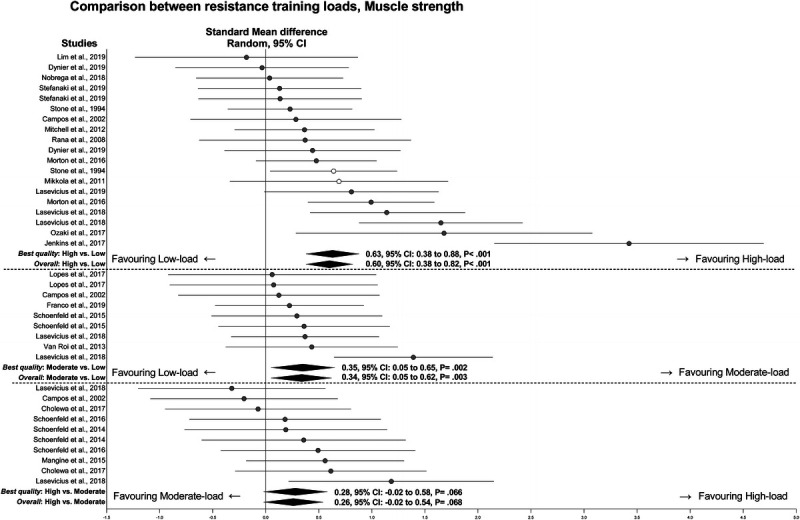
- Muscle strength was load-dependent: high-load training increased strength more than low-load (SMD 0.60; 95% CI 0.38–0.82; P < 0.001), and moderate-load more than low-load (SMD 0.34; 95% CI 0.05–0.62; P = 0.003). High vs moderate was nonsignificant (SMD 0.26; 95% CI −0.02 to 0.54; P = 0.068), with high load having 98.2% probability of being best.
- Meta-regression: for hypertrophy, training status was significant in high vs low (P = 0.033; untrained showed higher effects), and number of sessions was significant for moderate vs low (P = 0.031) and high vs moderate (P = 0.045). For strength, older studies (P = 0.023) and men (P = 0.037) showed higher effects in the low- vs high-load comparison.
Methods
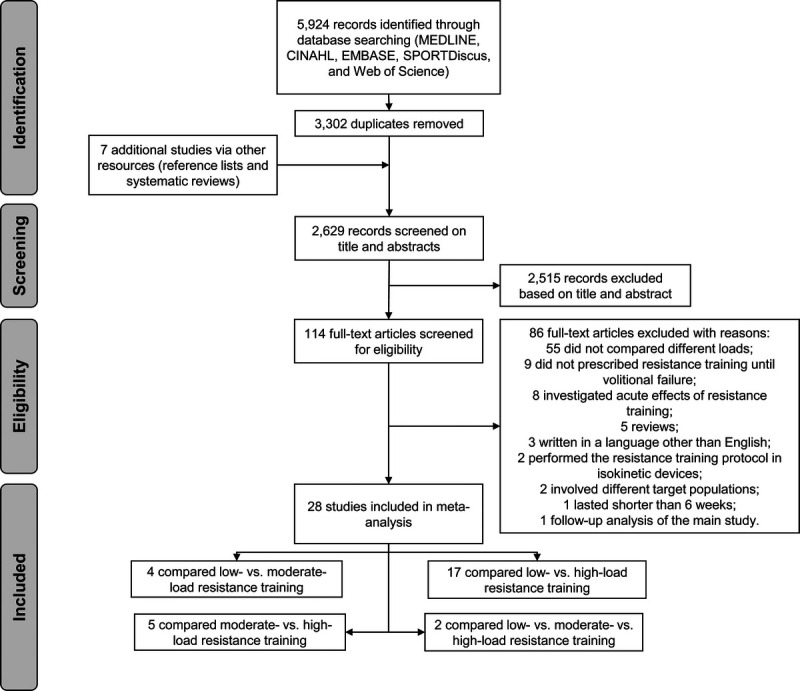
- Systematic review and network meta-analysis following PRISMA and Cochrane Back Review Group criteria; searched MEDLINE, CINAHL, EMBASE, SPORTDiscus, and Web of Science up to December 2019. Included experimental studies in healthy adults comparing low (<60% 1-RM or >15 RM), moderate (60–79% 1-RM or 9–15 RM), and high (≥80% 1-RM or ≤8 RM) resistance training performed until volitional failure; excluded interventions <6 wk, blood flow restriction, non-English, or insufficient data.
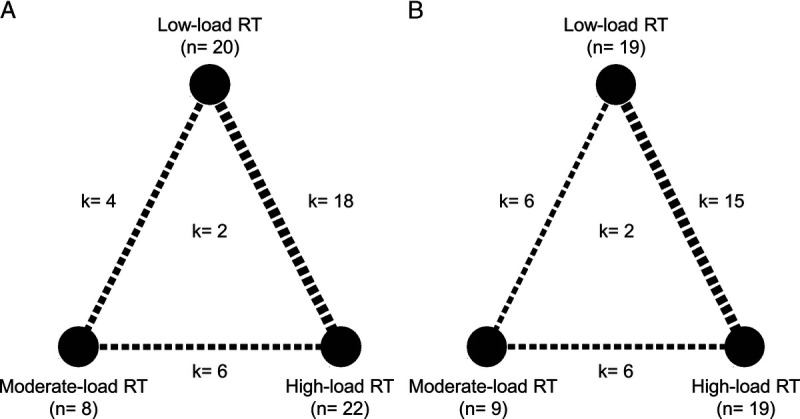
- 28 studies included (24 hypertrophy, 23 strength); 747 participants; mean intervention 8.9 ± 2.1 wk and 24.6 ± 7.5 sessions (range 16–48); most studies involved men (19/28) and untrained participants (21/28). Outcomes were muscle hypertrophy (muscle mass/size) and muscle strength (1-RM).
- Network meta-analysis used standardized mean differences from baseline to final assessment (R netmeta); subgroup analysis by risk of bias; univariate and multivariate network meta-regression (Stata mvmeta); risk of bias assessed with RoB 2.
Limitations
- The paper states included studies were mostly low quality due to concerns in randomization and outcome measurement; best-quality subgroup analyses were used and results maintained. It also states results cannot be extrapolated to highly strength-trained individuals, mostly young adults (23.4 ± 2.9 yr), nonspecific strength tests (isometric/isokinetic), or populations where volitional failure is not feasible; several studies performed multiple 1-RM tests, which may mask load differences; muscle size assessment is challenging; and few studies exceeded 14 wk.
- Evident from the text: publication bias was detected for muscle strength before adjustment (P = 0.014), with Anderson and Kearney identified as an outlier; heterogeneity was I² = 39.9% overall and 43.7% in best-quality strength analyses, while hypertrophy heterogeneity was I² = 0%. Most included studies were in men and untrained participants, limiting generalizability.
Model-written summary. Check it against the paper before relying on it.
Integrity signals
Registry
Cites
Statistics
Figures
Verification
Claims the paper makes
1 Valid · 0 Not valid · 25 Not checked · 58 Own results and interpretations
The cited sources support only part of this claim — read each source’s verdict below.
In the paper
“These differences are likely to be related to study design, conduct, and control because well-designed studies tend to get smaller effects and reducing bias over the years (70).”
§ Resistance Training Load Effects on Muscle Hypertrophy and Strength Gain: Systematic Review and Network Meta-analysis > DISCUSSION
What the sources say
- Partly supportedcites [70] Pannucci CJ Wilkins EG. Identifying and avoiding bias in research. Plast Reconstr Surg. 2010; 126(2): 619– 25. 20679844 PMC2917255 sourceExperimental — accuracy not yet measured
The paper’s “Definition and scope of bias” section says rigorous study design can reduce bias and gives an example in which more recent, rigorously designed studies reached a different result. It does not establish that well-designed studies generally produce smaller effects or that bias has declined over the years; it says bias can make estimates either larger or smaller. (LLM, conf=0.86)
hedgedstates a possible cause- Asserted: passes — The authors put it forward as true.
- Checkable: passes — It can be checked against evidence.
- Load-bearing: passes — The paper’s conclusions depend on it.
- Based: passes — The paper gives a reason why it holds.
- Partly supported
A result the paper reports from its own data — it cites no other source for it, so there is none to check. The quote shows it is in the paper.
In the paper
“Although the results of the consistency model indicate that moderate-load (84.5%) and high-load resistance training (75.8%) are the best load for muscle hypertrophy in overall and high-quality subgroup analyses, respectively, the ES values were unlikely to be considered meaningful (small ES: range, −0.09 to 0.15).”
§ Resistance Training Load Effects on Muscle Hypertrophy and Strength Gain: Systematic Review and Network Meta-analysis > RESULTS
hedged- Asserted: passes — The authors put it forward as true.
- Checkable: passes — It can be checked against evidence.
- Load-bearing: unclear — It is unclear whether the paper’s conclusions depend on it.
- Based: passes — The paper gives a reason why it holds.
A result the paper reports from its own data — it cites no other source for it, so there is none to check. The quote shows it is in the paper.
In the paper
“After the adjustment, the consistency network meta-analysis results show that high-load (SMD, 0.60; 95% confidence interval [CI], 0.38–0.82) and moderate-load (SMD, 0.34, 95% CI, 0.05–0.62) resulted in higher muscle strength effects when compared with low-load resistance training (P < 0.001 and 0.003, respectively).”
§ Resistance Training Load Effects on Muscle Hypertrophy and Strength Gain: Systematic Review and Network Meta-analysis > RESULTS
plainstates a cause- Asserted: passes — The authors put it forward as true.
- Checkable: passes — It can be checked against evidence.
- Load-bearing: passes — The paper’s conclusions depend on it.
- Based: passes — The paper gives a reason why it holds.
A result the paper reports from its own data — it cites no other source for it, so there is none to check. The quote shows it is in the paper.
In the paper
“Furthermore, no differences between the loads were observed in the subgroup analysis involving the best-quality studies (number of comparisons = 16, I2 = 0%, P = 0.871–0.995; Table 2).”
§ Resistance Training Load Effects on Muscle Hypertrophy and Strength Gain: Systematic Review and Network Meta-analysis > RESULTS
plain- Asserted: passes — The authors put it forward as true.
- Checkable: passes — It can be checked against evidence.
- Load-bearing: passes — The paper’s conclusions depend on it.
- Based: passes — The paper gives a reason why it holds.
A result the paper reports from its own data — it cites no other source for it, so there is none to check. The quote shows it is in the paper.
In the paper
“After the adjustment, the consistency network meta-analysis results show that high-load (SMD, 0.60; 95% confidence interval [CI], 0.38–0.82) and moderate-load (SMD, 0.34, 95% CI, 0.05–0.62) resulted in higher muscle strength effects when compared with low-load resistance training (P < 0.001 and 0.003, respectively).”
§ Resistance Training Load Effects on Muscle Hypertrophy and Strength Gain: Systematic Review and Network Meta-analysis > RESULTS
plainstates a cause- Asserted: passes — The authors put it forward as true.
- Checkable: passes — It can be checked against evidence.
- Load-bearing: passes — The paper’s conclusions depend on it.
- Based: passes — The paper gives a reason why it holds.
34 more claims
Create a free account to see all 84 claims and to verify the 41 references still open.
- It may state two separate claims as one. 36
- Probably not a substantial claim. 17
- The quote only partly states this claim. 1
Claims other papers make about this one
Each is checked against this paper’s own text: does it say what the citing paper says it does?
The source backs part of the claim, not all of it — or backs it for a different population, condition or comparison.
In the citing paper
“RT did not influence hypertrophy performed with low (1 d/wk) versus high (>5 d/wk) frequency when total volume was equated; low (30% 1RM) to high (100% 1RM) loads; contractions to muscle failure/fatigue; blood flow restriction; varying loads during repetitions; fast (0.5 s) versus slow (8 s) repetitions; power training techniques; periodization (linear, undulating, and nonperiodized); or exercise”
From American College of Sports Medicine Position Stand. Resistance Training Prescription for Muscle Function, Hypertrophy, and Physical Performance in Healthy Adults: An Overview of Reviews (2026) · cites this paper as [80]
Experimental — accuracy not yet measuredThe source backs part of the claim, not all of it — or backs it for a different population, condition or comparison.
In the citing paper
“Appropriately designed resistance training is generally viewed as the most efficient method of increasing skeletal muscle mass and strength in adults [52-54]”
From Fundamental Body Composition Principles Provide Context for Fat-Free and Skeletal Muscle Loss With GLP-1 RA Treatments (2024) · cites this paper as [54]
Experimental — accuracy not yet measuredThe cited source says what the claim attributes to it.
In the citing paper
“However, voluntary strength was enhanced by lifting heavier loads (≥80% one-repetition maximum), through a complete range of motion, for 2–3 sets, at the beginning of training sessions, and ≥2 sessions/wk.”
In the citing paper
“Previous studies have shown that traditional resistance training, particularly higher-load training, is generally more effective in promoting muscle strength improvements, accompanied by enhancements in muscle morphology and neural adaptations (72, 73).”
Self-check
Percentages, sums and reported differences re-computed from the paper’s own numbers.
Each contradiction between two passages listed here was confirmed by an independent check.
Rated minor: it would not touch a result — a value no result rests on, a p-value that stays on the same side of the significance level, or a conflict that is clerical, resolved elsewhere in the paper, or outside its own findings.
In the paper
§ Resistance Training Load Effects on Muscle Hypertrophy and Strength Gain: Systematic Review and Network Meta-analysis > RESULTS
“A total of 747 healthy men and women with an average age of 23.4 ± 3.0 yr participated in the included studies.”
§ Resistance Training Load Effects on Muscle Hypertrophy and Strength Gain: Systematic Review and Network Meta-analysis > DISCUSSION
“the present investigation included mostly studies undertaken in young adults (23.4 ± 2.9 yr)”
Rated minor: it would not touch a result — a value no result rests on, a p-value that stays on the same side of the significance level, or a conflict that is clerical, resolved elsewhere in the paper, or outside its own findings.
In the paper
“| High vs low | Year of publication | 1982–2019 | −0.11 ± 0.05 | −0.20 to −0.15 | 0.023 |”
§ Resistance Training Load Effects on Muscle Hypertrophy and Strength Gain: Systematic Review and Network Meta-analysis > RESULTS
Reported -0.11 · recomputed -0.175
Rated minor: it would not touch a result — a value no result rests on, a p-value that stays on the same side of the significance level, or a conflict that is clerical, resolved elsewhere in the paper, or outside its own findings.
In the paper
§ Resistance Training Load Effects on Muscle Hypertrophy and Strength Gain: Systematic Review and Network Meta-analysis > RESULTS
“The mean exercise intervention duration was 8.9 ± 2.1 wk, with an average of 24.6 ± 7.5 sessions (range, 16–48).”
§ Resistance Training Load Effects on Muscle Hypertrophy and Strength Gain: Systematic Review and Network Meta-analysis > RESULTS
“| High vs low | Number of sessions | 12–48 | 0.01 ± 0.01 | −0.02 to 0.05 | 0.518 |”
Citations
Cites
Bias in meta-analysis detected by a simple, graphical test
Egger, M., Smith, G. D., Schneider, M., & Minder, C. (1997) · BMJ · doi:10.1136/bmj.315.7109.629 · Cited by 56,722
RoB 2: a revised tool for assessing risk of bias in randomised trials
Sterne, J. A. C., Savović, J., Page, M. J., Elbers, R. G., Blencowe, N. S., Boutron, I., Cates, C. J., Cheng, H.-Y., Corbett, M. S., Eldridge, S. M., et al. (2019) · BMJ · doi:10.1136/bmj.l4898 · Cited by 34,787 · cited 2×
“Overall risk of bias was expressed as “low risk of bias” if all domains where classified as low risk, “some concerns” if some concern was raised in at least one domain but not classified as at high risk in any other, or “high risk of bias” if at least one domain was classified as high risk, or have multiple domains wi…”
BackgroundMethodLiberati, A., Altman, D. G., Tetzlaff, J., Mulrow, C., Gøtzsche, P. C., Ioannidis, J. P. A., Clarke, M., Devereaux, P. J., Kleijnen, J., & Moher, D. (2009) · PLoS Medicine · doi:10.1371/journal.pmed.1000100 · Cited by 28,164
Liberati, A., Altman, D. G., Tetzlaff, J., Mulrow, C., Gotzsche, P. C., Ioannidis, J. P. A., Clarke, M., Devereaux, P. J., Kleijnen, J., & Moher, D. (2009) · BMJ · doi:10.1136/bmj.b2700 · Cited by 17,648
Cumpston, M., Li, T., Page, M. J., Chandler, J., Welch, V. A., Higgins, J. P., & Thomas, J. (2019) · Cochrane Database of Systematic Reviews · doi:10.1002/14651858.ed000142 · Cited by 7,218
Cohen, J. (1992) · Current Directions in Psychological Science · doi:10.1111/1467-8721.ep10768783 · Cited by 5,870
Progression Models in Resistance Training for Healthy Adults
(2009) · Medicine & Science in Sports & Exercise · doi:10.1249/mss.0b013e3181915670 · Cited by 4,332
Progression Models in Resistance Training for Healthy Adults
(2002) · Medicine and Science in Sports and Exercise · doi:10.1097/00005768-200202000-00027 · Cited by 2,979
Self-citation2009 updated method guidelines for systematic reviews in the Cochrane Back Review Group
Furlan, A. D., Pennick, V., Bombardier, C., & van Tulder, M. (2009) · Spine · doi:10.1097/brs.0b013e3181b1c99f · Cited by 1,663 · cited 1×
“Study selection procedure The study was undertaken in accordance with the Preferred Reporting Items for Systematic Reviews and Meta-Analyses (PRISMA) statement (20, 21), and the method used was based on the minimum criteria established by the Cochrane Back Review Group (CBRG) (22).”
MethodNeural adaptation to resistance training
SALE, D. G. (1988) · Medicine & Science in Sports & Exercise · doi:10.1249/00005768-198810001-00009 · Cited by 1,421 · cited 1×
“As reported in previous literature, trained muscles may already present with an increased cross-sectional area (61) and lower anabolic signalling as observed in reduced AMPK and Akt phosphorylation after a resistance training session (62), resulting in an AC CE PT ED”
Background
Cited by
Items 101–200 of 338
Ramadan, A. M., ElDeeb, A. M., Ramadan, A. A., & Mohamed, D. M. A. (2024) · Journal of the Egyptian National Cancer Institute · doi:10.1186/s43046-023-00205-z · Cited by 7
“Moreover, increased muscle strength may result from neuromuscular adaptations resulting from increased motoneuron recruitment and excitability which enhance muscle cell activation during exercises [16].”
BackgroundYang, X., Li, Y., Mei, T., Duan, J., Yan, X., McNaughton, L. R., & He, Z. (2024) · Physiological Genomics · doi:10.1152/physiolgenomics.00019.2024 · Cited by 12
Nyberg, A., Milad, N., Martin, M., Patoine, D., Morissette, M. C., Saey, D., & Maltais, F. (2022) · Frontiers in Physiology · doi:10.3389/fphys.2022.873465 · Cited by 12
“The 20–30 repetition maximum zone was based on resistance training guidelines for improving local muscle endurance (Kraemer and Ratamess, 2004; American College of Sports Medicine, 2009; Lopez et al., 2021).”
BackgroundMethodBommasamudram, T., Morrell, Z. G., Clarkson, M. J., Nayak, K. R., Kadavigere, R., Russell, A. P., & Warmington, S. A. (2025) · Journal of Sports Sciences · doi:10.1080/02640414.2025.2474346 · Cited by 6
“Traditional resistance training usually requires moderate to high loads for significant improvements in muscle strength and hypertrophy (Lopez et al., 2021).”
Weinstein, Y., Ovadia, Y., Weinstein, B., & Weinstein, A. (2023) · Nutrients · doi:10.3390/nu15030538 · Cited by 7
“5 kg), this was an expected outcome [28].”
BackgroundMolinari, T., Radaelli, R., Rech, A., Brusco, C. M., Markarian, A. M., & López, P. (2023) · The Journal of Strength and Conditioning Research · doi:10.1519/jsc.0000000000004666 · Cited by 9
“Among potential benefits, resistance training is an effective intervention for increasing muscle strength (47), power (6), and size (47,48) as well as reducing fat mass (48).”
BackgroundResultSelf-citationLuders, J. G., Gleadhill, S., Garrett, J. M., & Bennett, H. (2024) · International Journal of Sports Science & Coaching · doi:10.1177/17479541241272256 · Cited by 6
“…these recommendations may seem logical considering they align with the ACSM guidelines for strength development 3 and meta-analytic research 39,40 indicating that high intensities and low repetition ranges often lead to superior increases in strength, it is important to highlight that do not…”
Stojanović, S., Rančić, D., Ilić, T., Aleksandrović, M., Đorđević, S. N., Hadžović, M., & Jorgić, B. (2024) · Disability and Rehabilitation · doi:10.1080/09638288.2024.2419421 · Cited by 8
Effect weight training on muscular hypertrophy: a systematic review
Ihsan, F., Nasrulloh, A., Nugroho, S., & Yuniana, R. (2023) · Pedagogy of Physical Culture and Sports · doi:10.15561/26649837.2023.0601 · Cited by 11
“Studies by Lopez et al. [26] and Zhu et al. [27] show that adequate recovery between training sessions helps optimize the recovery process and muscle growth.”
Drozd, M., Kędra, N., Motowidło, J., Ficek, K., Bichowska, M., & Zając, A. (2024) · Applied Sciences · doi:10.3390/app14051732 · Cited by 7
Minimum Intensity of Daily Six Eccentric Contractions to Increase Muscle Strength and Size
Yoshida, R., Murakami, Y., Kasahara, K., Sato, S., Nosaka, K., & Nakamura, M. (2024) · Scandinavian Journal of Medicine and Science in Sports · doi:10.1111/sms.14683 · Cited by 6
The Effects of Training Load During Dietary Intervention Upon Fat Loss: A Randomized Crossover Trial
Carlson, L., Gschneidner, D., Steele, J., & Fisher, J. P. (2022) · Research Quarterly for Exercise and Sport · doi:10.1080/02701367.2022.2097625 · Cited by 9
“…research has suggested that muscle hypertrophy increases are similar whether training with heavier-(>60% 1-repetition maximum; RM) or lighter-(<60% 1RM) loads (Lopez et al., 2021), and indeed, that adaptations are more likely a product of effort rather than external load (Fisher et al., 2020).”
BackgroundLi, J., Chen, Z., Xu, K., Wang, Y., & Gong, M. (2025) · The Journal of Strength and Conditioning Research · doi:10.1519/jsc.0000000000005369 · Cited by 7
Marini, C. F., Shoaei, V., Micheli, L., Francia, P., Grossi, T., Maggio, S., Benelli, P., Federici, A., Lucertini, F., & Zoffoli, L. (2022) · PLoS ONE · doi:10.1371/journal.pone.0278909 · Cited by 7
“Resistance training is important for both health purposes and sports performance [1].”
BackgroundNie, X., Yang, T., Nie, X., & Yuan, J. (2024) · Heliyon · doi:10.1016/j.heliyon.2024.e31555 · Cited by 8
“In addition, 0.5 was used as the correlation coefficient to calculate the difference in SD before and after the intervention [26].”
MethodInfluentialSafford, D. W., Shah, K. M., Breidenbach, F., & McClure, P. W. (2024) · International Journal of Sports Physical Therapy · doi:10.26603/001c.118143 · Cited by 7
Off- and On-Bike Resistance Training in Cyclists: A Randomized Controlled Trial
Barranco‐Gil, D., Hernández‐Belmonte, A., Rodríguez-Rielves, V., Iriberri, J., Martínez-Cava, A., Buendía‐Romero, Á., Alejo, L. B., Franco‐López, F., Sánchez-Redondo, I. R., de Pablos, R., et al. (2024) · Medicine & Science in Sports & Exercise · doi:10.1249/mss.0000000000003556 · Cited by 6
“…muscle force demands associated with these sprints are also low (12), which must be also taken into account because heavy RT loads have been recommended to improve cycling performance (2), and moderate to high relative loads are needed to maximize muscle strength gains with RT in general (15 – 17).”
Muscle Hypertrophy and Strength Adaptations to Systematically Varying Resistance Exercises
Kassiano, W., Costa, B. D. D. V., Kunevaliki, G., Nunes, J. P., Castro-e-Souza, P., Felipe, J. P., Tricoli, I., Luiz, A., Tricoli, V., & Cyrino, E. S. (2024) · Research Quarterly for Exercise and Sport · doi:10.1080/02701367.2024.2409961 · Cited by 5
“Regarding muscular strength, training with heavier loads often induces higher increases in maximum strength (Lopez et al., 2021; Schoenfeld et al., 2017).”
Liu, B., You, J., Fan, Y., Xia, Y., Zhang, X., & Zhang, Y. (2025) · Frontiers in Pediatrics · doi:10.3389/fped.2025.1546156 · Cited by 10
Amdi, C. H., & King, A. (2025) · Journal of Sports Sciences · doi:10.1080/02640414.2025.2535198 · Cited by 7
“These adaptations are influenced by numerous variables, including volume (Currier et al., 2023), load (Lopez et al., 2021) and proximity-to-failure (Robinson et al., 2024), among others.”
Crawley, K., Adams, K. J., DeBeliso, M., & Lawrence, M. M. (2023) · The Journal of Strength and Conditioning Research · doi:10.1519/jsc.0000000000004592 · Cited by 6
“…current investigation findings and the afore-mentioned strong evidence on the importance of moderate to high intensity for optimizing muscular strength gains (18,27) suggest that exercise intensity may contribute more to strength development than the set volume, although multiple sets are needed.”
BackgroundResultInfluentialThe Effect of Time-Equated Concurrent Training Programs in Resistance-Trained Men
Dolan, C., Quiles, J. M., Goldsmith, J. A., Mendez, K. M., Klemp, A., Robinson, Z. P., Pelland, J. C., Coccia, C. C., & Zourdos, M. C. (2024) · Journal of Human Kinetics · doi:10.5114/jhk/185637 · Cited by 7
“On the other hand, strength gains appear to have a dose-response relationship with loads (Lopez et al., 2021); thus, fatigue from the barbell circuit in the RTC group may have compromised performance and thus loads used.”
BackgroundNunes, P. R. P., Kassiano, W., Castro-e-Souza, P., Camilo, B. D. F., Cristina-Souza, G., Souza, L. M. V., Cyrino, E. S., & Carneiro, M. A. S. (2024) · Archives of Gerontology and Geriatrics · doi:10.1016/j.archger.2024.105474 · Cited by 10
Nakatani, M., Takai, Y., & Kanehisa, H. (2024) · PLoS ONE · doi:10.1371/journal.pone.0307841 · Cited by 11
Benitez, B., Dinyer, T. K., McCallum, L., Kwak, M., Succi, P. J., & Bergstrom, H. C. (2022) · The Journal of Strength and Conditioning Research · doi:10.1519/jsc.0000000000004379 · Cited by 5
“ple, a recent meta-analysis (31) reported similar gains in muscle”
ResultBlázquez-Fernández, A., Marcos-Antón, S., & Cano‐de‐la‐Cuerda, R. (2024) · Neurology International · doi:10.3390/neurolint16060104 · Cited by 6
Moda, T. E. D. R., Viana, R. B., Dias, R. K. N., Penna, E. M., & Coswig, V. S. (2023) · Sports Medicine and Health Science · doi:10.1016/j.smhs.2023.12.003 · Cited by 8
“In the weekly volume per muscle group analysis (Tables 5 – 7), two studies involved protocols with only low RT volume, 45,46 while six were based on protocols with high RT volume, 26,36,37,39,41,47 and fi ve covered both.”
BackgroundMethodHuang, J., Hortobágyi, T., Dos’Santos, T., Shi, Y., Que, Y., Lin, J., Su, Y., & Li, W. (2024) · PeerJ · doi:10.7717/peerj.18047 · Cited by 10
“Firstly, the development of muscle strength was largely determined by the training loads ( Lopez et al., 2021 ), instead of the direction of force executed during training exercises.”
BackgroundJiang, X., Che, T., Zhang, L., & Li, C. (2025) · Scientific Reports · doi:10.1038/s41598-025-04708-8 · Cited by 10
Antunes, M., dos Santos, L., Gobbo, L. A., Silva, A. M., Cunha, P. M., Kassiano, W., Cyrino, L. T., Nabuco, H. C. G., Rodrigues, R. J., Sardinha, L. B., et al. (2025) · European Journal of Clinical Nutrition · doi:10.1038/s41430-025-01635-9 · Cited by 3
“With this in mind, coaches and professionals who prescribe and monitor this population can establish strategies to ensure adherence for a longer time.”
Olmos, A. A., Sontag, S. A., Lawson, D. J., Richardson, L. D., Roth, B. L., Jeon, S., SMITH, J., Redinger, A. L., & Trevino, M. A. (2025) · European Journal of Applied Physiology · doi:10.1007/s00421-025-05849-4 · Cited by 4
“We hypothesize maximal strength will increase similarly between groups, likely due to the high-load training (Dankel et al. 2017; Lopez et al. 2021).”
Refsnes, P. E., Medbø, J. I., Jakobsen, V. E., Vilberg, A., & Vikne, H. (2025) · European Journal of Applied Physiology · doi:10.1007/s00421-025-05828-9 · Cited by 5
“…which is typical for already resistance-trained populations following both AEL (Brandenburg and Docherty 2002; Walker et al. 2016; Maroto-Izquierdo et al. 2017; Douglas et al. 2018) and DCER resistance-training (Ahtiainen et al. 2003; Helland et al. 2017; Lopez et al. 2021) of similar duration.”
Perception-Based Methods and Beyond: A Current Opinion on How to Assess Static Stretching Intensity
Warneke, K., Blazevich, A. J., Jochum, D., Behm, D. G., Thomas, E., Nakamura, M., & Afonso, J. R. (2025) · Sports Medicine · doi:10.1007/s40279-025-02307-1 · Cited by 8
Amdi, C. H., Spence, A., Helms, E. R., & McGuigan, M. R. (2025) · The Journal of Strength and Conditioning Research · doi:10.1519/jsc.0000000000005261 · Cited by 5
Straub, D., Englert, T., Beller, A., Stadelmaier, J., Stahl, M., Kilian, J., Borzym, J., Rotermund, C., Akbuğa-Schön, T., Krakau, S., et al. (2026) · Sports Medicine - Open · doi:10.1186/s40798-026-00990-6 · Cited by 5
“Participants with lower baseline strength demonstrated the greatest relative improvements, consistent with the principle of diminishing returns in resistance training [31, 32].”
Raun, S. H., Pham, T. C. P., Viggars, M. R., Ato, S., Takagaki, Y., Yan, Z., Bock, K. D., Hornberger, T. A., Richter, E. A., Auwerx, J. H., et al. (2026) · Cell Metabolism · doi:10.1016/j.cmet.2026.03.005 · Cited by 5
Role of Resistance Exercise in Cardiology
Torun, A. (2024) · The Anatolian Journal of Cardiology · doi:10.14744/anatoljcardiol.2023.4073 · Cited by 6
Uğurlu, D., Gülü, M., Yapıcı, H., Yağın, F. H., Cömertpay, E., Eroğlu, O., Afonso, J. R., & Aldhahi, M. I. (2024) · Medicine · doi:10.1097/md.0000000000040322 · Cited by 5
“…to a meta-analysis, muscle strength development was superior for both high-and medium-load RT compared to low-load RT, and a nonsignificant but superior effect was found for high-load RT compared to medium-load RT. [57] However, this study showed a greater improvement was observed in the MVT group.”
ResultGismondi, A., Iellamo, F., Caminiti, G., Sposato, B., Gregorace, E., D’Antoni, V., Biasio, D. D., Vadalà, S., Franchini, A., Mancuso, A., et al. (2024) · Journal of Cardiovascular Development and Disease · doi:10.3390/jcdd12010008 · Cited by 6
Lee, M. J., Sung, J., & Kim, J. (2025) · Applied Sciences · doi:10.3390/app15020757 · Cited by 6
Carneiro, M. A. S., Júnior, G. N. D. O., de Sousa, J. F. R., Martins, F. M., Santagnello, S. B., Souza, M. V. C., & Orsatti, F. L. (2022) · Sport Sciences for Health · doi:10.1007/s11332-022-00907-2 · Cited by 7
Investigating the impact of external load on muscle synergies during bipedal squats
Kenville, R., Clauß, M., & Maudrich, T. (2024) · European Journal of Applied Physiology · doi:10.1007/s00421-024-05432-3 · Cited by 4
“A commonly employed control variable to progressively advance the induction of resistance training objectives such as hypertrophy and muscle strength in both rehabilitative and competitive settings is external load (Lopez et al. 2021).”
MethodBarriers toward xenotransplantation in Arab World
Ghazi, M., Saleh, A. A., Abdallah, M., Masri, D. E., Masri, J. E., Ayoubi, L. M. E., Hawi, J. S., & Jurjus, A. R. (2024) · Xenotransplantation · doi:10.1111/xen.12852 · Cited by 5
“36,37 In addition, a high number of the published articles conducted in the Arab countries were classified as low quality and not recognized and published in high impact journals.”
BackgroundBueno, A. H. F., de Oliveira, N. M., Matias, C. N., Guariglia, D. A., Guerra‐Júnior, G., & Gonçalves, E. M. (2024) · European Journal of Sport Science · doi:10.1002/ejsc.12167 · Cited by 4
“…et al., 2002), such as reductions in body fat (Wewege et al., 2022), osteoporosis risk (Kitsuda et al., 2021; Zhao et al., 2015), improvements in muscle function (Seo et al., 2021), strength (Lopez et al., 2021), power, resistance (Kraemer et al., 2002), and hypertrophy (Schoenfeld et al., 2017).”
Background(2022) · Medicine & Science in Sports & Exercise · doi:10.1249/mss.0000000000002838 · Cited by 4
Crisafulli, O., Fortunati, M., Gemelli, T., Febbi, M., Drid, P., Ramat, S., & D’Antona, G. (2025) · Sports · doi:10.3390/sports13060191 · Cited by 6
“Additionally, we suggest focusing on the higher end of the P–Lr, as training at these loads is more likely to enhance strength and neuromuscular adaptations [27].”
Resistance of mature and elderly bodybuilders to anaerobic energy supply load
Чернозуб, А. А., Альошина, А. І., Korobeynikov, G., Koval, V., Havrylov, Y., Sherstiuk, L., Potop, V., Timnea-Florescu, C. A., & Timnea, O. C. (2025) · PeerJ · doi:10.7717/peerj.19844 · Cited by 5
“In modern bodybuilding, using various training models in combination with different load modes is considered effective in achieving success ( Lopez et al., 2021 ; He et al., 2024 ).”
Holm, M. R., Holtvedt, H., Hansen, M., Paulsen, G., & Seynnes, O. (2025) · Scandinavian Journal of Medicine and Science in Sports · doi:10.1111/sms.70189 · Cited by 3
“This discrepancy may be attributable to several factors, including the relatively greater training-induced effects in muscles that are less mechanically loaded in daily life [29, 30].”
Relative pedaling forces are low during cycling
Barranco‐Gil, D., Hernández‐Belmonte, A., Iriberri, J., Martínez-Cava, A., Buendía‐Romero, Á., Alejo, L. B., Rodríguez-Rielves, V., Sánchez-Redondo, I. R., de Pablos, R., Lucia, A., et al. (2024) · Journal of science and medicine in sport · doi:10.1016/j.jsams.2024.05.009 · Cited by 5
Burke, R., McMahon, G. E., & Schoenfeld, B. J. (2024) · Strength and conditioning journal · doi:10.1519/ssc.0000000000000855 · Cited by 3
Distinct muscle growth and strength adaptations after preacher and incline biceps curls
Kassiano, W., Costa, B. D. D. V., Kunevaliki, G., Lisboa, F., Stavinski, N. G. D. L., Prado, A., Tricoli, I., Francsuel, J., Lima, L., Nunes, J. P., et al. (2025) · International Journal of Sports Medicine · doi:10.1055/a-2517-0509 · Cited by 6
Normand‐Gravier, T., Solsona, R., Arnould, F., Deriaz, R., Bertrand‐Gaday, C., Borrani, F., Bernardi, H., & Sanchez, A. M. J. (2025) · Journal of Thermal Biology · doi:10.1016/j.jtherbio.2025.104169 · Cited by 5
McClung, H. L., Lieberman, H. R., Thompson, L., Farina, E. K., & Beckner, M. E. (2025) · Journal of Applied Physiology · doi:10.1152/japplphysiol.00197.2025 · Cited by 4
Amdi, C. H., Cleather, D. J., & Tallent, J. (2025) · International Journal of Sports Science & Coaching · doi:10.1177/17479541251371308 · Cited by 4
Kadhim, I. F., Banarjee, C., Fu, J., Choudhury, R., Mangum, L. C., Fukuda, D. H., Stout, J. R., Cramer, J. T., & Park, J. (2024) · IEEE Transactions on Neural Systems and Rehabilitation Engineering · doi:10.1109/tnsre.2024.3435798 · Cited by 6
“Many studies have been conducted to assess and optimize the effect of different resistance training tools for inducing muscle hypertrophy, e.g., [1], [2], [3], [5].”
BackgroundMethodSetijono, H., Lolita, Y., Wiriawan, O., & Ashadi, K. (2024) · Physical Education Theory and Methodology · doi:10.17309/tmfv.2024.4.12 · Cited by 8
“The increase and high training load will increase muscle mass (Lopez et al., 2021), which will affect their strength abilities.”
BackgroundJuvenile Neuromuscular Systems Show Amplified Disturbance to Muscle Unloading
Deschenes, M. R., Patek, L. G., Trebelhorn, A. M., High, M. C., & Flannery, R. E. (2021) · Frontiers in Physiology · doi:10.3389/fphys.2021.754052 · Cited by 4
“This system, which features both motor neurons and the myofibers they innervate, may experience an expansion (high intensity, short duration) exercise (Volek et al., 1999; Stock et al., 2017; Lopez et al., 2021) or reduction (low intensity, long duration) exercise (Deschenes et al.”
BackgroundHenriksson, A., Strandberg, E., Stenling, A., Mazzoni, A., Sjövall, K., Börjeson, S., Raastad, T., Demmelmaier, I., Berntsen, S., & Nordin, K. (2023) · BMC Sports Science Medicine and Rehabilitation · doi:10.1186/s13102-023-00617-3 · Cited by 3
“Interestingly, individuals with previous training experience demonstrate superior strength gains when increasing exercise sessions [28], although this may be due to a higher exercise volume in response to an increased exercise frequency [29].”
BackgroundTorres, I. R. (2023) · Retos · doi:10.47197/retos.v49.97259 · Cited by 6
Lesinski, M., Bashford, G. R., & Cassel, M. (2024) · Journal of Sports Sciences · doi:10.1080/02640414.2024.2413803 · Cited by 2
“…architecture have received considerable attention (Baz-Valle et al., 2022; Cuthbert et al., 2019; Gérard et al., 2020; Krzysztofik et al., 2019; Lopez et al., 2021; Schoenfeld et al., 2016; Yagiz et al., 2022), the acute responses in muscle architecture following hypertrophy-focused training…”
The effects of normobaric hypoxic resistance training on muscle strength in healthy adults
Wang, H., Tuerhongjiang, M., Zeng, Z., Wang, Y., Liu, J., & Liu, R. (2025) · European Journal of Applied Physiology · doi:10.1007/s00421-025-05736-y · Cited by 3
“Novice trainees often experience rapid strength gains, whereas advanced trainees face plateaus, requiring increasingly demanding stimuli to elicit further improvements (Lopez et al. 2021; Coffey et al. 2006).”
Javaid, H. M. W., Rehman, S. S. U., Kashif, M., Bashir, M. S., & Zia, W. (2025) · Journal of Clinical Medicine · doi:10.3390/jcm14082830 · Cited by 2
“However, there remains a gap in identifying the effects of manual therapy treatment approaches, i.e., JM and MFR, on the TrA and LM muscles in patients with NSLBP [26,27].”
Resistance Training is Medicine: Focusing on the Positive Impact on Metabolic Syndrome Risk Factors
Jung, D. (2025) · The Asian Journal of Kinesiology · doi:10.15758/ajk.2025.27.2.36 · Cited by 3
Ulupınar, S., Arı, U., Kishalı, N. F., İnce, İ., Çabuk, S., Gençoğlu, C., & Özbay, S. (2025) · Journal of Exercise Science & Fitness · doi:10.1016/j.jesf.2025.07.002 · Cited by 4
“11,17,19,28 This characteristic makes EMS particularly attractive for individuals with limited time availability, those recovering from injuries, or those seeking to supplement their regular training regimens.”
InfluentialLiu, J., Gao, J., Zou, Q. Y., Li, C., Zhang, S.-Q., Xu, R.-J., Shi, L., Li, Y., & Sun, X. (2025) · Medicine & Science in Sports & Exercise · doi:10.1249/mss.0000000000003845 · Cited by 2
Tension to Translation: External to Internal Processes in Muscle Hypertrophy
Greyvenstein, D., Newbold, J. P., & Phillips, S. M. (2025) · Physiology · doi:10.1152/physiol.00034.2025 · Cited by 9
Drummond, M. D. M., da Silva, R. Â. D., Carvas, N., de Melo, M. S., & Ferreira, M. H. L. (2026) · Translational Sports Medicine · doi:10.1155/tsm2/5557511 · Cited by 4
Martini, G. L., Schemes, M. B., Strey, B. M., Schneider, C. D., de Souza, C. G., & Pinto, R. S. (2026) · Scandinavian Journal of Medicine and Science in Sports · doi:10.1111/sms.70224 · Cited by 2
“The RT protocol followed current guidelines [30] and was designed to effectively muscle hypertrophy and strength gains in individuals with little to no prior resistance training experience [4].”
InfluentialSelf-citationTsartsapakis, I., Zafeiroudi, A., & Kouthouris, C. (2026) · Journal of Functional Morphology and Kinesiology · doi:10.3390/jfmk11010080 · Cited by 3
“Network meta-analytic evidence indicates that hypertrophy is primarily driven by effort and fiber recruitment when sets approach volitional failure [11].”
Brandl, A., Schmidt, T., Schleip, R., & Keiner, M. (2026) · Journal of Bodywork and Movement Therapies · doi:10.1016/j.jbmt.2026.03.032 · Cited by 2
Atomi, A., Sato, M., Oyauchi, M., Takano, W., Shimizu, M., Watanabe, T., Atomi, T., & Yoriko, A. (2026) · PLoS ONE · doi:10.1371/journal.pone.0345749 · Cited by 2
Lin, C.-L., Huang, S.-W., Chen, H., Huang, M.-H., Liou, T., & Liao, C. (2026) · Nutrients · doi:10.3390/nu18091409 · Cited by 4
“Among the diverse exercise training modalities, RET was deemed to have the most promising effects on increments in muscle mass or volume since it significantly elucidates myofibril proliferation [79,80], muscle protein synthesis [81,82], and the ultimate hypertrophy [83,84].”
Castoldi, R. C., Giometti, I. C., Ozaki, G. A. T., Garcia, T. A., Moreira, R. J., Mostarda, C. T., de Oliveira-Junior, S. A., Belangero, W. D., & Filho, J. C. S. C. (2023) · Sport Sciences for Health · doi:10.1007/s11332-023-01091-7 · Cited by 2
“In this way, it seems that both GH and physical training are capable of causing adaptations in muscle tissue [29, 35].”
Fonseca, P. A. B., Ide, B. N., Pascher, E., & da Mota, G. R. (2023) · Sports Medicine · doi:10.1007/s40279-023-01946-6 · Cited by 2
“Due to the expected differences in muscle hypertrophy responses observed between trained, untrained [18], and also young and older participants [19], we believe that some of the references cited by Refalo et al. [1] do not support the overall statements and conclusions.”
Noguchi, K. S., Moncion, K., Wiley, E., Morgan, A. R., Huynh, E., Beauchamp, M., Phillips, S. M., Thabane, L., & Tang, A. (2023) · PLoS ONE · doi:10.1371/journal.pone.0295680 · Cited by 3
Yao, Z., Guo, L., Zhang, L., & Nie, Q. (2024) · International Journal of Molecular Sciences · doi:10.3390/ijms25063516 · Cited by 6
“Similar studies have demonstrated that resistance training or progressive loading can effectively improve muscle condition in animals with muscle atrophy [58–60].”
ResultPamungkas, G., Rismayanthi, C., Nasrulloh, A., & Arjuna, F. (2024) · Physical Education Theory and Methodology · doi:10.17309/tmfv.2024.2.18 · Cited by 2
“…in various aspects of athletic performance such as muscle strength and endurance (Hughes et al., 2018; Peterson, Rhea, & Alvar, 2005), hypertrophy (Lopez et al., 2021), VO 2 max (Santisteban, Lovering, Halliwill, & Minson, 2022), speed (Behm et al., 2017), power (Moran et al., 2023), and even…”
BackgroundTokutake, G., & Ueta, K. (2024) · Asian Journal of Sports Medicine · doi:10.5812/asjsm-147182 · Cited by 2
Janicijevic, D. N., Miras‐Moreno, S., Morenas‐Aguilar, M. D., & García‐Ramos, A. (2024) · Journal of Human Kinetics · doi:10.5114/jhk/188366 · Cited by 9
“…many studies have investigated how various factors (e.g., exercise choice, exercise intensity, inter-set rest periods, or the lifting tempo) affect training volume using sets to failure (Grgic et al., 2022; Lopez et al., 2021), this approach does not fully reflect most athletes' training routines.”
Medeiros, D. M., Robaina, B. D. Q., Rigotti, V. V. W., & Baroni, B. M. (2025) · Physical Therapy in Sport · doi:10.1016/j.ptsp.2025.05.009 · Cited by 2
Wiedenmann, T., Held, S., Morat, T., Rappelt, L., Isenmann, E., Berndsen, E., Hopp, N.-H., & Donath, L. (2025) · Gerontology · doi:10.1159/000546346 · Cited by 10
“In this respect, it is well established that the training intensity (training load) of resistance training is a major factor in fl uencing the effect magnitude of strength outcomes [130, 131].”
Nagy, S.-R., Mititelu, M., Marin, R. C., Popovici, V., Pallag, A., & Jurca, T. (2025) · Sports · doi:10.3390/sports13060182 · Cited by 4
“More broadly, exercise performance decreased as age increased [88,89].”
Hernández, I. M. D. L. V., Sekli, G. M., & Santander, K. (2025) · IEEE Engineering Management Review · doi:10.1109/emr.2025.3618554 · Cited by 4
“This exercise focused on the nuanced variations in keyword application, as noted by Lopez et al.[45].”
Can exhaled volatile organic compounds differentiate high and low responders to resistance exercise?
Bell, L. R., Wallen, M. P., Talpey, S., Myers, M. A., & O’Brien, B. J. (2022) · Medical Hypotheses · doi:10.1016/j.mehy.2022.110837 · Cited by 2
Effects of Resistance Training Intensity on Arterial Stiffness in Healthy Adults
Son, J.-S., Lee, R., & Hwang, M. (2023) · Exercise Science · doi:10.15857/ksep.2023.00388 · Cited by 2
“저항성 운동은 근력 증가를 포함한 근육 기능 개선에 필수적인 행 동 중재이며, 체지방률 감소, 기초대사량 증가, 골밀도 향상 및 노화로 인한 근감소증 방지에 효과적인 권장 신체활동 종류 중 하나이다[1,2].”
Is the Dynamic Knee Extension Exercise Inherently Ischemic Already at Low to Moderate Loads?
Wernbom, M. (2025) · Scandinavian Journal of Medicine and Science in Sports · doi:10.1111/sms.70128 · Cited by 2
Maximizing the efficiency of resistance training
Pawlina, M., Ziętara, K. J., Raksa, K., Nowakowska, K., & Lewkowicz, M. (2022) · Journal of Education Health and Sport · doi:10.12775/jehs.2022.12.07.002 · Cited by 3
“Nie zaobserwowano istotnych statystycznie różnic w hipertrofii mięśni między użyciem dużego i małego, dużego i umiarkowanego oraz umiarkowanego i małego obciążenia [6].”
Lee, H.-S., Lee, S.-Y., Choi, Y.-J., Lee, D.-Y., Yu, J.-H., Kim, J.-S., Kim, S., & Hong, J. (2023) · The Journal of Korean Physical Therapy · doi:10.18857/jkpt.2023.35.2.71 · Cited by 1
Szafraniec, R., Harmaciński, D., & Kuczyński, M. (2023) · Applied Sciences · doi:10.3390/app132212146 · Cited by 3
Rodrigues, F. F., Jacinto, M., Antunes, R., Morouço, P., Monteiro, A. M., Forte, P. M., & Monteiro, D. (2023) · Cuadernos de Psicología del Deporte · doi:10.6018/cpd.567251 · Cited by 2
Amjed, A. S., Abdelhakiem, A., Allen, N., Brune, C., Sokoloski, M. L., & Gordon, R. A. (2024) · Physiologia · doi:10.3390/physiologia4040026 · Cited by 2
Almeida, G. P. L., Rios, J. F. M., de Castro, D. B. B., Coelho, B. A. L., Baroni, B. M., & de Oliveira, R. R. (2025) · Journal of Orthopaedic and Sports Physical Therapy · doi:10.2519/jospt.2025.13062 · Cited by 2
Henderson, Z. J., Wang, S., Cornish, S. M., & Scribbans, T. D. (2025) · Applied Physiology, Nutrition, and Metabolism · doi:10.1139/apnm-2025-0039 · Cited by 3
Nakayama, K., Ito, K., Minegishi, Y., Ota, N., Ebihara, S., & Sanbongi, C. (2025) · Journal of the International Society of Sports Nutrition · doi:10.1080/15502783.2025.2535372 · Cited by 1
“However, it should be noted that previous meta-analyses showed that high load resistance training is more effective for increasing muscle strength than low load resistance training [10,36,37].”
Müller-Kühnle, J., Bill, K., Thun, P., Mai, P., Bagehorn, T., Kamatsuki, Y., Mausehund, L., Solbakken, S., Singh, M., Petrovic, M., et al. (2025) · JOSPT open. · doi:10.2519/josptopen.2025.0144 · Cited by 1
Liang, Z., Wang, C., Zhang, M., Yu, Y., Hao, F., & Tian, S. (2025) · Seminars in Arthritis and Rheumatism · doi:10.1016/j.semarthrit.2025.152855 · Cited by 2
Zhang, J., Ye, Z., Guo, F., Ye, Y., Yu, X., Song, Z., Zhang, F., Gu, N., Ao, M., & Liu, Q. (2025) · BMC Pediatrics · doi:10.1186/s12887-025-06115-4 · Cited by 2
“When standard deviations of change scores were not reported, we computed them using an assumed correlation coefficient of 0.5 applied to the following equation [16]: We conducted a frequentist network meta-analysis with 10,000 iterations using R4.”
InfluentialHammert, W. B., Kataoka, R., Yamada, Y., Sallberg, R. W., Kang, A., Buckner, S., & Loenneke, J. (2025) · Sports Medicine · doi:10.1007/s40279-025-02370-8 · Cited by 1
“…in studies that have examined strength adaptations between isotonic high-and low-load resistance training, it has been comprehensively demonstrated that higher load training produces greater increases in isotonic 1RM strength in exercises that were performed during the intervention [7, 10, 12, 13].”
InfluentialLei, E., Wan, K.-W., Dai, Z.-H., & Tam, B. T. (2026) · BMJ Open Sport & Exercise Medicine · doi:10.1136/bmjsem-2025-002781 · Cited by 5
“While acute exercise research often focuses on these aspects, long-term training protocols may overlook them, underscoring the need for comprehensive reporting of intervention characteristics.”
Hammert, W. B., Moreno, E. N., Sallberg, R. W., Yamada, Y., Metcalf, E. E., Young, E. W., Kataoka, R., & Loenneke, J. P. (2026) · European Journal of Applied Physiology · doi:10.1007/s00421-026-06129-5 · Cited by 2
“Numerous studies have compared training proto - cols that differ in one specific variable [e.g., load (Schoen - feld et al. 2017a; Lopez et al. 2021 ), repetition tempo (Wilk et al. 2021 ), rest intervals (Grgic et al. 2017)] and reported comparable increases in skeletal muscle size when all sets…”
Metadata
- Authors
- LOPEZ, P., RADAELLI, R., TAAFFE, D. R., NEWTON, R. U., GALVÃO, D. A., TRAJANO, G. S., TEODORO, J. L., KRAEMER, W. J., HÄKKINEN, K., & PINTO, R. S.
- Affiliations
- Universidade Federal do Rio Grande do Sul (BR)
- Edith Cowan University (AU)
- Queensland University of Technology (AU)
- The Ohio State University (US)
- University of Jyväskylä (FI)
- ORCID
- Venue
- Medicine & Science in Sports & Exercise
- Published
- 2020-12-26
- Volume
- 53
- Issue
- 6
- Pages
- 1206-1216
- ISSN
- 0195-9131 (ISSN-L)
- 1530-0315
- PMC
- PMC8126497
- OpenAlex
- W3119537491
- Semantic Scholar
- 23abfcf627b4b65f4f7964db5fb1375d91d0ec32
- Cited by
- 340
- References
- 74
- Citations by year
- 2026: 78 · 2025: 70 · 2024: 81 · 2023: 67 · 2022: 32 · 2021: 12
- FWCI
- 5.46
- Type
- journal article
- Language
- en
- Update notices
- correction (2022-02-01)
- Open access
- hybrid
- doi.org
- Licence
- Locations
- Medicine & Science in Sports & Exercise (publishedVersion, cc-by-nc-nd)
- PubMed Central (publishedVersion, cc-by-nc-nd)
- PubMed (publishedVersion)
- QUT ePrints (Queensland University of Technology) (submittedVersion, cc-by-nc-nd)
- Jyväskylä University Digital Archive (University of Jyväskylä) (submittedVersion, cc-by-nc-nd)
- Australasian Journal of Paramedicine (submittedVersion, cc-by-nc-nd)
- Funders
- National Health and Medical Research Council
- Topics
- Health Sciences › Medicine › Orthopedics and Sports Medicine › Sports Performance and Training
- Health Sciences › Medicine › Physiology (medical) › Cardiovascular and exercise physiology
- Health Sciences › Nursing › Nutrition and Dietetics › Muscle metabolism and nutrition
- Keywords
- resistance training, training load, muscle hypertrophy, muscle strength, repetitions to failure, high-load resistance training, training experience, training sessions
- MeSH terms
- Network Meta-Analysis, Skeletal Muscle Enlargement, Adult, Female, Humans, Male, Muscle Strength, Resistance Training
About these checks
Registry, retraction, Cites and statistics results are computed, not judged, with one exception: a printed reference that no index lists is read once by a model before it counts as a citation error. Claims are extracted by a model and kept only when their quote appears verbatim in the text; each cited source is then checked, with a model’s help, for whether it says what the claim relies on. Those verdicts can be wrong — read the claim’s quote and the cited source before relying on one.
The claim verdicts this report counts are experimental: their accuracy is not yet measured.
A language model drew the claims from the paper on 2026-10-05, under version 3 of the claim definition (model deepseek-v4.1-flash, prompt extract-v3).
A second model labelled each claim on 2026-10-05 (model jev-1.13-20260917, definition revision gold-guideline-v0.2).
Cited sources are checked with a language model’s help (gpt-6-sol).
Statistics and arithmetic are recomputed, not judged.
Confidence bands are shown only for fields calibrated on our annotated test set. None is calibrated yet, so no band is shown.
What counts as a claim ›How we measure confidence ›How we check this ›
Are you an author, or do you see a problem with this page? Request a review
Data sources
Bibliographic data: Semantic Scholar, OpenAlex, Crossref.
Contains information from the Semantic Scholar Academic Graph Datasets, made available under the ODC Attribution License (ODC-BY 1.0).
Semantic Scholar’s data is described in: Kinney, R., et al. (2023). The Semantic Scholar Open Data Platform. arXiv:2301.10140.
