

Resistance training load effects on muscle hypertrophy and strength gain: systematic review and network meta-analysis.
Open accessThe DOI matches its Crossref record; 74 of the 74 references it cites were found in a registry or an index; 1 of the 45 sources its claims cite were checked for support.
Abstract
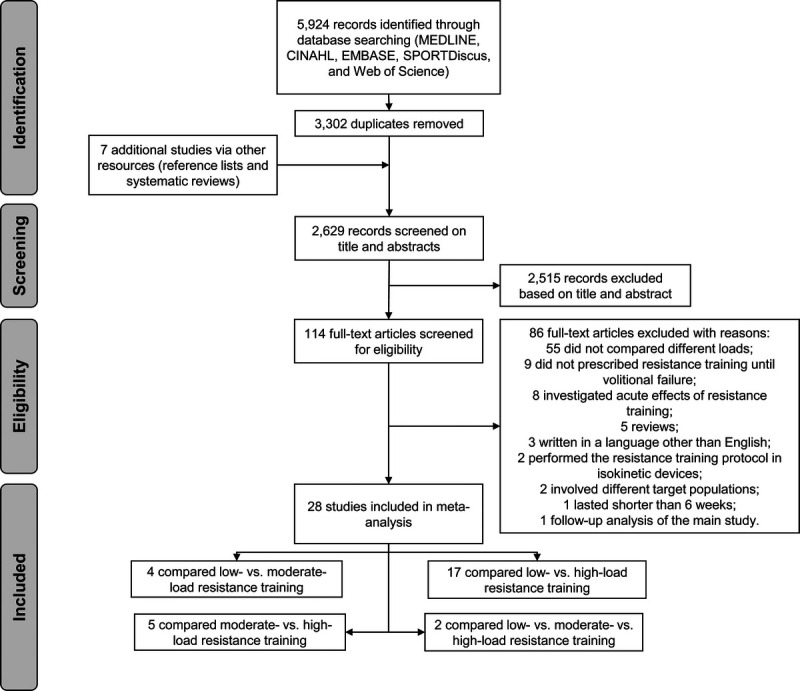
Purpose: This study aimed to analyze the effect of resistance training (RT) performed until volitional failure with low, moderate, and high loads on muscle hypertrophy and muscle strength in healthy adults and to assess the possible participant-, design-, and training-related covariates that may affect the adaptations. Methods: Using Preferred Reporting Items for Systematic Reviews and Meta-Analyses guidelines, MEDLINE, CINAHL, EMBASE, SPORTDiscus, and Web of Science databases were searched. Including only studies that performed sets to volitional failure, the effects of low- (>15 repetitions maximum (RM)), moderate- (9–15 RM), and high-load (≤8 RM) RTs were examined in healthy adults. Network meta-analysis was undertaken to calculate the standardized mean difference (SMD) between RT loads in overall and subgroup analyses involving studies deemed of high quality. Associations between participant-, design-, and training-related covariates with SMD were assessed by univariate and multivariate network meta-regression analyses. Results: Twenty-eight studies involving 747 healthy adults were included. Although no differences in muscle hypertrophy between RT loads were found in overall ( P = 0.113–0.469) or subgroup analysis ( P = 0.871–0.995), greater effects were observed in untrained participants ( P = 0.033) and participants with some training background who undertook more RT sessions ( P = 0.031–0.045). Muscle strength improvement was superior for both high-load and moderate-load compared with low-load RT in overall and subgroup analysis (SMD, 0.60–0.63 and 0.34–0.35, respectively; P < 0.001–0.003), with a nonsignificant but superior effect for high compared with moderate load (SMD, 0.26–0.28, P = 0.068). Conclusions: Although muscle hypertrophy improvements seem to be load independent, increases in muscle strength are superior in high-load RT programs. Untrained participants exhibit greater muscle hypertrophy, whereas undertaking more RT sessions provides superior gains in those with previous training experience.
Overview
CoChat Summary
TL;DR
Resistance training performed to volitional failure produced similar muscle hypertrophy across low, moderate, and high loads in healthy adults, while muscle strength gains were load-dependent and greater with high loads. The review supports high-load training for strength and either moderate or high loads for hypertrophy over short interventions.
Key findings
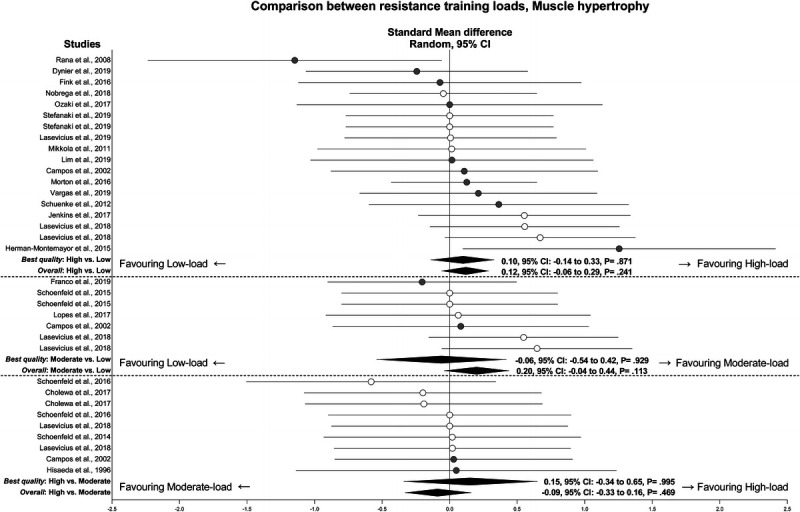
- In 28 studies (747 healthy adults; mean age 23.4 ± 3.0 yr), network meta-analysis found no significant differences in muscle hypertrophy between high vs low, moderate vs low, or high vs moderate loads (P = 0.113–0.469; I² = 0%). Best-intervention probabilities were 84.5% for moderate load overall and 75.8% for high load in best-quality studies, but effect sizes were small (range −0.09 to 0.15).
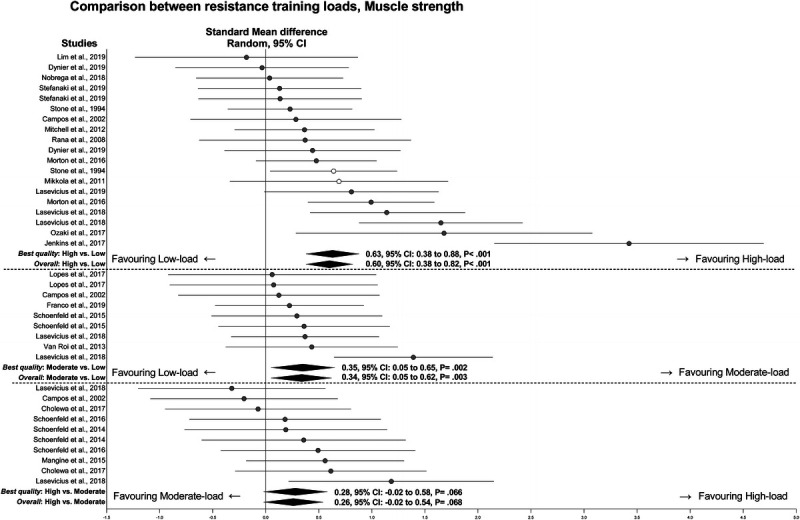
- Muscle strength was load-dependent: high-load training increased strength more than low-load (SMD 0.60; 95% CI 0.38–0.82; P < 0.001), and moderate-load more than low-load (SMD 0.34; 95% CI 0.05–0.62; P = 0.003). High vs moderate was nonsignificant (SMD 0.26; 95% CI −0.02 to 0.54; P = 0.068), with high load having 98.2% probability of being best.
- Meta-regression: for hypertrophy, training status was significant in high vs low (P = 0.033; untrained showed higher effects), and number of sessions was significant for moderate vs low (P = 0.031) and high vs moderate (P = 0.045). For strength, older studies (P = 0.023) and men (P = 0.037) showed higher effects in the low- vs high-load comparison.
Methods
- Systematic review and network meta-analysis following PRISMA and Cochrane Back Review Group criteria; searched MEDLINE, CINAHL, EMBASE, SPORTDiscus, and Web of Science up to December 2019. Included experimental studies in healthy adults comparing low (<60% 1-RM or >15 RM), moderate (60–79% 1-RM or 9–15 RM), and high (≥80% 1-RM or ≤8 RM) resistance training performed until volitional failure; excluded interventions <6 wk, blood flow restriction, non-English, or insufficient data.
- 28 studies included (24 hypertrophy, 23 strength); 747 participants; mean intervention 8.9 ± 2.1 wk and 24.6 ± 7.5 sessions (range 16–48); most studies involved men (19/28) and untrained participants (21/28). Outcomes were muscle hypertrophy (muscle mass/size) and muscle strength (1-RM).
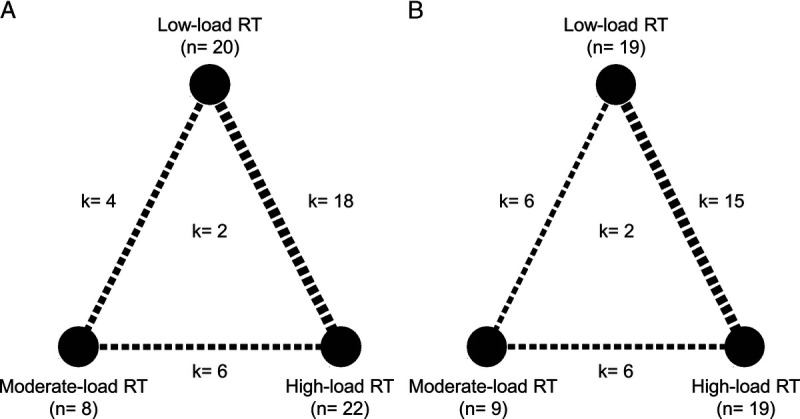
- Network meta-analysis used standardized mean differences from baseline to final assessment (R netmeta); subgroup analysis by risk of bias; univariate and multivariate network meta-regression (Stata mvmeta); risk of bias assessed with RoB 2.
Limitations
- The paper states included studies were mostly low quality due to concerns in randomization and outcome measurement; best-quality subgroup analyses were used and results maintained. It also states results cannot be extrapolated to highly strength-trained individuals, mostly young adults (23.4 ± 2.9 yr), nonspecific strength tests (isometric/isokinetic), or populations where volitional failure is not feasible; several studies performed multiple 1-RM tests, which may mask load differences; muscle size assessment is challenging; and few studies exceeded 14 wk.
- Evident from the text: publication bias was detected for muscle strength before adjustment (P = 0.014), with Anderson and Kearney identified as an outlier; heterogeneity was I² = 39.9% overall and 43.7% in best-quality strength analyses, while hypertrophy heterogeneity was I² = 0%. Most included studies were in men and untrained participants, limiting generalizability.
Model-written summary. Check it against the paper before relying on it.
Integrity signals
Registry
Cites
Statistics
Figures
Verification
Claims the paper makes
1 Valid · 0 Not valid · 25 Not checked · 58 Own results and interpretations
The cited sources support only part of this claim — read each source’s verdict below.
In the paper
“These differences are likely to be related to study design, conduct, and control because well-designed studies tend to get smaller effects and reducing bias over the years (70).”
§ Resistance Training Load Effects on Muscle Hypertrophy and Strength Gain: Systematic Review and Network Meta-analysis > DISCUSSION
What the sources say
- Partly supportedcites [70] Pannucci CJ Wilkins EG. Identifying and avoiding bias in research. Plast Reconstr Surg. 2010; 126(2): 619– 25. 20679844 PMC2917255 sourceExperimental — accuracy not yet measured
The paper’s “Definition and scope of bias” section says rigorous study design can reduce bias and gives an example in which more recent, rigorously designed studies reached a different result. It does not establish that well-designed studies generally produce smaller effects or that bias has declined over the years; it says bias can make estimates either larger or smaller. (LLM, conf=0.86)
hedgedstates a possible cause- Asserted: passes — The authors put it forward as true.
- Checkable: passes — It can be checked against evidence.
- Load-bearing: passes — The paper’s conclusions depend on it.
- Based: passes — The paper gives a reason why it holds.
- Partly supported
A result the paper reports from its own data — it cites no other source for it, so there is none to check. The quote shows it is in the paper.
In the paper
“Although the results of the consistency model indicate that moderate-load (84.5%) and high-load resistance training (75.8%) are the best load for muscle hypertrophy in overall and high-quality subgroup analyses, respectively, the ES values were unlikely to be considered meaningful (small ES: range, −0.09 to 0.15).”
§ Resistance Training Load Effects on Muscle Hypertrophy and Strength Gain: Systematic Review and Network Meta-analysis > RESULTS
hedged- Asserted: passes — The authors put it forward as true.
- Checkable: passes — It can be checked against evidence.
- Load-bearing: unclear — It is unclear whether the paper’s conclusions depend on it.
- Based: passes — The paper gives a reason why it holds.
A result the paper reports from its own data — it cites no other source for it, so there is none to check. The quote shows it is in the paper.
In the paper
“After the adjustment, the consistency network meta-analysis results show that high-load (SMD, 0.60; 95% confidence interval [CI], 0.38–0.82) and moderate-load (SMD, 0.34, 95% CI, 0.05–0.62) resulted in higher muscle strength effects when compared with low-load resistance training (P < 0.001 and 0.003, respectively).”
§ Resistance Training Load Effects on Muscle Hypertrophy and Strength Gain: Systematic Review and Network Meta-analysis > RESULTS
plainstates a cause- Asserted: passes — The authors put it forward as true.
- Checkable: passes — It can be checked against evidence.
- Load-bearing: passes — The paper’s conclusions depend on it.
- Based: passes — The paper gives a reason why it holds.
A result the paper reports from its own data — it cites no other source for it, so there is none to check. The quote shows it is in the paper.
In the paper
“Furthermore, no differences between the loads were observed in the subgroup analysis involving the best-quality studies (number of comparisons = 16, I2 = 0%, P = 0.871–0.995; Table 2).”
§ Resistance Training Load Effects on Muscle Hypertrophy and Strength Gain: Systematic Review and Network Meta-analysis > RESULTS
plain- Asserted: passes — The authors put it forward as true.
- Checkable: passes — It can be checked against evidence.
- Load-bearing: passes — The paper’s conclusions depend on it.
- Based: passes — The paper gives a reason why it holds.
A result the paper reports from its own data — it cites no other source for it, so there is none to check. The quote shows it is in the paper.
In the paper
“After the adjustment, the consistency network meta-analysis results show that high-load (SMD, 0.60; 95% confidence interval [CI], 0.38–0.82) and moderate-load (SMD, 0.34, 95% CI, 0.05–0.62) resulted in higher muscle strength effects when compared with low-load resistance training (P < 0.001 and 0.003, respectively).”
§ Resistance Training Load Effects on Muscle Hypertrophy and Strength Gain: Systematic Review and Network Meta-analysis > RESULTS
plainstates a cause- Asserted: passes — The authors put it forward as true.
- Checkable: passes — It can be checked against evidence.
- Load-bearing: passes — The paper’s conclusions depend on it.
- Based: passes — The paper gives a reason why it holds.
34 more claims
Create a free account to see all 84 claims and to verify the 41 references still open.
- It may state two separate claims as one. 36
- Probably not a substantial claim. 17
- The quote only partly states this claim. 1
Claims other papers make about this one
Each is checked against this paper’s own text: does it say what the citing paper says it does?
The source backs part of the claim, not all of it — or backs it for a different population, condition or comparison.
In the citing paper
“RT did not influence hypertrophy performed with low (1 d/wk) versus high (>5 d/wk) frequency when total volume was equated; low (30% 1RM) to high (100% 1RM) loads; contractions to muscle failure/fatigue; blood flow restriction; varying loads during repetitions; fast (0.5 s) versus slow (8 s) repetitions; power training techniques; periodization (linear, undulating, and nonperiodized); or exercise”
From American College of Sports Medicine Position Stand. Resistance Training Prescription for Muscle Function, Hypertrophy, and Physical Performance in Healthy Adults: An Overview of Reviews (2026) · cites this paper as [80]
Experimental — accuracy not yet measuredThe source backs part of the claim, not all of it — or backs it for a different population, condition or comparison.
In the citing paper
“Appropriately designed resistance training is generally viewed as the most efficient method of increasing skeletal muscle mass and strength in adults [52-54]”
From Fundamental Body Composition Principles Provide Context for Fat-Free and Skeletal Muscle Loss With GLP-1 RA Treatments (2024) · cites this paper as [54]
Experimental — accuracy not yet measuredThe cited source says what the claim attributes to it.
In the citing paper
“However, voluntary strength was enhanced by lifting heavier loads (≥80% one-repetition maximum), through a complete range of motion, for 2–3 sets, at the beginning of training sessions, and ≥2 sessions/wk.”
In the citing paper
“Previous studies have shown that traditional resistance training, particularly higher-load training, is generally more effective in promoting muscle strength improvements, accompanied by enhancements in muscle morphology and neural adaptations (72, 73).”
Self-check
Percentages, sums and reported differences re-computed from the paper’s own numbers.
Each contradiction between two passages listed here was confirmed by an independent check.
Rated minor: it would not touch a result — a value no result rests on, a p-value that stays on the same side of the significance level, or a conflict that is clerical, resolved elsewhere in the paper, or outside its own findings.
In the paper
§ Resistance Training Load Effects on Muscle Hypertrophy and Strength Gain: Systematic Review and Network Meta-analysis > RESULTS
“A total of 747 healthy men and women with an average age of 23.4 ± 3.0 yr participated in the included studies.”
§ Resistance Training Load Effects on Muscle Hypertrophy and Strength Gain: Systematic Review and Network Meta-analysis > DISCUSSION
“the present investigation included mostly studies undertaken in young adults (23.4 ± 2.9 yr)”
Rated minor: it would not touch a result — a value no result rests on, a p-value that stays on the same side of the significance level, or a conflict that is clerical, resolved elsewhere in the paper, or outside its own findings.
In the paper
“| High vs low | Year of publication | 1982–2019 | −0.11 ± 0.05 | −0.20 to −0.15 | 0.023 |”
§ Resistance Training Load Effects on Muscle Hypertrophy and Strength Gain: Systematic Review and Network Meta-analysis > RESULTS
Reported -0.11 · recomputed -0.175
Rated minor: it would not touch a result — a value no result rests on, a p-value that stays on the same side of the significance level, or a conflict that is clerical, resolved elsewhere in the paper, or outside its own findings.
In the paper
§ Resistance Training Load Effects on Muscle Hypertrophy and Strength Gain: Systematic Review and Network Meta-analysis > RESULTS
“The mean exercise intervention duration was 8.9 ± 2.1 wk, with an average of 24.6 ± 7.5 sessions (range, 16–48).”
§ Resistance Training Load Effects on Muscle Hypertrophy and Strength Gain: Systematic Review and Network Meta-analysis > RESULTS
“| High vs low | Number of sessions | 12–48 | 0.01 ± 0.01 | −0.02 to 0.05 | 0.518 |”
Citations
Cites
Bias in meta-analysis detected by a simple, graphical test
Egger, M., Smith, G. D., Schneider, M., & Minder, C. (1997) · BMJ · doi:10.1136/bmj.315.7109.629 · Cited by 56,722
RoB 2: a revised tool for assessing risk of bias in randomised trials
Sterne, J. A. C., Savović, J., Page, M. J., Elbers, R. G., Blencowe, N. S., Boutron, I., Cates, C. J., Cheng, H.-Y., Corbett, M. S., Eldridge, S. M., et al. (2019) · BMJ · doi:10.1136/bmj.l4898 · Cited by 34,787 · cited 2×
“Overall risk of bias was expressed as “low risk of bias” if all domains where classified as low risk, “some concerns” if some concern was raised in at least one domain but not classified as at high risk in any other, or “high risk of bias” if at least one domain was classified as high risk, or have multiple domains wi…”
BackgroundMethodLiberati, A., Altman, D. G., Tetzlaff, J., Mulrow, C., Gøtzsche, P. C., Ioannidis, J. P. A., Clarke, M., Devereaux, P. J., Kleijnen, J., & Moher, D. (2009) · PLoS Medicine · doi:10.1371/journal.pmed.1000100 · Cited by 28,164
Liberati, A., Altman, D. G., Tetzlaff, J., Mulrow, C., Gotzsche, P. C., Ioannidis, J. P. A., Clarke, M., Devereaux, P. J., Kleijnen, J., & Moher, D. (2009) · BMJ · doi:10.1136/bmj.b2700 · Cited by 17,648
Cumpston, M., Li, T., Page, M. J., Chandler, J., Welch, V. A., Higgins, J. P., & Thomas, J. (2019) · Cochrane Database of Systematic Reviews · doi:10.1002/14651858.ed000142 · Cited by 7,218
Cohen, J. (1992) · Current Directions in Psychological Science · doi:10.1111/1467-8721.ep10768783 · Cited by 5,870
Progression Models in Resistance Training for Healthy Adults
(2009) · Medicine & Science in Sports & Exercise · doi:10.1249/mss.0b013e3181915670 · Cited by 4,332
Progression Models in Resistance Training for Healthy Adults
(2002) · Medicine and Science in Sports and Exercise · doi:10.1097/00005768-200202000-00027 · Cited by 2,979
Self-citation2009 updated method guidelines for systematic reviews in the Cochrane Back Review Group
Furlan, A. D., Pennick, V., Bombardier, C., & van Tulder, M. (2009) · Spine · doi:10.1097/brs.0b013e3181b1c99f · Cited by 1,663 · cited 1×
“Study selection procedure The study was undertaken in accordance with the Preferred Reporting Items for Systematic Reviews and Meta-Analyses (PRISMA) statement (20, 21), and the method used was based on the minimum criteria established by the Cochrane Back Review Group (CBRG) (22).”
MethodNeural adaptation to resistance training
SALE, D. G. (1988) · Medicine & Science in Sports & Exercise · doi:10.1249/00005768-198810001-00009 · Cited by 1,421 · cited 1×
“As reported in previous literature, trained muscles may already present with an increased cross-sectional area (61) and lower anabolic signalling as observed in reduced AMPK and Akt phosphorylation after a resistance training session (62), resulting in an AC CE PT ED”
Background
Cited by
Egan, B., & Sharples, A. P. (2023) · Physiological Reviews · doi:10.1152/physrev.00054.2021 · Cited by 278
HUNTER, S. K., S. ANGADI, S., BHARGAVA, A., HARPER, J., HIRSCHBERG, A. L., D. LEVINE, B., L. MOREAU, K., J. NOKOFF, N., STACHENFELD, N. S., & BERMON, S. (2023) · Medicine & Science in Sports & Exercise · doi:10.1249/mss.0000000000003300 · Cited by 241
Currier, B. S., Mcleod, J. C., Banfield, L., Beyene, J., Welton, N. J., D'Souza, A. C., Keogh, J. A. J., Lin, L., Coletta, G., Yang, A., et al. (2023) · British Journal of Sports Medicine · doi:10.1136/bjsports-2023-106807 · Cited by 179
“⇒ Since all protocols increased strength and hypertrophy, rather than determining an ‘optimal’ protocol, future work could determine minimal ‘doses’ of resistance exercise and practices to promote engagement and adherence in this health-promoting form of exercise”
Mcleod, J. C., Currier, B. S., Lowisz, C. V., & Phillips, S. M. (2024) · Journal of Sport and Health Science · doi:10.1016/j.jshs.2023.06.005 · Cited by 176
“One low-quality review (QoE: Level 2), 36 2 moderate-quality reviews (QoE: Level 3), 44,48 and 1 high-quality review (QoE: Level 4) 37 provided evidence that RT load does not impact RT-induced skeletal muscle hypertrophy (Table 3).”
BackgroundInfluentialSchoenfeld, B., Fisher, J., Grgic, J., Haun, C., Helms, E., Phillips, S., Steele, J., & Vigotsky, A. (2021) · International Journal of Strength and Conditioning · doi:10.47206/ijsc.v1i1.81 · Cited by 124
“In accord with these findings, a subsequent meta-analysis on the topic concluded that hypertrophy was load-independent when comparing the effects of low- (>15 RM), moderate- (9-15 RM), and high-load (≤8 RM) training protocols (84).”
BackgroundResultCarvalho, L., Junior, R. M., Barreira, J., Schoenfeld, B. J., Orazem, J., & Barroso, R. (2022) · Applied Physiology, Nutrition, and Metabolism · doi:10.1139/apnm-2021-0515 · Cited by 116
CURRIER, B. S., D’SOUZA, A. C., SINGH, M. A. F., LOWISZ, C. V., RAWSON, E. S., SCHOENFELD, B. J., SMITH-RYAN, A. E., STEEN, J. P., THOMAS, G. A., TRIPLETT, N. T., et al. (2026) · Medicine & Science in Sports & Exercise · doi:10.1249/mss.0000000000003897 · Cited by 105
Training Specificity for Athletes: Emphasis on Strength-Power Training: A Narrative Review
Stone, M. H., Hornsby, W. G., Suarez, D. G., Duca, M., & Pierce, K. C. (2022) · Journal of Functional Morphology and Kinesiology · doi:10.3390/jfmk7040102 · Cited by 142
Tinsley, G. M., & Heymsfield, S. B. (2024) · Journal of the Endocrine Society · doi:10.1210/jendso/bvae164 · Cited by 81
“Appropriately designed resistance training is generally viewed as the most efficient method of increasing skeletal muscle mass and strength in adults [52-54] and therefore represents an appropriate modality to promote skeletal muscle preservation during weight loss.”
MethodNeuromuscular adaptations to resistance training in elite versus recreational athletes
Aslam, S., Habyarimana, J. D. D., & Bin, S. Y. (2025) · Frontiers in Physiology · doi:10.3389/fphys.2025.1598149 · Cited by 122
Huiberts, R. O., Wüst, R. C. I., & van der Zwaard, S. (2024) · Sports Medicine · doi:10.1007/s40279-023-01943-9 · Cited by 75
“Together with the greater muscle hypertrophy in untrained participants after strength training [153], one may expect untrained participants to show larger increases in the fiber cross-sectional area following concurrent training.”
Robinson, Z. P., Pelland, J. C., Remmert, J. F., Refalo, M. C., Jukic, I., Steele, J., & Zourdos, M. C. (2024) · Sports Medicine · doi:10.1007/s40279-024-02069-2 · Cited by 63
“It is well established that the configuration of resistance training variables, such as set volume [1, 2], load [percentage of one-repetition maximum (% of 1RM)] [3, 4], and frequency [6], can impact resistance training outcomes.”
Lacio, M., Vieira, J. G., Trybulski, R., Campos, Y., Santana, D., Filho, J. E., Novaes, J., Vianna, J., & Wilk, M. (2021) · International Journal of Environmental Research and Public Health · doi:10.3390/ijerph182111237 · Cited by 55
“60–79% 1RM, or 9–15RM) during resistance training performed until volitional failure in healthy adults [19].”
BackgroundResultWeight Pulling: A Novel Mouse Model of Human Progressive Resistance Exercise
Zhu, W. G., Hibbert, J. E., Lin, K. H., Steinert, N. D., Lemens, J. L., Jorgenson, K. W., Newman, S. M., Lamming, D. W., & Hornberger, T. A. (2021) · Cells · doi:10.3390/cells10092459 · Cited by 53
“For instance, numerous studies have shown that 8-16 weeks of PRE can lead to a 5-20% increase in skeletal muscle mass/volume along with an even greater increase in strength [8-10].”
BackgroundResultHenkin, J. S., Pinto, R. S., Machado, C. L. F., & Wilhelm, E. N. (2023) · Experimental Gerontology · doi:10.1016/j.exger.2023.112193 · Cited by 78
Self-citationRefalo, M. C., Helms, E. R., Hamilton, D. L., & Fyfe, J. J. (2022) · Journal of Sports Sciences · doi:10.1080/02640414.2022.2080165 · Cited by 48
Orange, S. T., Hritz, A., Pearson, L. T., Jeffries, O., Jones, T. W. A., & Steele, J. (2022) · Journal of Sports Sciences · doi:10.1080/02640414.2022.2059320 · Cited by 61
“Resistance training load is an important variable in resistance training programmes because it influences adaptations in muscle strength, at least when strength is operationalised as one repetition maximum (1RM) or maximum voluntary contraction (Fink et al., 2016; Lopez et al., 2021).”
BackgroundComparison of therapies of white spot lesions: a systematic review and network meta-analysis
Xie, Z., Yu, L., Li, S., Li, J., & Liu, Y. (2023) · BMC Oral Health · doi:10.1186/s12903-023-03076-x · Cited by 71
“We also compared other systematic reviews that were not included in other languages to identify possible bias [114, 115].”
ResultRefalo, M. C., Hamilton, D. L., Paval, D. R., Gallagher, I. J., Feros, S. A., & Fyfe, J. J. (2021) · Journal of Sports Sciences · doi:10.1080/02640414.2021.1898094 · Cited by 45
Physiology of Stretch-Mediated Hypertrophy and Strength Increases: A Narrative Review
Warneke, K., Lohmann, L. H., Lima, C. D., Hollander, K., Konrad, A., Zech, A., Nakamura, M., WIRTH, K. J., Keiner, M., & Behm, D. G. (2023) · Sports Medicine · doi:10.1007/s40279-023-01898-x · Cited by 61
“…seems to provide a sufficient stimulus to enhance flexibility [36, 37], while on the other hand, animal studies reported hypertrophy and strength increases by attaching weight/resistance to one wing of a quail or using a stretching apparatus [34, 35] to apply (weighted) stretch to the muscles.”
BackgroundSexton, C. L., Godwin, J. S., McIntosh, M. C., Ruple, B. A., Osburn, S. C., Hollingsworth, B. R., Kontos, N. J., Agostinelli, P. J., Kavazis, A. N., Ziegenfuss, T. N., et al. (2023) · Cells · doi:10.3390/cells12020263 · Cited by 44
Hunter, S. K., Angadi, S. S., Bhargava, A., Harper, J., Hirschberg, A. L., Levine, B. D., Moreau, K. L., Nokoff, N. J., Stachenfeld, N. S., & Bermon, S. (2023) · Translational Journal of the American College of Sports Medicine · doi:10.1249/tjx.0000000000000236 · Cited by 43
Aerobic Adaptations to Resistance Training: The Role of Time under Tension
Mang, Z. A., Ducharme, J. B., Mermier, C. M., Kravitz, L. R., Magalhães, F. D. C., & Amorim, F. T. (2022) · International Journal of Sports Medicine · doi:10.1055/a-1664-8701 · Cited by 48
Effects of Resistance Training Overload Progression Protocols on Strength and Muscle Mass
Chaves, T. S., Scarpelli, M. C., Bergamasco, J. G. A., da Silva, D. G., Medalha, R. A., Dias, N. F., Bittencourt, D., Filho, P. C. C., Angleri, V., Nóbrega, S. R., et al. (2024) · International Journal of Sports Medicine · doi:10.1055/a-2256-5857 · Cited by 45
“In fact, previous studies suggest that there seems to be a greater difference in strength gains between protocols with loads greater than 80 % 1RM when compared to protocols with loads below 60 % 1RM [31, 32].”
Rodríguez, M. Á., Quintana-Cepedal, M., Cheval, B., Thøgersen-Ntoumani, C., Crespo, I., & Olmedillas, H. (2026) · British Journal of Sports Medicine · doi:10.1136/bjsports-2025-110027 · Cited by 39
“75 76 This may be due to the use of bodyweight exercises, which might not have provided the necessary overload to achieve a significant cumulative training effect on the body.”
Miras‐Moreno, S., Pérez‐Castilla, A., & García‐Ramos, A. (2022) · International Journal of Sports Physiology and Performance · doi:10.1123/ijspp.2021-0534 · Cited by 31
Radaelli, R., Rech, A., Molinari, T., Markarian, A. M., Πετροπούλου, Μ., Granacher, U., Hortobágyi, T., & López, P. (2024) · Sports Medicine · doi:10.1007/s40279-024-02123-z · Cited by 46
“In contrast, our results concur and extend the findings from our previous network meta-analysis [217] and the study by Cur-rier et al. [218].”
Self-citationde Queirós, V. S., de França, I. M., Trybulski, R., Vieira, J. G., dos Santos, Í. K., Neto, G. R., Wilk, M., de Matos, D. G., Vieira, W. H. D. B., Novaes, J. D. S., et al. (2021) · Frontiers in Physiology · doi:10.3389/fphys.2021.786752 · Cited by 33
“This is certainly justified by the fact that some evidence indicates that lowload {20–40% of 1 repetition maximum [1RM] (Lopez et al., 2021)} resistance training with arterial BFR and venous occlusion artificially induced can promote gains in muscle strength and hypertrophy more pronounced than low-load resistance tra…”
BackgroundDevries, M. C., & Giangregorio, L. (2022) · Bone · doi:10.1016/j.bone.2022.116573 · Cited by 39
Jukić, I., King, A., Sousa, C. A., Prnjak, K., & McGuigan, M. R. (2023) · Scientific Reports · doi:10.1038/s41598-023-34416-0 · Cited by 31
Rodrigues, F. F., Amaro, N., Matos, R. M. N., Mendes, D., Monteiro, D., & Morouço, P. (2022) · Frontiers in Physiology · doi:10.3389/fphys.2022.1039131 · Cited by 34
“Indeed, improvements were quite like those expressed in a recent review with 28 studies focused on resistance training (Lopez et al., 2021).”
BackgroundYin, H., Zhang, J., Lian, M., & Zhang, Y. (2025) · BMC Public Health · doi:10.1186/s12889-025-22829-7 · Cited by 41
“One possible explanation is that muscle strength improvements depend more on overall training volume, intensity, and resistance load [60].”
Matcha green tea beverage moderates fatigue and supports resistance training-induced adaptation
Shigeta, M., Aoi, W., Morita, C., Soga, K., Inoüe, R., Fukushima, Y., Kobayashi, Y., & Kuwahata, M. (2023) · Nutrition Journal · doi:10.1186/s12937-023-00859-4 · Cited by 36
“As a counter-intervention, resistance exercise training has been recommended to improve athletic performance and prevent sarcopenia in older adults [1].”
BackgroundYu, Q., Kong, Z., Zou, L., Chapman, R. F., Shi, Q., & Nie, J. (2023) · Journal of Exercise Science & Fitness · doi:10.1016/j.jesf.2023.09.001 · Cited by 29
“63,64 Identified predictors driven by a 95% CI from univariate regression were selected as multiple variables in the next multivariate regression analysis.”
MethodCao, S., Wang, Z., Guo, J., Soh, K. G., Sun, H., & Liu, J. (2024) · Frontiers in Physiology · doi:10.3389/fphys.2024.1386788 · Cited by 54
Zhang, X., Weakley, J. J. S., Li, H., Li, Z., & García‐Ramos, A. (2025) · Sports Medicine · doi:10.1007/s40279-025-02176-8 · Cited by 28
“Such an intervention may not provide the specific stimulus required to induce maximal strength improvement [83, 84].”
Helén, J., Kyröläinen, H., Ojanen, T., Pihlainen, K., Santtila, M., Heikkinen, R., & Vaara, J. P. (2023) · The Journal of Strength and Conditioning Research · doi:10.1519/jsc.0000000000004559 · Cited by 47
The Minimum Effective Training Dose Required for 1RM Strength in Powerlifters
Androulakis‐Korakakis, P., Michalopoulos, N., Fisher, J. P., Keogh, J., Loenneke, J. P., Helms, E. R., Wolf, M., Nuckols, G., & Steele, J. (2021) · Frontiers in Sports and Active Living · doi:10.3389/fspor.2021.713655 · Cited by 35
Sheng-tao, Y., Zhang, P., Sevilla-Sánchez, M., Zhou, D., Cao, J., He, J., Gao, B., & Carballeira, E. (2022) · Frontiers in Physiology · doi:10.3389/fphys.2022.852693 · Cited by 33
Hortobágyi, T., Větrovský, T., Brach, J. S., van Haren, M., Voleský, K., Radaelli, R., López, P., & Granacher, U. (2023) · Sports Medicine - Open · doi:10.1186/s40798-023-00585-5 · Cited by 30
“, sarcopenia) is associated with an increase in falls [22–24], frailty [25], fractures [26], intra- and inter-muscular fat accumulation [27, 28], risks for cardiovascular disease [29], incidence of cancer [30–32], mental health problems [20, 33], cognitive impairment [34], hospitalization [24], morbidity, and mortalit…”
BackgroundInfluentialSelf-citationHammert, W. B., Dankel, S. J., Kataoka, R., Yamada, Y., Kassiano, W., Song, J. S., & Loenneke, J. P. (2024) · The Journal of Strength and Conditioning Research · doi:10.1519/jsc.0000000000004978 · Cited by 26
Khazaei, L., Parnow, A., & Amani-Shalamzari, S. (2023) · BMC Sports Science Medicine and Rehabilitation · doi:10.1186/s13102-023-00754-9 · Cited by 37
“Resistance training (RT), which increases hypertrophy [16], maximum strength [16–19], and hence muscle power, is often an integral part of the athlete’s long-term development plans [20].”
BackgroundHernández‐Belmonte, A., & Pallarés, J. G. (2022) · Applied Sciences · doi:10.3390/app12094425 · Cited by 27
Review of Exercise Interventions to Improve Clinical Outcomes in Nondialysis CKD
Hayden, C., Begue, G., Gamboa, J. L., Baar, K., & Roshanravan, B. (2024) · Kidney International Reports · doi:10.1016/j.ekir.2024.07.032 · Cited by 23
Lecce, E., Romagnoli, R., Frinolli, G., Felici, F., Piacentini, M. F., & Bazzucchi, I. (2024) · European Journal of Applied Physiology · doi:10.1007/s00421-024-05604-1 · Cited by 21
“…explaining mentioned enhancements are linked to specific changes in motor unit behavior (Del Vecchio et al. 2019) that are at the base of various observations of increases in force and power following a strength training period (Bandy et al. 1990; Lopez et al. 2021; Sale 1988; Sarabia et al. 2017).”
InfluentialBMAL1/PGC1α4-FNDC5/irisin axis impacts distinct outcomes of time-of-day resistance exercise
Guo, M., Shen, F., Guo, X., Zhang, J., Ma, Y., Wu, X., Zuo, H., Yao, J., Hu, Y., Wang, D., et al. (2024) · Journal of sport and health science/Journal of Sport and Health Science · doi:10.1016/j.jshs.2024.100968 · Cited by 25
Lin, T., Chueh, T., & Hung, T. (2023) · Sports Medicine - Open · doi:10.1186/s40798-023-00640-1 · Cited by 19
Cano-Sánchez, J., Aibar‐Almazán, A., Hita‐Contreras, F., Afanador-Restrepo, D. F., Martínez‐Amat, A., Achalandabaso‐Ochoa, A., & Carcelén‐Fraile, M. D. C. (2024) · Journal of Clinical Medicine · doi:10.3390/jcm13051378 · Cited by 24
“Among the anticipated outcomes of this training approach are increased muscle size and strength, contributing to improvements in performance, endurance, and overall health [21].”
BackgroundRodrigues, F. F., Jacinto, M., Figueiredo, N., Monteiro, A. M., & Forte, P. M. (2023) · Medicina · doi:10.3390/medicina59020371 · Cited by 30
“Indeed, the gains were similar to those reported in a recent review of 28 studies on resistance training [37].”
ResultPelland, J. C., Remmert, J. F., Robinson, Z. P., Hinson, S. R., & Zourdos, M. C. (2026) · Sports Medicine · doi:10.1007/s40279-025-02344-w · Cited by 18
“Therefore, in addition to potential beneficial effects on muscular adaptations, it is possible that higher frequencies lead to higher quality practice, ultimately increasing training performance and therefore loads used (119).”
Robinson, Z. P., Helms, E. R., Trexler, E. T., Steele, J., Hall, M. E., Huang, C.-J., & Zourdos, M. C. (2024) · Sports Medicine · doi:10.1007/s40279-024-02050-z · Cited by 24
“Indeed, the results of meta-analyses have led researchers to establish general training recommendations for volume [2, 3] and load [4, 5] based on group-level data.”
Costa, J. S. R., Fonseca, G. F. A. C., Ottone, N. C. D. S., Silva, P. A., Antonaccio, R. F., Silva, G., Rocha, M. D. S. A., Coimbra, C. C., Esteves, E. A., Mang, Z. A., et al. (2021) · Life Sciences · doi:10.1016/j.lfs.2021.119639 · Cited by 21
Abuse of Anabolic-Androgenic Steroids and Adverse Effects on Human Organ Health: A Review
(2022) · Biointerface Research in Applied Chemistry · doi:10.33263/briac133.281 · Cited by 28
Häkkinen, K., Newton, R. U., Walker, S., HÄKKINEN, A. H., Krapi, S., Rekola, R., Koponen, P., Kraemer, W. J., Haff, G. G., Blazevich, A. J., et al. (2022) · Journal of Sports Science and Medicine · doi:10.52082/jssm.2022.200 · Cited by 21
Self-citationGodwin, J. S., Sexton, C. L., Kontos, N. J., Ruple, B. A., Willoughby, D. S., Young, K. C., Mobley, C. B., & Roberts, M. D. (2023) · Journal of Applied Physiology · doi:10.1152/japplphysiol.00596.2022 · Cited by 18
Cordingley, D. M., Anderson, J. E., & Cornish, S. M. (2022) · Journal of Science in Sport and Exercise · doi:10.1007/s42978-022-00164-2 · Cited by 24
“The decrease in irisin and LIF response observed with age and decrease in IL-4, IL-7, irisin and LIF with training in response to acute BFR-RE could contribute to the reported differences in musculoskeletal adaptations to resistance exercise with advancing age [29, 49, 69]and level of training [55].”
BackgroundSteele, J., Malleron, T., Har-Nir, I., Androulakis‐Korakakis, P., Wolf, M., Fisher, J. P., & Halperin, I. (2022) · Sports Medicine · doi:10.1007/s40279-022-01717-9 · Cited by 22
“participants reach or approach task failure in sets, hypertrophic adaptations are similar irrespective of the loads lifted [41, 51, 56], although improvements in maximal strength (as measured with 1RM) are superior when using heavier loads [41, 56, 57].”
BackgroundPosnakidis, G., Aphamis, G., Giannaki, C. D., Mougios, V., & Bogdanis, G. C. (2022) · Sports · doi:10.3390/sports10120207 · Cited by 19
“Recent evidence suggests that muscle hypertrophy can be achieved using low loads, provided that sets are preformed to volitional failure, which is not always the case in HIFT [15].”
BackgroundSinger, A., Wolf, M., Generoso, L., Arias, E., Delcastillo, K., Echevarria, E., Martinez, A., Androulakis Korakakis, P., Refalo, M. C., Swinton, P. A., et al. (2024) · Frontiers in Sports and Active Living · doi:10.3389/fspor.2024.1429789 · Cited by 14
Intentionally Slow Concentric Velocity Resistance Exercise and Strength Adaptations: A Meta-Analysis
Hermes, M. J., & Fry, A. C. (2023) · The Journal of Strength and Conditioning Research · doi:10.1519/jsc.0000000000004490 · Cited by 18
“Intensity seems to highly influence strength adaptations, with previous meta-analyses indicating that higher intensities better facilitate strength adaptations than lower intensities (41,58).”
BackgroundResultHernández‐Belmonte, A., Martínez-Cava, A., Buendía‐Romero, Á., Franco‐López, F., & Pallarés, J. G. (2023) · Medicine & Science in Sports & Exercise · doi:10.1249/mss.0000000000003271 · Cited by 21
“Therefore, athletes are encouraged to focus their attention on other training parameters widely shown to be key modulators of these adaptations, such as the intentionality of execution (44,45), intensity (24), volume (46), intraset fatigue (23), or range of motion (1).”
BackgroundMethodCarpenter, D. J., Peluso, C., Hilton, C. J., Velasquez, F., Annichine, A., Matsko, K., Rosenberg, J., Diaz, A. K., Hyde, P. N., Beriwal, S., et al. (2024) · Cancer Medicine · doi:10.1002/cam4.7001 · Cited by 18
Čurović, I., Rhodes, D., Alexander, J., & Harper, D. J. (2024) · Sports Medicine · doi:10.1007/s40279-024-02039-8 · Cited by 17
“…that, with the exception of Cook et al. [54], who studied semi-professional rugby players, all other investigations involved untrained or recreationally active individuals who could gain notable improvements in strength and hypertrophy with a smaller number of resistance training sessions [131].”
BackgroundYapici, H., Gülü, M., Yagin, F. H., Ugurlu, D., Comertpay, E., Eroglu, O., Kocoğlu, M., Aldhahi, M. I., Karayigit, R., & Badri AL-Mhanna, S. (2023) · Frontiers in Physiology · doi:10.3389/fphys.2023.1148494 · Cited by 13
“In addition, participants with previous RT experience and participants without training experience also provide different adaptations (Lopez et al., 2021).”
BackgroundЧернозуб, А. А., Manolachi, V., Tsos, А., Potop, V., Korobeynikov, G., Manolachi, V., Sherstiuk, L., Zhao, J., & Mihăilă, I. (2023) · PeerJ · doi:10.7717/peerj.14878 · Cited by 23
Jukić, I., Helms, E. R., & McGuigan, M. R. (2023) · Physiology & Behavior · doi:10.1016/j.physbeh.2023.114158 · Cited by 15
Kassiano, W., Nunes, J. P., Costa, B. D. D. V., Ribeiro, A. S., Loenneke, J. P., & Cyrino, E. S. (2025) · Sports Medicine · doi:10.1007/s40279-024-02169-z · Cited by 17
“Of note, the hypothesis that lifting high loads could result in greater hypertrophy has been refuted [37, 38], and the relationship between greater electromyographic activity and hypertrophy has also been challenged [39, 40].”
Opara, M., & Kozinc, Ž. (2023) · Journal of Functional Morphology and Kinesiology · doi:10.3390/jfmk8020074 · Cited by 12
Tian, S., Liang, Z., Tian, M., Qiu, F., Yu, Y., Mou, H., & Gao, Y. (2024) · Age and Ageing · doi:10.1093/ageing/afae211 · Cited by 20
Mcleod, J. C., Lim, C., Stokes, T., Sharif, J.-A., Zeynalli, V., Wiens, L., D’Souza, A. C., Colenso‐Semple, L. M., McKendry, J., Morton, R. W., et al. (2024) · NAR Molecular Medicine · doi:10.1093/narmme/ugae016 · Cited by 12
HERMANN, T., MOHAN, A. E., ENES, A., SAPUPPO, M., PIÑERO, A., ZAMANZADEH, A., ROBERTS, M., COLEMAN, M., KORAKAKIS, P. A., WOLF, M., et al. (2025) · Medicine & Science in Sports & Exercise · doi:10.1249/mss.0000000000003728 · Cited by 12
Wang, Z., ATAKAN, M. M., Açar, B., Xiong, R., & Peng, L. (2023) · Journal of Human Kinetics · doi:10.5114/jhk/163013 · Cited by 14
“However, there is a strong trend for heavier load conditions to be superior in terms of strength and hypertrophy outcomes (Lopez et al., 2021; Refalo et al., 2021; Schoenfeld et al., 2016).”
BackgroundReljic, D., Koller, A., Herrmann, H. J., Ekici, A. B., Neurath, M. F., & Zopf, Y. (2023) · Antioxidants · doi:10.3390/antiox12101847 · Cited by 13
Enes, A. A. N., Oneda, G., Leonel, D. F., Lemos, L., Alves, F., Ferreira, L. H. B., Escalante, G., Schoenfeld, B. J., & de Souza, T. P. (2024) · European Journal of Sport Science · doi:10.1002/ejsc.12042 · Cited by 12
“In addition, it is well ‐ documented that high loads are a main driver of muscle strength adaptations (Lopez et al., 2021).”
BackgroundNormand‐Gravier, T., Solsona, R., Dablainville, V., Racinais, S., Borrani, F., Bernardi, H., & Sanchez, A. M. J. (2024) · European Journal of Applied Physiology · doi:10.1007/s00421-024-05642-9 · Cited by 21
“Resistance exercise particularly promotes hypertrophy through an increase in fiber cross-sectional area (CSA) and strength gains (Lopez et al. 2021).”
Alibazi, R. J., Frazer, A. K., Pearce, A. J., Tallent, J., Avela, J., & Kidgell, D. J. (2021) · Journal of Sports Sciences · doi:10.1080/02640414.2021.2004681 · Cited by 11
“to be independent of relative intensity (Lopez et al., 2021), the differences in the increase in muscle strength brought about by low- and high-intensity strength training may be related to modifications in the corticospinal responses to strength”
BackgroundSaunders, B., da Costa, L. R., de Souza, R. A. S., Barreto, G., & Marticorena, F. M. (2023) · Advances in food and nutrition research · doi:10.1016/bs.afnr.2023.03.002 · Cited by 15
Carneiro, M. A. S., Kassiano, W., Júnior, G. N. D. O., de Sousa, J. F. R., Cyrino, E. S., & Orsatti, F. L. (2023) · Medicine & Science in Sports & Exercise · doi:10.1249/mss.0000000000003176 · Cited by 13
Maté‐Muñoz, J. L., Garnacho‐Castaño, M. V., Hernández-Lougedo, J., Maicas-Pérez, L., Notario-Alonso, R., Silva‐Grigoletto, M. E. D., García-Fernández, P., & Elvar, J. R. H. (2022) · Biology · doi:10.3390/biology11020336 · Cited by 11
de Camargo, J. B. B., Brigatto, F. A., Zaroni, R. S., Trindade, T. B., Germano, M. D., Tavares, A. C., de Oliveira, T. P., Marchetti, P. H., Prestes, J., & Lopes, C. R. (2022) · International journal of exercise science · doi:10.70252/vyub3717 · Cited by 26
Yi, Q., Yang, C., Qi, Y., Feng, X., Tan, J., Song, X., Selvanayagam, V. S., & Cheong, J. P. G. (2025) · BMC Public Health · doi:10.1186/s12889-025-22321-2 · Cited by 13
“In addition, some older adults engage in strength and resistance training, which can enhance neuromuscular efficiency [58], muscle hypertrophy [59], and increased muscle fiber recruitment [60] significantly benefiting muscle strength.”
Pyramidal resistance training: A brief review of acute responses and long-term adaptations
Cardozo, D., & Destro, D. D. S. (2023) · Journal of Bodywork and Movement Therapies · doi:10.1016/j.jbmt.2023.04.070 · Cited by 11
Miras‐Moreno, S., Pérez‐Castilla, A., Rojas, F. J., & García‐Ramos, A. (2023) · Heliyon · doi:10.1016/j.heliyon.2023.e19628 · Cited by 15
“, number of sets and repetitions) are two of the most important variables that can be manipulated to induce selective gains in different strength manifestations [4,5].”
BackgroundMoreno-Villanueva, A., Pino‐Ortega, J., & Rico-González, M. (2021) · Strength and conditioning journal · doi:10.1519/ssc.0000000000000695 · Cited by 10
“These results could be due to greater load intensity (36,37) and the total repetition MAD (23,64).”
BackgroundPhysical activity levels affect mental health and behavior in men
Carreira-Míguez, M., & Clemente‐Suárez, V. J. (2023) · Journal of Men s Health · doi:10.22514/jomh.2023.048 · Cited by 9
“is an important variable in muscular endurance training to successfully increase muscle size and strength [54].”
BackgroundCampbell, K. L., Brown, J. C., Lee, C., Weltzien, E. K., Li, J., Sternfeld, B., Campbell, N., Vaughan, M. R., Fedric, R., Meyerhardt, J. A., et al. (2024) · Medicine & Science in Sports & Exercise · doi:10.1249/mss.0000000000003395 · Cited by 11
“Therefore, there is interest in interventions aimed at maintaining or increasing muscle mass using best-practice, evidence-informed RT methods (15).”
Barrero, C. V., Núñez-Sánchez, F. J., Loturco, I., & Pareja‐Blanco, F. (2023) · Biology of Sport · doi:10.5114/biolsport.2024.129487 · Cited by 11
“…of higher training loads may have more similar requirements and thus be more transferable to tasks with maximum or near-maximum force requirements, evoking greater ad - aptations to the 1RM test [31], and possibly induce larger increas - es in maximal neural activation and muscle thickness [29].”
Hickmott, L. M., Butcher, S. J., & Chilibeck, P. D. (2025) · European Journal of Applied Physiology · doi:10.1007/s00421-025-05709-1 · Cited by 8
“…for the percentage of 1RM nor neuromuscular fatigue, although quantifying load and fatigue are important in RT contexts to target specific acute and chronic responses whilst managing and monitoring performance (Lopez et al. 2021; Schoenfeld et al. 2017a; Jukic et al. 2023a; Hickmott et al. 2022).”
InfluentialLees, M. J., Mcleod, J. C., Morton, R. W., Currier, B. S., Fliss, M. D., McKellar, S. R., Sidhu, R., Stansfield, B. N., Webb, E. K., McGlory, C., et al. (2025) · The Journal of Physiology · doi:10.1113/jp289684 · Cited by 10
Castro-Coronado, J., Yasima-Vásquez, G., Zapata‐Lamana, R., Toloza–Ramirez, D., & Cigarroa, I. (2021) · Revista Española de Geriatría y Gerontología · doi:10.1016/j.regg.2021.05.004 · Cited by 14
Molinari, T., Molinari, T., Rabello, R., & Rodrigues, R. (2022) · Sport Sciences for Health · doi:10.1007/s11332-021-00872-2 · Cited by 12
“Finally, protocols with a reduced number of repetitions and higher load (< 8 RM) are believed to result in increased gains in maximal strength when compared to those with a higher number of repetitions (such as ours) [40].”
BackgroundTian, S., Liang, Z., Qiu, F., Yu, Y., Mou, H., Zhang, G., & Zhang, H. (2024) · Applied Psychology Health and Well-Being · doi:10.1111/aphw.12573 · Cited by 11
Knowledge of gym goers on myths and truths in resistance training
Unger, A., Mosgan, C., Wolte, C., Pettauer, S., & Wilke, J. (2025) · Scientific Reports · doi:10.1038/s41598-025-87485-8 · Cited by 10
“Seven papers investigated the impact of training load on hypertrophy 52–58 or maximum strength 52,55,59 , and five reviews focused on the role of training frequency 60–64 .”
Cano-Montoya, J., Rojas-Vargas, M., Vargas, S. B., Vergara, C. N., Martínez-Huenchullán, S., Gallegos, F., Álvarez, C., & Izquierdo, M. (2025) · BMC Sports Science Medicine and Rehabilitation · doi:10.1186/s13102-025-01119-0 · Cited by 12
“Physical exercise is known to enhance various aspects of PF, including body composition [9], muscle strength [10], and cardiorespiratory fitness [11], particularly in older adults [12].”
Gao, Y., Yang, Y., Xian, C., & Wang, Z. (2025) · Frontiers in Physiology · doi:10.3389/fphys.2025.1629055 · Cited by 13
Franke, R. D. A., Rodrigues, R., López, P., Nakamura, F. Y., & Baroni, B. M. (2025) · The Journal of Strength and Conditioning Research · doi:10.1519/jsc.0000000000005184 · Cited by 8
Tan, Z., Jiang, Y., Candow, D. G., Castagna, C., Wang, X., & Zheng, H. (2026) · European Review of Aging and Physical Activity · doi:10.1186/s11556-025-00399-2 · Cited by 14
“Using CTV allows modeling of non-linear dose-response relationships between total training dose and clinical outcomes (MS, WA, and body-composition indices), aligning with the FITT-VP framework by quantitatively operationalizing its “Volume” and “Time” components [34].”
InfluentialYang, M., Liang, B., ZHAO, X., Wang, Y., XUE, M., & Wang, D. (2023) · Medicine & Science in Sports & Exercise · doi:10.1249/mss.0000000000003228 · Cited by 8
“One study has shown that people presented different tolerances and neuromuscular fatigue in response to different training loads, which affected the effectiveness of rehabilitation training program (13).”
Backgroundde Oliveira, N. T., López, P., Severo-Silveira, L., Almeida, G. P. L., & Baroni, B. M. (2023) · Physical Therapy in Sport · doi:10.1016/j.ptsp.2023.07.006 · Cited by 12
Reis-Silva, A., Coelho-Oliveira, A. C., Moura-Fernandes, M. C., Bessa, M.-O. B., Batouli-Santos, D., Bernardo-Filho, M., & de Sá-Caputo, D. D. C. (2023) · Frontiers in Physiology · doi:10.3389/fphys.2023.1202613 · Cited by 8
Metadata
- Authors
- LOPEZ, P., RADAELLI, R., TAAFFE, D. R., NEWTON, R. U., GALVÃO, D. A., TRAJANO, G. S., TEODORO, J. L., KRAEMER, W. J., HÄKKINEN, K., & PINTO, R. S.
- Affiliations
- Universidade Federal do Rio Grande do Sul (BR)
- Edith Cowan University (AU)
- Queensland University of Technology (AU)
- The Ohio State University (US)
- University of Jyväskylä (FI)
- ORCID
- Venue
- Medicine & Science in Sports & Exercise
- Published
- 2020-12-26
- Volume
- 53
- Issue
- 6
- Pages
- 1206-1216
- ISSN
- 0195-9131 (ISSN-L)
- 1530-0315
- PMC
- PMC8126497
- OpenAlex
- W3119537491
- Semantic Scholar
- 23abfcf627b4b65f4f7964db5fb1375d91d0ec32
- Cited by
- 340
- References
- 74
- Citations by year
- 2026: 78 · 2025: 70 · 2024: 81 · 2023: 67 · 2022: 32 · 2021: 12
- FWCI
- 5.46
- Type
- journal article
- Language
- en
- Update notices
- correction (2022-02-01)
- Open access
- hybrid
- doi.org
- Licence
- Locations
- Medicine & Science in Sports & Exercise (publishedVersion, cc-by-nc-nd)
- PubMed Central (publishedVersion, cc-by-nc-nd)
- PubMed (publishedVersion)
- QUT ePrints (Queensland University of Technology) (submittedVersion, cc-by-nc-nd)
- Jyväskylä University Digital Archive (University of Jyväskylä) (submittedVersion, cc-by-nc-nd)
- Australasian Journal of Paramedicine (submittedVersion, cc-by-nc-nd)
- Funders
- National Health and Medical Research Council
- Topics
- Health Sciences › Medicine › Orthopedics and Sports Medicine › Sports Performance and Training
- Health Sciences › Medicine › Physiology (medical) › Cardiovascular and exercise physiology
- Health Sciences › Nursing › Nutrition and Dietetics › Muscle metabolism and nutrition
- Keywords
- resistance training, training load, muscle hypertrophy, muscle strength, repetitions to failure, high-load resistance training, training experience, training sessions
- MeSH terms
- Network Meta-Analysis, Skeletal Muscle Enlargement, Adult, Female, Humans, Male, Muscle Strength, Resistance Training
About these checks
Registry, retraction, Cites and statistics results are computed, not judged, with one exception: a printed reference that no index lists is read once by a model before it counts as a citation error. Claims are extracted by a model and kept only when their quote appears verbatim in the text; each cited source is then checked, with a model’s help, for whether it says what the claim relies on. Those verdicts can be wrong — read the claim’s quote and the cited source before relying on one.
The claim verdicts this report counts are experimental: their accuracy is not yet measured.
A language model drew the claims from the paper on 2026-10-05, under version 3 of the claim definition (model deepseek-v4.1-flash, prompt extract-v3).
A second model labelled each claim on 2026-10-05 (model jev-1.13-20260917, definition revision gold-guideline-v0.2).
Cited sources are checked with a language model’s help (gpt-6-sol).
Statistics and arithmetic are recomputed, not judged.
Confidence bands are shown only for fields calibrated on our annotated test set. None is calibrated yet, so no band is shown.
What counts as a claim ›How we measure confidence ›How we check this ›
Are you an author, or do you see a problem with this page? Request a review
Data sources
Bibliographic data: Semantic Scholar, OpenAlex, Crossref.
Contains information from the Semantic Scholar Academic Graph Datasets, made available under the ODC Attribution License (ODC-BY 1.0).
Semantic Scholar’s data is described in: Kinney, R., et al. (2023). The Semantic Scholar Open Data Platform. arXiv:2301.10140.
