

Resistance training load effects on muscle hypertrophy and strength gain: systematic review and network meta-analysis.
Open accessThe DOI matches its Crossref record; 74 of the 74 references it cites were found in a registry or an index; 1 of the 45 sources its claims cite were checked for support.
Abstract
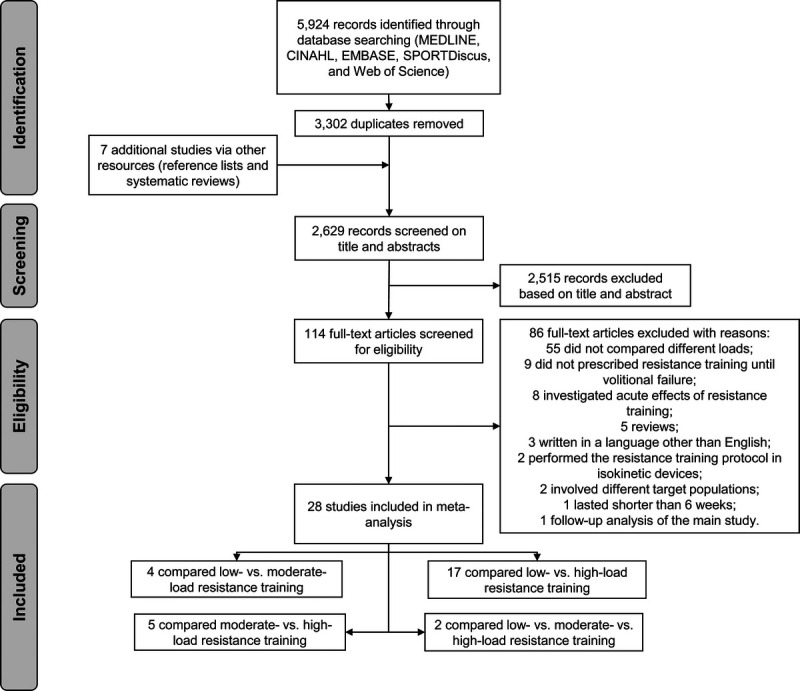
Purpose: This study aimed to analyze the effect of resistance training (RT) performed until volitional failure with low, moderate, and high loads on muscle hypertrophy and muscle strength in healthy adults and to assess the possible participant-, design-, and training-related covariates that may affect the adaptations. Methods: Using Preferred Reporting Items for Systematic Reviews and Meta-Analyses guidelines, MEDLINE, CINAHL, EMBASE, SPORTDiscus, and Web of Science databases were searched. Including only studies that performed sets to volitional failure, the effects of low- (>15 repetitions maximum (RM)), moderate- (9–15 RM), and high-load (≤8 RM) RTs were examined in healthy adults. Network meta-analysis was undertaken to calculate the standardized mean difference (SMD) between RT loads in overall and subgroup analyses involving studies deemed of high quality. Associations between participant-, design-, and training-related covariates with SMD were assessed by univariate and multivariate network meta-regression analyses. Results: Twenty-eight studies involving 747 healthy adults were included. Although no differences in muscle hypertrophy between RT loads were found in overall ( P = 0.113–0.469) or subgroup analysis ( P = 0.871–0.995), greater effects were observed in untrained participants ( P = 0.033) and participants with some training background who undertook more RT sessions ( P = 0.031–0.045). Muscle strength improvement was superior for both high-load and moderate-load compared with low-load RT in overall and subgroup analysis (SMD, 0.60–0.63 and 0.34–0.35, respectively; P < 0.001–0.003), with a nonsignificant but superior effect for high compared with moderate load (SMD, 0.26–0.28, P = 0.068). Conclusions: Although muscle hypertrophy improvements seem to be load independent, increases in muscle strength are superior in high-load RT programs. Untrained participants exhibit greater muscle hypertrophy, whereas undertaking more RT sessions provides superior gains in those with previous training experience.
Overview
CoChat Summary
TL;DR
Resistance training performed to volitional failure produced similar muscle hypertrophy across low, moderate, and high loads in healthy adults, while muscle strength gains were load-dependent and greater with high loads. The review supports high-load training for strength and either moderate or high loads for hypertrophy over short interventions.
Key findings
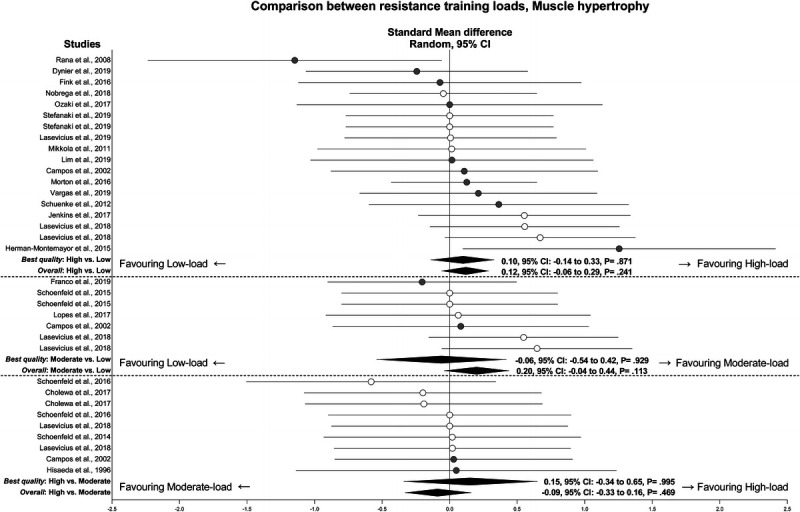
- In 28 studies (747 healthy adults; mean age 23.4 ± 3.0 yr), network meta-analysis found no significant differences in muscle hypertrophy between high vs low, moderate vs low, or high vs moderate loads (P = 0.113–0.469; I² = 0%). Best-intervention probabilities were 84.5% for moderate load overall and 75.8% for high load in best-quality studies, but effect sizes were small (range −0.09 to 0.15).
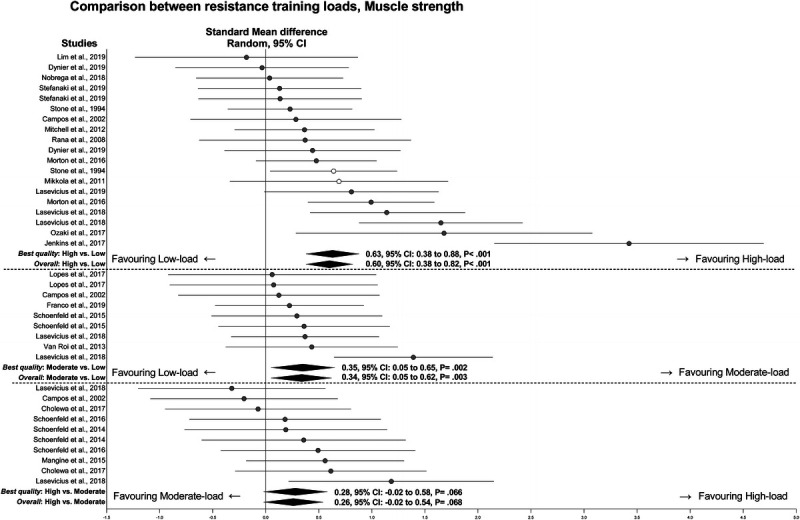
- Muscle strength was load-dependent: high-load training increased strength more than low-load (SMD 0.60; 95% CI 0.38–0.82; P < 0.001), and moderate-load more than low-load (SMD 0.34; 95% CI 0.05–0.62; P = 0.003). High vs moderate was nonsignificant (SMD 0.26; 95% CI −0.02 to 0.54; P = 0.068), with high load having 98.2% probability of being best.
- Meta-regression: for hypertrophy, training status was significant in high vs low (P = 0.033; untrained showed higher effects), and number of sessions was significant for moderate vs low (P = 0.031) and high vs moderate (P = 0.045). For strength, older studies (P = 0.023) and men (P = 0.037) showed higher effects in the low- vs high-load comparison.
Methods
- Systematic review and network meta-analysis following PRISMA and Cochrane Back Review Group criteria; searched MEDLINE, CINAHL, EMBASE, SPORTDiscus, and Web of Science up to December 2019. Included experimental studies in healthy adults comparing low (<60% 1-RM or >15 RM), moderate (60–79% 1-RM or 9–15 RM), and high (≥80% 1-RM or ≤8 RM) resistance training performed until volitional failure; excluded interventions <6 wk, blood flow restriction, non-English, or insufficient data.
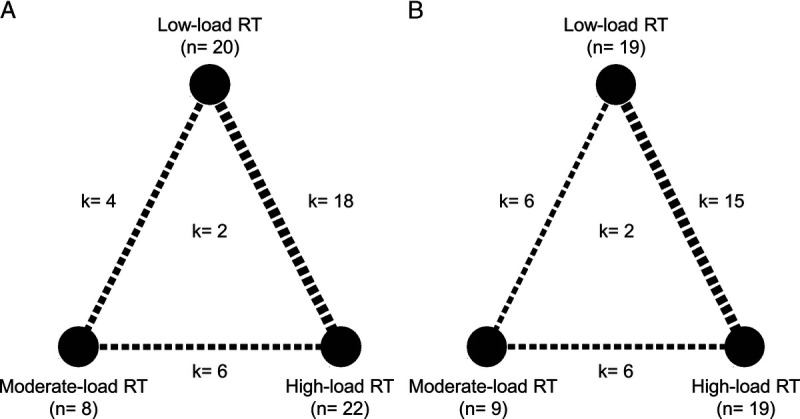
- 28 studies included (24 hypertrophy, 23 strength); 747 participants; mean intervention 8.9 ± 2.1 wk and 24.6 ± 7.5 sessions (range 16–48); most studies involved men (19/28) and untrained participants (21/28). Outcomes were muscle hypertrophy (muscle mass/size) and muscle strength (1-RM).
- Network meta-analysis used standardized mean differences from baseline to final assessment (R netmeta); subgroup analysis by risk of bias; univariate and multivariate network meta-regression (Stata mvmeta); risk of bias assessed with RoB 2.
Limitations
- The paper states included studies were mostly low quality due to concerns in randomization and outcome measurement; best-quality subgroup analyses were used and results maintained. It also states results cannot be extrapolated to highly strength-trained individuals, mostly young adults (23.4 ± 2.9 yr), nonspecific strength tests (isometric/isokinetic), or populations where volitional failure is not feasible; several studies performed multiple 1-RM tests, which may mask load differences; muscle size assessment is challenging; and few studies exceeded 14 wk.
- Evident from the text: publication bias was detected for muscle strength before adjustment (P = 0.014), with Anderson and Kearney identified as an outlier; heterogeneity was I² = 39.9% overall and 43.7% in best-quality strength analyses, while hypertrophy heterogeneity was I² = 0%. Most included studies were in men and untrained participants, limiting generalizability.
Model-written summary. Check it against the paper before relying on it.
Integrity signals
Registry
Cites
Statistics
Figures
Verification
Claims the paper makes
1 Valid · 0 Not valid · 25 Not checked · 58 Own results and interpretations
The cited sources support only part of this claim — read each source’s verdict below.
In the paper
“These differences are likely to be related to study design, conduct, and control because well-designed studies tend to get smaller effects and reducing bias over the years (70).”
§ Resistance Training Load Effects on Muscle Hypertrophy and Strength Gain: Systematic Review and Network Meta-analysis > DISCUSSION
What the sources say
- Partly supportedcites [70] Pannucci CJ Wilkins EG. Identifying and avoiding bias in research. Plast Reconstr Surg. 2010; 126(2): 619– 25. 20679844 PMC2917255 sourceExperimental — accuracy not yet measured
The paper’s “Definition and scope of bias” section says rigorous study design can reduce bias and gives an example in which more recent, rigorously designed studies reached a different result. It does not establish that well-designed studies generally produce smaller effects or that bias has declined over the years; it says bias can make estimates either larger or smaller. (LLM, conf=0.86)
hedgedstates a possible cause- Asserted: passes — The authors put it forward as true.
- Checkable: passes — It can be checked against evidence.
- Load-bearing: passes — The paper’s conclusions depend on it.
- Based: passes — The paper gives a reason why it holds.
- Partly supported
A result the paper reports from its own data — it cites no other source for it, so there is none to check. The quote shows it is in the paper.
In the paper
“Although the results of the consistency model indicate that moderate-load (84.5%) and high-load resistance training (75.8%) are the best load for muscle hypertrophy in overall and high-quality subgroup analyses, respectively, the ES values were unlikely to be considered meaningful (small ES: range, −0.09 to 0.15).”
§ Resistance Training Load Effects on Muscle Hypertrophy and Strength Gain: Systematic Review and Network Meta-analysis > RESULTS
hedged- Asserted: passes — The authors put it forward as true.
- Checkable: passes — It can be checked against evidence.
- Load-bearing: unclear — It is unclear whether the paper’s conclusions depend on it.
- Based: passes — The paper gives a reason why it holds.
A result the paper reports from its own data — it cites no other source for it, so there is none to check. The quote shows it is in the paper.
In the paper
“After the adjustment, the consistency network meta-analysis results show that high-load (SMD, 0.60; 95% confidence interval [CI], 0.38–0.82) and moderate-load (SMD, 0.34, 95% CI, 0.05–0.62) resulted in higher muscle strength effects when compared with low-load resistance training (P < 0.001 and 0.003, respectively).”
§ Resistance Training Load Effects on Muscle Hypertrophy and Strength Gain: Systematic Review and Network Meta-analysis > RESULTS
plainstates a cause- Asserted: passes — The authors put it forward as true.
- Checkable: passes — It can be checked against evidence.
- Load-bearing: passes — The paper’s conclusions depend on it.
- Based: passes — The paper gives a reason why it holds.
A result the paper reports from its own data — it cites no other source for it, so there is none to check. The quote shows it is in the paper.
In the paper
“Furthermore, no differences between the loads were observed in the subgroup analysis involving the best-quality studies (number of comparisons = 16, I2 = 0%, P = 0.871–0.995; Table 2).”
§ Resistance Training Load Effects on Muscle Hypertrophy and Strength Gain: Systematic Review and Network Meta-analysis > RESULTS
plain- Asserted: passes — The authors put it forward as true.
- Checkable: passes — It can be checked against evidence.
- Load-bearing: passes — The paper’s conclusions depend on it.
- Based: passes — The paper gives a reason why it holds.
A result the paper reports from its own data — it cites no other source for it, so there is none to check. The quote shows it is in the paper.
In the paper
“After the adjustment, the consistency network meta-analysis results show that high-load (SMD, 0.60; 95% confidence interval [CI], 0.38–0.82) and moderate-load (SMD, 0.34, 95% CI, 0.05–0.62) resulted in higher muscle strength effects when compared with low-load resistance training (P < 0.001 and 0.003, respectively).”
§ Resistance Training Load Effects on Muscle Hypertrophy and Strength Gain: Systematic Review and Network Meta-analysis > RESULTS
plainstates a cause- Asserted: passes — The authors put it forward as true.
- Checkable: passes — It can be checked against evidence.
- Load-bearing: passes — The paper’s conclusions depend on it.
- Based: passes — The paper gives a reason why it holds.
34 more claims
Create a free account to see all 84 claims and to verify the 41 references still open.
- It may state two separate claims as one. 36
- Probably not a substantial claim. 17
- The quote only partly states this claim. 1
Claims other papers make about this one
Each is checked against this paper’s own text: does it say what the citing paper says it does?
The source backs part of the claim, not all of it — or backs it for a different population, condition or comparison.
In the citing paper
“RT did not influence hypertrophy performed with low (1 d/wk) versus high (>5 d/wk) frequency when total volume was equated; low (30% 1RM) to high (100% 1RM) loads; contractions to muscle failure/fatigue; blood flow restriction; varying loads during repetitions; fast (0.5 s) versus slow (8 s) repetitions; power training techniques; periodization (linear, undulating, and nonperiodized); or exercise”
From American College of Sports Medicine Position Stand. Resistance Training Prescription for Muscle Function, Hypertrophy, and Physical Performance in Healthy Adults: An Overview of Reviews (2026) · cites this paper as [80]
Experimental — accuracy not yet measuredThe source backs part of the claim, not all of it — or backs it for a different population, condition or comparison.
In the citing paper
“Appropriately designed resistance training is generally viewed as the most efficient method of increasing skeletal muscle mass and strength in adults [52-54]”
From Fundamental Body Composition Principles Provide Context for Fat-Free and Skeletal Muscle Loss With GLP-1 RA Treatments (2024) · cites this paper as [54]
Experimental — accuracy not yet measuredThe cited source says what the claim attributes to it.
In the citing paper
“However, voluntary strength was enhanced by lifting heavier loads (≥80% one-repetition maximum), through a complete range of motion, for 2–3 sets, at the beginning of training sessions, and ≥2 sessions/wk.”
In the citing paper
“Previous studies have shown that traditional resistance training, particularly higher-load training, is generally more effective in promoting muscle strength improvements, accompanied by enhancements in muscle morphology and neural adaptations (72, 73).”
Self-check
Percentages, sums and reported differences re-computed from the paper’s own numbers.
Each contradiction between two passages listed here was confirmed by an independent check.
Rated minor: it would not touch a result — a value no result rests on, a p-value that stays on the same side of the significance level, or a conflict that is clerical, resolved elsewhere in the paper, or outside its own findings.
In the paper
§ Resistance Training Load Effects on Muscle Hypertrophy and Strength Gain: Systematic Review and Network Meta-analysis > RESULTS
“A total of 747 healthy men and women with an average age of 23.4 ± 3.0 yr participated in the included studies.”
§ Resistance Training Load Effects on Muscle Hypertrophy and Strength Gain: Systematic Review and Network Meta-analysis > DISCUSSION
“the present investigation included mostly studies undertaken in young adults (23.4 ± 2.9 yr)”
Rated minor: it would not touch a result — a value no result rests on, a p-value that stays on the same side of the significance level, or a conflict that is clerical, resolved elsewhere in the paper, or outside its own findings.
In the paper
“| High vs low | Year of publication | 1982–2019 | −0.11 ± 0.05 | −0.20 to −0.15 | 0.023 |”
§ Resistance Training Load Effects on Muscle Hypertrophy and Strength Gain: Systematic Review and Network Meta-analysis > RESULTS
Reported -0.11 · recomputed -0.175
Rated minor: it would not touch a result — a value no result rests on, a p-value that stays on the same side of the significance level, or a conflict that is clerical, resolved elsewhere in the paper, or outside its own findings.
In the paper
§ Resistance Training Load Effects on Muscle Hypertrophy and Strength Gain: Systematic Review and Network Meta-analysis > RESULTS
“The mean exercise intervention duration was 8.9 ± 2.1 wk, with an average of 24.6 ± 7.5 sessions (range, 16–48).”
§ Resistance Training Load Effects on Muscle Hypertrophy and Strength Gain: Systematic Review and Network Meta-analysis > RESULTS
“| High vs low | Number of sessions | 12–48 | 0.01 ± 0.01 | −0.02 to 0.05 | 0.518 |”
Citations
Cites
Bias in meta-analysis detected by a simple, graphical test
Egger, M., Smith, G. D., Schneider, M., & Minder, C. (1997) · BMJ · doi:10.1136/bmj.315.7109.629 · Cited by 56,722
RoB 2: a revised tool for assessing risk of bias in randomised trials
Sterne, J. A. C., Savović, J., Page, M. J., Elbers, R. G., Blencowe, N. S., Boutron, I., Cates, C. J., Cheng, H.-Y., Corbett, M. S., Eldridge, S. M., et al. (2019) · BMJ · doi:10.1136/bmj.l4898 · Cited by 34,787 · cited 2×
“Overall risk of bias was expressed as “low risk of bias” if all domains where classified as low risk, “some concerns” if some concern was raised in at least one domain but not classified as at high risk in any other, or “high risk of bias” if at least one domain was classified as high risk, or have multiple domains wi…”
BackgroundMethodLiberati, A., Altman, D. G., Tetzlaff, J., Mulrow, C., Gøtzsche, P. C., Ioannidis, J. P. A., Clarke, M., Devereaux, P. J., Kleijnen, J., & Moher, D. (2009) · PLoS Medicine · doi:10.1371/journal.pmed.1000100 · Cited by 28,164
Liberati, A., Altman, D. G., Tetzlaff, J., Mulrow, C., Gotzsche, P. C., Ioannidis, J. P. A., Clarke, M., Devereaux, P. J., Kleijnen, J., & Moher, D. (2009) · BMJ · doi:10.1136/bmj.b2700 · Cited by 17,648
Cumpston, M., Li, T., Page, M. J., Chandler, J., Welch, V. A., Higgins, J. P., & Thomas, J. (2019) · Cochrane Database of Systematic Reviews · doi:10.1002/14651858.ed000142 · Cited by 7,218
Cohen, J. (1992) · Current Directions in Psychological Science · doi:10.1111/1467-8721.ep10768783 · Cited by 5,870
Progression Models in Resistance Training for Healthy Adults
(2009) · Medicine & Science in Sports & Exercise · doi:10.1249/mss.0b013e3181915670 · Cited by 4,332
Progression Models in Resistance Training for Healthy Adults
(2002) · Medicine and Science in Sports and Exercise · doi:10.1097/00005768-200202000-00027 · Cited by 2,979
Self-citation2009 updated method guidelines for systematic reviews in the Cochrane Back Review Group
Furlan, A. D., Pennick, V., Bombardier, C., & van Tulder, M. (2009) · Spine · doi:10.1097/brs.0b013e3181b1c99f · Cited by 1,663 · cited 1×
“Study selection procedure The study was undertaken in accordance with the Preferred Reporting Items for Systematic Reviews and Meta-Analyses (PRISMA) statement (20, 21), and the method used was based on the minimum criteria established by the Cochrane Back Review Group (CBRG) (22).”
MethodNeural adaptation to resistance training
SALE, D. G. (1988) · Medicine & Science in Sports & Exercise · doi:10.1249/00005768-198810001-00009 · Cited by 1,421 · cited 1×
“As reported in previous literature, trained muscles may already present with an increased cross-sectional area (61) and lower anabolic signalling as observed in reduced AMPK and Akt phosphorylation after a resistance training session (62), resulting in an AC CE PT ED”
Background(1979) · PubMed · Cited by 1,302
Relation between size of neurons and their susceptibility to discharge
Henneman, E. (1957) · Science · doi:10.1126/science.126.3287.1345 · Cited by 1,227 · cited 1×
“, motor units are recruited from smallest to largest) (11), studies have advocated in favour of either high loads (12-15) or both low and high loads (16) to achieve maximal or near-maximal recruitment of motor units during fatiguing contractions to induce muscle hypertrophy.”
BackgroundIdentifying and Avoiding Bias in Research
Pannucci, C. J., & Wilkins, E. G. (2010) · Plastic and Reconstructive Surgery · doi:10.1097/prs.0b013e3181de24bc · Cited by 1,079 · cited 1×
“These differences are likely to be related to study design, conduct, and control since welldesigned studies tend to get smaller effects and reducing bias over the years (70).”
BackgroundCampos, G., Luecke, T., Wendeln, H., Toma, K., Hagerman, F., Murray, T., Ragg, K., Ratamess, N., Kraemer, W., & Staron, R. (2002) · European Journal of Applied Physiology · doi:10.1007/s00421-002-0681-6 · Cited by 1,066 · cited 8×
“Although a vast body of research work in this area has been published (2-7), issues regarding how to optimize resistance training outcomes remain (8, 9).”
BackgroundMethodInfluentialSelf-citationSchoenfeld, B. J., Grgic, J., Ogborn, D., & Krieger, J. W. (2017) · Journal of Strength and Conditioning Research · doi:10.1519/jsc.0000000000002200 · Cited by 851 · cited 6×
“Regarding the year of publication as a covariate, this variable was used because of the different results on muscle strength between current (5, 9) and past literature (2, 51).”
BackgroundMethodResultInfluentialNetwork meta-analysis: application and practice using Stata
Shim, S., Yoon, B.-H., Shin, I.-S., & Bae, J.-M. (2017) · Epidemiology and Health · doi:10.4178/epih.e2017047 · Cited by 656 · cited 1×
“The network meta-analysis was performed following the current PRISMA guideline items (26, 27): 1) a network geometry was created to explore the comparisons between resistance training loads; 2) transitivity was tested by fitting a network inconsistency assumption along with Q test and side-splitting analyses between i…”
MethodResistance exercise load does not determine training-mediated hypertrophic gains in young men
Mitchell, C. J., Churchward-Venne, T. A., West, D. W. D., Burd, N. A., Breen, L., Baker, S. K., & Phillips, S. M. (2012) · Journal of Applied Physiology · doi:10.1152/japplphysiol.00307.2012 · Cited by 627 · cited 8×
“Although a vast body of research work in this area has been published (2-7), issues regarding how to optimize resistance training outcomes remain (8, 9).”
BackgroundMethodInfluentialWernbom, M., Augustsson, J., & Thome??, R. (2007) · Sports Medicine · doi:10.2165/00007256-200737030-00004 · Cited by 583 · cited 1×
“Load selection has been considered an important resistance training variable to successfully increase muscle size and strength across different populations (10).”
BackgroundBurd, N. A., West, D. W. D., Staples, A. W., Atherton, P. J., Baker, J. M., Moore, D. R., Holwerda, A. M., Parise, G., Rennie, M. J., Baker, S. K., et al. (2010) · PLoS ONE · doi:10.1371/journal.pone.0012033 · Cited by 531 · cited 1×
“These findings indicate that muscle hypertrophy may be more responsive in untrained individuals because of the large window for adaptation, masking differential effects of training modalities and dosages (17), and not show an obvious load-dependent relationship when resistance training sets are performed until volitio…”
BackgroundNetwork meta-analysis: application and practice using R software
Shim, S. R., Kim, S.-J., Lee, J., & Rücker, G. (2019) · Epidemiology and Health · doi:10.4178/epih.e2019013 · Cited by 483 · cited 1×
“The network meta-analysis was performed following the current PRISMA guideline items (26, 27): 1) a network geometry was created to explore the comparisons between resistance training loads; 2) transitivity was tested by fitting a network inconsistency assumption along with Q test and side-splitting analyses between i…”
MethodSchoenfeld, B. J., Peterson, M. D., Ogborn, D., Contreras, B., & Sonmez, G. T. (2015) · Journal of Strength and Conditioning Research · doi:10.1519/jsc.0000000000000958 · Cited by 418 · cited 9×
“The concerns in muscle hypertrophy assessment were mainly due to the randomisation process as studies did not report concealment allocation (some concerns: 23 of 24 studies (3-7, 32-40, 43-50, 53), 95.”
BackgroundMethodInfluentialMorton, R. W., Oikawa, S. Y., Wavell, C. G., Mazara, N., McGlory, C., Quadrilatero, J., Baechler, B. L., Baker, S. K., & Phillips, S. M. (2016) · Journal of Applied Physiology · doi:10.1152/japplphysiol.00154.2016 · Cited by 404 · cited 8×
“(43) was included in the systematic review.”
BackgroundMethodInfluentialMultivariate Random-effects Meta-regression: Updates to Mvmeta
White, I. R. (2011) · The Stata Journal: Promoting communications on statistics and Stata · doi:10.1177/1536867x1101100206 · Cited by 400
Electromyographic changes during strength training and detraining
HAKKINEN, K., & KOMI, P. V. (1983) · Medicine & Science in Sports & Exercise · doi:10.1249/00005768-198315060-00003 · Cited by 394 · cited 2×
“This finding is expected following: 1) the principle of specificity (13) as participants allocated in higher load resistance training groups trained more closely to the requirement for the 1-RM test and presented greater transfer to this outcome, and 2) a combination of both neural and skeletal muscle adaptations deri…”
BackgroundSelf-citationAcute hormonal responses to two different fatiguing heavy-resistance protocols in male athletes
Hakkinen, K., & Pakarinen, A. (1993) · Journal of Applied Physiology · doi:10.1152/jappl.1993.74.2.882 · Cited by 344
Self-citationEarly signaling responses to divergent exercise stimuli in skeletal muscle from well-trained humans
Coffey, V. G., Zhong, Z., Shield, A., Canny, B. J., Chibalin, A. V., Zierath, J. R., & Hawley, J. A. (2006) · The FASEB Journal · doi:10.1096/fj.05-4809fje · Cited by 336 · cited 1×
“As reported in previous literature, trained muscles may already present with an increased cross-sectional area (61) and lower anabolic signalling as observed in reduced AMPK and Akt phosphorylation after a resistance training session (62), resulting in an AC CE PT ED”
BackgroundIzquierdo, M., Ibañez, J., González-Badillo, J. J., Häkkinen, K., Ratamess, N. A., Kraemer, W. J., French, D. N., Eslava, J., Altadill, A., Asiain, X., et al. (2006) · Journal of Applied Physiology · doi:10.1152/japplphysiol.01400.2005 · Cited by 316 · cited 1×
“adaptations (58, 59), it was the strategy required to compare the efficacy of different resistance training load protocols (57).”
MethodSelf-citationTechnics of progressive resistance exercise.
Delorme, T. L., & Watkins, A. L. (1948) · PubMed · Cited by 256
Effect of resistance training on women’s strength/power and occupational performances
KRAEMER, W. J., MAZZETTI, S. A., NINDL, B. C., GOTSHALK, L. A., VOLEK, J. S., BUSH, J. A., MARX, J. O., DOHI, K., G??MEZ, A. L., MILES, M., et al. (2001) · Medicine and Science in Sports and Exercise · doi:10.1097/00005768-200106000-00022 · Cited by 254
Self-citationMuscular adaptations in low- versus high-load resistance training: a meta-analysis.
Schoenfeld, B. J., Wilson, J. M., Lowery, R. P., & Krieger, J. W. (2016) · European Journal of Sport Science · doi:10.1080/17461391.2014.989922 · Cited by 249 · cited 2×
“In addition, considering previous findings on this topic (9, 19), the present review also extends the results on muscle hypertrophy and strength taking into account different moderators of resistance exercise response such as participants, training status, experimental design, assessed outcomes and training prescripti…”
ResultPage, M. J., McKenzie, J. E., Bossuyt, P. M., Boutron, I., Hoffmann, T., Mulrow, C. D., Shamseer, L., & Moher, D. (2020) · Journal of Clinical Epidemiology · doi:10.1016/j.jclinepi.2019.11.010 · Cited by 211 · cited 1×
“Study selection procedure The study was undertaken in accordance with the Preferred Reporting Items for Systematic Reviews and Meta-Analyses (PRISMA) statement (20, 21), and the method used was based on the minimum criteria established by the Cochrane Back Review Group (CBRG) (22).”
MethodMangine, G. T., Hoffman, J. R., Gonzalez, A. M., Townsend, J. R., Wells, A. J., Jajtner, A. R., Beyer, K. S., Boone, C. H., Miramonti, A. A., Wang, R., et al. (2015) · Physiological Reports · doi:10.14814/phy2.12472 · Cited by 204 · cited 8×
“0% of the studies have some concern (20 of 23 studies (3-7, 32, 33, 35, 38-41, 43-48, 50, 52)), while the remaining have a high risk (3 of 23 studies (2, 42, 51), 13.”
BackgroundInfluentialAnderson, T., & Kearney, J. T. (1982) · Research Quarterly for Exercise and Sport · doi:10.1080/02701367.1982.10605218 · Cited by 197 · cited 9×
“, 3 sets of 30-40 RM and 3 sets of 100-150 RM defined as low load resistance training (2)), as well as outcomes when considered within the same outcome category (e.”
BackgroundInfluentialGreater neural adaptations following high- vs. low-load resistance training
Jenkins, N. D. M., Miramonti, A. A., Hill, E. C., Smith, C. M., Cochrane-Snyman, K. C., Housh, T. J., & Cramer, J. T. (2017) · Frontiers in Physiology · doi:10.3389/fphys.2017.00331 · Cited by 197 · cited 8×
“Most of the studies involved men (19 of 28 (2-7, 34, 38-42, 44-48, 53), 67.”
BackgroundMethodInfluentialThe Interference Effects of Training for Strength and Endurance Simultaneously.
Hennessy, L. C., & Watson, A. W. S. (1994) · Journal of Strength and Conditioning Research · doi:10.1519/00124278-199402000-00003 · Cited by 193
Haun, C. T., Vann, C. G., Roberts, B. M., Vigotsky, A. D., Schoenfeld, B. J., & Roberts, M. D. (2019) · Frontiers in Physiology · doi:10.3389/fphys.2019.00247 · Cited by 192 · cited 1×
“Fifth, the assessment of muscle size presents numerous challenges when evaluating training effects with regard to load, movement, range, and type of contraction, all influencing regional hypertrophy and further complicated by location of measurement, technology, and methodology (72).”
BackgroundSchoenfeld, B. J., Ratamess, N. A., Peterson, M. D., Contreras, B., Sonmez, G. T., & Alvar, B. A. (2014) · Journal of Strength and Conditioning Research · doi:10.1519/jsc.0000000000000480 · Cited by 187 · cited 8×
“high-load (7, 32, 37, 41, 48), and 2 studies compared lowvs.”
BackgroundMethodInfluentialLasevicius, T., Ugrinowitsch, C., Schoenfeld, B. J., Roschel, H., Tavares, L. D., De Souza, E. O., Laurentino, G., & Tricoli, V. (2018) · European Journal of Sport Science · doi:10.1080/17461391.2018.1450898 · Cited by 180 · cited 6×
“Although a vast body of research work in this area has been published (2-7), issues regarding how to optimize resistance training outcomes remain (8, 9).”
BackgroundMethodInfluentialAdam, A., & De Luca, C. J. (2003) · Journal of Neurophysiology · doi:10.1152/jn.00179.2003 · Cited by 178 · cited 2×
“Although this is a topic of intense debate in the literature, when low-load sets are performed until volitional failure, neuromuscular fatigue necessitates increasing percentage recruitment of the motor unit pool, and, through this mechanism (12), such training may produce meaningful drive for muscle hypertrophy.”
BackgroundConcurrent Endurance and Strength Training Not to Failure Optimizes Performance Gains
IZQUIERDO-GABARREN, M., GONZÁLEZ DE TXABARRI EXPÓSITO, R., GARCÍA-PALLARÉS, J., SÁNCHEZ-MEDINA, L., DE VILLARREAL, E. S. S., & IZQUIERDO, M. (2010) · Medicine & Science in Sports & Exercise · doi:10.1249/mss.0b013e3181c67eec · Cited by 166 · cited 1×
“adaptations (58, 59), it was the strategy required to compare the efficacy of different resistance training load protocols (57).”
MethodMorton, R. W., Sonne, M. W., Farias Zuniga, A., Mohammad, I. Y. Z., Jones, A., McGlory, C., Keir, P. J., Potvin, J. R., & Phillips, S. M. (2019) · The Journal of Physiology · doi:10.1113/jp278056 · Cited by 139 · cited 1×
“, motor units are recruited from smallest to largest) (11), studies have advocated in favour of either high loads (12-15) or both low and high loads (16) to achieve maximal or near-maximal recruitment of motor units during fatiguing contractions to induce muscle hypertrophy.”
BackgroundTraining to Fatigue: The Answer for Standardization When Assessing Muscle Hypertrophy?
Dankel, S. J., Jessee, M. B., Mattocks, K. T., Mouser, J. G., Counts, B. R., Buckner, S. L., & Loenneke, J. P. (2017) · Sports Medicine · doi:10.1007/s40279-016-0633-7 · Cited by 115 · cited 3×
“, individuals who are able to complete different numbers of repetitions at a given relative load), and ensures methodological feasibility when comparing different resistance training loads (57), other approaches have been successfully used such as RM zones and percentage of 1-RM, where failure is not mandated but moni…”
BackgroundMethodSchuenke, M. D., Herman, J. R., Gliders, R. M., Hagerman, F. C., Hikida, R. S., Rana, S. R., Ragg, K. E., & Staron, R. S. (2012) · European Journal of Applied Physiology · doi:10.1007/s00421-012-2339-3 · Cited by 102 · cited 10×
“The concerns in muscle hypertrophy assessment were mainly due to the randomisation process as studies did not report concealment allocation (some concerns: 23 of 24 studies (3-7, 32-40, 43-50, 53), 95.”
BackgroundMethodInfluential(2016) · Europe PMC (PubMed Central) · Cited by 101
Strength/Endurance Effects From Three Resistance Training Protocols With Women
Stone, W. J., & Coulter, S. P. (1994) · Journal of Strength and Conditioning Research · doi:10.1519/00124278-199411000-00005 · Cited by 101
Self-Selected Resistance Training Intensity in Healthy Women: The Influence of a Personal Trainer
Ratamess, N. A., Faigenbaum, A. D., Hoffman, J. R., & Kang, J. (2008) · Journal of Strength and Conditioning Research · doi:10.1519/jsc.0b013e31815f29cc · Cited by 100 · cited 1×
“These results may be related to sex differences in prior experience with resistance training and perceived exertion with resistance training sessions as previously suggested (66-68), and possible discrepancies between the prescribed and complied resistance training dosage (35).”
ResultBurd, N. A., Mitchell, C. J., Churchward-Venne, T. A., & Phillips, S. M. (2012) · Applied Physiology Nutrition and Metabolism · doi:10.1139/h2012-022 · Cited by 99 · cited 1×
“Although a vast body of research work in this area has been published (2-7), issues regarding how to optimize resistance training outcomes remain (8, 9).”
BackgroundNóbrega, S. R., Ugrinowitsch, C., Pintanel, L., Barcelos, C., & Libardi, C. A. (2018) · Journal of Strength and Conditioning Research · doi:10.1519/jsc.0000000000001787 · Cited by 97 · cited 9×
“The concerns in muscle hypertrophy assessment were mainly due to the randomisation process as studies did not report concealment allocation (some concerns: 23 of 24 studies (3-7, 32-40, 43-50, 53), 95.”
BackgroundMethodInfluentialLasevicius, T., Schoenfeld, B. J., Silva-Batista, C., Barros, T. D. S., Aihara, A. Y., Brendon, H., Longo, A. R., Tricoli, V., Peres, B. D. A., & Teixeira, E. L. (2022) · Journal of Strength & Conditioning Research · doi:10.1519/jsc.0000000000003454 · Cited by 95 · cited 8×
“The concerns in muscle hypertrophy assessment were mainly due to the randomisation process as studies did not report concealment allocation (some concerns: 23 of 24 studies (3-7, 32-40, 43-50, 53), 95.”
BackgroundMethodInfluentialMikkola, J., Vesterinen, V., Taipale, R., Capostagno, B., Häkkinen, K., & Nummela, A. (2011) · Journal of Sports Sciences · doi:10.1080/02640414.2011.589467 · Cited by 86 · cited 8×
“Most of the studies involved men (19 of 28 (2-7, 34, 38-42, 44-48, 53), 67.”
BackgroundInfluentialSelf-citationResistance exercise–induced changes in muscle phenotype are load dependent
LIM, C., KIM, H. J., MORTON, R. W., HARRIS, R., PHILLIPS, S. M., JEONG, T. S., & KIM, C. K. (2019) · Medicine & Science in Sports & Exercise · doi:10.1249/mss.0000000000002088 · Cited by 81
Rana, S. R., Chleboun, G. S., Gilders, R. M., Hagerman, F. C., Herman, J. R., Hikida, R. S., Kushnick, M. R., Staron, R. S., & Toma, K. (2008) · Journal of Strength and Conditioning Research · doi:10.1519/jsc.0b013e31815f30e7 · Cited by 65 · cited 8×
“Most of the studies involved men (19 of 28 (2-7, 34, 38-42, 44-48, 53), 67.”
BackgroundInfluentialFOCHT, B. C. (2007) · Journal of Strength and Conditioning Research · doi:10.1519/00124278-200702000-00033 · Cited by 64 · cited 1×
“These results may be related to sex differences in prior experience with resistance training and perceived exertion with resistance training sessions as previously suggested (66-68), and possible discrepancies between the prescribed and complied resistance training dosage (35).”
da Silva, L. X. N., Teodoro, J. L., Menger, E., Lopez, P., Grazioli, R., Farinha, J., Moraes, K., Bottaro, M., Pinto, R. S., Izquierdo, M., et al. (2018) · Experimental Gerontology · doi:10.1016/j.exger.2018.03.017 · Cited by 63
Self-citationFink, J., Kikuchi, N., Yoshida, S., Terada, K., & Nakazato, K. (2016) · SpringerPlus · doi:10.1186/s40064-016-2333-z · Cited by 61 · cited 9×
“The concerns in muscle hypertrophy assessment were mainly due to the randomisation process as studies did not report concealment allocation (some concerns: 23 of 24 studies (3-7, 32-40, 43-50, 53), 95.”
BackgroundMethodInfluentialArterial stiffness is reduced regardless of resistance training load in young men
AU, J. S., OIKAWA, S. Y., Morton, R. W., MACDONALD, M. J., & PHILLIPS, S. M. (2017) · Medicine & Science in Sports & Exercise · doi:10.1249/mss.0000000000001106 · Cited by 50 · cited 1×
“(54) was a follow-up analysis from Morton et al.”
BackgroundOzaki, H., Kubota, A., Natsume, T., Loenneke, J. P., Abe, T., Machida, S., & Naito, H. (2018) · Journal of Sports Sciences · doi:10.1080/02640414.2017.1331042 · Cited by 47 · cited 9×
“The concerns in muscle hypertrophy assessment were mainly due to the randomisation process as studies did not report concealment allocation (some concerns: 23 of 24 studies (3-7, 32-40, 43-50, 53), 95.”
BackgroundMethodInfluentialLooney, D. P., Kraemer, W. J., Joseph, M. F., Comstock, B. A., Denegar, C. R., Flanagan, S. D., Newton, R. U., Szivak, T. K., DuPont, W. H., Hooper, D. R., et al. (2016) · Journal of Strength and Conditioning Research · doi:10.1519/jsc.0000000000001109 · Cited by 46 · cited 1×
“, motor units are recruited from smallest to largest) (11), studies have advocated in favour of either high loads (12-15) or both low and high loads (16) to achieve maximal or near-maximal recruitment of motor units during fatiguing contractions to induce muscle hypertrophy.”
BackgroundSelf-citationInfluence of two different modes of resistance training in female subjects
HISAEDA, H., MIYAGAWA, K., KUNO, S.-Y., FUKUNAGA, T., & MURAOKA, I. (1996) · Ergonomics · doi:10.1080/00140139608964505 · Cited by 44 · cited 9×
“The concerns in muscle hypertrophy assessment were mainly due to the randomisation process as studies did not report concealment allocation (some concerns: 23 of 24 studies (3-7, 32-40, 43-50, 53), 95.”
BackgroundMethodInfluentialNeuromuscular adaptation during strength training, ageing, detraining, and immobilization
Häkkinen, K. (1994) · Critical Reviews in Physical and Rehabilitation Medicine · Cited by 40
Self-citationTesta, M., Noakes, T. D., & Desgorces, F.-D. (2012) · Journal of Strength and Conditioning Research · doi:10.1519/jsc.0b013e31824301d1 · Cited by 37 · cited 1×
“However, it is important to note that the practical application may still favour the use of a lower number of repetitions using moderate to high loads as the performance of low loads until volitional failure results in higher discomfort due to the higher number of repetitions, longer time under muscular tension and ti…”
BackgroundDinyer, T. K., Byrd, M. T., Garver, M. J., Rickard, A. J., Miller, W. M., Burns, S., Clasey, J. L., & Bergstrom, H. C. (2019) · Journal of Strength and Conditioning Research · doi:10.1519/jsc.0000000000003194 · Cited by 36 · cited 6×
“5% of the studies have some concern (21 of 24 studies (3-7, 33-39, 43-50, 53)), while the remaining have a high risk (3 of 24 studies (32, 40, 42), 12.”
BackgroundInfluentialMiller, J. D., Lippman, J. D., Trevino, M. A., & Herda, T. J. (2020) · Journal of Strength and Conditioning Research · doi:10.1519/jsc.0000000000003694 · Cited by 34 · cited 1×
“, motor units are recruited from smallest to largest) (11), studies have advocated in favour of either high loads (12-15) or both low and high loads (16) to achieve maximal or near-maximal recruitment of motor units during fatiguing contractions to induce muscle hypertrophy.”
BackgroundCholewa, J. M., Rossi, F. E., MacDonald, C., Hewins, A., Gallo, S., Micenski, A., Norton, L., & Campbell, B. I. (2018) · Journal of Strength and Conditioning Research · doi:10.1519/jsc.0000000000002048 · Cited by 32 · cited 7×
“high-load (7, 32, 37, 41, 48), and 2 studies compared lowvs.”
BackgroundMethodInfluentialStrength testing or strength training: considerations for future research
Spitz, R. W., Bell, Z. W., Wong, V., Yamada, Y., Song, J. S., Buckner, S. L., Abe, T., & Loenneke, J. P. (2020) · Physiological Measurement · doi:10.1088/1361-6579/abb1fa · Cited by 31 · cited 1×
“moderate- and highload resistance training programs, due to the number of exposures to maximal strength tests and the potential increases in muscle strength not related to the intervention per se (71).”
BackgroundThe Effects of Resistance Training Prioritization in NCAA Division I Football Summer Training
Smith, R. A., Martin, G. J., Szivak, T. K., Comstock, B. A., Dunn‐Lewis, C., Hooper, D. R., Flanagan, S. D., Looney, D. P., Volek, J. S., Maresh, C. M., et al. (2013) · The Journal of Strength and Conditioning Research · doi:10.1519/jsc.0b013e3182977e56 · Cited by 30
Self-citationLopes, C. R., Aoki, M. S., Crisp, A. H., de Mattos, R. S., Lins, M. A., da Mota, G. R., Schoenfeld, B. J., & Marchetti, P. H. (2017) · Journal of Human Kinetics · doi:10.1515/hukin-2017-0081 · Cited by 25 · cited 6×
“Most of the studies involved men (19 of 28 (2-7, 34, 38-42, 44-48, 53), 67.”
BackgroundInfluentialVargas-Molina, S., Petro, J. L., Romance, R., Bonilla, D. A., Florido, M. Á., Kreider, R. B., Schoenfeld, B. J., & Benítez‐Porres, J. (2019) · European Journal of Applied Physiology · doi:10.1007/s00421-019-04082-0 · Cited by 25 · cited 10×
“The concerns in muscle hypertrophy assessment were mainly due to the randomisation process as studies did not report concealment allocation (some concerns: 23 of 24 studies (3-7, 32-40, 43-50, 53), 95.”
BackgroundInfluentialVan Roie, E., Bautmans, I., Boonen, S., Coudyzer, W., Kennis, E., & Delecluse, C. (2013) · Journal of Strength and Conditioning Research · doi:10.1519/jsc.0b013e3182606e35 · Cited by 22 · cited 9×
“0% of the studies have some concern (20 of 23 studies (3-7, 32, 33, 35, 38-41, 43-48, 50, 52)), while the remaining have a high risk (3 of 23 studies (2, 42, 51), 13.”
BackgroundInfluentialCotter, J. A., Garver, M. J., Dinyer, T. K., Fairman, C. M., & Focht, B. C. (2017) · Journal of Strength and Conditioning Research · doi:10.1519/jsc.0000000000001782 · Cited by 22 · cited 1×
“These results may be related to sex differences in prior experience with resistance training and perceived exertion with resistance training sessions as previously suggested (66-68), and possible discrepancies between the prescribed and complied resistance training dosage (35).”
Herman-Montemayor, J. R., Hikida, R. S., & Staron, R. S. (2015) · Journal of Strength and Conditioning Research · doi:10.1519/jsc.0000000000000925 · Cited by 21 · cited 9×
“The concerns in muscle hypertrophy assessment were mainly due to the randomisation process as studies did not report concealment allocation (some concerns: 23 of 24 studies (3-7, 32-40, 43-50, 53), 95.”
BackgroundMethodInfluentialFranco, C. M. D. C., Carneiro, M. A. D. S., Alves, L. T. H., Júnior, G. N. D. O., de Sousa, J. D. F. R., & Orsatti, F. L. (2019) · Journal of Strength and Conditioning Research · doi:10.1519/jsc.0000000000002970 · Cited by 21 · cited 8×
“5% of the studies have some concern (21 of 24 studies (3-7, 33-39, 43-50, 53)), while the remaining have a high risk (3 of 24 studies (32, 40, 42), 12.”
BackgroundMethodInfluentialStefanaki, D. G. A., Dzulkarnain, A., & Gray, S. R. (2019) · Journal of Sports Sciences · doi:10.1080/02640414.2018.1559536 · Cited by 18 · cited 8×
“The concerns in muscle hypertrophy assessment were mainly due to the randomisation process as studies did not report concealment allocation (some concerns: 23 of 24 studies (3-7, 32-40, 43-50, 53), 95.”
BackgroundMethodInfluential(1994) · doi:10.1519/1073-6840(1994)016<0020:dempif>2.3.co;2 · cited 1×
“These findings indicate that muscle hypertrophy may be more responsive in untrained individuals because of the large window for adaptation, masking differential effects of training modalities and dosages (17), and not show an obvious load-dependent relationship when resistance training sets are performed until volitio…”
Background
Cited by
Egan, B., & Sharples, A. P. (2023) · Physiological Reviews · doi:10.1152/physrev.00054.2021 · Cited by 278
HUNTER, S. K., S. ANGADI, S., BHARGAVA, A., HARPER, J., HIRSCHBERG, A. L., D. LEVINE, B., L. MOREAU, K., J. NOKOFF, N., STACHENFELD, N. S., & BERMON, S. (2023) · Medicine & Science in Sports & Exercise · doi:10.1249/mss.0000000000003300 · Cited by 241
Currier, B. S., Mcleod, J. C., Banfield, L., Beyene, J., Welton, N. J., D'Souza, A. C., Keogh, J. A. J., Lin, L., Coletta, G., Yang, A., et al. (2023) · British Journal of Sports Medicine · doi:10.1136/bjsports-2023-106807 · Cited by 179
“⇒ Since all protocols increased strength and hypertrophy, rather than determining an ‘optimal’ protocol, future work could determine minimal ‘doses’ of resistance exercise and practices to promote engagement and adherence in this health-promoting form of exercise”
Mcleod, J. C., Currier, B. S., Lowisz, C. V., & Phillips, S. M. (2024) · Journal of Sport and Health Science · doi:10.1016/j.jshs.2023.06.005 · Cited by 176
“One low-quality review (QoE: Level 2), 36 2 moderate-quality reviews (QoE: Level 3), 44,48 and 1 high-quality review (QoE: Level 4) 37 provided evidence that RT load does not impact RT-induced skeletal muscle hypertrophy (Table 3).”
BackgroundInfluentialSchoenfeld, B., Fisher, J., Grgic, J., Haun, C., Helms, E., Phillips, S., Steele, J., & Vigotsky, A. (2021) · International Journal of Strength and Conditioning · doi:10.47206/ijsc.v1i1.81 · Cited by 124
“In accord with these findings, a subsequent meta-analysis on the topic concluded that hypertrophy was load-independent when comparing the effects of low- (>15 RM), moderate- (9-15 RM), and high-load (≤8 RM) training protocols (84).”
BackgroundResult
Metadata
- Authors
- LOPEZ, P., RADAELLI, R., TAAFFE, D. R., NEWTON, R. U., GALVÃO, D. A., TRAJANO, G. S., TEODORO, J. L., KRAEMER, W. J., HÄKKINEN, K., & PINTO, R. S.
- Affiliations
- Universidade Federal do Rio Grande do Sul (BR)
- Edith Cowan University (AU)
- Queensland University of Technology (AU)
- The Ohio State University (US)
- University of Jyväskylä (FI)
- ORCID
- Venue
- Medicine & Science in Sports & Exercise
- Published
- 2020-12-26
- Volume
- 53
- Issue
- 6
- Pages
- 1206-1216
- ISSN
- 0195-9131 (ISSN-L)
- 1530-0315
- PMC
- PMC8126497
- OpenAlex
- W3119537491
- Cited by
- 340
- References
- 74
- Citations by year
- 2026: 78 · 2025: 70 · 2024: 81 · 2023: 67 · 2022: 32 · 2021: 12
- FWCI
- 5.46
- Type
- journal article
- Language
- en
- Update notices
- correction (2022-02-01)
- Open access
- hybrid
- doi.org
- Licence
- Locations
- Medicine & Science in Sports & Exercise (publishedVersion, cc-by-nc-nd)
- PubMed Central (publishedVersion, cc-by-nc-nd)
- PubMed (publishedVersion)
- QUT ePrints (Queensland University of Technology) (submittedVersion, cc-by-nc-nd)
- Jyväskylä University Digital Archive (University of Jyväskylä) (submittedVersion, cc-by-nc-nd)
- Australasian Journal of Paramedicine (submittedVersion, cc-by-nc-nd)
- Funders
- National Health and Medical Research Council
- Topics
- Health Sciences › Medicine › Orthopedics and Sports Medicine › Sports Performance and Training
- Health Sciences › Medicine › Physiology (medical) › Cardiovascular and exercise physiology
- Health Sciences › Nursing › Nutrition and Dietetics › Muscle metabolism and nutrition
- Keywords
- resistance training, training load, muscle hypertrophy, muscle strength, repetitions to failure, high-load resistance training, training experience, training sessions
- MeSH terms
- Network Meta-Analysis, Skeletal Muscle Enlargement, Adult, Female, Humans, Male, Muscle Strength, Resistance Training
About these checks
Registry, retraction, Cites and statistics results are computed, not judged, with one exception: a printed reference that no index lists is read once by a model before it counts as a citation error. Claims are extracted by a model and kept only when their quote appears verbatim in the text; each cited source is then checked, with a model’s help, for whether it says what the claim relies on. Those verdicts can be wrong — read the claim’s quote and the cited source before relying on one.
The claim verdicts this report counts are experimental: their accuracy is not yet measured.
A language model drew the claims from the paper on 2026-10-05, under version 3 of the claim definition (model deepseek-v4.1-flash, prompt extract-v3).
A second model labelled each claim on 2026-10-05 (model jev-1.13-20260917, definition revision gold-guideline-v0.2).
Cited sources are checked with a language model’s help (gpt-6-sol).
Statistics and arithmetic are recomputed, not judged.
Confidence bands are shown only for fields calibrated on our annotated test set. None is calibrated yet, so no band is shown.
What counts as a claim ›How we measure confidence ›How we check this ›
Are you an author, or do you see a problem with this page? Request a review
Data sources
Bibliographic data: Semantic Scholar, OpenAlex, Crossref.
Contains information from the Semantic Scholar Academic Graph Datasets, made available under the ODC Attribution License (ODC-BY 1.0).
Semantic Scholar’s data is described in: Kinney, R., et al. (2023). The Semantic Scholar Open Data Platform. arXiv:2301.10140.
