

Technology and Big Data Are Changing Economics: Mining Text to Track Methods
Open accessThe DOI matches its Crossref record; 15 of the 15 references it cites were found in a registry or an index; 2 of the 12 sources its claims cite were checked for support.
Abstract
The last 40 years have seen huge innovations in computing and in the availability of data. Data derived from millions of administrative records or by using (as we do) new methods of data generation such as text mining are now common. New data often requires new methods, which in turn can inspire new data collection. If history is any guide, some methods will stick and others will prove to be a flash in the pan. However, the larger trends toward demanding greater credibility and transparency from researchers in applied economics and a 'collage' approach to assembling evidence will likely continue.
Overview
CoChat Summary
TL;DR
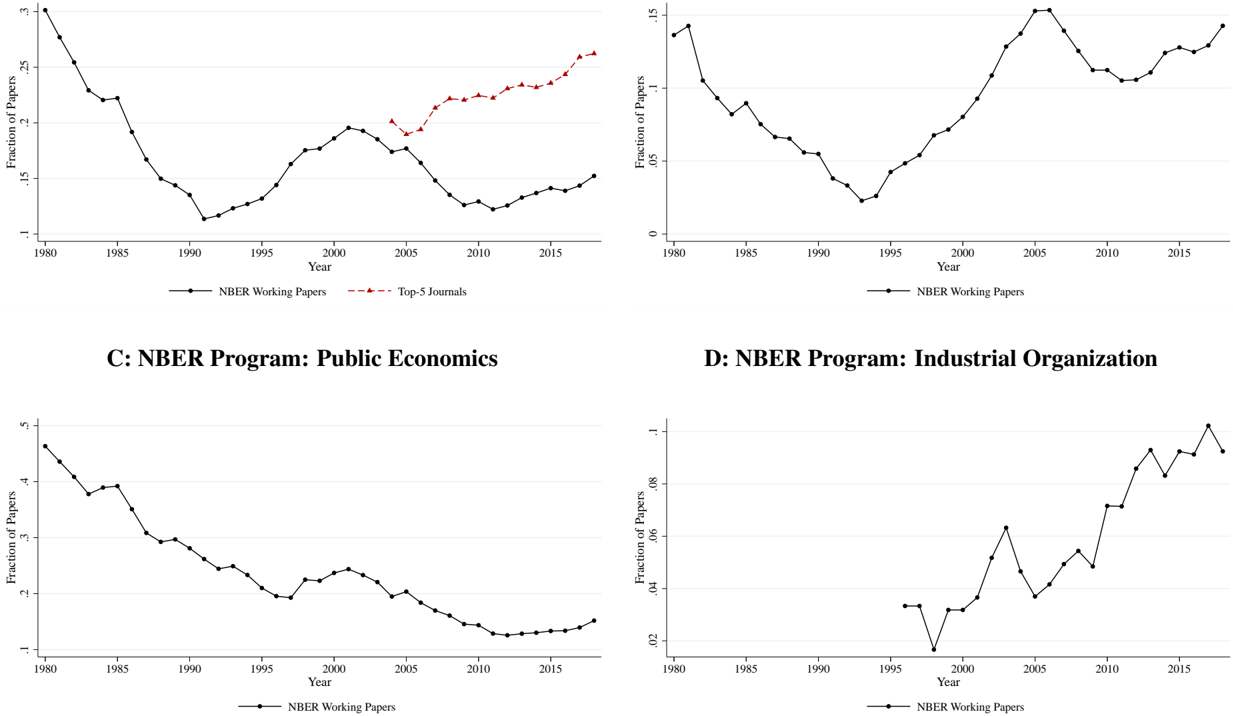
This paper uses text mining on 2,830 top-five journal papers and 10,324 NBER working papers in applied microeconomics to document major shifts in methods and data use over time. It argues that applied economics has become more focused on identification, experiments, administrative data, precision, and combining multiple empirical strategies, consistent with a “credibility revolution” and a “collage” approach.
Key findings
- References to identification rose roughly linearly in both series, from around 4% to 50% of papers.
- References to experimental and quasi-experimental methods also increased: over 40% of NBER papers and about 35% of top-five papers now mention methods such as RCTs, lab experiments, difference-in-differences, regression discontinuity, event studies, or bunching.
- References to administrative data rose from the mid-1990s to about 30% today in the NBER series; the top-five series shows a similar increase with a lag of about three years.
- The paper reports that concern with mechanisms rose from about 20% to about 60% in NBER papers and to more than 70% today in top-five papers; references to “precisely estimated zero” are still only in a little over 1% of papers.
Methods
- The study is a text-mining analysis of economics papers, using regex searches on plain-text versions of papers after removing references sections.
- Sample: all NBER working papers from January 1, 1980 to June 30, 2018 in selected applied micro programs, and all papers in the top-five journals from January 1, 2004 to August 2019; final sample sizes are 10,324 NBER papers and 2,830 top-five papers.
- Main analysis: compute five-year moving averages of the fraction of papers mentioning predefined methods- and data-related trigger phrases (for example, identification, RCTs, administrative data, big data, clustering, fixed effects, structural models).
Limitations
- The authors state that their search algorithms were built by trial and error, and that some Type I and Type II errors may remain; they say this is not a major concern because their focus is on trends rather than levels.
- Their within-paper comparison of NBER papers that were later published in top-five journals uses a matched sample of 610 papers, which they describe as arguably too small to draw firm conclusions.
- Evident from the text: the analysis relies on keyword mentions, so it captures discussion of methods and data rather than direct measures of whether those methods were actually used.
Model-written summary. Check it against the paper before relying on it.
Integrity signals
Registry
Cites
Statistics
Figures




Verification
Claims the paper makes
1 Valid · 3 Not valid · 9 Not checked · 75 Own results and interpretations
A result the paper states — it cites no source for it, so there is none to check. The quote shows it is in the paper.
In the paper
“As a result, the fraction of applied microeconomics papers published in major general interest journals has increased from 55-60% to about 75%.”
plainstates a cause- Asserted: passes — The authors put it forward as true.
- Checkable: passes — It can be checked against evidence.
- Load-bearing: unclear — It is unclear whether the paper’s conclusions depend on it.
- Based: unclear — It is unclear why the paper says it holds.
- Rests on 2 assumptions not shown here.
A result the paper reports from its own data — it cites no other source for it, so there is none to check. The quote shows it is in the paper.
In the paper
“This time pattern mirrors the rise of lab and field experiments quite closely.”
plainstates an association- Asserted: passes — The authors put it forward as true.
- Checkable: passes — It can be checked against evidence.
- Load-bearing: unclear — It is unclear whether the paper’s conclusions depend on it.
- Based: passes — The paper gives a reason why it holds.
- Rests on 2 assumptions not shown here.
A result the paper reports from its own data — it cites no other source for it, so there is none to check. The quote shows it is in the paper.
In the paper
“Panel A shows a sharp rise in the fraction of NBER working papers discussing randomized controlled trials since 2005, and especially since 2010.”
plainstates an association- Asserted: passes — The authors put it forward as true.
- Checkable: passes — It can be checked against evidence.
- Load-bearing: passes — The paper’s conclusions depend on it.
- Based: passes — The paper gives a reason why it holds.
- Rests on 2 assumptions not shown here.
A result the paper reports from its own data — it cites no other source for it, so there is none to check. The quote shows it is in the paper.
In the paper
“The top-five series shows a much gentler rise in RCTs, to about 5 percent of papers by 2019.”
plainstates an association- Asserted: passes — The authors put it forward as true.
- Checkable: passes — It can be checked against evidence.
- Load-bearing: unclear — It is unclear whether the paper’s conclusions depend on it.
- Based: passes — The paper gives a reason why it holds.
- Rests on 2 assumptions not shown here.
A result the paper states — it cites no source for it, so there is none to check. The quote shows it is in the paper.
In the paper
“More recently, the popularity of lab experiments has turned downwards in both series.”
plain- Asserted: passes — The authors put it forward as true.
- Checkable: passes — It can be checked against evidence.
- Load-bearing: unclear — It is unclear whether the paper’s conclusions depend on it.
- Based: passes — The paper gives a reason why it holds.
- Rests on 2 assumptions not shown here.
41 more claims
Create a free account to see all 88 claims and every source verdict.
- It may state two separate claims as one. 22
- Probably not a substantial claim. 22
- The quote only partly states this claim. 2
Citations
Cites
Identification and Estimation of Treatment Effects with a Regression-Discontinuity Design
Hahn, J., Todd, P., & Klaauw, W. (2001) · Econometrica · doi:10.1111/1468-0262.00183 · Cited by 2,679
Angrist, J. D., & Pischke, J.-S. (2010) · Journal of Economic Perspectives · doi:10.1257/jep.24.2.3 · Cited by 1,566
Estimating the Effect of Training Programs on Earnings
Ashenfelter, O. (1978) · The Review of Economics and Statistics · doi:10.2307/1924332 · Cited by 1,515
Using Maimonides' Rule to Estimate the Effect of Class Size on Scholastic Achievement
Angrist, J. D., & Lavy, V. (1999) · The Quarterly Journal of Economics · doi:10.1162/003355399556061 · Cited by 1,482
Using the Longitudinal Structure of Earnings to Estimate the Effect of Training Programs
Ashenfelter, O., & Card, D. (1985) · The Review of Economics and Statistics · doi:10.2307/1924810 · Cited by 1,023
Do Taxpayers Bunch at Kink Points?
Saez, E. (2010) · American Economic Journal: Economic Policy · doi:10.1257/pol.2.3.180 · Cited by 950
Using the Longitudinal Structure of Earnings to Estimate the Effect of Training Programs
Ashenfelter, O., & Card, D. (1984) · National Bureau of Economic Research · doi:10.3386/w1489 · Cited by 876
Kleven, H. J. (2016) · Annual Review of Economics · doi:10.1146/annurev-economics-080315-015234 · Cited by 416
Self-citationHow Does Your Kindergarten Classroom Affect Your Earnings? Evidence From Project STAR
Chetty, R., Friedman, J., Hilger, N., Saez, E., Schanzenbach, D. W., & Yagan, D. (2010) · National Bureau of Economic Research · doi:10.3386/w16381 · Cited by 386
Nine Facts about Top Journals in Economics
Card, D., & DellaVigna, S. (2013) · Journal of Economic Literature · doi:10.1257/jel.51.1.144 · Cited by 333
Cited by
Synthetic Difference-in-Differences
Arkhangelsky, D., Athey, S., Hirshberg, D. A., Imbens, G. W., & Wager, S. (2021) · American Economic Review · doi:10.1257/aer.20190159 · Cited by 1,518
An Introductory Guide to Event Study Models
Miller, D. L. (2023) · Journal of Economic Perspectives · doi:10.1257/jep.37.2.203 · Cited by 360
Advances in Difference-in-differences Methods for Policy Evaluation Research
Wang, G., Hamad, R., & White, J. S. (2024) · Epidemiology · doi:10.1097/ede.0000000000001755 · Cited by 117
The Rise of Research Teams: Benefits and Costs in Economics
Jones, B. F. (2021) · The Journal of Economic Perspectives · doi:10.1257/jep.35.2.191 · Cited by 96
Causal Inference in the Social Sciences
Imbens, G. W. (2023) · Annual Review of Statistics and Its Application · doi:10.1146/annurev-statistics-033121-114601 · Cited by 137
Synthetic Difference In Differences
Arkhangelsky, D., Athey, S., Hirshberg, D., Imbens, G., & Wager, S. (2019) · National Bureau of Economic Research · doi:10.3386/w25532 · Cited by 87
On synthetic difference-in-differences and related estimation methods in Stata
Clarke, D., Pailañir, D., Athey, S. C., & Imbens, G. W. (2024) · The Stata Journal Promoting communications on statistics and Stata · doi:10.1177/1536867x241297914 · Cited by 264
Sufficient Statistics Revisited
Kleven, H. (2021) · Annual Review of Economics · doi:10.1146/annurev-economics-060220-023547 · Cited by 125
Self-citationDifference-in-Differences for Policy Evaluation
Callaway, B. (2022) · Springer eBooks · doi:10.1007/978-3-319-57365-6_352-1 · Cited by 129
Clemens, J. P., & Strain, M. R. (2021) · National Bureau of Economic Research · doi:10.3386/w29264 · Cited by 53
Causality in Econometrics: Choice vs Chance
Imbens, G. W. (2022) · Econometrica · doi:10.3982/ecta21204 · Cited by 51
Selection in Surveys: Using Randomized Incentives to Detect and Account for Nonresponse Bias
Dutz, D., Huitfeldt, I., Lacouture, S., Mogstad, M., Torgovitsky, A., & van Dijk, W. (2021) · National Bureau of Economic Research · doi:10.3386/w29549 · Cited by 34
Ambivalent economizations: the case of value added modeling in teacher evaluation
Griffen, Z. W., & Panofsky, A. L. (2020) · Theory and Society · doi:10.1007/s11186-020-09417-x · Cited by 36
The Effect of Innovation Similarity on Asset Prices: Evidence from Patents’ Big Data
Bekkerman, R., Fich, E. M., & Khimich, N. V. (2022) · The Review of Asset Pricing Studies · doi:10.1093/rapstu/raac014 · Cited by 36
Difference-in-Differences Designs: A Practitioner’s Guide
Baker, A., Callaway, B., Cunningham, S., Goodman-Bacon, A., & Sant’Anna, P. H. C. (2026) · Journal of Economic Literature · doi:10.1257/jel.20251650 · Cited by 263
Visual Inference and Graphical Representation in Regression Discontinuity Designs
Korting, C., Lieberman, C., Matsudaira, J. D., Pei, Z., & Shen, Y. (2023) · The Quarterly Journal of Economics · doi:10.1093/qje/qjad011 · Cited by 38
Is Recreational Marijuana a Gateway to Harder Drug Use and Crime?Preprint
Sabia, J. J., Dave, D., Alotaibi, F. M., & Rees, D. I. (2021) · SSRN Electronic Journal · doi:10.3386/w29038 · Cited by 24
Doubly robust identification for causal panel data models
Arkhangelsky, D., & Imbens, G. W. (2022) · Econometrics Journal · doi:10.1093/ectj/utac019 · Cited by 51
Double-Robust Identification for Causal Panel Data Models
Arkhangelsky, D., & Imbens, G. (2021) · National Bureau of Economic Research · doi:10.3386/w28364 · Cited by 17
Sieweke, J., Hentschel, T., Gazdag, B. A., & Henningsen, L. (2024) · The Leadership Quarterly · doi:10.1016/j.leaqua.2024.101843 · Cited by 27
Nagaraj, A., & Tranchero, M. (2023) · National Bureau of Economic Research · doi:10.3386/w31372 · Cited by 37
Utilizing machine learning to expedite the fabrication and biological application of carbon dots
Tang, Y., Xu, Q., Zhu, P., Zhu, R., & Wang, J. (2023) · Materials Advances · doi:10.1039/d3ma00443k · Cited by 15
Denisova–Schmidt, E., Huber, M., Leontyeva, E., & Solovyeva, A. (2020) · Empirical Economics · doi:10.1007/s00181-020-01827-1 · Cited by 19
Difference-in-Differences with matching methods in leadership studies: A review and practical guide
Lee, K., Jeong, Y., Han, S., Joo, S., Park, J., & Qi, K. (2024) · The Leadership Quarterly · doi:10.1016/j.leaqua.2024.101813 · Cited by 20
Do words hurt more than actions? The impact of trade tensions on financial markets
Minesso, M. F., Kurcz, F., & Pagliari, M. S. (2022) · Journal of Applied Econometrics · doi:10.1002/jae.2924 · Cited by 14
Labor by design: contributions of David Card, Joshua Angrist, and Guido Imbens*
Hull, P., Kolesár, M., & Walters, C. (2022) · Scandinavian Journal of Economics · doi:10.1111/sjoe.12505 · Cited by 12
Pearl before economists: the book of why and empirical economics
Huntington‐Klein, N. (2022) · Journal of Economic Methodology · doi:10.1080/1350178x.2022.2088085 · Cited by 8
Nowcasting Entrepreneurship: Urban Third Place versus the Creative Class
Fang, L., & Slaper, T. F. (2022) · Sustainability · doi:10.3390/su14020763 · Cited by 15
A New Measure of 19th Century US Suicides
Kronenberg, C. (2021) · Social Indicators Research · doi:10.1007/s11205-021-02674-y · Cited by 9
Mis(sed) Diagnosis: Physician Decision-Making and ADHD
Marquardt, K. (2022) · Journal of Political Economy · doi:10.1086/742421 · Cited by 10
Noise-induced randomization in regression discontinuity designs
Eckles, D., Ignatiadis, N., Wager, S., & Wu, H. (2025) · Biometrika · doi:10.1093/biomet/asaf003 · Cited by 29
Evaluation of technology clubs by clustering: a cautionary note
Andrés, A. R., Amavilah, V. H., & Otero, A. (2021) · Applied Economics · doi:10.1080/00036846.2021.1934393 · Cited by 6
What's Worth Knowing? Economists' Opinions About EconomicsPreprint
Falk, A., & Andre, P. (2021) · SSRN Electronic Journal · doi:10.2139/ssrn.3885426 · Cited by 26
Mostly Harmless Machine Learning: Learning Optimal Instruments in Linear IV ModelsPreprint
Chen, J., Chen, D. L., & Lewis, G. (2020) · RePEc: Research Papers in Economics · doi:10.48550/arxiv.2011.06158 · Cited by 25
EU Accession, Institutional Change, Growth and Human Capital
Kant, C. (2018) · Economies · doi:10.3390/economies13060177 · Cited by 6
Myers, C. K., & Srinivasan, A. (2024) · Perspectives on Sexual and Reproductive Health · doi:10.1111/psrh.12268 · Cited by 5
Caviglia‐Harris, J. L. (2023) · Southern Economic Journal · doi:10.1002/soej.12655 · Cited by 6
An Empirical Study of the Role of Big Data Analytics in Corporate Decision Making
Shao, X. (2023) · Journal of Global Information Management · doi:10.4018/jgim.321176 · Cited by 10
Perks and pitfalls of city directories as a micro-geographic data source
Albers, T., & Kappner, K. (2022) · Explorations in Economic History · doi:10.1016/j.eeh.2022.101476 · Cited by 18
Zhang, W. (2022) · China Agricultural Economic Review · doi:10.1108/caer-08-2021-0164 · Cited by 6
Title: Methods Used to Evaluate the Health Effects of Social Policies: A Systematic Review
Dore, E. C., Wright, E., White, J. S., & Hamad, R. (2024) · Current Epidemiology Reports · doi:10.1007/s40471-024-00356-0 · Cited by 8
Misclassification in Difference-in-Differences ModelsPreprint
Denteh, A., & Kédagni, D. (2022) · SSRN Electronic Journal · doi:10.2139/ssrn.4181736 · Cited by 11
Design-Robust Two-Way-Fixed-Effects Regression For Panel DataPreprint
Arkhangelsky, D., Imbens, G. W., Lei, L., et al. (2021) · RePEc: Research Papers in Economics · doi:10.48550/arxiv.2107.13737 · Cited by 4
Clemens, J. P., McNichols, D., & Sabia, J. J. (2020) · National Bureau of Economic Research · doi:10.3386/w27999 · Cited by 4
LaLonde (1986) after Nearly Four Decades: Lessons LearnedPreprint
Xu, Y., & Imbens, G. W. (2024) · SSRN Electronic Journal · doi:10.2139/ssrn.4849285 · Cited by 3
David Card, Nobel Prize 2021: the Design-Based Revolution
Goux, D., & Maurin, É. (2023) · Revue d économie politique · doi:10.3917/redp.331.0025 · Cited by 2
Research on Big Data Text Clustering Algorithm Based on Swarm Intelligence
Li, X., & Shu, Z. (2022) · Wireless Communications and Mobile Computing · doi:10.1155/2022/7551035 · Cited by 3
Do Words Hurt More than Actions? The Impact of Trade Tensions on Financial MarketsPreprint
Ferrari, M., Kurcz, F., & Pagliari, M. S. (2020) · SSRN Electronic Journal · doi:10.2139/ssrn.3735905 · Cited by 3
Causality in Empirical Analyses with Emphasis on Asymmetric Information and Risk Management
Dionne, G. (2024) · Springer eBooks · doi:10.1007/978-3-031-69561-2_13 · Cited by 3
Suh, J., Chung, H., Cho, C., & Kim, J. (2024) · Journal of Channel and Retailing · doi:10.17657/jcr.2024.10.31.6 · Cited by 2
Altshuler, R., Dickert‐Conlin, S., Gentry, W. M., et al. (2023) · National Tax Journal · doi:10.1086/727348 · Cited by 2
Causal Evaluation of Educational Policies
Meier, D. H., & Thomsen, S. L. (2023) · Springer eBooks · doi:10.1007/978-3-319-57365-6_353-1 · Cited by 3
Causality in Empirical Analyses With Emphasis on Asymmetric Information and Risk ManagementPreprint
Dionne, G. (2023) · SSRN Electronic Journal · doi:10.2139/ssrn.4619113 · Cited by 2
Coyle, D., & Muhtar, M. A. (2022) · SSRN Electronic Journal · doi:10.2139/ssrn.4062126 · Cited by 2
Melo, V., & Neilson, E. (2022) · SSRN Electronic Journal · doi:10.2139/ssrn.4194160 · Cited by 2
Canadian Journal of Economics: A historic overview
Μεταξόγλου, Κ. (2021) · Canadian Journal of Economics/Revue canadienne d économique · doi:10.1111/caje.12519 · Cited by 3
Clemens, J. P., & Strain, M. R. (2021) · SSRN Electronic Journal · doi:10.2139/ssrn.3926945 · Cited by 2
Cluster and local science-industry collaborations: evidence from a place-based innovation policy
Quignon, A. (2025) · The Journal of Technology Transfer · doi:10.1007/s10961-025-10284-w · Cited by 5
Integrating Open Science Principles into Quasi-Experimental Social Science Research
Heller, B., & Robinson, C. D. (2025) · Social Sciences · doi:10.3390/socsci14080499 · Cited by 2
Guerrero-Escobar, S., Hernández‐del‐Valle, G., & Vega, M. A. H. (2025) · Global Finance Journal · doi:10.1016/j.gfj.2025.101165 · Cited by 3
Gurgul, H., & Wójtowicz, T. (2025) · Central European Journal of Operations Research · doi:10.1007/s10100-025-00962-3 · Cited by 2
Modeling event studies with heterogeneous treatment effects
Argys, L. M., Mroz, T. A., & Pitts, M. M. (2023) · doi:10.29338/wp2023-11 · Cited by 1
David Card, Nobel Prize 2021: The design-based revolution
Goux, D., & Maurin, É. (2023) · Revue d économie politique · doi:10.3917/redp.331.0001 · Cited by 1
Nagaraj, A., & Tranchero, M. (2023) · SSRN Electronic Journal · doi:10.2139/ssrn.4483672 · Cited by 2
Generating Big Data in (Micro)Economics
Aydoğan, Y. (2022) · Advances in human and social aspects of technology book series · doi:10.4018/978-1-7998-8553-5.ch006 · Cited by 1
Li, C., & Yang, M. (2022) · Journal of Mathematics · doi:10.1155/2022/3661477 · Cited by 1
RetractedRomano, P., & Sampaio, R. M. B. (2021) · SSRN Electronic Journal · doi:10.2139/ssrn.3931841 · Cited by 1
The effect of Innovation Similarity on Asset Prices: Evidence from Patents’ Big DataPreprint
Bekkerman, R., Fich, E. M., & Khimich, N. V. (2018) · SSRN Electronic Journal · doi:10.2139/ssrn.3147218 · Cited by 1
Sequential deviation minimization for improving the estimation in synthetic control methods
Kyo, K., & Kawata, Y. (2026) · Journal of Applied Statistics · doi:10.1080/02664763.2026.2717163
Diffusing Economic Knowledge: Economics Education in the Twentieth Century
Brent, J., Jhun, J., & Medema, S. G. (2026) · History of Political Economy · doi:10.1215/00182702-12727491
Finding Causal Variation in Policy Text with Large Language ModelsPreprint
Liu, F. (2026) · SSRN Electronic Journal · doi:10.2139/ssrn.6487478
The Shape of Economics: Semantic Structure, Knowledge Flows, and SpecializationPreprint
Harris, T. (2026) · SSRN Electronic Journal · doi:10.2139/ssrn.6549201 · Cited by 1
The Use of Econometrics in Labour ResearchPreprint
Chan, M., & Márk, L. (2026) · SSRN Electronic Journal · doi:10.2139/ssrn.7090498
Durkheim and the roots of cliometric reasoning
Boyer, J.-D., Diebolt, C., & Haupert, M. (2025) · Cliometrica · doi:10.1007/s11698-025-00325-7
Counterfactuals in economics and allied social sciences: Methods, applications, and debates
Punongbayan, J. C. B., & Paloyo, A. R. (2025) · Elsevier eBooks · doi:10.1016/b978-0-443-26629-4.00100-3
Double/debiased machine learning for semiparametric synthetic difference-in-differences models
Zhang, Z., Fu, L., & Wang, D. (2025) · Econometric Reviews · doi:10.1080/07474938.2025.2581285 · Cited by 1
Race‐related research in economics
Advani, A., Ash, E., Boltachka, A., Cai, D., & Imran Rasul, A. (2025) · Economica · doi:10.1111/ecca.70022
Hull, P. (2025) · Springer eBooks · doi:10.1007/978-3-031-77623-6_37
Can we Randomize Worlds? An Exploration into the MultiversePreprint
Yang, R. (2025) · SSRN Electronic Journal · doi:10.2139/ssrn.5807882
It's About Time (Series): A Simple Correction For Difference-in-Differences EstimatorsPreprint
Cornwall, G. J., & Wentland, S. A. (2025) · SSRN Electronic Journal · doi:10.2139/ssrn.5991734
The Impact of Asymmetric Price Limits on Stock Portfolio Returns: Evidence from Indonesian Markets
Rosidin, N., SUDARAJAD, O. Y., & Wiryono, S. K. (2024) · International Journal of Economics and Management · doi:10.47836/ijeam_18.3.05
The Impact of Asymmetric Price Limits on Stock Portfolio Returns: Evidence from Indonesian Markets
Rosidin, N., SUDARAJAD, O. Y., & Wiryono, S. K. (2024) · International Journal of Economics and Management · doi:10.47836/ijeam.18.3.05
Wu, X., & Cheng, M. (2022) · 2022 4th International Conference on Smart Systems and Inventive Technology (ICSSIT) · doi:10.1109/icssit53264.2022.9716573
Highly Powered Analysis PlansPreprint
Anderson, M., & Magruder, J. (2022) · SSRN Electronic Journal · doi:10.2139/ssrn.4056796
Perks and Pitfalls of City Directories as a Micro-Geographic Data SourcePreprint
Kappner, K., & Albers, T. (2022) · SSRN Electronic Journal · doi:10.2139/ssrn.4075520
Doctors, Documents, and Diagnostic Disparities: Essays on the Economics of Mental Health
Marquardt, K. (2021) · UA Campus Repository (The University of Arizona) · Cited by 1
Metadata
- Authors
- Currie, J., Kleven, H., & Zwiers, E.
- Affiliations
- Princeton University (US)
- Venue
- AEA Papers and Proceedings
- Publisher
- American Economic Association
- Published
- 2020-05-01
- Volume
- 110
- Pages
- 42-48
- ISSN
- 2574-0768 (ISSN-L)
- 2574-0776
- OpenAlex
- W3003454468
- Cited by
- 86
- References
- 5
- Citations by year
- 2026: 7 · 2025: 13 · 2024: 10 · 2023: 12 · 2022: 20 · 2021: 16 · 2020: 6
- FWCI
- 38.44
- Type
- journal article
- Language
- en
- Open access
- green
- www.nber.org
- Locations
- AEA Papers and Proceedings (publishedVersion)
- RePEc: Research Papers in Economics (submittedVersion)
- Topics
- Social Sciences › General Social Sciences › Computational and Text Analysis Methods
- Social Sciences › Decision Sciences › Information Systems and Management › Big Data Technologies and Applications
- Physical Sciences › Mathematics › Statistics and Probability › Advanced Causal Inference Techniques
- Keywords
- text mining, administrative data, big data, data collection methods, research credibility, evidence aggregation
About these checks
Registry, retraction, Cites and statistics results are computed, not judged, with one exception: a printed reference that no index lists is read once by a model before it counts as a citation error. Claims are extracted by a model and kept only when their quote appears verbatim in the text; each cited source is then checked, with a model’s help, for whether it says what the claim relies on. Those verdicts can be wrong — read the claim’s quote and the cited source before relying on one.
The claim verdicts this report counts are experimental: their accuracy is not yet measured.
A language model drew the claims from the paper on 2026-10-10, under version 3 of the claim definition (model deepseek-v4.1-flash, prompt extract-v3).
A second model labelled each claim on 2026-10-10 (model jev-1.13-20260917, definition revision gold-guideline-v0.2).
Statistics and arithmetic are recomputed, not judged.
Confidence bands are shown only for fields calibrated on our annotated test set. None is calibrated yet, so no band is shown.
What counts as a claim ›How we measure confidence ›How we check this ›
Are you an author, or do you see a problem with this page? Request a review
Data sources
Bibliographic data: Semantic Scholar, OpenAlex, Crossref.
Contains information from the Semantic Scholar Academic Graph Datasets, made available under the ODC Attribution License (ODC-BY 1.0).
Semantic Scholar’s data is described in: Kinney, R., et al. (2023). The Semantic Scholar Open Data Platform. arXiv:2301.10140.
