

The DOI matches its Crossref record; 79 of the 79 references it cites were found in a registry or an index.
Prenatal Exposure to Bisphenol A at Environmentally Relevant Doses Adversely Affects the Murine Female Reproductive Tract Later in Life
Open accessAbstract
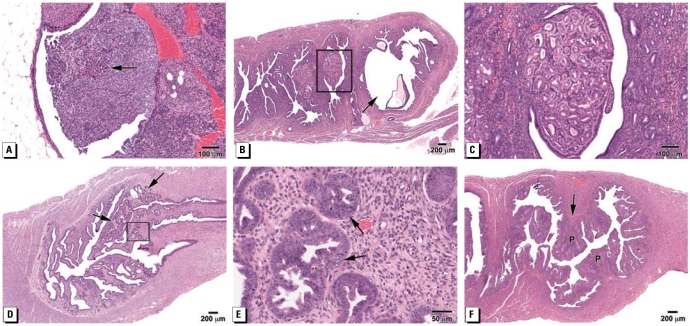
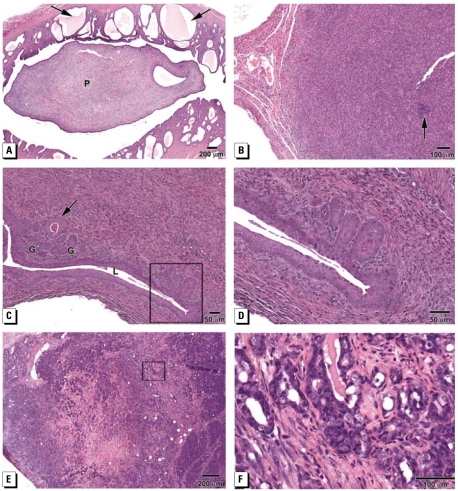
Background: Exposure to endocrine-disrupting chemicals during critical developmental periods causes adverse consequences later in life; an example is prenatal exposure to the pharmaceutical diethylstilbestrol (DES). Bisphenol A (BPA), an environmental estrogen used in the synthesis of plastics, is of concern because its chemical structure resembles that of DES, and it is a “high-volume production” chemical with widespread human exposure. Objectives: In this study we investigated whether prenatal BPA causes long-term adverse effects in female reproductive tissues in an experimental animal model previously shown useful in studying effects of prenatal DES. Methods: Timed pregnant CD-1 mice were treated on days 9–16 of gestation with BPA (0.1, 1, 10, 100, or 1,000 μg/kg/day). After delivery, pups were held for 18 months; reproductive tissues were then evaluated. Results: Ovarian cysts were significantly increased in the 1-μg/kg BPA group; ovarian cyst-adenomas were seen in the other three BPA-treated groups but not in corn-oil controls. We observed increased progressive proliferative lesions of the oviduct after BPA treatment, similar to those described in response to DES. Further, although not statistically different from the controls, prominent mesonephric (Wolffian) remnants and squamous metaplasia of the uterus, as well as vaginal adenosis, were present in BPA-treated mice, similar to lesions reported following DES treatment. More severe pathologies observed in some BPA-treated animals included atypical hyperplasia and stromal polyps of the uterus; sarcoma of the uterine cervix; and mammary adenocarcinoma. We did not observe these lesions in controls. Conclusions: These data suggest that BPA causes long-term adverse reproductive and carcinogenic effects if exposure occurs during critical periods of differentiation.
Overview
The claims and statistics of this paper haven’t been checked yet.
Run the check — free, no account needed. It reads the open-access text and checks the sources it cites.
Integrity signals
Registry
Cites
Statistics
Figures
Verification
Claims the paper makes
The claims and statistics of this paper haven’t been checked yet.
Run the check — free, no account needed. It reads the open-access text and checks the sources it cites.
Claims other papers make about this one
Each is checked against this paper’s own text: does it say what the citing paper says it does?
In the citing paper
“BPA is thought to be an endocrine disruptor that acts as an estrogen mimetic [ 128–131 ], thus research has focused largely on its effects in reproductive tissues.”
From DNA methylation: a mechanism linking environmental chemical exposures to risk of autism spectrum disorders? (2016) · cites this paper as [129]
Self-check
Percentages, sums and reported differences re-computed from the paper’s own numbers.
The self-check needs the paper’s full text.
Citations
Cites
Human exposure to bisphenol A (BPA)
Vandenberg, L. N., Hauser, R. B., Marcus, M., Olea, N., & Welshons, W. V. (2007) · Reproductive Toxicology · doi:10.1016/j.reprotox.2007.07.010 · Cited by 2,984
Exposure of the U.S. Population to Bisphenol A and 4- tertiary -Octylphenol: 2003–2004
Calafat, A. M., Ye, X., Wong, L.-Y., Reidy, J. A., & Needham, L. L. (2008) · Environmental Health Perspectives · doi:10.1289/ehp.10753 · Cited by 1,743
Estrogenicity of Resin-Based Composites and Sealants Used in Dentistry
Olea, N., Pulgar, R., Pérez, P., Olea‐Serrano, F., Rivas, A., Novillo-Fertrell, A., Pedraza, V., Soto, A. M., & Sonnenschein, C. (1996) · Environmental Health Perspectives · doi:10.1289/ehp.96104298 · Cited by 1,041
Xenoestrogens Released from Lacquer Coatings in Food Cans
Brotons, J. A., Olea‐Serrano, F., Villalobos, M., Pedraza, V., & Olea, N. (1995) · Environmental Health Perspectives · doi:10.1289/ehp.95103608 · Cited by 942
Oken, E., & Gillman, M. W. (2003) · Obesity Research · doi:10.1038/oby.2003.69 · Cited by 929
In vitro molecular mechanisms of bisphenol A action.
Wetherill, Y. B., Akingbemi, B. T., Kanno, J., McLachlan, J. A., Nadal, A., Sonnenschein, C., Watson, C. S., Zoeller, R. T., & Belcher, S. M. (2007) · Reproductive Toxicology · doi:10.1016/j.reprotox.2007.05.010 · Cited by 920
Exposure to bisphenol A advances puberty
Howdeshell, K. L., Hotchkiss, A. K., Thayer, K. A., Vandenbergh, J. G., & vom Saal, F. S. (1999) · Nature · doi:10.1038/44517 · Cited by 820
Environmental Obesogens: Organotins and Endocrine Disruption via Nuclear Receptor Signaling
Grün, F., & Blumberg, B. (2006) · Endocrinology · doi:10.1210/en.2005-1129 · Cited by 812
Ho, S.-M., Tang, W.-Y., Belmonte de Frausto, J., & Prins, G. S. (2006) · Cancer Research · doi:10.1158/0008-5472.can-06-0516 · Cited by 796
Saal, F. S. V., Timms, B. G., Montano, M. M., Palanza, P., Thayer, K. A., Nagel, S. C., Dhar, M. D., Ganjam, V. K., Parmigiani, S., & Welshons, W. V. (1997) · Proceedings of the National Academy of Sciences · doi:10.1073/pnas.94.5.2056 · Cited by 701
Research works printed but not linked: 4
- Bern, 1992, The Fragil Fetus
- Davis, 1999, Ovary, Oviduct, Uterus, and Vagina.
- NIH, 1999, DES Research Update: Current Knowledge, Future Directions
- NTP, 2008, CEHR Brief on Bisphenol A
Cited by
Sorted by citations
EDC-2: the endocrine society's second scientific statement on endocrine-disrupting chemicals
Gore, A. C., Chappell, V. A., Fenton, S. E., Flaws, J. A., Nadal, A., Prins, G. S., Toppari, J., & Zoeller, R. T. (2015) · Endocrine Reviews · doi:10.1210/er.2015-1010 · Cited by 2,407
Zoeller, R. T., Brown, T. R., Doan, L. L., Gore, A. C., Skakkebæk, N. E., Soto, A. M., Woodruff, T. J., & Saal, F. S. V. (2012) · Endocrinology · doi:10.1210/en.2012-1422 · Cited by 1,185
Huang, Y., Wong, C. K. C., Zheng, J., Bouwman, H., Barra, R. O., Wahlström, B. A., Neretin, L. N., & Wong, M. H. (2011) · Environment International · doi:10.1016/j.envint.2011.04.010 · Cited by 1,148
EFSA Panel on Food Contact Materials, E. (2015) · EFSA Journal · doi:10.2903/j.efsa.2015.3978 · Cited by 1,075
Dumesic, D. A., Oberfield, S. E., Stener-Victorin, E., Marshall, J. C., Laven, J. S., & Legro, R. S. (2015) · Endocrine Reviews · doi:10.1210/er.2015-1018 · Cited by 1,020
Metadata
- Authors
- Newbold, R. R., Jefferson, W. N., & Padilla-Banks, E.
- Affiliations
- National Institutes of Health (US)
- Developmental Endocrinology and Endocrine Disruptor Section, Laboratory of Molecular Toxicology, National Institute of Environmental Health Sciences, National Institutes of Health, Department of Health and Human Services, Research Triangle Park, North Carolina, USA
- Corresponding author
- Newbold, Retha R.
- ORCID
- Jefferson, Wendy N.
- Venue
- Environmental Health Perspectives
- Publisher
- American Chemical Society (ACS)
- Published
- 2009-01-15
- Volume
- 117
- Issue
- 6
- Pages
- 879-885
- ISSN
- 0091-6765 (ISSN-L)
- 1552-9924
- PMC
- PMC2702400
- OpenAlex
- W2080879610
- Cited by
- 236
- References
- 79
- Citations by year
- 2026: 4 · 2025: 7 · 2024: 8 · 2023: 11 · 2022: 12 · 2021: 17 · 2020: 12 · 2019: 14 · 2018: 15 · 2017: 17 · 2016: 19 · 2015: 19 · 2014: 16 · 2013: 13 · 2012: 13
- FWCI
- 12.31
- Type
- journal article
- Language
- en
- Open access
- gold
- doi.org
- Licence
- public-domain
- creativecommons.org/licenses/by/4.0/ (vor, 3270 d)
- Locations
- Environmental Health Perspectives (publishedVersion, public-domain)
- PubMed Central (publishedVersion, public-domain)
- PubMed (publishedVersion)
- Funders
- Wake Forest University
- National Institutes of Health
- National Institute of Environmental Health Sciences
- Topics
- Physical Sciences › Environmental Science › Health, Toxicology and Mutagenesis › Effects and risks of endocrine disrupting chemicals
- Life Sciences › Biochemistry, Genetics and Molecular Biology › Endocrinology › Estrogen and related hormone effects
- Health Sciences › Medicine › Reproductive Medicine › Reproductive Biology and Fertility
- Keywords
- bisphenol A, prenatal exposure, endocrine disruptors, female reproductive tract, ovarian cysts, vaginal adenosis, mammary adenocarcinoma, developmental toxicity, diethylstilbestrol
- MeSH terms
- Bisphenol A Compounds, Animals, Benzhydryl Compounds, Diethylstilbestrol, Female, Ovary, Phenols, Pregnancy, Prenatal Exposure Delayed Effects, Reproduction, Uterus, Water Pollutants, Chemical, Mice, Endocrine Disruptors
About these checks
Registry, retraction, Cites and statistics results are computed, not judged, with one exception: a printed reference that no index lists is read once by a model before it counts as a citation error. Claims are extracted by a model and kept only when their quote appears verbatim in the text; each cited source is then checked, with a model’s help, for whether it says what the claim relies on. Those verdicts can be wrong — read the claim’s quote and the cited source before relying on one.
Statistics and arithmetic are recomputed, not judged.
Confidence bands are shown only for fields calibrated on our annotated test set. None is calibrated yet, so no band is shown.
What counts as a claim ›How we measure confidence ›How we check this ›
Are you an author, or do you see a problem with this page? Request a review
