

The DOI matches its Crossref record; 44 of the 45 references it cites were found in a registry or an index.
Grasping the Intentions of Others with One's Own Mirror Neuron System
Open accessAbstract
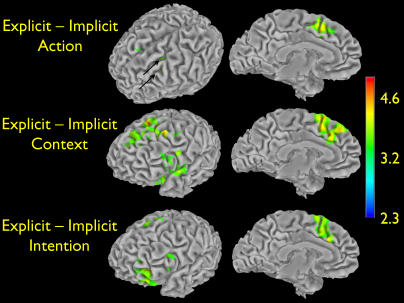
Understanding the intentions of others while watching their actions is a fundamental building block of social behavior. The neural and functional mechanisms underlying this ability are still poorly understood. To investigate these mechanisms we used functional magnetic resonance imaging. Twenty-three subjects watched three kinds of stimuli: grasping hand actions without a context, context only (scenes containing objects), and grasping hand actions performed in two different contexts. In the latter condition the context suggested the intention associated with the grasping action (either drinking or cleaning). Actions embedded in contexts, compared with the other two conditions, yielded a significant signal increase in the posterior part of the inferior frontal gyrus and the adjacent sector of the ventral premotor cortex where hand actions are represented. Thus, premotor mirror neuron areas-areas active during the execution and the observation of an action-previously thought to be involved only in action recognition are actually also involved in understanding the intentions of others. To ascribe an intention is to infer a forthcoming new goal, and this is an operation that the motor system does automatically.
Overview
The claims and statistics of this paper haven’t been checked yet.
Run the check — free, no account needed. It reads the open-access text and checks the sources it cites.
Integrity signals
Registry
Cites
Statistics
Figures
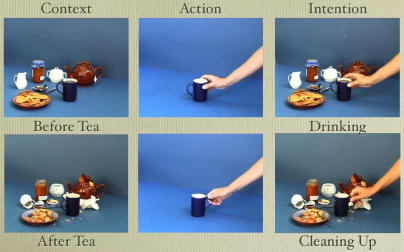
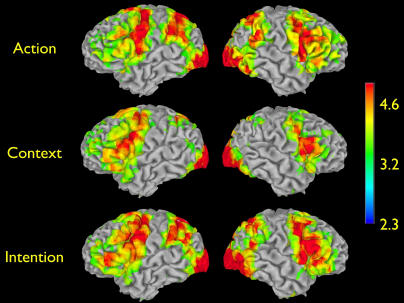
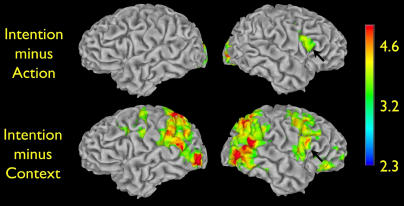
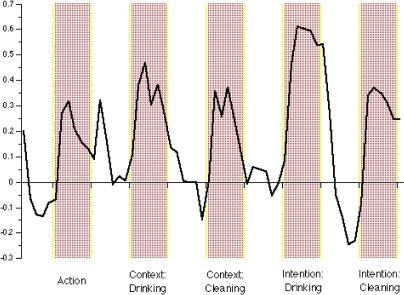
Verification
Claims the paper makes
The claims and statistics of this paper haven’t been checked yet.
Run the check — free, no account needed. It reads the open-access text and checks the sources it cites.
Claims other papers make about this one
Each is checked against this paper’s own text: does it say what the citing paper says it does?
The cited source says what the claim attributes to it.
In the citing paper
“Two recent studies also identified the IFG (an inferior part of the PMC) as an area involved in identifying the goals of hand movements (e.g., during behaviors like drinking and cleaning) as opposed to action execution alone [Iacoboni et al., 2005; Molnar-Szakacs et al., 2005].”
From Social cognition and the brain: A meta-analysis (2009) · cites this paper as Iacoboni et al., 2005
The cited source says what the claim attributes to it.
In the citing paper
“Similar goal identifying brain regions have been documented in the IFG of the human brain [Iacoboni et al., 2005].”
From Social cognition and the brain: A meta-analysis (2009) · cites this paper as Iacoboni et al., 2005
In the citing paper
“Evidence now suggests that this bodily resonance (see Glossary) can afford us a unique, first-person understanding of the experiences of others and is central to a number of social processes [7] including intention understanding [19], empathy [20], and emotion recognition [21].”
From Changing bodies changes minds: Owning another body affects social cognition (2015) · cites this paper as [19]
Self-check
Percentages, sums and reported differences re-computed from the paper’s own numbers.
The self-check needs the paper’s full text.
Citations
Cites
The assessment and analysis of handedness: The Edinburgh inventory
Oldfield, R. C. (1971) · Neuropsychologia · doi:10.1016/0028-3932(71)90067-4 · Cited by 35,900 · cited 1×
“questionnaire adapted from the Edinburgh Handedness Inventory [ 36 ].”
MethodJenkinson, M., Bannister, P., Brady, M., & Smith, S. (2002) · NeuroImage · doi:10.1006/nimg.2002.1132 · Cited by 11,888 · cited 2×
“The co-planar highresolution structural T2-weighted EPI volume was subsequently registered to the Montreal Neurological Institute Talairach-compatible MR atlas averaging 152 normal subjects using FMRIB’s Linear Image Registration Tool (FLIRT) [37].”
MethodFast robust automated brain extraction
Smith, S. M. (2002) · Human Brain Mapping · doi:10.1002/hbm.10062 · Cited by 10,496 · cited 1×
“Functional images were first registered to the co-planar high-resolution structural T2weighted EPI volume after non-brain structures had been removed with FMRIB’s Brain Extraction Tool (BET) from the co-planar highresolution T2-weighted EPI volume [38].”
MethodAction recognition in the premotor cortex
Gallese, V., Fadiga, L., Fogassi, L., & Rizzolatti, G. (1996) · Brain · doi:10.1093/brain/119.2.593 · Cited by 4,968 · cited 1×
“In the monkey brain, ventral premotor area F5 contains, in addition to mirror neurons, a population of cells called canonical neurons [4].”
BackgroundPremotor cortex and the recognition of motor actions
Rizzolatti, G., Fadiga, L., Gallese, V., & Fogassi, L. (1996) · Cognitive Brain Research · doi:10.1016/0926-6410(95)00038-0 · Cited by 4,870 · cited 1×
“Mirror neurons are premotor neurons that fire when the monkey performs object-directed actions such as grasping, tearing, manipulating, holding, but also when the animal observes somebody else, either a conspecific or a human experimenter, performing the same class of actions [3,4,5].”
BackgroundUnderstanding motor events: a neurophysiological study
di Pellegrino, G., Fadiga, L., Fogassi, L., Gallese, V., & Rizzolatti, G. (1992) · Experimental Brain Research · doi:10.1007/bf00230027 · Cited by 3,539 · cited 1×
“Neurons of this type have indeed been previously reported in F5 and referred to as ‘‘logically related’’ neurons [34].”
BackgroundSelf-citationNeurophysiological mechanisms underlying the understanding and imitation of action
Rizzolatti, G., Fogassi, L., & Gallese, V. (2001) · Nature Reviews Neuroscience · doi:10.1038/35090060 · Cited by 3,302
Forman, S. D., Cohen, J. D., Fitzgerald, M., Eddy, W. F., Mintun, M. A., & Noll, D. C. (1995) · Magnetic Resonance in Medicine · doi:10.1002/mrm.1910330508 · Cited by 3,202 · cited 1×
“Z image statistics were performed with a threshold of Z = 2.3 at voxel level and a cluster level corrected for the whole brain at p , 0.05 [41, 42 ].”
MethodInfluentialMirror neurons and the simulation theory of mind-reading
Gallese, V (1998) · Trends in Cognitive Sciences · doi:10.1016/s1364-6613(98)01262-5 · Cited by 3,201
Temporal Autocorrelation in Univariate Linear Modeling of FMRI Data
Woolrich, M. W., Ripley, B. D., Brady, M., & Smith, S. M. (2001) · NeuroImage · doi:10.1006/nimg.2001.0931 · Cited by 2,859 · cited 1×
“Time-series statistical analyses were carried out using FMRIB’s Improved Linear model (FILM) with local autocorrelation correction [39].”
Method
Cited by
Sorted by citations
Cattaneo, L., & Rizzolatti, G. (2009) · Archives of Neurology · doi:10.1001/archneurol.2009.41 · Cited by 3,137
“In the first, contextual features were used to clarify the intention behind a hand-object interaction.(28) In the process of inferring intentions, the frontal node of the mirror system in the right hemisphere was recruited.”
Social cognition and the brain: A meta-analysis
Van Overwalle, F. (2009) · Human Brain Mapping · doi:10.1002/hbm.20547 · Cited by 1,792
The functional role of the parieto-frontal mirror circuit: interpretations and misinterpretations
Rizzolatti, G., & Sinigaglia, C. (2010) · Nature Reviews Neuroscience · doi:10.1038/nrn2805 · Cited by 1,680
“Evidence that the parieto-frontal mirror circuit in humans is also involved in intention encoding was first provided by an fMRI experiment consisting of three condition”
MethodSelf-citationImitation, empathy, and mirror neurons
Iacoboni, M. (2009) · Annual Review of Psychology · doi:10.1146/annurev.psych.60.110707.163604 · Cited by 1,606
An integrated theory of language production and comprehension
Pickering, M. J., & Garrod, S. (2013) · Behavioral and Brain Sciences · doi:10.1017/s0140525x12001495 · Cited by 1,569
Metadata
- Authors
- Iacoboni, M., Molnar-Szakacs, I., Gallese, V., Buccino, G., Mazziotta, J. C., & Rizzolatti, G.
- Affiliations
- University of California, Los Angeles (US)
- University of Parma (IT)
- Corresponding author
- Iacoboni, Marco
- Venue
- PLoS Biology
- Publisher
- Public Library of Science (PLoS)
- Published
- 2005-02-22
- Volume
- 3
- Issue
- 3
- Pages
- e79
- ISSN
- 1544-9173 (ISSN-L)
- 1545-7885
- PMC
- PMC1044835
- OpenAlex
- W2042526117
- Cited by
- 2,044
- References
- 45
- Citations by year
- 2026: 45 · 2025: 41 · 2024: 54 · 2023: 68 · 2022: 45 · 2021: 63 · 2020: 85 · 2019: 96 · 2018: 88 · 2017: 95 · 2016: 93 · 2015: 134 · 2014: 113 · 2013: 134 · 2012: 123
- FWCI
- 153.01
- Type
- journal article
- Language
- en
- Open access
- gold
- doi.org
- Locations
- PLoS Biology (publishedVersion, cc-by)
- Europe PMC (PubMed Central) (publishedVersion, cc-by)
- PubMed Central (publishedVersion, cc-by)
- PubMed (publishedVersion)
- DOAJ (DOAJ: Directory of Open Access Journals) (submittedVersion, cc-by-sa)
- eScholarship (California Digital Library) (submittedVersion)
- eScholarship (California Digital Library) (submittedVersion, cc-by)
- Figshare (submittedVersion, cc-by)
- Funders
- National Science Foundation (0107077)
- Ahmanson Foundation
- Brain Mapping Support Foundation
- European Commission
- European Science Foundation
- National Institute of Mental Health (MH63680)
- National Center for Research Resources (RR08655, P41RR013642, RR12169, RR 13642, C06RR012169)
- Topics
- Social Sciences › Psychology › Social Psychology › Action Observation and Synchronization
- Social Sciences › Psychology › Developmental and Educational Psychology › Child and Animal Learning Development
- Life Sciences › Neuroscience › Cognitive Neuroscience › Face Recognition and Perception
- Keywords
- intention understanding, mirror neuron system, action observation, grasping, ventral premotor cortex, inferior frontal gyrus, social cognition, action context, goal inference, motor system
- MeSH terms
- Adult, Brain, Brain Mapping, Empathy, Female, Humans, Functional Laterality, Male, Motor Neurons, Nerve Net, Neurons, Reference Values, Video Recording, Hand Strength, Comprehension
About these checks
Registry, retraction, Cites and statistics results are computed, not judged, with one exception: a printed reference that no index lists is read once by a model before it counts as a citation error. Claims are extracted by a model and kept only when their quote appears verbatim in the text; each cited source is then checked, with a model’s help, for whether it says what the claim relies on. Those verdicts can be wrong — read the claim’s quote and the cited source before relying on one.
Statistics and arithmetic are recomputed, not judged.
Confidence bands are shown only for fields calibrated on our annotated test set. None is calibrated yet, so no band is shown.
What counts as a claim ›How we measure confidence ›How we check this ›
Are you an author, or do you see a problem with this page? Request a review
