

Primary Visual Cortex Activity along the Apparent-Motion Trace Reflects Illusory Perception
Open accessThe DOI matches its Crossref record; 64 of the 64 references it cites were found in a registry or an index.
Abstract
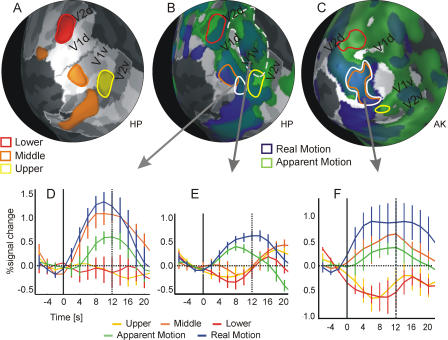
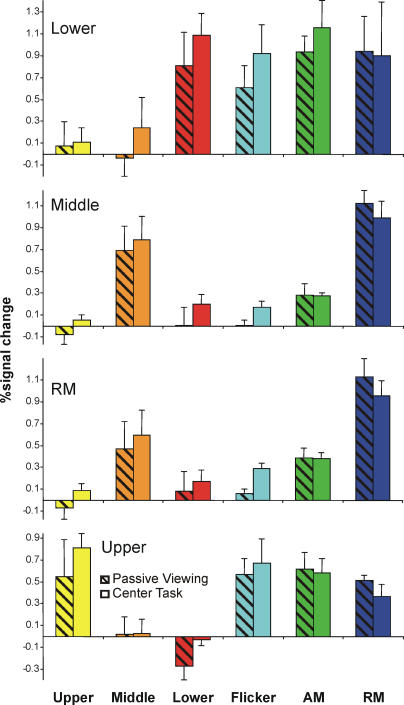
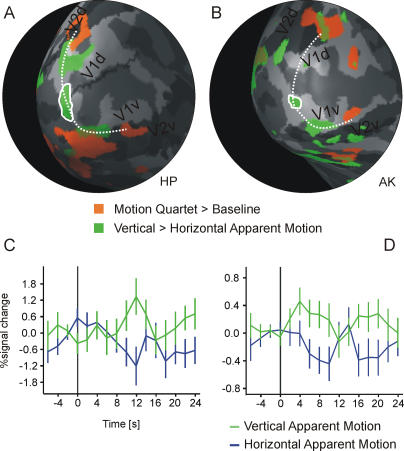
The illusion of apparent motion can be induced when visual stimuli are successively presented at different locations. It has been shown in previous studies that motion-sensitive regions in extrastriate cortex are relevant for the processing of apparent motion, but it is unclear whether primary visual cortex (V1) is also involved in the representation of the illusory motion path. We investigated, in human subjects, apparent-motion-related activity in patches of V1 representing locations along the path of illusory stimulus motion using functional magnetic resonance imaging. Here we show that apparent motion caused a blood-oxygenation-level-dependent response along the V1 representations of the apparent-motion path, including regions that were not directly activated by the apparent-motion-inducing stimuli. This response was unaltered when participants had to perform an attention-demanding task that diverted their attention away from the stimulus. With a bistable motion quartet, we confirmed that the activity was related to the conscious perception of movement. Our data suggest that V1 is part of the network that represents the illusory path of apparent motion. The activation in V1 can be explained either by lateral interactions within V1 or by feedback mechanisms from higher visual areas, especially the motion-sensitive human MT/V5 complex.
Overview
The claims and statistics of this paper haven’t been checked yet.
Free: it reads the open-access text and checks the first 5 claims that cite a source we can check. Create a free account to check every claim.
Integrity signals
Registry
Cites
Statistics
Figures



Verification
Claims the paper makes
The claims and statistics of this paper haven’t been checked yet.
Free: it reads the open-access text and checks the first 5 claims that cite a source we can check. Create a free account to check every claim.
Claims other papers make about this one
Each is checked against this paper’s own text: does it say what the citing paper says it does?
The source backs part of the claim, not all of it — or backs it for a different population, condition or comparison.
In the citing paper
“V5 feedback signals spread out to a large region in primary visual cortex (de-Wit et al. 2012; Muckli et al. 2005)”
From Whatever next? Predictive brains, situated agents, and the future of cognitive science (2013) · cites this paper as Muckli et al. 2005
Experimental — accuracy not yet measuredIn the citing paper
“Moreover, higher visual areas project back to V1 the associated color of grayscale objects [36] or the predicted motion path of an apparent motion illusion [37, 38].”
From Decoding sound and imagery content in early visual cortex (2014) · cites this paper as [37]
Self-check
Percentages, sums and reported differences re-computed from the paper’s own numbers.
The self-check needs the paper’s full text.
Citations
Cites
Neurophysiological investigation of the basis of the fMRI signal
Logothetis, N. K., Pauls, J., Augath, M., Trinath, T., & Oeltermann, A. (2001) · Nature · doi:10.1038/35084005 · Cited by 6,551 · cited 1×
“Current findings from simultaneous fMRI and electrophysiological recordings in monkeys have suggested that the BOLD signal might be especially sensitive to changes in local field potentials [ 53 ].”
BackgroundBorders of Multiple Visual Areas in Humans Revealed by Functional Magnetic Resonance Imaging
Sereno, M. I., Dale, A. M., Reppas, J. B., Kwong, K. K., Belliveau, J. W., Brady, T. J., Rosen, B. R., & Tootell, R. B. H. (1995) · Science · doi:10.1126/science.7754376 · Cited by 2,658
Linear Systems Analysis of Functional Magnetic Resonance Imaging in Human V1
Boynton, G. M., Engel, S. A., Glover, G. H., & Heeger, D. J. (1996) · The Journal of Neuroscience · doi:10.1523/jneurosci.16-13-04207.1996 · Cited by 2,314
Kastner, S., Pinsk, M. A., De Weerd, P., Desimone, R., & Ungerleider, L. G. (1999) · Neuron · doi:10.1016/s0896-6273(00)80734-5 · Cited by 1,622
Why visual attention and awareness are different
Lamme, V. A. F. (2003) · Trends in Cognitive Sciences · doi:10.1016/s1364-6613(02)00013-x · Cited by 1,172 · cited 1×
“In these studies, different imaging and electrophysiological methods have been used to investigate the functional properties of V1 during binocular rivalry [40– 43], perception of moving phosphenes [15,17], figure–ground segregation [34,44–46], the ‘‘line-motion’’ illusion [28], and color filling-in [47].”
MethodThe Underpinnings of the BOLD Functional Magnetic Resonance Imaging Signal
Logothetis, N. K. (2003) · The Journal of Neuroscience · doi:10.1523/jneurosci.23-10-03963.2003 · Cited by 1,039
Engel, S. A., Rumelhart, D. E., Wandell, B. A., Lee, A. T., Glover, G. H., Chichilnisky, E.-J., & Shadlen, M. N. (1994) · Nature · doi:10.1038/369525a0 · Cited by 990
Experimentelle Studien uber das Sehen von Bewegung
Wertheimer, M. (1912) · Cited by 975
Mechanisms of Directed Attention in the Human Extrastriate Cortex as Revealed by Functional MRI
Kastner, S., De Weerd, P., Desimone, R., & Ungerleider, L. G. (1998) · Science · doi:10.1126/science.282.5386.108 · Cited by 953
Are we aware of neural activity in primary visual cortex?
Crick, F., & Koch, C. (1995) · Nature · doi:10.1038/375121a0 · Cited by 932
Research works printed but not linked: 4
- Wertheimer, 1912, Z Psychol, 61, 161
- Albright, 1993, Rev Oculomot Res, 5, 177
- Neuhaus, 1930, Arch Gesamte Psychol, 75, 315
- Lee, 2002, J Vis, 2, 618
Cited by
Items 101–200 of 225
Parietal cortex mediates perceptual Gestalt grouping independent of stimulus size
Grassi, P. R., Zaretskaya, N., & Bartels, A. (2016) · NeuroImage · doi:10.1016/j.neuroimage.2016.03.008 · Cited by 22
Piper, M. S. (2019) · Consciousness and Cognition · doi:10.1016/j.concog.2019.04.006 · Cited by 21
Whitney, D. C., & Bressler, D. W. (2007) · Vision Research · doi:10.1016/j.visres.2006.09.016 · Cited by 19
Schindler, A., & Bartels, A. (2016) · Cerebral Cortex · doi:10.1093/cercor/bhw136 · Cited by 20
The cognitive penetrability of perception: A blocked debate and a tentative solution
Cermeño-Aínsa, S. (2019) · Consciousness and Cognition · doi:10.1016/j.concog.2019.102838 · Cited by 24
Active Inference, Predictive Coding and Cortical Architecture
Adams, R. A., Friston, K. J., & Bastos, A. M. (2015) · Springer eBooks · doi:10.1007/978-94-017-9900-3_7 · Cited by 23
Inhibition of target detection in apparent motion trajectory
Hidaka, S., Nagai, M., Sekuler, A. B., Bennett, P., & Gyoba, J. (2011) · Journal of Vision · doi:10.1167/11.10.2 · Cited by 20
Cues to intention bias action perception toward the most efficient trajectory
McDonough, K. L., Hudson, M., & Bach, P. (2019) · Scientific Reports · doi:10.1038/s41598-019-42204-y · Cited by 22
Repetitive transcranial magnetic stimulation of human MT+ reduces apparent motion perception
Matsuyoshi, D., Hirose, N., Mima, T., Fukuyama, H., & Osaka, N. (2007) · Neuroscience Letters · doi:10.1016/j.neulet.2007.10.002 · Cited by 17
Kolodny, T., Schallmo, M., Gerdts, J. A., Bernier, R., & Murray, S. O. (2020) · Journal of Neuroscience · doi:10.1523/jneurosci.2376-19.2020 · Cited by 20
Hsieh, P., Caplovitz, G. P., & Tse, P. U. (2006) · NeuroImage · doi:10.1016/j.neuroimage.2006.03.047 · Cited by 16
Velocity of motion across the skin influences perception of tactile location
Nguyen, E. H. L., Taylor, J. L., Brooks, J., & Seizova-Cajić, T. (2015) · Journal of Neurophysiology · doi:10.1152/jn.00707.2015 · Cited by 16
The influence of spatial orientation on the perceived path of visual saltatory motion
Khuu, S. K., Kidd, J. C., & Badcock, D. R. (2011) · Journal of Vision · doi:10.1167/11.9.5 · Cited by 17
Motion-Induced Position Shifts Activate Early Visual Cortex
Kohler, P. J., Patrick Cavanagh, B., & Tse, P. U. (2017) · Frontiers in Neuroscience · doi:10.3389/fnins.2017.00168 · Cited by 16
Feedback contribution to surface motion perception in the human early visual cortex
Marquardt, I., Weerd, P. D., Schneider, M., Gülban, Ö. F., Ivanov, D., Wang, Y., & Uludaǧ, K. (2020) · eLife · doi:10.7554/elife.50933 · Cited by 18
Dynamical evolution of motion perception
Kanai, R., Sheth, B. R., & Shimojo, S. (2007) · Vision Research · doi:10.1016/j.visres.2006.12.009 · Cited by 15
Activity in the Visual Cortex is Modulated by Top-Down Attention Locked to Reaction Time
Moradi, F., Hipp, C., & Koch, C. (2007) · Journal of Cognitive Neuroscience · doi:10.1162/jocn.2007.19.2.331 · Cited by 18
Pivotal role of hMT+ in long‐range disambiguation of interhemispheric bistable surface motion
Duarte, J. V., Costa, G. N., Martins, R., & Castelo-Branco, M. S. (2017) · Human Brain Mapping · doi:10.1002/hbm.23701 · Cited by 16
Tracing path-guided apparent motion in human primary visual cortex V1
Akselrod, M., Herzog, M. H., & Öğmen, H. (2014) · Scientific Reports · doi:10.1038/srep06063 · Cited by 16
Resolving visual motion through perceptual gaps
Teichmann, L., Edwards, G., & Baker, C. I. (2021) · Trends in Cognitive Sciences · doi:10.1016/j.tics.2021.07.017 · Cited by 15
Peiker, C., Wunderle, T., Eriksson, D., Schmidt, A., & Schmidt, K. E. (2013) · Journal of Neuroscience · doi:10.1523/jneurosci.1181-13.2013 · Cited by 13
Jurcoane, A., Choubey, B., Mitsieva, D., Muckli, L. F., & Sireteanu, R. (2009) · Vision Research · doi:10.1016/j.visres.2009.04.009 · Cited by 13
Self-citationScene segmentation in early visual cortex during suppression of ventral stream regions
Grassi, P. R., Zaretskaya, N., & Bartels, A. (2016) · NeuroImage · doi:10.1016/j.neuroimage.2016.11.024 · Cited by 15
Neural mechanisms of visual motion extrapolation
Turner, W., Sexton, C. M., & Hogendoorn, H. (2023) · Neuroscience & Biobehavioral Reviews · doi:10.1016/j.neubiorev.2023.105484 · Cited by 17
Ilg, R., Wohlschläger, A. M., Burazanis, S., Wöller, A. A., Nunnemann, S., & Mühlau, M. (2008) · European Journal of Neuroscience · doi:10.1111/j.1460-9568.2008.06520.x · Cited by 13
Apparent Motion Induces Activity Suppression in Early Visual Cortex and Impairs Visual Detection
Shen, L., Han, B., & de Lange, F. P. (2020) · Journal of Neuroscience · doi:10.1523/jneurosci.0563-20.2020 · Cited by 14
Representation of event and object concepts in ventral anterior temporal lobe and angular gyrus
Zhang, Y., Wu, W., Mirman, D., & Hoffman, P. (2023) · Cerebral Cortex · doi:10.1093/cercor/bhad519 · Cited by 12
Spatiotemporal feature integration shapes approximate numerical processing
Fornaciai, M., & Park, J. (2017) · Journal of Vision · doi:10.1167/17.13.6 · Cited by 12
Neural Correlates of Illusory Line Motion
Hamm, J. P., Crawford, T. J., Nebl, H., Kean, M., Williams, S., & Ettinger, U. (2014) · PLoS ONE · doi:10.1371/journal.pone.0087595 · Cited by 10
Dissociation of Prediction from Conscious Perception
Vetter, P., Sanders, L. L. O., & Muckli, L. F. (2014) · Perception · doi:10.1068/p7766 · Cited by 12
Self-citationDetection of visual events along the apparent motion trace in patients with paranoid schizophrenia
Sanders, L. L. O., Muckli, L. F., de Millas, W., Lautenschlager, M. M., Heinz, A., Kathmann, N., & Sterzer, P. (2012) · Psychiatry Research · doi:10.1016/j.psychres.2012.03.006 · Cited by 14
Self-citationThe effect of motion adaptation on the position of elements in the visual saltation illusion
Khuu, S. K., Kidd, J. C., & Errington, J. A. (2010) · Journal of Vision · doi:10.1167/10.12.19 · Cited by 11
In the brain of the beholder: bi-stable motion reveals mesoscopic-scale feedback modulation in V1
Pizzuti, A., Gülban, Ö. F., Huber, L., Peters, J. C., & Goebel, R. (2025) · Brain Structure and Function · doi:10.1007/s00429-025-02906-8 · Cited by 11
Backwards is the way forward: Feedback in the cortical hierarchy predicts the expected future
Muckli, L. F., Petro, L. S., & Smith, F. W. (2013) · Behavioral and Brain Sciences · doi:10.1017/s0140525x12002361 · Cited by 11
Self-citationSpillmann, L., Hsu, L.-C., Wang, W., Chen, C., Yeh, C.-I., & Tseng, C. (2023) · Journal of Vision · doi:10.1167/jov.23.14.4 · Cited by 9
Visual Rivalry Without Spatial Conflict
van Boxtel, J. J. A., & Koch, C. (2012) · Psychological Science · doi:10.1177/0956797611424165 · Cited by 9
Quality Space Model of Temporal Perception
Klincewicz, M. (2011) · Lecture notes in computer science · doi:10.1007/978-3-642-21478-3_18 · Cited by 11
Cortical feedback to V1 and V2 contains unique information about high-level scene structure
Morgan, A., Petro, L. S., & Muckli, L. F. (2016) · Journal of Vision · doi:10.1167/16.12.529 · Cited by 11
Self-citationApparent Motion Suppresses Responses in Early Visual Cortex: A Population Code Model
Humbeeck, N. V., Putzeys, T., & Wagemans, J. P. (2016) · PLoS Computational Biology · doi:10.1371/journal.pcbi.1005155 · Cited by 8
Kim, N. Y., Pinsk, M. A., & Kästner, S. (2021) · Cerebral Cortex · doi:10.1093/cercor/bhab009 · Cited by 8
A neural model of modified excitation/inhibition and feedback levels in schizophrenia
Zhu, J., Zikopoulos, B., & Yazdanbakhsh, A. (2023) · Frontiers in Psychiatry · doi:10.3389/fpsyt.2023.1199690 · Cited by 11
Visual perception of force: Comment on White (2012).
Hubbard, T. L. (2012) · Psychological Bulletin · doi:10.1037/a0028539 · Cited by 8
Apparent motion distorts the shape of a stimulus briefly presented along the motion path
Khuu, S. K., Phu, J., & Khambiye, S. (2010) · Journal of Vision · doi:10.1167/10.13.15 · Cited by 9
Crossmodal Postdiction: Conscious Perception as Revisionist History
Stiles, N. R. B., Tanguay, A. R., & Shimojo, S. (2022) · Journal of Perceptual Imaging · doi:10.2352/j.percept.imaging.2022.5.000403 · Cited by 9
Evidence for long-range spatiotemporal interactions in infant and adult visual cortex
Norcia, A. M., Pei, F., & Kohler, P. J. (2017) · Journal of Vision · doi:10.1167/17.6.12 · Cited by 8
V1 surface size predicts GABA concentration in medial occipital cortex
Bergmann, J., Pilatus, U., Genç, E., Kohler, A., Singer, W., & Pearson, J. (2015) · NeuroImage · doi:10.1016/j.neuroimage.2015.09.036 · Cited by 10
Self-citationA cyclopean visual saltation illusion reveals perceptual grouping in three-dimensional space
Khuu, S. K., Kidd, J. C., Phu, J., & Khambiye, S. (2010) · Journal of Vision · doi:10.1167/10.14.26 · Cited by 7
Color updating on the apparent motion path
Chong, E., Hong, S. W., & Shim, W. M. (2014) · Journal of Vision · doi:10.1167/14.14.8 · Cited by 7
Neural mechanisms underlying sound-induced visual motion perception: An fMRI study
Hidaka, S., Higuchi, S., Teramoto, W., & Sugita, Y. (2017) · Acta Psychologica · doi:10.1016/j.actpsy.2017.05.013 · Cited by 7
The maintenance and updating of representations of no longer visible objects and their parts
McCarthy, J. D., Erlikhman, G., & Caplovitz, G. P. (2017) · Progress in brain research · doi:10.1016/bs.pbr.2017.07.010 · Cited by 8
Svanera, M., Morgan, A., Petro, L. S., & Muckli, L. F. (2021) · Journal of Vision · doi:10.1167/jov.21.7.5 · Cited by 12
Self-citationRetinotopic encoding of the Ternus-Pikler display reflected in the early visual areas
Thunell, E., van der Zwaag, W., Öğmen, H., Plomp, G., & Herzog, M. H. (2016) · Journal of Vision · doi:10.1167/16.3.26 · Cited by 7
Jancke, D. (2017) · Neurophotonics · doi:10.1117/1.nph.4.3.031206 · Cited by 7
Sousa, T., Duarte, J. V., Costa, G. N., Kemper, V. G., Martins, R., Goebel, R., & Castelo-Branco, M. S. (2019) · Scientific Reports · doi:10.1038/s41598-018-37822-x · Cited by 7
Consciousness mediated by neural transition states: How invisibly rapid motions can become visible
Mattler, U., & Fendrich, R. (2010) · Consciousness and Cognition · doi:10.1016/j.concog.2009.12.015 · Cited by 8
Line drawings reveal the structure of internal visual models conveyed by cortical feedback.Preprint
Morgan, A., Petro, L. S., & Muckli, L. F. (2016) · bioRxiv (Cold Spring Harbor Laboratory) · doi:10.1101/041186 · Cited by 7
Self-citationHorizontal connectivity in V1: Prediction of coherence in contour and motion integration
Bec, B. L., Troncoso, X. G., Desbois, C., Passarelli, Y., Baudot, P., Monier, C., Pananceau, M., & Frégnac, Y. (2022) · PLoS ONE · doi:10.1371/journal.pone.0268351 · Cited by 5
Using Illusions to Track the Emergence of Visual Perception
Patrick Cavanagh, B. (2024) · Annual Review of Vision Science · doi:10.1146/annurev-vision-103023-012730 · Cited by 7
Motion-induced blindness is influenced by global properties of the moving mask
Wells, E. T., & Leber, A. B. (2014) · Visual Cognition · doi:10.1080/13506285.2013.875500 · Cited by 6
Changes in fMRI BOLD dynamics reflect anticipation to moving objects
Schellekens, W., Ramsey, N. F., Wezel, R. J. A. V., & Raemaekers, M. A. H. (2016) · NeuroImage · doi:10.1016/j.neuroimage.2016.09.017 · Cited by 5
Radial bias alters high-level motion perception
Menceloğlu, M., Nakayama, K., & Song, J. (2023) · Vision Research · doi:10.1016/j.visres.2023.108246 · Cited by 4
Neural Correlates of Visual Consciousness
Rees, G. E. (2009) · Elsevier eBooks · doi:10.1016/b978-0-12-800948-2.00004-2 · Cited by 6
Visual perception of apparent motion abides by minimization principles of geometry.
Liu, Y., & Lourenco, S. F. (2021) · Journal of Experimental Psychology Human Perception & Performance · doi:10.1037/xhp0000938 · Cited by 4
Agostino, C. S., Merkel, C., Ball, F., Vavra, P., Hinrichs, H., & Noesselt, T. (2022) · Human Brain Mapping · doi:10.1002/hbm.26123 · Cited by 5
Non‐stimulated regions in early visual cortex encode the contents of conscious visual perception
van Kemenade, B. M., Wilbertz, G., Müller, A., & Sterzer, P. (2021) · Human Brain Mapping · doi:10.1002/hbm.25731 · Cited by 5
Lenkic, P., & Enns, J. T. (2013) · Frontiers in Psychology · doi:10.3389/fpsyg.2013.00035 · Cited by 5
Neuronal and Cortical Dynamical Mechanisms Underlying Brain Functions
Stemme, A., & Deco, G. (2008) · Elsevier eBooks · doi:10.1016/b978-0-08-046616-3.00012-8 · Cited by 4
Strong perceptual consequences of low-level visual predictions: A new illusion
Jovanović, L., Trichanh, M., Martin, B., & Giersch, A. (2022) · Cognition · doi:10.1016/j.cognition.2022.105279 · Cited by 3
Costa, G. N., Schaum, M., Duarte, J. V., Martins, R., Duarte, I. C., Castelhano, J., Wibral, M., & Castelo-Branco, M. S. (2024) · Human Brain Mapping · doi:10.1002/hbm.26779 · Cited by 4
Response retention and apparent motion effect in visual cortex models
Tiselko, V. S., Volgushev, M., Jancke, D., & Chizhov, A. V. (2023) · PLoS ONE · doi:10.1371/journal.pone.0293725 · Cited by 3
Advancing the science of consciousness: From ethics to clinical care
Farisco, M., Evers, K., Annen, J., Blandin, V., Camassa, A., Cecconi, B., Charland‐Verville, V., Deco, G., Gosseries, O., Laureys, S., et al. (2025) · Neuroscience & Biobehavioral Reviews · doi:10.1016/j.neubiorev.2025.106497 · Cited by 3
Self-citationThe suggestible nature of apparent motion perception.
Davidenko, N., Cheong, Y., & Smith, J. A. (2015) · eScholarship (California Digital Library) · Cited by 3
Corrective mechanisms of motion extrapolation
Wang, X., Song, Y., Liao, M., Liu, T., Liu, L., & Reynaud, A. (2024) · Journal of Vision · doi:10.1167/jov.24.3.6 · Cited by 3
Budnik, U., Attar, C. H., Hamburger, K., Pinna, B., Hennig, J., & Speck, O. (2016) · Perception · doi:10.1177/0301006616652051 · Cited by 3
Yan, C., Pérez-Bellido, A., & de Lange, F. P. (2021) · Journal of Vision · doi:10.1167/jov.21.5.13 · Cited by 4
Disambiguating ambiguous motion perception: what are the cues?
Piedimonte, A., Woods, A. J., & Chatterjee, A. K. (2015) · Frontiers in Psychology · doi:10.3389/fpsyg.2015.00902 · Cited by 3
Hallucinations visuelles complexes après infarctus occipital et perception d’illusions visuelles
Renou, P., Deltour, S., & Samson, Y. (2008) · Revue Neurologique · doi:10.1016/j.neurol.2008.02.038 · Cited by 3
Sound can enhance the suppression of visual target detection in apparent motion trajectory
Hidaka, S., Teramoto, W., & Nagai, M. (2012) · Vision Research · doi:10.1016/j.visres.2012.02.008 · Cited by 3
Masking and color inheritance along the apparent motion path
Souto, D., & Johnston, A. (2012) · Journal of Vision · doi:10.1167/12.7.18 · Cited by 3
Spatiotemporal averaging of perceived brightness along an apparent motion trajectory
Nagai, T., Beer, R. D., Krizay, E., & MacLeod, D. I. A. (2011) · Journal of Vision · doi:10.1167/11.7.5 · Cited by 3
Hock, H. S., Schöner, G., Brownlow, S., & Taler, D. (2011) · Attention Perception & Psychophysics · doi:10.3758/s13414-011-0105-y · Cited by 3
Veridical stimulus localization is linked to human area V5/MT+ activity
Bonkhoff, A. K., Zimmermann, E., & Fink, G. R. (2017) · NeuroImage · doi:10.1016/j.neuroimage.2017.05.010 · Cited by 3
Local biases drive, but do not determine, the perception of illusory trajectories
Gheorghes, T. N., Richardson, P., & Reidy, J. G. (2020) · Scientific Reports · doi:10.1038/s41598-020-64837-0 · Cited by 3
Cortical suppressive waves shape the representation of long-range apparent motionPreprint
Chemla, S., Reynaud, A., di Volo, M., Zerlaut, Y., Perrinet, L., Destexhe, A., & Chavane, F. (2018) · bioRxiv (Cold Spring Harbor Laboratory) · doi:10.1101/372763 · Cited by 4
Representing stimulus motion with waves in adaptive neural fields
Shaw, S., & Kilpatrick, Z. P. (2024) · Journal of Computational Neuroscience · doi:10.1007/s10827-024-00869-z · Cited by 3
Clockwise Bias in 2D Rotation: A Cognitive Rather Than Sensory Phenomenon
Jiang, R., Li, R., & Meng, M. (2025) · Cognitive Science · doi:10.1111/cogs.70075 · Cited by 2
Herde, L. D., Rossi, V., Pourtois, G., & Rauss, K. S. (2017) · Cognitive Neuroscience · doi:10.1080/17588928.2017.1338250 · Cited by 2
Body movement perception is shaped by both generic and actor-specific models of human bodies.
Vandenberghe, A., & Vannuscorps, G. (2026) · Journal of Experimental Psychology Human Perception & Performance · doi:10.1037/xhp0001393 · Cited by 2
Giersch, A., & Laprévote, V. (2022) · Current topics in behavioral neurosciences · doi:10.1007/7854_2022_393 · Cited by 2
Hidaka, S., Nagai, M., & Gyoba, J. (2009) · Journal of Vision · doi:10.1167/9.13.6 · Cited by 3
Neural responses to apparent motion can be predicted by responses to non-moving stimuli
Poncet, M., & Ales, J. M. (2020) · NeuroImage · doi:10.1016/j.neuroimage.2020.116973 · Cited by 2
Time, unity, and conscious experience
Klincewicz, M. W. (2013) · PhilPapers (PhilPapers Foundation) · Cited by 2
Rees, G. E. (2009) · Elsevier eBooks · doi:10.1016/b978-008045046-9.00401-0 · Cited by 2
Advancing the science of consciousness: from ethics to clinical carePreprint
Farisco, M., Evers, K., Annen, J., Blandin, V., Camassa, A., Cecconi, B., Charland‐Verville, V., Deco, G., Gosseries, O., Laureys, S., et al. (2023) · PsyArXiv (OSF Preprints) · doi:10.31234/osf.io/sutrc · Cited by 4
Self-citationLocal motion signals silence the perceptual solution of global apparent motion
Nakada, H., & Murakami, I. (2023) · Journal of Vision · doi:10.1167/jov.23.6.12 · Cited by 1
Migem, M. V., Marinazzo, D., & Pourtois, G. (2026) · Psychophysiology · doi:10.1111/psyp.70219 · Cited by 2
Disentangling visually driven tactile predictions from multisensory integration in body ownership
Lanfranco, R. C., Chancel, M., Hasenack, B., & Ehrsson, H. H. (2026) · Royal Society Open Science · doi:10.1098/rsos.252132 · Cited by 1
Report Decoding Sound and Imagery Content in Early Visual Cortex
Vetter, P., Smith, F. W., & Muckli, L. F. (2014) · Cited by 1
Self-citationPlaying in Streams of Knowledge: Multimodality in Perception and Action
Christensen, J. (2018) · Theory and history in the human and social sciences · doi:10.1007/978-3-319-92339-0_10 · Cited by 1
Neural Correlates of Visual Consciousness
Rees, G. E. (2009) · Elsevier eBooks · doi:10.1016/b978-0-12-374168-4.00005-8 · Cited by 1
Metadata
- Authors
- Muckli, L., Kohler, A., Kriegeskorte, N., & Singer, W.
- Affiliations
- Max Planck Institute for Brain Research (DE)
- Corresponding author
- Muckli, Lars
- Venue
- PLoS Biology
- Publisher
- Public Library of Science (PLoS)
- Published
- 2005-07-19
- Volume
- 3
- Issue
- 8
- Pages
- e265
- ISSN
- 1544-9173 (ISSN-L)
- 1545-7885
- PMC
- PMC1175820
- OpenAlex
- W2033471768
- Cited by
- 225
- References
- 64
- Citations by year
- 2026: 4 · 2025: 5 · 2024: 4 · 2023: 9 · 2022: 6 · 2021: 8 · 2020: 13 · 2019: 10 · 2018: 11 · 2017: 13 · 2016: 12 · 2015: 17 · 2014: 19 · 2013: 15 · 2012: 12
- FWCI
- 4.45
- Type
- journal article
- Language
- en
- Open access
- gold
- doi.org
- Locations
- PLoS Biology (publishedVersion, cc-by)
- Europe PMC (PubMed Central) (publishedVersion, cc-by)
- PubMed Central (publishedVersion, cc-by)
- PubMed (publishedVersion)
- ENLIGHTEN (Jurnal Bimbingan dan Konseling Islam) (acceptedVersion)
- DOAJ (DOAJ: Directory of Open Access Journals) (submittedVersion)
- DOAJ (DOAJ: Directory of Open Access Journals) (submittedVersion, cc-by-sa)
- Max Planck Institute for Plasma Physics (submittedVersion)
- Figshare (submittedVersion, cc-by)
- Publication Server of Goethe University Frankfurt am Main (Goethe University Frankfurt) (submittedVersion, cc-by)
- Funders
- Deutsche Forschungsgemeinschaft
- Bundesministerium für Bildung und Forschung
- Max-Planck-Gesellschaft
- Topics
- Life Sciences › Neuroscience › Cognitive Neuroscience › Visual perception and processing mechanisms
- Social Sciences › Psychology › Experimental and Cognitive Psychology › Multisensory perception and integration
- Life Sciences › Neuroscience › Cognitive Neuroscience › Motor Control and Adaptation
- Keywords
- apparent motion, primary visual cortex, illusory motion, motion perception, visual attention
- MeSH terms
- Adult, Brain Mapping, Female, Humans, Magnetic Resonance Imaging, Male, Motion Perception, Optical Illusions, Photic Stimulation, Visual Cortex, Vision Screening
About these checks
Registry, retraction, Cites and statistics results are computed, not judged, with one exception: a printed reference that no index lists is read once by a model before it counts as a citation error. Claims are extracted by a model and kept only when their quote appears verbatim in the text; each cited source is then checked, with a model’s help, for whether it says what the claim relies on. Those verdicts can be wrong — read the claim’s quote and the cited source before relying on one.
Statistics and arithmetic are recomputed, not judged.
Confidence bands are shown only for fields calibrated on our annotated test set. None is calibrated yet, so no band is shown.
What counts as a claim ›How we measure confidence ›How we check this ›
Are you an author, or do you see a problem with this page? Request a review
Data sources
Bibliographic data: Semantic Scholar, OpenAlex, Crossref.
Contains information from the Semantic Scholar Academic Graph Datasets, made available under the ODC Attribution License (ODC-BY 1.0).
Semantic Scholar’s data is described in: Kinney, R., et al. (2023). The Semantic Scholar Open Data Platform. arXiv:2301.10140.
