

The DOI matches its Crossref record; 128 of the 128 references it cites were found in a registry or an index.
Is Sleep Essential?
Open accessAbstract
No current hypothesis can explain why animals need to sleep. Yet, sleep is universal, tightly regulated, and cannot be deprived without deleterious consequences. This suggests that searching for a core function of sleep, particularly at the cellular level, is still a worthwhile exercise.
Overview
The claims and statistics of this paper haven’t been checked yet.
Free: it reads the open-access text and checks the first 5 claims that cite a source we can check. Create a free account to check every claim.
Integrity signals
Registry
Cites
Statistics
Figures

Verification
Claims the paper makes
The claims and statistics of this paper haven’t been checked yet.
Free: it reads the open-access text and checks the first 5 claims that cite a source we can check. Create a free account to check every claim.
Claims other papers make about this one
Each is checked against this paper’s own text: does it say what the citing paper says it does?
The source backs part of the claim, not all of it — or backs it for a different population, condition or comparison.
In the citing paper
“From a behavioral standpoint, sleep is characterized by a reduced responsiveness to environmental stimuli, usually associated with immobility and stereotyped postures3.”
From Consciousness and sleep (2024) · cites this paper as [3]
Experimental — accuracy not yet measuredThe source backs part of the claim, not all of it — or backs it for a different population, condition or comparison.
In the citing paper
“This reduced responsiveness is rapidly reversible: behavioral arousability distinguishes sleep from both anesthesia and coma (see Box 1: Sleep and arousability).”
From Consciousness and sleep (2024) · cites this paper as [3]
Experimental — accuracy not yet measuredThe source backs part of the claim, not all of it — or backs it for a different population, condition or comparison.
In the citing paper
“Disconnection is sleep’s defining feature and, given its inherent dangerousness, it is likely essential to its function3.”
From Consciousness and sleep (2024) · cites this paper as [3]
Experimental — accuracy not yet measuredThe cited source says what the claim attributes to it.
In the citing paper
“In parallel to, or possibly related to, volatile anesthetic action on all branches of life is the growing identification of sleep’s phylogenetic ubiquity [19, 20].”
From The Biology of General Anesthesia from Paramecium to Primate (2019) · cites this paper as [20]
The cited source says what the claim attributes to it.
In the citing paper
“Sleep probably occurs in all vertebrates, including birds, fishes, and reptiles, and sleeplike states are similarly observed in invertebrates like flies, bees, and cockroaches (209).”
From About Sleep's Role in Memory (2013) · cites this paper as [209]
1 more claim about this paper
Create a free account to see every claim other papers make about this one.
Self-check
Percentages, sums and reported differences re-computed from the paper’s own numbers.
The self-check needs the paper’s full text.
Citations
Cites
An Energy Budget for Signaling in the Grey Matter of the Brain
Attwell, D., & Laughlin, S. B. (2001) · Journal of Cerebral Blood Flow & Metabolism · doi:10.1097/00004647-200110000-00001 · Cited by 3,543 · cited 1×
“of synaptic strength at the end of a waking day would result in higher energy consumption [92,93], larger”
BackgroundVan Dongen, H. P. A., Maislin, G., Mullington, J. M., & Dinges, D. F. (2003) · Sleep · doi:10.1093/sleep/26.2.117 · Cited by 3,173
Reactivation of hippocampal ensemble memories during sleep
Wilson, M. A., & McNaughton, B. L. (1994) · Science · doi:10.1126/science.8036517 · Cited by 3,118
Sleep function and synaptic homeostasis
Tononi, G., & Cirelli, C. (2006) · Sleep Medicine Reviews · doi:10.1016/j.smrv.2005.05.002 · Cited by 2,151 · cited 2×
“environment and need to learn, there is a net increase in synaptic strength in many brain areas, in which case sleep would be needed to renormalize such changes [90,91].”
BackgroundSelf-citationCoordinated memory replay in the visual cortex and hippocampus during sleep
Ji, D., & Wilson, M. A. (2007) · Nature Neuroscience · doi:10.1038/nn1825 · Cited by 1,669
Belenky, G., Wesensten, N. J., Thorne, D. R., Thomas, M. L., Sing, H. C., Redmond, D. P., Russo, M. B., & Balkin, T. J. (2003) · Journal of Sleep Research · doi:10.1046/j.1365-2869.2003.00337.x · Cited by 1,436 · cited 1×
“Partial sleep restriction also impairs cognitive performance, although subjects may not realize that they are impaired [57,58].”
BackgroundThe metabolic consequences of sleep deprivation
Knutson, K. L., Spiegel, K., Penev, P., & Van Cauter, E. (2007) · Sleep Medicine Reviews · doi:10.1016/j.smrv.2007.01.002 · Cited by 1,365 · cited 1×
“Although the entire body benefits from sleep [71], the most immediate, unavoidable”
BackgroundNatural waking and sleep states: a view from inside neocortical neurons
Steriade, M., Timofeev, I., & Grenier, F. (2001) · Journal of Neurophysiology · doi:10.1152/jn.2001.85.5.1969 · Cited by 1,296 · cited 1×
“In the best known example, brain activity in NREM sleep and REM sleep is remarkably different: the EEG of NREM sleep is distinctive, with slow waves and spindles, and the EEG of REM is similar to that of wakefulness [68].”
ResultCorrelates of Sleep and Waking in Drosophila melanogaster
Shaw, P. J., Cirelli, C., Greenspan, R. J., & Tononi, G. (2000) · Science · doi:10.1126/science.287.5459.1834 · Cited by 1,295
Self-citationRegional cerebral blood flow throughout the sleep-wake cycle. An H2(15)O PET study
Braun, A. (1997) · Brain · doi:10.1093/brain/120.7.1173 · Cited by 1,268
Research works printed but not linked: 127
- Zepelin, 1974, Brain Behav Evol, 10, 425
- Campbell, 1984, Neurosci Biobehav Rev, 8, 269
- Lesku, 2008, Sleep Med Rev, 12, 229
- Capellini, 2008, Evolution
- Meddis, 1975, Anim Behav, 23, 676
- Rial, 2007, Sleep Med Rev, 11, 311
- Siegel, 2008, Trends Neurosci, 31, 208
- Horne, 1985, Ann CLin Res, 17, 199
- Rechtschaffen, 1998, Perspect Biol Med, 41, 359
- Mignot, 2008, PLoS Biol, 6, e106
- Hendricks, 2000, Neuron, 25, 129
- Shaw, 2000, Science, 287, 1834
- Cirelli, 2003, Bioessays, 25, 940
- Shaw, 2003, J Biol Rhythms, 18, 4
- Ho, 2005, Methods Enzymol, 393, 772
- Cirelli, 2005, J Neurochem, 94, 1411
- Zimmerman, 2006, Physiol Genomics, 27, 337
- Nitz, 2002, Curr Biol, 12, 1934
- Zhdanova, 2001, Brain Res, 903, 263
- Prober, 2006, J Neurosci, 26, 13400
- Yokogawa, 2007, PLoS Biol, 5, e277
- Raizen, 2008, Nature, 451, 569
- Hobson, 1967, Electroencephalogr Clin Neurophysiol, 22, 113
- Tauber, 1969, Commun Behav Biol, 3, 131
- Goldshmid, 2004, Limnol Oceanogr, 49, 1832
- Holbrook, 2002, Ecology, 83, 2855
- Mukhametov, 1977, Brain Res, 134, 581
- Mukhametov, 1987, Neurosci Lett, 79, 128
- Ridgway, 2002, Brain Behav Evol, 60, 265
- Lyamin, 2002, Behav Brain Res, 128, 129
- Lyamin, 2002, Behav Brain Res, 129, 125
- Tobler, 1995, Behav Brain Res, 69, 35
- Berger, 1994, Am J Physiol, 267, R945
- Achermann, 2003, Front Biosci, 8, S683
- Rechtschaffen, 2002, Sleep, 25, 18
- Shaw, 2002, Nature, 417, 287
- Stephenson, 2007, J Exp Biol, 210, 2540
- Montagna, 2002, Clin Neurophysiol, 113, 552
- Newman, 2008, Physiol Behav, 93, 50
- Franken, 1999, Sleep, 22, 155
- Franken, 1991, Am J Physiol, 261, R198
- Tobler, 1990, Physiol Behav, 48, 121
- Larkin, 2004, Am J Physiol Regul Integr Comp Physiol, 287, R104
- Oleksenko, 1992, J Sleep Res, 1, 40
- Friedman, 1979, Sleep, 1, 369
- Gulevich, 1966, Arch Gen Psychiatry, 15, 29
- Rogers, 2003, Front Biosci, 8, s1056
- Naitoh, 1969, Electroencephalogr Clin Neurophysiol, 27, 2
- Cajochen, 1999, Am J Physiol, 277, R640
- Cajochen, 2002, Neuroscience, 114, 1047
- Pigarev, 1997, Neuroreport, 8, 2557
- Rector, 2005, Brain Res, 1047, 45
- Cirelli, 2005, Sleep deprivation: basic science, physiology, and behavior, 63
- Van Dongen, 2004, Sleep, 27, 423
- Tucker, 2007, J Sleep Res, 16, 170
- Van Dongen, 2003, Sleep, 26, 117
- Belenky, 2003, J Sleep Res, 12, 1
- Ganguly-Fitzgerald, 2006, Science, 313, 1775
- Rattenborg, 2004, PLoS Biol, 2, e212
- Tartar, 2006, Eur J Neurosci, 23, 2739
- Jones, 2005, Trends Pharmacol Sci, 26, 578
- Wesensten, 2005, J Sleep Res, 14, 255
- Braun, 1997, Brain, 120, 1173
- Maquet, 1997, J Neurosci, 17, 2807
- Andersson, 1998, J Cereb Blood Flow Metab, 18, 701
- Nofzinger, 2002, Brain, 125, 1105
- Steriade, 2001, J Neurophysiol, 85, 1969
- Maquet, 2000, J Sleep Res, 9, 207
- Parmeggiani, 2003, Front Biosci, 8, s557
- Knutson, 2007, Sleep Med Rev, 11, 163
- Mednick, 2002, Nat Neurosci, 5, 677
- Benington, 1995, Prog Neurobiol, 45, 347
- Franken, 2003, Am J Physiol Regul Integr Comp Physiol, 285, R413
- Franken, 2006, Neurosci Lett, 402, 176
- Reimund, 1994, Med Hypotheses, 43, 231
- Inoue, 1995, Behav Brain Res, 69, 91
- Gopalakrishnan, 2004, Sleep, 27, 27
- Everson, 2005, Am J Physiol Regul Integr Comp Physiol, 288, R374
- Cirelli, 2004, Neuron, 41, 35
- Naidoo, 2005, J Neurochem, 92, 1150
- Cirelli, 2000, Brain Res, 885, 303
- Cirelli, 2006, J Neurochem, 98, 1632
- Terao, 2003, Neuroscience, 120, 1115
- Terao, 2003, Neuroscience, 116, 187
- Terao, 2006, Neuroscience, 137, 593
- Mackiewicz, 2007, Physiol Genomics, 31, 441
- Maret, 2007, Proc Natl Acad Sci U S A, 104, 20090
- Jones, 2008, J Neurochem, 105, 46
- Tononi, 2003, Brain Res Bull, 62, 143
- Tononi, 2006, Sleep Med Rev, 10, 49
- Attwell, 2001, J Cereb Blood Flow Metab, 21, 1133
- Rothman, 2003, Annu Rev Physiol, 65, 401
- Chklovskii, 2002, Neuron, 34, 341
- Steriade, 1976, Prog Neurobiol, 6, 155
- Kavanau, 1997, Neuroscience, 79, 7
- Krueger, 1993, J Sleep Res, 2, 63
- Krueger, 2003, Front Biosci, 8, d511
- Giuditta, 1995, Behav Brain Res, 69, 157
- Marks, 1995, Behav Brain Res, 69, 1
- Jouvet, 1998, J Sleep Res, 7, 1
- Tononi, 2001, Arch Ital Biol, 139, 221
- Born, 2006, Neuroscientist, 12, 410
- Stickgold, 2007, Sleep Med, 8, 331
- Steriade, 1999, Trends Neurosci, 22, 337
- Sejnowski, 2000, Brain Res, 886, 208
- Wilson, 1994, Science, 265, 676
- Peigneux, 2004, Neuron, 44, 535
- Nadasdy, 1999, J Neurosci, 19, 9497
- Ji, 2007, Nat Neurosci, 10, 100
- Euston, 2007, Science, 318, 1147
- Hill, 2008, Brain Res Bull, 76, 605
- Tobler, 1992, J Sleep Res, 1, 231
- Tobler, 1983, Behav Brain Res, 8, 351
- Kaiser, 1983, Nature, 301, 707
- Kaiser, 1988, J Comp Physiol A, 163, 565
- Sauer, 2003, J Comp Physiol A Neuroethol Sens Neural Behav Physiol, 189, 599
- Sauer, 2004, J Sleep Res, 13, 145
- Tobler, 1985, J Comp Physiol [A], 157, 817
- Shapiro, 1976, Physiol Behav, 16, 613
- Jones, 2008, BMC Neurosci, 9, 47
- Flanigan, 1974, Sleep Res, 3, 84
- Rattenborg, 2000, Neurosci Biobehav Rev, 24, 817
- Ridgway, 2006, J Exp Biol, 209, 2902
- Ridgway, 2006, J Exp Biol, 209, 3621
- Lyamin, 2005, Nature, 435, 1177
- Gnone, 2006, Nature, 441, E10
- Sekiguchi, 2006, Nature, 441, E9
Cited by
Items 301–400 of 643
Social sleepers: The effects of social status on sleep in terrestrial mammals
Smeltzer, E. A., Stead, S. M., Li, M. F., Samson, D. R., Kumpan, L. T., & Teichroeb, J. A. (2022) · Hormones and Behavior · doi:10.1016/j.yhbeh.2022.105181 · Cited by 21
Sleep quality, BDNF genotype and gene expression in individuals with chronic abdominal pain
Reddy, S. Y., Rasmussen, N. A., Fourie, N. H., Berger, R. S., Martino, A. C., Gill, J., Longchamps, R. J., Wang, X. M., Heitkemper, M. M., & Henderson, W. A. (2014) · BMC Medical Genomics · doi:10.1186/preaccept-5083716641050637 · Cited by 18
[SLEEP QUALITY, EXCESSIVE DAYTIME SLEEPINESS AND INSOMNIA IN CHILEAN PARALYMPIC ATHLETES].
Durán‐Agüero, S., Arroyo-Jofré, P., Varas-Standen, C., Herrera-Valenzuela, T., Cantillana, C. M., Robledo, R. P., & Valdés-Badilla, P. A. (2015) · PubMed · doi:10.3305/nh.2015.32.6.9893 · Cited by 32
Doing with less sleep remains a dream
Van Someren, E. J. W. (2010) · Proceedings of the National Academy of Sciences · doi:10.1073/pnas.1011249107 · Cited by 17
Bojarska, K., Maugeri, L., Kuehn, R., Król, W., Theuerkauf, J., Okarma, H., & Gula, R. (2021) · Forest Ecology and Management · doi:10.1016/j.foreco.2021.119511 · Cited by 17
Alitalo, O., Saarreharju, R., Henter, I. D., Zarate, C. A., Kohtala, S., & Rantamäki, T. (2021) · Progress in Neurobiology · doi:10.1016/j.pneurobio.2021.102140 · Cited by 20
The cyclic interaction between daytime behavior and the sleep behavior of laboratory dogs
Schork, I. G., Manzo, I. A., de Oliveira, M. R. B., da Costa, F. V., Young, R. J., & de Azevedo, C. S. (2022) · Scientific Reports · doi:10.1038/s41598-021-04502-2 · Cited by 23
The Sleep Parameters of Paralympic Athletes: Characteristics and Assessment Instruments
Grade, I., Andrade, H. D. A., Guerreiro, R. D. C., Stieler, E., da Silva, F. R., da Silva, H. G. V., Vital, R., Resende, R. A., Gonçalves, D. A. P., de Andrade, A. G. P., et al. (2022) · Journal of Sport Rehabilitation · doi:10.1123/jsr.2021-0407 · Cited by 21
Hitchcott, P. K., Menicucci, D., Frumento, S., Zaccaro, A., & Gemignani, A. (2019) · Sleep And Breathing · doi:10.1007/s11325-019-01865-9 · Cited by 19
Schork, I. G., Manzo, I. A., de Oliveira, M. R. B., da Costa, F. V., Young, R. J., & de Azevedo, C. S. (2023) · Animals · doi:10.3390/ani13091467 · Cited by 20
Common but neglected problem in chronic spontaneous urticaria: Sleep disturbance
Can, A., Coşkun, R., Karabacak, D. E., Tüzer, C., Yeğit, O. O., Karadağ, P., Öztop, N., Beyaz, Ş., Okumuş, G., Demir, S., et al. (2023) · Allergy and Asthma Proceedings · doi:10.2500/aap.2023.44.230011 · Cited by 18
Michel, M., & Lyons, L. C. (2014) · Frontiers in Systems Neuroscience · doi:10.3389/fnsys.2014.00133 · Cited by 18
“…years, our understanding of the functions of sleep and its functional necessity has rapidly progressed through research in Drosophila (reviewed in Cirelli and Tononi, 2008; Piscopo, 2009; Potdar and Sheeba, 2013) by providing evidence for the synaptic homeostasis hypothesis of sleep proposed by…”
BackgroundInfluentialTransgenerational plasticity following a dual pathogen and stress challenge in fruit flies
Nystrand, M., Cassidy, E. J., & Dowling, D. K. (2016) · BMC Evolutionary Biology · doi:10.1186/s12862-016-0737-6 · Cited by 15
Guettari, T., Istrate, D., Boudy, J., Benkelfat, B.-E., Fumel, B., & Daviet, J. (2016) · IEEE Journal of Biomedical and Health Informatics · doi:10.1109/jbhi.2016.2639823 · Cited by 16
Kim, J., Oh, J.-K., Kim, S. W., Yee, J., & Kim, T.-H. (2020) · The Spine Journal · doi:10.1016/j.spinee.2020.09.002 · Cited by 16
Sleep in the Rock Hyrax, Procavia capensis
Gravett, N., Bhagwandin, A., Lyamin, O. I., Siegel, J. M., & Manger, P. R. (2012) · Brain Behavior and Evolution · doi:10.1159/000335342 · Cited by 22
“Mammalian sleep has been physiologically divided into non-rapid eye movement sleep (NREM), occupied mostly by slow wave sleep (SWS) and rapid eye movement sleep (REM) [Nicolau et al., 2000; Zepelin et al., 2005; Cirelli and Tononi, 2008; Lesku et al., 2008; Siegel, 2008].”
BackgroundHomeostatic Plasticity in the Nervous System
Maffei, A., Bucher, D. M., & Fontanini, A. (2012) · Neural Plasticity · doi:10.1155/2012/913472 · Cited by 18
The Many Unknowns of Partial Sensory Disconnection during Sleep: A Review of the Literature
Cirelli, C., & Tononi, G. (2024) · Clinical and Translational Neuroscience · doi:10.3390/ctn8010009 · Cited by 15
“Despite the obvious risks associated with the reduced ability to respond to a potential threat, we sleep for many hours every day, as do all other animals carefully studied so far [1].”
BackgroundSelf-citationKeshavarzi, A., Sharifi, A., Jahangard, L., Soltanian, A. R., Brühl, A. B., Ahmadpanah, M., & Brand, S. (2022) · Neuropsychobiology · doi:10.1159/000520457 · Cited by 15
Mortlock, E., Silovský, V., Güldenpfennig, J., Faltusová, M., Olejarz, A., Börger, L., Ježek, M., Jennings, D. J., & Capellini, I. (2024) · Proceedings of the Royal Society B Biological Sciences · doi:10.1098/rspb.2023.2115 · Cited by 18
Zahedi, A., Lynn, S. J., & Sommer, W. (2024) · Frontiers in Psychology · doi:10.3389/fpsyg.2024.1388347 · Cited by 19
“To understand this better, we will focus on dreaming; during the rapid eye movement (REM) part of sleep, where dreams occur most commonly, the anticipatory motor predictions are easily detectable (Cirelli and Tononi, 2008; Hobson, 2009).”
BackgroundCircadian rhythms in the morphology of neurons in Drosophila
Mehnert, K. I., & Cantera, R. (2011) · Cell and Tissue Research · doi:10.1007/s00441-011-1174-x · Cited by 15
“Prolonged sleep-deprivation leads to death (for a review, see Cirelli and Tononi 2008 ).”
BackgroundWie Schlaf und Alzheimer-Krankheit zusammenhängen: Insomnie, Amnesie und Amyloid
Busche, M. A., Kekuš, M., & Förstl, H. (2016) · Der Nervenarzt · doi:10.1007/s00115-016-0122-0 · Cited by 19
Sleep in Young Adults: Comparing Foster Care Alumni to a Low-Income Sample
Fusco, R. A. (2019) · Journal of Child and Family Studies · doi:10.1007/s10826-019-01555-w · Cited by 19
Almaspour, M.-B., Nasehi, M., Khalifeh, S., & Zarrindast, M. (2020) · Prostaglandins Leukotrienes and Essential Fatty Acids · doi:10.1016/j.plefa.2020.102097 · Cited by 17
McGlinchey, E. L. (2015) · Elsevier eBooks · doi:10.1016/b978-0-12-417188-6.00019-0 · Cited by 21
Neurobiología del sueño y su importancia: antología para el estudiante universitario
Carrillo‐Mora, P., Ramírez-Peris, J., & Magaña-Vázquez, K. (2013) · Revista de la Facultad de Medicina (México) · Cited by 196
Glover, Z., Hodges, M., Dravecz, N., Cameron, J., Askwith, H., Shirras, A. D., & Broughton, S. J. (2019) · Journal of Experimental Biology · doi:10.1242/jeb.194332 · Cited by 15
Enhancement of Sleep Quality and Stability Using Acoustic Stimulation During Slow Wave Sleep
Golrou, A., Sheikhani, A., Nasrabadi, A. M., & Saebipour, M. R. (2018) · International Clinical Neuroscience Journal · doi:10.15171/icnj.2018.25 · Cited by 15
Secretory patterns of catecholamines in Indo-Pacific bottlenose dolphins
Suzuki, M., Nozawa, A., Ueda, K., Bungo, T., Terao, H., & Asahina, K. (2012) · General and Comparative Endocrinology · doi:10.1016/j.ygcen.2012.02.010 · Cited by 14
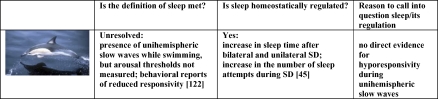
“Some scientists have asserted that this is not true sleep because dolphins are mobile during sleep and there is no evidence that the hemisphere with slow waves is less capable of responding to the environment [4,33].”
BackgroundHan, Z., Thapa, S., Reuter-Carlson, U., Reed, H. M., Gates, M. K., Lambert, K. N., & Schroeder, N. E. (2018) · PLoS Pathogens · doi:10.1371/journal.ppat.1007198 · Cited by 13
Smith, B. R., & Macdonald, S. J. (2020) · Genes · doi:10.3390/genes11030294 · Cited by 12
“Although there is considerable variation in how sleep is presented across taxa [1,3,4], at a fundamental level, sleep is characterized by a state of behavioral quiescence.”
BackgroundResting beta-cells – A functional reserve?
Hara, M., Fowler, J. L., Bell, G. I., & Philipson, L. H. (2016) · Diabetes & Metabolism · doi:10.1016/j.diabet.2016.01.001 · Cited by 15
“In fact, other amazing adaptations are found n cetaceans and birds demonstrating the example of active sleep: ne hemisphere of the brain remains awake, while the other is n slow-wave sleep so that animals can continue moving [3,4].”
BackgroundGlobal dissociation of the posterior amygdala from the rest of the brain during REM sleep
Matei, M., Bergel, A., Pezet, S., & Tanter, M. (2022) · Communications Biology · doi:10.1038/s42003-022-04257-0 · Cited by 18
“Subiculum [16] Dentate Gyrus [41] Residual Hippocampus [22] CA3 Region [33] Fimbria [36] CA1 Region [29]”
Xu, Z., Chang, Y., Wang, C., Guo, F., Zheng, M., Fang, P., & Zhu, Y. (2023) · NeuroImage · doi:10.1016/j.neuroimage.2023.120462 · Cited by 13
“Sleep plays a crucial role in maintaining human health and well-being (Cirelli et al., 2008).”
BackgroundAuditory inputs modulate intrinsic neuronal timescales during sleep
Klar, P., Çatal, Y., Fogel, S. M., Jocham, G., Langner, R., Owen, A. M., & Northoff, G. (2023) · Communications Biology · doi:10.1038/s42003-023-05566-8 · Cited by 15
“The modulation of the brain ’ s intrinsic spontaneous activity by extrinsic stimuli diminishes during N2 sleep, where long electrophysiological timescales in the delta band (0.5 – 4 Hz) dominate 41,46 that suppress modulation by extrinsic sensory stimuli 31,32 .”
BackgroundMethodInfluentialMititelu, M., Popovici, V., Neacșu, S. M., Musuc, A. M., Busnatu, Ș., Oprea, E., Boroghină, S. C., Mihai, A., Streba, C. T., Lupuliasa, D., et al. (2024) · Healthcare · doi:10.3390/healthcare12101006 · Cited by 14
Survey Results of a Pilot Sleep Study Near Atlanta International Airport
Rocha, S., Smith, M. G., Witte, M. A., & Basner, M. (2019) · International Journal of Environmental Research and Public Health · doi:10.3390/ijerph16224321 · Cited by 14
Zhao, Y., Pagani‐Núñez, E., Liu, Y., Xing, X., Zhang, Z., Pan, G., Song, L., Li, X., Zhou, Z., Chen, Y., et al. (2022) · Avian Research · doi:10.1016/j.avrs.2022.100048 · Cited by 13
Insufficient Sleep Syndrome: A Blind Spot in Our Vision of Healthy Sleep
Mader, E. C., Mader, A. C. L., & Singh, P. (2022) · Cureus · doi:10.7759/cureus.30928 · Cited by 16
“Evidently, certain physiologic processes involved in restoring homeostasis, molecular biosynthesis, and building neural circuits operate more efficiently during sleep [1,2].”
BackgroundComparative approaches to the study of physiology:Drosophilaas a physiological tool
Neckameyer, W. S., & Argue, K. J. (2012) · American Journal of Physiology-Regulatory, Integrative and Comparative Physiology · doi:10.1152/ajpregu.00084.2012 · Cited by 19
“Although the exact purpose of sleep is unknown, it is conserved in all animal species that have been examined thus far (18).”
Brand, S., Zimmerer, S., Kalak, N., Planta, S. V., Schwenzer-Zimmerer, K., Müller, A. A., Zeilhofer, H., & Holsboer‐Trachsler, E. (2014) · The World Journal of Biological Psychiatry · doi:10.3109/15622975.2014.888093 · Cited by 13
“With respect to sleep, numerous studies show that restoring and suffi cient sleep is associated with favourable neuronal processing (Cirelli & Tononi 2008; Jan et al. 2010), better cognitive performance (Van Dongen et al. 2003), emotion regulation (Talbot et al. 2010), problem solving (Brand et al.…”
BackgroundThe vicious interplay between disrupted sleep and malignant brain tumors: a narrative review
Orešković, D., Kaštelančić, A., Raguž, M., Dlaka, D., Predrijevac, N., Matec, D., Matec, M., Tomac, D., Jeleč, V., Marinović, T., et al. (2021) · Croatian Medical Journal · doi:10.3325/cmj.2021.62.376 · Cited by 13
Schwarz, J., & Bringmann, H. (2017) · eLife · doi:10.7554/elife.24846 · Cited by 10
“1 mW/mm (Cirelli and Tononi, 2008) as measured with a light voltmeter.”
BackgroundMethodLi, H., Wu, Y., Xie, J., & Chen, X. (2022) · Evidence-based Complementary and Alternative Medicine · doi:10.1155/2022/7044208 · Cited by 14
“Sleep is indeed a fundamental necessity for sustaining a healthy brain [1].”
BackgroundOuyang, J., Peng, Y., & Gong, Y. (2022) · Foods · doi:10.3390/foods11233930 · Cited by 13
“tion and optimizing energy allocation [2,54,74,95].”
BackgroundMortlock, E., English, H. M., Fitzsimmons, J., Börger, L., Jennings, D. J., & Capellini, I. (2024) · Animal Behaviour · doi:10.1016/j.anbehav.2024.03.006 · Cited by 12
“Sleep can increase predation risk since sleeping individuals react less promptly to events in their surroundings (Cirelli & Tononi, 2008).”
BackgroundHeenehan, H. L., Tyne, J. A., Bejder, L., Parijs, S. M. V., & Johnston, D. W. (2016) · The Journal of the Acoustical Society of America · doi:10.1121/1.4955094 · Cited by 12
“[http://dx.doi.org/10.1121/1.4955094] [WA] Pages: 206–215 I. INTRODUCTION Rest is a ubiquitous behavior in animals and is especially important for those that undertake lengthy, complex tasks (Cirelli and Tononi, 2008).”
BackgroundInfluentialAcsády, L., & Harris, K. D. (2017) · Science · doi:10.1126/science.aam7917 · Cited by 13
“Sleep appears to be a universal phenomenon in the animal kingdom (1) and lack of sleep leads to severe cognitive disruption(2).”
BackgroundKirov, R., & Br, S. (2012) · InTech eBooks · doi:10.5772/22929 · Cited by 12
“Although the precise functions of sleep are still beyond comprehensive understanding (Cirelli & Tononi, 2008), many studies point to the critical role of sleep for physiological functioning and adaptation.”
Great challenges to sleep medicine: problems and paradigms
Pandi-Perumal, S. R., Spence, D., Brown, G. M., & Thorpy, M. J. (2010) · Frontiers in Neurology · doi:10.3389/fneur.2010.00007 · Cited by 13
Transient brain activity dynamics discriminate levels of consciousness during anesthesia
Ensel, S., Uhrig, L., Ozkirli, A., Hoffner, G., Tasserie, J., Dehaene, S., Ville, D. V. D., Jarraya, B., & Pirondini, E. (2024) · Communications Biology · doi:10.1038/s42003-024-06335-x · Cited by 14
“These results are in line with previous studies [34] and commonly interpreted to reflect reduced consciousness during sleep [35].”
ResultNorman, H., Munson, A. A., Cortese, D., Koeck, B., & Killen, S. S. (2024) · Journal of Experimental Biology · doi:10.1242/jeb.247138 · Cited by 11
Xu, Z., Ma, C., Wang, C., Guo, F., Zheng, M., Fang, P., & Zhu, Y. (2025) · NeuroImage · doi:10.1016/j.neuroimage.2025.121099 · Cited by 11
“Sleep plays a crucial role in maintaining both health and cognitive function (Cirelli and Tononi, 2008).”
Automated analysis of sleep control via a single neuron active at sleep onset in C. elegans
Urmersbach, B., Besseling, J., Spies, J., & Bringmann, H. (2016) · genesis · doi:10.1002/dvg.22924 · Cited by 11
“Sleep is an essential behavior that is found in animals that have a nervous system (Cirelli and Tononi, 2008).”
BackgroundMader, E. C., & Mader, A. C. L. (2016) · Journal of the Neurological Sciences · doi:10.1016/j.jns.2016.05.025 · Cited by 13
“Theories and models have been proposed to understand sleep function and evolution [1-4, 13-15].”
BackgroundInfluentialThe evolution of sleep is inevitable in a periodic world
Field, J. M., & Bonsall, M. B. (2018) · PLoS ONE · doi:10.1371/journal.pone.0201615 · Cited by 11
Vigilance, resilience and failures of science and management
Johnston, D. W. (2014) · Cambridge University Press eBooks · doi:10.1017/cbo9781139018166.023 · Cited by 11
Tso, M. C. F., & Herzog, E. D. (2015) · BMC Biology · doi:10.1186/s12915-015-0178-5 · Cited by 11
“Chronic sleep deprivation also extends the astrocyte coverage of neuronal spines, an intriguing observation that may relate to the reported increase in size and number of synapses during wakefulness in Drosophila and mice [3].”
BackgroundInfluentialLife and Death Decision in Adult Neurogenesis: In Praise of Napping
Lepousez, G., & Lledo, P. (2011) · Neuron · doi:10.1016/j.neuron.2011.08.014 · Cited by 11
“Many of these studies have pointed to potential link between sleep need and neural plasticity (Cirelli and Tononi, 2008).”
BackgroundSleep supports inhibitory operant conditioning memory in AplysiaPreprint
Vorster, A. P. A., & Jan Born, A. (2017) · Learning & Memory · doi:10.1101/lm.045054.117 · Cited by 11
“Specifically, as signs of sleep are present in all animals carefully studied so far (Campbell and Tobler 1984; Cirelli and Tononi 2008), we might ask whether the memory function of sleep is analogously present in organisms that are evolutionary rather distant from mammals.”
BackgroundHacking the functions of sleep: noninvasive approaches to stimulate sleep neurophysiology
Krugliakova, E., Breuer, F., Adelhöfer, N., Alonso, A., Besedovsky, L., Murphy, K. R., Peters, E., Raczek, K., Rasch, B., Salvesen, L., et al. (2025) · Physiological Reviews · doi:10.1152/physrev.00007.2025 · Cited by 23
The significance of consilience: psychoanalysis, attachment, neuroscience, and evolution
Hopkins, J. (2018) · Routledge eBooks · doi:10.4324/9780429478734-2 · Cited by 10
Sound disrupts sleep-associated brain oscillations in rodents in a meaning-dependent manner
van Kronenberg, P., Milinski, L., Kruschke, Z., & de Hoz, L. (2022) · Scientific Reports · doi:10.1038/s41598-022-09457-6 · Cited by 9
“In a linear mixed model featuring sound type and time as interacting fixed effects and variation over sessions and animals as random effects, we found an effect of sound for all sounds during block 3 of NREM (F(4,374) = 8.”
BackgroundFifel, K., Yanagisawa, M., & Deboer, T. (2022) · Advanced Science · doi:10.1002/advs.202203170 · Cited by 11
Slumber in a cell: honeycomb used by honey bees for food, brood, heating… and sleeping
Klein, B. A., & Busby, M. K. (2020) · PeerJ · doi:10.7717/peerj.9583 · Cited by 10
Kim, A., Lee, S., & Park, J. (2022) · PLoS ONE · doi:10.1371/journal.pone.0263923 · Cited by 11
“Sleep is an essential and universal function in humans [37].”
BackgroundNeural Correlates of Consciousness
Cecconi, B., van der Lande, G., & Sala, A. (2023) · Springer eBooks · doi:10.1007/978-3-031-50563-8_1 · Cited by 9
Cardiac signals inform auditory regularity processing in the absence of consciousness
Pelentritou, A., Pfeiffer, C., Iten, M., Hænggi, M., Zubler, F., Schwartz, S., & Marzia De Lucia, E. (2025) · Proceedings of the National Academy of Sciences · doi:10.1073/pnas.2505454122 · Cited by 12
“This process extends beyond conscious wakefulness to altered consciousness states such as sleep and coma, when detecting unexpected changes in the environment can be crucial for survival ( 2 ).”
Transient knock-down of kcna2 reduces sleep in larval zebrafish
Srdanović, S., Þorsteinsson, H., Friðriksson, Þ., Pétursson, S. Ó., Maier, V. H., & Karlsson, K. Æ. (2017) · Behavioural Brain Research · doi:10.1016/j.bbr.2017.02.026 · Cited by 10
The social evolution of sleep: sex differences, intragenomic conflicts and clinical pathologies
Faria, G. S., Varela, S. A. M., & Gardner, A. (2019) · Proceedings of the Royal Society B Biological Sciences · doi:10.1098/rspb.2018.2188 · Cited by 10
“Sleep—defined as a reversible state of behavioural inactivity, elevated arousal threshold, and homeostatic regulation [1,2]—has been found to occur in all animal species that have been adequately studied [3,4].”
BackgroundCharacterization of specific spatial functional connectivity difference in depression during sleep
Lian, J., Song, Y., Zhang, Y., Guo, X., Wen, J., & Luo, Y. (2021) · Journal of Neuroscience Research · doi:10.1002/jnr.24947 · Cited by 10
“Sleep is related to the adjustment of brain function and involves neuronal reorganization to maintain the homeostasis of the brain network (Cirelli & Tononi, 2008; Colrain, 2011; Tononi & Cirelli, 2006).”
BackgroundNon-mammalian Genetic Model Systems in Sleep Research
Raizen, D. M., & Zimmerman, J. E. (2011) · Sleep Medicine Clinics · doi:10.1016/j.jsmc.2011.04.005 · Cited by 9
Sleep, emotions, and visceral control
Pigarev, I. N., & Pigareva, M. L. (2013) · Human Physiology · doi:10.1134/s036211971306008x · Cited by 9
“[4–6].”
Pandey, A., Oliver, R., & Kar, S. K. (2020) · Clocks & Sleep · doi:10.3390/clockssleep2040033 · Cited by 9
“Thus, sleep seems to have specific, overarching functions for all species that depend on it [19].”
Sleep quality among inpatients of Spanish public hospitals
Bellon, F., Stremler, R., Rubinat, E., Padilla‐Martínez, J. M., Casado‐Ramírez, E., Sánchez-Ortuño, M. M., Gea‐Sánchez, M., Martín-Vaquero, Y., Moreno‐Casbas, T., & Abad‐Corpa, E. (2022) · Scientific Reports · doi:10.1038/s41598-022-26412-7 · Cited by 10
Anthropogenic disturbance affects calling and collective behaviour in corvid roosts
Broad, H. R., Dibnah, A. J., Smith, A. E., & Thornton, A. (2024) · Philosophical Transactions of the Royal Society B Biological Sciences · doi:10.1098/rstb.2023.0185 · Cited by 12
“Sleep is an important and widespread behaviour in animals [59] that is thought to serve many essential roles [53], including maintenance of brain health and function [60–62].”
BackgroundSleep Phases in Crayfish: Relationship Between Brain Electrical Activity and Autonomic Variables
Osorio-Palacios, M., Montiel-Trejo, L., Oliver-Domínguez, I., Hernández‐Falcón, J., & Mendoza‐Ángeles, K. (2021) · Frontiers in Neuroscience · doi:10.3389/fnins.2021.694924 · Cited by 7
Melillo, R. J., Leisman, G., Machado, C., & Carmeli, E. (2023) · BMJ Case Reports · doi:10.1136/bcr-2023-255285 · Cited by 9
Drug-induced sleep: theoretical and practical considerations
Ellenbogen, J. M., & Pace-Schott, E. F. (2011) · Pflügers Archiv - European Journal of Physiology · doi:10.1007/s00424-011-1033-3 · Cited by 8
“While a full discussion is beyond the scope of this article, the inclined reader might consider detailed articles about the nature and purpose of sleep [20, 61].”
Investigating the Evolution of Sleep in the Mexican Cavefish
Duboué, E. R., & Keene, A. C. (2015) · Elsevier eBooks · doi:10.1016/b978-0-12-802148-4.00015-3 · Cited by 11
Where Dolphins Sleep: Resting Areas in the Red Sea
Fumagalli, M., Cesario, A., & Costa, M. (2018) · Springer oceanography · doi:10.1007/978-3-319-99417-8_17 · Cited by 9
Classification of Sleep Arousal using Compact CNN
Eldaraa, A. M., Baali, H., Bouzerdoum, A., Belhaouari, S. B., Alam, T., & Rahman, A. S. A. (2020) · IEEE International Conference on Informatics, IoT, and Enabling Technologies (ICIoT) · doi:10.1109/iciot48696.2020.9089621 · Cited by 8
“It helps our bodies recover their critical functions, such as memory, immunity, hormone regulation, and metabolism [1].”
BackgroundInsomnia and other sleep disorders in adolescence
Delahoyde, M.-K., Tyack, C., Kugarajah, S., & Joseph, D. (2024) · BMJ Paediatrics Open · doi:10.1136/bmjpo-2021-001229 · Cited by 14
Dynamic Interplay Between Wake Slow Waves and Epileptiform Discharges in the Epileptogenic Zone
Sheybani, L., Vivekananda, U., Sinha, N., Conrad, E. C., Litt, B., Burgess, N., Bush, D., & Walker, M. C. (2025) · Neurology · doi:10.1212/wnl.0000000000214001 · Cited by 11
Drosophila Contributions towards Understanding Neurofibromatosis 1
Atsoniou, K., Giannopoulou, E., Georganta, E., & Skoulakis, E. M. C. (2024) · Cells · doi:10.3390/cells13080721 · Cited by 7
“Although the exact purpose of sleep is unknown, it is conserved in all animal species that have been examined thus far [133].”
BackgroundIgnorance can be evolutionarily beneficial
Field, J. M., & Bonsall, M. B. (2017) · Ecology and Evolution · doi:10.1002/ece3.3627 · Cited by 7
van der Lande, G., Blume, C., & Annen, J. (2022) · Seminars in Neurology · doi:10.1055/a-1893-2785 · Cited by 10
A bird's-eye view of the function of sleep
Rattenborg, N. C., & Amlaner, C. J. (2001) · Cambridge University Press eBooks · doi:10.1017/cbo9780511642074.008 · Cited by 7
Ciszak, M., & Bellesi, M. (2011) · Chaos An Interdisciplinary Journal of Nonlinear Science · doi:10.1063/1.3657381 · Cited by 7
Gravett, N., Bhagwandin, A., Lyamin, O. I., Siegel, J. M., & Manger, P. R. (2017) · Frontiers in Neuroanatomy · doi:10.3389/fnana.2017.00105 · Cited by 7
“Mammalian sleep is divided into non rapid eye movement sleep (NREM), which is often but not always synonymous to slow wave sleep (SWS), and rapid eye movement sleep (REM; Nicolau et al., 2000; Zepelin, 2005; Cirelli and Tononi, 2008; Lesku et al., 2008; Siegel, 2008).”
BackgroundSleep Slow Oscillations and Cortical Maturation
Kurth, S., & Huber, R. (2012) · Elsevier eBooks · doi:10.1016/b978-0-12-384995-3.00010-1 · Cited by 9
The flower pot method of REM sleep deprivation causes apoptotic cell death in the hepatocytes of ratPreprint
Pandey, A., Kumar, D., Ray, G., & Kar, S. (2018) · bioRxiv (Cold Spring Harbor Laboratory) · doi:10.1101/375717 · Cited by 8
“Sleep is an important evolutionary physiological and behavioral process required for the survival and well-being of animals studied, although no predominant hypothesis has emerged to explain its functions [1,2].”
BackgroundFrank, M. G. (2012) · Cited by 7
Marquez, J., Panayiotou, M., Farzinnia, R., Cheng, Q., & Humphrey, N. (2025) · Quality of Life Research · doi:10.1007/s11136-025-03894-2 · Cited by 8
Enhancing sleep quality in synucleinopathies through physical exercise
Canonichesi, J., Bellingacci, L., Rivelli, F., & Tozzi, A. (2025) · Frontiers in Cellular Neuroscience · doi:10.3389/fncel.2025.1515922 · Cited by 6
Fusi, J., Scarfò, G., Silvestro, R., & Franzoni, F. (2025) · Nutrients · doi:10.3390/nu17111779 · Cited by 10
“It is regulated by circadian or ultradian rhythms and characterized by rapid reversibility [2].”
Corticothalamic modeling of sleep neurophysiology with applications to mobile electroencephalography
Morshedzadeh, T., Kadak, K., Bastiaens, S. P., Oveisi, M. P., Momi, D., Wang, Z., Harita, S., Jaoude, M. A., Aimone, C., Mann, S., et al. (2025) · SLEEP · doi:10.1093/sleep/zsaf086 · Cited by 7
Subject of study—the aging brain
Ivanitskii, G. R., & Morozov, A. A. (2020) · Physics-Uspekhi · doi:10.3367/ufne.2020.06.038791 · Cited by 8
Xu, Z., Zhu, Y., Zhao, H., Guo, F., Wang, H., & Zheng, M. (2022) · Nature and Science of Sleep · doi:10.2147/nss.s355702 · Cited by 7
“Introduction Sleep is an important element of one’s daily routine and occupies about one-third of the average human’s life.(1) However, a substantial number of people get inadequate sleep and have various sleep disorders, as the result of stressful life-events, the 24/7 rhythm of the modern world, shift-work, entertai…”
Background
Metadata
- Authors
- Cirelli, C., & Tononi, G.
- Affiliations
- University of Wisconsin–Madison (US)
- Corresponding author
- Cirelli, Chiara
- Venue
- PLoS Biology
- Publisher
- Public Library of Science (PLoS)
- Published
- 2008-08-26
- Volume
- 6
- Issue
- 8
- Pages
- e216
- ISSN
- 1544-9173 (ISSN-L)
- 1545-7885
- PMC
- PMC2525690
- OpenAlex
- W2024515932
- Cited by
- 646
- References
- 128
- Citations by year
- 2026: 31 · 2025: 32 · 2024: 43 · 2023: 28 · 2022: 49 · 2021: 39 · 2020: 48 · 2019: 44 · 2018: 38 · 2017: 46 · 2016: 38 · 2015: 32 · 2014: 35 · 2013: 35 · 2012: 34
- FWCI
- 12.41
- Type
- journal article
- Language
- en
- Open access
- gold
- doi.org
- Locations
- PLoS Biology (publishedVersion, cc-by)
- PubMed Central (publishedVersion, cc-by)
- PubMed (publishedVersion)
- DOAJ (DOAJ: Directory of Open Access Journals) (submittedVersion, cc-by-sa)
- Funders
- National Institutes of Health (5p20mh077967-04, R01GM, DP1OD000579, R01 NS)
- National Institute of Mental Health (P20MH-077967, MH 077967)
- National Institute of General Medical Sciences (R01GM075315)
- National Institute of Neurological Disorders and Stroke (R01NS055185)
- Topics
- Life Sciences › Neuroscience › Cognitive Neuroscience › Sleep and Wakefulness Research
- Life Sciences › Neuroscience › Endocrine and Autonomic Systems › Circadian rhythm and melatonin
- Life Sciences › Neuroscience › Endocrine and Autonomic Systems › Neuroscience of respiration and sleep
- Keywords
- sleep, sleep deprivation, sleep regulation
- MeSH terms
- Animals, Behavior, Animal, Sleep, Species Specificity
About these checks
Registry, retraction, Cites and statistics results are computed, not judged, with one exception: a printed reference that no index lists is read once by a model before it counts as a citation error. Claims are extracted by a model and kept only when their quote appears verbatim in the text; each cited source is then checked, with a model’s help, for whether it says what the claim relies on. Those verdicts can be wrong — read the claim’s quote and the cited source before relying on one.
Statistics and arithmetic are recomputed, not judged.
Confidence bands are shown only for fields calibrated on our annotated test set. None is calibrated yet, so no band is shown.
What counts as a claim ›How we measure confidence ›How we check this ›
Are you an author, or do you see a problem with this page? Request a review
Data sources
Bibliographic data: Semantic Scholar, OpenAlex, Crossref.
Contains information from the Semantic Scholar Academic Graph Datasets, made available under the ODC Attribution License (ODC-BY 1.0).
Semantic Scholar’s data is described in: Kinney, R., et al. (2023). The Semantic Scholar Open Data Platform. arXiv:2301.10140.
