

Speech Rhythms and Multiplexed Oscillatory Sensory Coding in the Human Brain
Open accessThe DOI matches its Crossref record; 77 of the 77 references it cites were found in a registry or an index.
Abstract
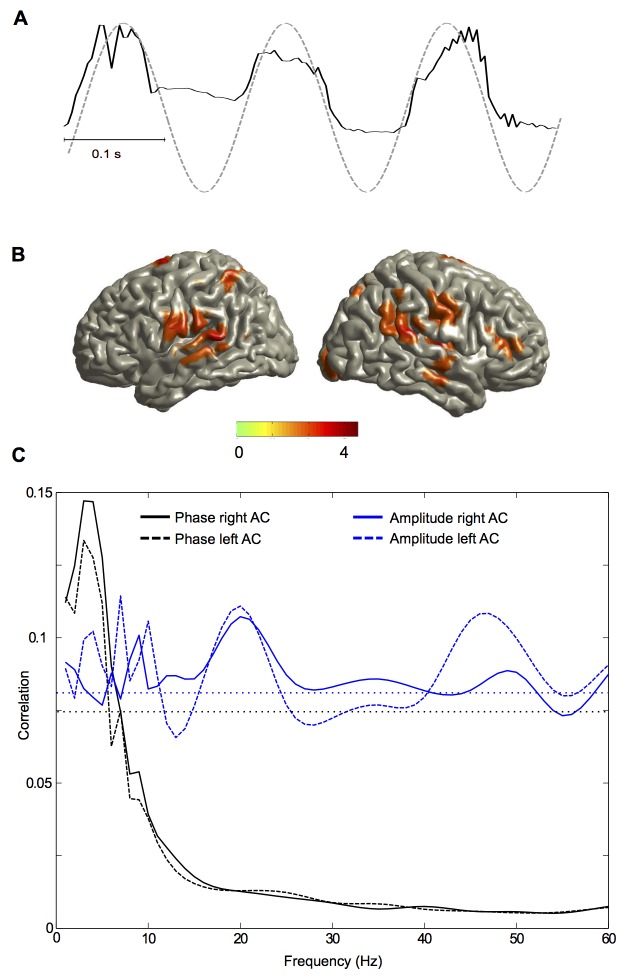
Cortical oscillations are likely candidates for segmentation and coding of continuous speech. Here, we monitored continuous speech processing with magnetoencephalography (MEG) to unravel the principles of speech segmentation and coding. We demonstrate that speech entrains the phase of low-frequency (delta, theta) and the amplitude of high-frequency (gamma) oscillations in the auditory cortex. Phase entrainment is stronger in the right and amplitude entrainment is stronger in the left auditory cortex. Furthermore, edges in the speech envelope phase reset auditory cortex oscillations thereby enhancing their entrainment to speech. This mechanism adapts to the changing physical features of the speech envelope and enables efficient, stimulus-specific speech sampling. Finally, we show that within the auditory cortex, coupling between delta, theta, and gamma oscillations increases following speech edges. Importantly, all couplings (i.e., brain-speech and also within the cortex) attenuate for backward-presented speech, suggesting top-down control. We conclude that segmentation and coding of speech relies on a nested hierarchy of entrained cortical oscillations.
Overview
The claims and statistics of this paper haven’t been checked yet.
Free: it reads the open-access text and checks the first 5 claims that cite a source we can check. Create a free account to check every claim.
Integrity signals
Registry
Cites
Statistics
Figures



Verification
Claims the paper makes
The claims and statistics of this paper haven’t been checked yet.
Free: it reads the open-access text and checks the first 5 claims that cite a source we can check. Create a free account to check every claim.
Claims other papers make about this one
Each is checked against this paper’s own text: does it say what the citing paper says it does?
The source backs part of the claim, not all of it — or backs it for a different population, condition or comparison.
In the citing paper
“Biologically, this may be a description of central pattern generators [110, 117] that underwrite rhythmical activity (e.g., walking and talking) that is characteristic of biological systems [118].”
From The free energy principle made simpler but not too simple (2023) · cites this paper as [117]
Experimental — accuracy not yet measured
Self-check
Percentages, sums and reported differences re-computed from the paper’s own numbers.
The self-check needs the paper’s full text.
Citations
Cites
Controlling the False Discovery Rate: A Practical and Powerful Approach to Multiple Testing
Benjamini, Y., & Hochberg, Y. (1995) · Journal of the Royal Statistical Society Series B: Statistical Methodology · doi:10.1111/j.2517-6161.1995.tb02031.x · Cited by 109,482
Elements of Information Theory
Cover, T. M., & Thomas, J. A. (2001) · Wiley eBooks · doi:10.1002/0471200611 · Cited by 36,808
Brainard, D. H. (1997) · Spatial Vision · doi:10.1163/156856897x00357 · Cited by 19,702
A method for registration of 3-D shapes
Besl, P. J., & McKay, N. D. (1992) · IEEE Transactions on Pattern Analysis and Machine Intelligence · doi:10.1109/34.121791 · Cited by 18,103
Oostenveld, R., Fries, P., Maris, E., & Schoffelen, J.-M. (2011) · Computational Intelligence and Neuroscience · doi:10.1155/2011/156869 · Cited by 10,323
The cortical organization of speech processing
Hickok, G., & Poeppel, D. (2007) · Nature Reviews Neuroscience · doi:10.1038/nrn2113 · Cited by 5,495 · cited 2×
“These results support the asymmetric sampling in time (AST) model [12,14,40] Speech Rhythms and Multiplexed Oscillatory Coding”
BackgroundResultMeasuring phase synchrony in brain signals
Lachaux, J.-P., Rodriguez, E., Martinerie, J., & Varela, F. J. (1999) · Human Brain Mapping · doi:10.1002/(sici)1097-0193(1999)8:4<194::aid-hbm4>3.0.co;2-c · Cited by 3,798
CircStat : A MATLAB Toolbox for Circular Statistics
Berens, P. (2009) · Journal of Statistical Software · doi:10.18637/jss.v031.i10 · Cited by 3,099
High Gamma Power Is Phase-Locked to Theta Oscillations in Human Neocortex
Canolty, R. T., Edwards, E., Dalal, S. S., Soltani, M., Nagarajan, S. S., Kirsch, H. E., Berger, M. S., Barbaro, N. M., & Knight, R. T. (2006) · Science · doi:10.1126/science.1128115 · Cited by 2,650
Spectral Analysis for Physical Applications
Percival, D. B., & Walden, A. T. (1993) · Cambridge University Press eBooks · doi:10.1017/cbo9780511622762 · Cited by 2,161
Cited by
Active inference: a process theory
Friston, K., FitzGerald, T., Rigoli, F., Schwartenbeck, P., & Pezzulo, G. (2017) · Neural Computation · doi:10.1162/neco_a_00912 · Cited by 1,156
“Although this is a little fast for overt exploratory movements in a maze, it corresponds to the intervals between saccadic eye movements in visual exploration (Srihasam, Bullock, & Grossberg, 2009) and the rate at which syllables are articulated in normal speech (Gross et al., 2013).”
BackgroundCortical tracking of hierarchical linguistic structures in connected speech
Ding, N., Melloni, L., Zhang, H., Tian, X., & Poeppel, D. (2016) · Nature Neuroscience · doi:10.1038/nn.4186 · Cited by 1,059
VanRullen, R. (2016) · Trends in Cognitive Sciences · doi:10.1016/j.tics.2016.07.006 · Cited by 635
Low-Frequency Cortical Entrainment to Speech Reflects Phoneme-Level Processing
Di Liberto, G. M., O’Sullivan, J. A., & Lalor, E. C. (2015) · Current Biology · doi:10.1016/j.cub.2015.08.030 · Cited by 578
A New Unifying Account of the Roles of Neuronal Entrainment
Lakatos, P., Gross, J., & Thut, G. (2019) · Current Biology · doi:10.1016/j.cub.2019.07.075 · Cited by 508
Self-citation
Metadata
- Authors
- Gross, J., Hoogenboom, N., Thut, G., Schyns, P., Panzeri, S., Belin, P., & Garrod, S.
- Affiliations
- University of Glasgow (GB)
- Heinrich Heine University Düsseldorf (DE)
- Italian Institute of Technology (IT)
- Corresponding author
- Gross, Joachim
- Venue
- PLoS Biology
- Publisher
- Public Library of Science (PLoS)
- Published
- 2013-12-31
- Volume
- 11
- Issue
- 12
- Pages
- e1001752
- ISSN
- 1544-9173 (ISSN-L)
- 1545-7885
- PMC
- PMC3876971
- OpenAlex
- W2029130465
- Cited by
- 643
- References
- 77
- Citations by year
- 2026: 45 · 2025: 50 · 2024: 52 · 2023: 59 · 2022: 80 · 2021: 57 · 2020: 62 · 2019: 56 · 2018: 50 · 2017: 37 · 2016: 45 · 2015: 39 · 2014: 10 · 2013: 1
- FWCI
- 17.37
- Type
- journal article
- Language
- en
- Open access
- gold
- doi.org
- Licence
- Locations
- PLoS Biology (publishedVersion, cc-by)
- PubMed Central (publishedVersion, cc-by)
- PubMed (publishedVersion)
- ENLIGHTEN (Jurnal Bimbingan dan Konseling Islam) (acceptedVersion)
- HAL (submittedVersion, cc-by)
- DOAJ (DOAJ: Directory of Open Access Journals) (submittedVersion, cc-by-sa)
- Figshare (submittedVersion, cc-by)
- Funders
- Wellcome Trust (098433/Z/12/Z, 091928, 098434, 098433, 98434)
- Agence Nationale de la Recherche (ANR-11-IDEX-0001)
- Medical Research Council (MC_G1001214)
- Economic and Social Research Council (ES/E020933/1, RES-060-25-0010)
- Topics
- Life Sciences › Neuroscience › Cognitive Neuroscience › Neural dynamics and brain function
- Life Sciences › Neuroscience › Cognitive Neuroscience › Neuroscience and Music Perception
- Life Sciences › Neuroscience › Cognitive Neuroscience › Neurobiology of Language and Bilingualism
- Keywords
- speech segmentation, speech coding, cortical oscillations, phase entrainment, auditory cortex, delta oscillations, theta oscillations, gamma oscillations, speech envelope, top-down control, hemispheric lateralization
- MeSH terms
- Adult, Auditory Cortex, Brain, Female, Humans, Functional Laterality, Magnetic Resonance Imaging, Male, Speech, Speech Perception, Magnetoencephalography, Young Adult, Functional Neuroimaging
About these checks
Registry, retraction, Cites and statistics results are computed, not judged, with one exception: a printed reference that no index lists is read once by a model before it counts as a citation error. Claims are extracted by a model and kept only when their quote appears verbatim in the text; each cited source is then checked, with a model’s help, for whether it says what the claim relies on. Those verdicts can be wrong — read the claim’s quote and the cited source before relying on one.
Statistics and arithmetic are recomputed, not judged.
Confidence bands are shown only for fields calibrated on our annotated test set. None is calibrated yet, so no band is shown.
What counts as a claim ›How we measure confidence ›How we check this ›
Are you an author, or do you see a problem with this page? Request a review
Data sources
Bibliographic data: Semantic Scholar, OpenAlex, Crossref.
Contains information from the Semantic Scholar Academic Graph Datasets, made available under the ODC Attribution License (ODC-BY 1.0).
Semantic Scholar’s data is described in: Kinney, R., et al. (2023). The Semantic Scholar Open Data Platform. arXiv:2301.10140.
