

Speech Rhythms and Multiplexed Oscillatory Sensory Coding in the Human Brain
Open accessThe DOI matches its Crossref record; 77 of the 77 references it cites were found in a registry or an index.
Abstract
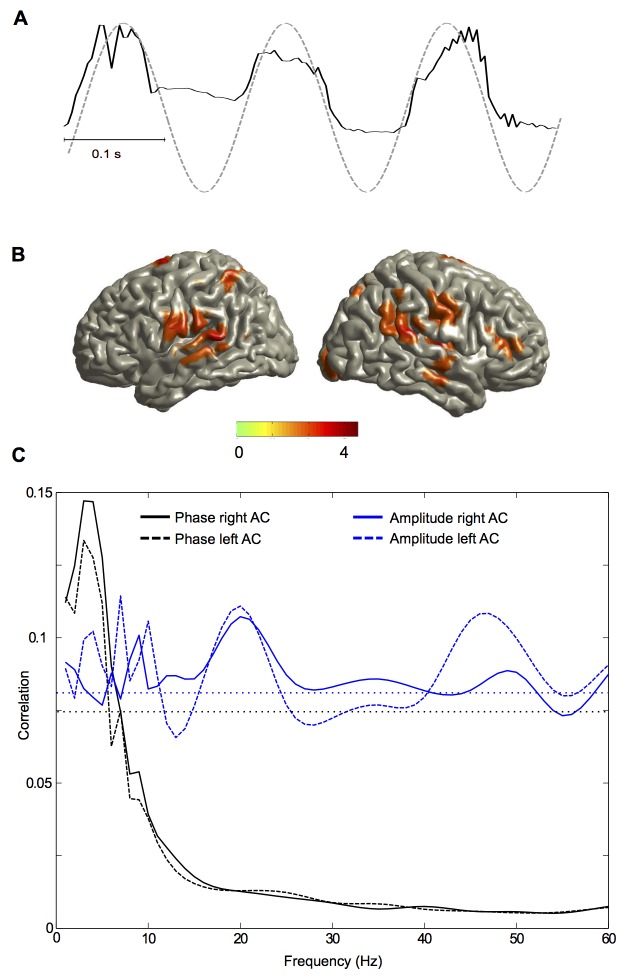
Cortical oscillations are likely candidates for segmentation and coding of continuous speech. Here, we monitored continuous speech processing with magnetoencephalography (MEG) to unravel the principles of speech segmentation and coding. We demonstrate that speech entrains the phase of low-frequency (delta, theta) and the amplitude of high-frequency (gamma) oscillations in the auditory cortex. Phase entrainment is stronger in the right and amplitude entrainment is stronger in the left auditory cortex. Furthermore, edges in the speech envelope phase reset auditory cortex oscillations thereby enhancing their entrainment to speech. This mechanism adapts to the changing physical features of the speech envelope and enables efficient, stimulus-specific speech sampling. Finally, we show that within the auditory cortex, coupling between delta, theta, and gamma oscillations increases following speech edges. Importantly, all couplings (i.e., brain-speech and also within the cortex) attenuate for backward-presented speech, suggesting top-down control. We conclude that segmentation and coding of speech relies on a nested hierarchy of entrained cortical oscillations.
Overview
The claims and statistics of this paper haven’t been checked yet.
Free: it reads the open-access text and checks the first 5 claims that cite a source we can check. Create a free account to check every claim.
Integrity signals
Registry
Cites
Statistics
Figures



Verification
Claims the paper makes
The claims and statistics of this paper haven’t been checked yet.
Free: it reads the open-access text and checks the first 5 claims that cite a source we can check. Create a free account to check every claim.
Claims other papers make about this one
Each is checked against this paper’s own text: does it say what the citing paper says it does?
The source backs part of the claim, not all of it — or backs it for a different population, condition or comparison.
In the citing paper
“Biologically, this may be a description of central pattern generators [110, 117] that underwrite rhythmical activity (e.g., walking and talking) that is characteristic of biological systems [118].”
From The free energy principle made simpler but not too simple (2023) · cites this paper as [117]
Experimental — accuracy not yet measured
Self-check
Percentages, sums and reported differences re-computed from the paper’s own numbers.
The self-check needs the paper’s full text.
Citations
Cites
Controlling the False Discovery Rate: A Practical and Powerful Approach to Multiple Testing
Benjamini, Y., & Hochberg, Y. (1995) · Journal of the Royal Statistical Society Series B: Statistical Methodology · doi:10.1111/j.2517-6161.1995.tb02031.x · Cited by 109,482
Elements of Information Theory
Cover, T. M., & Thomas, J. A. (2001) · Wiley eBooks · doi:10.1002/0471200611 · Cited by 36,808
Brainard, D. H. (1997) · Spatial Vision · doi:10.1163/156856897x00357 · Cited by 19,702
A method for registration of 3-D shapes
Besl, P. J., & McKay, N. D. (1992) · IEEE Transactions on Pattern Analysis and Machine Intelligence · doi:10.1109/34.121791 · Cited by 18,103
Oostenveld, R., Fries, P., Maris, E., & Schoffelen, J.-M. (2011) · Computational Intelligence and Neuroscience · doi:10.1155/2011/156869 · Cited by 10,323
The cortical organization of speech processing
Hickok, G., & Poeppel, D. (2007) · Nature Reviews Neuroscience · doi:10.1038/nrn2113 · Cited by 5,495 · cited 2×
“These results support the asymmetric sampling in time (AST) model [12,14,40] Speech Rhythms and Multiplexed Oscillatory Coding”
BackgroundResultMeasuring phase synchrony in brain signals
Lachaux, J.-P., Rodriguez, E., Martinerie, J., & Varela, F. J. (1999) · Human Brain Mapping · doi:10.1002/(sici)1097-0193(1999)8:4<194::aid-hbm4>3.0.co;2-c · Cited by 3,798
CircStat : A MATLAB Toolbox for Circular Statistics
Berens, P. (2009) · Journal of Statistical Software · doi:10.18637/jss.v031.i10 · Cited by 3,099
High Gamma Power Is Phase-Locked to Theta Oscillations in Human Neocortex
Canolty, R. T., Edwards, E., Dalal, S. S., Soltani, M., Nagarajan, S. S., Kirsch, H. E., Berger, M. S., Barbaro, N. M., & Knight, R. T. (2006) · Science · doi:10.1126/science.1128115 · Cited by 2,650
Spectral Analysis for Physical Applications
Percival, D. B., & Walden, A. T. (1993) · Cambridge University Press eBooks · doi:10.1017/cbo9780511622762 · Cited by 2,161
Cited by
Active inference: a process theory
Friston, K., FitzGerald, T., Rigoli, F., Schwartenbeck, P., & Pezzulo, G. (2017) · Neural Computation · doi:10.1162/neco_a_00912 · Cited by 1,156
“Although this is a little fast for overt exploratory movements in a maze, it corresponds to the intervals between saccadic eye movements in visual exploration (Srihasam, Bullock, & Grossberg, 2009) and the rate at which syllables are articulated in normal speech (Gross et al., 2013).”
BackgroundCortical tracking of hierarchical linguistic structures in connected speech
Ding, N., Melloni, L., Zhang, H., Tian, X., & Poeppel, D. (2016) · Nature Neuroscience · doi:10.1038/nn.4186 · Cited by 1,059
VanRullen, R. (2016) · Trends in Cognitive Sciences · doi:10.1016/j.tics.2016.07.006 · Cited by 635
Low-Frequency Cortical Entrainment to Speech Reflects Phoneme-Level Processing
Di Liberto, G. M., O’Sullivan, J. A., & Lalor, E. C. (2015) · Current Biology · doi:10.1016/j.cub.2015.08.030 · Cited by 578
A New Unifying Account of the Roles of Neuronal Entrainment
Lakatos, P., Gross, J., & Thut, G. (2019) · Current Biology · doi:10.1016/j.cub.2019.07.075 · Cited by 508
Self-citationNeural Cross-Frequency Coupling: Connecting Architectures, Mechanisms, and Functions
Hyafil, A., Giraud, A.-L., Fontolan, L., & Gutkin, B. (2015) · Trends in Neurosciences · doi:10.1016/j.tins.2015.09.001 · Cited by 509
Speech rhythms and their neural foundations
Poeppel, D., & Assaneo, M. F. (2020) · Nature Reviews Neuroscience · doi:10.1038/s41583-020-0304-4 · Cited by 476
Cortical entrainment to continuous speech: functional roles and interpretations
Ding, N., & Simon, J. Z. (2014) · Frontiers in Human Neuroscience · doi:10.3389/fnhum.2014.00311 · Cited by 443
Neural Entrainment and Attentional Selection in the Listening Brain
Obleser, J., & Kayser, C. (2019) · Trends in Cognitive Sciences · doi:10.1016/j.tics.2019.08.004 · Cited by 432
The Encoding of Speech Sounds in the Superior Temporal Gyrus
Yi, H. G., Leonard, M. K., & Chang, E. F. (2019) · Neuron · doi:10.1016/j.neuron.2019.04.023 · Cited by 417
Temporal coding organized by coupled alpha and gamma oscillations prioritize visual processing
Jensen, O., Gips, B., Bergmann, T. O., & Bonnefond, M. (2014) · Trends in Neurosciences · doi:10.1016/j.tins.2014.04.001 · Cited by 389
Ince, R. A. A., Giordano, B. L., Kayser, C., Rousselet, G. A., Gross, J., & Schyns, P. G. (2017) · Human Brain Mapping · doi:10.1002/hbm.23471 · Cited by 366
Self-citationPark, H., Ince, R. A. A., Schyns, P. G., Thut, G., & Gross, J. (2015) · Current Biology · doi:10.1016/j.cub.2015.04.049 · Cited by 356
Self-citationRhythmic facilitation of sensory processing: A critical review
Haegens, S., & Zion Golumbic, E. (2018) · Neuroscience & Biobehavioral Reviews · doi:10.1016/j.neubiorev.2017.12.002 · Cited by 343
Cortical entrainment to music and its modulation by expertise
Doelling, K. B., & Poeppel, D. (2015) · Proceedings of the National Academy of Sciences · doi:10.1073/pnas.1508431112 · Cited by 333
Meyer, L. (2018) · European Journal of Neuroscience · doi:10.1111/ejn.13748 · Cited by 328
Keitel, A., Gross, J., & Kayser, C. (2018) · PLOS Biology · doi:10.1371/journal.pbio.2004473 · Cited by 312
Proactive Sensing of Periodic and Aperiodic Auditory Patterns
Rimmele, J. M., Morillon, B., Poeppel, D., & Arnal, L. H. (2018) · Trends in Cognitive Sciences · doi:10.1016/j.tics.2018.08.003 · Cited by 267
Prediction and constraint in audiovisual speech perception
Peelle, J. E., & Sommers, M. S. (2015) · Cortex · doi:10.1016/j.cortex.2015.03.006 · Cited by 246
Brain-to-brain entrainment: EEG interbrain synchronization while speaking and listening
Pérez, A., Carreiras, M., & Duñabeitia, J. A. (2017) · Scientific Reports · doi:10.1038/s41598-017-04464-4 · Cited by 226
Speech encoding by coupled cortical theta and gamma oscillations
Hyafil, A., Fontolan, L., Kabdebon, C., Gutkin, B., & Giraud, A.-L. (2015) · eLife · doi:10.7554/elife.06213 · Cited by 235
Neural Entrainment to Speech Modulates Speech Intelligibility
Riecke, L., Formisano, E., Sorger, B., Başkent, D., & Gaudrain, E. (2018) · Current Biology · doi:10.1016/j.cub.2017.11.033 · Cited by 232
Neural population coding: combining insights from microscopic and mass signals
Panzeri, S., Macke, J. H., Gross, J., & Kayser, C. (2015) · Trends in Cognitive Sciences · doi:10.1016/j.tics.2015.01.002 · Cited by 226
Self-citationImagined speech can be decoded from low- and cross-frequency intracranial EEG features
Proix, T., Delgado Saa, J., Christen, A., Martin, S., Pasley, B. N., Knight, R. T., Tian, X., Poeppel, D., Doyle, W. K., Devinsky, O., et al. (2022) · Nature Communications · doi:10.1038/s41467-021-27725-3 · Cited by 212
Entrained neural oscillations in multiple frequency bands comodulate behavior
Henry, M. J., Herrmann, B., & Obleser, J. (2014) · Proceedings of the National Academy of Sciences · doi:10.1073/pnas.1408741111 · Cited by 204
Out‐of‐synchrony speech entrainment in developmental dyslexia
Molinaro, N., Lizarazu, M., Lallier, M., Bourguignon, M., & Carreiras, M. (2016) · Human Brain Mapping · doi:10.1002/hbm.23206 · Cited by 212
Neural Entrainment Determines the Words We Hear
Kösem, A., Bosker, H. R., Takashima, A., Meyer, A., Jensen, O., & Hagoort, P. (2018) · Current Biology · doi:10.1016/j.cub.2018.07.023 · Cited by 192
Predictive motor control of sensory dynamics in auditory active sensing
Morillon, B., Hackett, T. A., Kajikawa, Y., & Schroeder, C. E. (2015) · Current Opinion in Neurobiology · doi:10.1016/j.conb.2014.12.005 · Cited by 181
Spectrotemporal modulation provides a unifying framework for auditory cortical asymmetries
Flinker, A., Doyle, W. K., Mehta, A. D., Devinsky, O., & Poeppel, D. (2019) · Nature Human Behaviour · doi:10.1038/s41562-019-0548-z · Cited by 194
Two Distinct Neural Timescales for Predictive Speech Processing
Donhauser, P. W., & Baillet, S. (2020) · Neuron · doi:10.1016/j.neuron.2019.10.019 · Cited by 189
Keitel, A., & Gross, J. (2016) · PLOS Biology · doi:10.1371/journal.pbio.1002498 · Cited by 179
IFCN-endorsed practical guidelines for clinical magnetoencephalography (MEG)
Hari, R., Baillet, S., Barnes, G., Burgess, R., Forss, N., Gross, J., Hämäläinen, M., Jensen, O., Kakigi, R., Mauguière, F., et al. (2018) · Clinical Neurophysiology · doi:10.1016/j.clinph.2018.03.042 · Cited by 167
Neural encoding of the speech envelope by children with developmental dyslexia
Power, A. J., Colling, L. J., Mead, N., Barnes, L., & Goswami, U. (2016) · Brain and Language · doi:10.1016/j.bandl.2016.06.006 · Cited by 177
The “Narratives” fMRI dataset for evaluating models of naturalistic language comprehension
Nastase, S. A., Liu, Y.-F., Hillman, H., Zadbood, A., Hasenfratz, L., Keshavarzian, N., Chen, J., Honey, C. J., Yeshurun, Y., Regev, M., et al. (2021) · Scientific Data · doi:10.1038/s41597-021-01033-3 · Cited by 148
Neural Noise Hypothesis of Developmental Dyslexia
Hancock, R., Pugh, K. R., & Hoeft, F. (2017) · Trends in Cognitive Sciences · doi:10.1016/j.tics.2017.03.008 · Cited by 156
Phase Entrainment of Brain Oscillations Causally Modulates Neural Responses to Intelligible Speech
Zoefel, B., Archer-Boyd, A., & Davis, M. H. (2018) · Current Biology · doi:10.1016/j.cub.2017.11.071 · Cited by 183
The free energy principle made simpler but not too simple
Friston, K., Da Costa, L., Sajid, N., Heins, C., Ueltzhöffer, K., Pavliotis, G. A., & Parr, T. (2023) · Physics Reports · doi:10.1016/j.physrep.2023.07.001 · Cited by 163
“Biologically, this may be a description of central pattern generators [110,117] that underwrite rhythmical activity (e.g., walking and talking) that is characteristic of biological systems [118].”
Magnetoencephalography in Cognitive Neuroscience: A Primer
Gross, J. (2019) · Neuron · doi:10.1016/j.neuron.2019.07.001 · Cited by 160
Hullett, P. W., Hamilton, L. S., Mesgarani, N., Schreiner, C. E., & Chang, E. F. (2016) · The Journal of Neuroscience · doi:10.1523/jneurosci.1779-15.2016 · Cited by 160
Meyer, L., Sun, Y., & Martin, A. E. (2019) · Language Cognition and Neuroscience · doi:10.1080/23273798.2019.1693050 · Cited by 189
Understanding Dialogue: Language Use and Social Interaction
Pickering, M. J., & Garrod, S. (2021) · Cambridge University Press eBooks · doi:10.1017/9781108610728 · Cited by 207
Self-citationSimple Acoustic Features Can Explain Phoneme-Based Predictions of Cortical Responses to Speech
Daube, C., Ince, R. A. A., & Groß, J. (2019) · Current Biology · doi:10.1016/j.cub.2019.04.067 · Cited by 176
Park, H., Kayser, C., Thut, G., & Groß, J. (2016) · eLife · doi:10.7554/elife.14521 · Cited by 173
Self-citationIrregular Speech Rate Dissociates Auditory Cortical Entrainment, Evoked Responses, and Frontal Alpha
Kayser, S. J., Ince, R. A. A., Groß, J., & Kayser, C. (2015) · Journal of Neuroscience · doi:10.1523/jneurosci.2243-15.2015 · Cited by 147
Keitel, A., Ince, R. A. A., Groß, J., & Kayser, C. (2016) · NeuroImage · doi:10.1016/j.neuroimage.2016.11.062 · Cited by 146
Distinct contributions of low- and high-frequency neural oscillations to speech comprehension
Kösem, A., & van Wassenhove, V. (2016) · Language Cognition and Neuroscience · doi:10.1080/23273798.2016.1238495 · Cited by 149
Synchronisation of Neural Oscillations and Cross-modal Influences
Bauer, A. R., Debener, S., & Nobre, A. C. (2020) · Trends in Cognitive Sciences · doi:10.1016/j.tics.2020.03.003 · Cited by 146
Acoustic-Emergent Phonology in the Amplitude Envelope of Child-Directed Speech
Leong, V., & Goswami, U. (2015) · PLoS ONE · doi:10.1371/journal.pone.0144411 · Cited by 142
Delta(but not theta)‐band cortical entrainment involves speech‐specific processing
Molinaro, N., & Lizarazu, M. (2018) · European Journal of Neuroscience · doi:10.1111/ejn.13811 · Cited by 145
Palva, S., & Palva, J. M. (2018) · Trends in Neurosciences · doi:10.1016/j.tins.2018.08.008 · Cited by 139
Cavallari, S., Panzeri, S., & Mazzoni, A. (2014) · Frontiers in Neural Circuits · doi:10.3389/fncir.2014.00012 · Cited by 141
Self-citationDelta- and theta-band cortical tracking and phase-amplitude coupling to sung speech by infants
Attaheri, A., Choisdealbha, Á. N., Liberto, G. M. D., Rocha, S., Brusini, P., Mead, N., Olawole‐Scott, H., Boutris, P., Gibbon, S., Williams, I., et al. (2021) · NeuroImage · doi:10.1016/j.neuroimage.2021.118698 · Cited by 155
The not face: A grammaticalization of facial expressions of emotion
Benitez-Quiroz, C. F., Wilbur, R. Β., & Martínez, A. M. (2016) · Cognition · doi:10.1016/j.cognition.2016.02.004 · Cited by 133
Speech rhythm and language acquisition: an amplitude modulation phase hierarchy perspective
Goswami, U. (2019) · Annals of the New York Academy of Sciences · doi:10.1111/nyas.14137 · Cited by 153
Short‐ and long‐term rhythmic interventions: perspectives for language rehabilitation
Schön, D., & Tillmann, B. (2015) · Annals of the New York Academy of Sciences · doi:10.1111/nyas.12635 · Cited by 117
Linguistic Structure and Meaning Organize Neural Oscillations into a Content-Specific Hierarchy
Kaufeld, G., Bosker, H. R., ten Oever, S., Alday, P. M., Meyer, A. S., & Martin, A. E. (2020) · Journal of Neuroscience · doi:10.1523/jneurosci.0302-20.2020 · Cited by 135
A Compositional Neural Architecture for Language
Martin, A. E. (2020) · Journal of Cognitive Neuroscience · doi:10.1162/jocn_a_01552 · Cited by 143
Delta, theta, beta, and gamma brain oscillations index levels of auditory sentence processing
Mai, G., Minett, J. W., & Wang, W. Y. (2016) · NeuroImage · doi:10.1016/j.neuroimage.2016.02.064 · Cited by 138
Sustained neural rhythms reveal endogenous oscillations supporting speech perception
van Bree, S., Sohoglu, E., Davis, M. H., & Zoefel, B. (2021) · PLoS Biology · doi:10.1371/journal.pbio.3001142 · Cited by 131
EEG oscillations entrain their phase to high-level features of speech sound
Zoefel, B., & VanRullen, R. (2015) · NeuroImage · doi:10.1016/j.neuroimage.2015.08.054 · Cited by 130
Besserve, M., Lowe, S. C., Logothetis, N. K., Schölkopf, B., & Panzeri, S. (2015) · PLOS Biology · doi:10.1371/journal.pbio.1002257 · Cited by 117
Self-citationLeft Superior Temporal Gyrus Is Coupled to Attended Speech in a Cocktail-Party Auditory Scene
Ghinst, M. V., Bourguignon, M., Beeck, M. O. D., Wens, V., Marty, B., Hassid, S., Choufani, G., Jousmäki, V., Hari, R., Bogaert, P. V., et al. (2016) · Journal of Neuroscience · doi:10.1523/jneurosci.1730-15.2016 · Cited by 124
The Temporal Modulation Structure of Infant-Directed Speech
Leong, V., Kalashnikova, M., Burnham, D. K., & Goswami, U. (2017) · Open Mind · doi:10.1162/opmi_a_00008 · Cited by 129
Henry, M. J., Herrmann, B., Kunke, D., & Obleser, J. (2017) · Nature Communications · doi:10.1038/ncomms15801 · Cited by 127
The use of content and timing to predict turn transitions
Garrod, S., & Pickering, M. J. (2015) · Frontiers in Psychology · doi:10.3389/fpsyg.2015.00751 · Cited by 107
Self-citationPefkou, M., Arnal, L. H., Fontolan, L., & Giraud, A. (2017) · Journal of Neuroscience · doi:10.1523/jneurosci.2882-16.2017 · Cited by 121
The Brain Behind the Response: Insights Into Turn-taking in Conversation From Neuroimaging
Bögels, S., & Levinson, S. C. (2017) · Research on Language and Social Interaction · doi:10.1080/08351813.2017.1262118 · Cited by 101
Colling, L. J., Noble, H., & Goswami, U. (2017) · Frontiers in Neuroscience · doi:10.3389/fnins.2017.00360 · Cited by 119
Asymmetric sampling in human auditory cortex reveals spectral processing hierarchy
Giroud, J., Trébuchon, A., Schön, D., Marquis, P., Liégeois‐Chauvel, C., Poeppel, D., & Morillon, B. (2020) · PLoS Biology · doi:10.1371/journal.pbio.3000207 · Cited by 106
Lizarazu, M., Lallier, M., Molinaro, N., Bourguignon, M., Paz‐Alonso, P. M., Lerma‐Usabiaga, G., & Carreiras, M. (2015) · Human Brain Mapping · doi:10.1002/hbm.22986 · Cited by 113
Language prediction mechanisms in human auditory cortex
Forseth, K. J., Hickok, G., Rollo, P. S., & Tandon, N. (2020) · Nature Communications · doi:10.1038/s41467-020-19010-6 · Cited by 97
Multi-timescale neural dynamics for multisensory integration
Senkowski, D., & Engel, A. K. (2024) · Nature reviews. Neuroscience · doi:10.1038/s41583-024-00845-7 · Cited by 119
Multi-time resolution analysis of speech: evidence from psychophysics
Maria Chait, A., Greenberg, S., Arai, T., Simon, J. Z., & Poeppel, D. (2015) · Frontiers in Neuroscience · doi:10.3389/fnins.2015.00214 · Cited by 102
Voloh, B., & Womelsdorf, T. (2016) · Frontiers in Systems Neuroscience · doi:10.3389/fnsys.2016.00018 · Cited by 114
Marchesotti, S., Nicolle, J., Merlet, I., Arnal, L. H., Donoghue, J. P., & Giraud, A. (2020) · PLoS Biology · doi:10.1371/journal.pbio.3000833 · Cited by 110
Rapid tuning shifts in human auditory cortex enhance speech intelligibility
Holdgraf, C., de Heer, W. A., Pasley, B. N., Rieger, J. W., Crone, N. E., Lin, J. J., Knight, R. T., & Theunissen, F. E. (2016) · Nature Communications · doi:10.1038/ncomms13654 · Cited by 107
Mothers speak differently to infants at‐risk for dyslexia
Kalashnikova, M., Goswami, U., & Burnham, D. K. (2016) · Developmental Science · doi:10.1111/desc.12487 · Cited by 103
Teng, X., Tian, X., Rowland, J., & Poeppel, D. (2017) · PLoS Biology · doi:10.1371/journal.pbio.2000812 · Cited by 97
Hierarchical organization in the temporal structure of infant-direct speech and song
Falk, S., & Kello, C. T. (2017) · Cognition · doi:10.1016/j.cognition.2017.02.017 · Cited by 104
Watrous, A. J., Fell, J., Ekstrom, A. D., & Axmacher, N. (2015) · Current Opinion in Neurobiology · doi:10.1016/j.conb.2014.07.024 · Cited by 93
Cumming, R., Wilson, A. M., & Goswami, U. (2015) · Frontiers in Psychology · doi:10.3389/fpsyg.2015.00972 · Cited by 103
Lip-Reading Enables the Brain to Synthesize Auditory Features of Unknown Silent Speech
Bourguignon, M., Baart, M., Kapnoula, E. C., & Molinaro, N. (2019) · Journal of Neuroscience · doi:10.1523/jneurosci.1101-19.2019 · Cited by 103
Gross, J. (2014) · Journal of Neuroscience Methods · doi:10.1016/j.jneumeth.2014.03.007 · Cited by 86
Song, J., & Iverson, P. (2018) · Cognition · doi:10.1016/j.cognition.2018.06.001 · Cited by 90
M/EEG analysis of naturalistic stories: a review from speech to language processing
Alday, P. M. (2018) · Language Cognition and Neuroscience · doi:10.1080/23273798.2018.1546882 · Cited by 95
Language acquisition and speech rhythm patterns: an auditory neuroscience perspective
Goswami, U. (2022) · Royal Society Open Science · doi:10.1098/rsos.211855 · Cited by 96
Neuronal oscillations as a mechanistic substrate of auditory temporal prediction
Morillon, B., & Schroeder, C. E. (2015) · Annals of the New York Academy of Sciences · doi:10.1111/nyas.12629 · Cited by 79
Alpha Phase Determines Successful Lexical Decision in Noise
Strauß, A., Henry, M. J., Scharinger, M., & Obleser, J. (2015) · Journal of Neuroscience · doi:10.1523/jneurosci.3357-14.2015 · Cited by 87
Effects of rhythm on memory for spoken sequences: A model and tests of its stimulus-driven mechanism
Hartley, T., Hurlstone, M. J., & Hitch, G. J. (2016) · Cognitive Psychology · doi:10.1016/j.cogpsych.2016.05.001 · Cited by 86
Differential brain-to-brain entrainment while speaking and listening in native and foreign languages
Pérez, A., Dumas, G., Karadag, M., & Duñabeitia, J. A. (2018) · Cortex · doi:10.1016/j.cortex.2018.11.026 · Cited by 90
Cutini, S., Szűcs, D., Mead, N., Huss, M., & Goswami, U. (2016) · NeuroImage · doi:10.1016/j.neuroimage.2016.08.012 · Cited by 82
Phase−amplitude coupling between theta and gamma oscillations adapts to speech rate
Lizarazu, M., Lallier, M., & Molinaro, N. (2019) · Annals of the New York Academy of Sciences · doi:10.1111/nyas.14099 · Cited by 92
Atypical coordination of cortical oscillations in response to speech in autism
Jochaut, D., Lehongre, K., Saitovitch, A., Devauchelle, A.-D., Olasagasti, I., Chabane, N., Zilbovicius, M., & Giraud, A.-L. (2015) · Frontiers in Human Neuroscience · doi:10.3389/fnhum.2015.00171 · Cited by 75
No evidence for differences among language regions in their temporal receptive windows
Blank, I. A., & Fedorenko, E. (2020) · NeuroImage · doi:10.1016/j.neuroimage.2020.116925 · Cited by 71
Tan, H.-R. M., Gross, J., & Uhlhaas, P. J. (2015) · NeuroImage · doi:10.1016/j.neuroimage.2015.07.055 · Cited by 74
Key considerations in designing a speech brain-computer interface
Bocquelet, F., Hueber, T., Girin, L., Chabardès, S., & Yvert, B. (2016) · Journal of Physiology-Paris · doi:10.1016/j.jphysparis.2017.07.002 · Cited by 73
Kayser, C., Wilson, C. A., Safaai, H., Sakata, S., & Panzeri, S. (2015) · Journal of Neuroscience · doi:10.1523/jneurosci.0268-15.2015 · Cited by 72
Self-citationAcoustically Driven Cortical δ Oscillations Underpin Prosodic Chunking
Rimmele, J. M., Poeppel, D., & Ghitza, O. (2021) · eNeuro · doi:10.1523/eneuro.0562-20.2021 · Cited by 76
The Role of High-Level Processes for Oscillatory Phase Entrainment to Speech Sound
Zoefel, B., & VanRullen, R. (2015) · Frontiers in Human Neuroscience · doi:10.3389/fnhum.2015.00651 · Cited by 84
Causal cortical dynamics of a predictive enhancement of speech intelligibility
Liberto, G. M. D., Lalor, E. C., & Millman, R. E. (2017) · NeuroImage · doi:10.1016/j.neuroimage.2017.10.066 · Cited by 77
Metadata
- Authors
- Gross, J., Hoogenboom, N., Thut, G., Schyns, P., Panzeri, S., Belin, P., & Garrod, S.
- Affiliations
- University of Glasgow (GB)
- Heinrich Heine University Düsseldorf (DE)
- Italian Institute of Technology (IT)
- Corresponding author
- Gross, Joachim
- Venue
- PLoS Biology
- Publisher
- Public Library of Science (PLoS)
- Published
- 2013-12-31
- Volume
- 11
- Issue
- 12
- Pages
- e1001752
- ISSN
- 1544-9173 (ISSN-L)
- 1545-7885
- PMC
- PMC3876971
- OpenAlex
- W2029130465
- Cited by
- 643
- References
- 77
- Citations by year
- 2026: 45 · 2025: 50 · 2024: 52 · 2023: 59 · 2022: 80 · 2021: 57 · 2020: 62 · 2019: 56 · 2018: 50 · 2017: 37 · 2016: 45 · 2015: 39 · 2014: 10 · 2013: 1
- FWCI
- 17.37
- Type
- journal article
- Language
- en
- Open access
- gold
- doi.org
- Licence
- Locations
- PLoS Biology (publishedVersion, cc-by)
- PubMed Central (publishedVersion, cc-by)
- PubMed (publishedVersion)
- ENLIGHTEN (Jurnal Bimbingan dan Konseling Islam) (acceptedVersion)
- HAL (submittedVersion, cc-by)
- DOAJ (DOAJ: Directory of Open Access Journals) (submittedVersion, cc-by-sa)
- Figshare (submittedVersion, cc-by)
- Funders
- Wellcome Trust (098433/Z/12/Z, 091928, 098434, 098433, 98434)
- Agence Nationale de la Recherche (ANR-11-IDEX-0001)
- Medical Research Council (MC_G1001214)
- Economic and Social Research Council (ES/E020933/1, RES-060-25-0010)
- Topics
- Life Sciences › Neuroscience › Cognitive Neuroscience › Neural dynamics and brain function
- Life Sciences › Neuroscience › Cognitive Neuroscience › Neuroscience and Music Perception
- Life Sciences › Neuroscience › Cognitive Neuroscience › Neurobiology of Language and Bilingualism
- Keywords
- speech segmentation, speech coding, cortical oscillations, phase entrainment, auditory cortex, delta oscillations, theta oscillations, gamma oscillations, speech envelope, top-down control, hemispheric lateralization
- MeSH terms
- Adult, Auditory Cortex, Brain, Female, Humans, Functional Laterality, Magnetic Resonance Imaging, Male, Speech, Speech Perception, Magnetoencephalography, Young Adult, Functional Neuroimaging
About these checks
Registry, retraction, Cites and statistics results are computed, not judged, with one exception: a printed reference that no index lists is read once by a model before it counts as a citation error. Claims are extracted by a model and kept only when their quote appears verbatim in the text; each cited source is then checked, with a model’s help, for whether it says what the claim relies on. Those verdicts can be wrong — read the claim’s quote and the cited source before relying on one.
Statistics and arithmetic are recomputed, not judged.
Confidence bands are shown only for fields calibrated on our annotated test set. None is calibrated yet, so no band is shown.
What counts as a claim ›How we measure confidence ›How we check this ›
Are you an author, or do you see a problem with this page? Request a review
Data sources
Bibliographic data: Semantic Scholar, OpenAlex, Crossref.
Contains information from the Semantic Scholar Academic Graph Datasets, made available under the ODC Attribution License (ODC-BY 1.0).
Semantic Scholar’s data is described in: Kinney, R., et al. (2023). The Semantic Scholar Open Data Platform. arXiv:2301.10140.
