

Activation and Alliance of Regulatory Pathways in C. albicans during Mammalian Infection
Open accessThe DOI matches its Crossref record; 47 of the 47 references it cites were found in a registry or an index.
Abstract
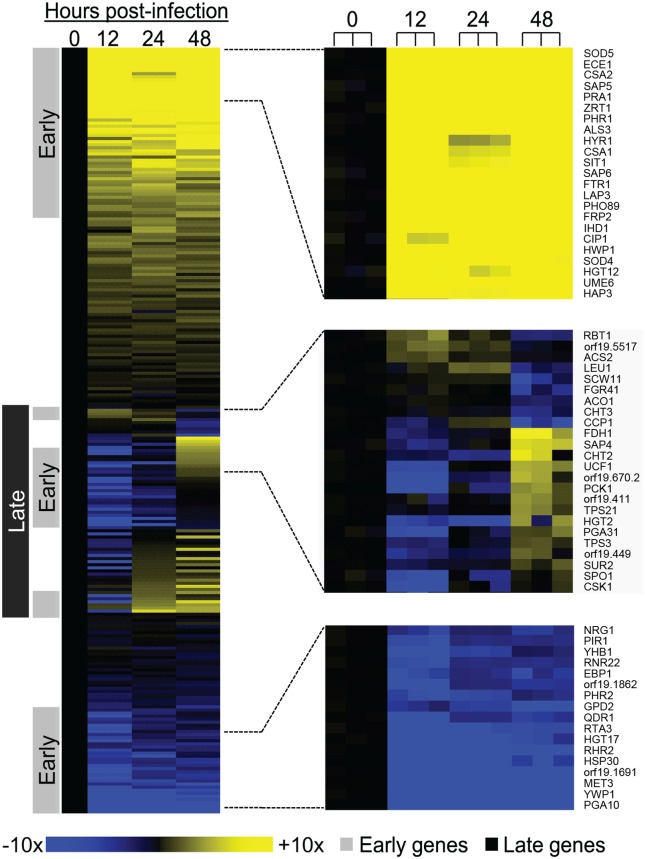
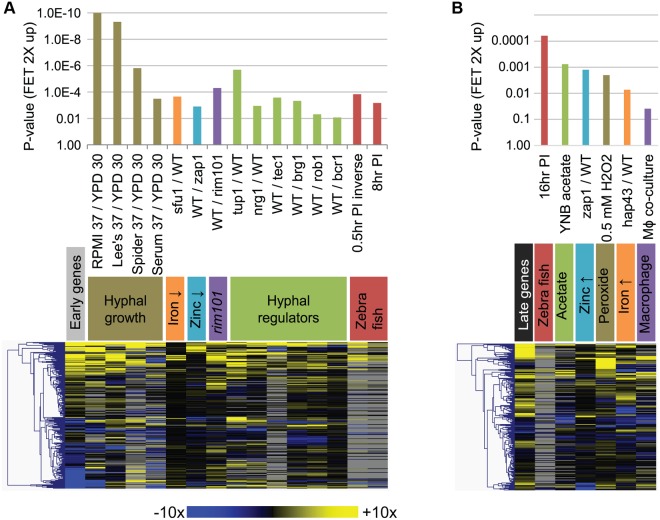
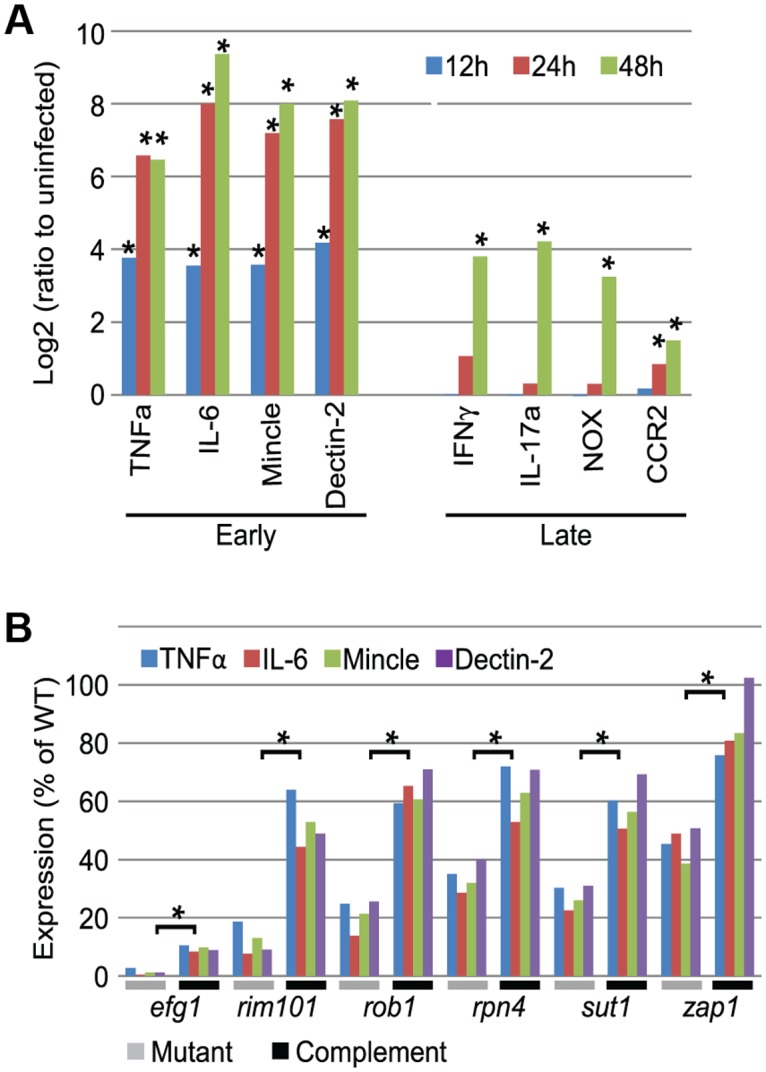
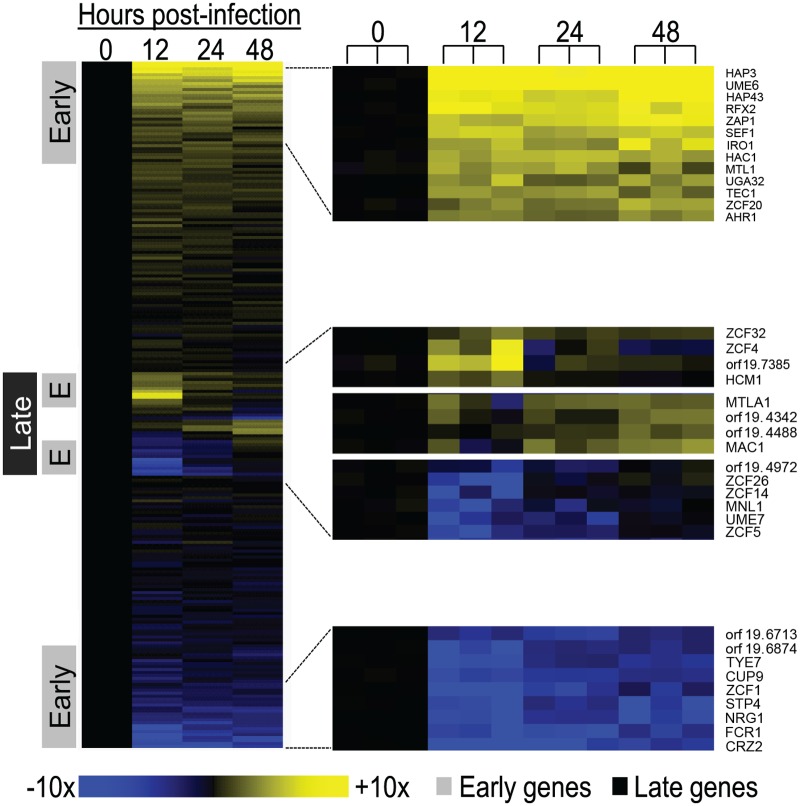
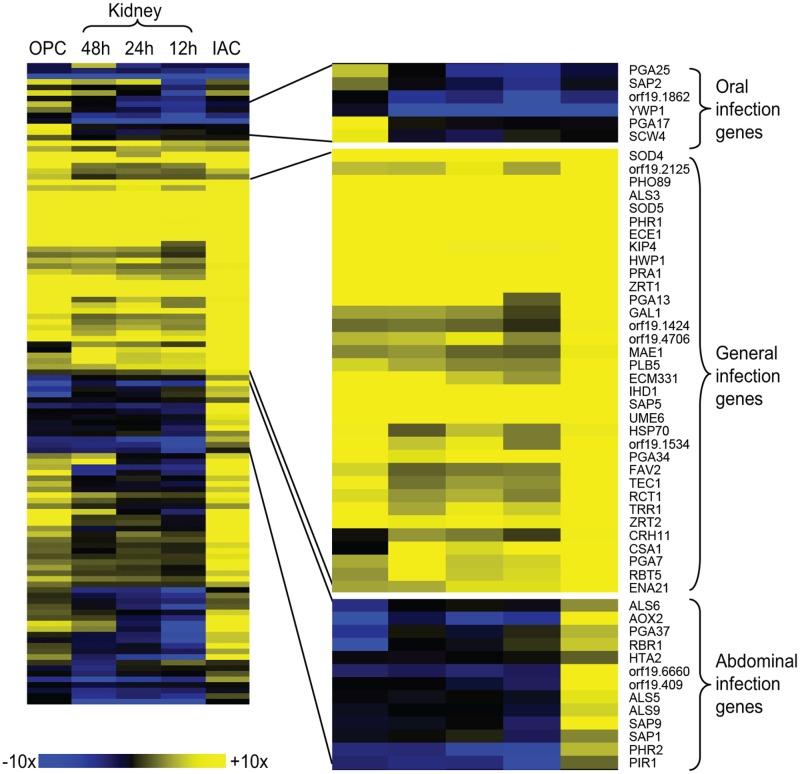
Gene expression dynamics have provided foundational insight into almost all biological processes. Here, we analyze expression of environmentally responsive genes and transcription factor genes to infer signals and pathways that drive pathogen gene regulation during invasive Candida albicans infection of a mammalian host. Environmentally responsive gene expression shows that there are early and late phases of infection. The early phase includes induction of zinc and iron limitation genes, genes that respond to transcription factor Rim101, and genes characteristic of invasive hyphal cells. The late phase includes responses related to phagocytosis by macrophages. Transcription factor gene expression also reflects early and late phases. Transcription factor genes that are required for virulence or proliferation in vivo are enriched among highly expressed transcription factor genes. Mutants defective in six transcription factor genes, three previously studied in detail (Rim101, Efg1, Zap1) and three less extensively studied (Rob1, Rpn4, Sut1), are profiled during infection. Most of these mutants have distinct gene expression profiles during infection as compared to in vitro growth. Infection profiles suggest that Sut1 acts in the same pathway as Zap1, and we verify that functional relationship with the finding that overexpression of either ZAP1 or the Zap1-dependent zinc transporter gene ZRT2 restores pathogenicity to a sut1 mutant. Perturbation with the cell wall inhibitor caspofungin also has distinct gene expression impact in vivo and in vitro. Unexpectedly, caspofungin induces many of the same genes that are repressed early during infection, a phenomenon that we suggest may contribute to drug efficacy. The pathogen response circuitry is tailored uniquely during infection, with many relevant regulatory relationships that are not evident during growth in vitro. Our findings support the principle that virulence is a property that is manifested only in the distinct environment in which host-pathogen interaction occurs.
Overview
The claims and statistics of this paper haven’t been checked yet.
Free: it reads the open-access text and checks the first 5 claims that cite a source we can check. Create a free account to check every claim.
Integrity signals
Registry
Cites
Statistics
Figures
Verification
Claims the paper makes
The claims and statistics of this paper haven’t been checked yet.
Free: it reads the open-access text and checks the first 5 claims that cite a source we can check. Create a free account to check every claim.
Claims other papers make about this one
Each is checked against this paper’s own text: does it say what the citing paper says it does?
The check wasn’t confident either way, so it gives no verdict — never disputed.
In the citing paper
“Previous studies have reported that AOX2 expression is upregulated upon phagocytosis by murine macrophages23 and during progressive infection of kidneys in systemically infected mice24.”
From Multifactor transcriptional control of alternative oxidase induction integrates diverse environmental inputs to enable fungal virulence (2023) · cites this paper as [24]
Experimental — accuracy not yet measured
Self-check
Percentages, sums and reported differences re-computed from the paper’s own numbers.
The self-check needs the paper’s full text.
Citations
Cites
Epidemiology of Invasive Candidiasis: a Persistent Public Health Problem
Pfaller, M. A., & Diekema, D. J. (2007) · Clinical Microbiology Reviews · doi:10.1128/cmr.00029-06 · Cited by 4,174 · cited 3×
“Caspofungin, a cell wall inhibitor, is an extremely effective antifungal drug [6].”
BackgroundInfluentialDirect multiplexed measurement of gene expression with color-coded probe pairs
Geiss, G. K., Bumgarner, R. E., Birditt, B., Dahl, T., Dowidar, N., Dunaway, D. L., Fell, H. P., Ferree, S., George, R. D., Grogan, T., et al. (2008) · Nature Biotechnology · doi:10.1038/nbt1385 · Cited by 2,066 · cited 2×
“While prior profiling studies have provided foundational insight into mammalian infection, the dynamic range and sensitivity of microarray signals [5,10,11] may have limited detection of key regulatory genes that govern the infection process.”
BackgroundMethodCandida albicans pathogenicity mechanisms
Mayer, F. L., Wilson, D., & Hube, B. (2013) · Virulence · doi:10.4161/viru.22913 · Cited by 1,848 · cited 2×
“Late genes reflect responses that have been logically inferred from interactions with innate immune cells: oxidative stress and the consequences of phagocytosis by macrophages [32,33].”
BackgroundNonfilamentous C. albicans Mutants Are Avirulent
Lo, H.-J., Köhler, J. R., DiDomenico, B., Loebenberg, D., Cacciapuoti, A., & Fink, G. R. (1997) · Cell · doi:10.1016/s0092-8674(00)80358-x · Cited by 1,809 · cited 1×
“albicans strains characterized [22,23].”
Nutritional immunity: transition metals at the pathogen–host interface
Hood, M. I., & Skaar, E. P. (2012) · Nature Reviews Microbiology · doi:10.1038/nrmicro2836 · Cited by 1,535 · cited 2×
“This correlation is consistent with the idea that nutritional immunity is used broadly as a defense mechanism [31].”
BackgroundGillum, A. M., Tsay, E. Y. H., & Kirsch, D. R. (1984) · Molecular and General Genetics MGG · doi:10.1007/bf00328721 · Cited by 1,251 · cited 1×
“It is derived from the SC5314 background [44] strain DAY286 [45], which in turn derives from strain BWP17 [43], as do all of the deletion mutants studied here.”
BackgroundRapid Hypothesis Testing with Candida albicans through Gene Disruption with Short Homology Regions
Wilson, R. B., Davis, D., & Mitchell, A. P. (1999) · Journal of Bacteriology · doi:10.1128/jb.181.6.1868-1874.1999 · Cited by 762 · cited 3×
“C. albicans Strains C. albicans deletion mutant strains were constructed in the BWP17 strain background through homologous recombination [43].”
BackgroundMethodSelf-citationDual RNA-seq of pathogen and host
Westermann, A. J., Gorski, S. A., & Vogel, J. (2012) · Nature Reviews Microbiology · doi:10.1038/nrmicro2852 · Cited by 760 · cited 2×
“While prior profiling studies have provided foundational insight into mammalian infection, the dynamic range and sensitivity of microarray signals [5,10,11] may have limited detection of key regulatory genes that govern the infection process.”
BackgroundTranscriptional Response of Candida albicans upon Internalization by Macrophages
Lorenz, M. C., Bender, J. A., & Fink, G. R. (2004) · Eukaryotic Cell · doi:10.1128/ec.3.5.1076-1087.2004 · Cited by 712 · cited 2×
“Interestingly, up-regulation of ICL1,MLS2, PCK1, and FOX2 occurs upon internalization by macrophages [17].”
BackgroundA Recently Evolved Transcriptional Network Controls Biofilm Development in Candida albicans
Nobile, C. J., Fox, E. P., Nett, J. E., Sorrells, T. R., Mitrovich, Q. M., Hernday, A. D., Tuch, B. B., Andes, D. R., & Johnson, A. D. (2012) · Cell · doi:10.1016/j.cell.2011.10.048 · Cited by 711 · cited 4×
“Among the 63 up-regulated genes, only four were up-regulated in the in vitro efg1Δ/Δ characterization [25], and their fold-change was much greater in vivo than in vitro.”
BackgroundResultInfluential
Cited by
Calpain research for drug discovery: challenges and potential
Ono, Y., Saido, T. C., & Sorimachi, H. (2016) · Nature Reviews Drug Discovery · doi:10.1038/nrd.2016.212 · Cited by 282
Gerwien, F., Skrahina, V., Kasper, L., Hube, B., & Brunke, S. (2018) · FEMS Microbiology Reviews · doi:10.1093/femsre/fux050 · Cited by 250
Witchley, J. N., Penumetcha, P., Abon, N. V., Woolford, C. A., Mitchell, A. P., & Noble, S. M. (2019) · Cell Host & Microbe · doi:10.1016/j.chom.2019.02.008 · Cited by 240
“To assess fungal transcript levels in commensally growing strains, we utilized a NanoString nCounter platform (Xu et al., 2015) that can quantify low-abundance fungal transcripts amid excess host, bacterial, archaeal, and viral RNAs.”
Self-citationDynamic Fungal Cell Wall Architecture in Stress Adaptation and Immune Evasion
Hopke, A., Brown, A. J. P., Hall, R. A., & Wheeler, R. T. (2018) · Trends in Microbiology · doi:10.1016/j.tim.2018.01.007 · Cited by 228
“Tools such as Nanostring pro fi ling , RNAseq , and cell intrinsic reporters have also enabled investigators to probe fungal physiology during infection [30,40 – 44].”
BackgroundRole of Calprotectin in Withholding Zinc and Copper from Candida albicans
Besold, A. N., Gilston, B. A., Radin, J. N., Ramsoomair, C., Culbertson, E. M., Li, C. X., Cormack, B. P., Chazin, W. J., Kehl-Fie, T. E., & Culotta, V. C. (2018) · Infection and Immunity · doi:10.1128/iai.00779-17 · Cited by 136
“evidence of causing decreased virulence in the mouse model of disseminated candidiasis (10, 64).”
Background
Metadata
- Authors
- Xu, W., Solis, N. V., Ehrlich, R. L., Woolford, C. A., Filler, S. G., & Mitchell, A. P.
- Affiliations
- Carnegie Mellon University (US)
- University of California, Los Angeles (US)
- Corresponding author
- Filler, Scott G.
- Mitchell, Aaron P.
- Venue
- PLOS Biology
- Publisher
- Public Library of Science (PLoS)
- Published
- 2015-02-18
- Volume
- 13
- Issue
- 2
- Pages
- e1002076
- ISSN
- 1544-9173 (ISSN-L)
- 1545-7885
- PMC
- PMC4333574
- OpenAlex
- W2004992298
- Cited by
- 103
- References
- 47
- Citations by year
- 2026: 3 · 2025: 2 · 2024: 10 · 2023: 11 · 2022: 6 · 2021: 13 · 2020: 7 · 2019: 4 · 2018: 11 · 2017: 13 · 2016: 15 · 2015: 8
- FWCI
- 6.80
- Type
- journal article
- Language
- en
- Open access
- gold
- doi.org
- Licence
- Locations
- PLoS Biology (publishedVersion, cc-by)
- Europe PMC (PubMed Central) (publishedVersion, cc-by)
- PubMed Central (publishedVersion, cc-by)
- PubMed (publishedVersion)
- DOAJ (DOAJ: Directory of Open Access Journals) (submittedVersion)
- eScholarship (California Digital Library) (submittedVersion, cc-by)
- Figshare (submittedVersion, cc-by)
- Funders
- Andrew W. Mellon Foundation
- Richard King Mellon Foundation
- National Institutes of Health
- National Institute of Allergy and Infectious Diseases (R01AI054928)
- National Institute of Dental and Craniofacial Research (R21DE023311)
- Topics
- Life Sciences › Biochemistry, Genetics and Molecular Biology › Molecular Biology › Fungal and yeast genetics research
- Health Sciences › Medicine › Infectious Diseases › Antifungal resistance and susceptibility
- Health Sciences › Medicine › Infectious Diseases › Fungal Infections and Studies
- Keywords
- Candida albicans, invasive candidiasis, host-pathogen interaction, transcription factor gene expression, Rim101, Zap1, SUT1, EFG1, Rpn4, zinc limitation, iron limitation, hyphal differentiation, macrophage phagocytosis, caspofungin, antifungal drug response, virulence
- MeSH terms
- Caspofungin, Animals, Antifungal Agents, Candida albicans, Candidiasis, DNA-Binding Proteins, Fungal Proteins, Injections, Intravenous, Kidney, Male, Mice, Inbred BALB C, Mutation, Transcription Factors, Virulence, Signal Transduction, Gene Expression Regulation, Fungal, Gene Expression Profiling, Cation Transport Proteins, Mice, Gene Regulatory Networks, Echinocandins, Host-Pathogen Interactions, Lipopeptides, Molecular Sequence Annotation
About these checks
Registry, retraction, Cites and statistics results are computed, not judged, with one exception: a printed reference that no index lists is read once by a model before it counts as a citation error. Claims are extracted by a model and kept only when their quote appears verbatim in the text; each cited source is then checked, with a model’s help, for whether it says what the claim relies on. Those verdicts can be wrong — read the claim’s quote and the cited source before relying on one.
Statistics and arithmetic are recomputed, not judged.
Confidence bands are shown only for fields calibrated on our annotated test set. None is calibrated yet, so no band is shown.
What counts as a claim ›How we measure confidence ›How we check this ›
Are you an author, or do you see a problem with this page? Request a review
Data sources
Bibliographic data: Semantic Scholar, OpenAlex, Crossref.
Contains information from the Semantic Scholar Academic Graph Datasets, made available under the ODC Attribution License (ODC-BY 1.0).
Semantic Scholar’s data is described in: Kinney, R., et al. (2023). The Semantic Scholar Open Data Platform. arXiv:2301.10140.
